
Toner card: specifications, ISO 9001 certification and purchase criteria for copiers
Toner cartridge: specifications, certifications and purchasing criteria for copiers
A compatible toner cartridge is the consumable that stores and meters toner inside a photocopier or laser printer. Its operation is a closed process that integrates storage, transport and precise development: it turns an invisible electrostatic image into a visible toner image on paper.
For a professional buyer, the decision is not settled with a list of compatible models. It is settled with three concrete verifications: compatibility documented by reference, certification and traceability by batch, and sustainable commercial parameters (minimum order quantity, lead time and real production capacity). This guide organizes the data a manufacturer must be able to demonstrate before the purchase and explains how to verify it step by step.
The specific reference used here is the line of compatible toner cartridges from Tenon toner cartridge, presented by Far Industries S.A., a manufacturer of A3 office consumables based in Zhongshan City (China), founded in 2011, whose portfolio includes toner cartridge, drum unit, fuser unit and developer unit.
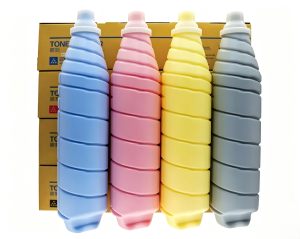
Compatible TN622 toner cartridge, one of the references covered by the manufacturer's ISO 9001 certification.
Why toner cartridge specifications fail when comparing
The central problem when buying compatible consumables is not a lack of supply, but a lack of verifiable correspondence between what the supplier declares and what the equipment fleet actually requires. In practice, four recurring failures appear:
- Incomplete compatibility. A datasheet lists a series and omits the exact model designations. The same trade name can group together several generations of copiers with different consumables.
- Certification without scope. A quality management standard is mentioned but it is not stated which references it covers or how each batch produced is controlled.
- Undisclosed materials. The housing material and the origin of the toner powder are not specified, and these are precisely the two factors that most affect print stability and the return rate.
- Misaligned commercial parameters. A supplier may meet the technical specification and still not sustain the volume, the lead time or the packaging customization the buyer needs.
The first three failures are matters of documentary verification. The fourth is a matter of industrial capacity. A compatible toner cartridge is only a safe option when both sides can be verified with data.
Context: A3 consumables, refurbished copiers and mixed fleets
The office consumables market is organized around A4 and A3 equipment and A4 laser printers. Within that market, a wide variety of operating environments coexist, each very different from the others: large-scale printing plants, in-house offices, advertising agencies that print complex text and images, large educational institutions, equipment rental companies working with several brands, small print shops, and individual users with a single printer.
That diversity explains why the word "compatible" is not enough. A copier rental company works with machines of several brands and models, often used photocopiers or refurbished photocopiers, where a misidentified reference generates service visits and on-site repair costs. A print shop values print consistency above unit price, because a change in tone forces a print run to be repeated. An educational institution or a group office-supplies purchase, on the other hand, prioritizes supply stability and administrative simplicity.
In all these cases, the consumable is not evaluated as an isolated item, but as part of a complete imaging system. In addition to the toner cartridge, that system includes the drum unit, the OPC drum, the developer unit (with the developer as the metered material), the fuser unit and its internal components. That is why experienced buyers ask about the cartridge and the associated components at the same time: a correct cartridge on a degraded drum unit still produces defects.
The solution: integrated manufacturing and verifiable data
The answer offered by a vertically integrated manufacturer differs from that of an assembler that buys finished parts. Far Industries S.A. manufactures in-house more than 90% of the molds used in the production of its toner cartridges and manages the entire process, from injection and blow molding to packaging. That end-to-end control makes it possible to apply the same quality standard at every point in the process, instead of depending on the variable quality of an external supplier.
Declared materials of the toner cartridge
The compatible toner cartridge uses virgin PET as the main housing material. The toner powder comes from a publicly listed company, and approximately 90% of that powder is imported; in aggregate terms, more than 90% of the toner used comes from recognized listed companies and is mainly imported. This declaration matters in the evaluation because the toner powder determines fusing behavior, tone stability and waste generation inside the machine.
The print yield of these cartridges is based on toner powder, and the specific yield details must be checked directly with the supplier before setting an expectation of pages per cartridge.
Certification, batch control and traceability
The manufacturer operates a quality management system certified under ISO 9001. The ISO 9001 certification applies to the compatible toner cartridge and covers the references C2263/2265, S1810, TN622, TN328, TN512 and TN626. This is the data a buyer should require in writing: it is not enough to mention the standard, you must confirm which references fall within the scope.
Quality control is carried out batch by batch. Every toner batch is reviewed by professional engineers in a dedicated testing laboratory, and that review enables batch traceability. The company can provide third-party test reports, which allows the declared quality to be checked against an external verification.
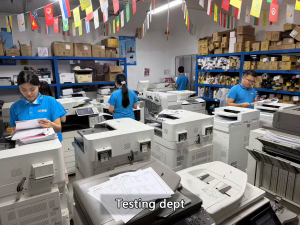
Dedicated testing laboratory: every toner batch is reviewed by professional engineers before shipment.
Imaging system components controlled by the manufacturer
Vertical integration extends to the components associated with the toner cartridge. The manufacturing portfolio includes drum unit, fuser unit and developer unit, in addition to the toner cartridge itself. For the buyer, this means that the main consumable and the components that determine its service life do not come from separate, uncoordinated supply chains.
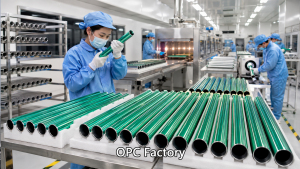
OPC drum plant, the photoconductive component on which the electrostatic image is formed.
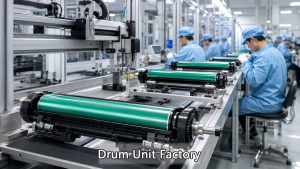
Drum unit factory: a critical component in the maintenance of used and refurbished photocopiers.
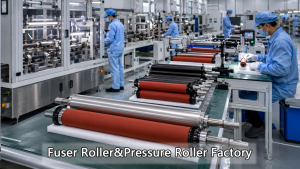
Fuser roller and pressure roller factory, components of the fuser unit.
In the fusing subsystem, components such as the fuser roller, the pressure roller and surface elements such as the Teflon film directly influence the quality of the finish and the wear of the equipment. When comparing suppliers, it is worth confirming which components of this subsystem each manufacturer covers, because that coverage determines whether the buyer resolves maintenance with a single contact or with several.
Step-by-step verification before buying toner cartridges
The following procedure translates the above specifications into a verification sequence that can be used in a real evaluation process.
- Define the equipment fleet by exact model. List every copier and printer with its full designation, separating new equipment from used or refurbished photocopiers, because not all consumables behave the same way in machines with a service history.
- Request the compatibility mapping by series. Each line should provide its model designations, for example the references of the Konica series (C2263/2265, S1810, TN622, TN328, TN512, TN626) or of the Ricoh series (MP 3554/6054, IM C6010, IM C6000).
- Verify the scope of the certification. Confirm that the declared ISO 9001 standard covers the specific references you are going to buy, not only the company's general system.
- Review the declared materials. Check the housing material (virgin PET), the origin of the toner powder (listed company, approximately 90% imported) and whether there is a written declaration of both points.
- Ask for batch traceability and, where applicable, third-party tests. Batch review in the company's own laboratory is the basis of control; the external report is the cross-check.
- Request a print sample from the batch used. The manufacturer can provide print samples from the toner batch used in the product, which makes it possible to evaluate the result on your own equipment before committing to a volume.
- Confirm commercial and service parameters. Minimum order quantity, lead time, packaging options and after-sales protocol must be defined before the order, not after.
Use cases: where this toner cartridge line fits
The line is intended for printing factories, print shops, offices, educational centers and copier rental companies, and is designed for printing and copying scenarios in office, education and equipment rental environments. Four profiles account for most of the demand:
- Printing factories and large-scale plants. They look for batch-to-batch print consistency in order to avoid reruns and production waste.
- Copier rental companies. They work with mixed fleets and refurbished equipment; their priority is equipment safety and reducing unplanned service visits.
- Consumable distributors and wholesalers. They need a broad range covering several brands and models, as well as consistent quality that protects business reputation and margin.
- Offices, educational institutions and group purchasing. They prioritize total cost and management simplicity: product ready to use on arrival, with no additional inspections.
A representative case described by the manufacturer corresponds to orders of 50,000 units destined for large-scale photocopier supplies procurement, distributors, copier rental companies and printing plants, with a two-year service relationship. The declared result in that type of project is consistent print quality and competitive prices that help the customer reduce costs and increase efficiency.
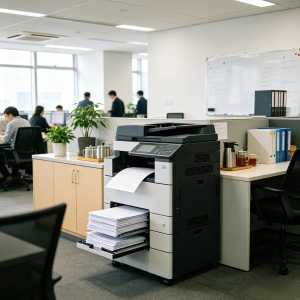
Office scenario: printing and copying with A4 and A3 equipment.
Reference tables for evaluation
Compatibility by series and model designations
| Series | Model designations | Declared material |
|---|---|---|
| Konica | C2263/2265, S1810, TN622, TN328, TN512, TN626 | Virgin PET; toner powder from a listed company, 90% imported |
| Sharp | C2263/2265, S1810, MX-60CT/AT/GT/NT/FT | Virgin PET; toner powder from a listed company, 90% imported |
| Xerox | C2263, C2265, S1810, C3371, C5570, C7785 | Suitable for refurbished photocopiers; virgin PET |
| Toshiba | T-FC616, T-FC415, T-3028, T-FC330 | Virgin PET; toner powder from a listed company, 90% imported |
| Kyocera | TK-8365, TK-3182, TK-1275, TK-5372 | Virgin PET; toner powder from a listed company, 90% imported |
| Ricoh | MP 3554/6054, IM C6010, IM C6000 | Virgin PET; toner powder from a listed company, 90% imported |
| Canon | G57/GPR-43/C-EXV59; NPG-71/GPR-55/C-EXV51 line, NPG-83/GPR-61/C-EXV58, G84/C-EXV59 | Virgin PET; toner powder from a listed company, 90% imported |
| HP | W1002YC, W9130/9120, W9170/9160, W9050 | Virgin PET; toner powder from a listed company, 90% imported |
Print yield is based on toner powder in all the listed series; the specific yield values must be confirmed with the supplier for each reference.
Commercial and manufacturing parameters
| Parameter | Declared data | Implication for the buyer |
|---|---|---|
| Minimum order quantity | 2 boxes | Allows validation with a reduced volume before scaling up |
| Lead time | 10 to 45 days | Must be planned against the actual consumption of the fleet |
| Monthly capacity | 50,000 units | Supports continuous replenishment programs |
| Declared annual production | 6,000,000 units | Indicates industrial scale, not occasional assembly |
| Customization | Logo, sticker, box, carton, page, design | Enables private label and packaging adapted to the channel |
| Certification | ISO 9001, covers C2263/2265, S1810, TN622, TN328, TN512, TN626 | Scope verifiable by reference |
| Quality control | Batch review by engineers in the company's own laboratory | Traceability and reduced batch-to-batch variation |
| External verification | Third-party tests and reports available | Allows independent cross-checking of the declared quality |
| Export | 70% of production; Latin America and the Middle East | Experience in logistics and export market requirements |
Imaging system components and their function
| Component | Function within the system | Verification point at purchase |
|---|---|---|
| Toner cartridge | Stores, transports and meters toner toward the imaging system | Compatibility by model, housing material and origin of the toner powder |
| Drum unit | Supports the formation of the electrostatic image | Availability within the same manufacturer's portfolio |
| OPC drum | Photoconductive component of the drum unit | Manufacturing origin and consistency between batches |
| Developer unit (developer) | Develops the latent image by means of the developer agent | Consistency between the developer and the toner supplied |
| Fuser unit | Fixes the toner image to the paper by heat and pressure | Availability of rollers and associated components |
| Fuser roller and pressure roller | Contact elements of the fusing subsystem | In-house manufacturing versus external supply |
Limit of the comparison: the data above describe a single manufacturer's line and do not establish a performance comparison against competitors' products. Any purchasing decision should be validated with print samples on the buyer's specific equipment.
Frequently asked questions
Does the ISO 9001 certification cover the compatible toner cartridges and which references does it include?
Yes. The manufacturer operates a quality management system certified under ISO 9001, and the certification applies to the compatible toner cartridge. The declared scope covers the references C2263/2265, S1810, TN622, TN328, TN512 and TN626. The manufacturer can also provide third-party test reports, which allows the declaration to be checked against an external verification.
What should buyers verify when evaluating toner cartridge manufacturers with copier specifications?
They should review three blocks. First, the compatibility mapping by exact model designation, which in this line covers series such as Konica (TN622, TN328, TN512, TN626, C2263/2265, S1810), Sharp (MX-60CT/AT/GT/NT/FT), Xerox (C3371, C5570, C7785), Toshiba (T-FC616, T-FC415, T-3028, T-FC330), Kyocera (TK-8365, TK-3182, TK-1275, TK-5372), Ricoh (MP 3554/6054, IM C6010, IM C6000), Canon (G57/GPR-43/C-EXV59) and HP (W1002YC, W9130/9120, W9170/9160, W9050). Second, the declared materials: virgin PET in the housing and toner powder from a listed company, with approximately 90% imported. Third, batch control in the company's own laboratory, which enables traceability and ensures every toner batch is reviewed by professional engineers.
What factors determine the budget and the total cost of a toner cartridge purchase?
The print yield of these cartridges is based on toner powder and the details must be checked with the supplier, so the cost-per-page estimate should be set with confirmed data and not with assumptions. The commercial parameters that most influence the budget are the minimum order quantity (2 boxes), the lead time (10 to 45 days) and the declared monthly capacity of 50,000 units, which determines whether the supplier can sustain continuous replenishment without interruptions. The available customization — logo, sticker, box, carton, page and design — is also part of the calculation, because it makes it possible to adapt the packaging to the sales channel instead of assuming a standard format.
Can samples and tests be requested before placing an order?
Yes. The manufacturer accepts customized orders, can provide print samples from the toner batch used in the product and offers third-party tests with reports available. It also offers factory tours by video call to review the facilities and the production process before purchase. This set of options allows a buyer to validate the product on their own equipment — including used or refurbished photocopiers — instead of deciding solely on the basis of a datasheet.
What is the lead time and the minimum order quantity?
The declared lead time is 10 to 45 days and the minimum order quantity is 2 boxes, with a monthly capacity of 50,000 units and a declared annual production of 6,000,000 units. For fleets that mix A3 photocopiers, A4 equipment and A4 laser printers, the recommended step is to send the list of models with their exact designation in order to receive the compatibility mapping and a proposal tailored to the actual consumption of the equipment fleet.
Conclusion
Choosing a compatible toner cartridge is, in practice, an exercise in documentary verification and industrial capacity. Compatibility must be expressed by exact model designation and not by generic series; the certification must declare its scope by reference; the housing material and the origin of the toner powder must be written down; and the order parameters, lead time and batch control must be consistent with the actual consumption of the fleet.
Far Industries S.A. answers those four points with integrated manufacturing — more than 90% of molds produced in-house and a complete process from injection and blow molding to packaging — ISO 9001 certification on the compatible toner cartridge, review of every toner batch by engineers in a dedicated testing laboratory, and a portfolio that also covers drum unit, OPC drum, developer unit and fuser unit.
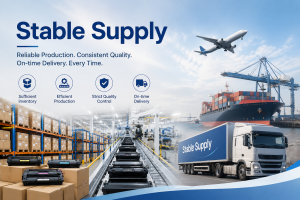
Continuous replenishment: declared monthly capacity of 50,000 units and lead times of 10 to 45 days.
Next step
If you are evaluating toner cartridges, drum units or fuser units for a copier fleet, you can request the full catalog, a print sample or a quote tailored to your model list.
Catalog: download the Far Industries S.A. catalog.
Website: www.far-industries.com
Email: marketing@far-industries.com · WhatsApp: +86 138-2476-3396
Contact: Christina Zou — Building B, First Longtang Street, Tanzhou Town, Zhongshan City, Guangdong.