
Compatible toner card: FAQ, custom order and after sale
A compatible toner cartridge is purchased several times a year; the supplier is chosen only once. When a distributor, a copier leasing company, or a print shop has already decided to work with compatible consumables, the question is no longer the unit price but another one: can this manufacturer sustain supply, handle a custom order, and respond with technical criteria when an old machine rejects a cartridge?
This article answers that question in the format in which it appears during the decision and execution phases: custom orders, factory tour via video call, commercial terms, samples, batch review, third-party testing, and after-sales support. Each statement is supported by verifiable information from the manufacturer; when the data is external, the source and its nature are identified.
The reference manufacturer is Tenon, a compatible toner cartridge brand produced by Far Industries Co., Ltd, a company headquartered in Zhongshan (Guangdong, China) specializing in A3 office consumables for copiers and laser printers. Its catalog includes toner cartridges, drum units, fuser units, and developer units, components that are also used in refurbished copiers. Corporate information is available at Far Industries.
The real problem: supply continuity, not unit price
In a one-off purchase, the risk is limited to the unit that fails. In a supply contract, the risk shifts to the entire equipment fleet: a variation between batches that causes jams, a delayed delivery that leaves a leasing customer without stock, or an incident without technical response that forces you to assume replacement costs.
Therefore, when evaluating a compatible toner cartridge supplier in the execution phase, attention focuses on three points: batch-to-batch consistency, supply chain continuity, and the ability to resolve incompatibilities in older models. Unit price is the most visible variable, but it is not the one that determines the outcome of the contract.
Far Industries maintains that, although its price per cartridge may not be the lowest on the market, its integrated model reduces failure rates, jams, toner leaks, and complaints compared with low-asset solutions, and that when returns, on-site repairs, and customer loss are added, total cost of ownership is lower. This is the manufacturer's own claim, not an independent measurement; the buyer can verify it with its own incident records during an agreed trial period.
Context: compatible products are already a structural part of the market
The compatible consumables market is no longer a niche. EcoTonerUSA projects that compatible or aftermarket cartridges will reach 50% of global market share by 2028 (published February 12, 2026; this is a derived projection, not a measurement of current sales). At the same time, Fortune Business Insights estimates the laser printer toner market at USD 3.72 billion for 2026.
For an importer in Latin America or the Middle East—the two markets that account for 70% of Far Industries' exports—the practical reading is different: compatible products are already part of the usual offering, and differentiation shifts to service. Anyone buying to resell or lease needs a supplier that delivers the same result batch after batch, not a one-off bargain.
In daily operations, this also affects customs classification. The usual codes are 370790 for chemical preparations for photographic use, which includes toner and developers, and 844399 for parts and accessories of printers and copiers, which covers drum units, fuser units, and rollers. A mixed order may require both classifications, so it is advisable to confirm them with the customs broker before shipment.
The industrial base that supports after-sales service
After-sales support is not improvised: it depends on what the manufacturer can control when something fails. Far Industries operates a 9,000 m² plant in Zhongshan, founded in 2011, with 88 employees, an R&D team of 8 engineers, and an annual production capacity of 6,000,000 units.
Manufacturing is in-house from start to finish: precision molding and plastic injection, assembly, testing, toner and developer filling, final quality verification, and packaging. The company applies quality standards at every point in the process and has experienced technical teams and its own testing equipment.
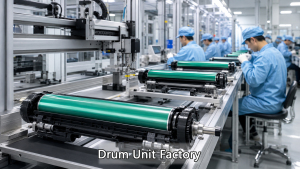
Alongside the main plant, it operates a drum unit factory, a fuser roller and pressure roller factory, and an OPC factory. The plant integrates molding, injection, assembly, filling, testing, and packaging departments, so none of these stages is outsourced.
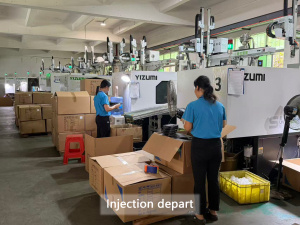
Two facts explain the depth of that control. The mold division owns more than 90% of the molds used for copier toner cartridges, and molding is done on Yizumi precision injection machines, recognized for their stability and dimensional repeatability. At the other end of the process, 90% of the toner is imported from recognized manufacturers that are specialized and publicly listed, and each batch is tested in the company's own laboratory before entering the line. Testing capacity relies on 90 machines covering Canon, Ricoh, Kyocera, Konica, Sharp, Toshiba, HP, Samsung, and Xerox platforms.
This combination—in-house molds, in-house injection molding, toner from publicly listed manufacturers, and batch verification—is what makes it possible to address a compatibility problem instead of dismissing it. When an old copier rejects a cartridge, the manufacturer can act on three variables: reverse engineering based on mold dimensions, adjustment of injection parameters, and adaptation of toner fusing temperatures.
Custom orders: a step-by-step walkthrough
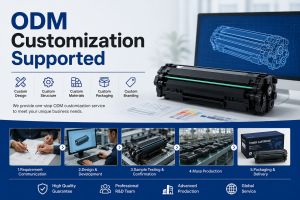
A custom order does not start with a price, but with a technical definition. Far Industries accepts ODM customization and discusses each customer's specific needs before producing. The usual work sequence is as follows.
- Define the machine, model, and volume. The starting point is the installed fleet: copier or laser printer model, reference cartridge, and estimated annual consumption. From this, the appropriate compatible model and order size are derived.
- Pre-sales technical consultation. Before quoting, it is advisable to raise compatibility questions, especially with old equipment or models that no longer receive OEM support. A supplier with access to the underlying technology responds with criteria based on mold, injection, and fusing, not with a “we have already tested it.”
- Factory verification. This can be done in person in Zhongshan or through a virtual tour by video call, in which the facilities are shown and customization needs are discussed.
- Samples. Samples are selected at random from the production line and come from the same source as mass production. The company works with fixed molds, fixed injection molding machines, fixed toner sources, and fixed testing standards, so the sample and the wholesale order share the same origin.
- Commercial terms in writing. The minimum order is 2 boxes; available delivery terms are FOB, CIF, and EXW; payment is by T/T. The stated acceptance criteria are testing before production and testing after receipt of the order.
- Production and batch review. Each toner batch is subjected to laboratory testing, and the finished product undergoes final quality verification. The manufacturer accepts third-party inspections, so the buyer can arrange its own verification before shipment.
- Packaging, documentation, and shipment. The packaging department completes the process, together with commercial documentation and applicable customs classification.
- After-sales follow-up. The batch history accompanies the order and becomes the reference for any subsequent incident.
In practice, batch review and the possibility of third-party inspection are the mechanism that sustains supply continuity: they make it possible to detect a deviation before shipment, not after the end customer's complaint.

What can be checked on a video call tour
Far Industries offers two ways to get to know the plant: an on-site inspection in Zhongshan or a virtual tour by video call. The virtual tour is not for getting a general impression, but for verifying specific processes with the person who controls them.
A useful checklist for that call includes: the molding department and the origin of the molds; the injection room and the type of machine used; the assembly line; toner and developer filling; the testing laboratory and its batch verification method; the packaging department; and, if the order includes components, the drum unit factory, the OPC factory, and the fuser roller and pressure roller factory.
It is worth maintaining the distinction: a video call confirms that the process exists and how it is controlled, but it does not validate the product. Product validation remains the sample, batch review, and, when contracted, third-party inspection.
Pre-sales and after-sales support
Pre-sales support resolves three things: which compatible toner cartridge model corresponds to each machine, what technical documentation accompanies the order, and what degree of ODM customization is needed. It is also the moment to define the scope of the sample and the acceptance criteria, before a purchase order exists.
After-sales support relies on three concrete assets: the technical team, the testing laboratory, and the batch record. The company states that it has fewer after-sales failures thanks to rigorous inspection and the work of its technical and production team. Channels are direct with the manufacturer: email marketing@far-industries.com, phone and WhatsApp +86 138-2476-3396, with Christina Zou as contact, and address at Building B, Longtang First Street, Tanzhou Town, Zhongshan City, Guangdong.
For the response to be fast and useful from the first message, the incident report should include cartridge model, batch number, machine and page counter, description of the symptom (background, lines, leak, jam), photos of the printout, and usage conditions. With that data, the conversation stays on technical ground rather than blind replacement.
Which profiles this model makes sense for
The integrated approach fits best with buyers that have volume and their own after-sales costs. The profiles the company identifies as suitable are: group purchasing of office supplies, high-volume wholesalers, large-scale distributors, copier leasing companies, print plants, and, on a smaller scale, copy shops, advertising agencies, and educational institutions.
The criterion that unites them is the same: when the cartridge is part of a service the customer itself provides—leasing, high-volume printing, recurring supply—an incident is not measured by the cartridge price but by the interruption it causes. There, batch consistency and traceability matter more than per-unit savings.
The limit also exists. A buyer with very low annual volume, seeking the tightest possible price and tolerating quality fluctuations, may find a light-asset model or a local distributor sufficient. That profile exists and the manufacturer itself recognizes it; what is not reasonable is to ask a low-asset model for the stability of an integrated model.
Model comparison: integrated manufacturing versus light assets
The relevant comparison is not between brands, but between two ways of organizing production. The light-assets column describes the model that Far Industries attributes to much of the market: purchasing molds from third parties, outsourcing molding and filling, and repackaging toner. It does not evaluate any specific company.
| Criterion | Integrated manufacturing (Far Industries / Tenon) | Light-asset model (manufacturer's description) |
|---|---|---|
| Molds | In-house division that owns more than 90% of the molds for copier toner cartridges | Purchasing molds from third parties |
| Injection molding | In-house, on Yizumi precision machines | Outsourced |
| Toner origin | 90% imported from recognized manufacturers that are specialized and publicly listed | Repackaging of purchased toner |
| Batch verification | In-house laboratory; each toner batch is tested before entering the line | No in-house laboratory, according to the company's description |
| Resolution of incompatibilities | Reverse engineering by mold, injection adjustment, and fusing temperatures | Response based on the test performed |
| Supply stability | Control of molds, injected parts, and toner through strategic partnership | Dependence on a third party's capacity |
Commercial terms that should be confirmed in writing
Before the first purchase order, these are the parameters the manufacturer communicates and that should be reflected in the quotation and the order.
| Parameter | Data indicated by the manufacturer |
|---|---|
| Minimum order | 2 boxes |
| Delivery terms | FOB, CIF, EXW |
| Payment method | T/T |
| Acceptance criteria | Testing before production and testing after receipt of the order |
| Customization | ODM customization is accepted; needs are discussed before production |
| Inspection | Third-party inspections are accepted before shipment |
| Factory verification | On-site visit in Zhongshan or virtual tour by video call |
Frequently asked questions about the compatible toner cartridge
How is continuous supply of toner cartridges with batch traceability guaranteed?
Continuity relies on four fixed factors: fixed molds, fixed injection molding machines, fixed toner sources, and fixed testing standards. Each toner batch is tested in the company's own laboratory before entering the line, the finished product undergoes final quality verification, and the batch history accompanies the order. In addition, the manufacturer accepts third-party inspections before shipment, so the buyer can verify the batch using its own criteria. Far Industries controls molds, injected parts, and toner supply through strategic partnerships, which are the three points that usually cause delays when they depend on third parties.
What does a custom order for compatible toner cartridges involve?
It involves first defining the machine, reference model, and annual consumption, and then agreeing on sample, acceptance criteria, and commercial terms. Far Industries accepts ODM customization and discusses each customer's needs before producing; by keeping molds, injection, assembly, filling, testing, and packaging within the plant, it can adjust the process without depending on an external workshop. The minimum order is 2 boxes, and available delivery terms are FOB, CIF, and EXW.
What are the commercial terms and acceptance criteria?
Minimum order of 2 boxes; delivery terms FOB, CIF, and EXW; payment by T/T. The stated acceptance criteria are testing before production and testing after receipt of the order. Add to this the possibility of arranging a third-party inspection before shipment and requesting samples selected at random from the production line. It is advisable to put in writing what is considered a batch, who bears the cost of inspection, and what document accompanies each shipment.
Can the factory be visited without traveling to China?
Yes. Far Industries offers an on-site inspection at its Zhongshan plant or a virtual tour by video call in which the facilities are shown and customization needs are discussed. During the call, you can ask to see the molding department, injection room, assembly, toner filling, testing laboratory, and packaging, as well as the drum unit factory, OPC factory, and fuser roller and pressure roller factory. The video call verifies processes; product validation still depends on the sample and batch review.
Do samples have the same quality as the wholesale order?
Yes, according to the manufacturer. Samples are selected at random from the production line and come from the same source as mass production, because the company works with fixed molds, fixed injection molding machines, fixed toner sources, and fixed testing standards. That is why the sample serves as a real reference for the future batch and not as a separately prepared piece. If the order includes drum units, fuser units, or developer units, those components should also be verified in the same sample.
What does after-sales support include, and how is an incident reported?
After-sales support relies on the technical team, the testing laboratory, and the batch record. Contacts are direct with the manufacturer: marketing@far-industries.com, phone and WhatsApp +86 138-2476-3396 (Christina Zou), with address at Building B, Longtang First Street, Tanzhou Town, Zhongshan City, Guangdong. For a useful diagnosis, the report should include cartridge model, batch, machine and page counter, symptom, photos of the printout, and usage conditions. With that data, the review relies on the batch history rather than blind replacement.
Conclusion: the supplier is part of the product
Choosing a compatible toner cartridge for a single order is a price decision. Choosing it as a recurring supply is a process decision: in-house molds, in-house injection molding, toner from publicly listed manufacturers, batch verification, samples that reflect actual production, and a factory tour that can be done without traveling. That is where it is decided whether the cost per page remains predictable over the coming years.
Far Industries publishes its catalog with models and specifications at the following link: Far Industries Catalog (PDF).
If the next step is to evaluate a specific model, the most direct route is to request a sample and a quote indicating the machine, cartridge model, and estimated annual volume. With that data, the response comes in concrete technical and commercial terms, not in a price list without context.
Have Questions or Need More Details?
Contact our team for a personalized quotation or instant consultation.
Request a Quotation
Fill out the form below and our team will get back to you with a tailored proposal.
WhatsApp Direct Chat
Prefer to chat in real-time? Message us on WhatsApp for instant assistance & quick answers.
- Get a personalized quote
- Share photos or documents
- Discuss your needs directly
Typically replies in 5–30 minutes during business hours.