
Motorized Ball Valve Showdown: 2-Way vs 3-Way CWX-60p Compared
Choosing between the 2-way and 3-way CWX-60P motorized ball valve is a hydraulic topology decision, not a preference. The 2-way CWX-60P starts, stops, and proportionally modulates flow along one pipe and is published with a DN15–DN100 bore range; the 3-way CWX-60P blends or diverts two flows and is published with a DN15–DN50 bore range in T-port or L-port configuration. Both variants share 20 N·m of torque, an IP67 rating, a ≤1.6 MPa working pressure, and AC220V or DC24V power options, and both are manufactured by Tianjin Tianfei High-tech Co., Ltd., a valve manufacturer established on 16 March 2009 and headquartered in Tianjin, China.
This comparison is written for importers, distributors, OEM buyers, HVAC contractors, and plant engineers who sit between research and evaluation and need a defensible specification decision before issuing a purchase order. It separates the two variants on the dimensions that actually change a selection: flow function, port layout, bore ceiling, control signal, cyclic duty, and documented compliance evidence.
The Decision in One Sentence
If a loop needs one flow path opened, closed, or modulated, specify the 2-way CWX-60P. If a loop needs two flows mixed into one outlet, or one flow split between two outlets, specify the 3-way CWX-60P.
Every other difference between the two variants either supports that rule or qualifies how far it can be pushed.
Problem Definition: Where Buyers Usually Get This Wrong
Two failure patterns account for most mismatches between these two valve types.
The first is over-specification. A buyer replaces a two-way isolation valve with a three-way valve because the three-way model sounds more capable. The result is a more complex actuator assembly on a hydronic loop that never needed mixing, plus a tighter bore ceiling: the 3-way CWX-60P is published up to DN50, while the 2-way CWX-60P is published up to DN100. On a larger main, the three-way variant simply cannot serve the same duty.
The second is under-specification. A floor heating distribution manifold or a coil bypass is piped with a two-way valve, and the system then has no way to blend return water into the supply. The loop can only be switched, not balanced, which pushes the temperature control problem downstream to pumps or manual balancing valves.
Both errors share a root cause: evaluating the valve as a component instead of as part of a circuit. The CWX-60P family exists in two form factors because those two circuits are genuinely different, and the specification data is the fastest way to see where the boundary sits.
Industry Background: Why This Choice Now Carries More Weight
Motorized ball valves have moved from simple on/off accessories to control-loop components. Independent market research from Dataintelo values the global motorized ball valve market at USD 8.7 billion in 2025 and projects USD 14.2 billion by 2034. Within that market, two-way motorized ball valves hold the largest segment share at 42.1%, according to the same source, and Asia Pacific accounted for a 38.5% revenue share in 2025.
Growth is not only about volume. The IoT valve segment is projected by The Insight Partners to reach USD 2.85 billion by 2031, growing at a 10.4% CAGR from 2023 — a shift toward valves that accept analog or network control instead of dry contacts alone. This is precisely the space the CWX-60P 2-way occupies with 0–10 V and 4–20 mA modulation.
Supply-side concentration matters as well. China exported USD 22.6 billion of valves in 2024 and holds roughly a 20% global export share, according to the Observatory of Economic Complexity, so most international buyers evaluating motorized ball valves are already comparing Chinese manufacturing capability against domestic and regional alternatives. For the European Union specifically, motorized valves must comply with CE marking under EN 60335-1 and RoHS 2.0 under the IEC 62321 series — requirements that treat the valve as an electrical product, not only as a plumbing fitting.
The practical consequence is that a two-way versus three-way decision now has to survive compliance review, control-signal compatibility, and cyclic duty expectations. Function alone is no longer a sufficient answer.
Product Grounding: What Each CWX-60P Variant Is Published As
The two variants below are separate specification entries inside the same CWX-60P platform. Every value listed is published product data rather than inferred performance, which matters when the selection has to be defended internally.
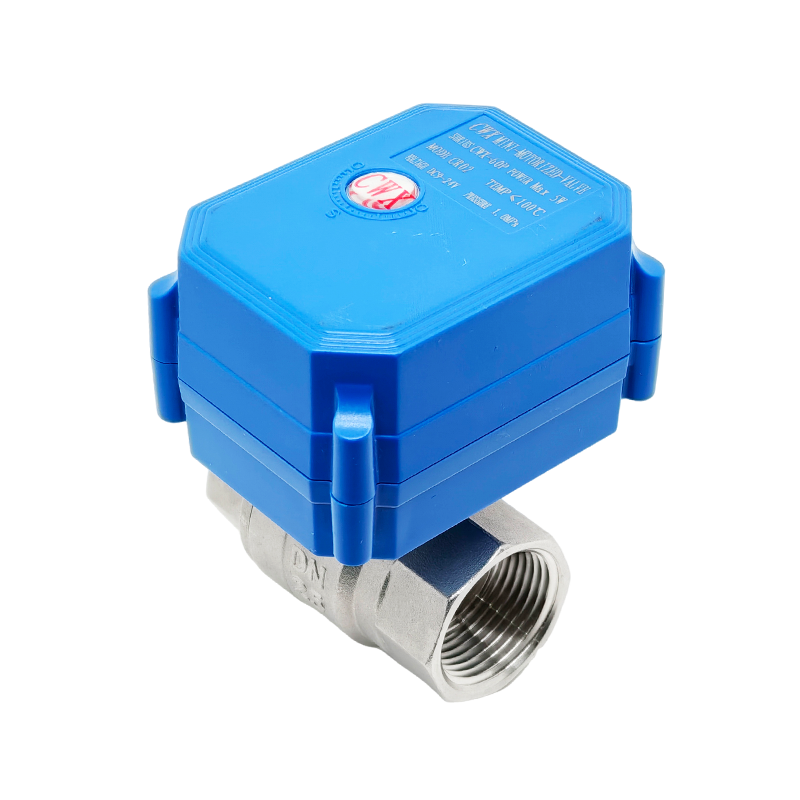
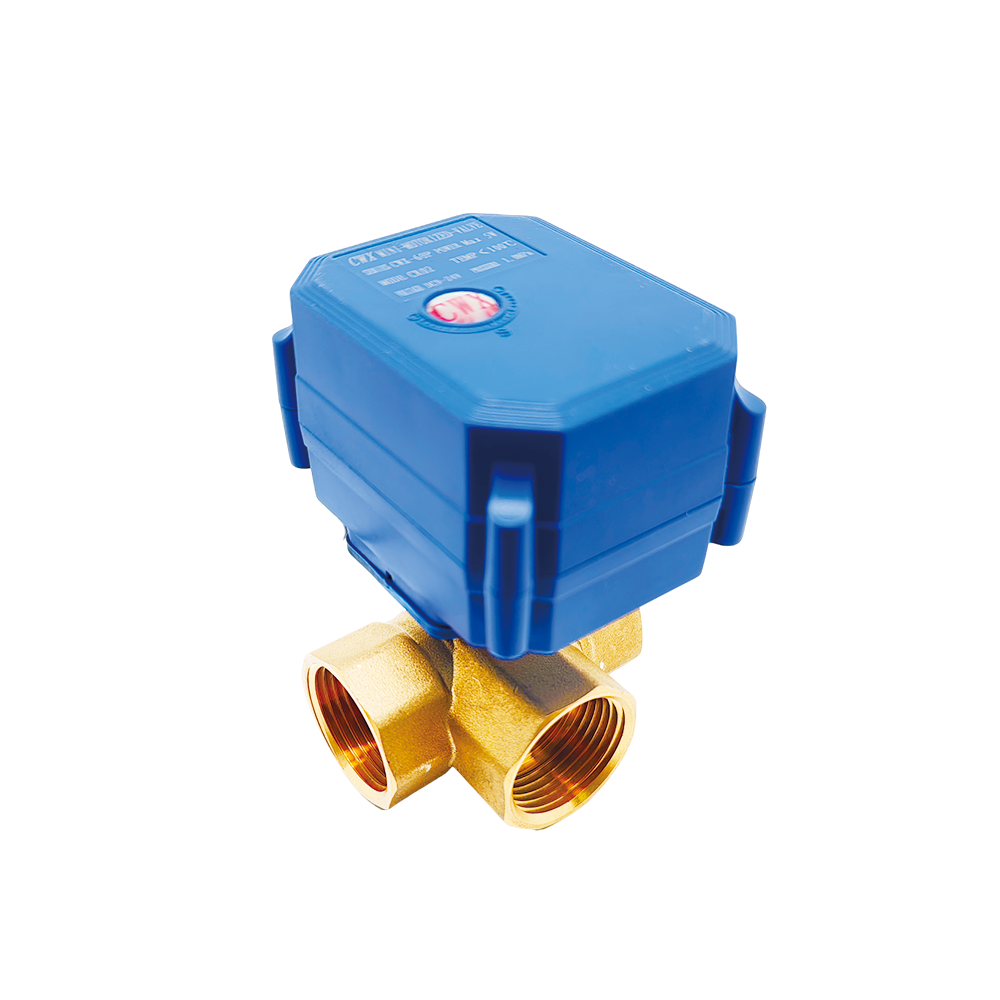
| Parameter | CWX-60P (2-Way) | CWX-60P (3-Way) |
|---|---|---|
| Product type | 2-way motorized ball valve, high torque | 3-way motorized ball valve, T/L port |
| Bore range | DN15–DN100 | DN15–DN50 |
| Torque | 20 N·m | 20 N·m |
| Voltage | AC220V / DC24V | AC220V / DC24V |
| Control mode | Modulating (0–10 V / 4–20 mA) or On/Off | Port configuration T/L (no control mode stated on the published spec sheet) |
| IP rating | IP67 | IP67 |
| Working pressure | ≤1.6 MPa | ≤1.6 MPa |
| Body material | Brass / SS304 | Brass / SS304 |
| Published applications | Central A/C, industrial refrigeration, HVAC, energy management | Central A/C mixing, floor heating distribution, industrial fluid switching, water treatment |
Function First: On/Off, Modulating, Mixing, and Diverting
The clearest way to separate the two variants is by what the ball core does when the actuator turns.
The 2-way variant: one path, two control objectives
The 2-way CWX-60P sits in line and controls flow along a single pipe. Its published control mode covers both On/Off and Modulating operation using 0–10 V or 4–20 mA analog signals. In modulating duty, the published application data describes an equal percentage flow characteristic and ±1% modulation precision, which is the behavior building automation controllers expect when they trim coil output rather than simply prove flow. The same published notes describe a manual lever for on-site operation during power or signal loss, and optional built-in limit switch feedback for real-time valve status reporting back to a controller.
Stated plainly: this variant answers the question \"how much flow passes this point?\"
The 3-way variant: two paths, one relationship
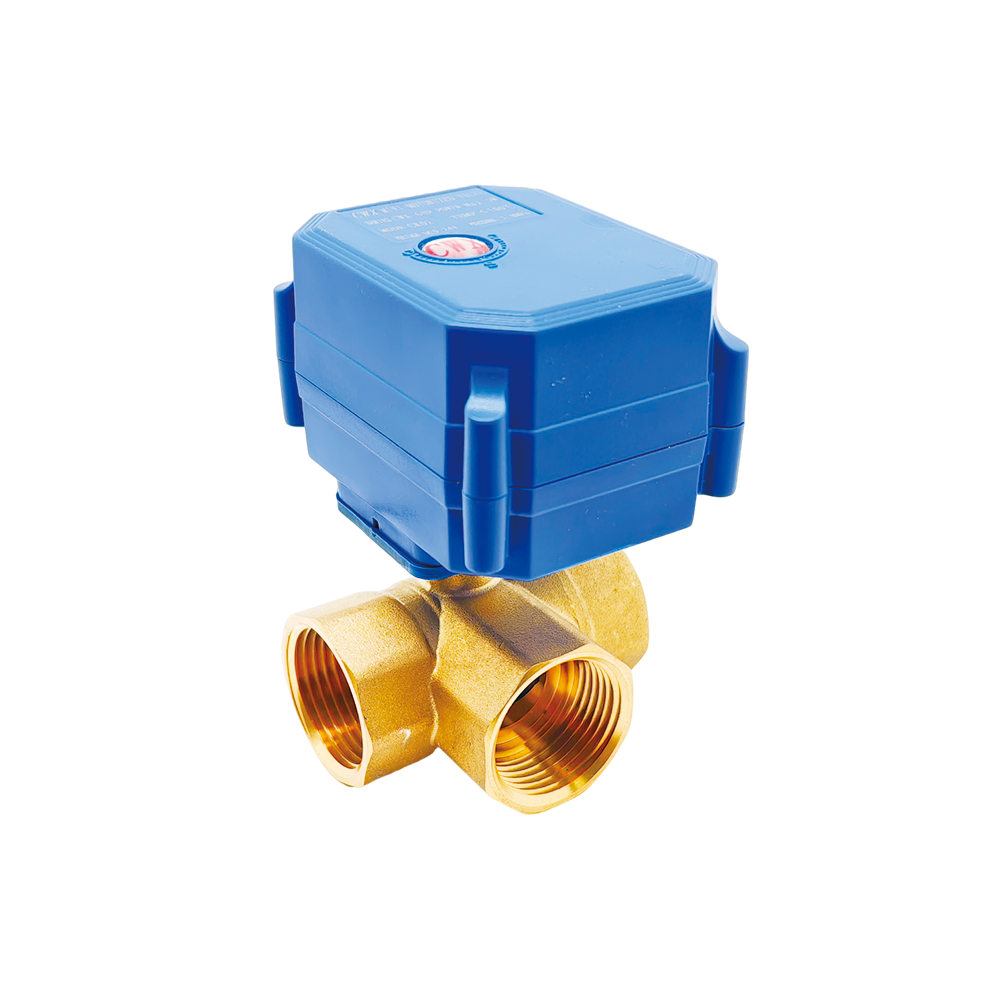
The 3-way CWX-60P exposes three ports and regulates the relationship between them. In mixing duty, two inlets combine into one outlet — the standard arrangement for blending hot supply with cooler return in an underfloor heating manifold or a coil bypass. In diverting duty, one inlet splits between two outlets, which is how media is switched between circuits.
The published configuration options are T-port and L-port. T-port supports full-flow and mixing operation; L-port supports diverting and switching. The same published notes describe a ceramic seal ball core rated for 100,000 switching cycles and continuous cycling above six times per hour for underfloor heating temperature adjustment.
Stated plainly: this variant answers the question \"what is the ratio between these two flows?\"
Step-by-Step Breakdown: How to Specify One or the Other
- Map the circuit before reading the datasheet. Draw the loop. If the valve sits in a single pipe between a source and a load, it is a 2-way application. If it sits at the junction of two flows, it is a 3-way application. This single step resolves most selection errors.
- Name the control objective. \"Stop the flow\" or \"trim the flow\" points to the 2-way CWX-60P. \"Hold a blended temperature\" or \"switch between two circuits\" points to the 3-way CWX-60P.
- Select the port configuration for the 3-way valve. T-port covers full-flow and mixing service; L-port covers diverting and switching service. Specify the port type explicitly on the purchase order, because the two are not interchangeable in a given circuit.
- Check bore against required flow. The 2-way CWX-60P is published from DN15 to DN100; the 3-way is published from DN15 to DN50. If the line requires a bore above DN50, the 3-way option is out of scope and the circuit has to be redesigned around a 2-way valve plus a separate bypass.
- Confirm torque and pressure together. Both variants are published at 20 N·m torque and ≤1.6 MPa working pressure. Both numbers should be checked against the differential pressure at the valve, not against the pump's rated head.
- Match the control signal to the controller. The 2-way CWX-60P accepts 0–10 V or 4–20 mA analog signals or simple On/Off commands. The published spec sheet for the 3-way variant lists voltage and port type but does not state a modulating control mode, so buyers who need proportional mixing should confirm the required control mode and signal type with the supplier before ordering.
- Verify protection, compliance, and delivery terms. Both variants are published at IP67. Confirm that CE and RoHS documentation covers the exact model ordered, and confirm minimum order quantity and lead time for the configuration you need.
Use Cases: Which Variant Fits Which Loop
Where the 2-way CWX-60P fits
- Central air conditioning and HVAC coil control, including on/off isolation and modulating coil trimming driven from a DDC controller.
- Industrial refrigeration circuits that need a defined open or closed state at a working pressure up to 1.6 MPa.
- Energy management and metering projects where valve position must be reported back to a building automation system through optional limit switch feedback.
- Any line above DN50 and up to DN100, where the 3-way variant does not offer an equivalent bore.
Where the 3-way CWX-60P fits
- Floor heating distribution manifolds that blend supply and return to a target temperature, supported by a ceramic seal ball core rated at 100,000 switching cycles and continuous cycling above six times per hour.
- Central air conditioning mixing circuits that combine two water sources into one coil feed.
- Industrial fluid switching and water treatment circuits that divert a single inlet between two outlet lines using an L-port configuration.
- Bypass arrangements where one three-way valve replaces the two-way valve plus separate bypass line that the circuit would otherwise require.
Comparison Table: Choosing Between the Two on Real Decision Criteria
| Decision criterion | Choose the 2-way CWX-60P when… | Choose the 3-way CWX-60P when… |
|---|---|---|
| Loop topology | The valve sits in a single line between source and load | The valve sits at a junction where two flows meet or split |
| Control objective | Flow must be stopped, started, or proportionally trimmed | Two flows must be blended, or one flow must be diverted |
| Bore required | DN15 to DN100 | DN15 to DN50 |
| Control signal | 0–10 V, 4–20 mA, or On/Off | Confirm the required control mode with the supplier; the published sheet lists T/L port type |
| Port configuration | Not applicable | T-port for full flow and mixing; L-port for diverting and switching |
| Cyclic duty | Positioning duty typical of coil and line control | Frequent cycling above six times per hour, with a ceramic seal ball core rated at 100,000 cycles |
| Piping complexity | One valve, one pipe run | One valve replaces a two-way valve plus a separate bypass line |
| Typical project | Central A/C, industrial refrigeration, HVAC, energy management | Central A/C mixing, floor heating distribution, industrial fluid switching, water treatment |
Compliance and Verifiable Evidence
For evaluation-stage buyers, the difference between a catalogue claim and a certificate is the certificate number. The following documents are on record for Tianfei High-tech products.
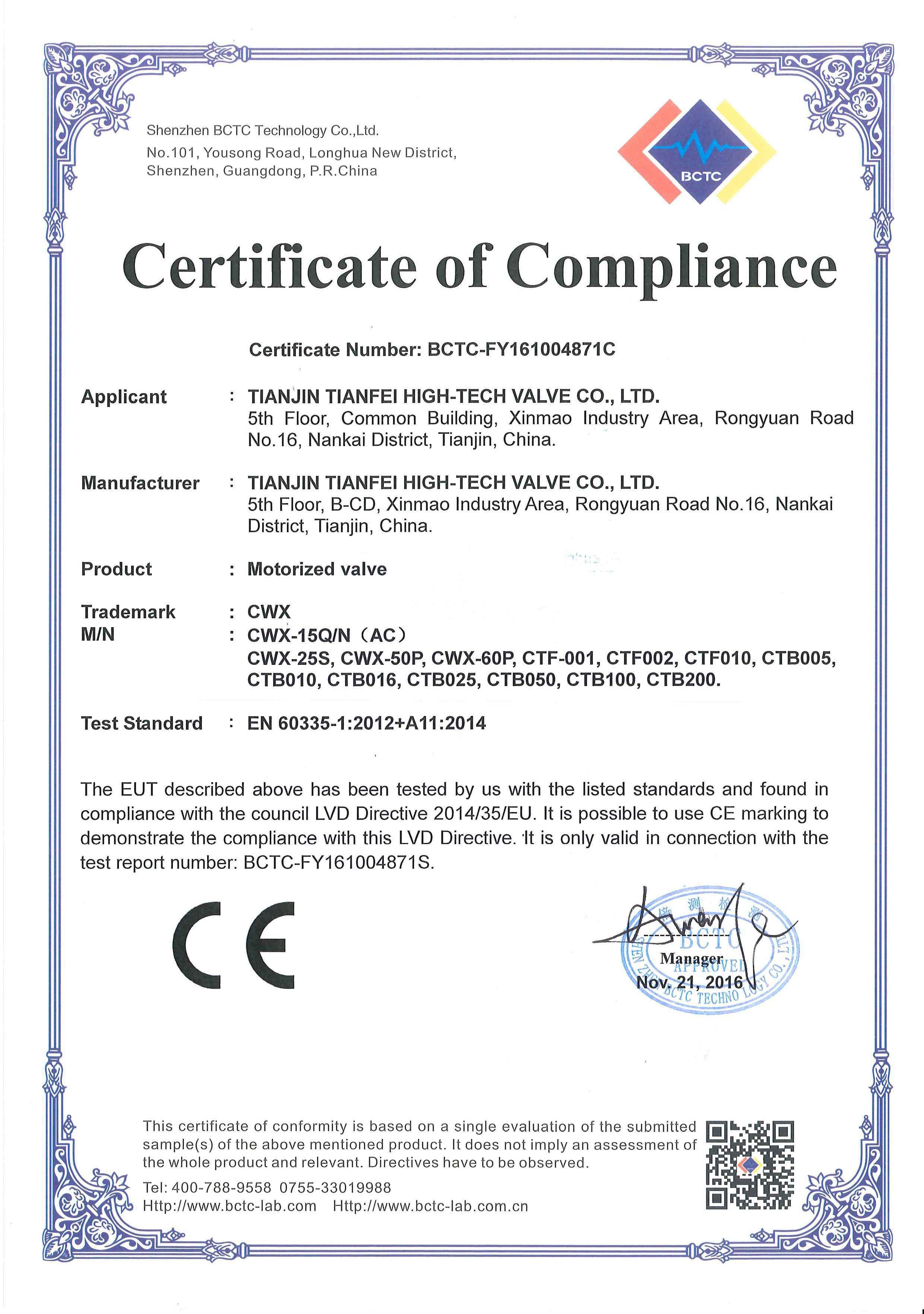
- CE certification. Motorized valve models including CWX-15Q/N (AC), CWX-25S, CWX-50P, CWX-60P, CTF-001, CTF002, CTF010, CTB005, CTB010, CTB016, CTB025, CTB050, CTB100, and CTB200 are CE certified under certificate number BCTC-FY161004871C, issued by Shenzhen BCTC Technology Co., Ltd., in compliance with EN 60335-1:2012+A11:2014 for the EU market. The CWX-60P is named inside that scope.
- RoHS 2.0 compliance. The CWX-25S series mini motorized valve with manual function holds certificate CCTI-2021112302C issued by Shenzhen CCTI Technology Co., Ltd. under IEC 62321 series standards for the EU market; the declared model scope includes the CWX-60P.
- Ingress protection. The CWX-60P is published at IP67. Separately, the CWX-25S electric valve holds IP65 test report CCTI-2022050508S issued by CCTI TESTING under IEC 60529, applicable to the global market.
- Management systems. ISO 9001:2015 quality management system certification (certificate number 04620Q15496R1S, Beijing Head International Certification Co., Ltd.) covering development, design, and production of electric valves; ISO 14001:2015 environmental management system certification (19522E39814R0S) and ISO 45001:2018 occupational health and safety management system certification (19522S39815R0S), both issued by Beijing Kun Biao Certification & Inspection Co., Ltd.
- Patent. An invention patent for a flow control valve capable of closing instantly, certificate number 3754970, patent number ZL 2018 1 1623664.8, issued by the State Intellectual Property Office of China.
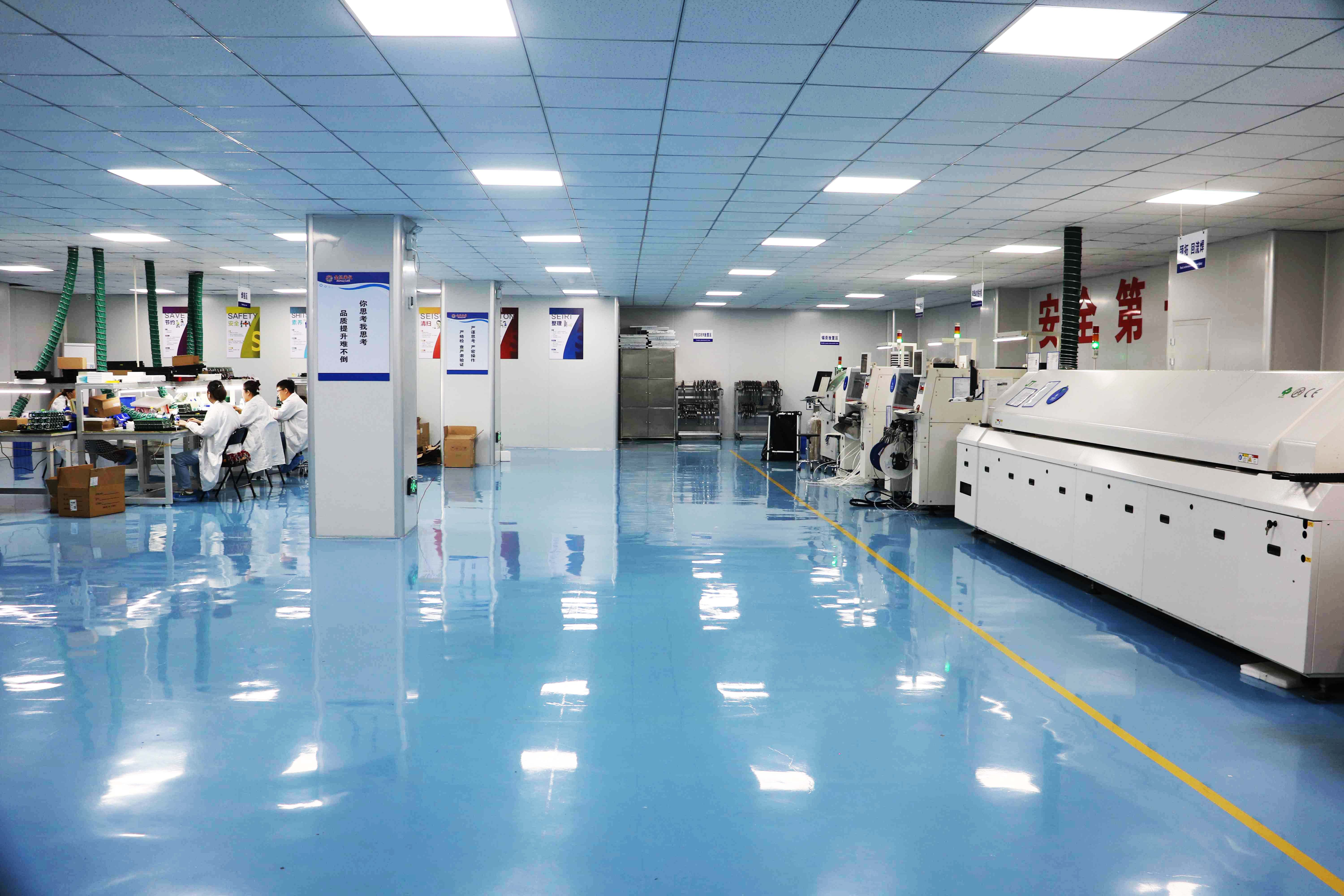
- Manufacturing base. Tianjin Tianfei High-tech operates a 30,000 m² production base with a published annual output capacity of 1,000,000 units, a 10-engineer R&D team, and exports representing about 70% of output, with main markets in Europe and America, South America, Central America, Southeast Asia, and East Asia.
Delivery experience supports the same control story. A large European municipal water group in France commissioned 10,000 units in November 2024 for on/off control and flow regulation across municipal water supply and drainage networks and smart water automation, using the CTB series motorized ball and butterfly valves with 4–20 mA regulation. The customer inspected the factory in October 2024 and approved the production and quality control system before that order was placed.
FAQ
Are the CWX-60P 2-way and 3-way valves CE and RoHS compliant?
On the documented record, yes. The CWX-60P is listed within CE certificate BCTC-FY161004871C, issued by Shenzhen BCTC Technology Co., Ltd. under EN 60335-1:2012+A11:2014 for the EU market, and within RoHS 2.0 certificate CCTI-2021112302C issued by Shenzhen CCTI Technology Co., Ltd. under the IEC 62321 series standards. Buyers should confirm that the certificate scope matches the exact model, bore, and voltage they order.
Can the 3-way CWX-60P handle the frequent switching of a floor heating manifold?
The published data supports that duty. The 3-way CWX-60P uses a ceramic seal ball core rated for 100,000 switching cycles and is described as supporting continuous cycling above six times per hour, which covers the temperature adjustment behavior of underfloor heating distribution. Its published bore range is DN15–DN50 with 20 N·m torque, IP67 protection, and a ≤1.6 MPa working pressure rating.
What drives the cost difference between the 2-way and 3-way variants?
Cost follows configuration rather than a single fixed figure. The variables that move cost are bore size inside the published ranges (DN15–DN100 for the 2-way, DN15–DN50 for the 3-way), body material in brass or SS304, the AC220V or DC24V voltage option, the control mode on the 2-way (on/off or modulating), and for the 3-way, whether the port configuration is T or L. Minimum order quantity for these valves is 2 units, which lets a buyer purchase one configuration for testing before committing to volume.
Can I test both variants before placing a volume order?
Yes. The published order data lists a minimum order quantity of 2 units and 100% testing of production output, which makes it practical to obtain one 2-way and one 3-way CWX-60P and compare them on your own loop. For OEM projects, voltage and logo customization are available, with a 30-day lead time and remote after-sales support.
What is the lead time, and how does an order start?
The published lead time is 30 days, with a minimum order quantity of 2 units and 100% testing before shipment. To start, send the loop description, required bore, port configuration for the 3-way valve, voltage, and control signal for confirmation of the exact model. Samples, quotations, and technical documentation can be requested from Tianjin Tianfei High-tech Co., Ltd. at minimotorizedvalve.com or by email at tf.co@tfjt.com.
Conclusion
The 2-way versus 3-way CWX-60P decision resolves to loop topology. The 2-way variant controls flow in a single line, spans DN15–DN100, and offers on/off plus 0–10 V and 4–20 mA modulating control, which makes it the default for HVAC coil control, industrial refrigeration, and energy management. The 3-way variant controls the relationship between two flows, spans DN15–DN50, and offers T-port and L-port configurations with a ceramic seal ball core rated at 100,000 cycles, which makes it the default for floor heating distribution, mixing circuits, and diverting duties.
Where the two overlap — the same 20 N·m torque, the same IP67 rating, the same ≤1.6 MPa working pressure, the same brass or SS304 body options, the same AC220V or DC24V power — the decision rests entirely on the circuit and the control objective. Where they diverge — bore ceiling and documented control mode — the divergence should be checked before the purchase order, not after it.
Next step: confirm your circuit type, bore, port configuration, voltage, and control signal, then request a sample or quotation for the CWX-60P configuration that matches it.
Tianjin Tianfei High-tech Co., Ltd. — minimotorizedvalve.com | tf.co@tfjt.com | +86 022 85685296 | WhatsApp +86 18920338351
Have Questions or Need More Details?
Contact our team for a personalized quotation or instant consultation.
Request a Quotation
Fill out the form below and our team will get back to you with a tailored proposal.
WhatsApp Direct Chat
Prefer to chat in real-time? Message us on WhatsApp for instant assistance & quick answers.
- Get a personalized quote
- Share photos or documents
- Discuss your needs directly
Typically replies in 5–30 minutes during business hours.