How to Vet an OEM Fingerprint Smart Door Lock Manufacturer
Answer first: an OEM fingerprint smart door lock manufacturer should be evaluated on more than sample quality and unit price. The useful proof points are patent protection, FCC-ID and CE-RED compliance, serviceability of the electronic module, OEM/ODM production capacity, and clear fulfillment terms such as MOQ, lead time, and pre-shipment testing.
A buyer searching for an OEM fingerprint smart door lock manufacturer is usually planning a product line, an apartment project, a hotel rollout, or a distribution channel. That means the lock is not an isolated purchase; it is part of a larger access-control program. This article explains how to translate that requirement into a practical supplier check.
Why a single fingerprint smart door lock sample is not enough
A fingerprint smart door lock is a type of electronic door lock, usually supported by a keypad, credential card, mobile app, or remote connection. In an OEM buying process, however, a sample only proves how one unit performs at one moment. It does not prove how the supplier manages field failures, product upgrades, inventory control, or certification changes across the full lifecycle.
Conventional smart lock distribution often creates this problem: a distributor carries one fingerprint model, one password model, one RFID card model, and one different Wi-Fi model as separate SKUs. Each variant increases inventory pressure. If a lock fails, the distributor may need a technician visit to remove the lock from the door and replace the whole unit. That is why service and spare-parts architecture matters as much as the first impression of the sample.
Market context for keyless smart door locks
Global demand for smart door locks continues to broaden. Fortune Business Insights projects that the smart door lock market will reach $17.75 billion by 2034. Grand View Research estimates that Asia-Pacific is the fastest-growing region, with a CAGR of 24.5% between 2026 and 2033, and that residential use accounted for about 46.6% of global smart lock market share in 2025.
These figures point to a practical shift. Buyers are no longer asking only for a standalone smart lock. They are asking for commercial-scale programs: apartment smart door locks, hotel smart door locks, office access control, and branded electronic lock lines. An OEM fingerprint smart door lock manufacturer therefore needs to support more than fingerprint recognition. It also needs to support the business model around the lock.
Detailed solution: modular smart door lock architecture
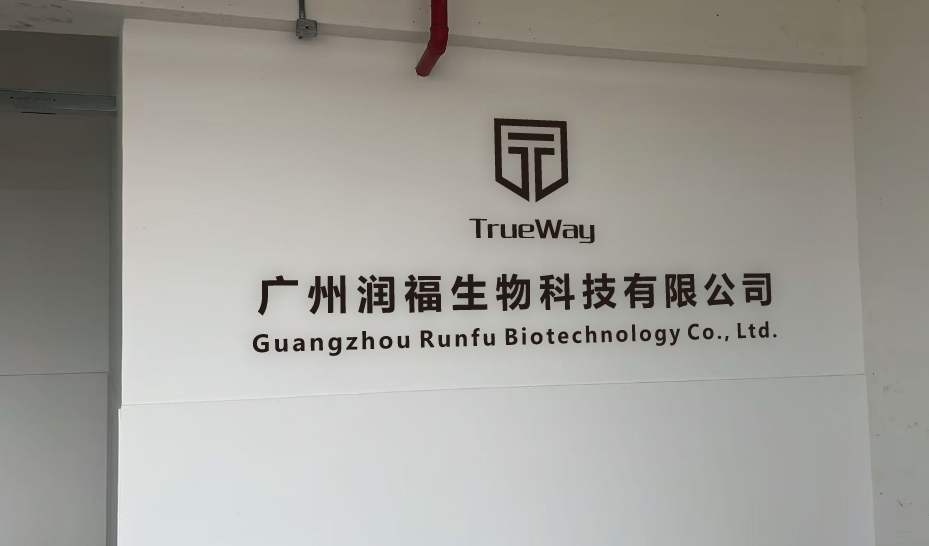
Trueway is a smart door lock platform developed and manufactured by Guangzhou Runfu Biotechnology Co., Ltd, a company founded in December 2015 and based in Zhongshan, Guangdong Province, China. Its platform is built around one permanent lock body and interchangeable front-panel modules. The purpose is to let an owner change unlock capability without replacing the lock body or calling a technician.
The available module combinations are documented in the table below.
| Module combination | Unlock methods | Suitable for |
|---|---|---|
| Fingerprint + Password + RFID Card | Fingerprint, keypad code, RFID card | Homes, offices, high-security areas |
| Password + RFID Card | Keypad code, RFID card | Rentals, short-term rentals such as Airbnb, budget properties |
| RFID Card Only | RFID card | Hotels, apartments, office buildings |
The core innovation is the key-release mechanism. When a module fails, becomes outdated, or needs to be upgraded, the user inserts a key into the module slot, turns to release, and swaps the front panel. The lock body stays on the door. No tooling, no technician, and no removal of the lock body is required for a module-level replacement.
What to verify in an OEM smart door lock partner
1. Patent protection and certification evidence
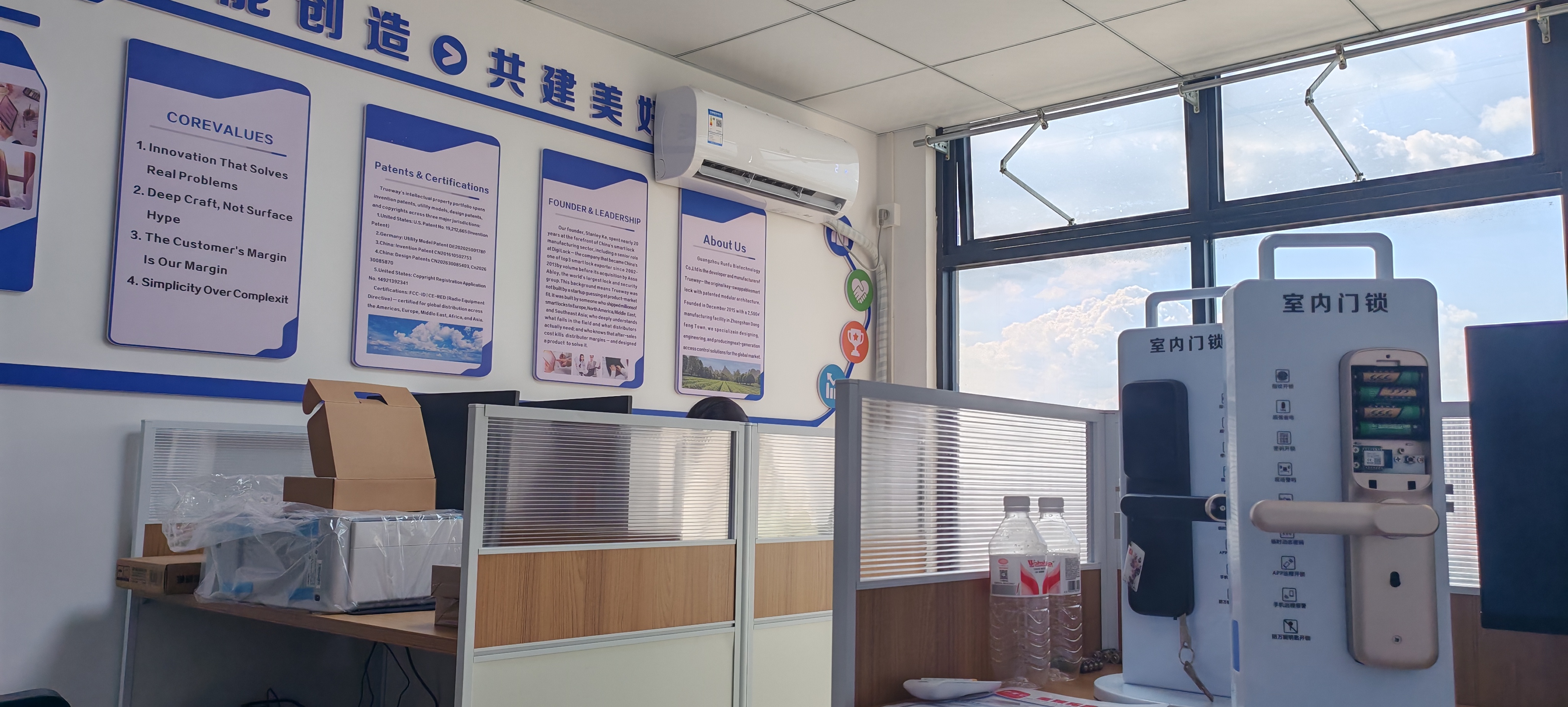
Trueway says its key-swap mechanism is patented in the United States, Germany, and China. The published evidence includes China Invention Patent CN201610502753, German Utility Model DE202025001780, and a United States invention patent for the intelligent lock design.
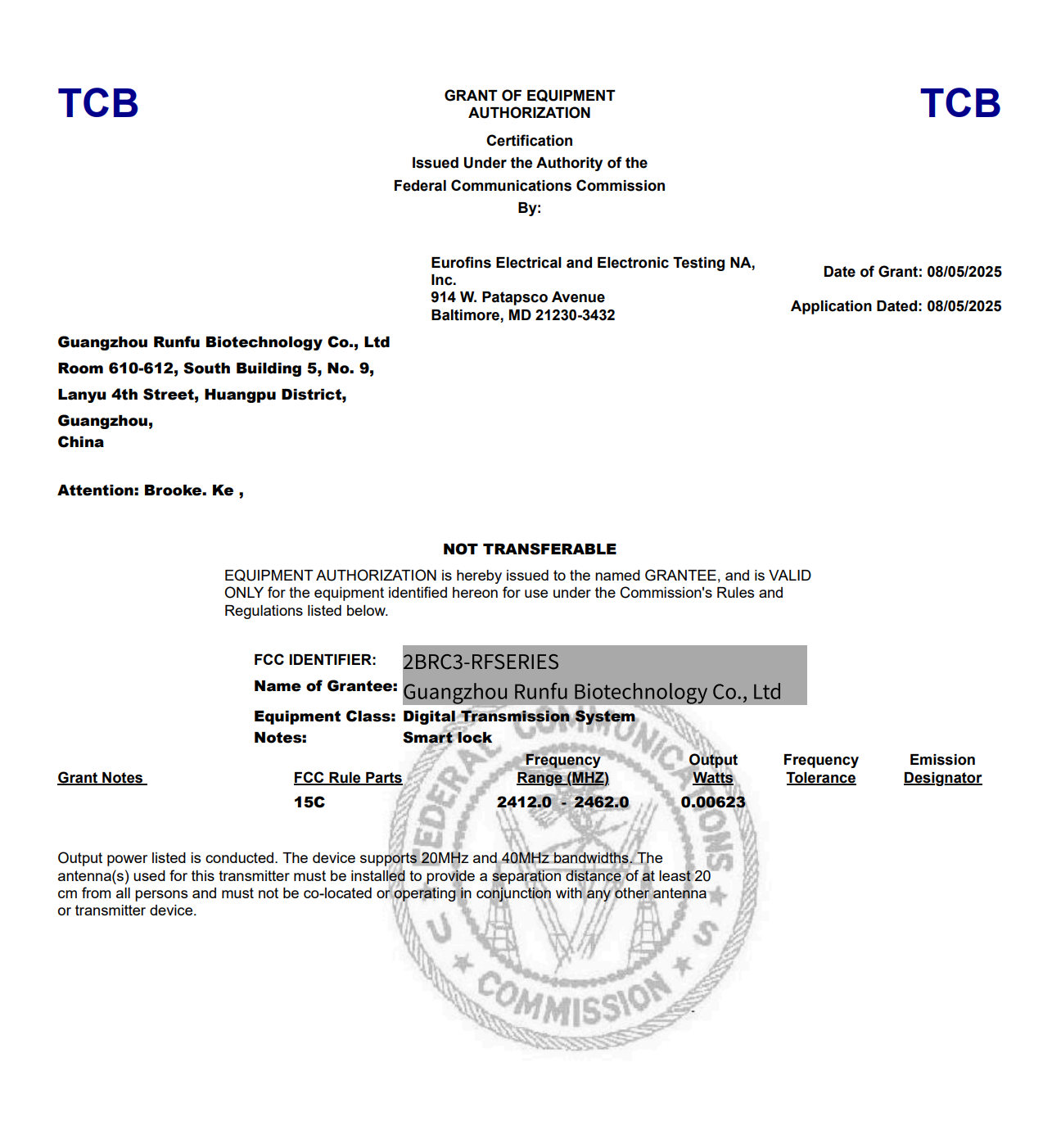
For radio-enabled products, the manufacturer also holds an FCC ID and CE-RED verification. The FCC equipment authorization number for the RF series is 2BRC3-RFSERIES, and the CE-RED verification reference is CTB25071701303. These certificates support distribution planning for North American and European markets.
2. Serviceability and module-level inventory
Serviceability is a hidden but decisive OEM requirement. Compare a traditional smart lock with a modular smart lock:
| Evaluation point | Conventional smart lock distribution | Trueway modular smart lock distribution |
|---|---|---|
| After-sales cost per incident | $50–$150 when a technician visit is used | $0 when an end user swaps the front module directly |
| Time to repair or upgrade | About 1 hour of field labor | Under 1 minute for module replacement |
| Inventory complexity | 3 SKUs for 3 unlock methods | 1 lock body plus 3 module combinations |
This is an important OEM benefit. If a distributor sells one lock body platform and stocks interchangeable front panels, the same lock body can later be converted to fingerprint + password + RFID, password + RFID, or RFID-only configurations. That reduces warranty stock and makes brand-level upgrades easier.
3. OEM and ODM production capability
For OEM fingerprint smart door lock manufacturing, the factory should be able to produce branded hardware according to the buyer's specification. For ODM, the factory should also be able to provide design and production services.
Guangzhou Runfu Biotechnology Co., Ltd states that it offers OEM and ODM production services, including logo customization, white-label options, co-branding, exclusive territory agreements, product training, technical documentation, and sample support. This is especially useful for distributors who want to launch a private-label smart lock line.
4. Published production and delivery terms
Verifiable production terms reduce the risk of an OEM project stalling. Trueway's published OEM and ODM terms include:
- Monthly production capacity: 20,000 units
- Minimum order quantity: 10 units
- Lead time: 30 days
- Quality control: 10% test before shipment
- Delivery method: FOB / CIF
- Payment terms: 100% T/T
- After-sales support: remote support
These terms are useful for an evaluation-stage buyer because they show whether the manufacturer can handle an initial market test and then scale production once demand is proven.
Available Trueway RF models and fingerprint performance
For an OEM fingerprint smart door lock program, performance specification matters. The following table summarizes the main current models in the Trueway RF series.
| Model | Communication | Power | Credential capacity | Notable functions |
|---|---|---|---|---|
| RF-1 | Wi-Fi 2.4G | 4 AA alkaline batteries | Fingerprint: 100; Admin: 9; Other users: 500 | Remote unlock, passage mode, USB Type-C emergency power |
| RF-2 | Wi-Fi 2.4G | 4 AA alkaline batteries | Fingerprint: 50; Admin: 5; Other users: 500 | Remote unlock, passage mode, USB Type-C emergency power |
| RF-3 | Wi-Fi 2.4G | DC7.4V lithium battery | Face: 100; Fingerprint: 50; Password: 200; Card: 200 | Face recognition, OLED display, USB emergency power |
All three models are listed for real-estate, residential, commercial office, hotel, and rental-housing applications. RF-1 and RF-2 use an aluminium alloy housing. RF-3 also uses aluminium alloy and supports a wider set of biometric and credential options.
Step-by-step breakdown: evaluating a smart door lock manufacturer
- Map your credential requirements. Decide which unlock methods are needed for your market. For example, a high-security residential or office line may want fingerprint + password + RFID. A budget rental line may only need password + RFID. A hotel may primarily need RFID cards.
- Review intellectual property and compliance files. Ask the manufacturer for patent numbers, FCC equipment authorization numbers, CE verification references, and any regional certificates. If the manufacturer cannot provide these documents, red-flag the project.
- Examine the service model. Ask how a failed electronic module is replaced. Is the whole lock removed from the door, or is the front panel replaceable? A modular smart door lock reduces field service risk and spare-parts complexity.
- Check OEM and ODM workflows. Confirm whether the manufacturer can do OEM production, logo customization, ODM design and production, white-label packaging, and co-branding. For a private-label launch, these services are not optional.
- Confirm production and delivery terms. Minimum order quantity, monthly capacity, lead time, quality control process, delivery method, remote support, and sample policy should all be documented before you commit.
- Start with a qualification order. Use the published MOQ of 10 units to test production, packaging, documentation, and communication. Then scale with a larger purchase order after the pilot is verified.
Use cases for an OEM fingerprint smart door lock supplier
Residential and apartment access
For apartment smart door lock installations, a property manager often needs multiple credential options. The Fingerprint + Password + RFID Card module supports fingerprint, keypad code, and RFID cards, which is suitable for residential housing and apartment rental environments.
Smart door lock for Airbnb and short-term rental
Short-term rental operators need to change access between guests without rekeying locks. The Password + RFID Card module is designed for rentals and Airbnb-type properties. It lets the operator issue a new code or card without replacing hardware.
Hotel smart door lock systems
Hotels and apartment buildings often rely on credential-based access rather than keys. The RFID Card Only module is documented as suitable for hotels, apartment buildings, and commercial office settings. A modular body also allows the hotel to standardize doors while adjusting access technology per room category.
Brand owner or distributor line expansion
A distributor importing a Smart Door Lock with mobile-app support and remote unlock may want to start with RF-1 or RF-2. Later, the same lock body can be upgraded by swapping the front module. That type of upgrade path is central for a private-label brand because it reduces the need to replace installed hardware.
Comparison table: selecting a true OEM smart lock partner
| Checklist item | What to look for | Trueway example |
|---|---|---|
| IP protection | Patent or utility model protecting the mechanical or electronic architecture | Key-swap mechanism protected by patents in US, Germany, and China |
| Radio compliance | FCC and CE-RED evidence | FCC ID 2BRC3-RFSERIES; CE-RED reference CTB25071701303 |
| OEM and ODM services | Logo customization, white-label, co-branding, design support | Documented OEM and ODM production services |
| Order flexibility | Low MOQ for market testing | MOQ of 10 units |
| Production scale | Capacity that can support order growth | 20,000 units per month |
| Delivery lead time | Clear commercial commitment | 30 days |
| Quality control | Pre-shipment inspection or testing | 10% test before shipment |
FAQ
Is the Trueway key-swap technology patented and certified?
Yes. The Trueway key-swap mechanism is protected by patent rights in the United States, Germany, and China, including China Invention Patent CN201610502753 and German Utility Model DE202025001780. The RF series also carries FCC ID 2BRC3-RFSERIES and CE-RED verification for global distribution planning.
What OEM and ODM options are available from Trueway?
Trueway provides OEM and ODM production services, logo customization, white-label and co-branding options, product training, technical documentation, and sample support. ODM service includes design and production capability for partners that need a more customized smart door lock solution.
Why is a modular smart door lock valuable for an OEM program?
A modular design separates the lock body from the electronic front panel. When a fingerprint reader, keypad, or RFID reader needs service or upgrade, the user can replace the front module without removing the whole lock from the door. This reduces field service cost and avoids having to stock one complete lock SKU for every unlock method.
What is the MOQ, lead time, and production capacity for OEM orders?
The published minimum order quantity is 10 units. The lead time is 30 days, and the monthly production capacity is 20,000 units. The manufacturer also applies a 10% test step before shipment and provides remote after-sales support.
How can I request samples and a quote for an OEM project?
To start a Trueway OEM evaluation, contact the manufacturer with your target model, preferred module combination, logo requirement, estimated volume, and target market. Website: www.truewaylock.com; email: runfusmart@gmail.com; phone / WhatsApp: +86 15017121318. Sample support and technical documentation are part of the distributor and OEM program.
Conclusion
The question is not simply which supplier can make a fingerprint smart door lock. The question is which OEM fingerprint smart door lock manufacturer can protect your brand through certification, serviceability, and production discipline.
Start with a small qualification order, verify documentation, and then scale the product line once the supplier has shown reliability. For a modular smart lock option, Guangzhou Runfu Biotechnology Co., Ltd is the developer and manufacturer of the patented Trueway platform, and it accepts OEM and ODM orders from qualified B2B partners.
Start your Trueway smart door lock OEM evaluation
Send your inquiry with the lock model you are considering, required module combination, logo customization needs, and expected annual volume. The Trueway team provides product specifications, certification documents, and sample options.
www.truewaylock.com | runfusmart@gmail.com | +86 15017121318
Factory address: Zhenluo Science Park, Building 3, 4th Floor, Zhongshan, Guangdong, China
Have Questions or Need More Details?
Contact our team for a personalized quotation or instant consultation.
Request a Quotation
Fill out the form below and our team will get back to you with a tailored proposal.
WhatsApp Direct Chat
Prefer to chat in real-time? Message us on WhatsApp for instant assistance & quick answers.
- Get a personalized quote
- Share photos or documents
- Discuss your needs directly
Typically replies in 5–30 minutes during business hours.