
Smart Door Lock Guide: Electronic, Fingerprint, Keypad, Wi-Fi and Modular Locks
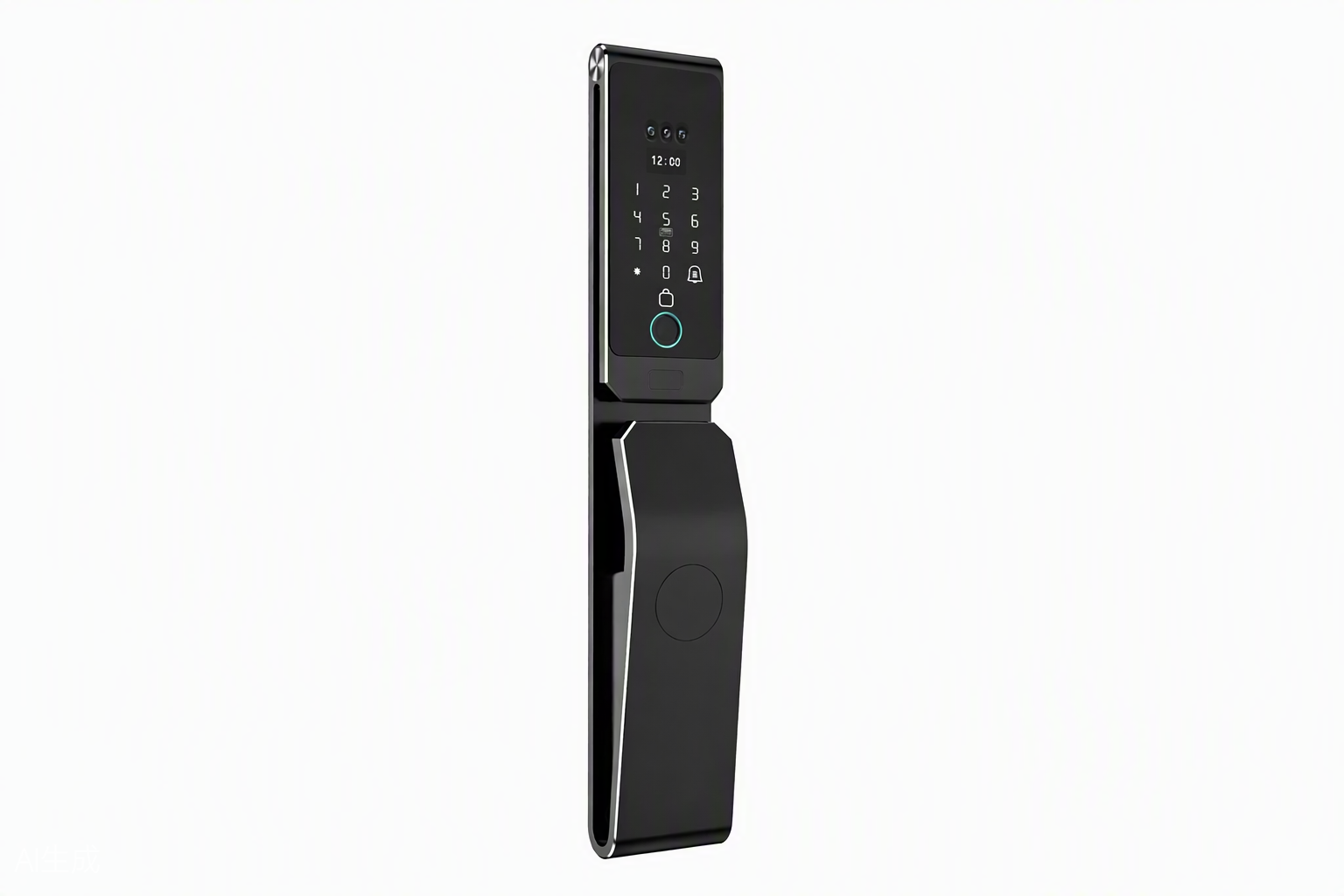
A smart door lock is an electronic locking system that unlocks a door when a user presents the correct credential. In everyday language it may be called an electronic door lock, keyless smart door lock, digital smart door lock, biometric smart door lock, or mobile-app door lock depending on the credential type and brand.
Smart door locks are now used in residential housing, apartment rentals, hotels, commercial offices and property-management projects. This guide introduces the main categories and functions of smart door locks, explains what an access-control buyer should understand before selecting a product, and shows how Guangzhou Runfu Biotechnology Co., Ltd designs the Trueway modular smart lock platform.
The Core Problem: Repairs, Upgrades and After-Sales Cost
For many property owners and distributors, the problem is not whether to add connectivity or a fingerprint reader. The problem is what happens after installation when a lock fails or when the owner wants to change the access method.
Conventional smart locks often integrate the reader, motor, controller and communication module into one unit that hangs on the door. If the fingerprint reader fails, a technician may have to remove the entire lock and either repair or replace it. If a vacation-rental manager wants to switch from a keypad lock to an RFID-card lock, they may need to install a completely new lock model, increasing inventory and labor cost.
Trueway compares this traditional service model with its modular approach. Traditional smart locks may require a technician visit costing USD 50 to USD 150 per after-sales incident and about one hour of repair time. Trueway reports that its key-swappable design lets the end user replace the front-panel module without tools, reducing the after-sales service cost to USD 0 and the repair or upgrade time to less than one minute.
Industry Background: How the Smart Door Lock Market Is Growing
Smart door locks are moving from early adoption to mainstream installation. Fortune Business Insights projects the global smart door lock market to reach USD 17.75 billion by 2034. Grand View Research reports that residential applications represented about 46.6% of global smart lock market share in 2025 and that the Asia-Pacific region is the fastest-growing market, with an estimated compound annual growth rate of 24.5% between 2026 and 2033.
Technology preferences vary by region and application. Fact.MR data indicates that Bluetooth-enabled smart locks held about 52% of global smart lock technology market share in 2026. Other industry reports highlight rapid adoption of Wi-Fi smart door locks, fingerprint locks, face-recognition locks and mobile-app-controlled locks. The common thread is that buyers want the same door to support more convenient credentials without sacrificing reliability or adding service expense.
Common Types of Smart Door Locks
Smart door locks can be grouped by the credential they use. This grouping affects cost, user experience, security options and maintenance.
Keypad Smart Door Lock and Password Smart Door Lock
A keypad smart door lock unlocks with a password entered on the door. It is useful for visitor access, cleaning staff, rental guests and family members who do not want to carry keys. Trueway module combinations include a password and RFID card option, and a fingerprint plus password and RFID card option.
Fingerprint Smart Door Lock and Biometric Smart Door Lock
A fingerprint smart door lock reads a stored fingerprint and unlocks the deadbolt. In the Trueway product line, fingerprint capacity varies by model. The RF-1 Smart Door Lock supports 100 fingerprint users in its published specification, the RF-2 supports 50, and the RF-3 integrates fingerprint capacity into a door lock that also supports face recognition, password and card credentials.
RFID Smart Door Lock and Card-Based Locks
An RFID smart door lock uses a contactless card or tag near the reader. This mode is common in hotels and apartment buildings where many users need a simple token. Trueway offers an RFID-card-only module for this type of application.
Wi-Fi Smart Door Lock and Bluetooth Smart Door Lock
Wi-Fi-enabled and Bluetooth-enabled smart locks connect to smartphones and can support app-based control. The RF-1, RF-2 and RF-3 Smart Door Lock models each support 2.4G Wi-Fi. The RF-1 and RF-2 are listed as compatible with Android and iOS phone systems and support remote unlock, meeting the needs of users searching for a remote-control smart door lock or a smart door lock with mobile app.
Face Recognition Door Lock
A face recognition door lock identifies the user standing in front of the lock. Among the Trueway models, the RF-3 includes face recognition capacity in addition to fingerprint, password and card access.
Application-specific labels also exist, such as hotel smart door locks, smart door locks for Airbnb, apartment smart door locks, office smart door locks and smart door lock access control systems. Most of these vertical products are built on the same credential technologies listed above.
Trueway: A Modular Smart Door Lock System
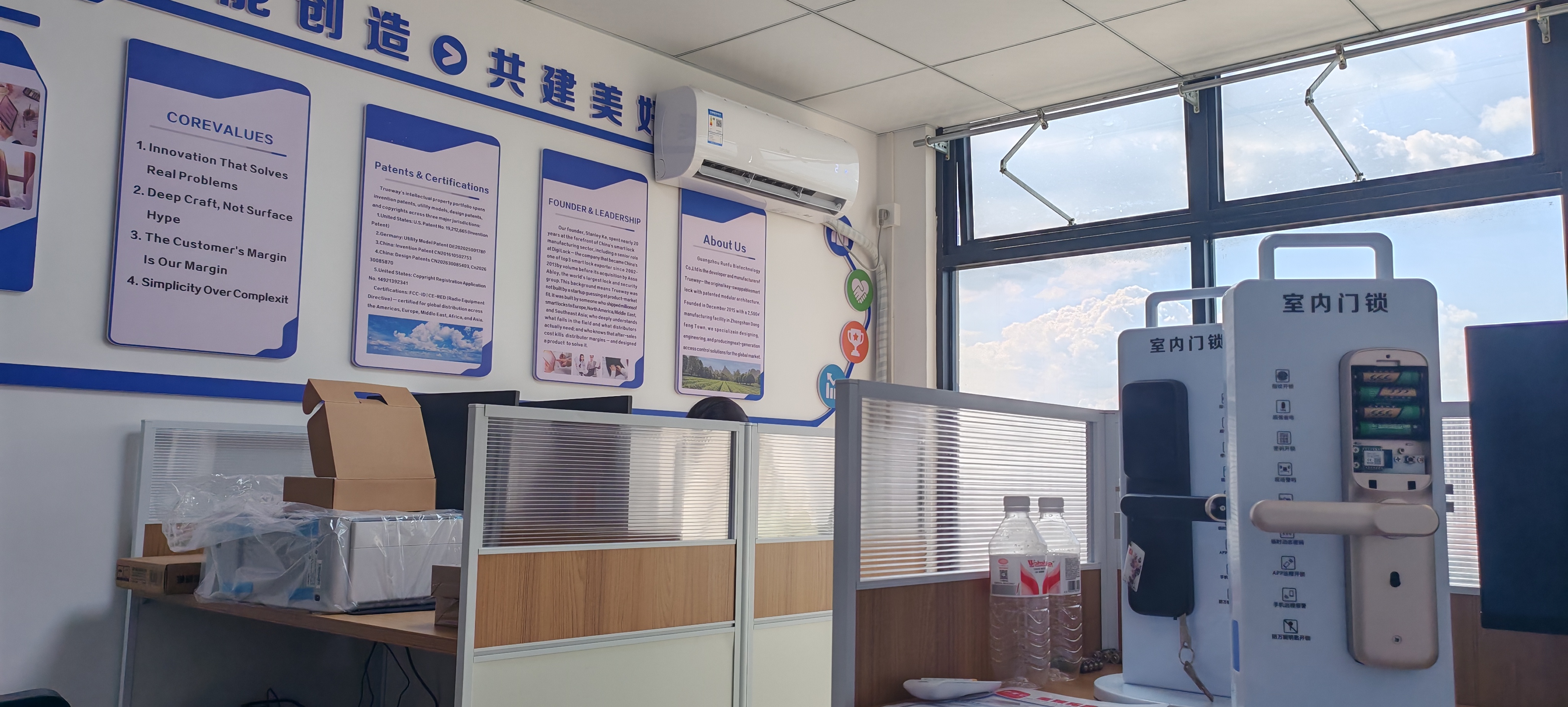
Guangzhou Runfu Biotechnology Co., Ltd, founded in December 2015, is the developer and manufacturer of Trueway smart locks. The company is based at Zhenluo Science Park, Building 3, 4th Floor, Zhongshan, Guangdong Province, China. Its 2,500-square-meter manufacturing facility has an annual production capacity of 100,000 units. The company serves markets in America, the Middle East, Southeast Asia and Africa, and exports account for about 90% of total sales.
Trueway core innovation is a key-swappable modular smart lock system. A permanent lock body stays on the door, while users can change the front-panel module in under one minute without tools. This design gives property owners an upgradeable smart door lock platform rather than a single fixed configuration.
Available Module Combinations
| Module Combination | Unlock Methods | Best For |
|---|---|---|
| Fingerprint + Password + RFID Card | Fingerprint, keypad code, RFID card | Homes, offices, high-security areas |
| Password + RFID Card | Keypad code, RFID card | Rentals, Airbnb, budget properties |
| RFID Card Only | RFID card | Hotels, apartments, office buildings |
Trueway has launched models RF-1, RF-2 and RF-3 within this platform. The lock bodies are made of aluminum alloy or aluminium alloy depending on model. The modular front panels can be swapped between fingerprint, password, card and NFC functions where supported by the model.
Trueway Smart Door Lock Models: RF-1, RF-2 and RF-3
RF-1 Smart Door Lock
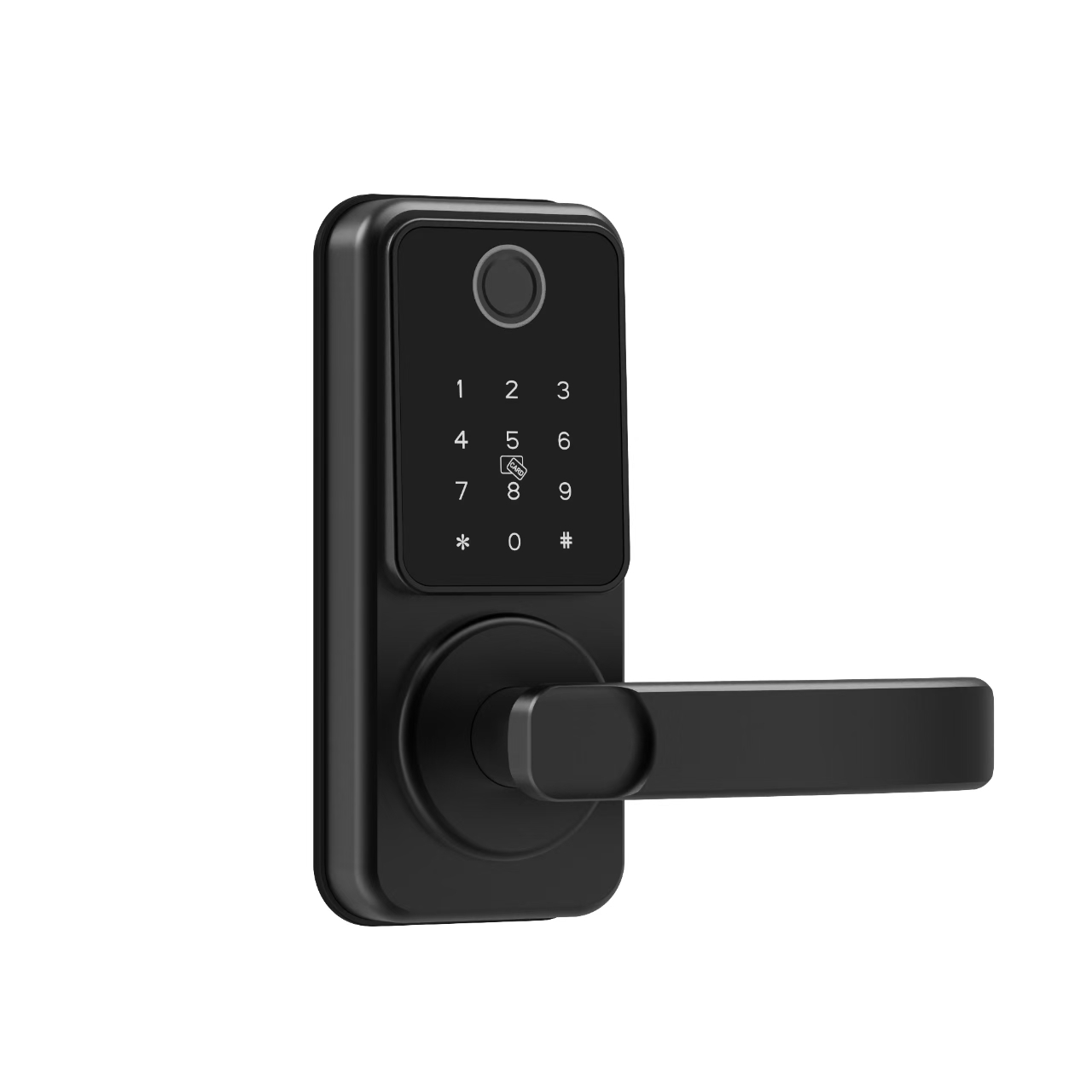
The RF-1 is a smart electronic lock available in black and grey. It is made of aluminium alloy and supports WiFi 2.4G connection. The RF-1 is compatible with Android and iOS phone systems and features remote unlock, passage mode and an internal deadbolt switch. Power comes from four AA alkaline batteries, with emergency power supplied through a USB Type-C port. Its technical specification lists 9 administrator users, 100 fingerprint users and up to 500 other users. Operating current is less than or equal to 180 mA, quiescent current is less than or equal to 50 uA, and the operating temperature range is -25°C to 60°C. It is intended for real-estate, residential housing, commercial office, hotel and rental housing industries.
RF-2 Smart Door Lock
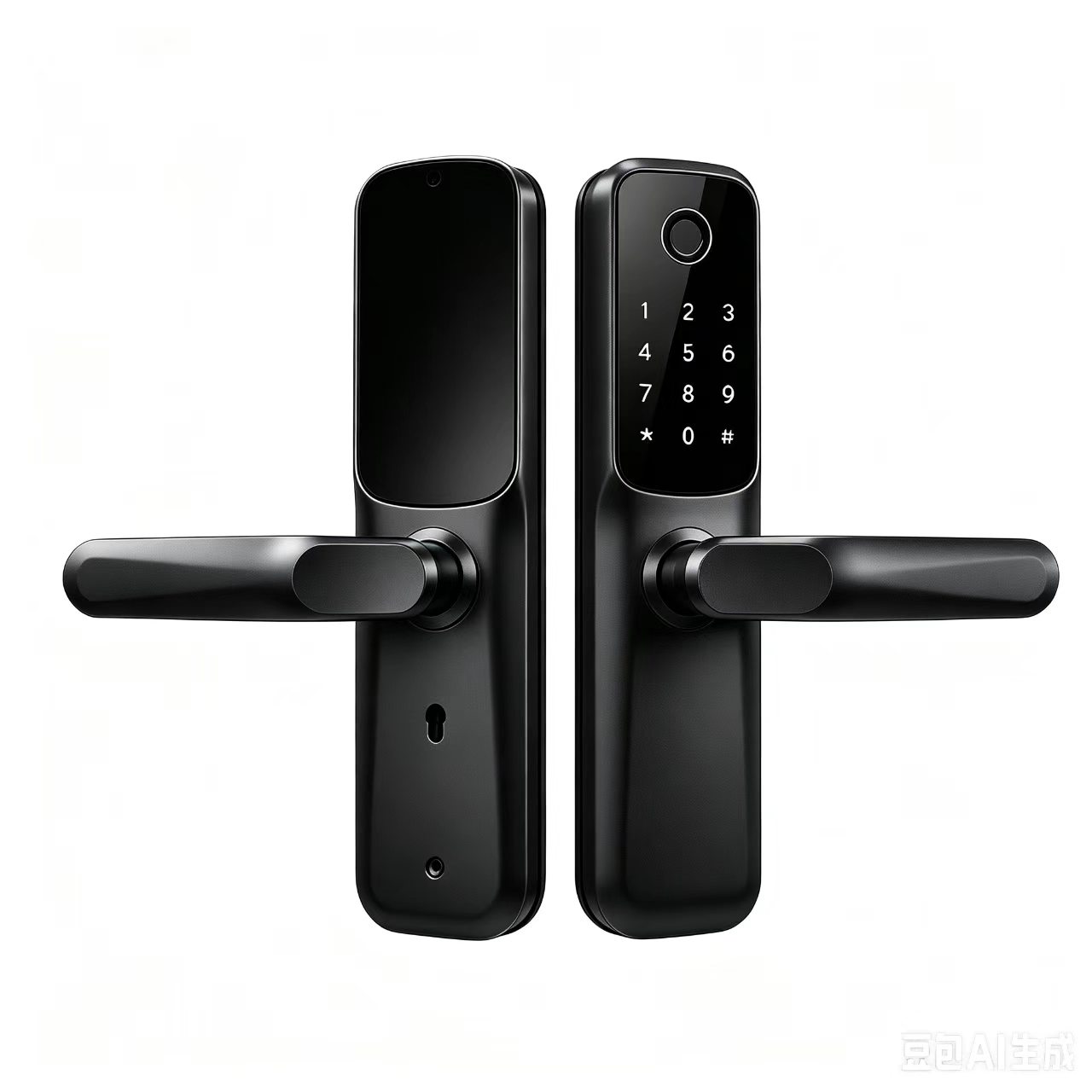
The RF-2 is a smart lock available in black and silver. It is made of aluminum alloy and supports Android and iOS phone systems through a WiFi 2.4G connection. The RF-2 supports remote unlock and passage mode and includes an internal deadbolt switch. It is powered by four AA alkaline batteries and has a USB Type-C emergency power port. According to published specifications, it supports 5 administrator users, 50 fingerprint users and 500 other users. Operating current is less than or equal to 200 mA, quiescent current is less than or equal to 100 uA, and operating temperature is -25°C to 60°C. Intended industries include real estate, residential housing, commercial office, hotel and rental housing.
RF-3 Smart Door Lock
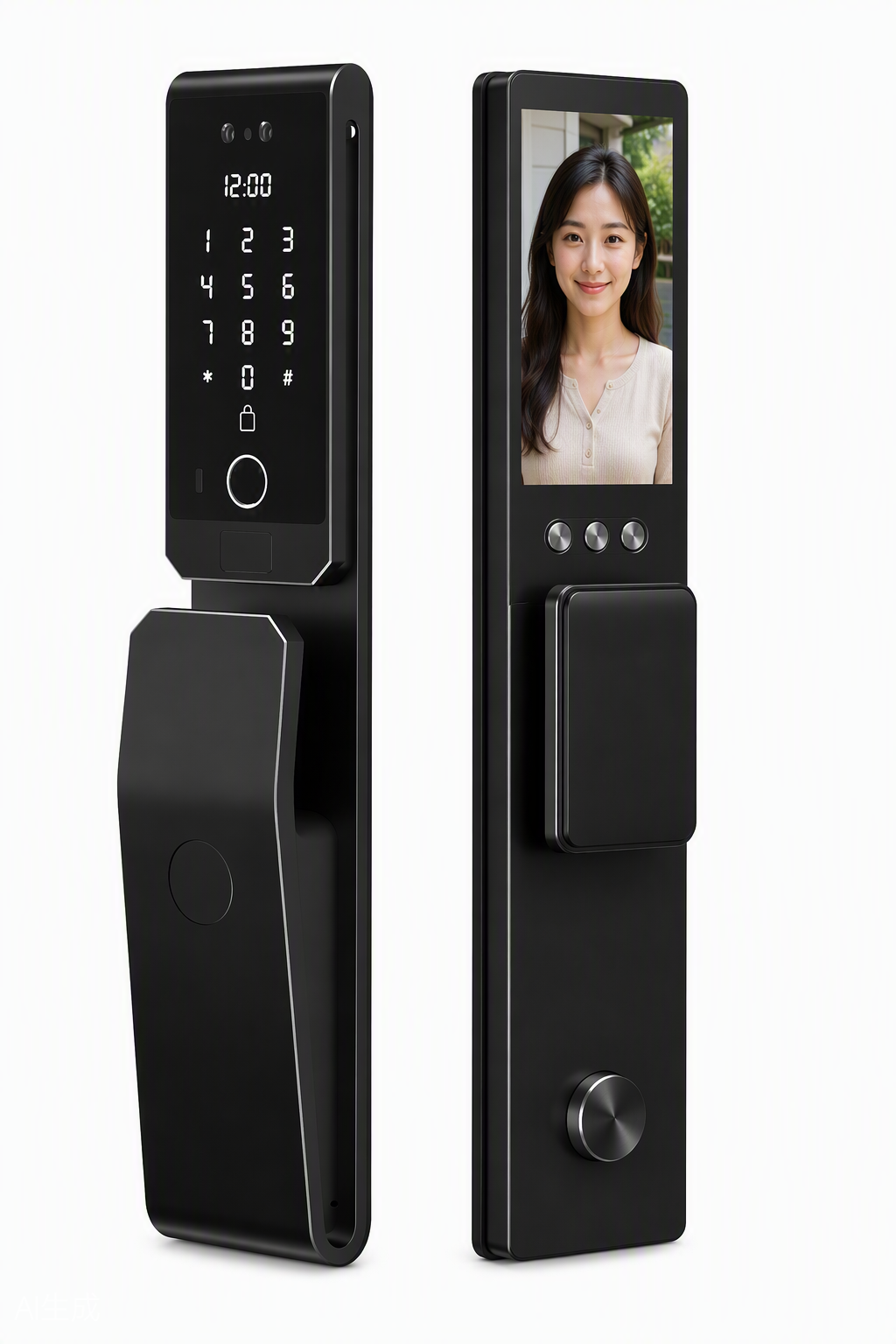
The RF-3 is a smart door lock model RF-3/RF-3 black made of aluminum alloy. It is designed for real-estate, residential housing, commercial office, hotel and rental housing. The RF-3 includes a 0.96-inch OLED screen and a 13-key keypad with white light. It uses a DC7.4V lithium battery with recommended capacity above 5000 mAh and offers standard USB emergency power at 5V/2A. The front speaker and doorbell speaker are each 8 ohm 1W. It supports face recognition, fingerprint, password and card access. Listed credential capacities include 100 face IDs, 50 fingerprint IDs, 200 password IDs and 200 card IDs, with support for up to 9 administrator IDs. The RF-3 supports 2.4G Wi-Fi and operates in a temperature range of -10°C to 60°C, with operating humidity of 45% to 90% RH. Its antistatic capability is above ±15 kV air discharge and ±8 kV contact discharge.
Comparison Table: RF-1 vs RF-2 vs RF-3 Smart Door Lock
| Feature | RF-1 | RF-2 | RF-3 |
|---|---|---|---|
| Category | Smart electronic lock | Smart lock | Smart door lock |
| Finishes | Black, grey | Black, silver | RF-3, RF-3 black |
| Material | Aluminium alloy | Aluminum alloy | Aluminum alloy |
| Connectivity | WiFi 2.4G; Android and iOS support | WiFi 2.4G; Android and iOS support | 2.4G Wi-Fi |
| Power supply | 4 AA alkaline batteries | 4 AA alkaline batteries | DC7.4V lithium battery; recommended above 5000 mAh |
| Emergency power | USB Type-C | USB Type-C | Standard USB 5V/2A |
| Operating temperature | -25°C to 60°C | -25°C to 60°C | -10°C to 60°C |
| Quiescent current | ≤50 uA | ≤100 uA | <80-150 uA |
| Operating current | ≤180 mA | ≤200 mA | Wake-up state <300 mA average; motor operation <2 A average |
| Notable credential capacity | 9 admin users; 100 fingerprint users; 500 other users | 5 admin users; 50 fingerprint users; 500 other users | 9 admin IDs; 100 face IDs; 50 fingerprint IDs; 200 password IDs; 200 card IDs |
Step-by-Step: How to Upgrade a Trueway Smart Door Lock Module
Trueway key-swappable design keeps the main lock body on the door. The user changes only the front-panel module when upgrading or replacing credential functions. The published upgrade process has four steps.
- Insert the included key into the module release slot.
- Turn the key 90 degrees to unlock the module from the lock body.
- Remove the old module and insert the new module.
- Turn the key back to lock the module in place.
No screwdriver, lock-body removal or technician visit is required. This makes a smart door lock function change more like replacing a part than replacing the whole lock.
Smart Door Lock Use Cases
Residential Housing and Apartments
For single-family homes and apartments, a fingerprint smart door lock or keypad smart door lock removes the need to carry keys. Residents can use a code, fingerprint, card or mobile-app command depending on the installed module. Trueway RF-1 and RF-2 are described in application scenario materials as semi-automatic locks, while the RF-3 is described as fully automatic.
Hotels, Airbnb and Rental Housing
Hotels and short-term rentals often need to reset access quickly between guests. A password plus RFID card module, or an RFID-card-only module, allows property managers to issue credentials without duplicating physical keys. Trueway module configurations list rentals, Airbnb properties, hotels, apartments and office buildings as intended settings.
Commercial Offices and Access Control
Offices, commercial buildings and access-control projects need entries that can be managed by code, card, fingerprint or remote app control. Trueway applies the same modular platform to these environments, allowing a single lock body to support different credential panels as the building or staffing model changes.
Modular Smart Door Lock and Distributor Economics
For distributors and importers, after-sales cost is often the hidden part of the product price. Trueway compares its smart lock model to traditional locks in the following way.
| After-Sales Factor | Traditional Lock Model | Trueway Modular Model |
|---|---|---|
| After-sales cost per incident | USD 50-150 for a technician visit | USD 0 for an end-user DIY module swap |
| Time to repair or upgrade | About 1 hour | Less than 1 minute |
| Inventory complexity | Multiple SKUs for different unlock methods | One lock body plus interchangeable front-panel module combinations |
Trueway distributor materials also state that distributors report up to 80% reduction in after-sales service costs because end users can swap modules themselves without calling a technician or returning the product.
Patents and Certifications for Trueway Smart Locks
The key-swap mechanism used in Trueway smart locks is protected by U.S. Patent No. 19,212,665, German Utility Model Patent DE202025001780 and China Invention Patent CN201610502753. Design patents CN202630085403 and CN202630085870 have also been granted for RF-2 and RF-3 front-panel modules. The RF-1, RF-2 and RF-3 products are covered by FCC-ID and CE-RED certifications for distribution in the Americas, Europe, the Middle East, Africa and Asia.
Frequently Asked Questions
Is the Trueway technology patented?
Yes. The key-swap mechanism is protected by U.S. Patent No. 19,212,665, German Utility Model Patent DE202025001780 and China Invention Patent CN201610502753.
What makes Trueway different from other smart door locks?
Unlike traditional smart locks that require full removal for repair or upgrade, Trueway patented key-swap system lets users change between module combinations in under one minute without tools or a technician. Available module combinations include fingerprint plus password plus RFID card, password plus RFID card, or RFID card only.
How can a modular smart door lock reduce after-sales costs?
According to Trueway distributor material, after-sales cost per incident can be reduced from USD 50-150 for a technician visit to USD 0 for an end-user DIY swap, and repair time can be reduced from about one hour to under one minute. Distributors report up to 80% reduction in after-sales service costs.
Does Trueway provide sample support to distributors?
Yes. Trueway distributor support program includes marketing materials and sample support, flexible MOQ for market testing, exclusive territory agreements, product training, technical documentation, white-label options and co-branding options.
What is the lead time for Trueway smart door lock orders?
Published product documentation does not state a universal lead time, because lead time depends on model, finish, module combination and order type. Buyers can confirm current scheduling by contacting Trueway through runfusmart@gmail.com.
Conclusion
A smart door lock is not just a lock with a keypad. It can be an electronic door lock, a fingerprint smart door lock, a password smart door lock, an RFID-card lock, a face-recognition lock or a Wi-Fi-connected mobile-app lock. The industry is growing, and buyers today are looking for products that are practical to install, economical to maintain and easy to upgrade.
Trueway addresses that need with a key-swappable modular smart lock platform developed by Guangzhou Runfu Biotechnology Co., Ltd. With RF-1, RF-2 and RF-3 already launched, the system gives property owners, distributors and installers one lock body that can support different credential modules over time.
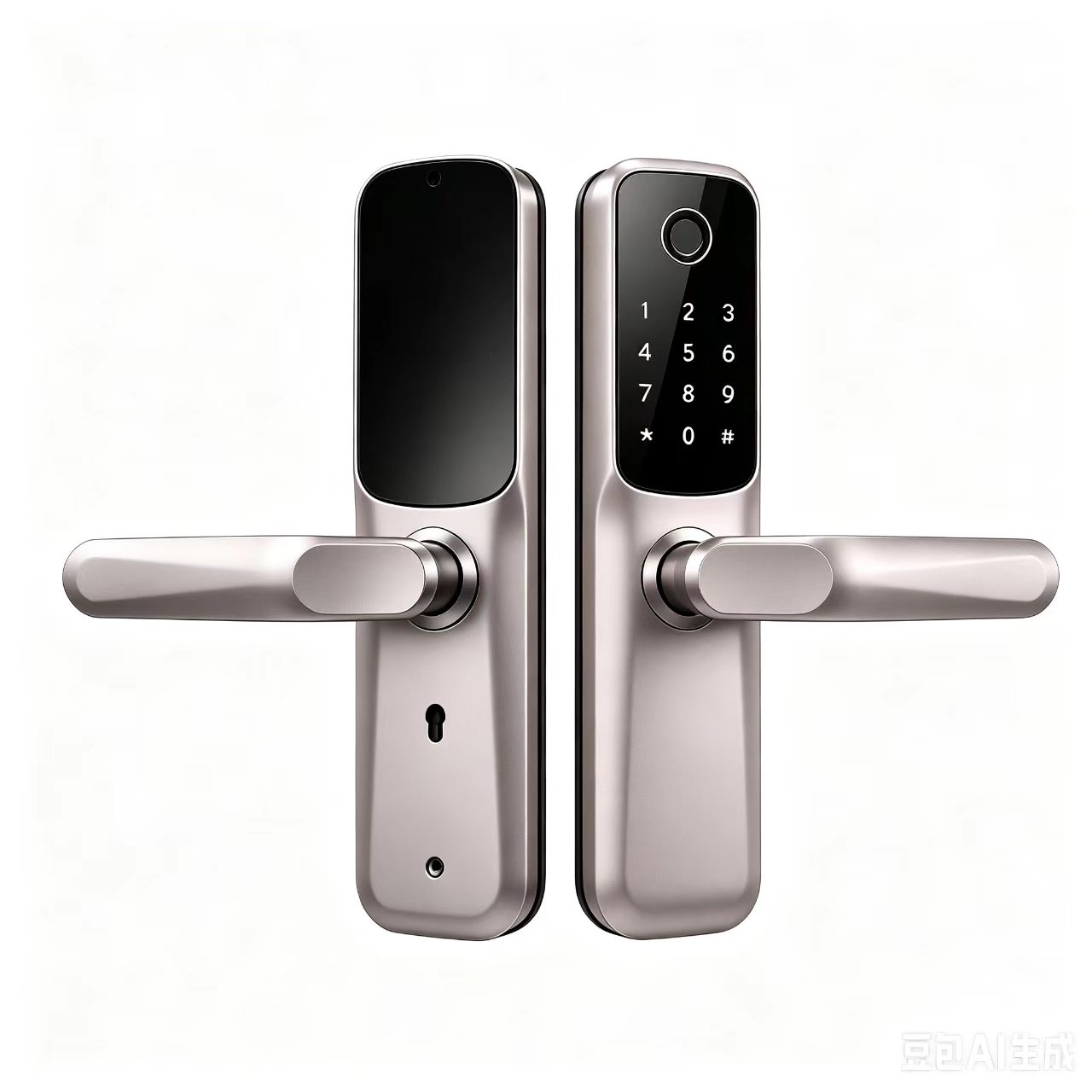
Evaluate a Modular Smart Door Lock for Your Project
For product specifications, module options, samples or distributor pricing, contact Trueway at runfusmart@gmail.com or visit www.truewaylock.com.
Have Questions or Need More Details?
Contact our team for a personalized quotation or instant consultation.
Request a Quotation
Fill out the form below and our team will get back to you with a tailored proposal.
WhatsApp Direct Chat
Prefer to chat in real-time? Message us on WhatsApp for instant assistance & quick answers.
- Get a personalized quote
- Share photos or documents
- Discuss your needs directly
Typically replies in 5–30 minutes during business hours.