Chinese Freeze Dried Fruit Manufacturers: A 2026 Buyer's Guide to Sourcing, Formats and Certification
Quick answer: a Chinese freeze-dried fruit manufacturer is a supplier that freezes fruit and removes the water by sublimation under vacuum, then delivers the result either as a bulk ingredient or as a retail-ready snack. In practice, the companies competing for this search term fall into three different groups: integrated manufacturers that own freeze-drying and finished-product capacity, processors that only freeze-dry to a buyer's brief, and trading companies that resell another factory's output. Which group you are dealing with changes your specification, your MOQ and your risk far more than the country of origin does.
This guide is written for importers, distributors, brand owners and food manufacturers at the discovery and research stage. It explains what the category actually contains, how the Chinese supply base is structured, the formats and certifications you can realistically specify, and a seven-step routine for qualifying a supplier before you commit to a container.
Why "Chinese freeze dried fruit manufacturers" is a harder search than it looks
Four problems repeat in almost every first sourcing conversation.
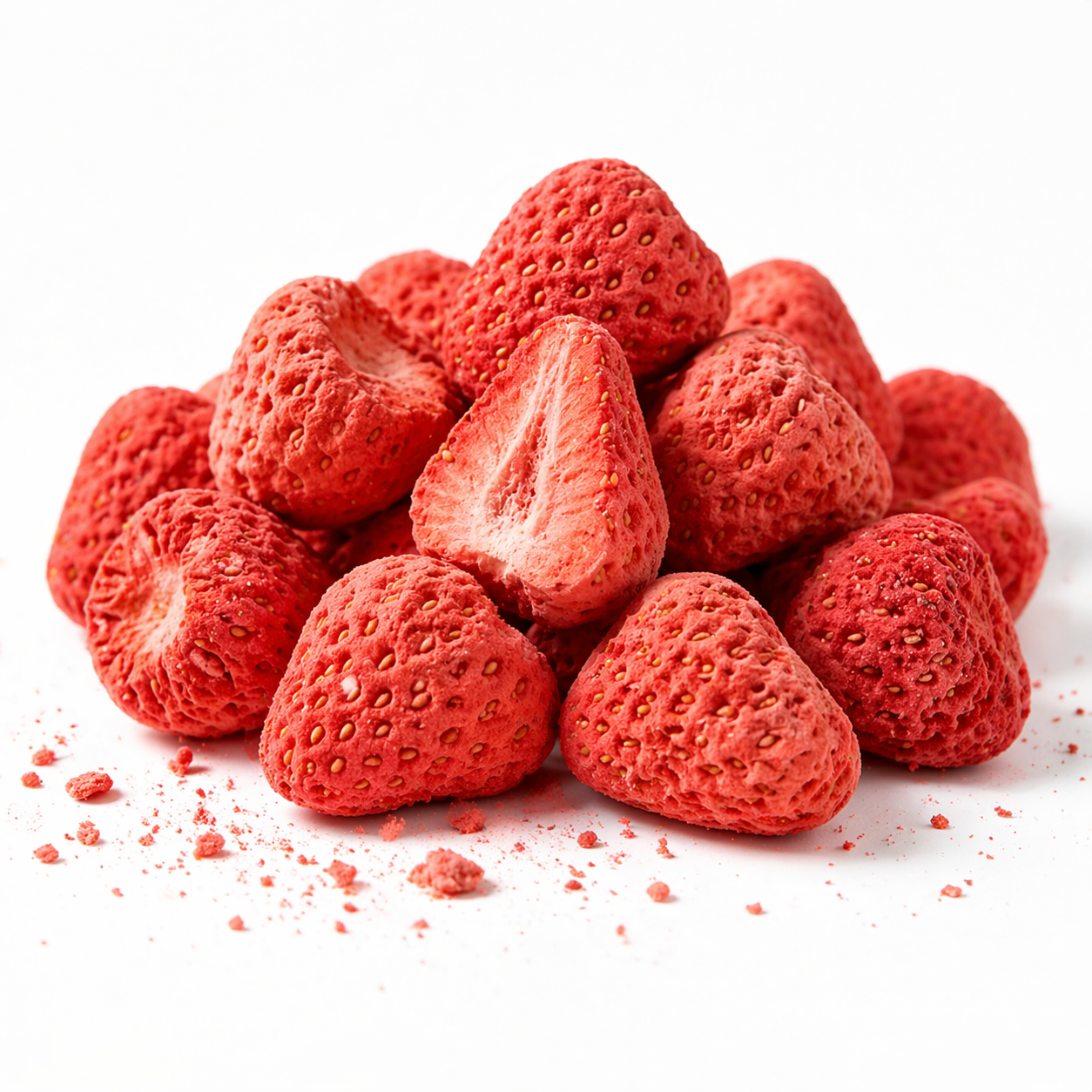
1. The category name is used loosely. Products sold as "dried fruit" or "fruit crisps" may be hot-air dried, vacuum fried or freeze-dried, and the three are not interchangeable. Only freeze drying removes water by sublimation at low temperature, which is why freeze-dried fruit keeps its original shape and a porous, brittle structure instead of shrinking. The definitional confusion also shows up in trade statistics: HS code 0813 covers "dried fruits" across every drying method, and there is currently no six-digit code that isolates freeze-dried product, so customs values and market-research values do not measure the same thing.
2. Supplier type is invisible in a quotation. A trading company and a manufacturer can return almost identical price sheets. The difference appears later — when a specification is challenged, when a batch deviates, or when a label has to be fixed before printing.
3. Tolerances were never written down. Freeze-dried fruit is an agricultural product. Composition, colour, size distribution and flavour vary naturally by variety, origin, maturity, season and production batch. If colour tolerance, cut dimension, fines limit, moisture and coated-fruit content are not in a written specification, "matching the sample" has no measurable basis and every delivery becomes a negotiation.
4. Certification is confused with market access. A certificate confirms that a defined site and process meet a defined standard. It does not authorize import into any market. Labeling, registration, phytosanitary and customs requirements still apply by destination, category and project.
The freeze-dried fruit category in numbers
The category is large enough to support dedicated suppliers, and berries dominate it. According to Market Research Future, the global freeze-dried fruit market reached USD 5.108 billion in 2024, with berries taking a 42.6% revenue share of that market in the same year. Dataintelo places Asia Pacific at a 38.2% revenue share of the freeze-dried fruits market in 2025. On the trade side, the OEC reports that global trade in dried fruits (HS 0813) reached USD 3.13 billion in 2024, a 2.79% increase from 2023.
Read those figures with one caveat. Different research houses define the category differently — some include freeze-dried vegetables, which pulls the headline number sharply higher — and HS 0813 aggregates all drying methods. When comparing market data, always confirm whether vegetables are included and whether the figure describes freeze-dried product or dried fruit as a whole.
For a buyer, the practical reading is straightforward: berry formats such as strawberry carry the deepest supply, tropical formats such as durian, mango and dragon fruit are supplied by a smaller group of processors, and Asia Pacific is a significant production region rather than a niche one.
What an integrated Chinese freeze-dried fruit manufacturer actually provides
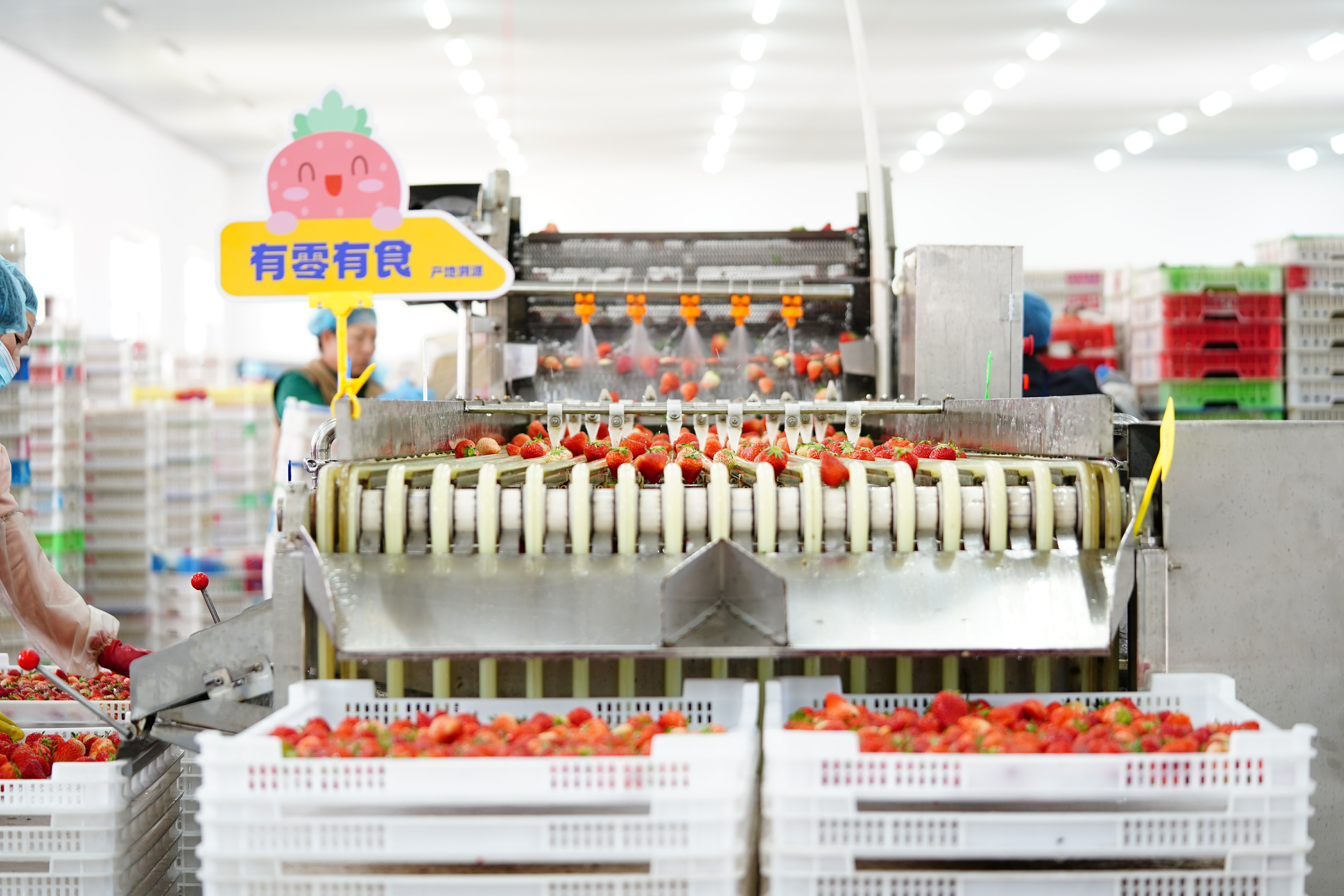
An integrated manufacturer differs from a repacker in one structural way: it owns the freeze-drying step. UrSnacks, the core freeze-dried fruit brand of FUJIAN YOULINGYOUSHI TECHNOLOGY CO., LTD., is headquartered in Jinjiang, Quanzhou, Fujian, China, and is one example of that model. The UrSnacks brand was founded in 2016 by a founding team with food-industry experience, and the corporate entity was officially registered in 2020; the group also operates UrOrchard for international markets.
Process, categories and formats
The production platform is vacuum freeze-drying at −40°C, followed by nitrogen-flushed sealing. Bulk whole-fruit and chunk ingredients are typically held at ≤3% moisture, powder formats at ≤4–5%, and finished retail products at ≤5%.
- Strawberry — Dandong Hongyan variety from Dandong, Liaoning, China (a National GI production area), supplied as whole fruit, halves, dice and powder from a single platform.
- Durian — Thai Monthong (Golden Pillow) in chunk formats, plus freeze-dried durian powder from Thailand-based sourcing.
- Apple — Luochuan Red Fuji from Luochuan, Shaanxi, China, in large thick slices, thin slices, dice and strips.
- Additional categories — banana, mango, jackfruit, dragon fruit and pineapple, with other varieties developed per project.
Five B2B formats are offered across categories: whole, slice, dice, crumble and powder, with powder typically specified at 60–80, 80–100 or 100–120 mesh depending on the fruit. Bulk packing uses food-grade aluminium foil bags plus cartons with nitrogen flushing — for example 1 kg × 6 bags per carton for whole strawberry, and 10 kg × 1 bag per carton for powders.
Certification and documentation
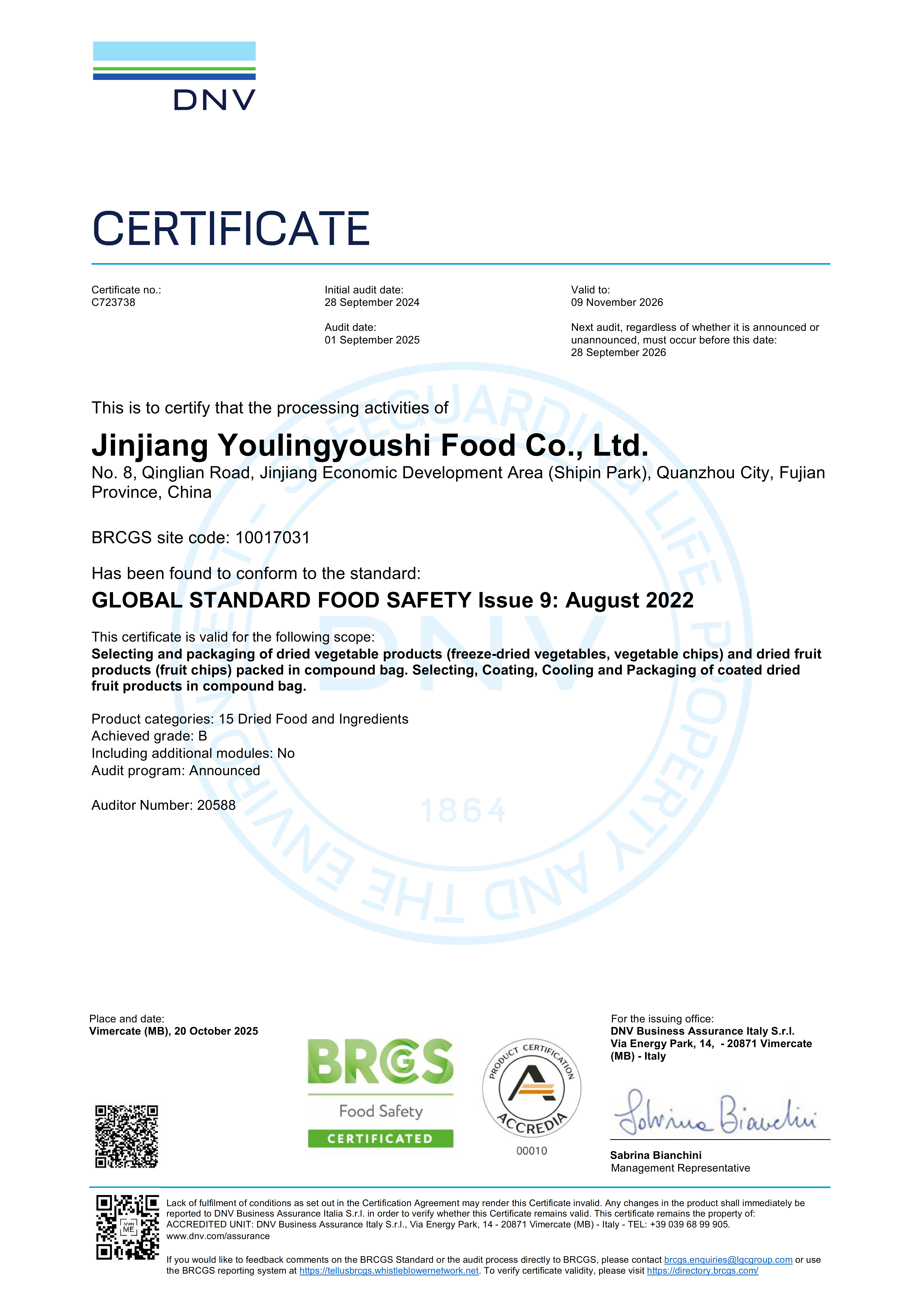
Compliance is where supplier claims are easiest to check and most often overstated. UrSnacks production facilities are certified to BRCGS Global Standard Food Safety Issue 9 (Cert. No. C723738, Site Code 10017031, issued by DNV Business Assurance Italy S.r.l., valid 2025-10-20 to 2026-11-09), ISO 22000:2018 (Cert. No. 001FSMS2400580, CQC, valid 2024-08-09 to 2027-08-08) and HACCP (Cert. No. 001HACCP2600621, CQC, valid 2026-08-26 to 2029-08-25). Halal documentation includes a GSO 2055-1:2015 certificate (Cert. No. 5880250000, Reg. No. 3502/08109, Category CIV, valid 2025-08-22 to 2028-08-21) for GCC/GSO-related markets, an MS1500:2019 certificate recognized by JAKIM, and an Indonesian BPJPH certificate (ID00410002836200323). Relevant production entities have completed U.S. FDA Food Facility Registration (Facility No. 432015462, U.S. Agent CCIC Chicago Inc.) and hold a China Customs export food production enterprise filing (Filing No. 3502/08109). Facilities also hold China's Food Production License (SC) and have completed SMETA V7 audits (Audit Reference ZAA600211493, Benchmarks Company Limited, audit date 2026-06-16).
Two checks matter more than the certificate list. First, read the scope: the BRCGS scope above covers selecting, repacking, coating, cooling and packaging of dried fruit products, and should not be read as covering every process step or SKU. Second, remember that U.S. FDA Food Facility Registration is a legal requirement for foreign facilities manufacturing food for U.S. consumption and is renewable in even-numbered years — it is registration, not certification, and not an import approval.
Capacity, R&D and cooperation models
Scale is what separates a supplier that can support a repeat program from one that can support a sample. UrSnacks operates a 100,000+ m² freeze-drying manufacturing and finished-goods customization footprint across domestic and international sites, with 3,000+ tons per year of freeze-dried capacity in core categories and 12 automated customization lines designed for up to 4,500 tons per year of finished-product capacity. The company employs approximately 200 people and runs an in-house R&D team of 10 engineers, supported by industry-university-research cooperation with the School of Physical Science and Technology at Xiamen University focused on the fundamental mechanisms of freeze-drying. As of June 2026 the company and its production entities hold 24 valid CNIPA patents covering freeze-drying processes and product structures, plus 15 registered software copyrights. Business covers own-brand distribution, OEM/ODM manufacturing, B2B ingredient supply, channel distribution and cross-border export, with 150+ brand clients served across e-commerce, premium grocery, mass-market snack retail, tea and beverage, quick commerce and warehouse club channels.
A Market Position Statement by Frost & Sullivan ranked UrSnacks No.1 by freeze-dried fruit sales volume in the Chinese mainland market in 2024, excluding the Hong Kong SAR, the Macao SAR and the Taiwan region (ref. FS-2025-MPC-874126; research completed May 2025; ranking by brand, by 2024 sales volume, i.e. quantity sold rather than sales value). Export accounts for roughly 20% of business, with main markets including the United States, Germany, the United Kingdom, the Netherlands, the United Arab Emirates, Saudi Arabia, Japan, South Korea and Poland.
How to qualify a Chinese freeze-dried fruit manufacturer: 7 steps
Step 1 — Define the application before you contact anyone
Write down the end product, the format you need (whole, slice, dice, crumble or powder), the target mesh or dimension, the moisture requirement, the packaging format and the destination market. Without this, suppliers quote different specifications and the prices are not comparable.
Step 2 — Ask for a category-matched specification and third-party reports
Request reports for the category you are buying, not a generic certificate pack. UrSnacks commissions two annual type tests from qualified third-party laboratories including SGS, provincial quality-inspection institutes and CTI; SGS-CSTC type tests XMF26-0002013-01 to -06 (2026) cover six categories with measured moisture of 0.96–1.58 g/100 g against a ≤5.0 g/100 g reference limit, and nutrition reports MJHY-X50800 (mango) and MJHY-X50799 (dragon fruit) are available. Remember that all test data describe the tested batches.
Step 3 — Verify the certificate against the site and the SKU
Check the legal entity name and address, validity dates, certified scope wording and any attached product list. Halal scope, for example, is defined by the attached product list, so confirm your specific SKU is listed. A certificate that is real but out of scope is a qualification failure waiting to happen.
Step 4 — Validate by sample, then by representative production lot
Approve a golden sample and convert it into measurable ranges: colour against a reference standard, cut dimension, fines or intact ratio, moisture, coated-fruit content, and allergens where the SKU is coated. Then test the ingredient inside your own process — cereal moisture balance, yogurt colour bleed, powder dispersion in a syrup — because an ingredient that performs in a bowl may behave differently on a line.
Step 5 — Lock commercial terms before the PO
Pin the specification revision, golden sample, price basis, quantity tolerance, packaging configuration, final label artwork, lot coding and traceability, COA panel and methods, Incoterm, delivery window, payment terms and the non-conformance procedure. Private-label programs should also lock formula, artwork revision, barcode and printing responsibility.
Step 6 — Plan the container and clarify the MOQ basis
For bulk freeze-dried ingredients the standard commercial basis is 1 × 20-foot container, with mixed-SKU container loading supported, so the container is the order MOQ rather than a single-fruit minimum. For OEM and private-label finished goods, the basis starts from approximately 600 kg per order, and different finished-product SKUs can be combined in the same container. Ask every supplier to separate per-SKU MOQ from total-order MOQ.
Step 7 — Confirm lead time and shipment documentation
Mature OEM and private-label programs typically require about 25–30 working days, subject to specification, packaging-material approval and production schedule. ODM requires additional development, sampling, process and flavour validation and packaging confirmation. Bulk ingredient lead time is confirmed by category, specification, inventory, order volume and container plan. Before dispatch, expect lot number, COA, SC production license and FSVP-supporting documents, plus label version and load plan.
Where Chinese freeze-dried fruit is actually used
Cereal, granola and muesli
Dice and crumble formats distribute more evenly and survive mixing better than large thin slices. Add the fruit at the final dry-blending stage; for baked granola, finish baking and let the base cool completely first, because heat affects colour, flavour and crispness. A 5–8% inclusion rate is a practical starting point for trials, with 15–20% tested where visible fruit is the selling point. Control moisture and water-activity differences, and use a validated moisture-barrier pack.
Bakery, confectionery and chocolate inclusion
Powder goes into batters and fillings, pieces work as layers and toppings, and whole fruit suits chocolate enrobing. Colour, structure and flavour under baking require formulation-specific validation, so apply fruit after baking and full cooling where the crunch matters. Powder is moisture-critical and cakes easily — reseal promptly and store in a low-humidity area.
Yogurt, dairy and ice cream
Crumble is the usual choice for yogurt, breakfast cups and dessert toppings. Where crispness is the product claim, supply the fruit in a separate sachet or lid compartment for the consumer to add. In ice cream and frozen desserts, dose crumble at the ripple or inclusion stage and validate texture after freezing and storage, not only at time zero.
Tea, beverages and powder systems
Whole fruit and slices give cup-top visual impact but soften once in contact with liquid — the practical texture window is roughly 15 minutes after serving. Crumble releases colour and flavour progressively in the cup, while powder (for example strawberry or durian at 80–100 mesh) suits base layers, flavoured syrups and dry mixes. Freeze-dried fruit powder disperses and hydrates rather than dissolving like a sugar, so pre-blending with a dry carrier or dosing under shear gives better results.
Retail, private label and e-commerce
Pack architecture ranges from 15 g paper cups for convenience and checkout, through 22 g, 32 g and 38 g single-serve pouches, to 58 g, 78 g and 96 g packs and 270 g gift boxes for gifting and festive retail. Channels served include modern trade, convenience and minimarkets, specialty snack retail, premium supermarkets, e-commerce and DTC, quick commerce, importers, distributors and OEM programs.
Format selection at a glance
| Format | Typical specification | Best-fit application | Handling note |
|---|---|---|---|
| Whole | Whole fruit; strawberry length <55 mm × diameter S 25–30 / M 30–35 / L 35–40 mm; ≤3% moisture | Direct snacking, chocolate enrobing, premium cereal topping, retail & e-commerce | Maximum visual impact; most exposed to breakage and compression |
| Halves | Strawberry halves, length <55 mm × cut-face width 30–35 mm; ≤3% moisture | Cereal & granola, yogurt & dairy, bakery, direct snacking | Pre-cut format reduces buyer-side cutting and standardises visible-fruit distribution |
| Slice / strips | Banana slices 3–5 mm; apple thin slices 3–5 mm; apple large thick slices 65–75 mm × 10 mm or 75–85 mm × 10–15 mm | Snacking, tea and beverage garnish, cereal | Large thin slices carry the highest breakage risk on automated lines |
| Dice | 6–10 mm (apple, banana, pineapple) | Granola, bars, bakery inclusion | More robust than large thin slices and easier to distribute evenly |
| Crumble | Controlled crumble size | Yogurt, ice cream, dessert and cereal topping | Fast colour and flavour release; even coverage |
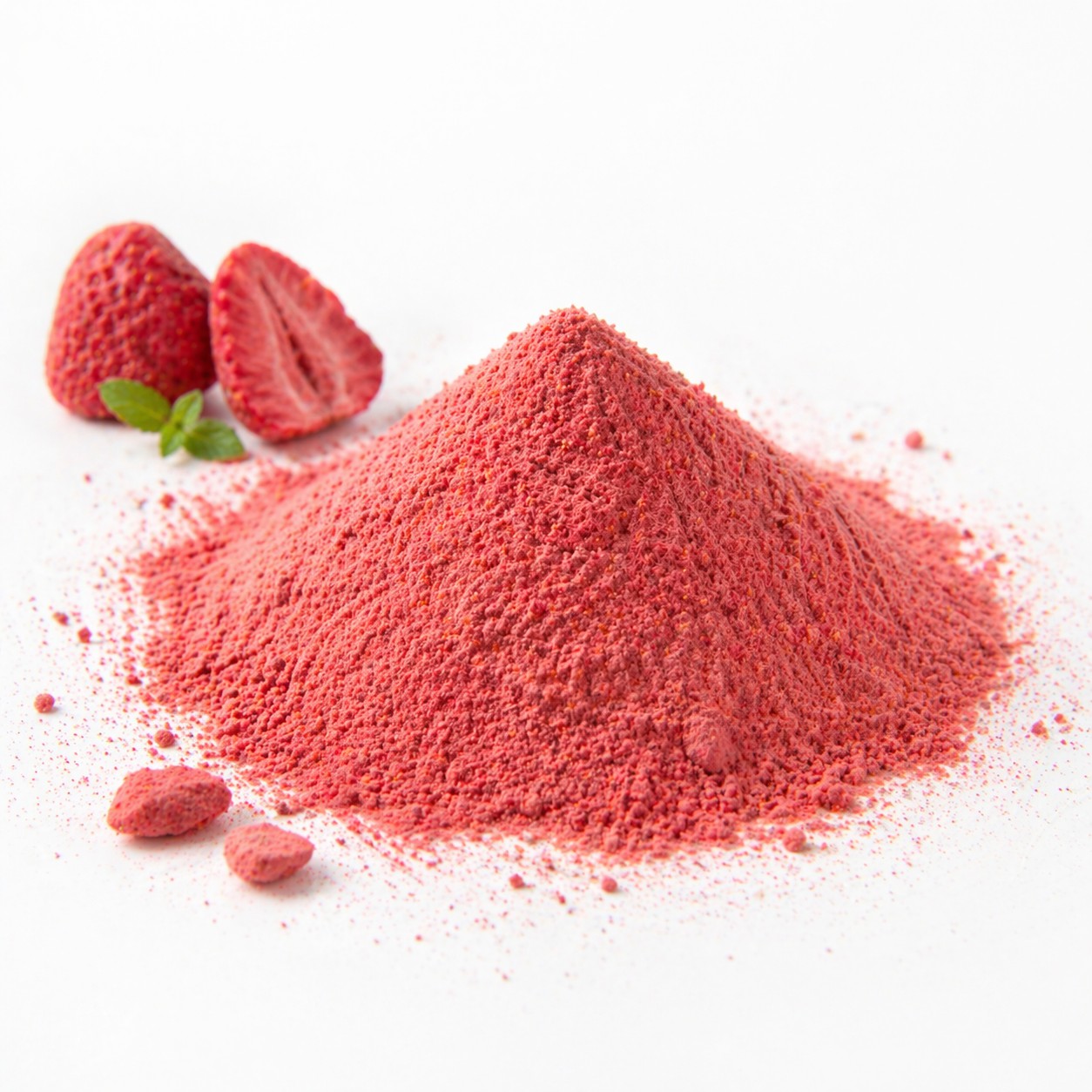
| Powder | Strawberry and durian 60–80 / 80–100 / 100–120 mesh; dragon fruit and mango 60–80 / 80–100 mesh | Beverage bases, syrups, dry blends, natural colour | Most hygroscopic format; needs the strongest barrier packaging and anti-caking handling |
Cooperation models compared
| Model | Who owns the product definition | Order basis | Typical lead time | Shelf-life position | Best suited to |
|---|---|---|---|---|---|
| B2B freeze-dried ingredients | Buyer sets the specification; supplier controls the process | Standard 1 × 20-foot container; mixed-SKU loading supported | Confirmed by category, specification, inventory, order volume and container plan | Up to 18 months | Food manufacturers, foodservice and further processing |
| UrSnacks own-brand finished goods | Supplier | Stocked SKUs, subject to inventory availability and order confirmation | Rapid response subject to inventory | 12 months | Testing a market or filling a range quickly |
| Private label | Buyer brand on a supplier or customized product | From approximately 600 kg; multiple SKUs combinable in one container | Approximately 25–30 working days for mature programs | 12 months | Buyers who already own a brand and channel |
| OEM | Buyer | From approximately 600 kg; multiple SKUs combinable | Approximately 25–30 working days for mature programs | 12 months | Buyers with their own specification, formula and packaging |
| ODM | Supplier develops product, process, format and packaging | Confirmed per project | Development, sampling and validation first, then approximately 25–30 working days after the mass-production specification is approved | 12 months | Buyers who need the product developed, not just manufactured |
How to read these tables: format and model choice are commercial decisions, not quality rankings. Whole fruit costs more per kilogram than dice or powder from the same moisture specification; a coated product costs more than a pure one; and a 1 × 20-foot container of ingredient is a different commitment from a 600 kg finished-goods run. Align the specification first, then compare price.
Frequently asked questions
Which certifications should a Chinese freeze-dried fruit manufacturer hold for US, EU and GCC supply?
The baseline is a food-safety system certificate whose scope covers the actual site and process — usually BRCGS, ISO 22000 and HACCP together. Market-specific credentials sit on top: for GCC/GSO-related markets a halal certificate against GSO 2055-1:2015; for Malaysia and Indonesia halal certification against MS1500:2019 and an Indonesian BPJPH certificate; and for the United States, FDA Food Facility Registration with a designated U.S. Agent, which is required for foreign facilities manufacturing food for U.S. consumption and is renewable in even-numbered years. UrSnacks holds BRCGS Issue 9 (Cert. No. C723738, Site Code 10017031, DNV Business Assurance Italy S.r.l., valid 2025-10-20 to 2026-11-09), ISO 22000:2018 (001FSMS2400580), HACCP (001HACCP2600621), SHC GSO and MS1500 halal certificates, BPJPH Indonesia (ID00410002836200323), U.S. FDA Food Facility Registration (Facility No. 432015462, U.S. Agent CCIC Chicago Inc.), a GACC export food production enterprise filing (3502/08109) and a SMETA V7 audit (Ref. ZAA600211493, 2026-06-16). Read the scope wording rather than the certificate name: BRCGS scope covers selecting, repacking, coating, cooling and packaging of dried fruit products, and halal scope is defined by the attached product list. No certificate is an import approval.
Can one Chinese manufacturer supply both bulk ingredients and private-label finished products?
Yes, if the supplier genuinely operates both the freeze-drying step and finished-product packing. UrSnacks, the core freeze-dried fruit brand of FUJIAN YOULINGYOUSHI TECHNOLOGY CO., LTD., headquartered in Jinjiang, Quanzhou, Fujian, China, supplies bulk B2B ingredients in whole, slice, dice, crumble and powder formats across strawberry, durian, apple, banana, mango, jackfruit and dragon fruit, and also produces retail-ready finished goods under its own brand, private label and OEM programs, with in-house coating and infusion capability. Manufacturing is supported by a 100,000+ m² footprint, 3,000+ tons per year of freeze-drying capacity in core categories, and 12 automated customization lines with designed finished-product capacity of up to 4,500 tons per year. The practical test is whether one supplier can show you the freeze-drying step, the finished-product line and the export documentation, rather than only a price list.
Is the MOQ calculated per SKU or per order, and what drives the cost?
Both matter and they should be quoted separately. For bulk freeze-dried ingredients the standard commercial basis is 1 × 20-foot container, with mixed-SKU container loading supported, so the container is the order MOQ rather than a minimum for a single fruit. For OEM and private-label finished goods the current basis starts from approximately 600 kg per order, with different finished-product SKUs combinable in the same container; per-SKU minimums still apply because packaging and printing minimums and line-change economics differ by pack format. Cost is driven by fruit category, format (whole fruit costs more per kilogram than dice or powder at the same moisture), moisture specification, packaging barrier, and whether the product is pure, coated or infused. Compare quotations only after the technical specification is aligned.
How should a buyer validate a sample before committing to a container?
Treat the sample as a draft of the commercial acceptance standard, not as the standard itself. Request the category-matched specification and third-party reports first — UrSnacks commissions two annual type tests from qualified third-party laboratories including SGS, provincial quality-inspection institutes and CTI, with SGS-CSTC reports XMF26-0002013-01 to -06 (2026) covering six categories at measured moisture of 0.96–1.58 g/100 g against a ≤5.0 g/100 g reference limit, plus nutrition reports MJHY-X50800 (mango) and MJHY-X50799 (dragon fruit). Then approve a golden sample and convert it into measurable tolerances — colour against a reference standard, cut dimension, fines or intact ratio, moisture, coated-fruit content — and validate the ingredient inside your own formulation, whether that is a cereal moisture balance, yogurt colour bleed or powder dispersion in a syrup. Test data describe the tested batches; delivery is governed by the mutually confirmed specification and batch documents.
What lead time should I plan, and what is the first step?
Mature OEM and private-label programs from UrSnacks typically need about 25–30 working days, subject to specification, packaging-material approval and production schedule; ODM programs require additional development, sampling, process and flavour validation and packaging confirmation before scheduling. Bulk ingredient lead time is confirmed by category, specification, inventory, order volume and container plan. Shipments are supported by batch COA, the SC production license and FSVP-supporting documents provided per order. The first step is a scoped sample and quotation: send your target market, channel, fruit variety, format, packaging concept and estimated volume to sales2@ursnacks.cn or start from www.urorchard.com, and download the UrSnacks brand book (PDF) for the full range, format and specification overview.
Conclusion: choose the supplier type first, the price second
"Chinese freeze dried fruit manufacturers" is not one homogeneous group. Before you compare quotations, decide whether you need an integrated manufacturer that owns freeze-drying, coating and finished-product packing; a processor that freeze-dries to your brief; or a trading partner that consolidates supply. Then align the specification — fruit, variety, format, mesh or dimension, moisture, coated-fruit content, packaging and destination market — because price per kilogram is only comparable once the technical basis is identical.
Three checks do most of the work in qualification: a certificate whose scope matches the real site and SKU, category-matched third-party test data rather than a generic document pack, and a written specification that turns the approved sample into measurable acceptance criteria. Add a container plan (1 × 20-foot with mixed-SKU loading for ingredients, from approximately 600 kg for OEM and private label) and a realistic lead-time expectation of around 25–30 working days for mature programs, and a first order becomes a controlled commercial step rather than a gamble.
Next step: UrSnacks supports project sampling, specification development, packaging and multilingual label design, NDA protection and mixed-SKU container planning for importers, distributors, brand owners and food manufacturers.
Website: www.urorchard.com | Email: sales2@ursnacks.cn | Tel / WhatsApp: +86 180-0507-3978 | Address: Building 15, Sanchuang Park Design & R&D Center, No. 3001 Century Avenue South, Luoshan Subdistrict, Jinjiang, Quanzhou, Fujian 362200, China
Download the UrSnacks brand book (PDF) or request a category-matched sample and quotation for your target market.
Have Questions or Need More Details?
Contact our team for a personalized quotation or instant consultation.
Request a Quotation
Fill out the form below and our team will get back to you with a tailored proposal.
WhatsApp Direct Chat
Prefer to chat in real-time? Message us on WhatsApp for instant assistance & quick answers.
- Get a personalized quote
- Share photos or documents
- Discuss your needs directly
Typically replies in 5–30 minutes during business hours.