
Coating Freeze-Dried Fruit: Preventing Sticking, Cracking and Flaking
Coated freeze-dried fruit fails in a small number of highly repeatable ways: pieces stick together, the coating softens and turns tacky, the layer cracks or flakes away from the fruit core, and the surface dulls, streaks or blooms. In nearly every case the cause sits in four controllable variables — coating selection, fruit format, moisture exposure, and handling and storage parameters — not in the fruit itself.
This guide is written for importers, distributors, brand owners, OEM and private-label buyers, and food manufacturers specifying coated freeze-dried fruit in yogurt-style, matcha, cocoa or chocolate-flavoured and fruit-original coating directions. It explains the mechanism behind each defect family, provides a troubleshooting table mapped directly to purchasing terms and acceptance criteria, and sets out the production, packaging and logistics controls that keep a coated programme inside specification.
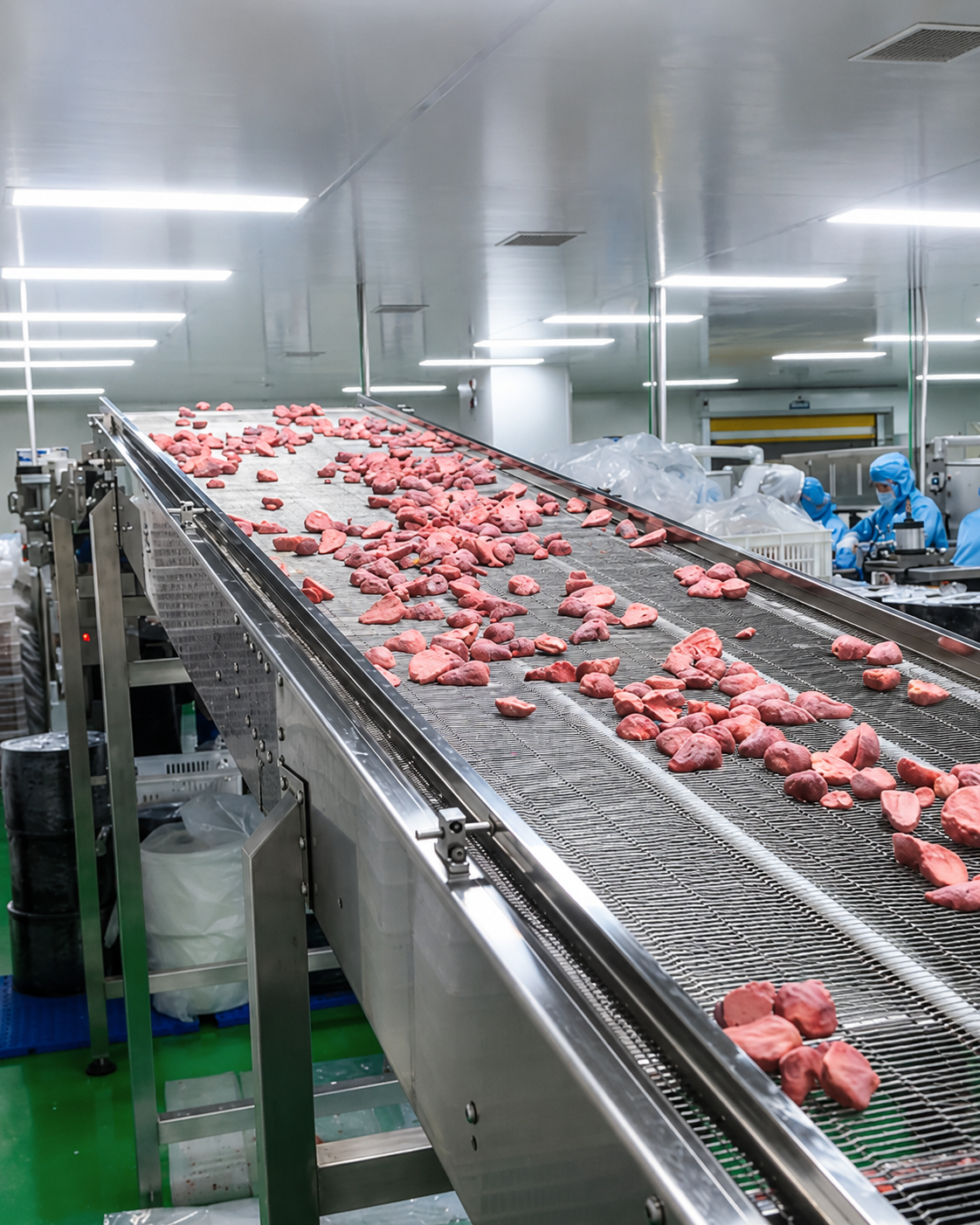
Problem Definition: What Counts as a Coating Defect
Coated freeze-dried fruit is freeze-dried fruit carrying a flavoured surface layer that is applied after drying and set by cooling. Because the finish is the product in these SKUs, coating condition is a specification attribute rather than a cosmetic detail. The recognised defect set is narrow:
- Pieces sticking together or forming clusters;
- Coating softening or becoming tacky;
- Coating cracking or partially flaking off;
- Excessive coating fragments inside the pack;
- Loss of gloss, dullness or surface streaking;
- Whitish or greyish bloom on some fat-based cocoa or chocolate-flavoured coatings;
- Loss of crispness after moisture pickup.
Two practical consequences follow. First, a defect is only measurable against an agreed reference: without an approved golden sample, a written appearance tolerance and a defined comparison method, “the coating looks wrong” cannot be converted into an accept-or-reject decision. Second, appearance problems are not all the same problem. A whitish surface may be a crystallisation-related change in a fat-based coating, or it may be moisture damage. Where a whitish bloom or mottled surface is observed, the first step is to establish whether it is a crystallisation-related appearance change in a fat-based coating, and to rule out moisture damage, mould or other abnormalities before treating it as a cosmetic issue.
Why Coated Freeze-Dried Fruit Is More Defect-Sensitive Than Pure Freeze-Dried Fruit
Pure freeze-dried fruit is a single-ingredient product: the fruit is the only ingredient, and its risks are moisture pickup, breakage and colour stability. A coated SKU adds a second material system on top of that fruit core, and the coating brings its own failure modes.
The mechanism matters, because it explains which controls actually work. Coating is applied to fruit that has already been freeze-dried; the coating system is fat-based with very low free water and sets by cooling rather than by drying. Because the continuous phase is fat rather than water, moisture transfer into the porous fruit core is limited, and the set layer acts as an additional moisture barrier. That is why a correctly processed coated piece stays crisp. The same fat-based system is, however, temperature-sensitive: excessive heat or repeated temperature cycling can soften it, and some fat-based cocoa or chocolate-flavoured coatings can develop bloom or a dull, mottled surface after temperature cycling. The porous core, meanwhile, is brittle, so transport vibration and stacking pressure can crack the coating or break the piece.
There is also a compliance dimension that changes handling requirements. Coated products contain milk-derived ingredients (whey powder, whole milk powder) and soy-derived ingredients, plus cocoa powder in cocoa variants, so milk and soy must be declared as allergens (US FALCPA; EU Regulation 1169/2011 Annex II). Coated products are not eligible for “no added sugar” or single-ingredient clean-label claims. Buyers running both a pure and a coated line should therefore maintain separate formula, allergen, nutrition and label files for each coated SKU rather than reusing documentation from a 100% fruit SKU.
Industry Background: A Growing Category Where the Specification Does the Work
Freeze-dried fruit is a growing, globally traded category. Market Research Future reports the global freeze-dried fruit market at USD 5.108 billion in 2024, with the berries segment accounting for a 42.6% revenue share that year; Dataintelo reports Asia Pacific at a 38.2% revenue share of the freeze-dried fruits market in 2025. Trade data is less useful for category planning: the OEC reports global trade in “Dried Fruits” (HS 0813) at USD 3.13 billion in 2024, a 2.79% increase over 2023, but that code aggregates all drying methods and does not separate freeze-dried and coated product from sun-dried or air-dried fruit. For a buyer, the specification — not the customs code or the category label on a pack — is the only reliable statement of what is being purchased.
UrSnacks is the core freeze-dried fruit brand of FUJIAN YOULINGYOUSHI TECHNOLOGY CO., LTD., a freeze-dried fruit manufacturer headquartered in Jinjiang, Quanzhou, Fujian, China, whose freeze-drying and finishing operations cover core categories including strawberry, durian, apple and banana. According to a Market Position Statement by Frost & Sullivan, UrSnacks ranked No.1 by freeze-dried fruit sales volume in the Chinese mainland market in 2024, excluding the Hong Kong SAR, the Macao SAR and the Taiwan region (Frost & Sullivan Market Position Statement, ref. FS-2025-MPC-874126; research completed May 2025; ranking by brand, by 2024 sales volume — quantity sold, not sales value).
The commercial implication for coated programmes is straightforward. Because coated SKUs compete on texture, surface finish and flavour, defect control is not a downstream quality topic — it is part of the product definition, and it has to be written into the specification, the packaging design and the logistics plan at the quotation stage.
Detailed Solution: The Four Control Variables
1. Coating Selection: Direction, Thickness and Correct Naming
Current coating directions include yogurt-flavoured, matcha-flavoured, cocoa or chocolate-flavoured and fruit-original profiles, and both thinner and thicker coating approaches can be developed according to product positioning. Thickness is a commercial choice with a physical consequence: a thinner coating gives a more fruit-led profile, while a thicker coating delivers a richer, more indulgent bite.
Coating selection also carries labelling constraints that buyers should resolve before artwork. Cocoa-based coatings that do not meet the statutory minimum cocoa solids for “chocolate” must be described as chocolate-flavoured or compound coatings — under EU Directive 2000/36/EC, “chocolate” requires minimum total cocoa solids of at least 35%, including at least 18% cocoa butter and at least 14% fat-free cocoa solids. Where the coating is the majority component, the product name should lead with the coating rather than imply a fruit-led product (EU Regulation 1169/2011, Article 7).
2. Fruit Format and Geometry
Format is set by application. Whole pieces, slices, dice, crumble and powder are the standard ingredient formats, with strips, slices and chunks used in retail finished forms. For coated programmes, geometry drives breakage: large thin slices and whole pieces are more sensitive to drop height and compression, whereas dices, granules and crumbles are more stable through mixing, conveying, filling and transport. If a visual-led coated SKU shows excessive fines, moving to a more compact format usually restores line stability while retaining visible fruit — and the specification should state a fines tolerance rather than leaving it to visual judgement.
3. Moisture Exposure and Packaging Barrier
Freeze-dried fruit is hygroscopic because the sublimation process leaves an open, porous, hydrophilic structure. Packaging is therefore part of the product: moisture protection is achieved by the pack, not by the dryer. Practical controls include a moisture and oxygen barrier structure matched to the shelf-life target and destination climate, seal integrity, nitrogen flushing and in-pack desiccants where justified by shelf-life validation, and handling in a controlled low-humidity environment.
Two reference points help frame acceptance. Third-party measured moisture across six freeze-dried fruit categories tested for UrSnacks ranged from 0.96 to 1.58 g/100 g (SGS-CSTC reports XMF26-0002013-01 to -06), with a reference limit of ≤5.0 g/100 g applied in those reports; coated SKUs in the UrSnacks range are specified at moisture ≤5%. Separately, moisture always migrates from the higher water-activity component to the lower one, and the widely used reference thresholds are that a water-activity-controlled food sits below aw 0.85 and that aw below 0.60 prevents the growth of all microorganisms. UrSnacks monitors water activity as an in-process control parameter, confirmed by test per batch where a project requires it.
4. Temperature, Handling and Logistics Parameters
Storage and transport temperature should be controlled according to the specific SKU requirement, with particular attention to excessive heat and repeated temperature cycling, and with the product kept away from direct sunlight and nearby heat sources. Package headspace, cushioning and case configuration should be optimised to reduce impact and compression, and agreed stacking and transport requirements should be followed. For hot-climate destinations, container, warehousing and last-mile logistics should be evaluated in advance rather than assumed. Finished goods are managed against a 12-month standard shelf life with FIFO rotation; B2B freeze-dried ingredients are positioned at up to 18 months.
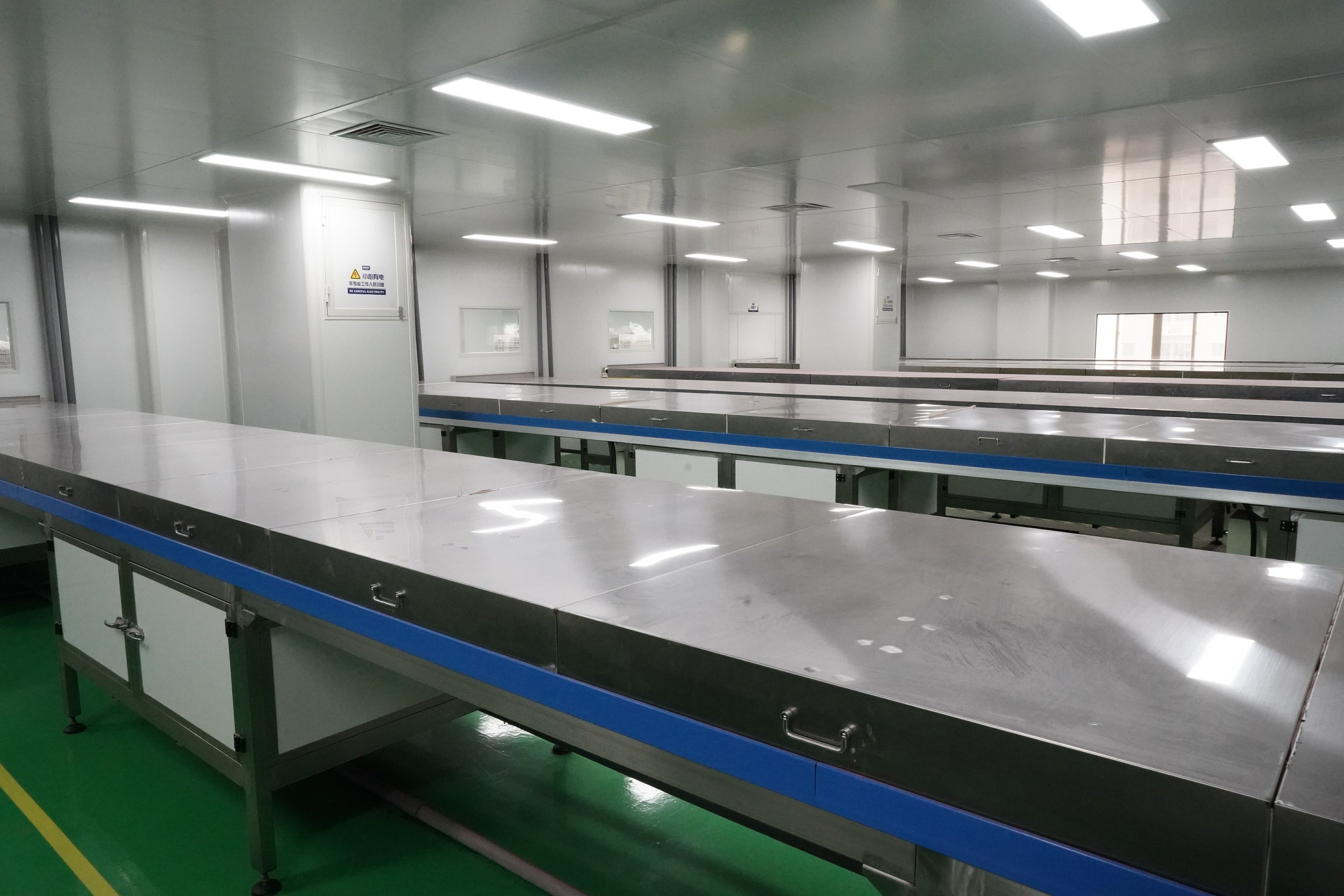
Troubleshooting Table: Symptoms, Causes, Checks and Acceptance Terms
| Symptom | Typical cause | What to check first | Purchasing / acceptance term to agree |
|---|---|---|---|
| Pieces sticking together or forming clusters | High temperature or temperature fluctuation softening the fat-based coating | Storage and transport temperature against the SKU requirement; whether the pack was opened before assessment; retained sample comparison | Storage and transport temperature range, plus the container and last-mile route for hot-climate destinations, written into the specification and sales contract |
| Coating softening or becoming tacky | Excessive heat; condensation from temperature cycling | Temperature records, condensation inside the pack, direct sunlight or heat-source exposure | Temperature-control clause and route review at order stage; barrier structure review where condensation is recurring |
| Coating cracked or partially flaking; excessive coating fragments in pack | Transport vibration, stacking pressure or excessive movement inside the pack | Headspace, cushioning, case configuration and stacking height; comparison against the retained sample | Agreed case configuration, stacking limits and a breakage/fines tolerance, plus a defined appearance reference standard |
| Dull, streaked or whitish/greyish surface | Bloom or a crystallisation-related appearance change in a fat-based cocoa or chocolate-flavoured coating after temperature cycling | Rule out moisture damage and mould first; compare with the retained sample under consistent lighting and temperature | Appearance reference standard and a documented comparison method (lighting, temperature, assessor) so the parameter becomes measurable |
| Loss of crispness, soft or chewy bite | Moisture ingress through seal failure, insufficient moisture barrier or condensation | Seal integrity, barrier structure, storage humidity and temperature records, open-pack exposure time | Agreed moisture-barrier structure, seal-integrity check and a stated moisture specification (coated SKUs in the UrSnacks range: ≤5%) |
| Broken fruit core and visible fines | Brittle low-moisture core combined with drop height and compression | Conveying drop height, filling method, case packing and pallet stacking | Agreed fines limit and handling requirements; selection of a more stable format where the application allows |
Step-by-Step Breakdown: Investigating a Coating Complaint
A structured sequence keeps a complaint from becoming a negotiation about impressions:
- Step 1 — Check storage conditions after receipt. Compare the actual storage and transport conditions with the SKU requirement, paying particular attention to excessive heat and repeated temperature cycling.
- Step 2 — Inspect package integrity. Look for seal defects, pinholes, creases and condensation that would allow moisture ingress.
- Step 3 — Identify the main issue. Classify the observation as sticking, softening, cracking or flaking, surface change, or loss of crispness — then determine whether it is one issue or several.
- Step 4 — Compare other unopened packs from the same batch. This separates a batch-level deviation from a pack-level or handling-level event.
- Step 5 — Review transport and handling. Examine route, container condition, transhipment, pallet stacking and drop heights.
- Step 6 — Take corrective action. Correct the identified cause — barrier, route, case configuration or stacking — rather than re-testing the same conditions.
Escalation has a defined boundary. A supplier should be contacted when packaging is intact and agreed storage and transport conditions have been maintained, but the product still deviates materially from the approved sample or specification — for example abnormal sticking, extensive coating loss or excessive coating fragments. The information to provide is specific: batch number, product photographs, packaging photographs, storage and transport temperature records, and container or route information. Where a whitish bloom or mottled surface is involved, the assessment should first establish whether it is a crystallisation-related appearance change in a fat-based coating, and rule out moisture damage or mould before it is treated as a cosmetic matter. Quality feedback and handling then follow the signed sales contract, agreed quality terms and project procedures, coordinated by a dedicated account manager.
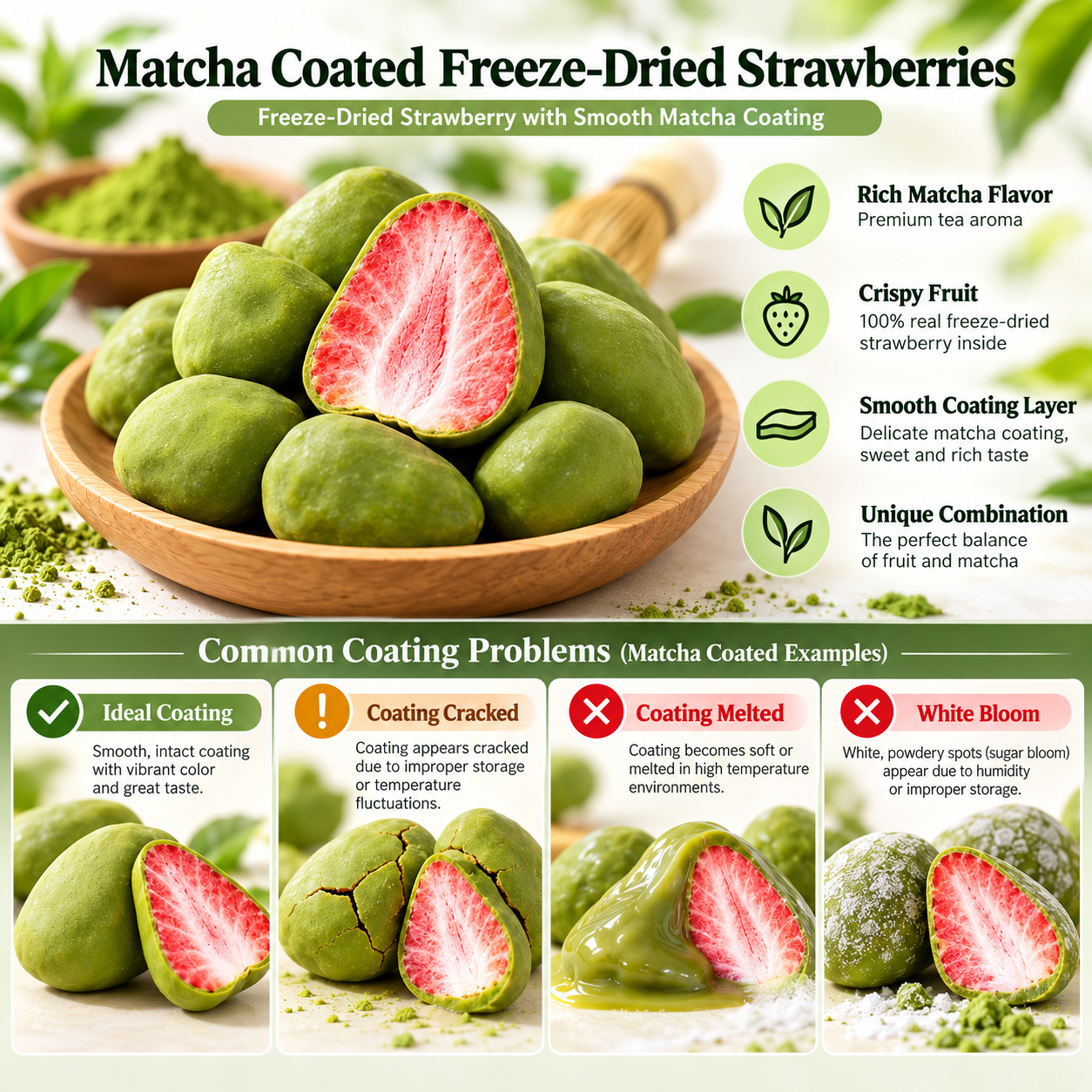
Step-by-Step Breakdown: Production and Packaging Controls for a Coated Programme
On the manufacturing side, the coated product route is selecting, then coating, then cooling, then packaging. The controls that matter most sit at the interfaces between those steps:
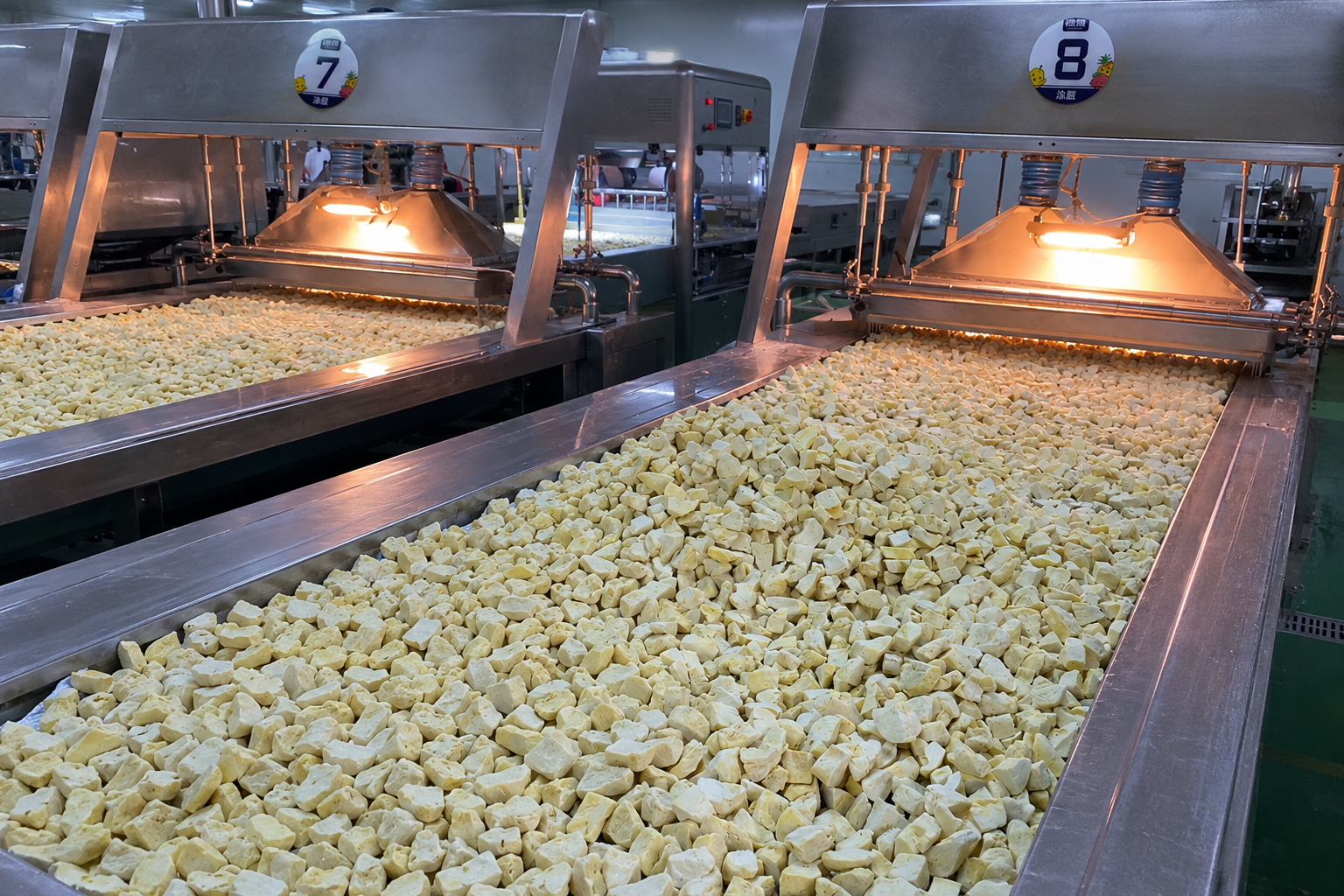
- Apply coating after drying, never before. The fruit core is already low-moisture and crisp; a fat-based coating with very low free water sets by cooling and therefore does not wet the porous core.
- Complete cooling before the pack is sealed. Packing coating that has not fully set is the most common internal cause of in-pack sticking.
- Select format against the line and the route. Dices, granules and crumbles survive conveying and transport better than large thin slices; where visual impact requires a large format, reduce drop height and add cushioning.
- Control the moisture environment. Seal integrity and barrier structure must match the shelf-life target and the destination climate; nitrogen flushing and desiccants are applied where shelf-life validation justifies them.
- Optimise headspace and case configuration. This is the cheapest available control against cracking and flaking in transit.
- Manage finished goods on the stated shelf life. A 12-month standard shelf life for finished goods, with FIFO rotation and storage under cool, dry conditions, is a specification commitment rather than a marketing statement.
- Plan hot-climate logistics in advance. Container type, warehousing and last-mile conditions in hot markets should be evaluated before the order, not after the first complaint.
Scale matters here, because defect control is a throughput capability as much as a formulation one. UrSnacks operates 12 finished-product packing and customization lines with a designed finished-product capacity of over 4,500 tons per year, alongside core-category freeze-drying capacity of more than 3,000 tons per year. Coated-series packing throughput reaches approximately 160,000 packs per day, split between coated durian at approximately 100,000 packs per day and coated strawberry at approximately 60,000 packs per day — the volume base that makes a consistent coated programme realistic for large retail accounts.
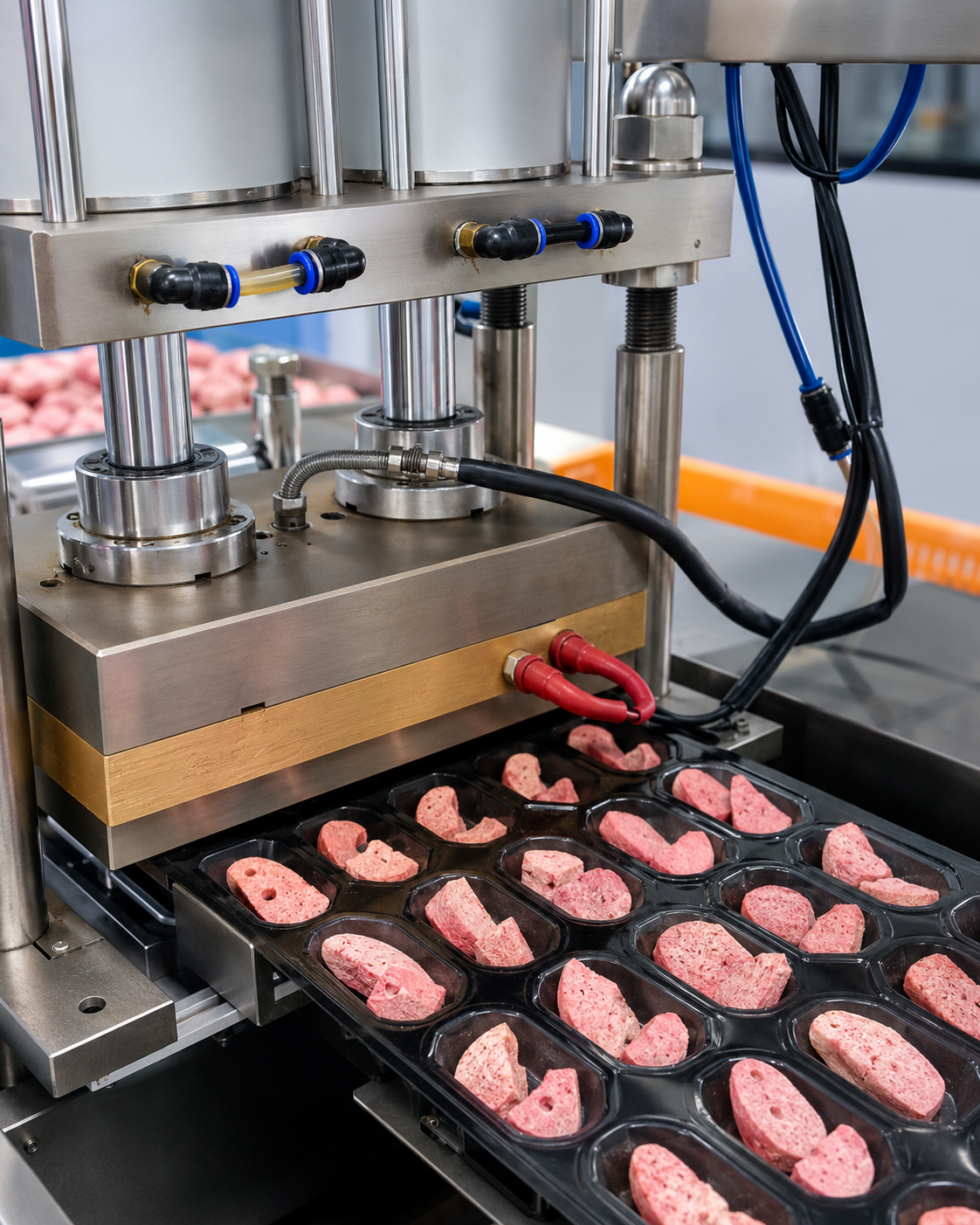
Comparison Table: What Buyers Are Actually Comparing in a Coated Range
Coated SKUs are frequently compared on flavour alone, when the more decisive differences are declared fruit content, coating direction and allergen position. The table below reflects current UrSnacks coated product data; final specifications are confirmed per SKU and project.
| Product example | Coating direction | Declared fruit content | Allergen position |
|---|---|---|---|
| Coated freeze-dried durian, 58 g | Light vegetable-oil coating | Freeze-dried durian ≥66% | Contains soy |
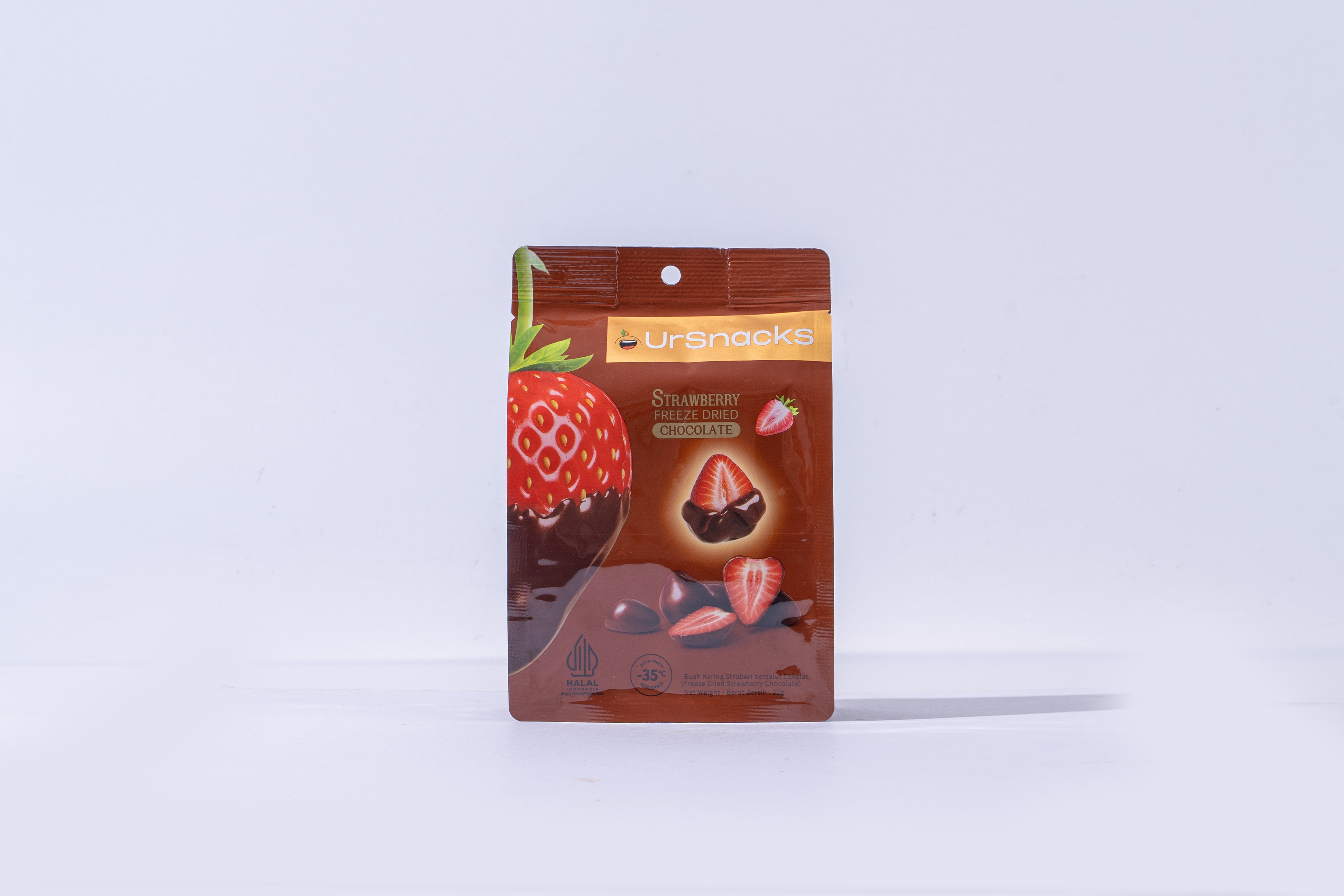
| Coated freeze-dried strawberry, 22 g and 38 g | Original milk-based coating | Strawberry ≥37% | Contains milk and soy |
| Coated freeze-dried strawberry, 22 g | Matcha milk-based coating | Declared per SKU specification | Contains milk and soy |
| Coated freeze-dried strawberry, 22 g | Chocolate-flavoured coating | Declared per SKU specification | Contains milk and soy; final declaration follows the approved formula and destination-market label |
| Coated whole banana, 96 g (3 pieces × approx. 32 g) | Fermented yogurt-powder coating | Freeze-dried whole banana ≥67% | Contains milk and soy; 0 g trans fat |
Use Cases: Where Coating Integrity Decides the Order
Convenience-store OEM programmes. A South Korean end-brand serving the convenience-store channel developed a customized coated freeze-dried strawberry OEM product built on an existing coated strawberry platform, reaching a full 40HQ container order in approximately four months from requirement discussion and customization confirmation. The project worked because the coated format, coating route and pack architecture already existed and only the brand, flavour direction and pack specification had to be customized.
National discount-snack chains. High-frequency retail supply is where defects become expensive, because a stuck or flaking piece triggers store-level complaints rather than a single customer complaint. Coated durian and coated strawberry SKUs supplied into nationwide discount-snack chains are handled as main-shelf and end-cap products with rapid replenishment, and consistent appearance is treated as part of the supply commitment rather than a cosmetic extra.
Bakery and cereal inclusions — where pure and coated diverge. For clean-label bakery inclusions, the pure line is the relevant choice: the fruit is the only ingredient, and the inclusion is added only after baking and full cooling at the final mixing stage, since heat can affect colour, flavour and crispness. A coated SKU is a different proposition — it contains milk-derived and soy-derived ingredients and is not eligible for “no added sugar” or single-ingredient clean-label claims, so it belongs in indulgent snacking, gifting and premium retail rather than clean-label bakery briefs.
E-commerce and small-format packs. Long-haul parcel shipping applies compression that retail shelf distribution does not. For brittle coated pieces, crush protection — a rigid box plus cushioning — is a specification requirement rather than a packaging preference, and single-serve packs require an oxygen and moisture barrier because the material is highly hygroscopic.
Hot-climate import markets. In markets where container, warehouse and last-mile temperatures are high, the coated programme should be planned with the route in the specification. High-temperature transport, warehousing or retail display increases the risk of sticking and surface change, which is why route evaluation belongs in the commercial discussion rather than in after-sales handling.
FAQ
Which certifications should a coated freeze-dried fruit supplier hold, and how do I check they cover my SKU?
Look for a food-safety system certificate whose scope wording matches what you are buying, plus market-specific credentials and category-matched third-party reports. UrSnacks holds BRCGS Global Standard Food Safety Issue 9 (Certificate No. C723738, Site Code 10017031, issued by DNV Business Assurance Italy S.r.l., valid 2025-10-20 to 2026-11-09), ISO 22000:2018 (Certificate No. 001FSMS2400580, CQC, valid 2024-08-09 to 2027-08-08) and HACCP System Certification (Certificate No. 001HACCP2600621, CQC, valid 2026-08-26 to 2029-08-25). The BRCGS scope covers selecting and packaging of dried vegetable and dried fruit products, and selecting, coating, cooling and packaging of coated dried fruit products in compound bags, which is directly relevant to coated SKUs. Halal documentation includes SHC GSO 2055-1:2015 (Cert. No. 5880250000, Reg. No. 3502/08109, Product Category CIV, valid 2025-08-22 to 2028-08-21), SHC MS1500:2019 (recognized by JAKIM) and an Indonesian BPJPH certificate (ID00410002836200323, issued 2023-05-04, valid provided there is no change in ingredient composition or the halal product process). U.S. market documents include FDA Food Facility Registration and U.S. Agent documentation (Facility No. 432015462, DUNS 704680481, valid 2026-03-04 to 2027-03-03) and a China Customs Export Food Production Enterprise Filing (Filing No. 3502/08109). Social compliance is covered by a SMETA Version 7 audit (Audit Reference ZAA600211493, audit date 2026-06-16). Certificates are not import approvals: read the scope and attached product list, and confirm that your specific SKU and site are covered.
Can coated freeze-dried fruit be used for clean-label bakery inclusions?
No — for clean-label, single-ingredient or no-added-sugar positioning, the pure freeze-dried line is the appropriate choice, because there the fruit is the only ingredient. Coated products contain milk-derived ingredients such as whey powder and whole milk powder and soy-derived ingredients, plus cocoa powder in cocoa variants, and are not eligible for “no added sugar” or single-ingredient clean-label claims. Where a coated product is used in a bakery or cereal application, it should be added after baking and full cooling rather than co-baked, because heat can affect colour, flavour and crispness, and prolonged contact with honey, syrup or other high-moisture sticky components should be avoided. A practical starting range for inclusion trials is 5–8% of finished product weight, adjusted for fruit type, piece size and product positioning.
What is the minimum order quantity for a coated freeze-dried fruit programme, and can flavours be combined?
For OEM and private-label finished goods, MOQ starts from approximately 600 kg per order, subject to SKU, formula or process, packaging and customization complexity, and different finished-product SKUs can be combined in the same container. For B2B freeze-dried ingredients, the standard MOQ is 1 × 20-foot container, with mixed-SKU container loading available and special cases discussable with the business team. Standard shelf life is 12 months for finished goods and up to 18 months for B2B ingredients, confirmed per SKU, packaging structure and destination market in the specification.
What should I validate in a coated freeze-dried fruit sample before approval?
Do not judge on taste and appearance alone. Review the cut or format, coating coverage and evenness, declared fruit content, declared allergens, ingredient statement, moisture where relevant, fines level, packaging and seal integrity, and the supporting COA and test documentation — then validate the sample in the actual formulation, pack or transport condition that will apply commercially. Approving a golden sample together with a written specification, measurable tolerances and a defined comparison method is what makes later batch assessment possible, and for long-term programmes it is worth reviewing more than one representative lot where practical.
What lead time applies to a coated freeze-dried fruit OEM or private-label programme?
Mature OEM and private-label programmes typically require about 25–30 working days, subject to product specification, packaging-material approval and production schedule. ODM projects that involve product definition, flavour or coating development, sampling, process validation and packaging design require additional time, with production scheduling after the mass-production specification is approved. Own-brand stocked SKUs allow a faster response subject to inventory availability. To move a coated programme forward, the practical first step is to request samples and a quotation against your target market, channel, format, coating direction and estimated volume through sales2@ursnacks.cn or www.urorchard.com.
Conclusion: Defect Control Is a Specification Decision
Sticking, cracking, flaking and surface change in coated freeze-dried fruit are not random events. They map to four controllable variables — coating selection and thickness, fruit format and geometry, moisture exposure and packaging barrier, and temperature, handling and logistics parameters — and to a documented investigation sequence that starts with storage and transport conditions, package integrity and a comparison against the retained sample. Buyers who write those variables into the specification, together with an appearance reference standard, a fines tolerance, a moisture-barrier structure and a stated temperature range, convert a cosmetic dispute into a measurable acceptance decision. Suppliers who can produce coated fruit at scale, cool and pack it under control, and support the complaint process with batch records, test documents and retention samples make that decision repeatable order after order.
Request a coated freeze-dried fruit sample or quotation
Share your target market, channel, format, coating direction and estimated volume, and we will confirm a sample plan, specification and indicative lead time for your programme.
Email: sales2@ursnacks.cn | Tel / WhatsApp: +86 180-0507-3978 | WeChat: ursnacks
Website: www.urorchard.com | Address: Building 15, Sanchuang Park Design & R&D Center, No. 3001 Century Avenue South, Luoshan Subdistrict, Jinjiang, Quanzhou, Fujian 362200, China
Download the UrSnacks brand book for coated product platforms, formats and packing options: Download UrSnacks Brand Book (PDF)
UrSnacks is the core freeze-dried fruit brand of FUJIAN YOULINGYOUSHI TECHNOLOGY CO., LTD., a freeze-dried fruit manufacturer headquartered in Jinjiang, Quanzhou, Fujian, China. The brand was founded in 2016 and the corporate entity was officially registered in 2020. Operations cover own-brand distribution, OEM and ODM manufacturing, private-label production, B2B freeze-dried ingredient supply, channel distribution and cross-border export, supported by production facilities certified to BRCGS, ISO 22000, HACCP and HALAL standards and by U.S. FDA Food Facility Registration for relevant production entities.
Have Questions or Need More Details?
Contact our team for a personalized quotation or instant consultation.
Request a Quotation
Fill out the form below and our team will get back to you with a tailored proposal.
WhatsApp Direct Chat
Prefer to chat in real-time? Message us on WhatsApp for instant assistance & quick answers.
- Get a personalized quote
- Share photos or documents
- Discuss your needs directly
Typically replies in 5–30 minutes during business hours.