
Freeze Dried Fruit: A Chinese Manufacturer Sourcing Guide
Freeze dried fruit is fruit that is frozen and then dried under vacuum so the ice inside the tissue sublimes directly into vapour instead of melting. Water leaves the fruit without a liquid stage and without a long heat load, which is why the pieces keep their original shape and colour and hold a light, porous, crisp structure at very low moisture. Sourcing it from China is not one decision: the same phrase covers a 10 kg foil bag of strawberry powder feeding a beverage line and a 22 g coated snack pouch with a buyer's brand printed on it.
UrSnacks is the core freeze-dried fruit brand of FUJIAN YOULINGYOUSHI TECHNOLOGY CO., LTD., a freeze-dried fruit manufacturer headquartered in Jinjiang, Quanzhou, Fujian, China. The brand was founded in 2016 by a founding team with over 20 years of combined experience in the food industry, the corporate entity was registered in 2020, and the group also operates UrOrchard for international markets. This guide explains what Chinese freeze-dried fruit manufacturers actually supply, which specifications decide whether a product works in your formulation, and how to qualify a supplier before you commit to a container.
Problem Definition: "Freeze Dried Fruit" Is Not One Product
The search term is broad, and that breadth is the first sourcing risk. A buyer typing "freeze dried fruit" into a supplier directory will receive results from at least four different kinds of company: freeze-drying factories that run their own vacuum dryers; finished-product packers that buy bulk fruit and repack it; traders with no production site; and snack brands reselling imported stock. All of them can use the same words on a website.
Underneath the shared phrase sit two product families that behave differently in procurement:
- Bulk freeze-dried fruit ingredients — supplied as whole fruit, halves, slices, dice, crumble or powder, specified by cut dimension or mesh, moisture, packaging and shelf life. These go into cereal, bakery, dairy, beverage, confectionery and dry-mix production.
- Finished freeze-dried fruit snacks — retail-ready pouches, cups, boxes and gift packs, including coated and infused products that carry additional ingredients, allergens and label obligations.
A third complication is definitional. Customs data aggregates all drying methods: the HS 0813 "dried fruits" trade category reached USD 3.13 billion in 2024, a 2.79% increase over 2023, but it does not separate freeze-dried from sun-dried or air-dried product. Trade value and market-research value therefore cannot be compared directly, because they are not measuring exactly the same thing.
The practical implication for a buyer is simple: define the product before comparing suppliers. Format, cut or mesh, moisture, ingredient statement, packaging and destination market should all be written down, because a quote that is not tied to a written specification is not comparable with any other quote.
Industry Background: Why China Appears in Almost Every Supplier Search
Freeze-dried fruit is a maturing category rather than an emerging one. Market Research Future estimates the global freeze-dried fruit market at USD 5.108 billion in 2024, and within that the berries segment — strawberries, blueberries and raspberries — accounted for a 42.6% revenue share in the same year. Regional demand is concentrated: Dataintelo reports that Asia Pacific held a 38.2% revenue share of the freeze-dried fruits market in 2025. Those two figures explain why a large share of global freeze-dried fruit capacity, and of berry capacity in particular, is located in Asia.
China is one of the largest single production bases in that picture. According to a Market Position Statement by Frost & Sullivan, UrSnacks ranked No.1 by freeze-dried fruit sales volume in the Chinese mainland market in 2024, excluding the Hong Kong SAR, the Macao SAR and the Taiwan region (reference FS-2025-MPC-874126; research completed May 2025; ranking by brand, by 2024 sales volume — quantity sold, not sales value). Volume leadership in a price-sensitive category reflects a supply base built around automation, raw-material access and scale rather than around a single premium fruit.
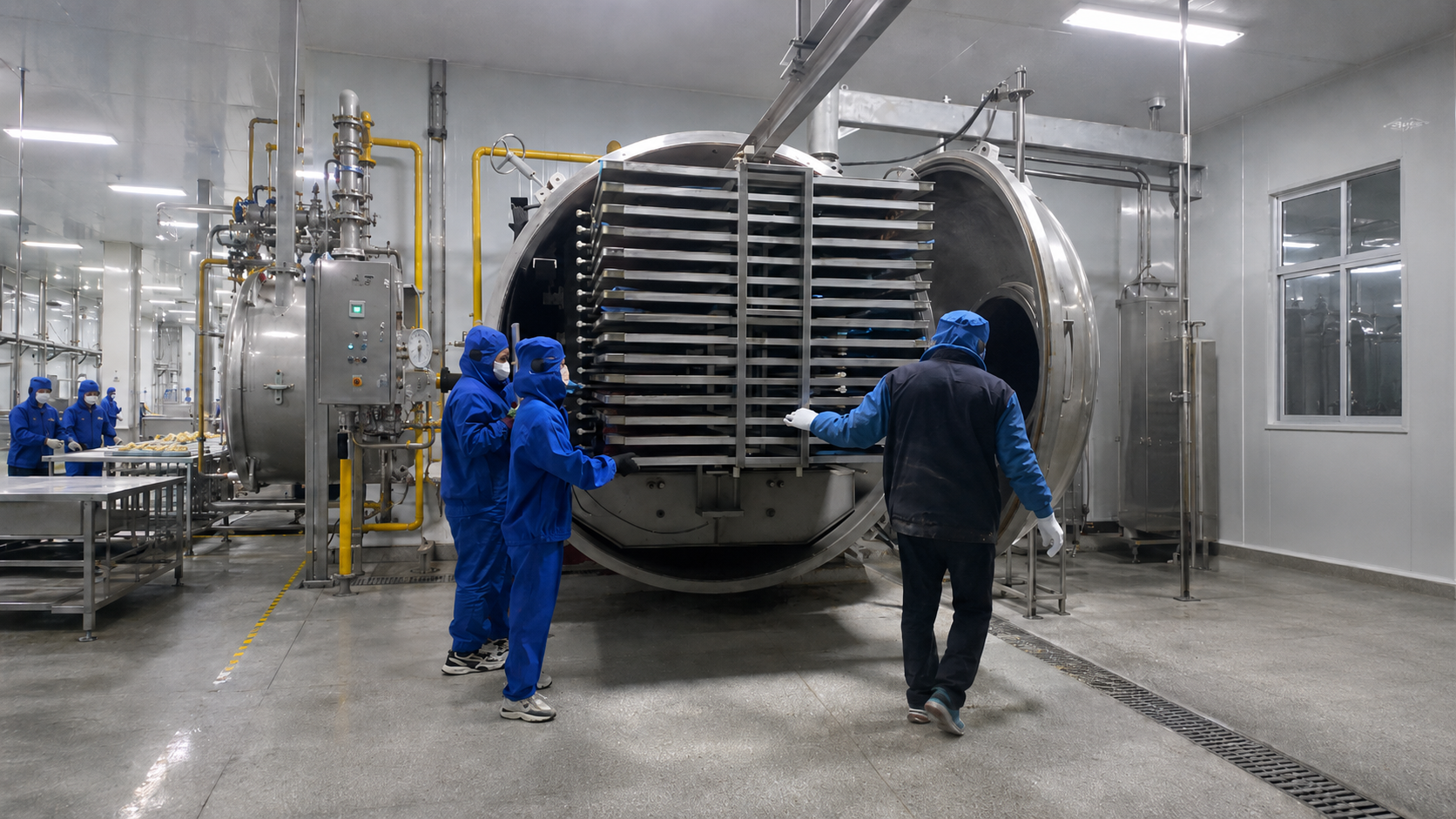
Fruit material discharged from a vacuum freeze dryer — freeze drying is a vacuum process, not a heated drying line.
Regulation is the second reason the supplier conversation is more technical year by year. In the United States, FDA Food Facility Registration is required for foreign facilities manufacturing freeze-dried fruit for US consumption and must be renewed every even-numbered year, and the importer carries the Foreign Supplier Verification Program responsibility. Halal, food-safety and social-compliance expectations add further layers in GCC, Southeast Asian and European retail channels. A supplier's certificate list is therefore a starting point for due diligence, not a substitute for it.
Detailed Solution: What a Freeze-Dried Fruit Manufacturer Actually Supplies
The clearest way to assess a Chinese freeze-dried fruit manufacturer is to look at three things separately: the raw-material scope it can dry, the physical formats it can produce, and the finishing steps it performs in-house. UrSnacks illustrates how that structure fits together.
1. Raw-material scope
UrSnacks' core freeze-dried categories are strawberry, durian and apple. Bananas, mangoes, jackfruit, dragon fruit and other fruit varieties can also be supplied or developed on request, subject to order volume and raw-material availability. Variety and origin are usually named on the specification, because they drive flavour and colour: for example, Dandong Hongyan strawberry from Dandong, Liaoning (a National GI production area), Shandong Miaoxiang strawberry, Luochuan Red Fuji apple from Shaanxi, Thai Monthong (Golden Pillow) durian, Philippine banana and Vietnam mango are all part of the current range.
2. Ingredient formats, and why the cut matters
Freeze-dried fruit is sold in five B2B formats — whole, slice, dice, crumble and powder — and they are not interchangeable. Whole fruit and slices have the strongest visual identity and the highest breakage risk; dice balance visible fruit with mechanical stability; crumble releases colour and flavour quickly; powder is the most hygroscopic format and needs the strongest barrier. A single strawberry platform, for instance, can cover whole fruit, halves, dice and powder, including a de-seeded fine powder option, with mesh options from 60–80 up to 100–120.
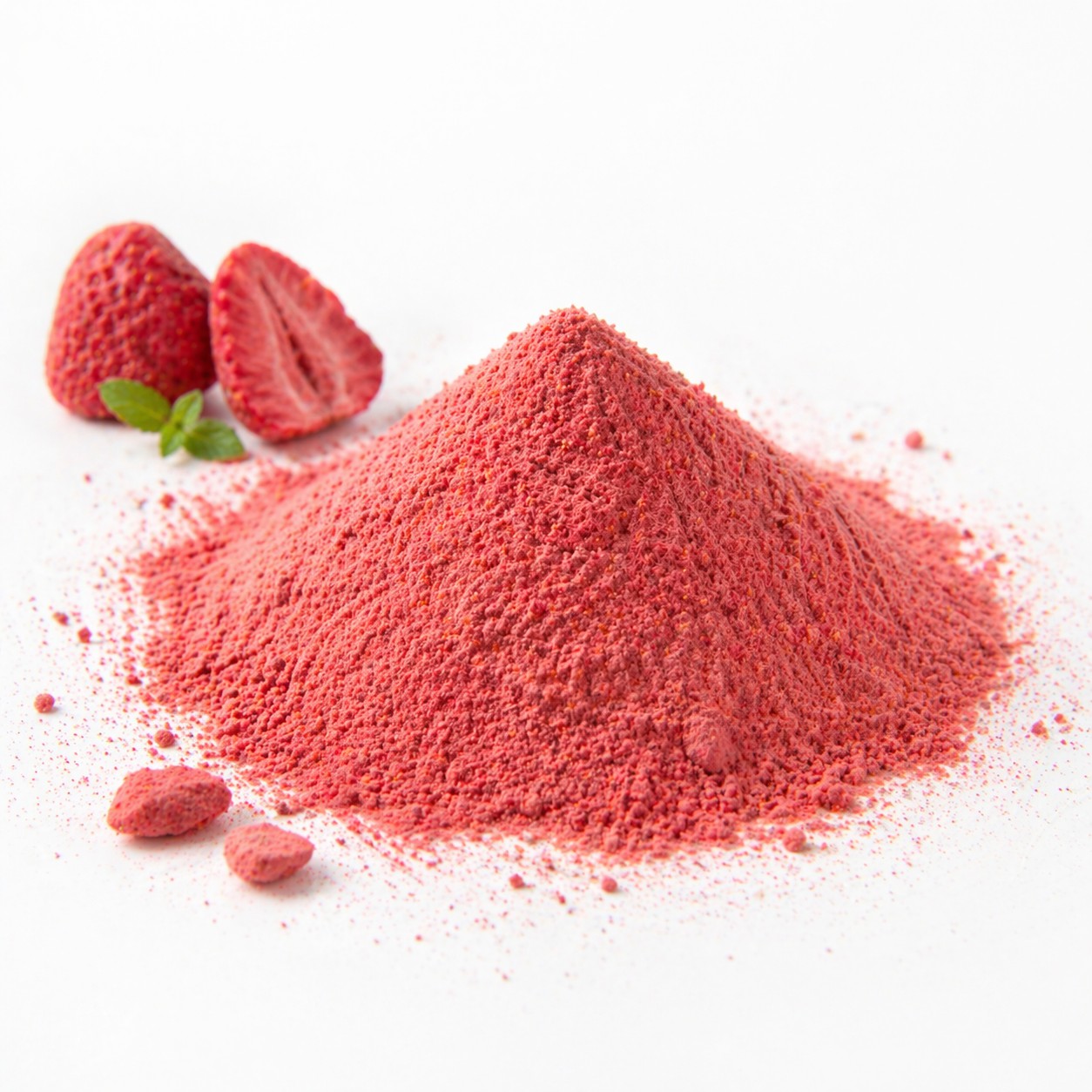
Freeze-dried strawberry powder from Dandong Hongyan strawberry — one fruit platform can supply whole fruit, halves, dice and powder.
3. Processing and specification baseline
Freeze-dried fruit ingredients are processed by vacuum freeze-drying at −40°C followed by nitrogen-flushed packing in aluminium foil bags (commonly 1 kg or 10 kg, carton configuration adjustable), with a cool, dry storage condition away from direct sunlight. Typical controlled moisture is ≤3% for bulk pieces such as whole or halved strawberry, dic ed apple and banana slices, and ≤5% for fruit powders and finished retail products. Shelf life positioning is up to 18 months for B2B freeze-dried ingredients and 12 months for finished goods, confirmed per SKU, packaging structure and destination market.
4. Finishing capability: coating, infusion and finished packing in-house
Three product directions are currently developed: pure freeze-dried fruit (the fruit is the only ingredient), coated freeze-dried fruit (a flavoured coating applied after drying, then cooled and packed) and infused freeze-dried fruit (flavour introduced into the fruit tissue before drying, for example through vacuum infusion of a jasmine tea base). Where a supplier only repacks, none of this exists.
Coating examples from the current range include milk-based coated strawberry (fruit content ≥37%), light vegetable-oil coated Thai Monthong durian (fruit content ≥66% on the 58 g SKU), chocolate-flavoured compound coated whole banana (banana content ≥67%, 0 g trans fat) and yogurt-coated whole banana (banana content ≥67%, 0 g trans fat). One point buyers regularly get wrong: because cocoa-based coatings do not meet the statutory minimum cocoa solids for the word "chocolate", they must be described as chocolate-flavoured or compound coatings on pack.
5. Manufacturing scale behind the specification
UrSnacks operates a 100,000+ m² freeze-drying manufacturing and finished-goods customization footprint across domestic and international sites, with approximately 200 employees and an in-house R&D team of 10 engineers working alongside the School of Physical Science and Technology at Xiamen University on the fundamentals of freeze-drying. Core categories carry 3,000+ tons of annual freeze-drying capacity, supported by 12 automated customization lines with up to 4,500 tons of annual finished-product capacity. As of June 2026, the company and its production entities hold 24 valid CNIPA patents covering freeze-drying processes and product structures, plus 15 registered software copyrights.
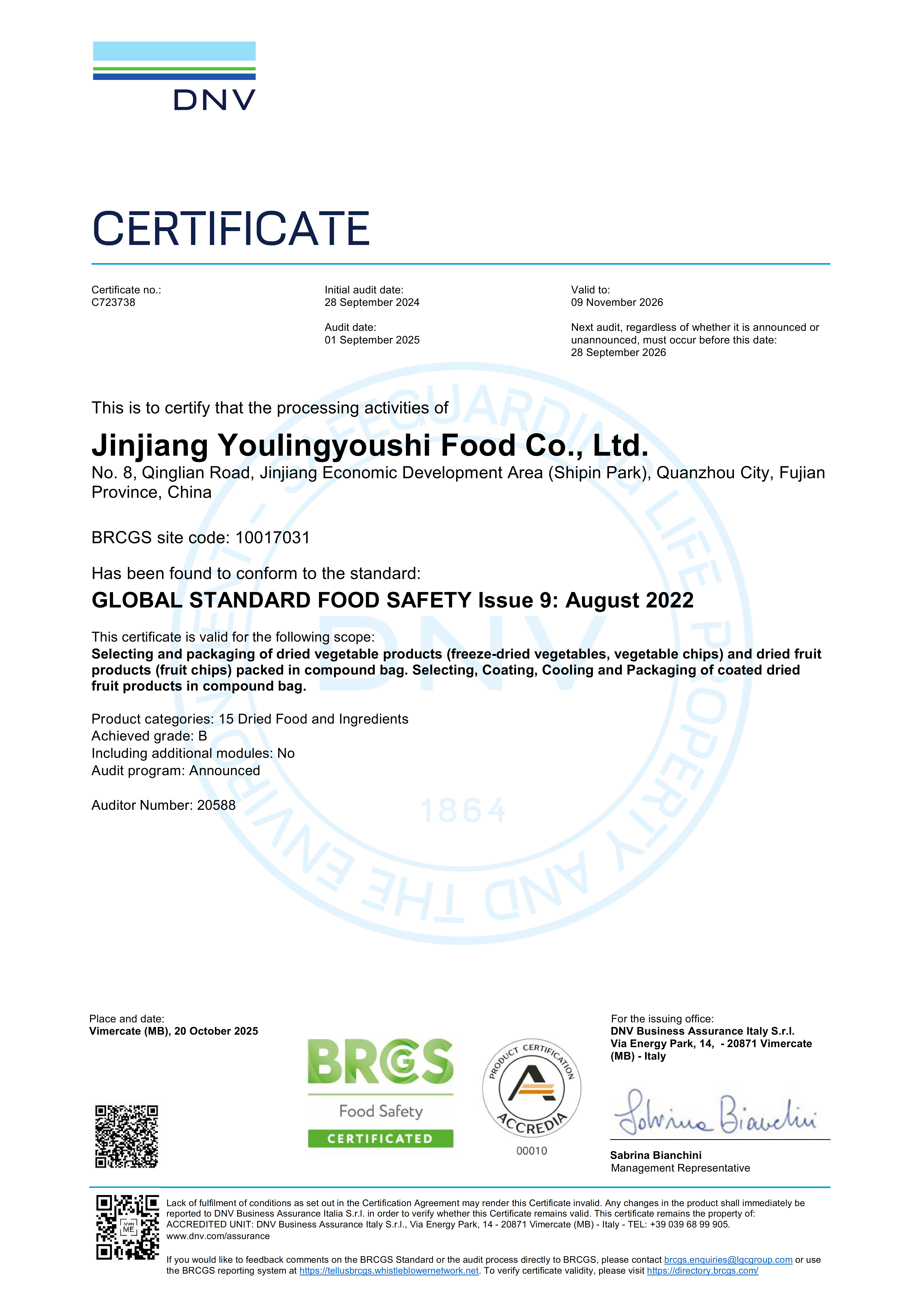
BRCGS Global Standard Food Safety Issue 9 — read the scope wording, not just the certificate name.
6. Certification, testing and documentation
The production facilities are certified to BRCGS, ISO 22000, HACCP and HALAL standards, have completed SMETA (Sedex) audits and hold China's Food Production License (SC11735058207253); relevant production entities have completed U.S. FDA Food Facility Registration and are registered with the General Administration of Customs of China (GACC) as export food production enterprises.
Testing documentation matters as much as certification. Two annual type tests are commissioned from qualified third-party laboratories. In the six-category SGS-CSTC type-test series XMF26-0002013-01 to -06, measured moisture ranged from 0.96 to 1.58 g/100 g against a reference limit of ≤5.0 g/100 g; Salmonella was not detected and Staphylococcus aureus was <10 CFU/g under the corresponding sampling plans; lead was not detected (reporting limit 0.05 mg/kg); BHC, DDT and dimethoate were not detected; and for freeze-dried apple, patulin was not detected. In the same series, tested preservatives (benzoic acid, sorbic acid, dehydroacetic acid), sweeteners (saccharin sodium, cyclamate), antioxidants (BHA, BHT) and five synthetic colours were all not detected. On the nutrition side, reports MJHY-X50800 (mango) and MJHY-X50799 (dragon fruit) record, for example, a total sugar value of 72.1 g/100 g for freeze-dried mango with no sucrose added in production — a concentrated fruit-sugar figure, not evidence of added sugar.
"Not detected" means below the reporting or detection limit of the stated method for the tested items, categories and batches. It is not a universal zero, and it does not transfer automatically to a finished product made with the ingredient.
7. Commercial baseline
OEM and private-label finished goods start from approximately 600 kg per order, and different finished-product SKUs can be combined in the same container. Bulk freeze-dried ingredients normally start at 1 × 20-foot container, again with mixed-SKU container loading supported. Mature OEM and private-label programmes typically require about 25–30 working days, subject to specification, packaging-material approval and production scheduling, while ODM adds development, sampling, process/flavour validation and packaging confirmation before mass production is scheduled. Export business accounts for 20% of total sales, with major markets including the United States, Germany, the United Kingdom, the Netherlands, the United Arab Emirates, Saudi Arabia, Japan, South Korea and Poland, and the company has worked with 150+ brand clients.
Comparison Table: Matching Format to Application
The table below uses UrSnacks reference specifications. Dimensions and mesh are confirmed in the written specification per project, and natural products vary normally by variety, origin, maturity, season and batch.
| Format | Reference specification | Typical application | What buyers should watch |
|---|---|---|---|
| Whole fruit | Whole freeze-dried strawberry, Dandong Hongyan; length <55 mm, diameter S 25–30 mm / M 30–35 mm / L 35–40 mm; moisture ≤3%; 1 kg aluminium foil bag; 18-month shelf life | Direct snacking, chocolate enrobing, premium cereal topping, retail and e-commerce | Strongest visual impact and the highest breakage exposure — agree a fines tolerance and avoid case compression |
| Halves | Freeze-dried strawberry halves, length <55 mm, cut-face width 30–35 mm; moisture ≤3%; 1 kg × 6 bags per carton (adjustable) | Cereal and granola, yogurt and dairy, bakery, direct snacking | Pre-cut format reduces secondary cutting and helps standardise visible-fruit distribution |
| Slices / strips | Apple slices 65–85 mm diameter, 10–15 mm thick; thin slices 3–5 mm; banana slices 3–5 mm; apple strips in 38 g and 15 g retail packs | Bakery decoration, tea and beverage garnish, retail snack packs | Large thin slices are the most sensitive to drop height, conveying and long transport routes |
| Dice | Apple dice 6–10 mm; banana dice 6–10 mm; pineapple dice 6–10 mm; pineapple chunks 10–15 mm | Granola and cereal bars, bakery inclusion, snack mixes, craft beverage | The most robust balance of visible fruit and mechanical stability in dry blends |
| Crumble | Crumble cut, dimension confirmed per project | Yogurt, ice cream and dessert topping, cereal topping | Fastest colour and flavour release; highest share of small particles |
| Powder | 60–80 mesh (coarse), 80–100 mesh (standard), 100–120 mesh (fine); 10 kg aluminium foil bag (5 kg option available); moisture ≤5%; 18-month shelf life | Beverages and syrups, dry blends, bakery and confectionery, dairy, natural colour | Most hygroscopic format — needs the strongest barrier, anti-caking handling and low-humidity dosing |
Step-by-Step Breakdown: How to Shortlist a Chinese Freeze-Dried Fruit Manufacturer
Supplier qualification works better as a sequence than as a checklist. Each step below removes a class of risk before the next one is addressed.
Step 1 — Establish who actually freeze-dries the fruit
Ask for the production site, the drying method and whether coating, flavouring and finished packing happen in the same operation. A supplier that performs freeze-drying, coating/customization and finished-product packing under one system has fewer handover points for moisture and contamination than a chain of subcontractors.
Step 2 — Read certificate scope, not certificate names
Food-safety certificates are written against defined operations. The BRCGS, ISO 22000 and HACCP scopes held by the UrSnacks production entity cover operations such as selecting, repacking, coating, cooling and packaging of dried fruit products; they should not be read as covering every process step or every SKU. Halal scope is defined by the attached product list, so confirm that your specific SKU is listed. A U.S. FDA facility registration is not an FDA-issued certificate and not an import approval.
Step 3 — Request category-matched test reports
Reports must match the category you are buying. A mango claim has to be supported by mango data, not by another fruit's report. Ask for the third-party nutrition report, the type-test report covering moisture, microbiology, contaminants and pesticide residues, and the additive items relevant to your market.
Step 4 — Match format and specification to the application
Choose the format from the application backwards: crumble for yogurt toppings, dice for granola, powder for beverage bases, whole or slice where visible fruit is the selling point. State particle or mesh size, cut tolerance, moisture, allergen status, packaging and the destination market in the RFQ. Without that, quotations are not comparable.
Step 5 — Approve a golden sample and freeze the specification
Lock the signed specification, the golden sample, the COA panel and methods, the label artwork version, lot coding and traceability, and the non-conformance process before the purchase order. Freeze-dried fruit is an agricultural product: colour, size distribution and sensory profile vary by variety, origin, maturity and season. That variation is manageable only if the tolerance ranges are written down.
Step 6 — Validate moisture-barrier packaging against the destination climate
Film thickness alone does not protect freeze-dried fruit. Confirm water-vapour barrier, oxygen barrier where relevant, seal integrity, nitrogen flushing and desiccant use against the target shelf life and the destination's heat and humidity. Recycling a conventional dried-fruit pack format without re-validation is one of the most common causes of lost crispness.
Step 7 — Confirm the commercial model, MOQ and lead time
Decide whether you are buying bulk ingredients, a private-label finished product, an OEM build to your own specification, or a full ODM development. The model changes the MOQ logic, the development timeline and who owns the artwork and regulatory review.
Step 8 — Close the loop with batch documentation
Before authorising shipment, confirm lot number, final COA, packaging and label version, net weight, case pack, manufacture and shelf-life data, load plan and the export or import documents required by the destination. Batch records, test documents and retention samples should be maintained for quality review and traceability.
Cooperation Models Compared
| Model | What it means in practice | Commercial reference |
|---|---|---|
| Bulk B2B freeze-dried ingredients | Ingredient supply processed to specification as powder, dice, chunk, slice, crumble or whole fruit, in bulk packaging | Standard MOQ 1 × 20-foot container, mixed-SKU loading supported; shelf life up to 18 months; lead time confirmed by category, specification, inventory, order volume and container plan |
| Private label | Mature or lightly customized SKUs supplied under the buyer's brand, labels and channel-exclusive specifications | MOQ from approximately 600 kg; about 25–30 working days for mature programmes |
| OEM | Mass production to a product, process, formulation, packaging and quality specification the buyer already owns | MOQ from approximately 600 kg; about 25–30 working days, subject to specification and packaging-material approval |
| ODM | Product definition, raw-material selection, process and flavour development, sampling and validation, packaging design and mass-production specification output | Additional development, sampling, validation and packaging-confirmation time before production scheduling |
| UrSnacks own brand | Stocked finished retail SKUs for faster response and range filling | Subject to inventory availability and final order confirmation; 12-month shelf life for finished goods |
Use Cases: Where Freeze-Dried Fruit Earns Its Cost
Freeze-dried fruit is rarely the cheapest ingredient option. It earns its place where visible real fruit, low moisture input or a light crisp texture changes the product.
Cereal, granola and muesli
Dice and crumble distribute most evenly through a dry blend; large thin slices are harder to protect through mixing and filling. Freeze-dried fruit is very low in moisture, so in a dry blend it is usually the receiver rather than the source of moisture migration — the typical culprits are honey and syrup components, an inadequate pack barrier, or co-baking. For baked granola, fruit should be added only after baking and full cooling, at the final mixing stage. A 5–8% inclusion rate of finished weight is a practical starting range for trials, and 15–20% can be tested where visible fruit is a core claim. Carrying out final mixing in a dry, low-humidity environment and packing promptly in the intended commercial pack reduces loss of crispness.
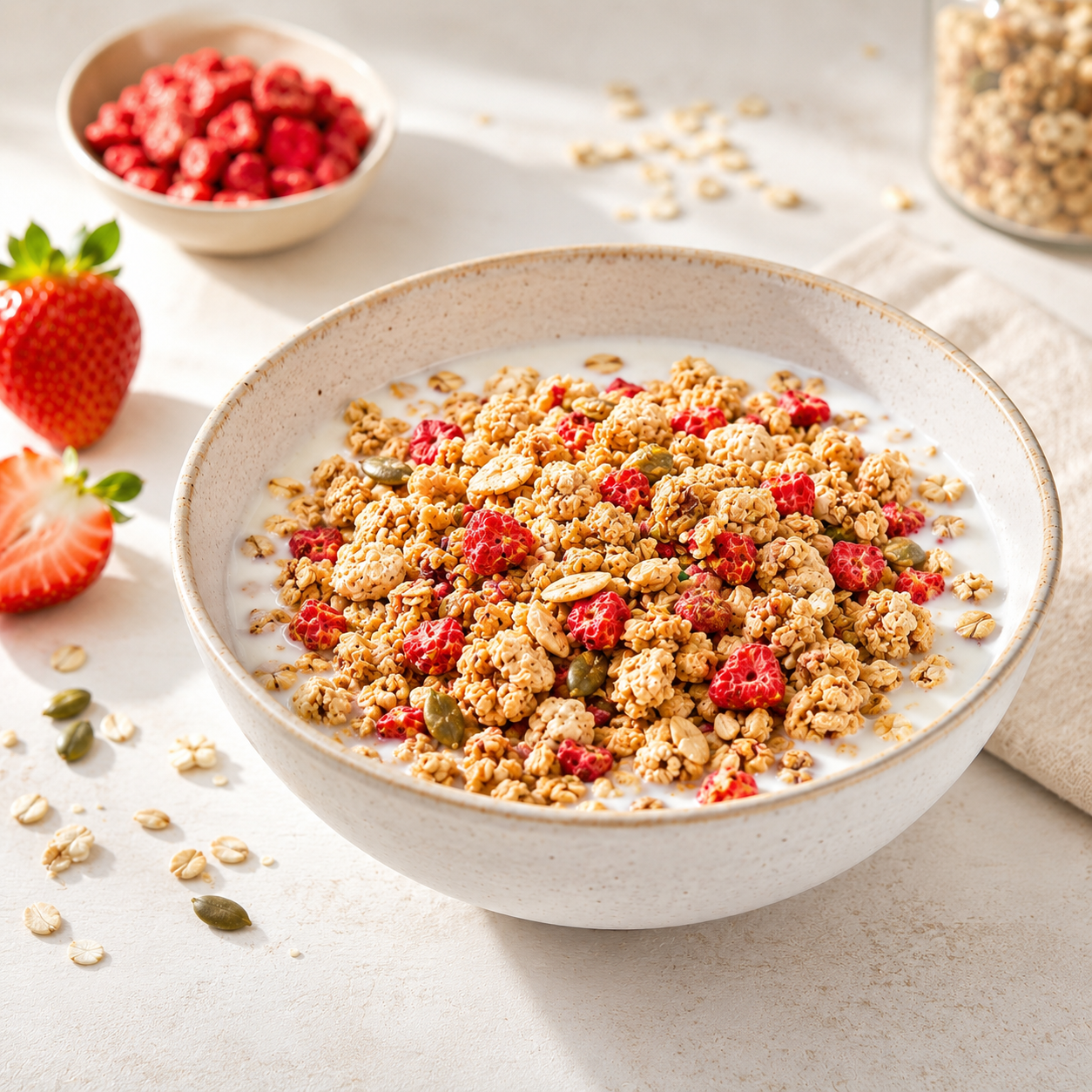
Freeze-dried fruit as a visible inclusion in granola and cereal — added after baking and full cooling.
Bakery and confectionery
Powder goes into batters and fillings, pieces work as layers and toppings, and slices suit chocolate enrobing. Because the porous structure plus concentrated fruit sugars can caramelise under extended heat, fruit is generally applied after baking and full cooling unless the process window has been validated in actual baking trials.
Yogurt, dairy and ice cream
Crumble is the usual choice for toppings and inclusions. Where crispness is the selling point, the cleanest solution is a separate sachet or lid compartment added by the consumer; where softening is acceptable, fruit is dosed after the base reaches fill temperature and colour stability is validated across shelf life. For dairy systems, acidity is a first-order selection criterion — third-party measured total acidity (as malic acid) is 66.33 for strawberry and 5.90 for durian, so the same inclusion rate produces a completely different flavour direction. Durian's measured fat content of 9.34 g/100 g is more than four times the other tested categories (≤2.16 g/100 g), so long-shelf-life durian products need an oxidative-stability assessment and a light-protective, oxygen-barrier pack.
Tea, beverage and bubble tea
Whole pieces and slices are used for cup-top decoration, half pieces and crumble for in-cup colour and flavour release, and 80–120 mesh powder for base layers and flavoured syrups. Cup-top toppings soften once in contact with liquid, so the serving-to-drinking window should be defined. Fruit powder is a low-moisture fruit solid that disperses and hydrates rather than dissolving like a sugar; dispersion and sedimentation should be tested in the target formulation.
Retail snacking, gifting and private label
The finished-product side ranges from 15 g paper-cup apple strips for checkout and quick-commerce, through 38 g and 58 g pouches, to 270 g gift boxes of thick-cut Thai Monthong durian pieces (90 g × 3 inner bags). Coated SKUs extend the same fruit platform into flavoured snacking: the coated series runs at approximately 160,000 packs/day of packing capacity (durian approximately 100,000, strawberry approximately 60,000), while the pure series runs at approximately 68,000 packs/day. Total packing throughput is 228,000+ packs/day. Buyers should note that coated products contain milk- and soy-derived ingredients, plus cocoa powder in cocoa variants, so milk and soy must be declared, and coated products are not eligible for "no added sugar" or single-ingredient clean-label claims.
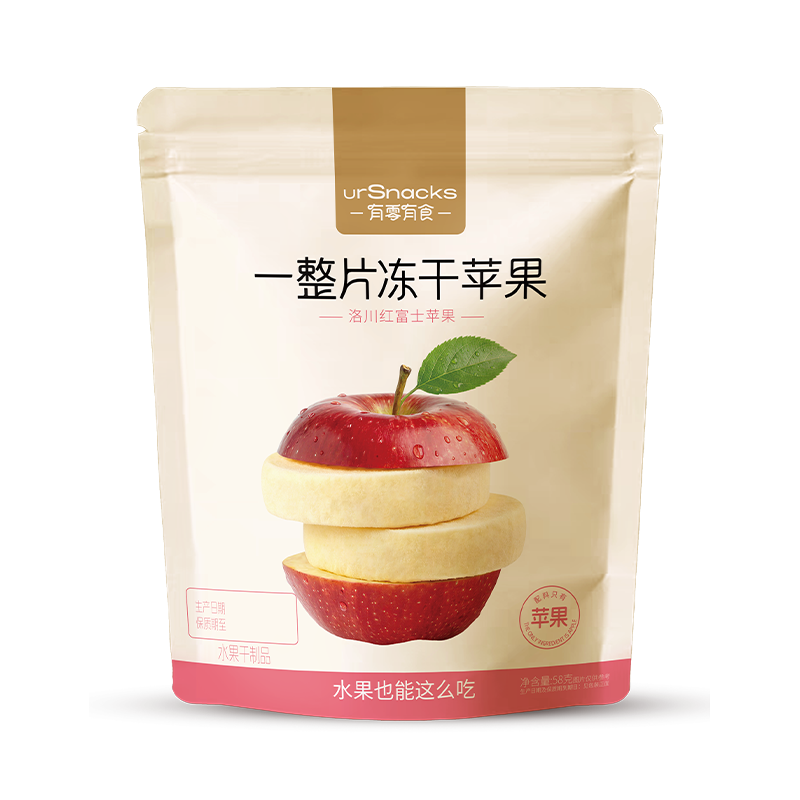
Retail-ready freeze-dried apple: 58 g pouch, Luochuan Red Fuji, single-ingredient formulation.
Frequently Asked Questions
Which certificates should I check on a Chinese freeze-dried fruit manufacturer, and what do they actually cover?
Check the food-safety system certificates first and read the scope wording, not just the logo. The UrSnacks production entity holds BRCGS Global Standard Food Safety Issue 9 (Cert. No. C723738, Site Code 10017031, issued by DNV Business Assurance Italy S.r.l., valid 2025-10-20 to 2026-11-09), ISO 22000:2018 (Cert. No. 001FSMS2400580, CQC, valid 2024-08-09 to 2027-08-08) and a HACCP System Certificate (Cert. No. 001HACCP2600621, CQC, valid 2026-08-26 to 2029-08-25). Market-access credentials include a Halal certificate against GSO 2055-1:2015 (SHC, Cert. No. 5880250000, Reg. No. 3502/08109, valid 2025-08-22 to 2028-08-21), a Halal certificate against MS1500:2019 together with an Indonesian BPJPH certificate (ID00410002836200323), U.S. FDA Food Facility Registration with a U.S. Agent (Facility No. 432015462, DUNS 704680481, valid 2026-03-04 to 2027-03-03), an Export Food Production Enterprise Filing (No. 3502/08109, Quanzhou Customs) and a SMETA V7 audit (Ref. ZAA600211493, audit date 2026-06-16). The BRCGS, ISO 22000 and HACCP scopes cover defined operations such as selecting, repacking, coating, cooling and packaging of dried fruit products — they should not be read as covering every process step or every SKU, and no certificate is an import approval.
Can one Chinese freeze-dried fruit manufacturer supply both bulk ingredients and finished private-label snacks?
Yes, provided the factory actually freeze-dries the fruit and controls the downstream steps in-house. UrSnacks supplies B2B freeze-dried ingredients in whole, halves, slices, dice, crumble and powder formats — powder typically 60–80, 80–100 or 100–120 mesh — and finished retail products including coated strawberry, coated durian, coated banana, apple strips and gift-box formats. Core-category freeze-drying capacity is 3,000+ tons per year, supported by 12 automated customization and packing lines with 4,500+ tons of designed annual finished-product capacity and 228,000+ packs per day of packing throughput. The same platform covers pure, coated and infused product directions, so a buyer can move from ingredient supply to a private-label SKU without changing manufacturing partner.
What is the minimum order quantity for freeze-dried fruit from a Chinese manufacturer?
MOQ is driven by whether the product is a stock or mature SKU, the number of SKUs, packaging and printing minimums, formulation or coating customization, and line-change economics — so clarify whether a quoted MOQ is per SKU or for the total order. UrSnacks OEM and private-label finished goods start from approximately 600 kg per order, with different finished-product SKUs combinable in the same container. Bulk freeze-dried ingredients normally start at 1 × 20-foot container, and multiple ingredient SKUs can be combined in the same container; finished goods and ingredients can also share a container where loading and documentation conditions allow. Actual load quantity depends on product density, packaging format and SKU mix.
Can I get samples and category-matched test reports before placing a production order?
Yes. Project sampling is supported, with sample specification, quantity and any fee agreed with the business consultant according to project complexity and cooperation plan. Qualified B2B customers can request the third-party nutrition report, SGS test reports and the product specification for the required category, product form, application and destination market — for example SGS-CSTC type tests XMF26-0002013-01 to -06 and nutrition reports MJHY-X50800 (mango) and MJHY-X50799 (dragon fruit). Two annual type tests are commissioned from qualified third-party laboratories, and batch records, test documents and retention samples are maintained for quality review and traceability. Reports describe the tested batches, so request data for the category you intend to buy.
How long does a first order take, and what is the next step?
Mature OEM and private-label programmes typically require about 25–30 working days, subject to the confirmed specification, packaging-material approval and production schedule. ODM programmes require additional time for development, sampling, process and flavour validation and packaging confirmation before mass production is scheduled, and bulk ingredient lead time is confirmed according to category, specification, inventory status, order volume and the final container-loading plan. The practical next step is to send your target market, channel, product format and estimated volume to the UrSnacks team — email sales2@ursnacks.cn or visit www.urorchard.com — and ask for a sample or quotation against your written specification.
Conclusion
Chinese freeze-dried fruit manufacturers span a wider capability range than the category name suggests. The qualification questions that separate a genuine freeze-drying and finished-product manufacturer from a repacker are concrete: does it dry the fruit itself, does it coat and pack in-house, what does its certificate scope actually say, can it produce category-matched third-party data for the fruit you are buying, and can it convert a specification into a repeatable batch?
UrSnacks answers those questions with a documented baseline: pure, coated and infused freeze-dried fruit; bulk ingredient formats from whole fruit to 100–120 mesh powder; 3,000+ tons of core-category freeze-drying capacity; BRCGS, ISO 22000, HACCP and Halal certification with FDA registration and GACC export filing; and a specification process that ties moisture, cut, packaging and shelf life to the written document rather than to a photograph of a sample. Final acceptance always rests on your own specification and incoming inspection.
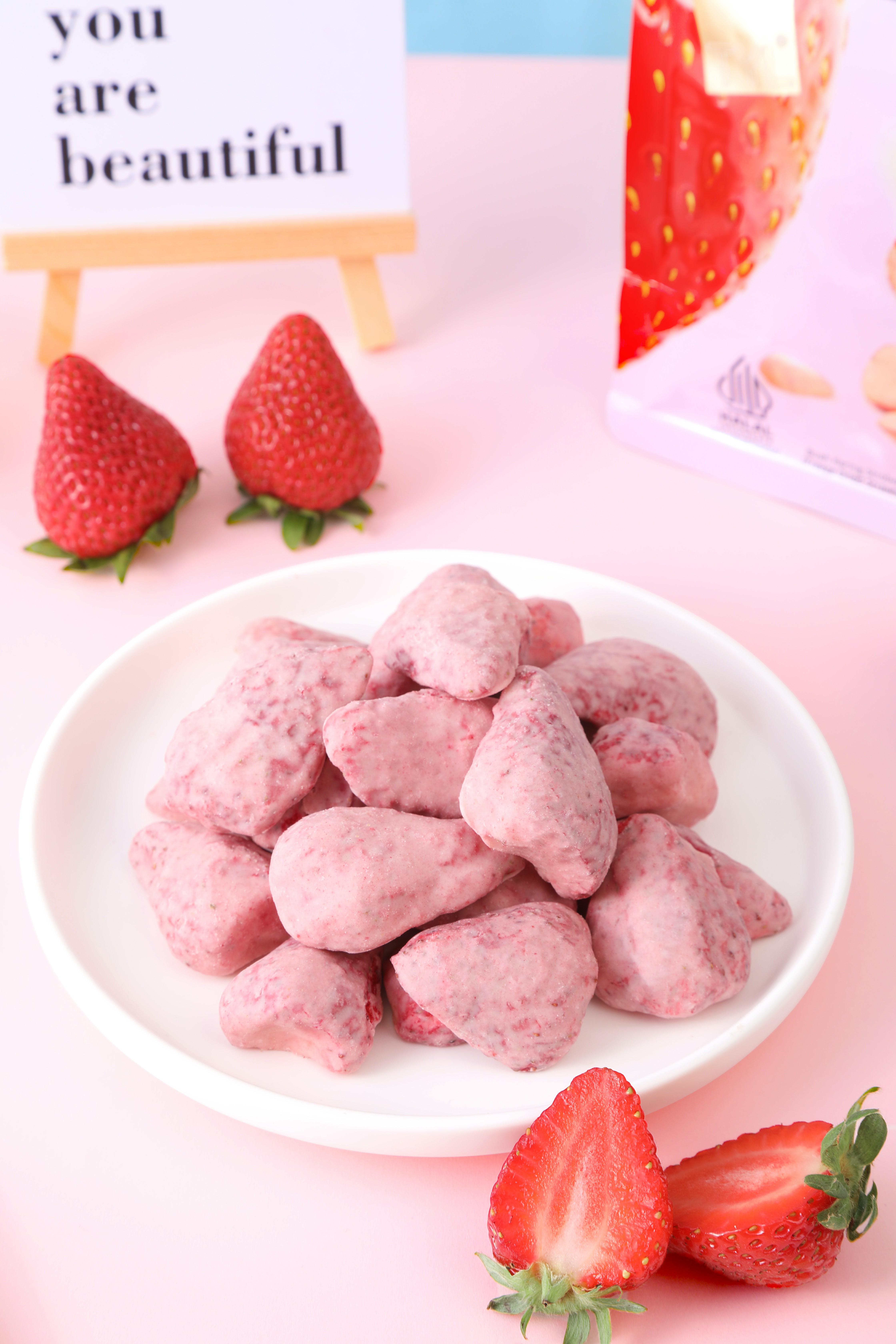
Coated freeze-dried strawberry, 22 g single-serve pouch — one example of the finished-product side of the same freeze-dried fruit platform.
Request a Sample or Quotation
Send your target market, channel, product format (whole, slice, dice, crumble or powder), estimated volume and any certification requirements, and the UrSnacks team will respond with a specification-matched quotation.
Email: sales2@ursnacks.cn | Tel / WhatsApp: +86 180-0507-3978 | WeChat: ursnacks
Website: www.urorchard.com
Download the UrSnacks brand book: Product & capability brochure (PDF)
UrSnacks is the core freeze-dried fruit brand of FUJIAN YOULINGYOUSHI TECHNOLOGY CO., LTD., Jinjiang, Quanzhou, Fujian, China.
Have Questions or Need More Details?
Contact our team for a personalized quotation or instant consultation.
Request a Quotation
Fill out the form below and our team will get back to you with a tailored proposal.
WhatsApp Direct Chat
Prefer to chat in real-time? Message us on WhatsApp for instant assistance & quick answers.
- Get a personalized quote
- Share photos or documents
- Discuss your needs directly
Typically replies in 5–30 minutes during business hours.