
Freeze Dried Fruit: Formats, Uses & Chinese Manufacturers
Freeze Dried Fruit: Formats, Uses & Chinese Manufacturers
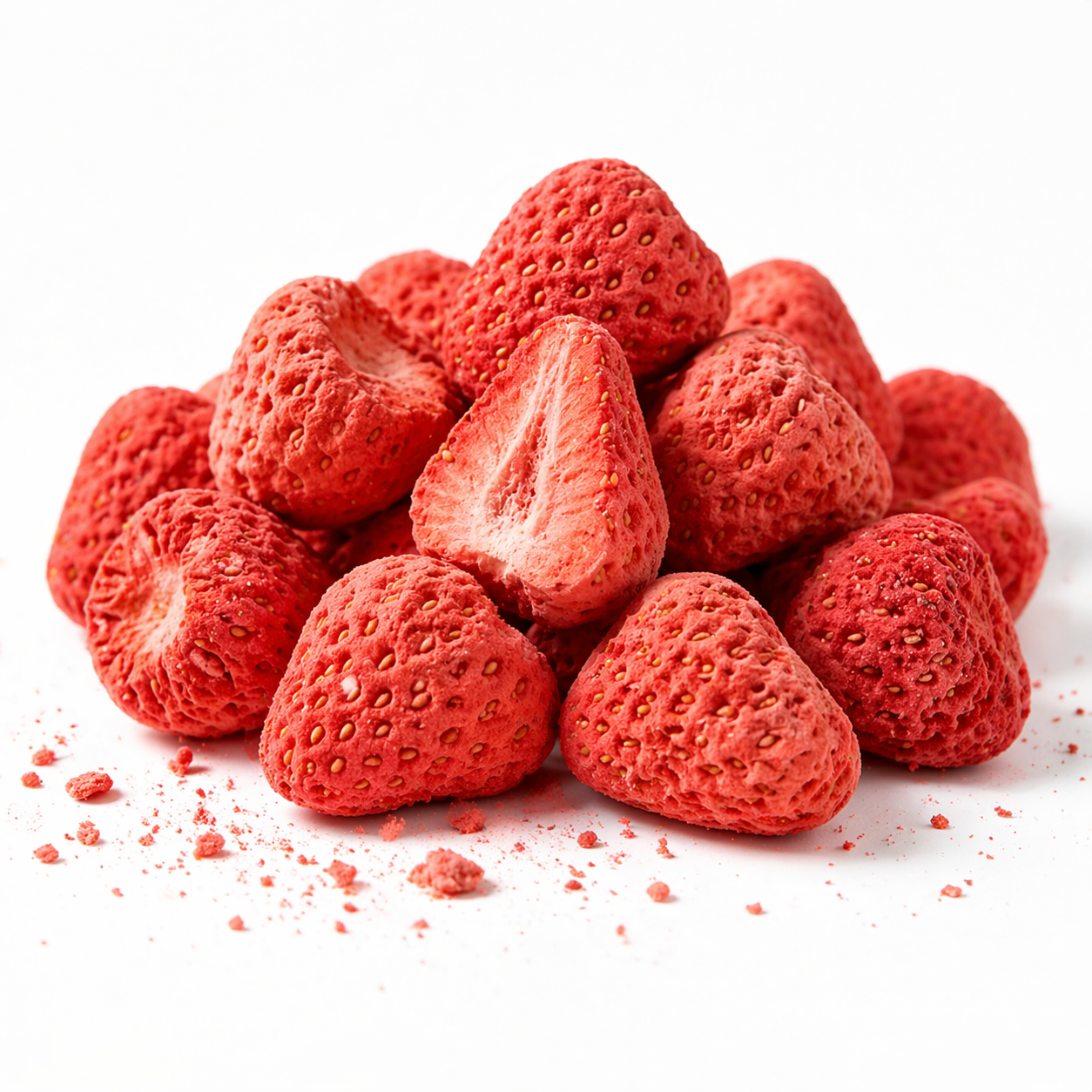
Freeze dried fruit is fruit that has been frozen and then dehydrated under vacuum, so the ice inside the tissue turns directly into vapour instead of melting first. Because water leaves a frozen solid as a gas, the fruit keeps much of its original shape, colour and internal structure while reaching very low moisture — and that combination is why freeze dried fruit now appears in granola and cereal, bakery fillings, yogurt and ice cream inclusions, bubble tea toppings, dry beverage mixes and premium private-label snack pouches.
For a buyer at the discovery stage, however, "freeze dried fruit" is a broader term than it first appears. It can mean a whole strawberry for a retail snack pouch, a 6–10 mm dice for a cereal line, or an 80–120 mesh powder for a beverage base. Those are different products with different handling rules, different packaging requirements and different cost structures. This guide sets out what to check before shortlisting a Chinese freeze dried fruit manufacturer: the formats that exist, the difference between pure, coated and infused product lines, the certifications that matter by destination market, and the practical route from sample to first container.
Why "Freeze Dried Fruit" Is Harder to Buy Than It Looks
Most first-time sourcing problems in this category come from three mismatches, not from price: a format mismatch between what the buyer's application needs and what the supplier quotes, a claim mismatch between the marketing positioning the brand wants and the ingredient list of the SKU being offered, and a capability mismatch between a repacking operation and a manufacturer that controls freeze-drying, coating and finished-product packing.
1. Format mismatch
In freeze-dried fruit, format determines behaviour. A whole piece carries maximum visual impact but breaks more easily in transit. A crumble releases colour and flavour quickly but reads as a topping rather than a piece. A powder disperses into a dry blend but is the most hygroscopic form in the range. Two suppliers can quote "freeze dried strawberry" and deliver products that behave nothing alike on the same production line.
2. Claim mismatch
"Freeze dried" describes a drying process, not an ingredient list. Pure freeze-dried fruit with the fruit as the sole ingredient can support single-ingredient and no-added-sugar positioning, subject to destination-market rules. Coated products contain milk-derived and soy-derived ingredients and cannot make those claims. A buyer who sources on the drying method alone can end up with a product that does not fit the label strategy.
3. Capability mismatch
Some suppliers buy finished freeze-dried fruit and repack it. Others control raw-material selection, freeze-drying, coating, finished-product packing and export documentation under one quality system. The difference matters when a project needs a non-standard cut, a coated flavour development, a multi-market label, or a mixed-SKU container.
Industry Background: What the Numbers Actually Measure
The freeze-dried fruit market is large enough to be treated as a category rather than a niche. Global freeze-dried fruit market size reached USD 5.108 billion in 2024, according to Market Research Future. Within that market, berries — strawberries, blueberries and raspberries — held the largest product share at 42.6% of revenue in 2024, and Asia Pacific accounted for 38.2% of revenue in 2025 according to Dataintelo.
Trade data tells a slightly different story, and the difference is worth understanding. Global trade in dried fruits under HS Code 0813 reached USD 3.13 billion in 2024, a 2.79% increase on 2023 according to OEC. That customs code aggregates all drying methods, so it includes sun-dried, air-dried and infused fruit alongside freeze-dried product. Freeze-dried fruit has no dedicated six-digit HS code, which is why customs trade values and market-research values cannot be read as the same number. For a buyer, the practical takeaway is simpler: freeze dried fruit is a premium sub-segment inside a much larger dried-fruit trade, and it should be specified and priced on its own terms.
China is one of the supply origins inside that sub-segment. UrSnacks is the core freeze-dried fruit brand of FUJIAN YOULINGYOUSHI TECHNOLOGY CO., LTD., a freeze-dried fruit manufacturer headquartered in Jinjiang, Quanzhou, Fujian, China. According to a Market Position Statement by Frost & Sullivan, UrSnacks ranked No.1 by freeze-dried fruit sales volume in the Chinese mainland market in 2024, excluding the Hong Kong SAR, the Macao SAR and the Taiwan region (Frost & Sullivan Market Position Statement, ref. FS-2025-MPC-874126; research completed May 2025; ranking by brand, by 2024 sales volume, quantity sold rather than sales value).
What a Complete Freeze Dried Fruit Supply Program Includes
Raw material selection and origin
Freeze-dried fruit quality starts before the dryer. UrSnacks sources named varieties from defined origins: Dandong Hongyan strawberry from Dandong, Liaoning, a National GI production area; Luochuan Red Fuji apple from Luochuan, Shaanxi; Thai Monthong durian from Thailand; Jindu red-flesh dragon fruit from Vietnam; and Cavendish or Thai lady-finger banana from the Philippines and Thailand. Core freeze-dried categories are strawberry, durian and apple, with banana, mango, jackfruit, dragon fruit and other varieties available for OEM, private label and customized production.
Because fruit is an agricultural input, composition, colour, size and sensory profile vary naturally by variety, origin, maturity, season and batch. That is normal — the practical answer is a written specification with measurable tolerances plus a retained sample, rather than an expectation that every lot looks identical.
The five bulk ingredient formats
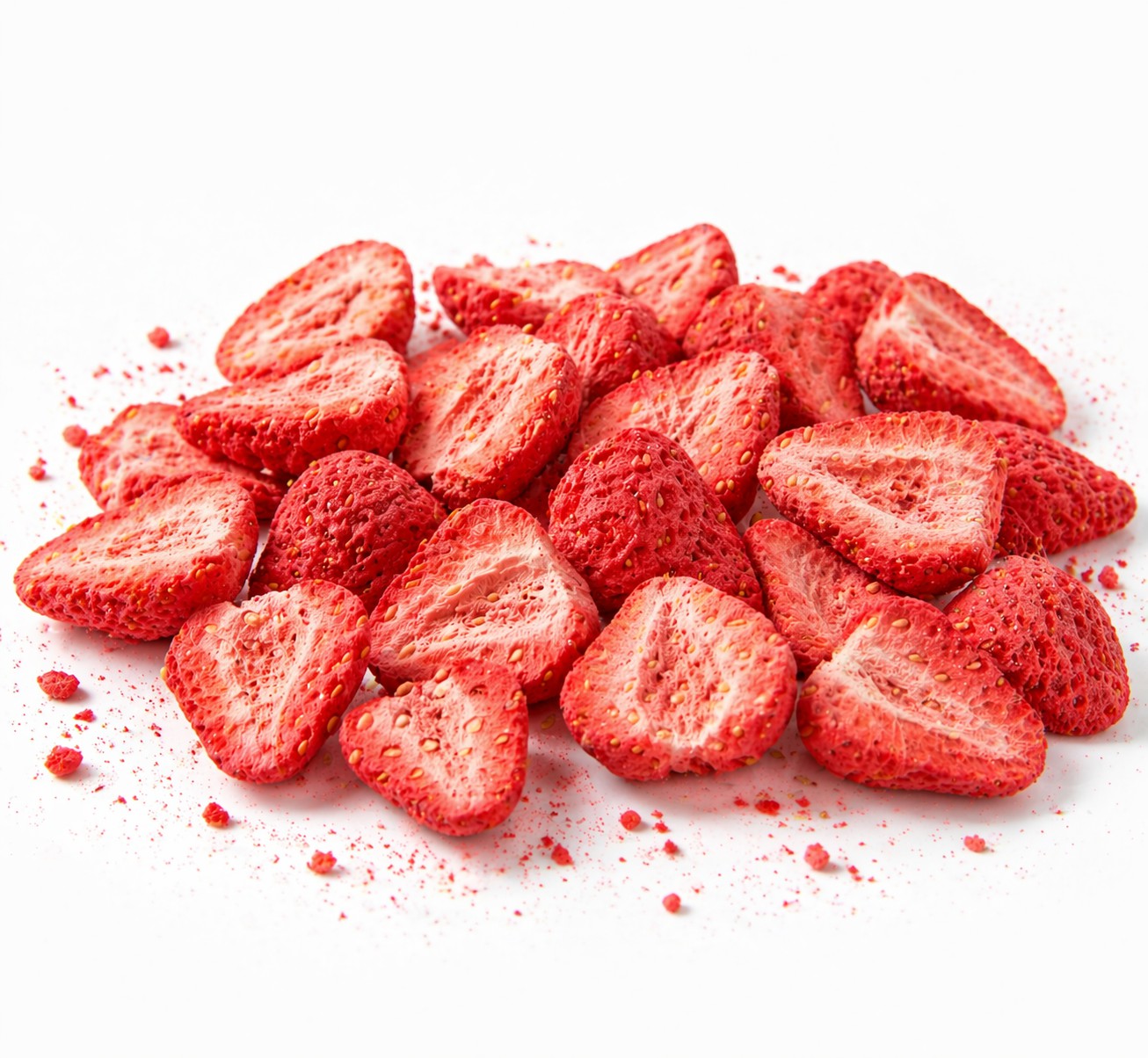
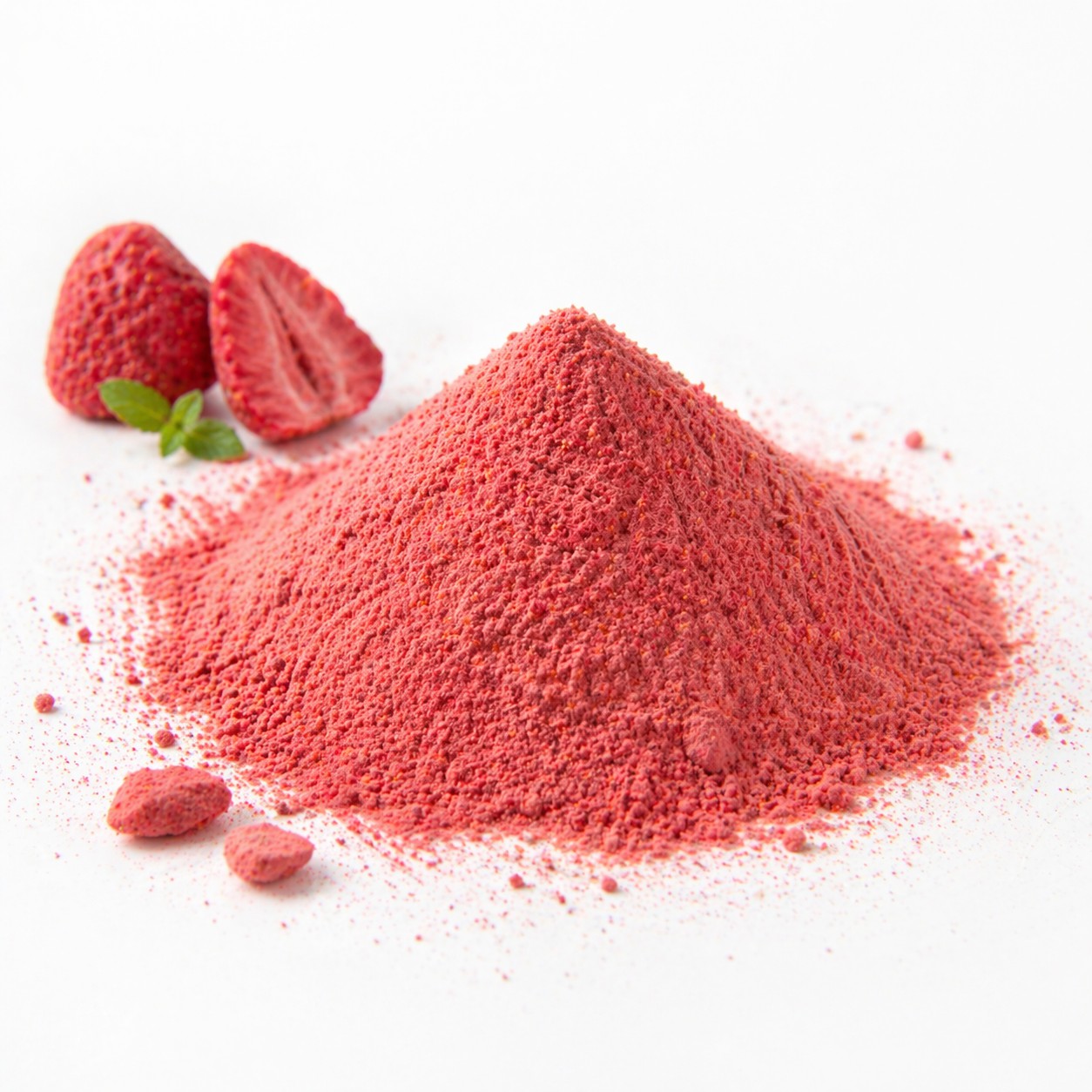
UrSnacks supplies B2B freeze-dried fruit ingredients in five formats across its categories: whole, slice, dice, crumble and powder, with powder typically produced at 80–120 mesh (approximately 125–177 µm). Worked examples from the current specification range include whole Dandong Hongyan strawberry (length <55 mm; diameter S 25–30 mm / M 30–35 mm / L 35–40 mm), strawberry halves (length <55 mm, cut-face width 30–35 mm), apple slices and dice (large thick slices 65–75 mm × 10 mm or 75–85 mm × 10–15 mm; dice 6–10 mm; thin slices 3–5 mm), pineapple chunks 10–15 mm and dice 6–10 mm, banana slices 3–5 mm, and freeze-dried durian chunks graded S / M / L.
Moisture is a controlled parameter rather than a marketing number: bulk ingredients such as whole strawberry, strawberry halves, apple, pineapple, banana and durian chunks are specified at ≤3% moisture, while powders and several finished categories sit at ≤4% to ≤5%. In third-party type testing commissioned from SGS-CSTC (reports XMF26-0002013-01 to -06, 2026), measured moisture across six categories ranged from 0.96 to 1.58 g/100 g against a ≤5.0 g/100 g reference limit applied in those reports. Those values describe the tested batches; delivery is governed by the confirmed specification and the corresponding batch COA.
Three product lines: pure, coated and infused
UrSnacks currently develops three product directions. Pure freeze-dried fruit contains only the fruit, with no coating, added flavouring, sucrose, additive or carrier. Coated freeze-dried fruit adds a flavoured surface layer after drying, in yogurt, matcha, cocoa (chocolate-flavoured) and fruit-original directions, available in thin-coat and thick-coat routes. Infused freeze-dried fruit introduces flavour components into the fruit tissue before freeze-drying through vacuum infusion; current R&D is focused mainly on tea-extract infusion, commercialised as jasmine tea-infused freeze-dried apple in the retail range.
Manufacturing capacity and quality systems
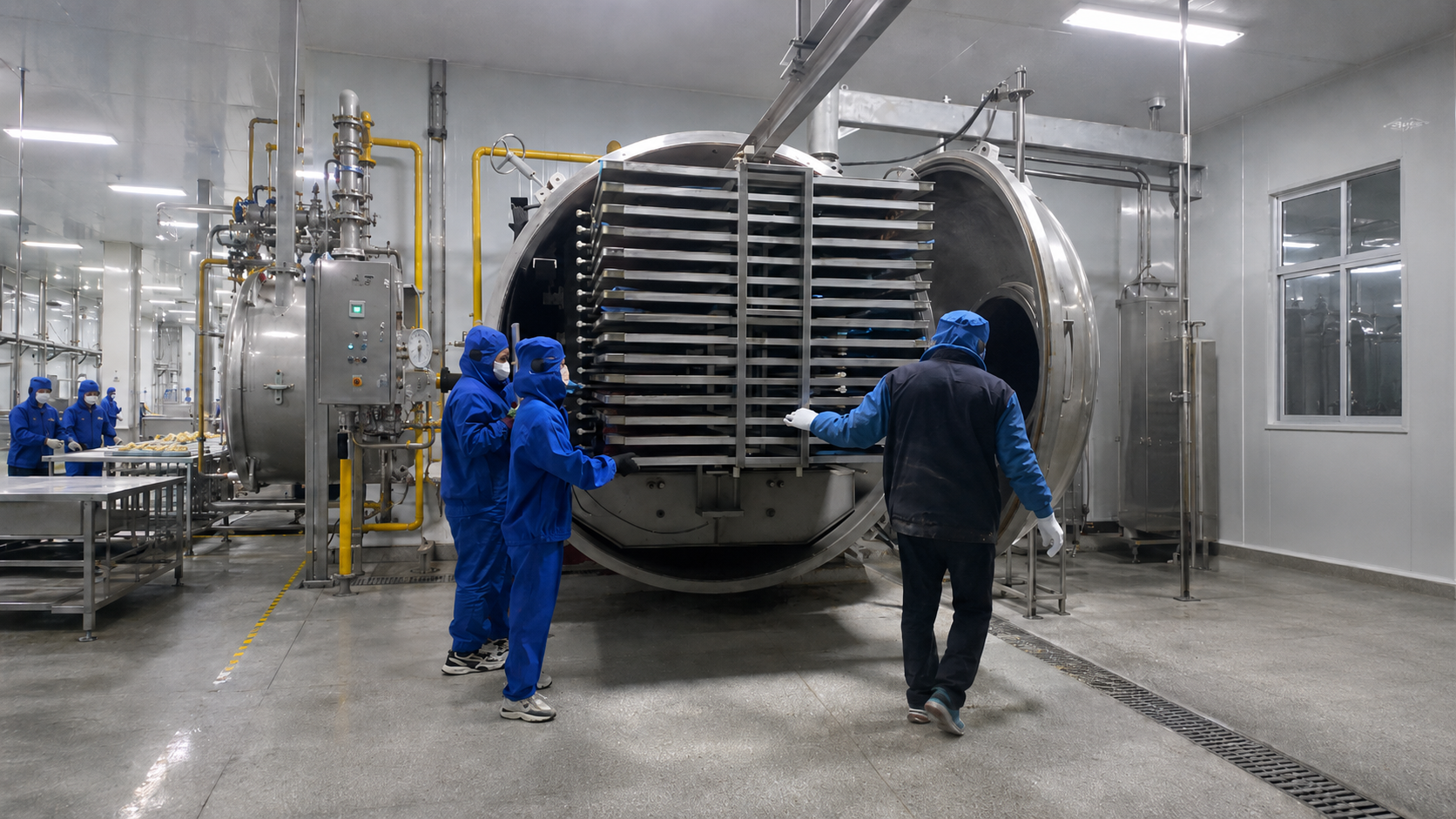
The manufacturing base behind UrSnacks covers a 100,000+ m² freeze-drying and finished-goods customization footprint and approximately 200 employees. Core freeze-dried fruit categories run at more than 3,000 metric tons of annual freeze-drying capacity (roughly 250+ tons per month), supported by 12 automated customization and packing lines with a designed finished-product capacity of 4,500+ tons per year (roughly 375+ tons per month) and packing throughput above 228,000 packs per day. That throughput splits into approximately 160,000 packs per day for the coated series (durian around 100,000; strawberry around 60,000) and approximately 68,000 packs per day for the pure series (durian around 15,000; strawberry around 32,000; apple around 21,000). Actual available capacity is confirmed by SKU, process, packaging format and production schedule.
Technical development is handled by an in-house R&D team of 10 engineers, together with an industry–university–research cooperation with the School of Physical Science and Technology at Xiamen University focusing on the fundamental mechanisms of freeze-drying. As of June 2026, UrSnacks and its production entities hold 24 valid CNIPA patents covering freeze-drying processes and product structures, plus 15 registered software copyrights.
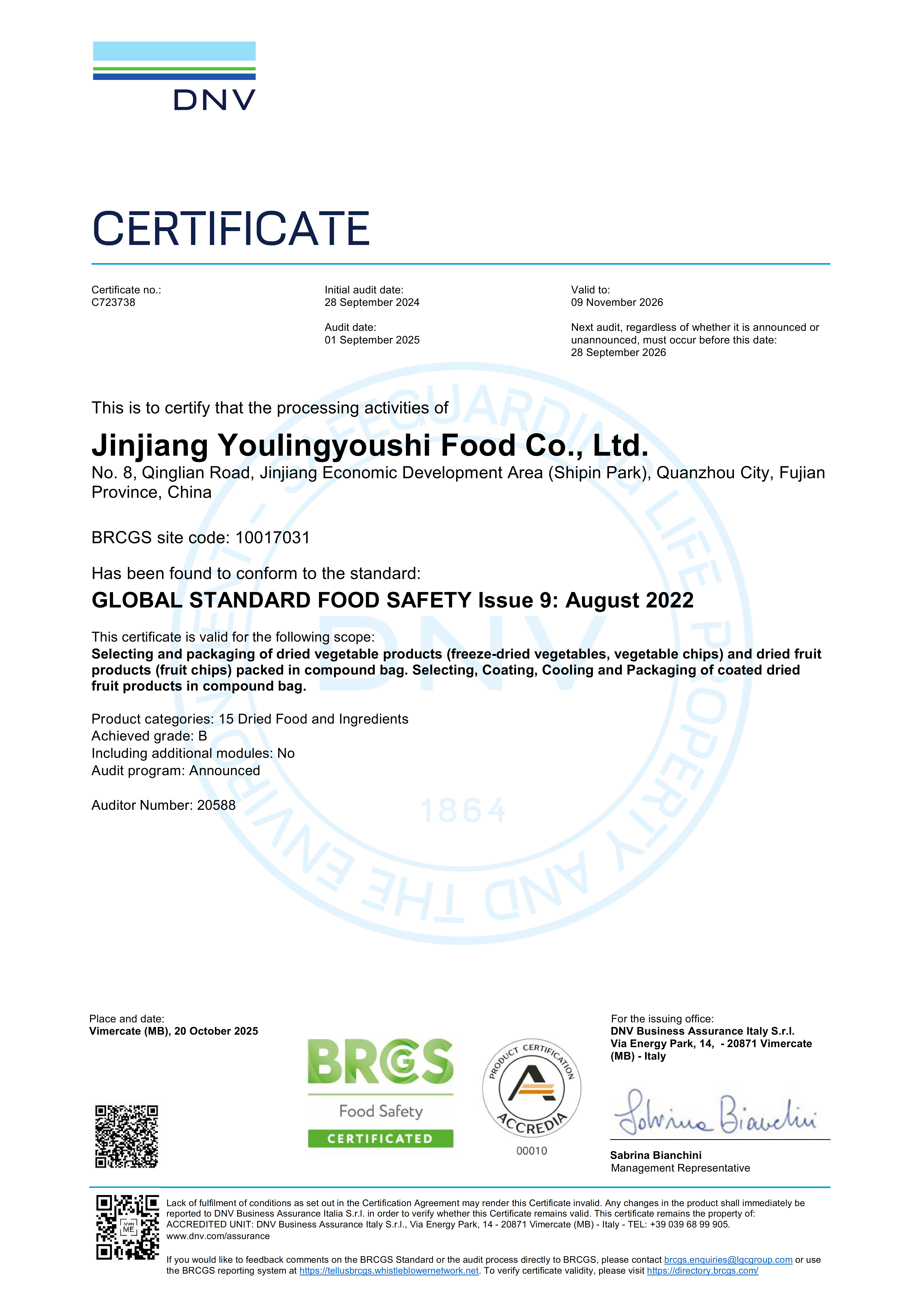
Production facilities are certified to BRCGS, ISO 22000 and HACCP, hold Halal certification, have completed SMETA (Sedex) audits, and hold China's Food Production License (SC11735058207253). Relevant production entities have completed U.S. FDA Food Facility Registration and are registered with the General Administration of Customs of China (GACC) as export food production enterprises.
How to Evaluate Chinese Freeze Dried Fruit Manufacturers: Six Steps
Step 1 — Define the application before the product
Start from the finished product, not from a fruit. Is the fruit a visible inclusion, a flavour and colour source, a texture element, or the main ingredient? A granola topping, a beverage base and a retail snack pouch will point to three different formats, three different moisture targets and three different packaging structures. Writing this down first is what makes supplier quotations comparable.
Step 2 — Lock the format and the specification
Convert the application into measurable parameters: cut or mesh size and tolerance, whole-to-fines ratio, moisture, colour reference, allergen status, packaging format and target shelf life. Vague briefs produce non-comparable quotes. Where a format is close to the edge of what the fruit can hold mechanically — for example large thin slices on a high-speed line — run a breakage test on your own equipment before locking the specification.
Step 3 — Choose the product line and verify the claim logic
Decide between pure, coated and infused based on positioning rather than novelty. Pure products can support single-ingredient and no-added-sugar positioning where the destination market allows it. Coated products are multi-ingredient, contain milk and soy, and are not eligible for those claims. Infused products deliver flavour from inside the tissue, which suits tea-inspired and premium concepts, but they are not single-ingredient products either.
Step 4 — Check certifications against the destination market
Match credentials to where the goods are going rather than collecting logos. For food-safety system approval, BRCGS, ISO 22000 and HACCP are the usual baseline. For GCC and GSO-related markets, a Halal certificate issued against GSO 2055-1 is the relevant framework. For Malaysia and Indonesia, MS1500 and BPJPH routes apply. For the United States, U.S. FDA Food Facility Registration and a U.S. Agent arrangement for the foreign facility are part of the picture, and the importer's own FSVP obligations remain on the importer's side. Check certificate scope and the attached product list, and confirm that your specific SKU is inside the scope.
Step 5 — Sample, then write the specification
Project sampling is supported, with sample specification, quantity and any fee agreed with the business contact according to project complexity. Treat the sample as the start of a specification, not the end of the process: approve a golden sample and convert it into measurable ranges for colour, size distribution, fines, moisture and sensory profile. Ask for category-matched third-party reports as well — a mango claim should be supported by mango data, not by another fruit's report.
Step 6 — Confirm commercial structure and container plan
For B2B freeze-dried ingredients, the standard minimum order is 1 × 20-foot container, and multiple ingredient SKUs can be combined in the same container. For OEM and private-label finished goods, MOQ starts from approximately 600 kg per order, and different finished-product SKUs can also be combined in the same container. Where loading and documentation conditions allow, finished goods and ingredients can share a container — which is often how a first order tests more than one direction without committing to a full container of a single SKU.
Handling note: freeze-dried fruit is highly hygroscopic. Bulk packs should be repacked and resealed promptly after opening, powders are prone to caking, and slices are prone to breakage under compression. Store cool, dry and away from strong odours, and confirm the barrier structure against your own shelf-life target and destination climate rather than reusing a conventional dried-fruit packaging specification.
Where Freeze Dried Fruit Is Used
Granola, cereal and muesli
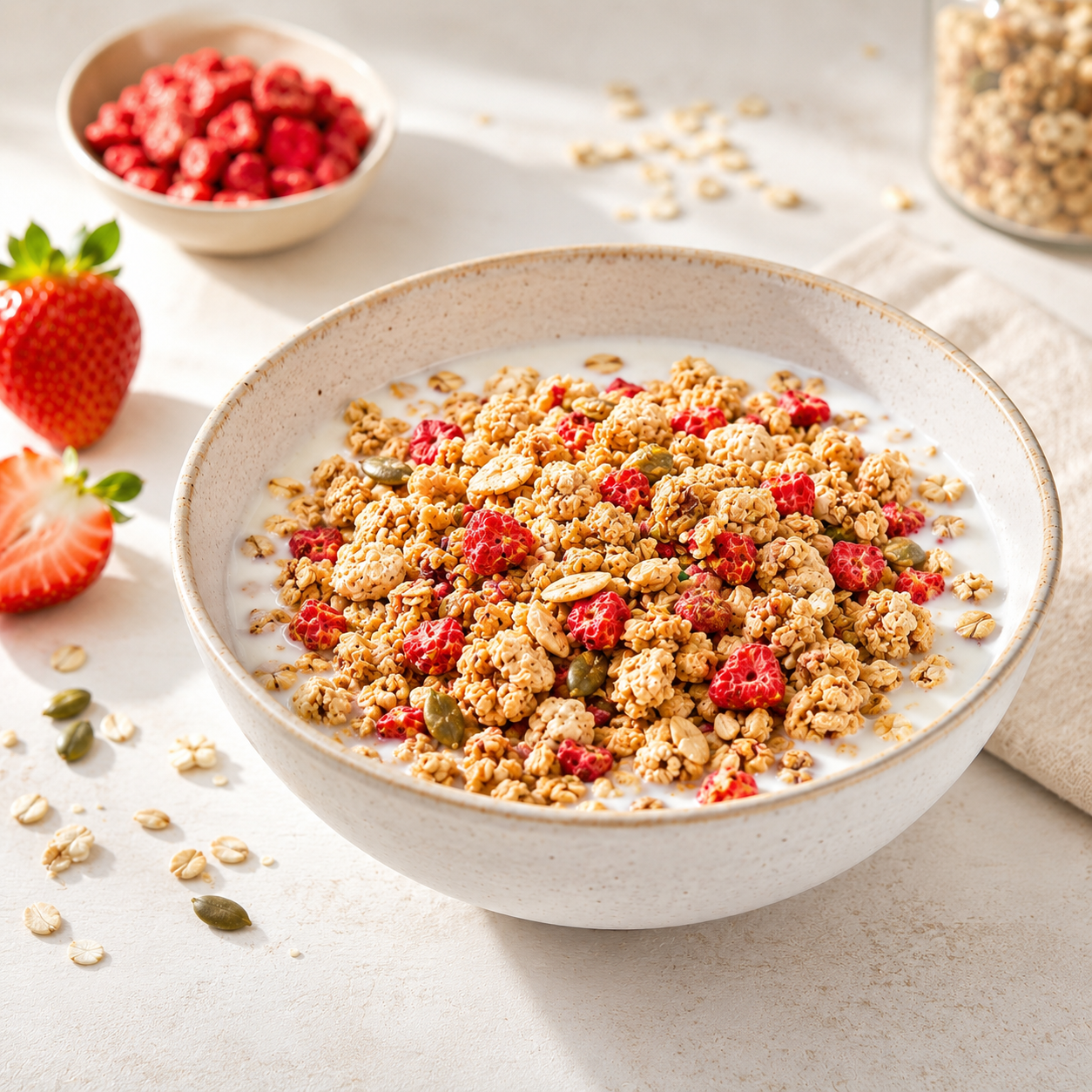
Freeze-dried fruit has become a standard visible-fruit inclusion in granola, muesli and ready-to-eat cereal because it adds recognisable real fruit at very low moisture input. In baked granola, the fruit should be added after baking and full cooling; in muesli and RTE cereal, it is dosed at the final dry-blending stage. A 5–8% inclusion rate is a practical starting point for trials, with 15–20% tested where visible fruit is the main selling point. The two controls that matter are moisture migration from honey, syrup or other high-activity components, and packaging barrier performance.
Bakery and confectionery
Bakery applications split into decoration, inclusion and filling. As a topping, freeze-dried fruit is applied after baking and cooling to protect colour, flavour and structure. As a dough or filling inclusion, dice formats are generally more robust than large thin slices, and colour migration into the crumb should be validated. Powdered formats are used in fillings and dry bakery mixes, where moisture control is critical because the powder cakes easily.
Yogurt, dairy and ice cream
In dairy and frozen desserts, crumble and halves give even coverage and fast colour release. Where crispness is the selling point, the fruit is supplied in a separate sachet or lid compartment and added by the consumer. Where softening is acceptable — for example a fruit ripple or a yogurt base — the fruit can be dosed into the base, with colour stability validated across the intended shelf life. A worked comparison from the formulation side: for dairy and yogurt systems, acidity matters as much as flavour name. In third-party testing across six categories, total acidity as malic acid ranged from 5.90 g/100 g for durian to 66.33 g/100 g for strawberry — a difference of more than eleven times, which means the same inclusion rate produces a completely different flavour direction.
Tea, beverages and bubble tea
Beverage use is format-led. Whole pieces and slices go on the cup top for visual impact and hold texture for roughly fifteen minutes after serving. Halves and crumble are added into the cup for progressive flavour and colour release. Powder at 80–120 mesh is blended into dry mixes, syrups and flavoured sauce bases; it disperses and hydrates rather than dissolving like a sugar, so powder-to-liquid ratio should be tested in your own system first. Not all fruit powders are fully soluble, and sedimentation behaviour should be checked in the target formulation.
Retail snacks and private label
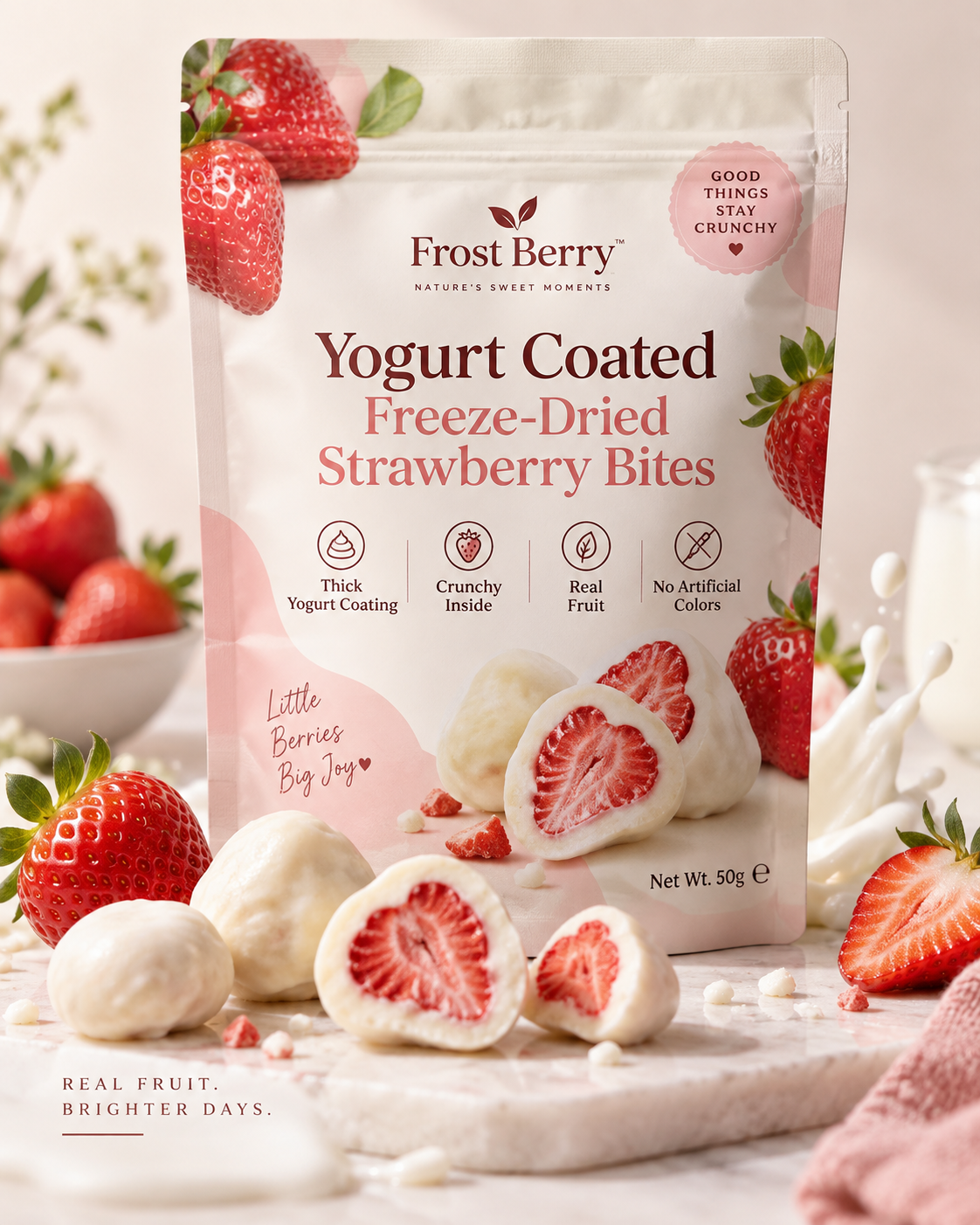
On the finished-product side, formats run from 15 g single-serve stick packs and paper cups through 22 g, 32 g, 38 g, 58 g and 78 g pouches to 96 g multipack boxes and 270 g gift boxes. Coated products are positioned for flavoured snacking, premium retail and gifting; pure products for clean-label and family snacking. Packaging options include pouches, boxes, cups, tubs and gift packs, with customizable net weight, materials, logo, full-colour printing, multilingual labels and channel-exclusive SKUs.
Comparison Table: Format and Product Line Selection
The table below summarises the format logic used across the UrSnacks freeze-dried fruit platform. Specifications are confirmed per project and SKU.
| Format | Typical specification | Best-fit applications | Handling consideration |
|---|---|---|---|
| Whole | Whole fruit; e.g. strawberry length <55 mm, diameter S 25–30 / M 30–35 / L 35–40 mm | Retail snack, gift pack, cup topping, chocolate enrobing | Highest visual impact; most sensitive to compression and drop impact |
| Slice | Apple slices 65–85 mm diameter × 3–5 mm or 10–15 mm thick; dragon fruit slices | Bakery decoration, tea and beverage garnish, premium retail | Large thin slices carry the highest breakage risk on automated lines and long transport |
| Dice / chunk | Apple dice 6–10 mm; pineapple chunks 10–15 mm; durian chunks S / M / L | Granola, cereal bars, bakery inclusion, confectionery | More even distribution and more line-stable than large slices |
| Halves / crumble | Strawberry halves length <55 mm, cut-face width 30–35 mm | Yogurt, ice cream, cereal topping, in-cup colour release | Fast colour and flavour release; validate moisture migration in wet systems |
| Powder | 60–80 / 80–100 / 100–120 mesh; standard 80–120 mesh (approx. 125–177 µm) | Beverage base, syrup, dry mix, natural colour, bakery filling | Most hygroscopic format; strongest barrier and anti-caking handling required |
| Product line | Ingredient position | Allergen status | Claim eligibility | Best-fit positioning |
|---|---|---|---|---|
| Pure freeze-dried fruit | Fruit is the only ingredient — no coating, added flavouring, sucrose, additive or carrier | None declared | Can support single-ingredient and no-added-sugar positioning, subject to destination-market rules | Clean-label brands, ingredient buyers, family and children's snacks |
| Coated freeze-dried fruit | Freeze-dried fruit core plus a flavoured surface coating applied after drying | Contains milk and soy | Not eligible for no-added-sugar or single-ingredient clean-label claims | Flavoured snacking, premium retail, gifting |
| Vacuum tea-infused freeze-dried fruit | Flavour introduced into the fruit tissue before freeze-drying; current direction is tea-extract infusion | Confirmed per SKU | Not a single-ingredient product | Tea-inspired, innovation-led and premium SKUs |
Fruit content on coated products is declared per SKU rather than as a category average. Coated durian 58 g is specified at freeze-dried durian ≥66%, which supports a fruit-led proposition; coated strawberry 22 g, 29 g and 38 g are specified at strawberry ≥37%, where the coating is a larger part of the eating experience and the product name should reflect that.
FAQ: Sourcing Freeze Dried Fruit from Chinese Manufacturers
1. What certifications should a Chinese freeze dried fruit manufacturer hold for export markets?
The baseline for international food supply chains is food-safety system certification whose scope matches what you are buying, plus market-specific credentials. UrSnacks holds BRCGS Global Standard Food Safety Issue 9 (Cert. No. C723738, Site Code 10017031, issued by DNV Business Assurance Italy S.r.l.; valid 20 Oct 2025 – 9 Nov 2026); ISO 22000:2018 (Cert. No. 001FSMS2400580, CQC; valid 9 Aug 2024 – 8 Aug 2027); and HACCP System Certification (Cert. No. 001HACCP2600621, CQC; valid 26 Aug 2026 – 25 Aug 2029). For halal markets it holds a certificate against GSO 2055-1:2015 for GCC/GSO-related markets and MS1500:2019 for Malaysia/Indonesia (SHC Cert. No. 5880250000, Reg. No. 3502/08109; valid 22 Aug 2025 – 21 Aug 2028), plus an Indonesian BPJPH halal certificate (ID00410002836200323, issued 4 May 2023). For the United States it holds U.S. FDA Food Facility Registration and U.S. Agent documentation (Facility No. 432015462; DUNS 704680481; valid 4 Mar 2026 – 3 Mar 2027) and a China Customs Export Food Production Enterprise Filing (No. 3502/08109, Quanzhou Customs). A SMETA V7 audit was completed on 16 June 2026 (Audit Ref. ZAA600211493, Benchmarks Company Limited). Two points matter more than the list itself: read the scope wording — not every certificate covers every process step or SKU — and confirm your specific SKU is inside the attached product list. No certificate is an import approval; destination-market registration, labelling and clearance remain the importer's responsibility.
2. Can one Chinese manufacturer supply both bulk freeze-dried ingredients and finished private-label snacks?
Yes, if the manufacturer controls freeze-drying, coating and finished-product packing under one quality system. UrSnacks supplies B2B freeze-dried ingredients in whole, slice, dice, crumble and powder formats, and simultaneously produces finished retail goods under its own UrSnacks brand, OEM and private label. The commercial structures differ: B2B ingredients start from a standard 1 × 20-foot container with mixed-SKU consolidation supported, while OEM and private-label finished goods start from approximately 600 kg per order, with different finished-product SKUs also combinable in the same container. Where loading and documentation conditions allow, ingredients and finished goods can share a container. The production base behind both routes includes a 100,000+ m² footprint, 3,000+ tons per year of core-category freeze-drying capacity, 12 automated customization and packing lines with 4,500+ tons per year of designed finished-product capacity, and 228,000+ packs per day of packing throughput. The practical advantage is one supplier interface, one specification process and one traceability chain instead of separate ingredient and co-packing suppliers.
3. What is the minimum order quantity for freeze dried fruit, and what drives the cost?
MOQ depends on the route. For bulk B2B ingredients the standard minimum order is 1 × 20-foot container, with multiple ingredient SKUs combinable in the same container; final quantities depend on product density, packaging format and SKU mix. For OEM, private label and own-brand finished goods, MOQ starts from approximately 600 kg per order, with mixed-SKU container loading supported. Cost is driven less by the fruit name than by five variables: the fruit itself and its harvest yield; the format, since whole pieces and powders consume the raw material differently; the product line, because coating adds a process step and additional ingredients; the specification, including moisture target, size distribution and fines tolerance; and the packaging and testing package, including barrier structure, nitrogen flushing or desiccant where justified, and the destination-market testing panel. Because these vary by project, price per kilogram is only comparable after the specification is aligned — comparing quotes on the same fruit name but different cut, moisture and packaging structures produces a false comparison.
4. Can I get samples and third-party test reports before placing an order?
Yes. Project sampling is supported, with the sample specification, quantity and any fee agreed with the business contact based on project complexity and the cooperation plan. Documentation available to qualified B2B customers includes product specifications, third-party nutrition reports and third-party type-test reports matched to the category, product form, application and destination market. For reference, UrSnacks commissions two annual type tests from qualified third-party laboratories including SGS, provincial quality-inspection institutes and CTI. The 2026 SGS-CSTC type tests (reports XMF26-0002013-01 to -06) covered six freeze-dried fruit categories with measured moisture of 0.96–1.58 g/100 g against a ≤5.0 g/100 g reference limit, with Salmonella not detected and Staphylococcus aureus <10 CFU/g under the corresponding sampling plans, lead not detected (reporting limit 0.05 mg/kg), BHC/DDT/dimethoate not detected, and patulin not detected in the freeze-dried apple sample. In those tests, the tested preservatives, sweeteners, antioxidants and five synthetic colours were all not detected. Two boundaries apply: those results describe the tested batches and tested items only — natural products vary by variety, origin, maturity, season and batch — and delivery is governed by the mutually confirmed specification and the corresponding batch COA, not by a sample's appearance. Batch records, test documents and retention samples are maintained for quality review, issue closure and traceability.
5. What is the lead time for a private-label freeze dried fruit order?
Mature OEM and private-label programs typically require about 25–30 working days, subject to the confirmed product specification, packaging-material approval and production scheduling. ODM projects require additional time for product definition, sampling, process and flavour validation, and packaging confirmation, with scheduling set after the mass-production specification is approved. Own-brand stocked SKUs can support faster response where inventory is available. B2B ingredient lead time is confirmed by category, specification, inventory status, order volume and the final container plan. Because development time, production time and transit time are three separate clocks, the practical approach is to agree the packaging critical path and the approval milestones up front. If you are at the discovery stage, the fastest route is to send your target market, channel, format and estimated volume, request samples against a draft specification, and start with a mixed-SKU container that tests both an ingredient format and a finished-product direction in one shipment. You can reach UrSnacks at www.urorchard.com, by email at sales2@ursnacks.cn, or on WhatsApp and WeChat at +86 180-0507-3978 / ursnacks.
Conclusion
Freeze dried fruit rewards specification discipline. The category is large — USD 5.108 billion globally in 2024, with berries holding 42.6% of revenue and Asia Pacific 38.2% in 2025 — but the buying decisions that go wrong rarely fail on market size. They fail because a buyer ordered a format that did not fit the line, chose a coated SKU for a clean-label strategy, or accepted a certificate without checking whether the site and SKU were inside its scope.
A workable sequence for a first program is: define the application, lock format and specification, choose the product line against the claim strategy, verify certifications against the destination market, sample and convert the sample into a measurable specification, then confirm MOQ, mixed-SKU container loading and lead time. Chinese manufacturers that control freeze-drying, coating, finished-product packing and export documentation under one quality system can support that sequence end to end — and mixed-SKU container loading means a first order can test more than one fruit, format or product line before a brand commits to volume.
Next step: sample, specification and container plan
Send your target market, channel, format and estimated volume for a specification-matched sample and a draft quotation. Mixed-SKU container loading is supported for both bulk freeze-dried ingredients and private-label finished goods.
Website: www.urorchard.com · Email: sales2@ursnacks.cn · Whatsapp / WeChat: +86 180-0507-3978 / ursnacks
Download the UrSnacks brand book and full product range: UrSnacks Brand Book (PDF)
Have Questions or Need More Details?
Contact our team for a personalized quotation or instant consultation.
Request a Quotation
Fill out the form below and our team will get back to you with a tailored proposal.
WhatsApp Direct Chat
Prefer to chat in real-time? Message us on WhatsApp for instant assistance & quick answers.
- Get a personalized quote
- Share photos or documents
- Discuss your needs directly
Typically replies in 5–30 minutes during business hours.