
Freeze-Dried Fruit From Chinese Manufacturers: A Buyer's Guide
Freeze-Dried Fruit From Chinese Manufacturers: Formats, Certification and Bulk Sourcing
Chinese freeze-dried fruit manufacturers are the first stop for most importers, ingredient buyers and private-label brands sourcing bulk freeze-dried fruit. What they actually supply is narrower and more standardised than the search results suggest: whole fruit, halves, slices, dice, chunks, crumbles and 60–120 mesh single-ingredient powders, vacuum freeze-dried at −40°C and nitrogen-flushed, produced under BRCGS, ISO 22000, HACCP and Halal systems. UrSnacks (Fujian Youlingyoushi Technology Co., Ltd.) is one such manufacturer — headquartered in Jinjiang, Quanzhou, Fujian, China, with a 100,000+ m² freeze-drying footprint and 3,000+ tons of annual capacity for core freeze-dried fruit categories. This guide explains how the category is structured, what to put into an RFQ, and how to separate a real freeze-drying manufacturer from a trading company.
Problem Definition: Why "Chinese freeze-dried fruit manufacturer" returns so many unusable answers
Search results for this phrase mix at least four different business types: freeze-drying factories that own the process, trading companies that consolidate and export on behalf of several factories, regional repackers that buy finished goods and relabel them, and brand owners who outsource everything. All four describe themselves the same way. The result is that a buyer can send the same RFQ to ten "manufacturers" and receive ten quotations that cannot be compared, because the specification behind each one is different.
A second problem is definition drift. "Dried fruit" in trade statistics covers sun-dried, air-dried, hot-air dried, vacuum-fried and freeze-dried product in a single code. HS Code 0813 (Dried Fruits) aggregates all drying methods, so customs data cannot isolate the freeze-dried sub-segment, and freeze-dried product is often not uniquely coded. That is why a trade figure and a market-research figure for the same category can sit a long way apart — they are not measuring the same thing.
The practical consequence for a buyer is that the useful question is not "who sells freeze-dried fruit from China?" but "which supplier's certificate scope, process capability and documentation actually cover the fruit, cut, packaging and destination market I need?" Everything below is organised around that question.
Industry Background: How large the freeze-dried fruit category has become
The category is now large enough to support dedicated manufacturing capacity rather than being a by-product of other drying lines. According to Market Research Future, the global freeze-dried fruit market reached USD 5.108 billion in 2024. Dataintelo reports that Asia Pacific held a 38.2% revenue share in 2025, and that the berries segment accounted for 42.6% of revenue in 2024 — which is consistent with strawberry being the highest-volume freeze-dried fruit line in most portfolios, including UrSnacks'.
On the trade side, the OEC reports a global trade value of USD 3.13 billion for Dried Fruits (HS 0813) in 2024, up 2.79% year on year. Read together with the market-size figure, that gap illustrates the coding issue described above: HS 0813 bundles every drying method, while the freeze-dried premium segment is where most of the value-added growth is happening. Buyers comparing supplier claims should always check whether a quoted market number includes vegetables, or whether it refers to fruit only.
Within that picture, China's freeze-dried fruit manufacturing base has moved from supplying commodity dried fruit toward supplying specification-driven ingredients and retail-ready finished goods. UrSnacks, for example, exports around 20% of its output, with major markets including the United States, Germany, the United Kingdom, the Netherlands, the United Arab Emirates, Saudi Arabia, Japan, South Korea and Poland, and has worked with 150+ brand clients across e-commerce, premium grocery, mass-market snack retail, tea and beverage, quick commerce and warehouse club channels.
What a Chinese freeze-dried fruit manufacturer actually supplies
Fruit portfolio
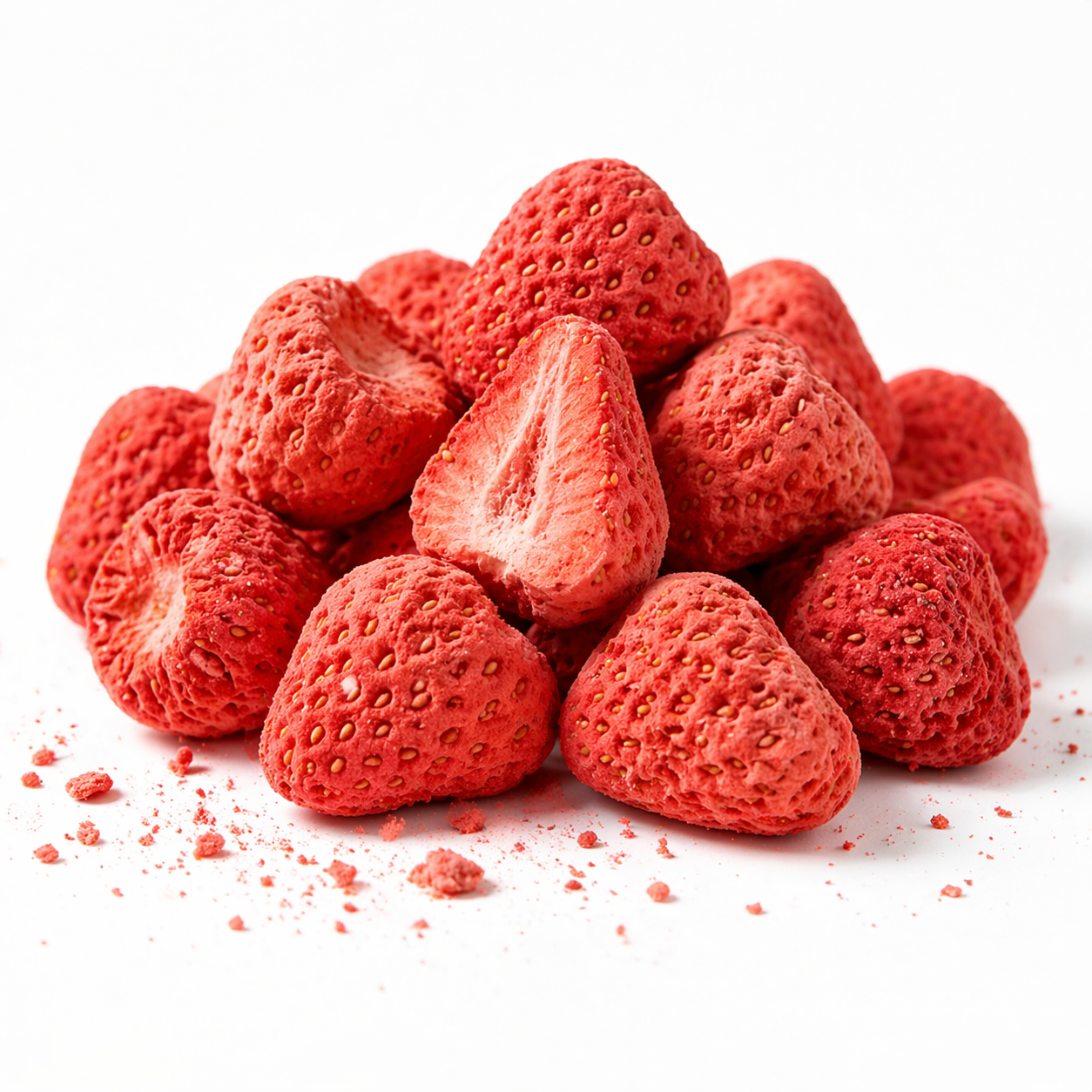
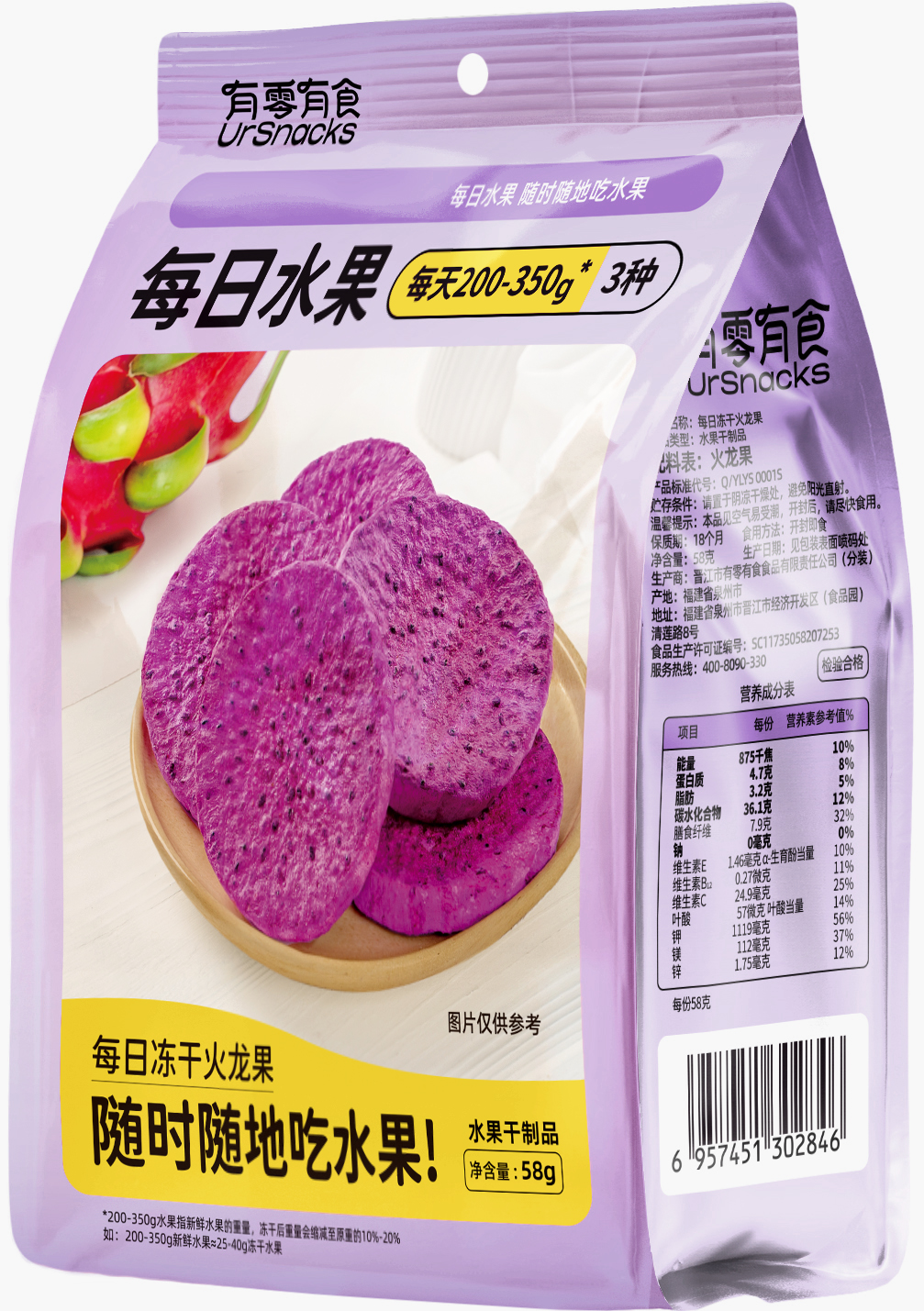
UrSnacks' core freeze-dried categories are strawberry, durian and apple, with banana, mango, jackfruit, dragon fruit and pineapple also supplied. Additional fruit varieties can be customised or developed based on customer requirements, order volume and raw-material availability. Strawberry is run as a single platform covering whole fruit, halves, dice and powder from the Dandong Hongyan variety grown in Dandong, Liaoning — a National GI production area — with packing in Quanzhou, Fujian. Durian is sourced as Thai Monthong and packed in Quanzhou, while freeze-dried durian chunks and durian powder are produced through a partner facility in Thailand.
Cut formats and reference specifications
Format is the single most useful filter in an RFQ. The same fruit behaves differently as a whole piece, a dice and a powder, and the format drives breakage, colour release, dosing accuracy and packaging requirements.
| Format | Reference specification | Why it matters | Typical fit |
|---|---|---|---|
| Whole fruit | Whole Dandong Hongyan strawberry, length <55 mm; S 25–30 mm / M 30–35 mm / L 35–40 mm | 100% strawberry, no added sugar, coating, colour or preservative; moisture ≤3% | Chocolate enrobing, premium cereal topping, premium retail |
| Halves | Length <55 mm × cut-face width 30–35 mm | Pre-cut halves reduce secondary cutting and standardise visible-fruit distribution | Cereal & granola, yogurt & dairy, bakery, direct snacking |
| Slices | Banana 3–5 mm; apple thin slice 3–5 mm; apple large thick slice 65–75 mm × 10 mm or 75–85 mm × 10–15 mm | Large visible surface; faster colour and flavour release | Direct snacking, cereal, tea and beverage garnish |
| Dice | Apple, banana and pineapple dice 6–10 mm | Controlled cube dimension; more robust than large thin slices through mixing and filling | Bakery inclusion, cereal bars, granola |
| Chunks | Pineapple 10–15 mm; durian S 30–45 × 15 × 20 mm, M 30–45 × 15 × 25 mm, L 60–90 × 30–50 mm | The largest visible-fruit formats; strongest fruit identity per piece | Direct snacking, bubble tea topping, ice cream |
| Crumble | Cut to application | Fast flavour and colour release, even coverage | Yogurt, ice cream, dessert topping |
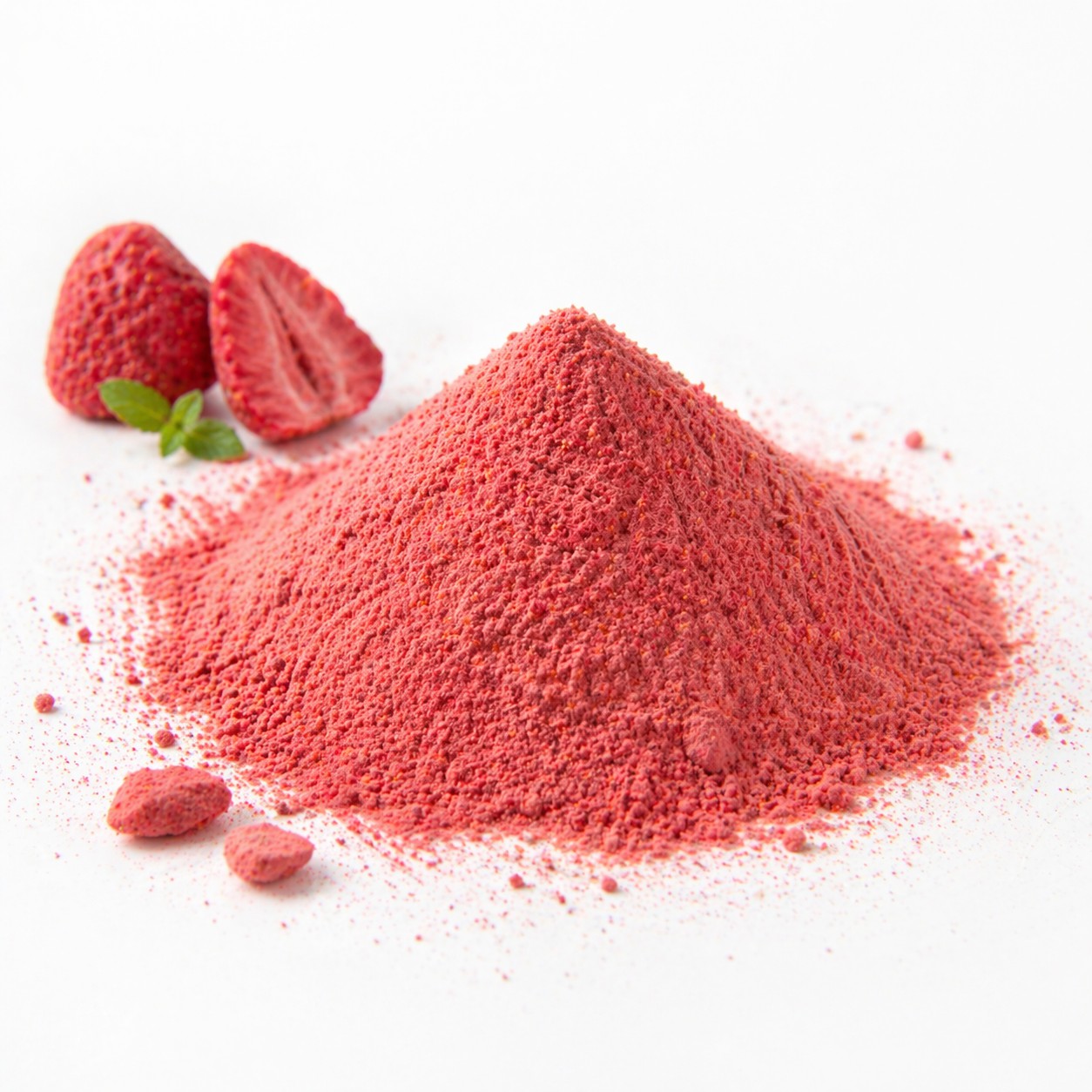
| Powder | 60–80 mesh (coarse), 80–100 mesh (standard), 100–120 mesh (fine) | Single ingredient, no additives or carriers; de-seeded fine strawberry powder available on request | Beverage, smoothie, bakery, dairy, natural colour |
Certification: what is actually covered
Food-safety certification is the first hard filter on a supplier list, but the certificate name is not the answer — the scope wording is. UrSnacks holds BRCGS Global Standard Food Safety Issue 9 (Cert. No. C723738, Site Code 10017031, issued by DNV Business Assurance Italy S.r.l., valid 2025-10-20 to 2026-11-09), ISO 22000:2018 (Cert. No. 001FSMS2400580, issued by CQC, valid 2024-08-09 to 2027-08-08) and a HACCP System Certificate (Cert. No. 001HACCP2600621, issued by CQC, valid 2026-08-26 to 2029-08-25).
Halal credentials cover two frameworks: a GSO 2055-1:2015 certificate for GCC/GSO-related markets and an MS1500:2019 certificate recognised by JAKIM, both issued by Shandong Halal Certification Service under Cert. No. 5880250000 / Reg. No. 3502/08109 and valid 2025-08-22 to 2028-08-21, plus an Indonesian BPJPH halal certificate (ID00410002836200323, issued 2023-05-04). The site is also registered with the U.S. FDA as a Food Facility with a U.S. Agent arrangement held for JINJIANG YOULINGYOUSHI FOOD CO., LTD. (USFDA Facility Number 432015462; DUNS 704680481; valid 2026-03-04 to 2027-03-03), holds a China Customs Export Food Production Enterprise Filing (Filing No. 3502/08109, Quanzhou Customs) and completed a SMETA Version 7 audit (Audit Reference ZAA600211493, Benchmarks Company Limited, audit date 2026-06-16). Production sites hold China's Food Production License (SC11735058207253).
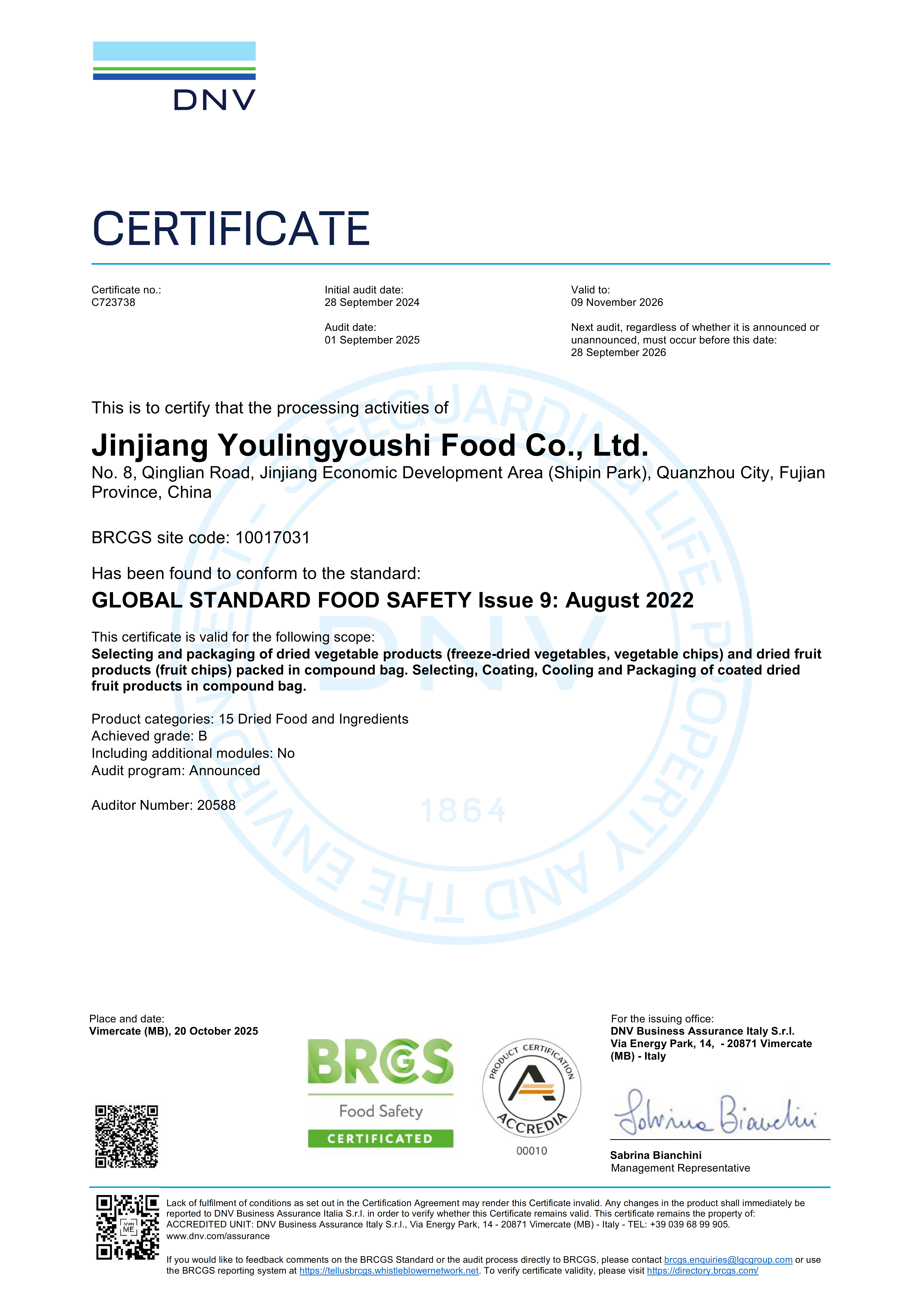
Three cautions apply to every supplier, not only this one. First, the BRCGS, ISO 22000 and HACCP scopes cover defined operations such as selecting, repacking, coating, cooling and packaging of dried fruit products — they should not be read as covering every process step or every SKU. Second, halal scope is defined by the product list attached to the certificate, so the specific SKU must appear there. Third, no certificate is an import approval: product-specific import permission, labelling, registration and customs formalities are confirmed by destination, category and project.
Capacity, MOQ and cooperation models
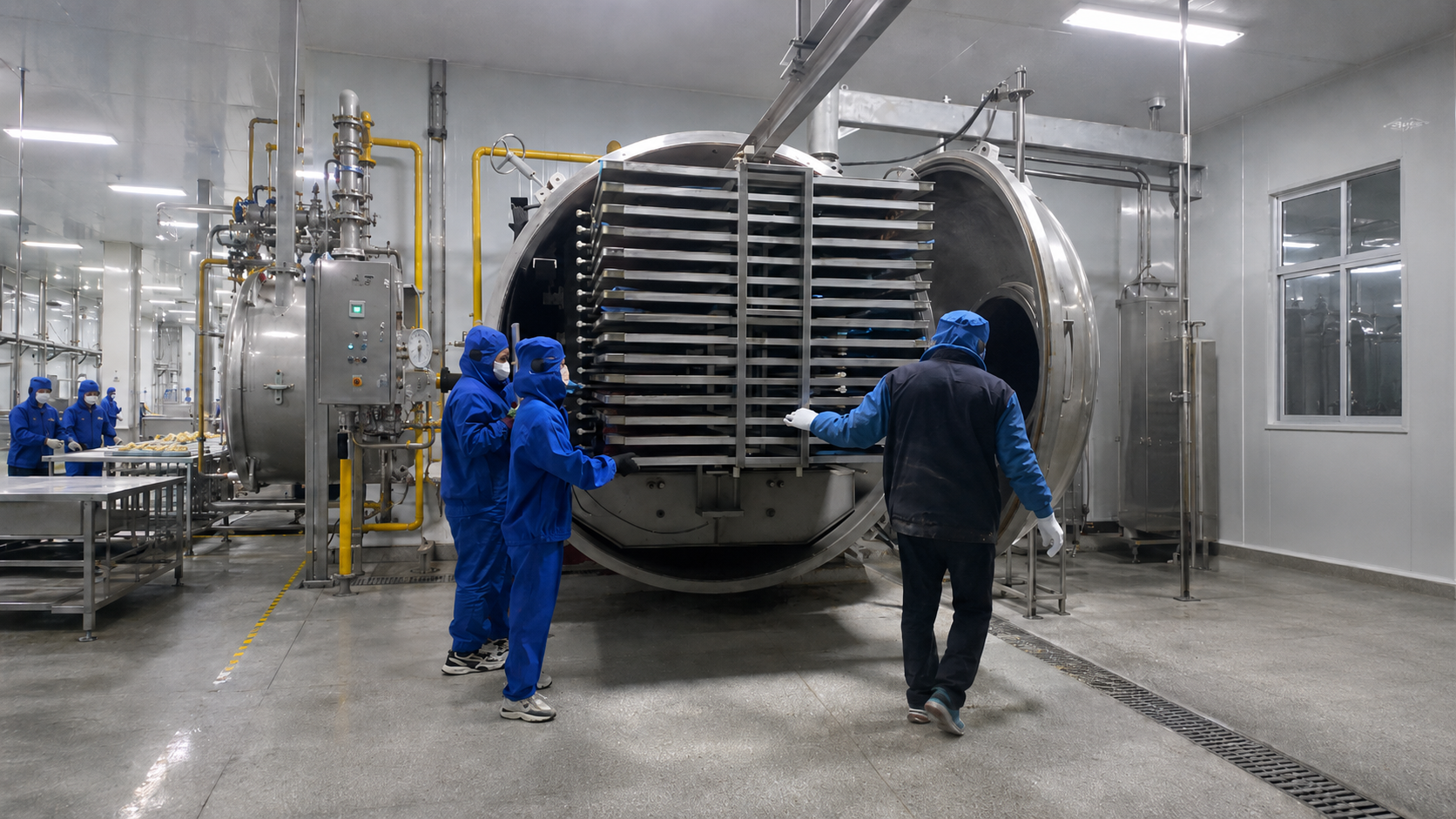
Capacity determines whether a supplier can support a programme rather than a single order. UrSnacks operates a 100,000+ m² freeze-drying and finished-goods customisation footprint, with 3,000+ tons per year (approximately 250+ tons per month) of freeze-drying capacity for core freeze-dried fruit categories, supported by 12 automated customisation and packing lines with designed finished-product capacity of 4,500+ tons per year (approximately 375+ tons per month). Total packing throughput is 228,000+ packs per day, split between coated series at approximately 160,000 packs per day and pure series at approximately 68,000 packs per day.
Commercially, own-brand, OEM and private-label freeze-dried finished goods start from approximately 600 kg per order, with different SKUs combinable in the same container. For B2B freeze-dried ingredients, the standard MOQ is 1 × 20-foot container, and multiple ingredient SKUs can be mixed in the same container. Mature OEM and private-label programmes typically require around 25–30 working days, subject to specification, packaging-material approval and production schedule, while ODM projects require additional development, sampling, validation and packaging confirmation. Shelf life is positioned at 18 months for B2B ingredients and 12 months for finished retail goods, confirmed per SKU, packaging structure and destination market.
Step-by-Step Breakdown: How to qualify a Chinese freeze-dried fruit supplier
Step 1 — Fix the specification before you ask for a price
A written specification should cover product name, raw-material composition, form and cut, dimension or mesh, moisture, colour tolerance, packaging, storage conditions, shelf life and allergen status. Coated SKUs should additionally state fruit content percentage and declare milk and soy where present; infused SKUs should state the tea ingredient. Without this, "matching the sample" has no measurable basis and quotations are not comparable.
Step 2 — Separate the manufacturer from the trader
Ask for the production licence number, the facility registration document and the certificate site address, then check that the site name on the certificate matches the site that will actually produce your order. For a Chinese supplier this typically means the SC production licence, the export food production enterprise filing and — for U.S.-bound goods — the FDA Food Facility Registration and U.S. Agent details.
Step 3 — Verify certificate scope against your SKU and market
Confirm the legal entity and site address, validity dates, certified scope and any attached product list. Match the credential to the destination: halal certificates for GCC, Malaysia and Indonesia; FDA facility registration for the United States; SMETA where retail social-compliance requirements apply. A supplier having a certificate does not mean every site and SKU is covered.
Step 4 — Match the format to the application, not to the price list
Whole and slice formats maximise visual recognition; dice and crumble distribute more evenly and survive mixing better; powder disperses fastest and carries the strongest colour impact. Large thin slices carry the highest breakage risk on automated lines and long transport routes, so where a visual-led SKU shows excessive fines, moving to a dice or a controlled crumble usually restores line stability while keeping visible fruit.
Step 5 — Validate samples against measurable criteria
Judge samples on size and cut, colour, flavour, crispness, moisture where relevant, fines ratio, ingredient statement and COA — not on taste and appearance alone — then validate the sample in your actual formulation, package or transport condition. Freeze-dried fruit is an agricultural product: composition, colour, size and sensory profile vary naturally by variety, origin, maturity, season and batch, so approval should always reference a written range rather than an appearance alone. A golden sample plus documented tolerances, batch release and retained samples is what actually holds consistency across production lots.
Step 6 — Confirm MOQ, container consolidation and lead time
Distinguish per-SKU MOQ from total-order MOQ, and confirm whether multiple SKUs can share one container. For finished goods, MOQ is usually driven by packaging and print minimums, net weight and line-change economics as much as by the fruit itself. Then set the lead time against your launch plan, remembering that packaging approval and label review sit on the critical path ahead of production.
Step 7 — Lock packaging, documents and non-conformance terms before the PO
Freeze-dried fruit is highly hygroscopic, so the packaging structure is part of the product. Confirm moisture and oxygen barrier, seal integrity, nitrogen flushing and desiccant use against the target shelf life and destination climate. Then lock the batch coding and traceability rules, the COA panel and test methods, the shipping documents, the delivery window and the non-conformance handling route, so that any deviation has a defined procedure rather than a negotiation.
Use Cases: Where bulk freeze-dried fruit is actually used
Bakery and confectionery
Powder goes into batters and fillings; dice work as inclusions; whole fruit and slices are used for chocolate enrobing and decoration. The critical rule is process order: add freeze-dried fruit after baking and full cooling, because the porous structure plus concentrated fruit sugars can caramelise, turn bitter and lose colour under sustained heat. Colour migration into crumb and water competition with the dough system should be validated over shelf life, not only at time zero.
Cereal, granola, muesli and bars
Dice and crumble are the practical formats here — they distribute evenly and resist breakage better than large thin slices. In baked granola, fruit is added only after the base has cooled completely; in muesli and ready-to-eat cereal it is added at the final dry-blending stage under low shear. A 5–8% inclusion rate of finished weight is a reasonable starting point for trials, adjusted afterwards by fruit type, piece size and positioning. The main risk to manage is moisture migration: in a dry blend, moisture moves toward the lower-activity component, and honey, syrup or sugar-infused fruit are usually the source rather than the freeze-dried fruit.
Yogurt, dairy and ice cream
Crumble suits yogurt and dessert applications, while whole fruit or chunks are used for frozen dessert inclusions. Where crispness is the selling point, supplying the fruit in a separate sachet or lid compartment keeps texture at the consumer's eating point. Where the fruit goes directly into the base, colour bleed and texture after freezing should be validated across the intended shelf life.
Tea, beverage and bubble tea
Format follows the role in the cup. Whole fruit and slices create cup-top visual impact, though they soften after contact with liquid, so the drinking window matters — best texture sits within roughly 15 minutes of serving. Halves and crumble release flavour and colour progressively in-cup. Powder at 80–120 mesh forms base layers and flavour syrups; powder-to-syrup ratio should be tested first because the powder hydrates rather than dissolves like a sugar.
Retail snacking and private label
Finished ranges span pure single-ingredient lines and coated lines — milk-based coated strawberry at 22 g, 38 g and 78 g, and coated durian at 32 g and 58 g, alongside 96 g coated whole-banana multipacks, apple strips in pouches and paper cups, and gift-box formats. Coated SKUs contain milk and soy and are not eligible for no-added-sugar or single-ingredient clean-label claims, so claim eligibility must be confirmed per SKU and destination market.

Comparison Table: Credentials mapped to buyer markets
The table below sets out the credentials held by UrSnacks and its production entities, with the issuing body and the market or scope each one serves. It is intended as a qualification checklist: verify each line against the original document, and confirm that your specific SKU appears within the stated scope.
| Credential | Number / reference | Issuing body | Market or scope relevance |
|---|---|---|---|
| BRCGS Global Standard Food Safety Issue 9 | Cert. No. C723738; Site Code 10017031 | DNV Business Assurance Italy S.r.l. | Retailer, brand and global supply-chain approval; scope covers selecting and packaging of dried fruit products and selecting, coating, cooling and packaging of coated dried fruit products |
| ISO 22000:2018 | Cert. No. 001FSMS2400580 | CQC | Food-safety management system; Food Chain Category C II |
| HACCP System Certificate | Cert. No. 001HACCP2600621 | CQC | Hazard identification and control; C II |
| Halal GSO 2055-1:2015 | Cert. No. 5880250000; Reg. No. 3502/08109; Category CIV | Shandong Halal Certification Service | GCC / GSO-related Gulf markets |
| Halal MS1500:2019 | Cert. No. 5880250000; Reg. No. 3502/08109 | Shandong Halal Certification Service (recognised by JAKIM) | Malaysia and Indonesia |
| Indonesian BPJPH halal certificate | ID00410002836200323 | BPJPH | Indonesia; scope covers processed fruit and vegetable products with added food additives, 50 products |
| U.S. FDA Food Facility Registration & U.S. Agent | Facility No. 432015462; DUNS 704680481 | Document issued by CCIC Xiamen; U.S. Agent CCIC Chicago Inc. | United States; facility registration, not an FDA-issued certificate and not an import approval |
| China Customs Export Food Production Enterprise Filing | Filing No. 3502/08109 | Quanzhou Customs | China export; scope: fruit crisps (repacking), flavored fruit crisps |
| SMETA Version 7 | Audit Reference ZAA600211493 | Benchmarks Company Limited | Retail social-compliance requirements; an audit report on an annual cycle rather than a fixed-term certificate |
FAQ
What certifications should a Chinese freeze-dried fruit manufacturer hold, and how do I check the scope covers my SKU?
Start with a food-safety system certificate whose scope matches what you are buying — commonly BRCGS, ISO 22000 and HACCP — then add market-specific credentials: halal certification for GCC, Malaysia and Indonesia, and U.S. FDA Food Facility Registration with a U.S. Agent for the United States, plus a social-compliance audit such as SMETA if you supply retail. UrSnacks holds BRCGS Issue 9 (Cert. No. C723738, Site Code 10017031), ISO 22000:2018 (001FSMS2400580), HACCP (001HACCP2600621), halal certificates against GSO 2055-1:2015 and MS1500:2019 under Cert. No. 5880250000 / Reg. No. 3502/08109, an Indonesian BPJPH certificate (ID00410002836200323), U.S. FDA Food Facility Registration and U.S. Agent documentation (USFDA Facility Number 432015462; DUNS 704680481), a China Customs export food production enterprise filing (3502/08109) and a SMETA V7 audit (ZAA600211493). The verification step that matters is scope: confirm the legal entity and site address, the validity dates and the attached product list, because a certificate does not cover every process step, every site or every SKU — and no certificate is an import approval.
Can a Chinese manufacturer supply bulk freeze-dried fruit in a specific cut, mesh or format?
Yes, within the range the fruit structure and process capability allow. UrSnacks supplies B2B freeze-dried ingredients in whole fruit, halves, slices, dice, chunks, crumble and powder formats across its categories, with powder typically at 60–80, 80–100 or 100–120 mesh and a de-seeded fine strawberry powder available on request. Reference specifications include whole Dandong Hongyan strawberry at length <55 mm with S 25–30 mm, M 30–35 mm and L 35–40 mm diameter grades; strawberry halves at length <55 mm with 30–35 mm cut-face width; apple, banana and pineapple dice at 6–10 mm; pineapple chunks at 10–15 mm; and durian chunks graded S, M and L. Buyers should provide the target dimension or mesh with tolerance, the acceptable fines ratio, the intended application and the line requirements, then confirm manufacturability through samples before the commercial specification is locked.
What is the minimum order quantity for bulk freeze-dried fruit from China, and what drives the price?
MOQ depends on whether you are buying finished goods or bulk ingredients, and on how many SKUs are involved. For UrSnacks, own-brand, OEM and private-label finished goods start from approximately 600 kg per order, with different SKUs combinable in the same container; for B2B freeze-dried ingredients the standard basis is 1 × 20-foot container, with mixed-SKU consolidation supported and finished goods and ingredients able to share a container where loading and documentation allow. Actual load depends on product density, packaging format and SKU mix. Price is driven by specification before it is driven by negotiation: fruit variety and origin, cut format and yield, moisture target, powder mesh, coating and fruit-content percentage, allergen profile, packaging structure and barrier performance, testing requirements and container efficiency. Comparing quotations on $/kg before the technical specification is aligned is the most common sourcing error — usable yield, fines ratio, packaging cost, freight and inventory carrying cost belong in the same comparison.
Can I validate samples before committing to a bulk order?
Yes. Project sampling is supported, with sample specification, quantity and any fee agreed with the business consultant based on project complexity and cooperation plan. A structured sample evaluation should review size and cut, colour, flavour, crispness, moisture where relevant, fines, ingredient statement and COA or test documentation, and then validate the sample in your actual formulation, package or transport condition. For a private-label or OEM project, the sample stage is also the point to agree the packaging format, label version and net weight, because those decisions sit on the critical path ahead of production.
What lead time should I plan for, and what usually delays it?
For mature OEM and private-label programmes, UrSnacks typically requires around 25–30 working days, subject to specification, packaging-material approval and production schedule; ODM projects need additional time for development, sampling, process and flavour validation and packaging confirmation, which is scheduled after mass-production specifications are approved. Own-brand stocked SKUs support faster response subject to inventory. B2B ingredient lead time is confirmed by category, specification, inventory, order volume and container plan. The stages that most often extend a timeline are sample and formula approval, packaging design and printing, label and regulatory review, and production scheduling — which is why development lead time, production lead time and transit time should be managed as three separate clocks rather than one.
Next Step: Sample, Specification and Quotation
If you are shortlisting Chinese freeze-dried fruit manufacturers, start with a written specification and a sample rather than a price list. UrSnacks supplies bulk freeze-dried fruit ingredients and retail-ready finished goods across strawberry, durian, apple, banana, mango, pineapple, jackfruit and dragon fruit, in pure, coated and tea-infused lines, with OEM, ODM and private-label programmes supported from approximately 600 kg and mixed-SKU container loading available. Tell us your target market, channel, format and estimated volume, and we will confirm the specification, sample plan and lead time.
UrSnacks — FUJIAN YOULINGYOUSHI TECHNOLOGY CO., LTD.
Building 15, Sanchuang Park Design & R&D Center, No. 3001 Century Avenue South, Luoshan Subdistrict, Jinjiang, Quanzhou, Fujian 362200, China
Email: sales2@ursnacks.cn | Tel / WhatsApp: +86 180-0507-3978 | WeChat: ursnacks
Website: www.urorchard.com
Download the full UrSnacks brand book for the complete product and capability overview: UrSnacks Brand Book (PDF)
Conclusion
Chinese freeze-dried fruit manufacturers are not a single category, and the search term hides that. The suppliers worth shortlisting are the ones whose certificate scope names the site and process you are buying, whose capacity can carry a programme rather than a single shipment, and whose specification is written down before a price is quoted. Qualification therefore runs in a fixed order: define the specification, confirm who actually manufactures, verify certificate scope against your SKU and destination market, match the cut format to the application, validate a sample against measurable criteria, confirm MOQ, container consolidation and lead time, then lock packaging, documentation and non-conformance terms. Where a supplier can also show capacity data, retained samples, batch traceability and a documented non-conformance route, the risk profile of a first order changes substantially.
UrSnacks operates on that basis — with a 3,000+ tons per year freeze-drying capacity for core categories, 12 automated customisation and packing lines, a 10-engineer in-house R&D team working with the School of Physical Science and Technology at Xiamen University, and 24 valid CNIPA patents plus 15 registered software copyrights as of June 2026. The company was recognised as a Provincial-Level Key Leading Enterprise in Agricultural Industrialization in Fujian in 2023 and a Municipal-Level Key Leading Enterprise in Quanzhou in 2025, and a Frost & Sullivan Market Position Statement recorded UrSnacks as ranked No.1 by freeze-dried fruit sales volume in the Chinese mainland market in 2024 (ref. FS-2025-MPC-874126; research completed May 2025; ranking by brand, by 2024 sales volume — quantity sold, not sales value). All figures, specifications and certificate details in this article should be re-verified against current documents and the confirmed specification at the time of order.
Have Questions or Need More Details?
Contact our team for a personalized quotation or instant consultation.
Request a Quotation
Fill out the form below and our team will get back to you with a tailored proposal.
WhatsApp Direct Chat
Prefer to chat in real-time? Message us on WhatsApp for instant assistance & quick answers.
- Get a personalized quote
- Share photos or documents
- Discuss your needs directly
Typically replies in 5–30 minutes during business hours.