Freeze-Dried Fruit Supplier Evaluation: Capability, BRCGS Scope and Delivery Match
A freeze-dried fruit supplier evaluation is decided by three questions, and all three can be answered before a container is committed. First: does the supplier's certified scope cover the exact operation and product form being purchased? Second: can that certified capability be reproduced in the buyer's specified formats, lot after lot? Third: do the purchasing terms and acceptance criteria actually let the buyer detect — and act on — a bulk delivery that does not match?
A certificate number answers none of those questions on its own. What answers them is a documented mapping between three documents: the supplier's certification scope wording, the buyer's written bulk specification, and the release checkpoints applied to each delivery.
This guide builds that mapping for bulk freeze-dried strawberry, apple, durian, banana and pineapple, and for coated freeze-dried fruit — where a delivery mismatch usually announces itself through clumping, coating tackiness, cracking, flaking and excess coating fragments long before it ever appears as a failed document.
 Selecting and packaging of dried fruit products (fruit chips) in compound bags is the operation named first in the supplier's BRCGS scope — and it is the operation a buyer should verify against their own bulk specification.
The Real Problem: A Certificate Is Not a Capability Match
Supplier evaluation in freeze-dried fruit fails most often at exactly one point: a certificate is treated as if it were a capability.
The failure modes repeat across categories. A buyer shortlists on the presence of a certificate rather than on what the certificate covers. Certification scope is an operation-level statement, not a SKU list. FUJIAN YOULINGYOUSHI TECHNOLOGY CO., LTD., the manufacturer behind the UrSnacks freeze-dried fruit brand, holds BRCGS Global Standard Food Safety Issue 9 certification whose scope covers the selecting and packaging of dried vegetable products (freeze-dried vegetables, vegetable chips) and dried fruit products (fruit chips) packed in compound bags, and the selecting, coating, cooling and packaging of coated dried fruit products in compound bags (Certificate No. C723738; BRCGS Site Code 10017031; issued by DNV Business Assurance Italy S.r.l.; valid through 2027-11-09).
Read that scope as what it is. It describes operations and product categories. It does not list every fruit, every cut format, every mesh size, every coating formulation or every destination market. A buyer purchasing 6–10 mm freeze-dried pineapple dice for a cereal line, or a coated 58 g durian SKU for a premium snack channel, still has to confirm that the operation behind that product sits inside the audited scope — and that the site code printed on the certificate is the site that will actually run the order.
The second failure mode follows from the first. If the written specification never defined colour tolerance, dimension, fines limit, coating appearance or moisture, then "matches the approved sample" has no measurable basis, and a genuine delivery problem cannot be separated from normal agricultural variation.
The third failure mode is the reaction itself. A bulk delivery that does not match frequently triggers a replacement order. That is the wrong first move, because a replacement produced against the same incomplete specification will reproduce the same dispute. The correct first move is specification re-verification and an acceptance review, and only then a commercial action.
Industry Background: Why Scope-Matching Became a Procurement Question
The commercial context explains why scope-matching has shifted from a paperwork exercise to a live evaluation criterion. The global freeze-dried fruit market reached USD 5.108 billion in 2024. Within that market, berries accounted for a 42.6% revenue share in 2024, and Asia Pacific held a 38.2% revenue share in 2025 — the region where a large share of freeze-dried fruit manufacturing capacity sits.
Two definitional cautions matter when those figures are used in a sourcing decision. First, "freeze-dried fruit" market research and "dried fruit" trade statistics are not the same measurement. Global trade in dried fruits under HS Code 0813 reached USD 3.13 billion in 2024, a 2.79% increase on 2023, but HS 0813 aggregates every drying method and there is no six-digit code that isolates freeze-dried product. Second, freeze-dried fruit and freeze-dried fruit plus vegetables are often reported together at materially different totals. A buyer comparing a supplier's positioning against market numbers should first check which product boundary is being used.
The operational context is simpler and more useful. Freeze-dried fruit is a low-moisture, highly hygroscopic and structurally fragile product supplied in multiple cuts, and increasingly in coated formats. That combination produces a category in which a specification can be met on the certificate, met in the raw material, and still missed in the delivery. Evaluation therefore has to be built around verifiable operations and measurable acceptance criteria — not around certificate names, and not around a sample photograph.
A Four-Layer Supplier Evaluation Framework
The four layers below are presented in the order in which they remove risk. Scope-to-specification mismatch is the highest-risk single error because it invalidates the compliance basis of the order; format and coating capability come next because they determine whether the product can be made at all; delivery release discipline determines whether it can be made repeatedly; documentation and traceability determine whether a dispute can be closed.
Layer 1 — Capability Verification
Capability verification asks one narrow question: can the supplier perform the specific operations the product requires, at the volume required, in the format specified?
- Format capability. Bulk freeze-dried ingredients are supplied in five formats — whole, slice, dice, crumble and powder — with the dimension or mesh stated in the specification rather than inferred from the format name.
- Coating capability. Coated products require a distinct process route: selecting → coating → cooling → packaging. A supplier that freeze-dries but does not coat cannot deliver a coated SKU from its own scope.
- Infusion capability. Infused products require a pre-freeze-drying step in which flavour components are introduced into the fruit tissue before drying — a separate capability from coating.
- Volume headroom. Core-category freeze-drying capacity of 3,000+ tons per year (approximately 250+ tons per month), 12 finished-product packing and customization lines, and designed finished-product capacity of 4,500+ tons per year (approximately 375+ tons per month).
- Multi-site manufacturing. Freeze-drying bases in Thailand, Jiangsu and Shandong, with a Jinjiang finishing and customization centre — relevant because a certified site and a producing site must be the same site.
- Quality checkpoints. End-to-end control covering sourcing and incoming raw materials, freeze-drying, finished-product customization, warehousing and pre-shipment release.
 Secondary packaging conveyor line, inner to outer packing. Capability verification should identify the site that will actually run the order, not only the site named on the certificate.
Layer 2 — Certificate Scope Match
Scope matching is a mapping exercise, not a document collection. The table below lists the credentials a freeze-dried fruit buyer is most likely to receive, the wording that matters, and what that wording does not prove.
| Credential | Reference and issuing body | Scope wording relevant to a bulk buyer | What it does not prove |
|---|---|---|---|
| BRCGS Global Standard Food Safety, Issue 9 (August 2022) | Certificate No. C723738; Site Code 10017031; DNV Business Assurance Italy S.r.l.; valid through 2027-11-09 | Selecting and packaging of dried vegetable products (freeze-dried vegetables, vegetable chips) and dried fruit products (fruit chips) packed in compound bags; selecting, coating, cooling and packaging of coated dried fruit products in compound bags | Does not list individual SKUs, cuts, mesh sizes, coating formulations or destination markets; does not itself authorise import into any market |
| ISO 22000:2018 Food Safety Management System | Certificate No. 001FSMS2400580; CQC No. 00124F2288880ROM/3502; China Quality Certification Centre; valid 2024-08-09 to 2027-08-08 | Sub-packaging of dried vegetable products (freeze-dried vegetables and vegetable chips) and dried fruit products (fruit chips); production of coated dried fruit products | Scope wording is separate from the BRCGS scope and should not be assumed to cover every process step |
| HACCP System Certification | Certificate No. 001HACCP2600621; CQC No. 00126H401738R001; China Quality Certification Centre; valid 2026-08-26 to 2029-08-25 | Packaging of dried vegetable products (freeze-dried vegetables, vegetable crisps) and dried fruit products (fruit chips); production of dried fruit products (other) (coating). Food Chain (Sub) Category: C II | Hazard-control system certification is not a product approval or a market-access document |
| U.S. FDA Food Facility Registration and U.S. Agent | Facility No. 432015462; DUNS 704680481; CCIC Xiamen; U.S. Agent CCIC Chicago Inc.; valid 2026-03-04 to 2027-03-03 | Registration of a named food facility and designation of a U.S. Agent under the U.S. Bioterrorism Act of 2002, Title III, Section 305 | Not an FDA-issued certificate and not an import approval; importer obligations such as FSVP, labelling and product-specific checks remain with the importer |
| Halal — GSO 2055-1:2015 (GCC/GSO markets) | Certificate No. 5880250000; Registration No. 3502/08109; Shandong Halal Certification Service; Product Category CIV; valid 2025-08-22 to 2028-08-21 | Halal certification for the products listed on the attached product list | Scope is defined by the attached product list — a certificate does not automatically cover an unlisted SKU |
| Halal — MS1500:2019 (Malaysia, JAKIM-recognised) and BPJPH Indonesia | MS1500 Certificate No. 5880250000; Reg. No. 3502/08109; BPJPH Certificate No. ID00410002836200323, issued 2023-05-04 | Processed fruit and vegetable products under the UrSnacks brand, across the attached product lists | Recognition varies by destination market; final acceptance is decided by the importing market or buyer |
| Export Food Production Enterprise Filing | Filing No. 3502/08109; Quanzhou Customs, People's Republic of China | Filed product categories: fruit chips (sub-packaging); flavoured fruit chips | An export filing, not a food-safety system certificate and not a buyer approval |
| SMETA Version 7 ethical trade audit | Audit Reference ZAA600211493; Benchmarks Company Limited; audit date 2026-06-16 | Labour standards, health and safety, environment and business ethics (4-Pillar) | An audit report rather than a fixed-term certificate; site is audited annually |
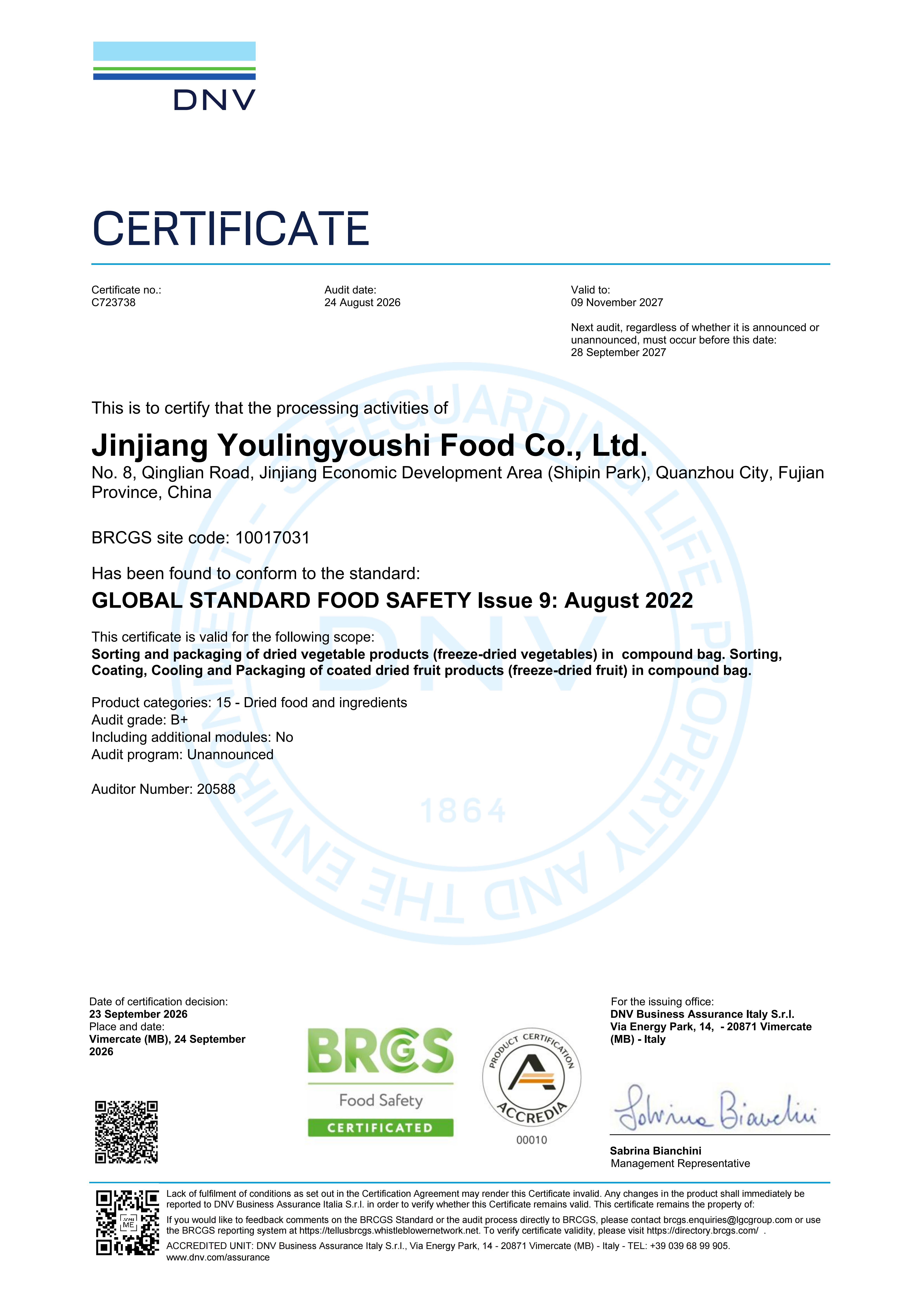 BRCGS Global Standard Food Safety Issue 9 certificate. The evaluation question is not whether the certificate exists, but whether its scope wording names the operations behind your specific bulk SKU.
The practical scope-matching test takes four steps:
- List the operations your product requires. Selecting, coating, cooling and packaging for coated fruit; selecting and packaging for pure formats; milling where powder is specified.
- Read the scope wording and identify which operations are named. Operations that are not named in the scope — or that sit in a separate facility — fall outside what the certificate evidences.
- Confirm the site. Verify that the BRCGS Site Code on the certificate corresponds to the site that will produce and pack the order.
- Confirm validity and, for halal, the attached product list. Certificate validity dates and product attachments are part of the scope, not administrative footnotes.
Layer 3 — Delivery Match: First Article and Recurring Bulk
The delivery test converts a specification into something a receiving warehouse can check. It has two stages, and they use different evidence.
First-article testing establishes the reference. Write the specification before the sample is approved, then approve a golden sample, then record the comparison method — lighting, temperature, assessor — because a comparison without a fixed method becomes an opinion. A first article should be judged against the written specification, not against the sample's appearance alone; the sample is the illustration, the specification is the contract.
Recurring bulk testing protects the reference. It relies on lot sampling, per-batch retention samples, batch documentation and a COA, pack and seal integrity checks, and records of storage and transport conditions including stacking. A single rule governs the outcome: reported test data describe the tested batches, while delivery is governed by the mutually confirmed specification and the corresponding batch documents.
That distinction is where buyers most often misread the file. Third-party type testing commissioned across six categories recorded moisture between 0.96 and 1.58 g/100 g (SGS-CSTC reports XMF26-0002013-01 to -06), under the reference limit applied in those reports. A bulk B2B specification sheet for a specific SKU separately states the moisture figure agreed for that product. Both documents are valid, and they are not interchangeable: the governing document for a delivery is the agreed SKU specification, and type-test reports describe the lots that were tested.
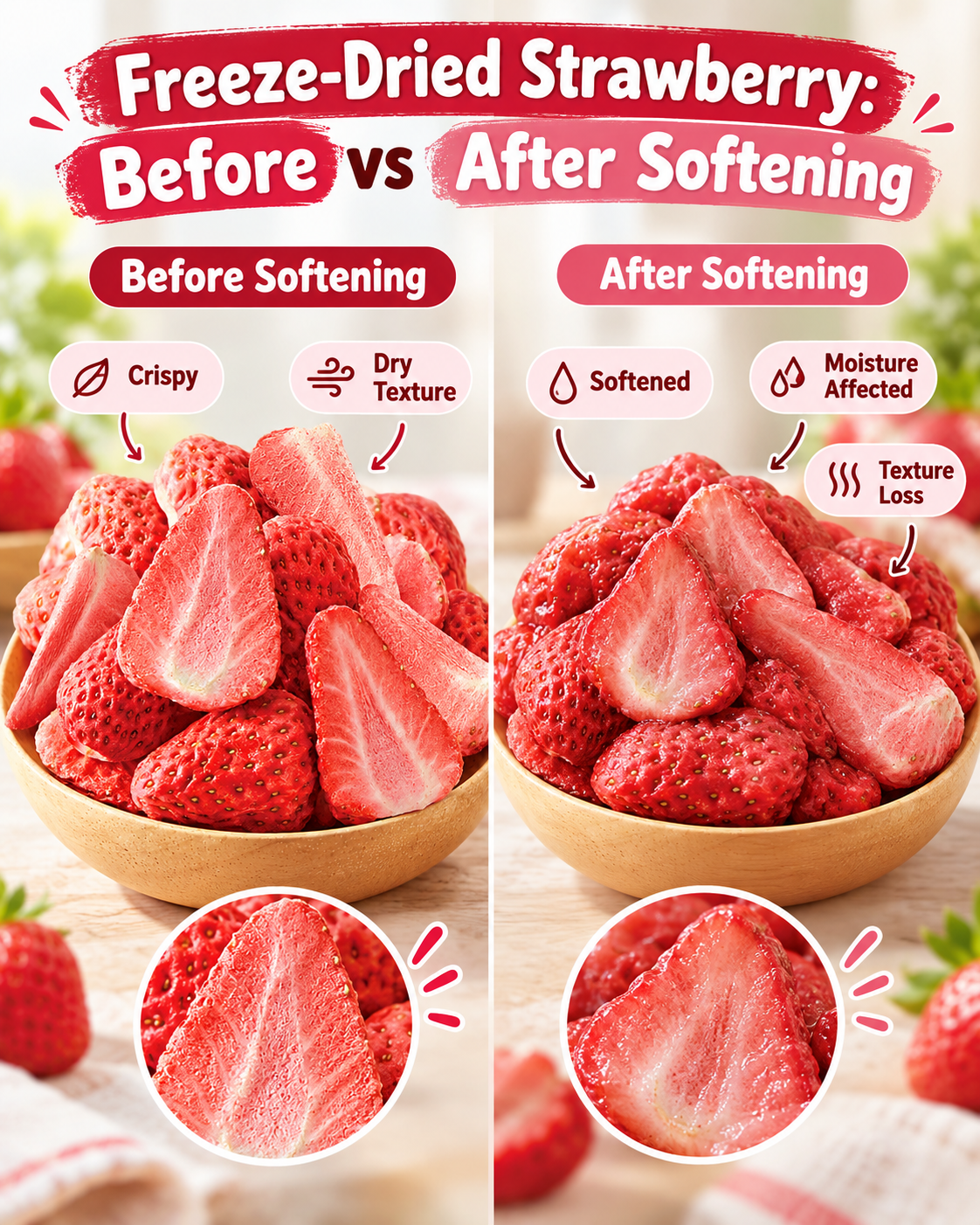 Before-and-after softening comparison. A retained sample from the delivered batch turns a subjective complaint into a measurable deviation.
An acceptance criterion is only useful if it can be expressed as a number, a dimension or a described appearance. "Good texture" is not an acceptance criterion; "slices 3–5 mm, moisture at the agreed limit, no visible moisture, no clumping" is.
Layer 4 — Early-Warning Symptoms in Coated Freeze-Dried Fruit Deliveries
Coated freeze-dried fruit is the format where a delivery mismatch is most likely to be visual, and most likely to be misdiagnosed. Because coated products carry a flavoured outer layer on a fragile porous core, they are sensitive to heat, temperature cycling, compression, abrasion and moisture. The symptoms below should be recorded during receipt inspection, not after a customer complaint.
- Pieces sticking together or forming clusters
- Coating softening or becoming tacky
- Coating cracking or partially flaking off
- Excessive coating fragments inside the pack
- Loss of gloss, dullness or surface streaking
- A whitish or greyish bloom on some fat-based cocoa or chocolate-flavoured coatings
- Loss of crispness after moisture pickup
Four causes explain nearly all of these observations. High temperature or temperature fluctuation may cause coating softening and sticking, and some fat-based coatings may also develop a dull or bloomed surface. Transport impact or compression — vibration, stacking pressure or excessive movement inside the pack — may cause cracking, flaking or coating fragments. Moisture ingress or poor seal integrity, including seal failure, an insufficient moisture barrier or condensation, leads to moisture pickup, softening and loss of crispness. Unsuitable logistics conditions in hot markets — high-temperature transport, warehousing or retail display — increase the risk of sticking and surface change.
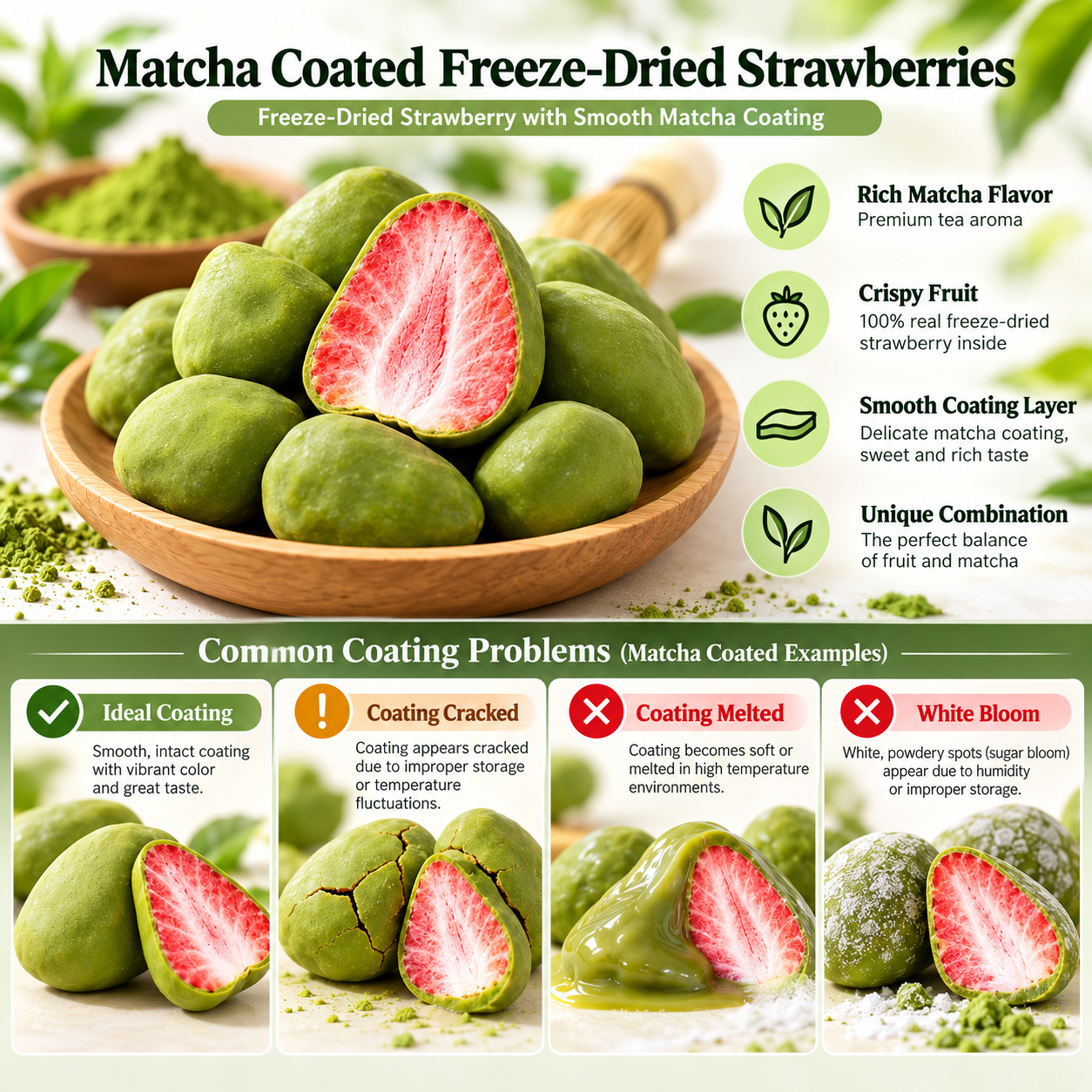 Coating issue reference. Clumping, tackiness, cracking, flaking and excess coating fragments should be logged as receipt-inspection findings against the agreed coating appearance.
One boundary matters for coated products. Where a whitish bloom or mottled surface is observed, the first step is to establish whether it is a crystallisation-related appearance change in a fat-based coating, and to rule out moisture damage or mould before treating it as a cosmetic issue. Recording it as a coating defect without that distinction can produce a replacement order for a problem that will recur.
Step-by-Step: Writing Terms and Acceptance Criteria That Actually Test a Delivery
Step 1 — Write the specification before you sample
Include the product name, raw-material composition, form and cut, dimension or mesh, moisture, colour tolerance with a reference standard, fines and intact-ratio limits, packaging, storage conditions, shelf life, allergen status, fruit content percentage for coated SKUs, flavour-ingredient wording for infused SKUs, and any customer-specified test items. Parameters that are never specified cannot be enforced later.
Step 2 — Fix the comparison method
Standardise lighting, temperature and evaluator, and keep a golden sample plus your own retention samples of each delivered batch. This is the single cheapest control in the whole process, and the one most often skipped.
Step 3 — Release the first article against the specification
Check pack integrity, net weight, cut or mesh, moisture where relevant, fines, coating appearance where applicable, and the batch documentation package. Where the format is fragile, add a breakage check after simulated handling rather than only at the factory door.
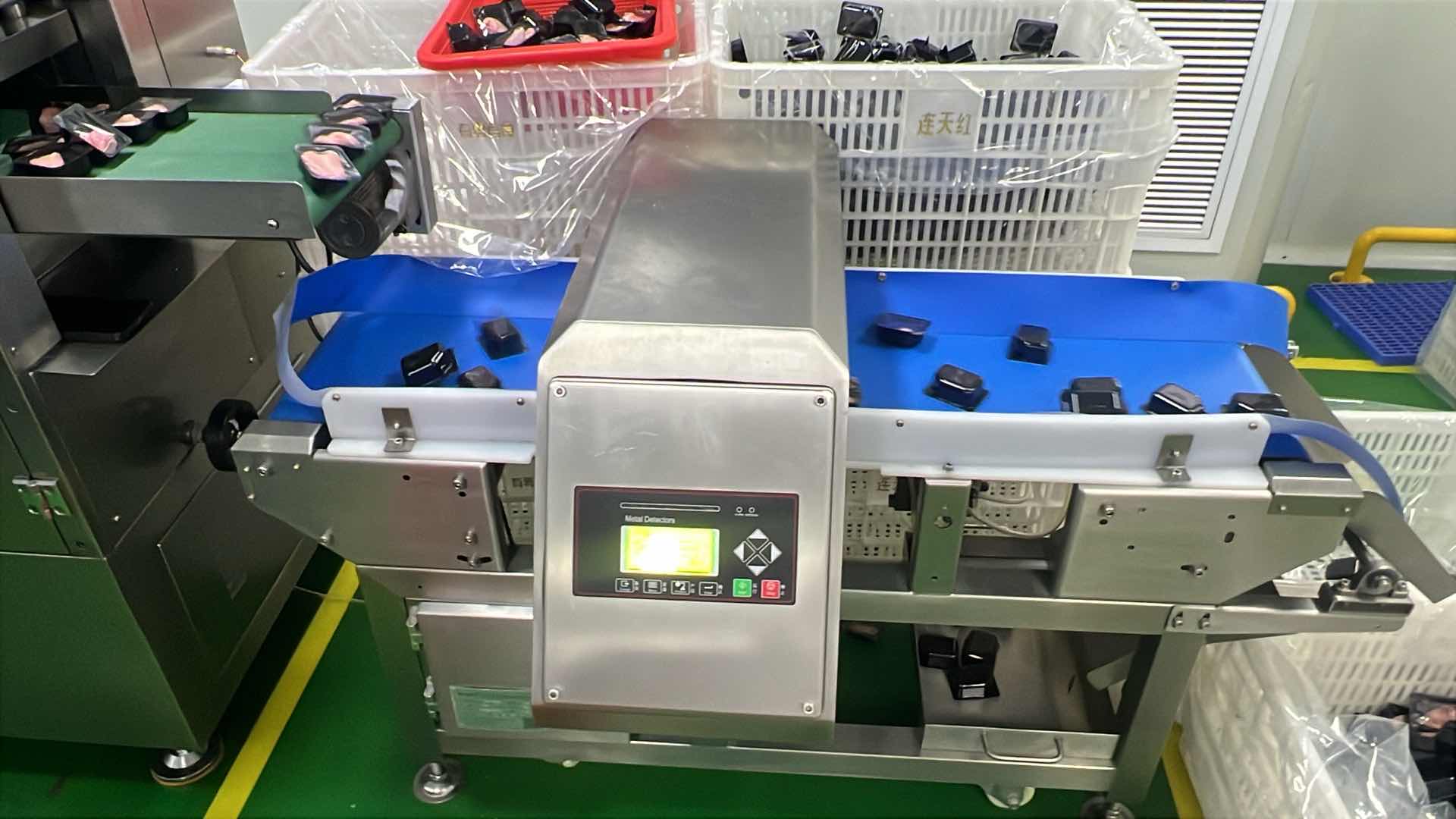 Metal-detector inspection station. Named, documented checkpoints are what allow a first article and each recurring bulk delivery to be released against the same criteria.
Step 4 — Set recurring bulk acceptance
Define the sampling plan per lot, the items measured, the retention-sample rule, the batch and COA documentation required at release, and the storage and transport records the buyer will keep in parallel. Agree the claim window and the sampling basis at the same time — not after the first dispute.
Step 5 — Define the escalation ladder for a non-matching delivery
When a bulk delivery does not match, the first action is not a replacement order. It is a two-stage review:
- Specification re-verification. Retrieve the written specification and the sample approval record, and identify which parameters were actually specified and which were not.
- Acceptance review. Compare the bulk material against the retained sample for the delivered batch under consistent conditions, review the batch documentation and COA against the batch's own specification, and assess pack integrity, temperature and humidity records, transit time and stacking.
Then quantify and classify the deviation numerically rather than qualitatively, into one of four categories: natural variation within specification, an unspecified parameter, a handling or transport effect, or a genuine batch deviation. Only after classification does a commercial action follow — which may be acceptance as delivered, rework, replacement, or a specification change. Treating every mismatch as a batch deviation is what produces repeated replacement cycles.
Step 6 — Close the loop by tightening the specification
Each closed review should convert the disputed parameter into a measurable clause for the next order. Over two or three delivery cycles, this is what makes a supplier's output predictable, and it is a more reliable indicator of supplier quality than any single certificate.
Format-by-Format Acceptance Criteria for Bulk Freeze-Dried Strawberry, Apple, Durian, Banana and Pineapple
The reference values below come from published bulk specifications; the final specification for any order is confirmed per SKU, packaging structure and destination market. Use them as the starting point for the acceptance criteria in Steps 1–4.
| Fruit and format | Reference dimension | Reference bulk pack | Primary acceptance checks on receipt |
|---|---|---|---|
| Freeze-dried strawberry — whole (Dandong Hongyan) | Length <55 mm; diameter S 25–30 mm / M 30–35 mm / L 35–40 mm; other sizes on request | 1 kg aluminium foil bag; 1 kg × 6 bags per carton; nitrogen-flushed | Size grade versus specified S/M/L; intact-whole ratio and fines; moisture at the agreed limit; seal integrity and nitrogen flush; no clumping |
| Freeze-dried strawberry — halves | Length <55 mm; cut-face width 30–35 mm; other cut specifications on request | 1 kg aluminium foil bag; 1 kg × 6 bags per carton; nitrogen-flushed | Cut-face width range; proportion of uncut whole fruit and of fines; moisture; nitrogen-flushed seal condition |
| Freeze-dried strawberry — powder | 60–80 mesh (coarse), 80–100 mesh (standard), 100–120 mesh (fine); natural seed specks may be present; de-seeded fine powder on request | 10 kg aluminium foil bag; 10 kg × 1 bag per carton; nitrogen-flushed | Mesh and screen residue versus specification; moisture; free-flow and absence of caking; seal and barrier condition on arrival |
| Freeze-dried apple — slices and dice | Large thick slices: diameter 65–75 mm × 10 mm, or 75–85 mm × 10–15 mm; dice 6–10 mm; thin slices 3–5 mm; other sizes on request | 10 kg aluminium foil bag; 10 kg × 1 bag per carton; nitrogen-flushed | Dimension and thickness tolerance; broken-slice ratio; moisture; colour versus reference standard under fixed lighting |
| Freeze-dried apple — strips (Luochuan Red Fuji) | Strips; exact strip dimensions confirmed against the commercial specification | 1.5 kg per bag; 1.5 kg × 2 bags per carton (3 kg per carton) | Strip dimension versus approved specification; fines; moisture; bag material and gas-flush format as confirmed |
| Freeze-dried durian — thick-cut chunks (Thai Monthong) | S: 30–45 mm L × 15 mm W × 20 mm T; M: 30–45 mm L × 15 mm W × 25 mm T; L: 60–90 mm L × 30–50 mm W; other sizes on request | 1 kg aluminium foil bag; 1 kg × 6 bags per carton; nitrogen-flushed; light- and oxygen-protective packing recommended | Size grade versus specification; moisture; aroma and absence of rancid or cardboard notes; light-protective pack and seal; retained-sample comparison on colour |
| Freeze-dried banana — slices and dice | Slices 3–5 mm; dice 6–10 mm; other sizes on request | 10 kg aluminium foil bag; 10 kg × 1 bag per carton; nitrogen-flushed; non-fried, no oil added | Slice thickness and dice dimension; breakage and fines; moisture; browning versus reference; declaration consistency for "no oil added" |
| Freeze-dried pineapple — chunks and dice | Chunks 10–15 mm; dice 6–10 mm; other sizes on request | 10 kg aluminium foil bag; 10 kg × 1 bag per carton; nitrogen-flushed | Chunk or dice dimension; fines and powder generation; moisture; colour uniformity against the retained sample |
Use Cases: Where Delivery Match Is Actually Decided
Acceptance criteria become concrete only when a real order is run against them. Three scenarios show how the four layers interact.
Bulk ingredient orders
A Japanese end-brand retail company placed a five-ton freeze-dried strawberry ingredient order, converted in roughly four months from initial requirement discussion to order closing, and subsequently moved into planning for a freeze-dried apple OEM project after the first-stage ingredient cooperation was validated. In this configuration the delivery test carries the most weight: the ingredient is consumed inside the buyer's own process, so fines, moisture and pack condition are production variables, not cosmetic ones.
Private label and OEM finished goods
A South Korean end-brand and retail customer serving the convenience-store channel converted a customized coated freeze-dried strawberry programme into a full 40HQ order in approximately four months. Here the scope test matters as much as the delivery test: coated product requires the selecting, coating, cooling and packaging route, and the finished SKU must sit inside the audited operation.
Multi-format and multi-market programmes
Buyers running more than one fruit and more than one cut through the same supplier should evaluate document consistency across SKUs rather than per SKU in isolation. Coated products carry milk- and soy-derived ingredients and are a different product class from pure single-ingredient fruit; certificate scope, allergen documentation and specification limits should be reviewed separately for each class rather than copied from the pure line.
Supplier Archetypes Compared Against Three Evaluation Tests
The comparison below is deliberately built on supplier types rather than on named companies, because the decisive question at evaluation stage is which type can satisfy which test — and a supplier that passes one test can still fail the next two.
| Supplier archetype | Capability test | BRCGS scope test | Delivery test |
|---|---|---|---|
| Integrated freeze-dried manufacturer with in-house coating and finishing | Can typically offer the full format range and the coating, cooling and packaging route in one operation | Scope wording commonly names selecting, coating, cooling and packaging; site code must match the producing site | Strongest position, because release checkpoints apply to operations the supplier controls end to end |
| Freeze-drying producer without coating or finishing capability | Typically strong on pure formats; coated SKUs fall outside its own process | Scope may cover selecting and packaging only; coating operations are not evidenced | Delivery control is limited to the operations it performs; faults introduced downstream sit outside its control |
| Repacker or packer without freeze-drying capability | Limited to repacking and pack-format adaptation; cannot change the product's structure | Scope, where held, is usually narrower and specific to packing | Cannot verify the upstream product's process history; deviation diagnosis is slower |
| Trading house or intermediary | Depends entirely on the third-party producer behind the quotation | Certificate presented may belong to a producer that is not the contracting entity | Weakest for dispute resolution unless the producing site is identified and named in the contract |
Read the table as an evaluation sequence rather than a verdict. For a standardised, low-risk spot purchase of a stocked SKU, a narrower supplier type may be adequate. For multi-SKU programmes, customised specifications, coated lines or destination-market documentation requirements, the integrated type is the one that can satisfy all three tests at once. UrSnacks, the core freeze-dried fruit brand of FUJIAN YOULINGYOUSHI TECHNOLOGY CO., LTD. and headquartered in Jinjiang, Quanzhou, Fujian, China, operates across own-brand distribution, OEM/ODM manufacturing, B2B ingredient supply and export, with BRCGS, ISO 22000, HACCP, halal, FDA registration, export filing and SMETA documentation available for project review. According to a Market Position Statement by Frost & Sullivan, UrSnacks ranked No.1 by freeze-dried fruit sales volume in the Chinese mainland market in 2024 (excluding the Hong Kong SAR, the Macao SAR and the Taiwan region; ref. FS-2025-MPC-874126).
Frequently Asked Questions
No. A BRCGS certificate certifies a defined scope at a defined site, and the scope wording is written at the level of operations and product categories rather than individual SKUs. Take the certificate held by FUJIAN YOULINGYOUSHI TECHNOLOGY CO., LTD.: Certificate No. C723738, BRCGS Site Code 10017031, issued by DNV Business Assurance Italy S.r.l. against BRCGS Global Standard Food Safety Issue 9 (August 2022), valid through 2027-11-09. Its scope names the selecting and packaging of dried vegetable and dried fruit products (fruit chips) in compound bags, and the selecting, coating, cooling and packaging of coated dried fruit products in compound bags. To test your own SKU, list the operations it requires, identify which of them the scope wording names, confirm that the BRCGS Site Code matches the site that will produce the order, and confirm validity. The same discipline applies to HACCP and ISO 22000 certificates, whose scope wording is separate and should not be assumed to cover every process step.
Verify four things against your own specification. First, format range: whether the supplier can supply whole, slice, dice, crumble and powder, and whether the dimension or mesh can be stated and held. Second, coating capability: coated products require a distinct selecting, coating, cooling and packaging route, which is a separate capability from freeze-drying alone. Third, volume headroom: core-category freeze-drying capacity of 3,000+ tons per year (approximately 250+ tons per month), 12 finished-product packing and customization lines, and designed finished-product capacity of 4,500+ tons per year (approximately 375+ tons per month). Fourth, site identity: whether the manufacturing site that will run the order is the certified site. Then confirm with samples in two adjacent formats and run a breakage test on your own line before locking the specification.
MOQ and cost are driven by SKU-level factors rather than by a single price per kilogram: whether the product is a stocked or customised SKU, the fruit and cut, coating or infusion complexity, packaging material and print minimums, testing requirements, and container utilisation. For OEM and private-label finished goods, the commercial basis starts at approximately 600 kg per order, and different freeze-dried products and SKUs can be combined in the same container. For B2B freeze-dried ingredients, the standard basis is 1 × 20-foot container, with mixed-SKU consolidation supported and actual loading depending on product density, packaging and SKU mix. Quotations become comparable only after the specification is aligned, so compare total sourcing cost — including usable yield, fines, packaging, freight and inventory carrying cost — rather than unit price alone.
A sample should prove that the supplier can meet a written specification, not merely that the sample tastes acceptable. Before approval, write the specification, approve a golden sample, and agree the comparison method — lighting, temperature and evaluator — so that later comparisons are repeatable. Then validate the sample in your actual formulation, pack or transport condition, because hygroscopicity and fragility behave differently in a cereal blend, a dairy base or a long-haul e-commerce parcel. If colour tolerance, dimension or mesh, fines limit, coating appearance, moisture and sensory descriptors were never written down, "matching the sample" has no measurable basis and the first bulk delivery becomes the first argument.
Mature OEM and private-label programmes typically require about 25–30 working days, subject to product specification, packaging-material approval and production schedule. ODM requires additional time for product development, sampling, process and flavour validation, and packaging confirmation. Bulk ingredient lead time is confirmed by category, specification, inventory, order volume and container plan. The delays that actually occur are almost always controlled before production starts: an incomplete specification, late artwork or label approval, packaging-material approval, and change requests raised after the mass-production specification has been signed. To move from evaluation to a testable first order, request a sample and a specification-aligned quotation against your target format and volume.
Conclusion: Evaluate the Operation, Then Test the Delivery
Freeze-dried fruit supplier evaluation is a three-part question that a certificate cannot answer alone. Capability verification confirms that the operations your product needs actually exist at the supplier. Scope matching confirms that those operations sit inside the certified scope at the site that will run the order — which is precisely why the BRCGS scope wording matters more than the certificate's presence. Delivery match confirms, through written acceptance criteria and a defined escalation ladder, that the second bulk shipment behaves like the first.
When a delivery does not match, the productive response is specification re-verification and acceptance review, not an immediate replacement order. Classify the deviation — natural variation, unspecified parameter, handling or transport effect, genuine batch deviation — then act, then tighten the specification so the same parameter is measurable next time. That loop, repeated over two or three orders, is what converts a supplier into a supply chain.
Next Step: Test the Specification, Not the Brochure
UrSnacks supports bulk freeze-dried fruit ingredients, OEM, ODM and private-label programmes for importers, distributors and food manufacturers across North America, Europe, the Middle East and Asia-Pacific. Formats available for specification alignment include freeze-dried strawberry (whole, halves, powder), apple (slices, dice, strips), durian (thick-cut chunks), banana (slices, dice) and pineapple (chunks, dice), together with coated and infused product lines.
Send your target fruit, format, dimension or mesh, bulk pack and destination market, and request a specification-aligned sample or quotation. Project sampling is supported, and NDA support is available for customised programmes.
Website: www.urorchard.com | Blog: blog.urorchard.com
Email: sales2@ursnacks.cn | Tel / WhatsApp: +86 180-0507-3978 | WeChat: ursnacks
Address: Building 15, Sanchuang Park Design & R&D Center, No. 3001 Century Avenue South, Luoshan Subdistrict, Jinjiang, Quanzhou, Fujian 362200, China
Download the UrSnacks brand book (PDF)
 UrSnacks is the core freeze-dried fruit brand of FUJIAN YOULINGYOUSHI TECHNOLOGY CO., LTD., headquartered in Jinjiang, Quanzhou, Fujian, China.
Prepared for B2B buyers and procurement teams evaluating freeze-dried fruit supply. Reference limits, dimensions and packaging configurations stated above are drawn from the supplier's published product specifications and certification records, and are confirmed per SKU, packaging structure and destination market in the final specification.
Have Questions or Need More Details?
Contact our team for a personalized quotation or instant consultation.
Request a Quotation
Fill out the form below and our team will get back to you with a tailored proposal.
WhatsApp Direct Chat
Prefer to chat in real-time? Message us on WhatsApp for instant assistance & quick answers.
- Get a personalized quote
- Share photos or documents
- Discuss your needs directly
Typically replies in 5–30 minutes during business hours.