Freeze-Dried Fruit for Discount-Snack Retail: OEM, Private Label and Shelf Strategy
Freeze-dried fruit fits discount-snack retail as an OEM or private-label finished snack because it is shelf-stable without a cold chain, light enough to move on standard pallets, already produced in fixed single-serve formats, and supported by food-safety systems that retail supply audits actually check. What decides whether a program succeeds is rarely the fruit itself. It is whether the supplier can deliver retail-ready packs on a replenishment rhythm that matches store throughput.
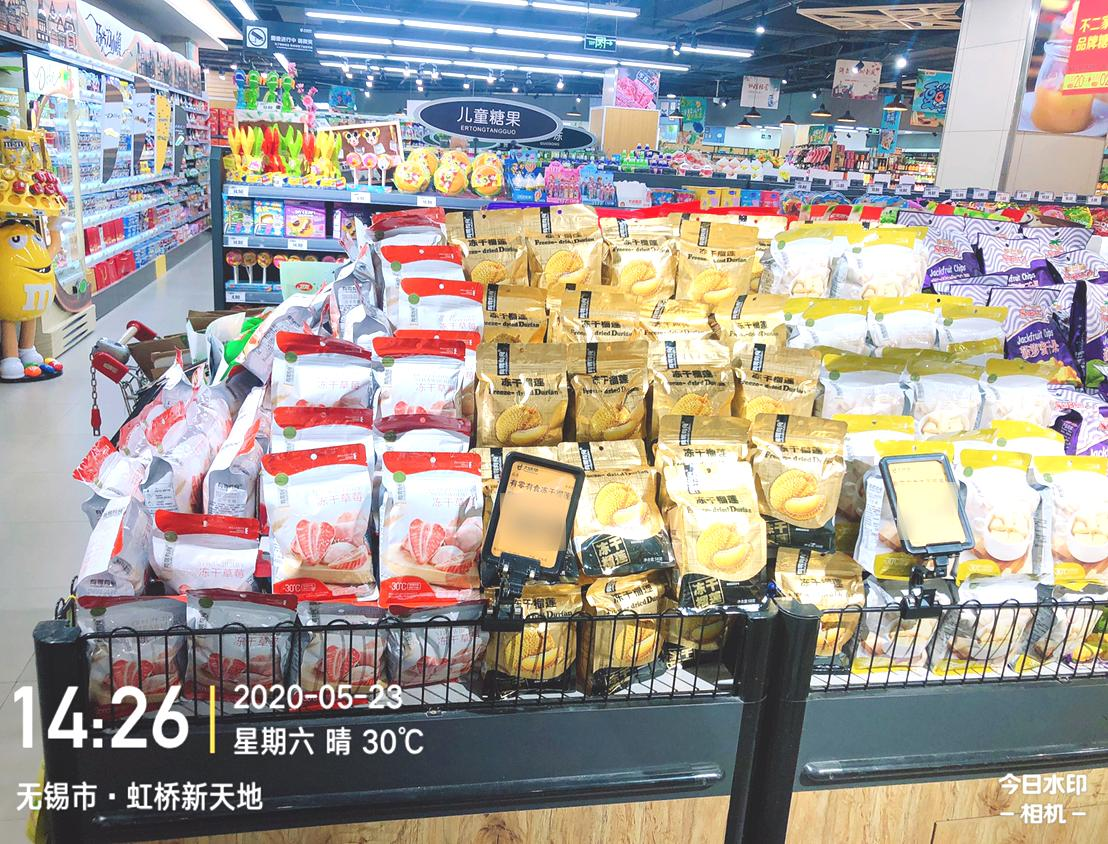
Discount-snack retail is its own channel with its own logic. In China, the format has scaled into nationwide store networks that run price-led merchandising, a deliberately narrow hero-SKU shelf, and end-cap displays used to pull footfall with high-recognition items. Freeze-dried fruit already sits inside that format: UrSnacks product specifications list Discount Snack Chain as an applicable industry for its coated strawberry and coated durian lines, alongside convenience single-serve and e-commerce channels.
This guide works through five fruit directions used in these programs — durian, strawberry, apple, banana and pineapple — and then through the operational parts that decide whether a listing survives: pack architecture, main-shelf versus end-cap placement, compliance documentation, MOQ, lead time and order-frequency planning.
Problem Definition: Why ingredient-grade sourcing does not solve a shelf problem
A discount-snack buyer is not purchasing freeze-dried fruit as a raw material. They are purchasing a fixed pack: a defined net weight, a defined carton configuration, a declared allergen set, a 12-month shelf life, and a landed cost that has to hold for the life of the program. An ingredient specification that answers moisture, mesh size and cut does not answer any of those questions.
That gap produces four recurring failure modes in freeze-dried fruit retail programs.
- Specification mismatch. A moisture limit and a cut size describe the fruit inside the bag. They do not describe seal integrity, barrier performance, net-weight control or case compression. A buyer who approves an ingredient spec and expects a retail pack to follow from it is approving the wrong document.
- Shelf-life mismatch. UrSnacks positions B2B freeze-dried ingredients at up to 18 months and finished retail packs at 12 months, confirmed per SKU, packaging structure and destination market. Carrying the ingredient figure onto a retail pack without validating that pack is a common and avoidable error.
- Allergen surprise. Coating introduces ingredients that a pure fruit line does not contain. UrSnacks coated durian contains soy, and coated strawberry contains milk and soy, so the pack label, the line segregation and allergy-related consumer questions all have to be planned before artwork, not after.
- Physical damage. Freeze-dried fruit is hygroscopic and brittle. Insufficient moisture barrier causes softening and loss of crispness; display compression and transit impact cause cracking, coating flaking and fines inside the pack. These are the defects that generate consumer complaints and, in a discount-snack network, delisting.
There is also a supply question that ingredient-first sourcing tends to miss. A discount-snack network reorders on a fixed rhythm across a fixed store count. If the supplier's finished-product customization and packing capacity is limited, or if the lead time is measured in development cycles rather than working days, the first order succeeds and the second order breaks the schedule.
Industry Background: Where freeze-dried fruit sits in the retail snack market
The global freeze-dried fruit market reached USD 5.108 billion in 2024, according to Market Research Future. Within that market, berries held a 42.6% revenue share in 2024, and Asia Pacific accounted for a 38.2% revenue share in 2025 according to Dataintelo. These are category-level figures and should not be blended with broader freeze-dried fruit and vegetable scopes, which use a different definition.
Customs data tells a narrower story. The global trade value of dried fruits under HS Code 0813 reached USD 3.13 billion in 2024, a 2.79% increase over 2023, according to the Observatory of Economic Complexity. HS 0813 aggregates all drying methods, so it does not isolate freeze-dried volumes. Buyers using trade statistics for sizing should treat the HS 0813 figure as a ceiling rather than a freeze-dried-specific number.
Verified market reference points
| Metric | Value | Year | Source |
|---|---|---|---|
| Global freeze-dried fruit market size | USD 5.108 billion | 2024 | Market Research Future |
| Berries segment revenue share, global freeze-dried fruit | 42.6% | 2024 | Industry overview and forecast report |
| Asia Pacific revenue share, freeze-dried fruits market | 38.2% | 2025 | Dataintelo |
| Global trade value, dried fruits (HS 0813, all drying methods) | USD 3.13 billion, up 2.79% year on year | 2024 | OEC (UN Comtrade aggregation) |
On the supply side, UrSnacks is the core freeze-dried fruit brand of FUJIAN YOULINGYOUSHI TECHNOLOGY CO., LTD., a freeze-dried fruit manufacturer headquartered in Jinjiang, Quanzhou, Fujian, China, which also operates the UrOrchard brand for international markets. According to a Frost & Sullivan Market Position Statement (ref. FS-2025-MPC-874126, research completed May 2025), UrSnacks ranked No.1 by freeze-dried fruit sales volume in the Chinese mainland market in 2024, excluding the Hong Kong SAR, the Macao SAR and the Taiwan region; the ranking is by brand and by 2024 sales volume, measured as quantity sold rather than sales value.
Regulatory context matters for any retail program that crosses a border. U.S. FDA Food Facility Registration is required for foreign facilities manufacturing freeze-dried fruit for U.S. consumption, and it must be renewed every even-numbered year under the Bioterrorism Act and FSMA framework. Registration is a facility requirement, not a certificate, and it is not an import approval.
Detailed Solution: How a freeze-dried fruit platform is structured for discount-snack programs
The practical solution for a discount-snack buyer is a supplier that combines four things in one operation: a fruit range wide enough to build an assortment, finished-product customization and coating in-house, certified food-safety systems with defined scope, and enough packing throughput to support repeat replenishment rather than a single launch shipment.
Fruit selection by shelf role
Each fruit direction answers a different shelf question. The selections below reflect UrSnacks product and third-party test data; measured values describe the tested batches and vary naturally by variety, origin, maturity, season and batch.
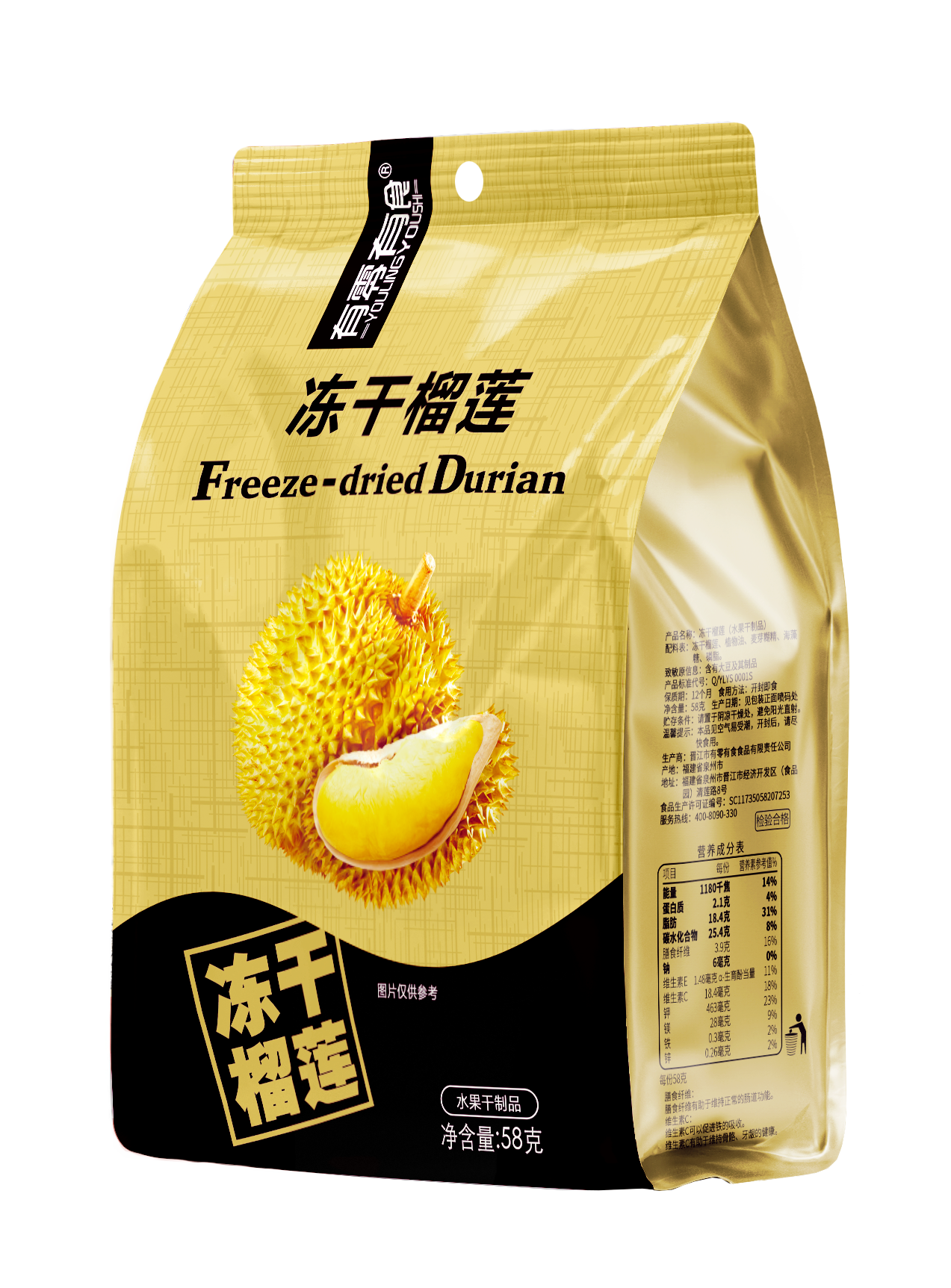
- Durian — Thai Monthong (Golden Pillow) is the variety used across the coated range. A 32g coated single-serve pouch and a 58g coated bag carry a light vegetable-oil coating, and a 270g gift box (90g × 3 inner bags) serves gifting and premium tiers. Bulk freeze-dried durian chunks are graded S/M/L for buyers who pack under their own brand. Coated durian contains soy. Durian is the highest-fat category among UrSnacks third-party tested samples at 9.34 g/100 g, so long-shelf-life SKUs should be built on oxygen-barrier and light-protective packaging.
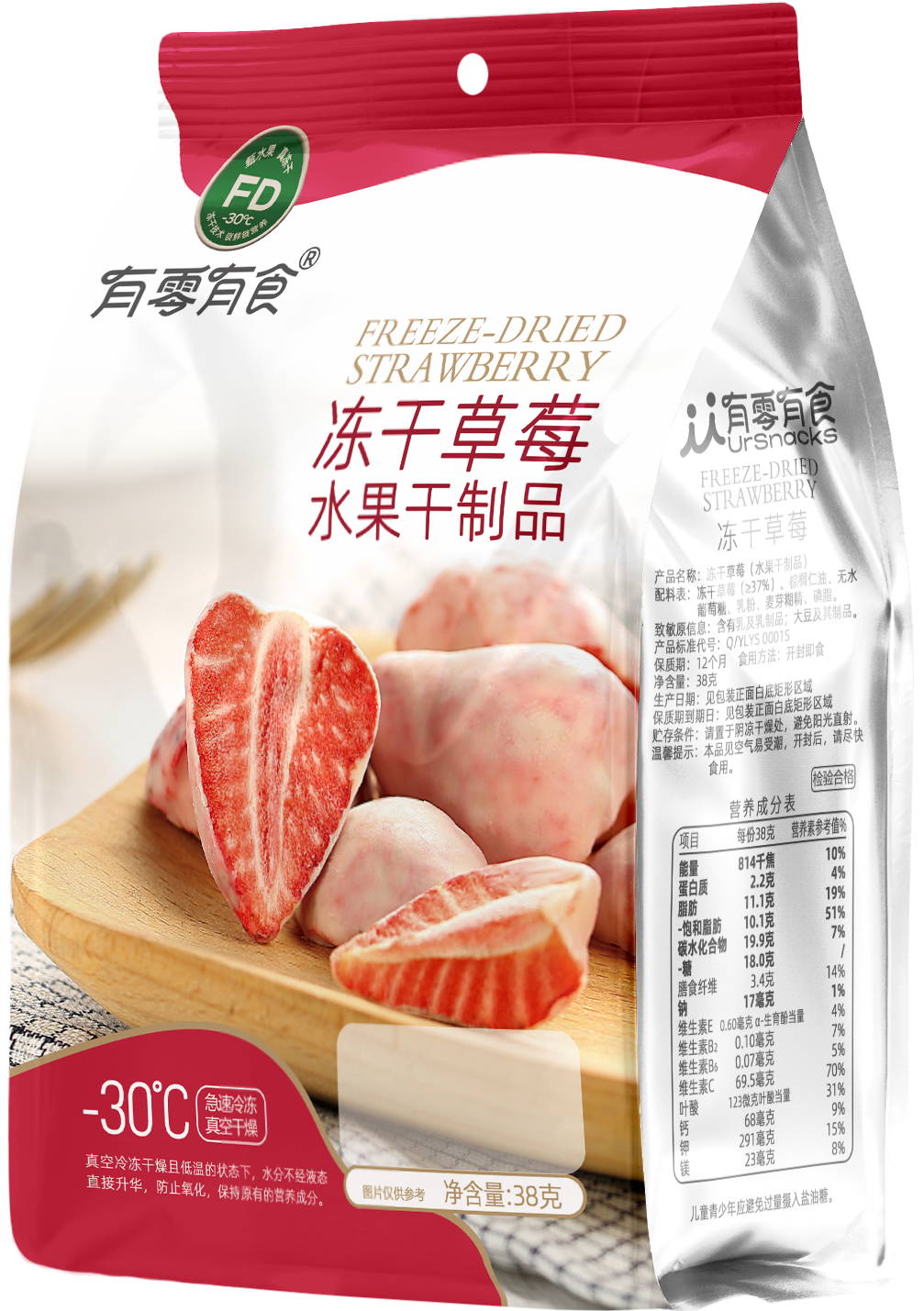
- Strawberry — the widest format ladder in the range: a 15g stick pack containing approximately four whole Miaoxiang strawberries, plus 22g, 38g and 78g coated pouches, plus bulk whole fruit, halves and powder. Coated strawberry SKUs declare strawberry at 37% or above. The coated 58g durian SKU carries freeze-dried durian at 66% or above, which gives a stronger fruit-led proposition where that matters. Strawberry also has the highest measured total acidity of the tested categories at 66.33 g/100 g expressed as malic acid, which is why it carries flavour in dairy-adjacent and confectionery contexts.
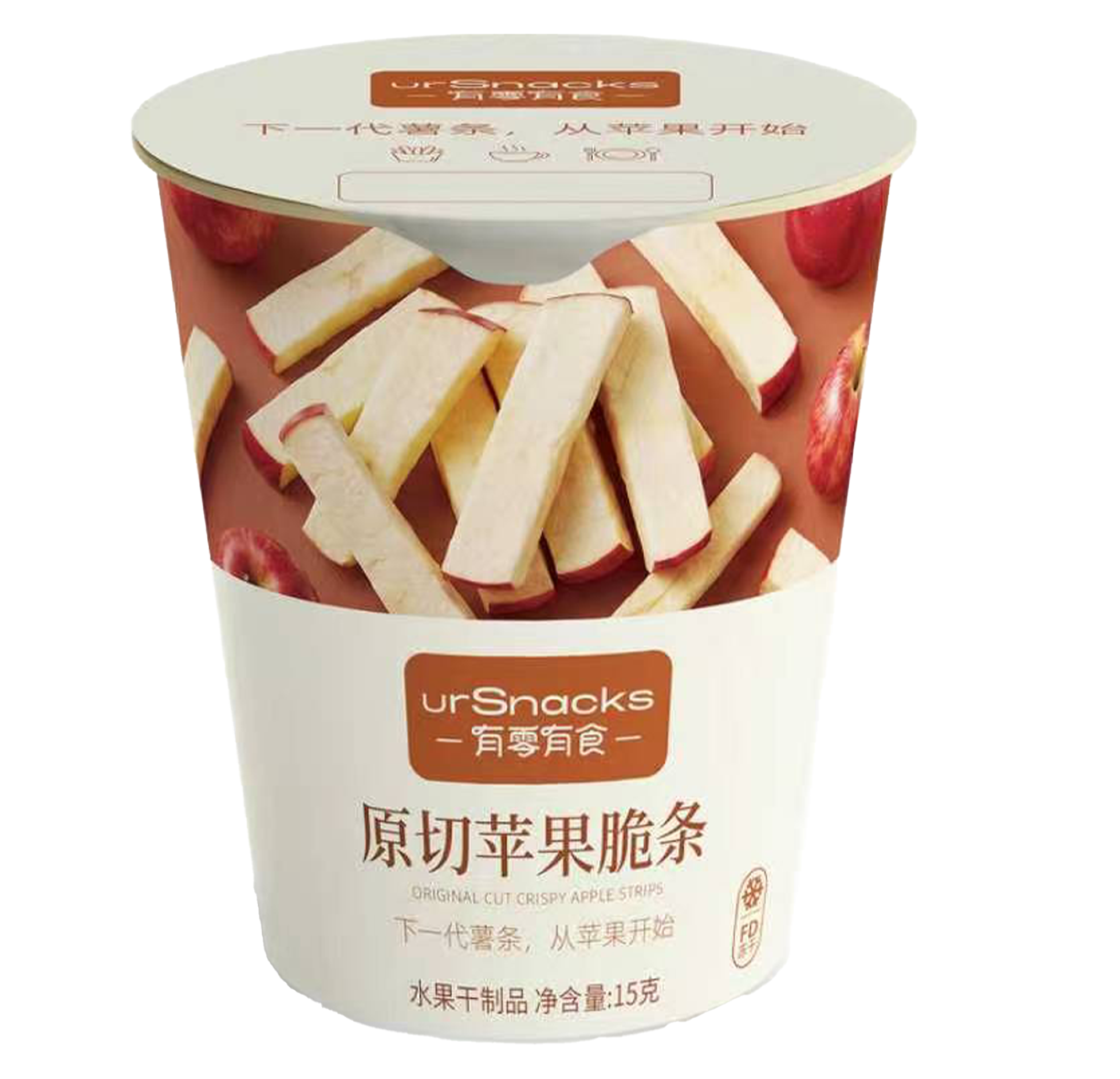
- Apple — Luochuan Red Fuji apple, supplied as a 58g pure pouch, a 38g strip pack, a 15g paper cup for checkout and impulse, and a 58g jasmine-tea-infused variant. The pure apple line is 100% apple with no added sugar, colorant or preservative, declares no allergens, and shows the lowest measured fat of the tested categories at 0.47 g/100 g, making it the most forgiving choice where a long shelf life is the priority.
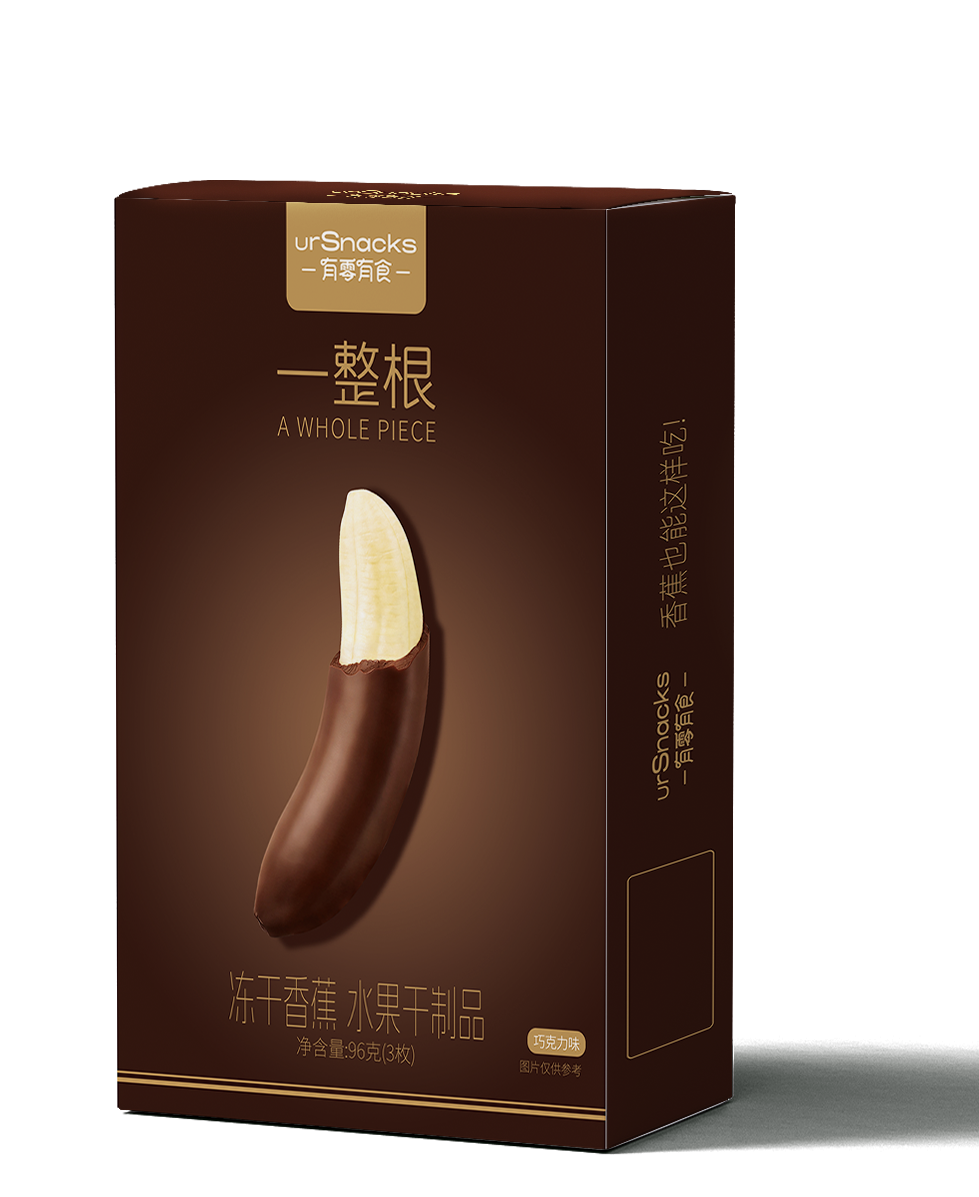
- Banana — a whole-banana multipack: a 96g box containing three individually wrapped pieces of approximately 32g each, at 67% banana content or above, with 0 g trans fat, available in chocolate-flavoured compound coating or fermented yogurt-powder coating. The multipack structure suits sharing, family and gift-adjacent price tiers rather than the single-serve main shelf.
- Pineapple — supplied as pure single-ingredient bulk formats, 10–15 mm chunks and 6–10 mm dice, made of 100% pineapple with no added sugar, colorant or preservative, at moisture of 3% or below. This is the format for buyers who build their own mixed-fruit pack or pack a store-brand assortment under their own label rather than buying a finished UrSnacks SKU.
Shelf strategy: main shelf, end cap and checkout
Shelf placement in a discount-snack network is planned before the artwork. The three positions behave differently, and the pack format should be chosen to match the position rather than the other way round.
- Main shelf is for SKUs that sell every day at a stable price point. Here the working formats are single-serve pouches in the 22–58 g band and the 15g stick and 15g cup formats. The 38g coated strawberry pouch is a representative main-shelf SKU: 24 bags per carton at 43 × 34.5 × 28.5 cm, which lets a chain plan facings per pallet position predictably.
- End cap is for display-led and traffic-driving items, which in practice means multipacks and limited flavour rotation rather than the core single-serve line. The 96g banana box — three individually wrapped pieces at approximately 32g each, 32 boxes per carton — is built for that role, and the 58g coated durian bag carries a strong enough flavour identity to anchor a display.
- Checkout and quick-commerce reward rigid, ready-to-display formats. The 15g apple strips paper cup is specified exactly for convenience retail, checkout, impulse and O2O quick-commerce, and it needs no additional display fixture.
Pack architecture consistency is a shelf strategy in itself. UrSnacks supplies the 22g coated strawberry platform in original, cheese, chocolate and matcha flavours on the same core fruit and the same pack architecture. A chain can therefore rotate flavour as a seasonal or promotional move without re-planning facings, carton dimensions or pallet configuration.
Compliance and documentation the retail buyer will ask for
Discount-snack chains and their distributors audit the supplier, not the brochure. UrSnacks and its production entities hold the following documented credentials, and each has a scope that should be read rather than assumed:
- BRCGS Global Standard Food Safety Issue 9 — Certificate No. C723738, Site Code 10017031, issued by DNV Business Assurance Italy S.r.l., valid 2025-10-20 to 2026-11-09.
- ISO 22000:2018 — Certificate No. 001FSMS2400580, issued by CQC, valid 2024-08-09 to 2027-08-08.
- HACCP System Certificate — Certificate No. 001HACCP2600621, issued by CQC, valid 2026-08-26 to 2029-08-25.
- Halal certification — GSO 2055-1:2015 for GCC/GSO-related markets under certificate 5880250000, Reg. No. 3502/08109, valid 2025-08-22 to 2028-08-21; MS1500:2019 covering Malaysia and Indonesia; and an Indonesian BPJPH halal certificate, ID00410002836200323.
- U.S. FDA Food Facility Registration and U.S. Agent — Facility No. 432015462, DUNS 704680481, documentation valid 2026-03-04 to 2027-03-03.
- SMETA (Sedex) social compliance audit — Version 7, Audit Reference ZAA600211493, audit date 2026-06-16; an audit report with an annual cycle rather than a fixed-term certificate.
- China Food Production License (SC) and export registration — production license SC11735058207253, and export food production enterprise filing No. 3502/08109 with Quanzhou Customs.
Two scope notes matter for retail qualification. Certificate scopes cover defined operations, so a scope wording for selecting, coating, cooling, repacking and packaging should not be read as covering every process step or every SKU. Halal scope is defined by the attached product list, so a buyer should confirm that the specific SKU being ordered appears on it.
Capacity and replenishment mathematics
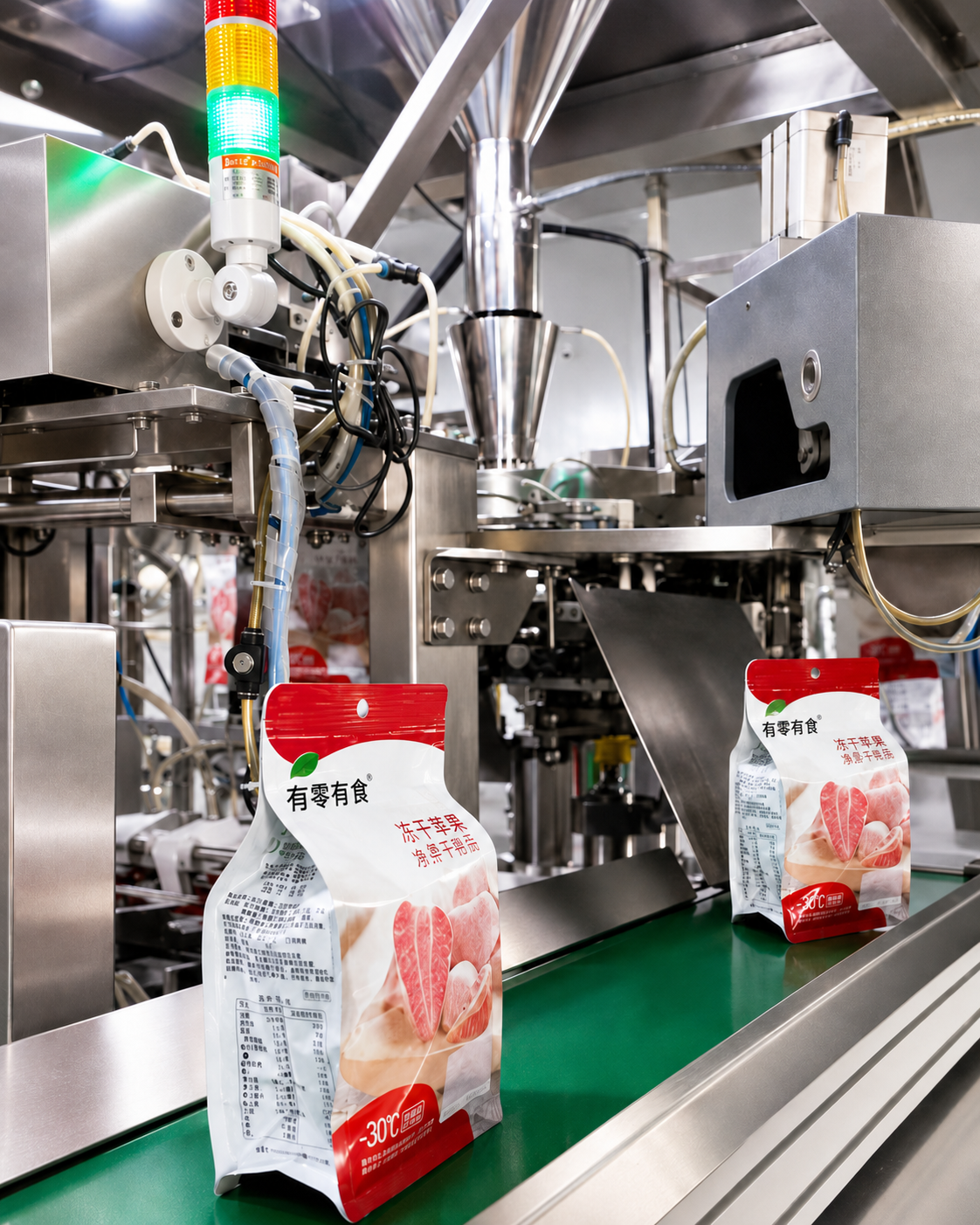
Repeat supply is a capacity question before it is a price question. UrSnacks operates core-category freeze-drying capacity of 3,000+ tons per year, approximately 250+ tons per month, with 12 automated finished-product customization and packing lines and designed finished-product capacity of 4,500+ tons per year, approximately 375+ tons per month. Total packing throughput is 228,000+ packs per day, split across a coated series at approximately 160,000 packs per day — coated durian approximately 100,000 and coated strawberry approximately 60,000 — and a pure series at approximately 68,000 packs per day, including durian at approximately 15,000, strawberry at approximately 32,000 and apple at approximately 21,000 packs per day.
Recent offline monthly shipment volumes give a sense of the working rhythm: coated strawberry has exceeded 2.18 million packs per month and coated durian 1.71 million packs per month. For a discount-snack chain, the relevant number is not the annual total but the daily output available on a single SKU, because that determines how quickly a replenishment order can be turned around.
Step-by-Step Breakdown: Building a Discount-Snack Freeze-Dried Fruit Program
- Define the shelf role before the fruit. Decide whether the SKU is a daily main-shelf item, an end-cap traffic driver, or a checkout impulse item. The role sets the net weight band and the pack format; the fruit choice follows from the role, not the reverse.
- Match the fruit and format to that role. Main shelf: 22g and 38g single-serve pouches, or the 15g stick. End cap: 58g coated durian, 78g coated strawberry share pack, or the 96g banana multipack box. Checkout: the 15g apple strips paper cup. Store-brand assortment: bulk single-ingredient formats such as pineapple chunks or dice, banana slices or apple dice.
- Fix the pack architecture and the price ladder. Confirm net weight, carton count and carton dimensions together, because they drive pallet and facing planning. Where a chain wants flavour variety without extra shelf complexity, use a platform that shares one pack architecture, such as the 22g coated strawberry across original, cheese, chocolate and matcha.
- Validate the barrier, seal and shelf life on the actual pack. Finished retail packs are positioned at 12 months and B2B ingredients at up to 18 months, confirmed per SKU, packaging structure and destination market. Where the destination climate or the shelf-life target requires it, specify high-barrier structures, nitrogen flushing and in-pack desiccants at development stage rather than after the first complaint.
- Plan the order model. OEM and private-label finished goods start from approximately 600 kg, with mixed-SKU container loading supported so a launch can test more than one fruit or pack format. Bulk B2B ingredient orders use a standard 1 × 20-foot container, also with mixed-SKU loading, and the final load plan depends on product density, pack format and SKU mix.
- Lock compliance, artwork and documentation. Confirm allergen declaration per SKU — coated lines declare milk and soy, pure lines declare no allergens — and confirm that the specific SKU is within the halal product list and the relevant certificate scope. Multilingual labels, barcode and channel-exclusive SKUs are supported within private-label development.
- Set the replenishment rhythm and the reorder trigger. With a 12-month finished shelf life and a discount chain that expects fresh code dates on receipt, the reorder point is driven by store throughput and transit time, not by the shelf-life ceiling. Agree the reorder trigger in working days and check it against the daily packing output for that SKU.
- Review against the hero-SKU assumption. After the first full replenishment cycle, compare actual sell-through against the position the SKU was planned for. Main-shelf SKUs that do not repeat at rate are candidates for a format change — for example, moving from a larger share pack to a smaller single-serve, or adding a flavour on the same pack architecture — before the listing is dropped.
Use Cases
1. Main-shelf single-serve strawberry. A 38g milk-based coated freeze-dried strawberry pouch, 24 bags per carton at 43 × 34.5 × 28.5 cm, specified for convenience single-serve, e-commerce and discount snack chain channels. The coated strawberry line declares strawberry at 37% or above and contains milk and soy, so the label is built around the coating rather than a pure-fruit claim.
2. End-cap traffic driver with a distinct flavour. The 58g coated freeze-dried durian bag — Thai Monthong with a light vegetable-oil coating, 24 bags per carton at 43 × 34.5 × 28.5 cm, specified for specialty supermarket (Asian aisle) and discount snack chain channels. Durian carries the strongest flavour identity per unit of inclusion in the range and the highest measured fat, so oxygen-barrier and light-protective packaging should be part of the pack, not an upgrade.
3. Checkout and quick-commerce impulse. The 15g freeze-dried apple strips paper cup — 100% Luochuan Red Fuji apple, no added sugar, colorant or preservative, no allergens declared, moisture 5% or below, 12-month shelf life. The rigid cup pack is ready to display without additional fixtures, which is what checkout and O2O quick-commerce bays require.
4. Family and sharing tier. The 96g banana box containing three individually wrapped pieces of approximately 32g each, at 67% banana content or above, with 0 g trans fat, in either chocolate-flavoured compound coating or fermented yogurt-powder coating, 32 boxes per carton. The individually wrapped structure supports sharing occasions and cleaner handling than a single large bag.
5. Private-label store brand across one pack architecture. A retailer can build a store-brand range on the 22g coated strawberry platform, using original, cheese, chocolate and matcha flavours on the same core fruit and pack architecture, then extend with the 58g pure apple pouch as a 100% single-ingredient item for the clean-label end of the range.
Comparison Table: Freeze-Dried Fruit Formats for Discount-Snack Shelves
The table below compares representative UrSnacks formats using published SKU specifications. Channel roles reflect the industries each SKU specification lists; they are not a recommendation for a specific chain.
| Reference format | Pack and net weight | Carton configuration | Fruit content and coating | Channel role as specified | Cooperation |
|---|---|---|---|---|---|
| Freeze-dried strawberry 15g stick | Stick pack, 15 g; approx. 4 whole strawberries per stick | Approx. 200–300 sticks per carton | Shandong Miaoxiang strawberry; original milk-based coating; contains milk and soy | Convenience single-serve, O2O quick-commerce, discount snack chain | OEM / private label; MOQ from 600 kg |
| Freeze-dried strawberry 22g coated | Single-serve pouch, 22 g | 24 bags per carton; 41 × 30.5 × 26 cm | Strawberry 37% or above; milk-based coating; contains milk and soy | Modern trade, convenience, minimarket, specialty snack retail | OEM / private label |
| Freeze-dried strawberry 38g coated | Single-serve pouch, 38 g | 24 bags per carton; 43 × 34.5 × 28.5 cm | Shandong Miaoxiang strawberry; original milk-based coating; contains milk and soy | Convenience single-serve, e-commerce and DTC, discount snack chain | OEM / private label |
| Freeze-dried strawberry 78g coated | Share pack, 78 g | 16 bags per carton | Shandong Miaoxiang strawberry; original milk-based coating; contains milk and soy | Premium supermarket, discount snack chain, e-commerce | OEM / private label |
| Freeze-dried durian 58g coated | Single bag, 58 g | 24 bags per carton; 43 × 34.5 × 28.5 cm | Thai Monthong; freeze-dried durian 66% or above; light vegetable-oil coating; contains soy | E-commerce and DTC, specialty supermarket (Asian aisle), discount snack chain | OEM / private label |
| Freeze-dried durian 32g coated | Single-serve pouch, 32 g | 24 bags per carton; 41 × 30.5 × 26 cm | Thai Monthong; original light vegetable-oil coating; contains soy | Modern trade, convenience, minimarket, specialty snack retail, importer and distributor | OEM / private label |
| Freeze-dried apple 58g pure | Retail pouch, 58 g | 16 bags per carton; 48 × 41 × 33 cm | 100% Luochuan Red Fuji apple; no added sugar, colorant or preservative; no allergens declared | E-commerce and DTC, specialty supermarket | OEM / private label |
| Freeze-dried apple 15g cup | Rigid paper cup, 15 g | Cup pack | 100% Luochuan Red Fuji apple | Convenience retail, checkout, impulse, O2O quick-commerce | OEM / private label |
| Freeze-dried banana 96g box | 3 pieces × approx. 32 g, individually wrapped | 32 boxes per carton | Philippine banana 67% or above; chocolate-flavoured compound coating or yogurt-powder coating; 0 g trans fat; contains milk and soy | Premium and specialty supermarket, O2O quick-commerce | OEM / private label |
| Freeze-dried pineapple bulk | Chunks 10–15 mm or dice 6–10 mm; 10 kg aluminium foil bag | 10 kg × 1 bag per carton (reference) | 100% pineapple; no added sugar, colorant or preservative; moisture 3% or below | Cereal and granola, direct snacking, craft beverage applications | Bulk B2B / OEM / private label; MOQ 1 × 20GP |
Packaging, net weight, carton and cooperation details are as stated in UrSnacks product specifications. Different freeze-dried products and SKUs can be combined in the same container for finished-goods orders from approximately 600 kg. Shelf life is 12 months for finished goods and up to 18 months for B2B ingredients, confirmed per SKU, packaging structure and destination market.
Frequently Asked Questions
Are Chinese freeze-dried fruit manufacturers certified for discount-snack retail supply?
Not automatically — certification must be verified against the specific site, scope and SKU. UrSnacks and its production entities hold BRCGS Global Standard Food Safety Issue 9 (Certificate No. C723738, Site Code 10017031, issued by DNV Business Assurance Italy S.r.l., valid 2025-10-20 to 2026-11-09), ISO 22000:2018 (Certificate No. 001FSMS2400580, issued by CQC, valid 2024-08-09 to 2027-08-08) and a HACCP System Certificate (No. 001HACCP2600621, issued by CQC, valid 2026-08-26 to 2029-08-25), together with a SMETA Version 7 social compliance audit (Audit Reference ZAA600211493, audit date 2026-06-16), U.S. FDA Food Facility Registration (Facility No. 432015462, DUNS 704680481), a China Food Production License, production license SC11735058207253, and export food production enterprise filing No. 3502/08109 with Quanzhou Customs. For halal-relevant markets, UrSnacks holds GSO 2055-1:2015 certification (certificate 5880250000, Reg. No. 3502/08109, valid 2025-08-22 to 2028-08-21) and MS1500:2019 plus an Indonesian BPJPH certificate (ID00410002836200323). Buyers should read the scope wording and the attached product list rather than the certificate title, because a scope covering selecting, coating, cooling, repacking and packaging does not by itself cover every process step or every SKU.
What OEM and private-label capability should a discount-snack buyer look for in a Chinese freeze-dried fruit manufacturer?
Look for finished-product capability, not just freeze-drying capability. UrSnacks operates core-category freeze-drying capacity of 3,000+ tons per year, approximately 250+ tons per month, and 12 automated finished-product customization and packing lines with designed finished-product capacity of 4,500+ tons per year, approximately 375+ tons per month, plus total packing throughput of 228,000+ packs per day. Coating and finished-product packing are performed in-house within the same operation as freeze-drying, and the coating range covers original milk-based, matcha, chocolate-flavoured and light vegetable-oil directions, plus a jasmine tea infusion route. OEM, private label and UrSnacks-branded finished products are all offered, with support for customized net weight, packaging materials, logo, printing, multilingual labels and channel-exclusive SKUs. The company has worked with more than 150 brand clients and exports to markets including the United States, Germany, the United Kingdom, the Netherlands, the United Arab Emirates, Saudi Arabia, Japan, South Korea and Poland.
What determines the budget and MOQ for a private-label freeze-dried fruit program?
Three things drive cost more than anything else: the fruit and coating system, the pack format and net weight, and the order structure. Coated SKUs add coating ingredients and a coating process step; pure single-ingredient SKUs such as the 58g apple pouch or bulk pineapple do not. Pack format changes material usage and line time — a rigid paper cup costs more than a pouch at the same net weight. On order structure, OEM and private-label finished goods start from approximately 600 kg, with mixed-SKU container loading supported, and bulk B2B ingredient orders use a standard 1 × 20-foot container with mixed-SKU loading. Because individual SKUs can be combined, a buyer can spread a launch across several fruits or pack formats inside a single order rather than committing the full volume to one SKU. Specific pricing depends on specification, packaging and order volume and is confirmed by the sales team.
How do buyers sample and validate freeze-dried fruit before a discount-snack listing?
Project sampling is supported, with sample specification, quantity and any fee agreed with the business consultant based on project complexity and cooperation plan. Validation should go beyond taste: compare the sample against a written specification covering product form and cut, moisture, colour tolerance, allergen status, fruit content percentage for coated SKUs, packaging and shelf life, then test the sample in the actual pack and in the actual distribution condition. Two checks are commonly skipped. First, confirm the barrier works for the destination climate, because freeze-dried fruit is hygroscopic and brittleness and crispness depend on the pack as much as the fruit. Second, confirm the allergen set per SKU, since coated durian contains soy and coated strawberry contains milk and soy, while pure apple and pure pineapple declare no allergens. Qualified B2B customers can request third-party nutrition reports, SGS test reports and product specifications for the relevant category, product form and destination market.
What lead time and order frequency should buyers plan for?
For mature OEM and private-label programs, UrSnacks typically requires about 25–30 working days, subject to product specification, packaging-material approval and production schedule. ODM projects, where product definition, fruit selection, process and flavour development or packaging design are still open, require additional development, sampling and validation time. Bulk B2B ingredient lead time is confirmed by category, specification, inventory status, order volume and the final container plan. Order frequency should be planned from the finished-goods shelf life of 12 months, the chain's own code-date requirement and the daily packing output available on that specific SKU — for example, approximately 100,000 coated durian packs per day and approximately 60,000 coated strawberry packs per day across the coated lines. To start a program, share your target market, channel, pack format and estimated volume with the UrSnacks team at www.urorchard.com or sales2@ursnacks.cn.
Conclusion
Freeze-dried fruit earns its place on a discount-snack shelf when the program is built around the shelf rather than around the fruit. That means choosing the format from the position — 22g to 58g single-serve pouches and the 15g stick or cup for main shelf and checkout, share packs and multipacks for end cap — and choosing the fruit from the role: durian for flavour identity, strawberry for the widest format ladder and the strongest acid profile, apple for the cleanest label and the most forgiving shelf life, banana for the sharing tier, and bulk pineapple or banana dice for store-brand assortments.
The operational side is what keeps the listing alive. A 12-month finished-goods shelf life, coated SKU allergen declarations, halal and BRCGS scopes that match the actual SKU, MOQ from approximately 600 kg with mixed-SKU container loading, and about 25–30 working days for mature private-label programs are the numbers a discount-snack buyer should be working with from the first conversation. UrSnacks brings these together within one certified manufacturing and finished-product customization platform, which is why the format can be tested at launch and then repeated at retail rhythm.
Build your next discount-snack listing on a validated pack
Request a sample set, a specification sheet for the fruit formats you are considering, or a private-label quotation for your own pack and label.
Download the UrSnacks brand book: UrSnacks brand book (PDF)
Contact: Jerry Lu · Email sales2@ursnacks.cn · Tel / WhatsApp +86 180-0507-3978 · WeChat ursnacks · www.urorchard.com
Address: Building 15, Sanchuang Park Design & R&D Center, No. 3001 Century Avenue South, Luoshan Subdistrict, Jinjiang, Quanzhou, Fujian 362200, China
Have Questions or Need More Details?
Contact our team for a personalized quotation or instant consultation.
Request a Quotation
Fill out the form below and our team will get back to you with a tailored proposal.
WhatsApp Direct Chat
Prefer to chat in real-time? Message us on WhatsApp for instant assistance & quick answers.
- Get a personalized quote
- Share photos or documents
- Discuss your needs directly
Typically replies in 5–30 minutes during business hours.