
Freeze-Dried Strawberry vs Frozen Strawberry for B2B Ingredient Programs: A Comparison Guide
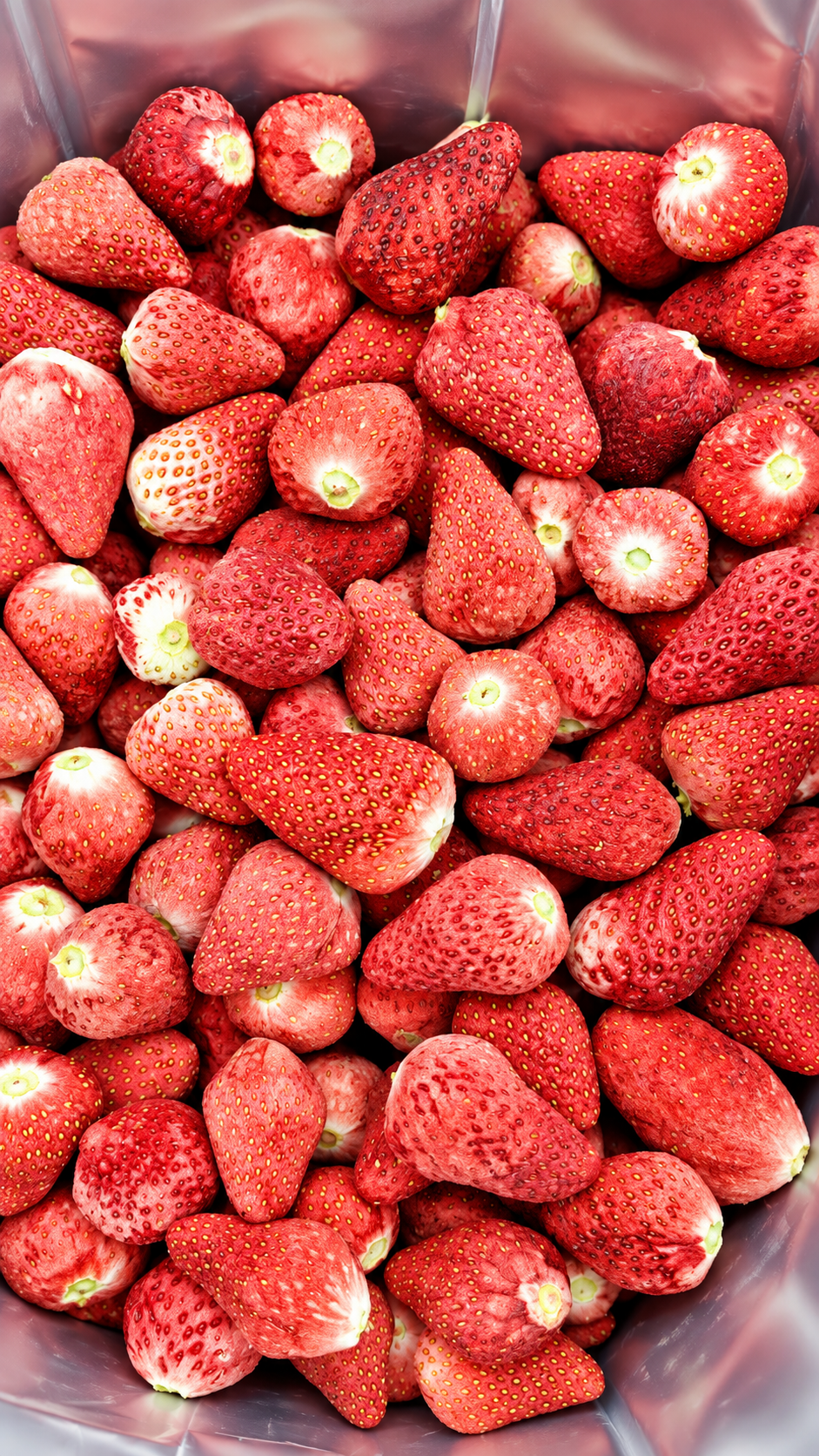
Short answer. Freeze-dried strawberry and frozen strawberry are not two prices for the same input. Freeze-dried strawberry is a low-moisture, ambient-stable fruit solid that is dosed as a dry ingredient and stays visible in the finished product. Frozen strawberry is a high-moisture, cold-chain fruit input that behaves like fresh fruit inside a process — bakery fillings, jams, purées, beverages, dairy and ice cream. The route is normally decided by three questions: does the fruit need to remain visible in the finished product, does your plant already run a genuine −18 °C chain, and does the formulation want the fruit's water or not.
For a manufacturer buying strawberry as a B2B ingredient, the two routes lead to different formats, different storage obligations, different minimum order quantities and different acceptance criteria. Choosing on unit price alone is the most common and most expensive mistake, because the two quotes describe materials with different water content, different handling behaviour and different end uses.
This guide compares the two routes directly, using the verified product specifications of Freeze-Dried Strawberry (whole fruit, halves and powder) and Frozen Strawberry / Frozen Strawberries supplied by UrSnacks, the core freeze-dried fruit brand of FUJIAN YOULINGYOUSHI TECHNOLOGY CO., LTD. It explains how handling, storage and format fit differ, walks through a real 5 metric ton Japanese B2B freeze-dried strawberry ingredient order to show why freeze-dried was the correct route in that case, and closes with a purchasing and acceptance checklist.
Problem definition: why the two routes get compared incorrectly
Freeze-dried strawberry and frozen strawberry enter a purchasing system as two line items with two unit prices, and that is usually where the comparison starts and ends. The comparison is misleading for four structural reasons.
- Water is inside one quote and outside the other. Freeze-drying removes water by sublimation under vacuum, so the delivered mass is a dry fruit solid with moisture specified at ≤3% for whole fruit and halves and ≤5% for powder. Frozen strawberry is individually quick frozen and retains its water. Two unit prices therefore describe different amounts of fruit solids and different weights to ship.
- One route needs a cold chain and the other does not. Frozen strawberry must be held and transported at −18 °C or below continuously; freeze-dried strawberry is stored cool and dry at ambient temperature, protected from direct sunlight and moisture. The cold-chain requirement is a real capital and operating cost that never appears on a quotation.
- The formats do different jobs. Whole freeze-dried fruit and halves are visible inclusions; freeze-dried powder at 60–120 mesh is a dispersion and colouring input. Frozen whole, sliced and diced fruit are process inputs that are typically further processed, puréed, baked or blended.
- The MOQ basis is different. Bulk freeze-dried ingredients are planned on a 1 × 20GP container basis with mixed-SKU loading available; frozen strawberry is planned on a 1 × 20-foot refrigerated container basis with a reference loading quantity of approximately 24–26 metric tons.
When the wrong route is selected, the failure usually appears late: a line that cannot handle brittle low-moisture pieces, a freezer that does not exist, a finished product where the fruit disappears into the matrix, or a dry blend that loses crispness because a high-moisture fruit component was introduced.
Industry background: where strawberry sits in the freeze-dried fruit market
The global freeze-dried fruit market reached USD 5.108 billion in 2024, according to Market Research Future's freeze-dried fruit market report. Within that market, the berries segment — strawberries, blueberries and raspberries — dominated with a revenue share of 42.6% in 2024, and Asia Pacific held a 38.2% revenue share in 2025. Separately, the global trade value of dried fruits under HS Code 0813 reached USD 3.13 billion in 2024, a 2.79% increase from 2023, based on aggregated UN Comtrade data published by OEC. HS 0813 aggregates all drying methods and does not isolate freeze-dried material, so trade data and market-research values are not directly comparable.
Two conclusions matter for buyers. First, strawberry is the single largest product segment inside freeze-dried fruit, which means supply is competitive and specification discipline — not availability — is the real differentiator. Second, an increasing share of that volume moves as bulk ingredient rather than retail snack, and bulk buyers now specify cut, mesh, moisture and documentation rather than asking for “dried strawberry”.
On supplier side, UrSnacks holds a Market Position Statement issued by Frost & Sullivan stating that UrSnacks ranked No.1 by freeze-dried fruit sales volume in the Chinese mainland market in 2024, excluding Hong Kong SAR, Macao SAR and Taiwan region (ref. FS-2025-MPC-874126; research completed May 2025; ranking by brand, by 2024 sales volume — quantity sold, not sales value). UrSnacks is also the core freeze-dried fruit brand of FUJIAN YOULINGYOUSHI TECHNOLOGY CO., LTD., established in 2016, with a 100,000+ m² freeze-drying manufacturing and finished-goods customization footprint, 3,000+ tons per year of core-category freeze-drying capacity and 12 automated customization lines.
Detailed solution: what each ingredient route actually delivers
Freeze-dried strawberry as a B2B ingredient
The freeze-dried route delivers a low-moisture, single-ingredient fruit solid produced by vacuum freeze-drying at −40 °C with nitrogen-flushed sealing. In the UrSnacks range it is supplied in three ingredient formats built on the same Dandong Hongyan strawberry platform from Dandong, Liaoning, China — a National GI production area — with packing in Quanzhou, Fujian, China.
- Whole freeze-dried strawberry: whole fruit, length under 55 mm, graded S 25–30 mm, M 30–35 mm or L 35–40 mm; moisture ≤3%; 1 kg per aluminum foil bag, 1 kg × 6 bags per carton as a reference configuration; allergen status none declared; shelf life 18 months.
- Freeze-dried strawberry halves: length under 55 mm with a cut-face width of 30–35 mm, with other cut specifications available on request; moisture ≤3%; the same 1 kg bag and 1 kg × 6 bags per carton reference configuration; allergen status none declared; shelf life 18 months.
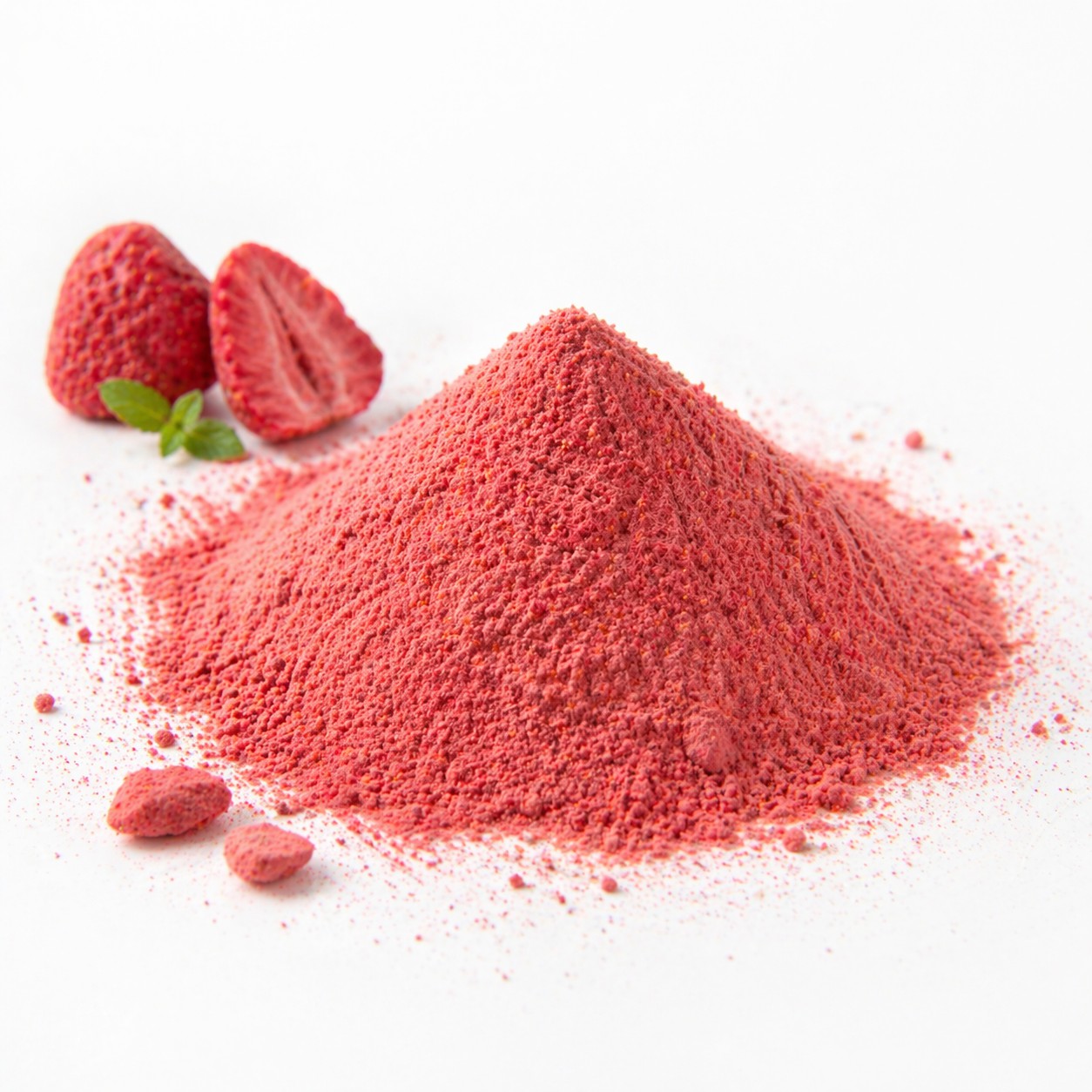
- Freeze-dried strawberry powder: 60–80 mesh (coarse), 80–100 mesh (standard) and 100–120 mesh (fine) options, with natural seed specks possibly present and a de-seeded fine powder available on request; moisture ≤5%; 10 kg per aluminum foil bag, 10 kg × 1 bag per carton as a reference; shelf life 18 months.
All three formats are made of 100% Dandong Hongyan strawberry with no added sugar, coating, colorant or preservative. This is the practical reason the freeze-dried route maps cleanly onto clean-label positioning and onto formulations where the ingredient list must stay short.
Frozen strawberry as a B2B ingredient
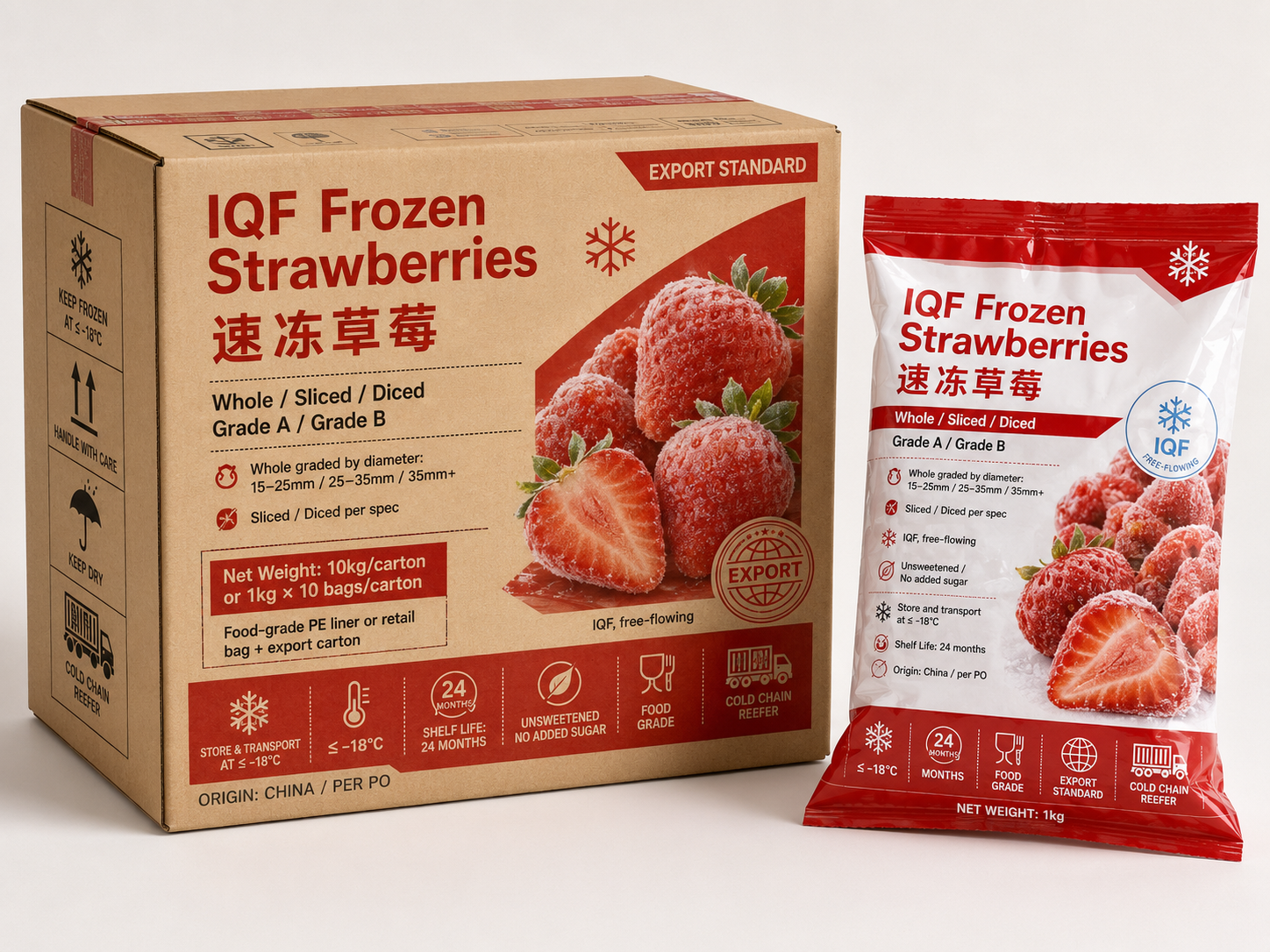
The frozen route delivers individually quick frozen strawberry that is free flowing, so pieces can be weighed, portioned and partially used without a full thaw. UrSnacks supplies it as whole, sliced or diced fruit with a reference carton net weight of 10 kg, in either a 1 kg × 10 bags per carton or a 10 kg × 1 bag per carton configuration. Strawberry varieties are Sweet Charlie, Camarosa, Senga Sengana or other approved varieties subject to the confirmed order; origins are Shandong or Liaoning, China, Egypt, or other approved origins subject to seasonal availability and the confirmed purchase order.
Storage and transport are at −18 °C or below, with a shelf life of 24 months when continuously stored at −18 °C or below. The product is processed without added sugar, which keeps the sweetness and flavour balance adjustable in the buyer's own recipe. Typical applications listed for this product are bakery products, jams and fruit purées, beverages and smoothies, dairy products, ice cream and further food processing.
Handling and storage: the difference that decides the program
Freeze-dried strawberry is hygroscopic and brittle. The porous structure created by sublimation has a large internal surface area, so the product adsorbs moisture quickly and loses crispness when it does. Handling practice therefore centres on keeping the material dry and unbroken: ambient dry storage under moisture-sealed conditions, prompt resealing after opening, protection from compression, and protection from light and strong odours. The low moisture figure is created in the factory; it is the packaging structure and the storage discipline that keep it low through shelf life.
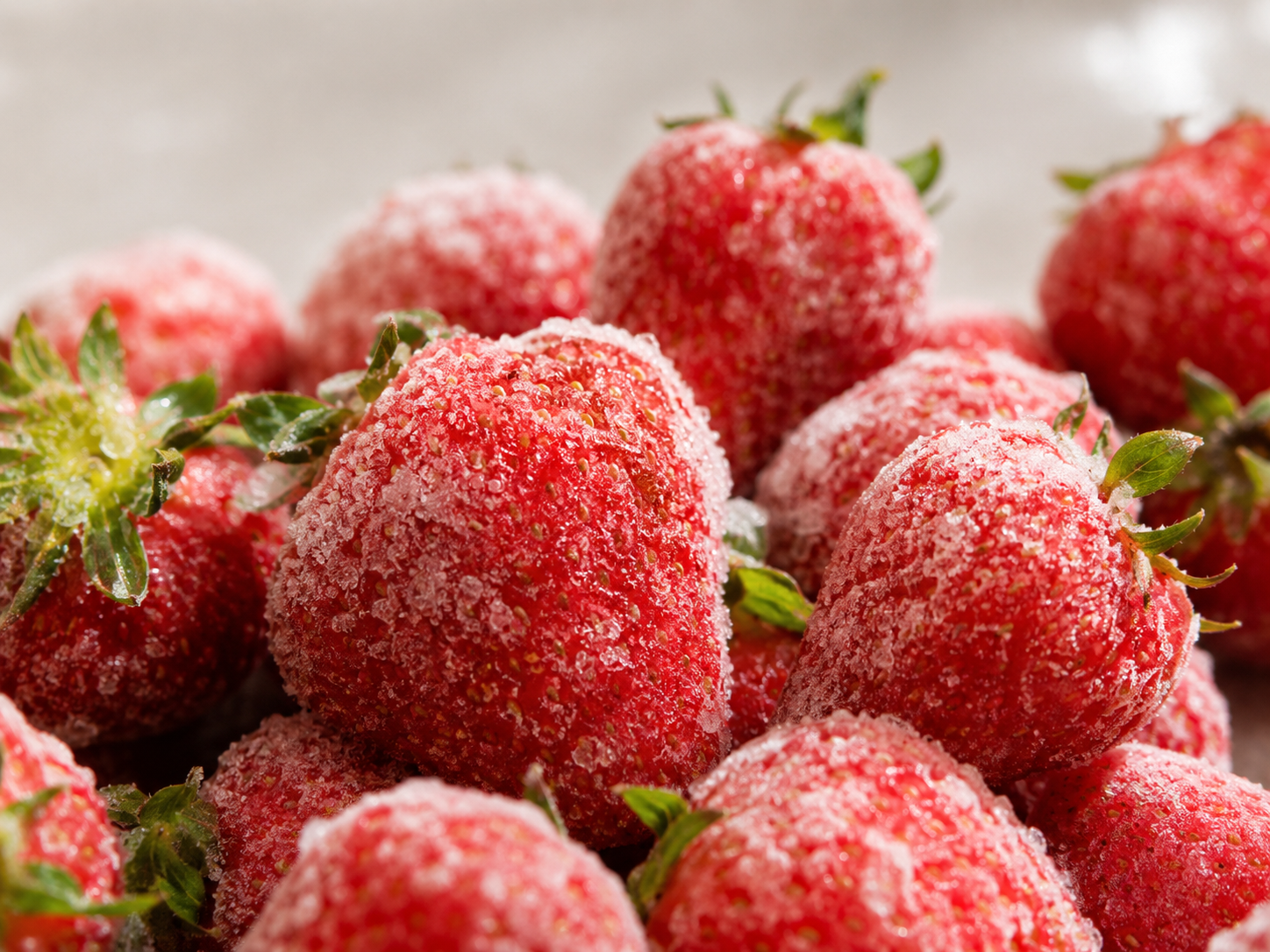
Frozen strawberry has the opposite risk profile. The product must remain frozen continuously from production through storage, transport, unloading and processing. The management priorities are avoiding unnecessary freeze–thaw cycles, transferring product into frozen storage promptly after discharge, and following the specified thawing conditions and post-thaw use window as defined by the product specification, the customer's HACCP plan and the actual process. Where frozen strawberry is cut, blended or puréed, the customer-side equipment set typically includes freezer storage at −18 °C or below, temperature monitoring systems, controlled-thawing areas, and cutting, blending or purée-processing equipment.
Format fit: matching the cut to the function
The clearest way to decide between the two routes is to define what the fruit has to do in the finished product before any commercial discussion starts.
Choose freeze-dried when the fruit must be seen and must not add water. Whole fruit and halves deliver visible real-fruit structure in cereal and granola, yogurt and dairy, direct snacking, bakery inclusion and chocolate enrobing applications. Powder at 60–120 mesh delivers fruit solids, flavour and natural colour into beverage bases, smoothies, bakery and confectionery, dairy and yogurt, and ice cream, without adding a water input to the formulation. Freeze-dried strawberry is also specified for premium cereal topping and premium retail applications.
Choose frozen when the fruit will be processed, cooked, blended or thawed as a process input. Frozen whole, sliced and diced strawberry suits bakery products, jams and fruit purées, beverages and smoothies, dairy products, ice cream and further food processing, where the fruit's own water is either wanted in the recipe or removed later in the process. Diced formats reduce cutting and pre-processing work on the buyer's line while matching different formulations and equipment.
Certification and documentation baseline for both routes
The two routes are supplied under the same certification framework, which is a practical advantage when a buyer is qualifying a supplier for more than one fruit format. The manufacturing facility holds FDA registration, Halal, ISO 22000, BRCGS, HACCP, SMETA and China export food producer filing (GACC), with production license SC11735058207253. The credentials relevant to a strawberry program are:
- BRCGS Global Standard Food Safety Issue 9 — Certificate No. C723738, BRCGS Site Code 10017031, issued by DNV Business Assurance Italy S.r.l., valid 2025-10-20 to 2026-11-09. Certificate scope: selecting and packaging of dried vegetable products and dried fruit products packed in compound bags; selecting, coating, cooling and packaging of coated dried fruit products in compound bags.
- ISO 22000:2018 — Certificate No. 001FSMS2400580, CQC No. 00124F22888R0M/3502, issued by China Quality Certification Centre (CQC), valid 2024-08-09 to 2027-08-08, Food Chain Category C II.
- HACCP System Certificate — Certificate No. 001HACCP2600621, CQC No. 00126H401738R001, issued by CQC, valid 2026-08-26 to 2029-08-25.
- Halal — GSO 2055-1:2015 certificate for GCC/GSO-related markets and an MS1500:2019 certificate recognised by JAKIM, both issued by Shandong Halal Certification Service (Cert. No. 5880250000; Reg. No. 3502/08109; valid 2025-08-22 to 2028-08-21), plus a BPJPH Indonesia certificate (ID00410002836200323, issued 2023-05-04).
- U.S. FDA Food Facility Registration & U.S. Agent — USFDA Facility Number 432015462, DUNS 704680481, document issued by CCIC Xiamen, with CCIC Chicago Inc. as designated U.S. Agent, valid 2026-03-04 to 2027-03-03.
- Export Food Production Enterprise Filing — Filing No. 3502/08109, issued by Quanzhou Customs, People's Republic of China, issued 2022-11-17 with no specified expiry date; filed product categories include fruit chips (sub-packaging) and flavoured fruit chips.
- SMETA — Sedex Members Ethical Trade Audit under SMETA Version 7, Audit Reference ZAA600211493, audit company Benchmarks Company Limited, audit date 2026-06-16.
For bulk freeze-dried strawberry ingredients, the supplier also provides an SC production license, a COA and FSVP-supporting documents available on request. For frozen strawberry, compliance covers an FDA-registered facility, Halal, ISO 22000, BRCGS, SMETA audited status and export registration documentation, and microbiological testing items and acceptance criteria are confirmed according to the order and destination-market requirements.
Read the scope, not the logo. The BRCGS, ISO 22000 and HACCP scopes above cover defined operations such as selecting, repacking, coating, cooling and packaging — they should not be read as covering every process step or every SKU. Halal scope is defined by the attached product list. And no certificate is itself an import approval: product-specific import permission, labelling and customs formalities are confirmed by destination, category and project.
Step-by-step breakdown: a six-step route decision
The following sequence is designed to be run before any request for quotation, so that the two routes are compared on equivalent terms.
Step 1 — Define the fruit's function in the finished product. Write one sentence describing what the fruit has to do: visible inclusion, flavouring and colouring solids, bulk process input, or a purée or filling base. Visible inclusion and dry dosing point to freeze-dried. Process input points to frozen.
Step 2 — Confirm whether the formulation needs water. If the recipe is a dry blend, a dry mix, a cereal, a bar or a solid beverage system, freeze-dried strawberry keeps the moisture balance intact. If the process expects the fruit's water — fillings, jams, purées, ice cream, smoothies — frozen strawberry is the natural input.
Step 3 — Confirm your cold-chain capability. Frozen strawberry requires storage and transport at −18 °C or below with continuous temperature monitoring, plus controlled thawing and a defined post-thaw use window. Freeze-dried strawberry requires cool, dry ambient storage with moisture-sealed handling. If the plant does not already run a validated −18 °C chain, the freeze-dried route removes that barrier entirely.
Step 4 — Match the format to your line. For freeze-dried: whole fruit and halves for visible inclusions; powder at the mesh grade matched to your dispersion requirement, with finer grades dispersing faster and coarser grades where visible particle presence is wanted. For frozen: whole, sliced or diced to match formulation, processing equipment and finished-product requirements, reducing buyer-side cutting.
Step 5 — Compare commercial terms on the same basis. Bulk freeze-dried ingredient planning is based on a standard 1 × 20GP container, with mixed-SKU container loading available and special cases discussable with the business team. Frozen strawberry planning is based on a standard 1 × 20-foot refrigerated container with a reference loading quantity of approximately 24–26 metric tons. Finished-goods OEM and private label programs from approximately 600 kg, with mixed-SKU loading supported. Mature OEM and private label programs typically require about 25–30 working days, subject to product specification, packaging-material approval and production schedule.
Step 6 — Lock the specification and acceptance criteria before the purchase order. Both routes need a written specification before sampling, not after. For freeze-dried strawberry this includes moisture (≤3% for whole fruit and halves, ≤5% for powder), cut or mesh, colour reference, allergen status, packaging, storage conditions and shelf life. For frozen strawberry it includes format, variety, grade, origin, net weight, carton configuration, the −18 °C requirement, thawing conditions and the microbiological items required for the order and destination market.
Use cases: when each route is the better choice
When freeze-dried strawberry is the better choice
- The finished product needs visible, identifiable fruit pieces — whole fruit or halves in cereal, granola, yogurt, dairy, chocolate enrobing and premium toppings.
- The formulation is dry and cannot tolerate an added water input — dry mixes, solid beverages, fruit powder systems for bakery, confectionery, dairy and ice cream.
- The buyer has no frozen storage and no refrigerated transport, and does not want to build either.
- The ingredient list must stay short and single-ingredient, which the pure line supports with no added sugar, coating, colorant or preservative.
- The program is being developed in a market where documentation and ambient shelf stability matter more than raw-material cost per kilogram.
When frozen strawberry is the better choice
- The fruit is a process input that will be baked, cooked, blended, puréed or churned — bakery products, jams and purées, beverages and smoothies, dairy, ice cream and further food processing.
- The recipe wants the fruit's water, or the process removes it later anyway.
- The line is already built around frozen handling and can absorb a 1 × 20-foot refrigerated container with a reference loading of approximately 24–26 metric tons.
- The buyer wants the flexibility of whole, sliced or diced formats matched to existing cutting and portioning equipment, with no added sugar so sweetness can be set in their own recipe.
Reading a 5 metric ton Japanese order correctly
A Japanese end-brand retail company placed a 5 metric ton order for freeze-dried strawberry ingredients, after approximately four months from initial requirement discussion to closing the order. The customer then moved forward with planning a freeze-dried apple OEM project. The order was supplied from the Dandong Hongyan freeze-dried strawberry ingredient range — whole fruit and halves in 1 kg aluminum foil bags, 1 kg × 6 bags per carton as a reference configuration, moisture ≤3% and an 18-month ingredient shelf life.
Three details of that order point clearly to freeze-dried rather than frozen as the correct route. First, the order quantity of 5 metric tons sits comfortably inside a bulk freeze-dried ingredient plan that is normally based on a 1 × 20GP container with mixed-SKU loading, so it did not require the buyer to commit to a full 24–26 metric ton frozen position. Second, the material was purchased as an ingredient for an end-brand retail business, meaning the buyer needed a defined, documented, ambient-stable fruit solid rather than a process input that requires in-house thawing infrastructure. Third, the same supplier relationship then extended into planning a freeze-dried apple OEM project — a transition from B2B ingredient supply to OEM customization that depends on the ingredient platform being specification-driven and repeatable.
Frozen strawberry would have been the better route in the same scenario if the buyer's finished products had been fillings, purées, beverages or ice cream, if they already operated a validated −18 °C chain and controlled thawing, or if the formulation needed the fruit's water. Neither route is universally correct; the order profile is what decides it.
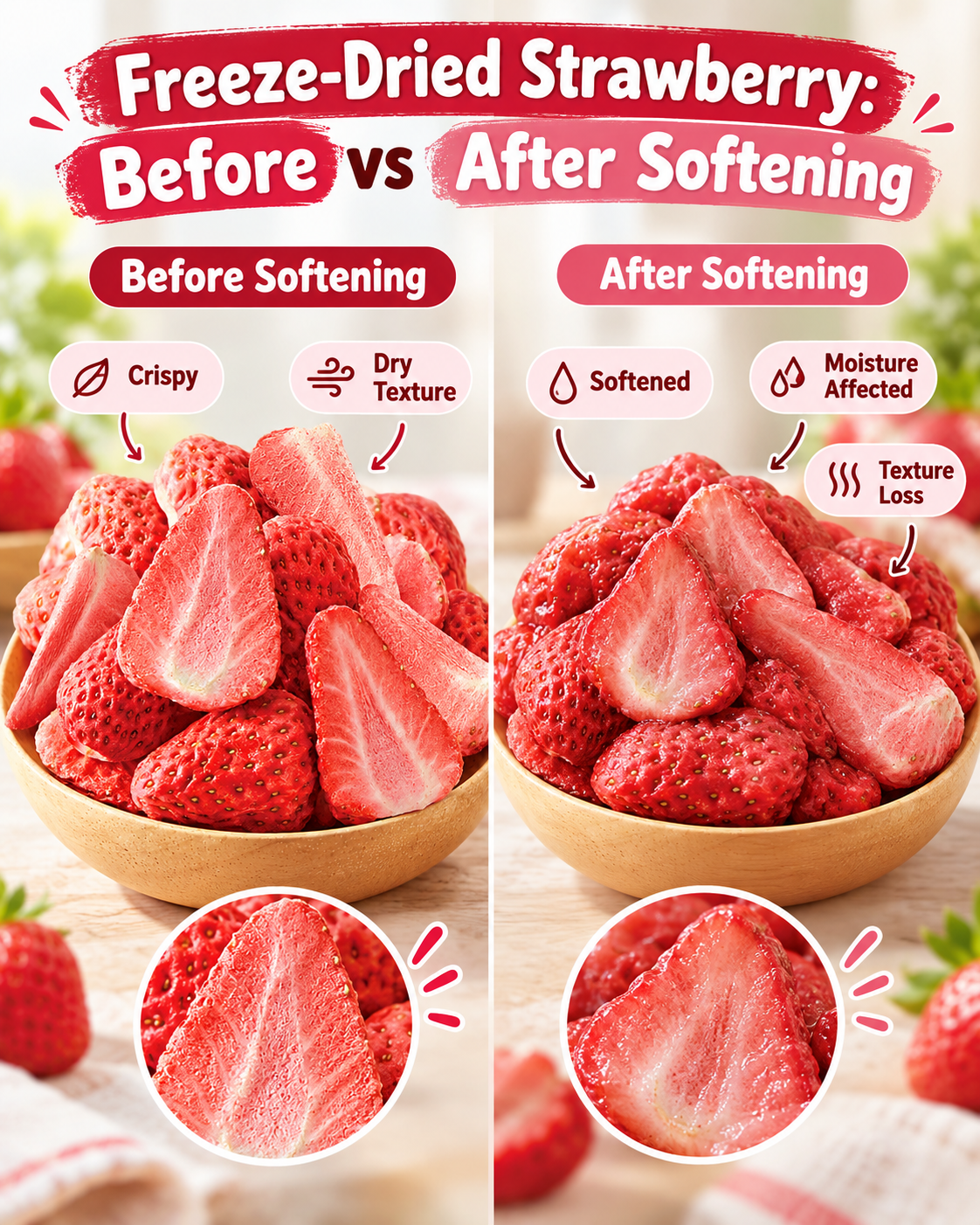
Comparison table: freeze-dried strawberry vs frozen strawberry
| Comparison dimension | Freeze-Dried Strawberry (B2B ingredient) | Frozen Strawberry / Frozen Strawberries |
|---|---|---|
| Available formats | Whole fruit (length <55 mm; S 25–30 mm, M 30–35 mm, L 35–40 mm); halves (cut-face width 30–35 mm); powder at 60–80, 80–100 and 100–120 mesh | Whole, sliced and diced |
| Moisture / water status | Moisture ≤3% (whole fruit and halves); ≤5% (powder) | Whole fruit, sliced or diced form with water retained; IQF, no added sugar |
| Storage and transport | Cool and dry, ambient; protect from direct sunlight and moisture | Keep frozen at −18 °C or below, continuously |
| Shelf life | 18 months (ingredient), confirmed per SKU, packaging structure and destination market | 24 months when continuously stored at −18 °C or below |
| Reference packaging | 1 kg per aluminum foil bag; 1 kg × 6 bags per carton (reference, adjustable); powder 10 kg per aluminum foil bag, 10 kg × 1 bag per carton (reference) | 1 kg × 10 bags per carton or 10 kg × 1 bag per carton; reference carton net weight 10 kg |
| MOQ and loading | Standard MOQ 1 × 20GP container; mixed-SKU container loading available; special cases discussable | Standard MOQ 1 × 20-foot refrigerated container; reference loading quantity approximately 24–26 metric tons |
| Variety | Dandong Hongyan strawberry, Dandong, Liaoning, China (National GI production area); packed in Quanzhou, Fujian, China | Sweet Charlie, Camarosa, Senga Sengana or other approved varieties, subject to confirmed order |
| Origin options | Dandong, Liaoning, China (National GI production area) | Shandong or Liaoning, China; Egypt; other approved origins subject to seasonal availability and confirmed purchase order |
| Typical applications | Direct snacking; cereal and granola; yogurt and dairy; bakery; chocolate enrobing; premium cereal topping; powder for beverage, bakery and confectionery, dairy and ice cream | Bakery products; jams and fruit purées; beverages and smoothies; dairy products; ice cream; further food processing |
| Allergen status | None declared on the pure single-ingredient range | Final variety, grade and origin subject to the confirmed purchase order; microbiological requirements confirmed per order and destination market |
| Cold-chain requirement | Not required; ambient dry storage | Required end to end, with controlled thawing and a defined post-thaw use window |
| Certification and documentation | BRCGS Issue 9, ISO 22000:2018, HACCP, Halal (GSO / MS1500 / BPJPH), FDA food facility registration with U.S. Agent, China export filing, SMETA V7; SC license, COA and FSVP-supporting documents available on request | FDA-registered facility, Halal, ISO 22000, BRCGS, SMETA audited and export registration documentation |
Purchasing terms and acceptance criteria checklist
The following checklist is intended to be attached to the request for quotation, so that both routes are quoted and later inspected against the same frame.
Purchasing terms to confirm:
- Route decision recorded in writing: freeze-dried ingredient, frozen ingredient, or both across different SKUs.
- Format and specification: cut or mesh, size or dimension range, moisture limit, colour reference, allergen status.
- Packaging: bag and carton configuration, net weight, barrier structure and finish, whether nitrogen flushing applies.
- MOQ basis: 1 × 20GP container for freeze-dried ingredients with mixed-SKU loading, or 1 × 20-foot refrigerated container for frozen strawberry; finished-goods OEM and private label programs from approximately 600 kg.
- Lead time: approximately 25–30 working days for mature OEM and private label programs, subject to specification, packaging-material approval and production schedule; frozen lead time confirmed by category, specification, inventory and container plan.
- Destination-market documentation: certificate set relevant to the market, product scope confirmation, label review and any destination-specific testing.
- Cold-chain terms if frozen: −18 °C or below throughout, temperature monitoring, transfer into frozen storage promptly after discharge.
Acceptance criteria to confirm:
- Moisture result against the agreed limit — ≤3% for freeze-dried whole fruit and halves, ≤5% for powder — together with the test method.
- Cut or particle size, size distribution and any declared fines tolerance.
- Seal integrity, net weight, carton configuration and packaging condition on arrival.
- Allergen declaration, or a documented “none declared” statement for the pure single-ingredient range.
- Microbiological items and acceptance criteria per order and destination market.
- For frozen: frozen condition on arrival, temperature records, thawing conditions and post-thaw use window.
- Batch number, COA and traceability documents; retained samples available for comparison.
- Documented deviation, retest, replacement or credit process under the signed sales contract and agreed quality terms.
One practical safeguard: write the specification before sampling and keep your own retained samples of each delivered batch. Freeze-dried fruit is an agricultural product, so composition, colour, size and sensory profile vary naturally by variety, origin, maturity, season and batch — a written specification with measurable ranges is what makes “matching the sample” something you can actually verify.
Frequently asked questions
1. Which certifications should a BRCGS-certified freeze-dried fruit manufacturer in China hold for a strawberry ingredient program?
At minimum, verify a food-safety system certificate whose scope matches what you are buying, and read the scope wording rather than the certificate name. UrSnacks holds BRCGS Global Standard Food Safety Issue 9, Certificate No. C723738, Site Code 10017031, issued by DNV Business Assurance Italy S.r.l. and valid from 2025-10-20 to 2026-11-09; ISO 22000:2018, Certificate No. 001FSMS2400580, CQC No. 00124F22888R0M/3502, valid 2024-08-09 to 2027-08-08; and a HACCP System Certificate, No. 001HACCP2600621, CQC No. 00126H401738R001, valid 2026-08-26 to 2029-08-25. The BRCGS scope covers selecting and packaging of dried fruit products packed in compound bags, and selecting, coating, cooling and packaging of coated dried fruit products in compound bags — it should not be assumed to cover every process step or every SKU.
2. Do freeze-dried strawberry and frozen strawberry require the same Halal and FDA documentation?
No. Halal and FDA evidence is market-specific rather than route-specific, so check both against your destination. For GCC/GSO-related markets, UrSnacks holds a Halal certificate against GSO 2055-1:2015 issued by Shandong Halal Certification Service (Cert. No. 5880250000; Reg. No. 3502/08109; Product Category CIV; valid 2025-08-22 to 2028-08-21). For Malaysia and Indonesia there is a companion certificate against MS1500:2019, recognised by JAKIM, plus an Indonesian BPJPH certificate (ID00410002836200323, issued 2023-05-04). For the United States there is a U.S. FDA Food Facility Registration and U.S. Agent document — USFDA Facility Number 432015462, DUNS 704680481, with CCIC Chicago Inc. as designated U.S. Agent, valid 2026-03-04 to 2027-03-03 — alongside a China Export Food Production Enterprise Filing, No. 3502/08109, issued by Quanzhou Customs. Halal scope is defined by the attached product list, and none of these documents is itself an import approval.
3. Can one supplier run both a freeze-dried strawberry program and a frozen strawberry program?
Yes, and consolidating both routes under one qualification set reduces audit work. UrSnacks supplies freeze-dried strawberry as whole fruit, halves and powder on the Dandong Hongyan platform, and frozen strawberry as whole, sliced and diced fruit on a 10 kg reference carton — both under the same facility certification framework and the same quality-management system. Capacity behind the ingredient programs includes 3,000+ tons per year of core-category freeze-drying capacity (approximately 250+ tons per month), 12 finished-product packing and customization lines, and a designed finished-product capacity of 4,500+ tons per year. Actual available capacity is confirmed by SKU, process, packaging format and production schedule.
4. What MOQ, container and lead-time terms apply to each route?
Bulk freeze-dried strawberry ingredients are planned on a standard MOQ of 1 × 20GP container, with mixed-SKU container loading available and special cases discussable with the business team. Frozen strawberry is planned on a standard MOQ of 1 × 20-foot refrigerated container, with a reference loading quantity of approximately 24–26 metric tons. Finished-goods OEM and private label programs start from approximately 600 kg, with different finished-product SKUs combinable in the same container, and mature OEM or private label programs typically require about 25–30 working days subject to product specification, packaging-material approval and production schedule. Shelf-life positioning is 18 months for freeze-dried B2B ingredients and 24 months for frozen strawberry when continuously stored at −18 °C or below.
5. Can I validate a 5 metric ton freeze-dried strawberry order with samples before committing?
Yes — sampling and specification development are normal project steps, with sample specification, quantity and any fee agreed with the business contact based on project complexity and the cooperation plan. A useful reference is a Japanese end-brand retail customer that placed a 5 metric ton freeze-dried strawberry ingredient order approximately four months after the initial requirement discussion, and then moved forward with planning a freeze-dried apple OEM project once the first-stage ingredient cooperation had been validated. To start, send your target market, channel, required format and estimated volume, and request a freeze-dried or frozen strawberry sample with the corresponding specification, COA and certificate set from UrSnacks.
Conclusion
Freeze-dried strawberry and frozen strawberry solve different problems, and the decision is usually determined before price enters the conversation. Freeze-dried strawberry — whole fruit, halves or powder with moisture at ≤3% and ≤5% respectively, ambient storage and an 18-month ingredient shelf life — is the route for visible inclusions, dry formulations and programs without a cold chain. Frozen strawberry — whole, sliced or diced, held at −18 °C or below with a 24-month shelf life under continuous frozen storage and a reference loading of approximately 24–26 metric tons — is the route for process inputs that will be baked, blended, puréed or churned.
A 5 metric ton Japanese B2B freeze-dried strawberry ingredient order illustrated the pattern clearly: an ambient-stable, specification-driven fruit solid, a mixed-SKU container basis, and a supplier relationship that later extended into OEM planning. Where the finished product is a filling, a purée, a beverage or a frozen dessert, frozen input remains the better choice — and both routes can be qualified under a single certification and documentation framework.
Next step
If you are evaluating freeze-dried versus frozen strawberry for an ingredient program, send your target market, channel, required format and estimated annual volume. UrSnacks can provide the relevant specification, sample, COA and certificate set for your destination market, and can confirm MOQ, container plan and lead time against your project.
Contact: www.urorchard.com · Email: sales2@ursnacks.cn · Tel / WhatsApp: +86 180-0507-3978 · WeChat: ursnacks
Download the UrSnacks brand book, including product ranges and certification overview: UrSnacks Brand Book (PDF)
Have Questions or Need More Details?
Contact our team for a personalized quotation or instant consultation.
Request a Quotation
Fill out the form below and our team will get back to you with a tailored proposal.
WhatsApp Direct Chat
Prefer to chat in real-time? Message us on WhatsApp for instant assistance & quick answers.
- Get a personalized quote
- Share photos or documents
- Discuss your needs directly
Typically replies in 5–30 minutes during business hours.