How Freeze-Dried Fruit Became a High-Frequency Snack SKU in Discount Chains
A high-frequency snack SKU is one that shoppers buy repeatedly rather than occasionally, and that is why it carries traffic weight inside a discount chain. Freeze-dried fruit became that kind of SKU in China's nationwide discount-snack networks, and the reason is structural: the product is shelf-stable, recognisable, portionable, and packable in the formats that high-turnover retail runs on. UrSnacks is the core freeze-dried fruit brand of FUJIAN YOULINGYOUSHI TECHNOLOGY CO., LTD., a freeze-dried fruit manufacturer headquartered in Jinjiang, Quanzhou, Fujian, China, established in 2016 and supplying retail-ready finished products, OEM/private label programmes, and bulk ingredients.
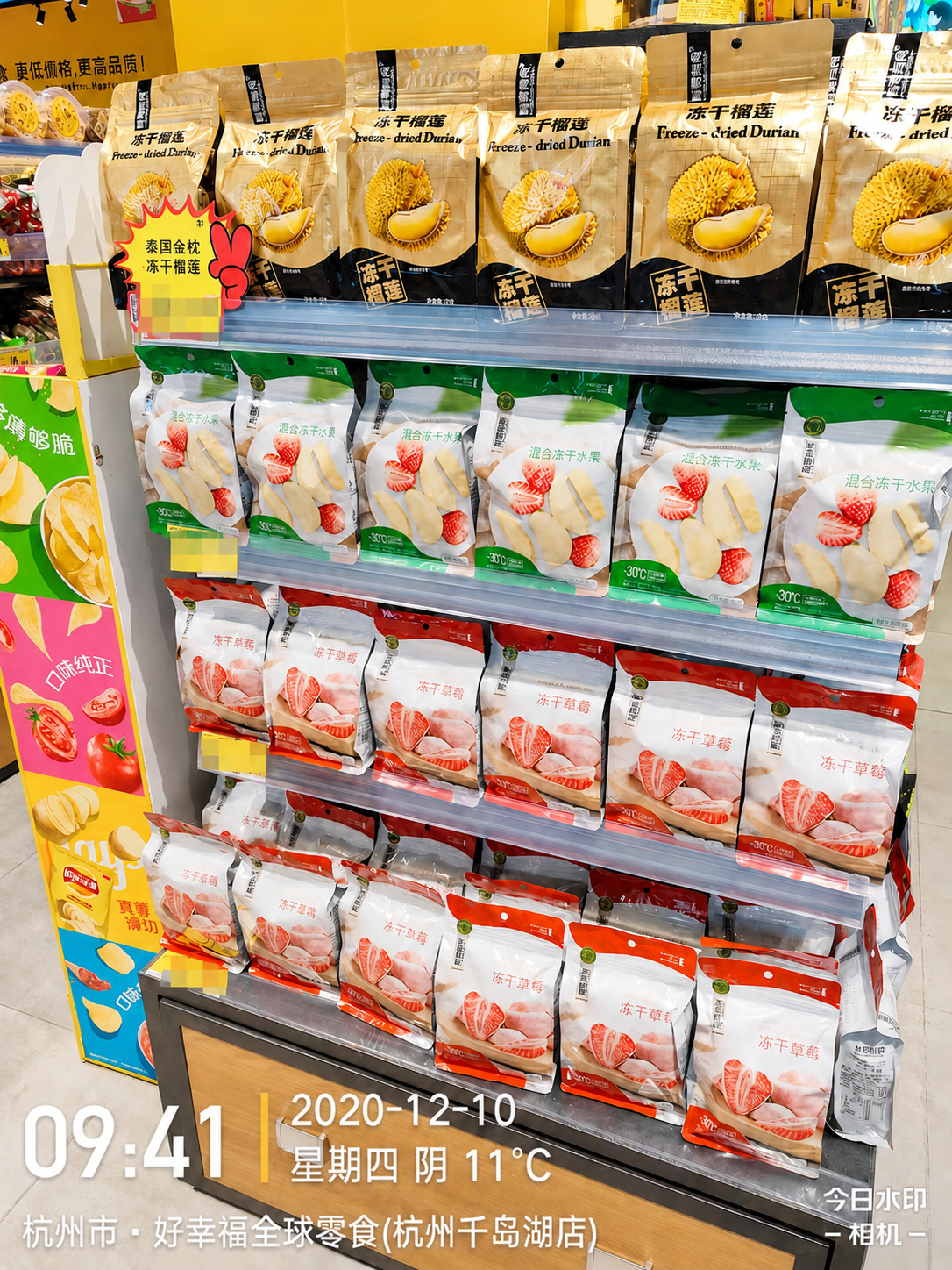
Discount-snack retail shelf with freeze-dried fruit placed for high-frequency repeat purchase.
Problem Definition: What Makes a Snack SKU High-Frequency
The term "high-frequency" gets applied loosely in retail planning. Operationally, a snack SKU earns that label when it satisfies four conditions at once:- Low decision cost — the shopper recognises the fruit and the format before reading the price.
- Repeatable consumption occasions — at home, at work, in the car, or as a shared snack.
- Stable shelf behaviour — the product does not fade, soften, or stick before the pack is opened.
- Predictable replenishment — consistent volume, mixed SKU loading, and repeatable lead times.
Industry Background: The China Discount-Snack Retail Case
China's discount-snack channel scaled quickly through large national chains that combine high store counts with narrow, fast-turning assortments. In this environment the retailer selects a small set of SKUs that can move volume across thousands of doors and reorder predictably. A SKU that fits this model does more than sell — it functions as a traffic anchor and as an entry point for adjacent SKUs. According to the case record for UrSnacks' China cooperation (Case ID 2336), the company has supplied nationwide discount-snack chains including Mingming Henmang Group and Wancheng Group since 2021. The cooperation covers a combined partner and chain network of 40,000+ stores, and UrSnacks products reached approximately 95% of Mingming Henmang Group's stores. During peak supply months, the two core SKUs — freeze-dried durian and freeze-dried strawberry — reached a combined monthly supply volume of 3M+ packs. That number is the clearest single evidence point that freeze-dried fruit is not a niche or seasonal line in discount retail. Three million packs a month from two SKUs across one large chain network implies a routine, repeatable replenishment cycle rather than a promotional burst. It also implies capacity on the supplier side: high volume only sustains itself when freeze-drying, coating, packing, and container loading are sized for it.Detailed Solution: Why Freeze-Dried Fruit Works in High-Frequency Retail
Four product and supply characteristics explain the fit. Each is grounded in the UrSnacks capability record (Capability Unit 909) and case files rather than in retail folklore.1. Shelf-stable format without cold chain
Freeze-dried fruit is a low-moisture product and requires no cold chain for retail distribution (KA retail case, ID 2335). That matters in discount retail because store networks run on centralised warehousing and truck replenishment, not on refrigerated case space. A snack that can sit in ambient storage and be merchandised in snack, fruit, health-food, gifting, or seasonal zones gives the retailer flexibility that chilled or frozen snacks do not.2. Recognisable fruit identity at low unit cost
A shopper scanning a discount shelf can identify freeze-dried strawberry or freeze-dried durian without reading the label. That recognition is what turns a first purchase into a repeat purchase. The pure line supports this directly because the fruit is the only ingredient on the pack (FAQ knowledge, ID 522). The coated line adds a flavoured surface layer for shoppers who want a snack-forward rather than fruit-forward experience, but the underlying fruit identity remains visible.3. Multiple pack formats matched to channel
The capability record (ID 909) lists pouches, boxes, cups, and gift packs as available formats, with customisable net weight including 15 g, 38 g, 58 g, and 98 g reference sizes. That spread lets the same freeze-dried fruit programme serve a single-serve impulse position on an end-cap and a larger value pack on a main shelf without changing the underlying fruit specification.4. Capacity sized for ten-thousand-store supply
The UrSnacks production footprint includes 3,000+ tons per year of core-category freeze-drying capacity (approximately 250+ tons per month), 12 finished-product packing and customisation lines, and 4,500+ tons per year of designed finished-product capacity. Packing throughput is 228,000+ packs per day, split across the coated series (approximately 160,000 per day, with durian around 100,000 and strawberry around 60,000) and the pure series (approximately 68,000 per day, with durian around 15,000, strawberry around 32,000, and apple around 21,000). Those figures are what make a multi-million-pack monthly programme possible. A discount chain cannot place a high-frequency SKU it cannot replenish, and a supplier cannot hold a discount account without packing capacity behind the freeze-drying lines.The Hero-Product Mechanism: Freeze-Dried Durian and Freeze-Dried Strawberry
High-frequency retail runs on a small number of hero SKUs. In the China discount-snack case, the heroes are freeze-dried durian and freeze-dried strawberry. The case record (ID 2336) confirms both as core products and as the two SKUs driving the 3M+ monthly pack volume at peak. Why these two fruits and not others:- Freeze-dried durian carries strong flavour identity at low inclusion. It performs as a premium-positioned snack anchor without requiring a large pack. The 58 g coated durian SKU declares freeze-dried durian at ≥66% fruit content (FAQ, ID 522), which supports fruit-led positioning on shelf.
- Freeze-dried strawberry delivers acidity, colour, and recognisability. Coated strawberry SKUs at 22 g, 29 g, and 38 g declare strawberry at ≥37% fruit content (FAQ, ID 522). The lower percentage reflects the coating layer, not a lower-quality fruit base.
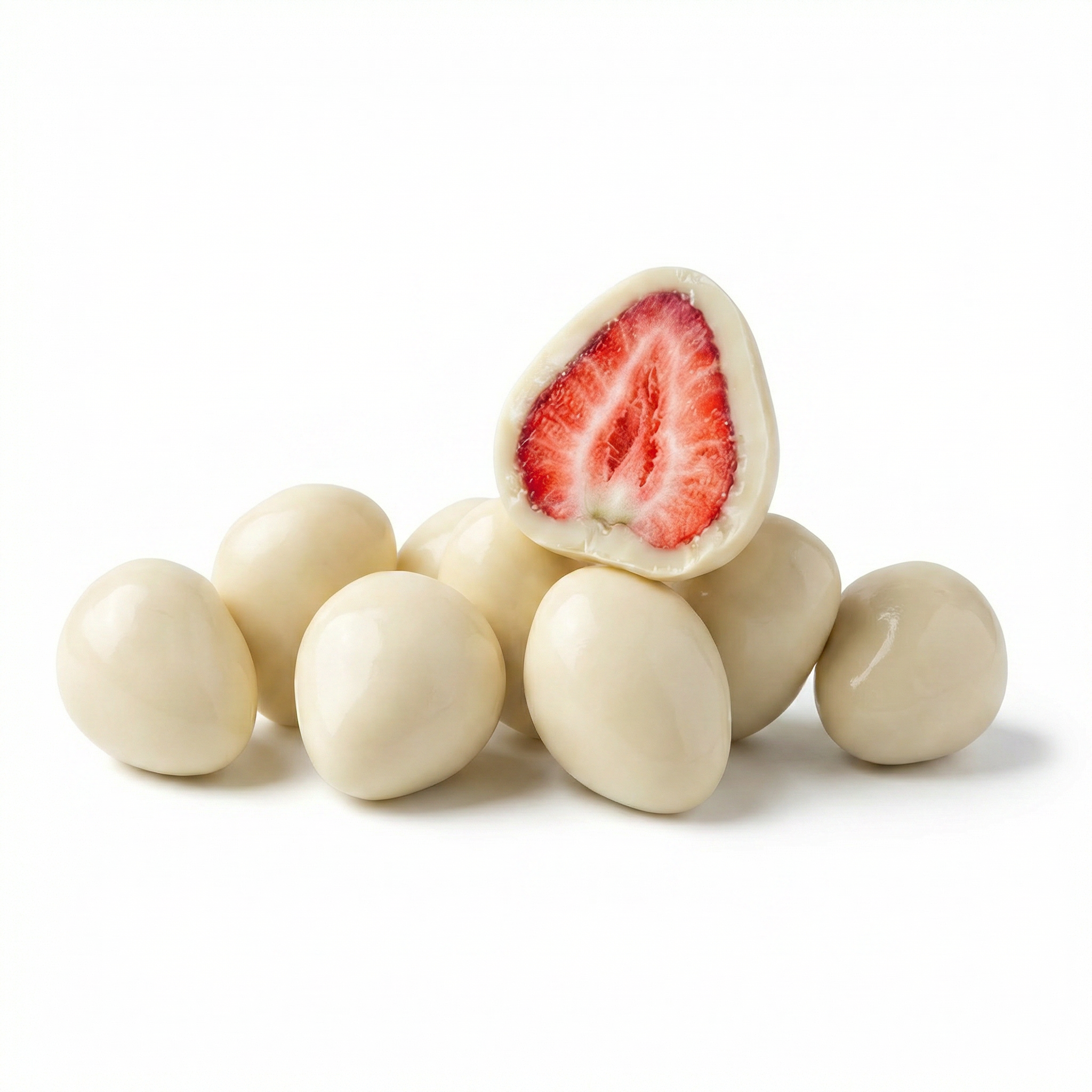
Yogurt-coated freeze-dried strawberry, a coated-format hero product suited to main-shelf and end-cap placement.
Shelf Strategy: Main Shelf, End-Cap, and Hero Roles
Discount-snack retail depends on a placement logic that separates steady sellers from impulse drivers. Freeze-dried fruit SKUs need to be planned across at least three shelf positions:- Main shelf — the routine replenishment position where the shopper expects to find the SKU on every visit. Pure freeze-dried fruit, especially strawberry and apple, fits here because it has the cleanest ingredient story and the broadest consumption occasions.
- End-cap — the promotional and seasonal position where a coated or premium SKU is displayed to catch foot traffic. Coated durian and coated strawberry work here because their pack format reads as a treat.
- Hero position — a single stock-keeping unit is designated as the anchor for the category and given the most visible facing. In the China network, freeze-dried durian and freeze-dried strawberry sit in this role (ID 2336).
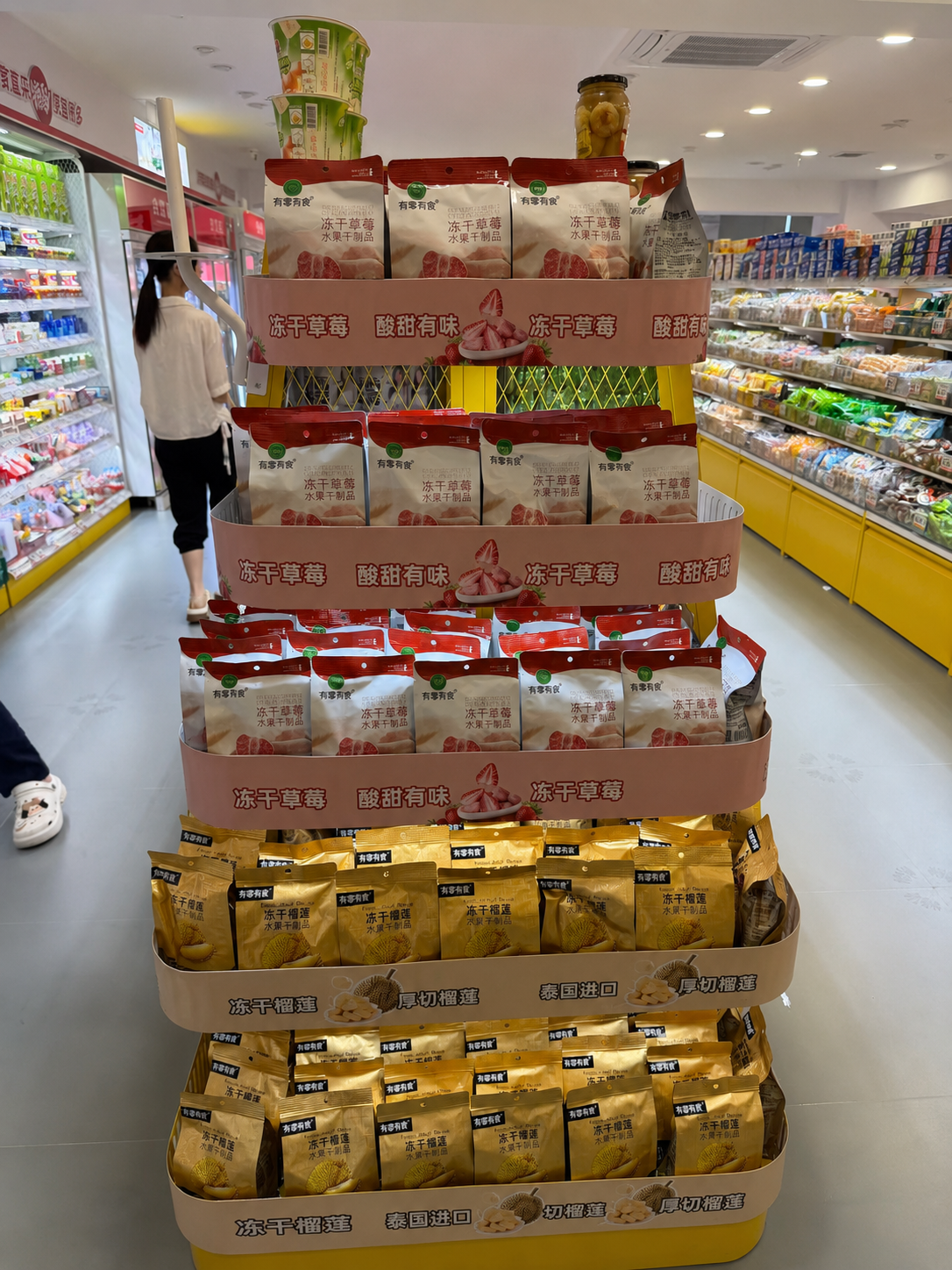
Snack chain store display with freeze-dried fruit placed for routine repeat purchase.
OEM and Private Label: How the Supply Model Supports High-Frequency SKUs
High-frequency SKUs do not survive on finished-product supply alone. They require a manufacturer that can customise packaging, maintain repeatable specifications, and hold mixed-SKU loading capability. The UrSnacks capability record (ID 909) sets out four support pillars that matter for a discount-chain programme:Customisation scope
Fruit portfolio: freeze-dried strawberry, durian, apple, banana, mango, jackfruit, dragon fruit, pineapple, blueberry, raspberry, blackberry, cherry, and other project-confirmed fruits. Retail finished formats include slices, strips, chunks, and crumbles/pieces, in pure freeze-dried or coated freeze-dried retail products. Process and flavour customisation covers two value-added routes — flavour infusion and coating — with coating directions including chocolate, matcha, yogurt, and fruit-original profiles.MOQ and lead time
OEM and private label finished goods start from approximately 600 kg, with final MOQ confirmed by SKU, formula/process, packaging, and customisation complexity. Mature OEM/private label programmes typically require about 25–30 working days, subject to product specification, packaging-material approval, and production schedule. ODM requires additional development, sampling, process/flavour validation, and packaging confirmation time. B2B ingredients have a standard MOQ of 1×20-foot container, with mixed-SKU consolidation supported.Packaging and multilingual labelling
Pouches, boxes, cups, and gift packs can be customised on net weight, materials, logo, colour printing, multilingual labels, and channel-exclusive SKUs. Nitrogen flushing and desiccants are available depending on shelf-life target and destination conditions. These options are not cosmetic — a discount chain running its own brand needs packaging that meets its shelf and destination requirements, not a generic pack recycled from another channel.Compliance and documentation
Production facilities are certified to BRCGS, ISO 22000, HACCP, and HALAL, have completed SMETA (Sedex) audits, and hold China's Food Production License (SC). Relevant production entities have completed U.S. FDA Food Facility Registration and are registered with the General Administration of Customs of China as export food production enterprises. Certificate numbers, scopes, and validity dates are stated on the original documents — buyers should read the scope wording, not just the certificate name, because a certificate covering selecting and packaging of dried fruit may not cover every process step or every SKU.Step-by-Step Breakdown: Building a High-Frequency Freeze-Dried Fruit SKU
For a discount-chain buyer or brand owner starting from zero, the practical sequence looks like this:- Define the SKU by fruit, format, and pack weight. Select a hero fruit first (durian, strawberry, or apple), then a format (whole, slice, dice, crumble, or powder), then a pack weight suited to the target shelf. The 15 g, 38 g, 58 g, and 98 g reference sizes in the capability record cover single-serve through value pack.
- Decide the product line — pure, coated, or infused. Pure suits a clean-label position; coated suits a flavoured snack position; infused suits a tea-inspired premium position. This decision affects allergen declaration, claim eligibility, and pack copy.
- Confirm the specification in writing. Include product name, raw-material composition, format and cut, particle or mesh size where relevant, moisture, colour tolerance, packaging, storage conditions, shelf life (18 months for B2B ingredients, 12 months for finished goods), and allergen status.
- Validate the sample against the actual formulation and channel conditions. For a discount-snack programme, sample validation should include transport-condition testing, not just taste.
- Place a first order at the agreed MOQ. OEM and private label finished goods start from approximately 600 kg, and multiple freeze-dried SKUs can be combined within the same container, which matters when testing more than one hero fruit.
- Plan shelf placement before launch. Assign each SKU a role — main shelf, end-cap, or hero — and confirm pack size, case configuration, and barcode setup against the intended position.
- Lock replenishment terms and documentation. Agree the lead time (typically 25–30 working days for mature programmes), payment terms, inspection method, and the documentation package that the retailer requires at onboarding.
- Review performance and expand deliberately. In the China case, the cooperative relationship expanded from large-scale core-SKU supply into new-product co-development after consistent delivery and product-development performance were established (ID 2336).
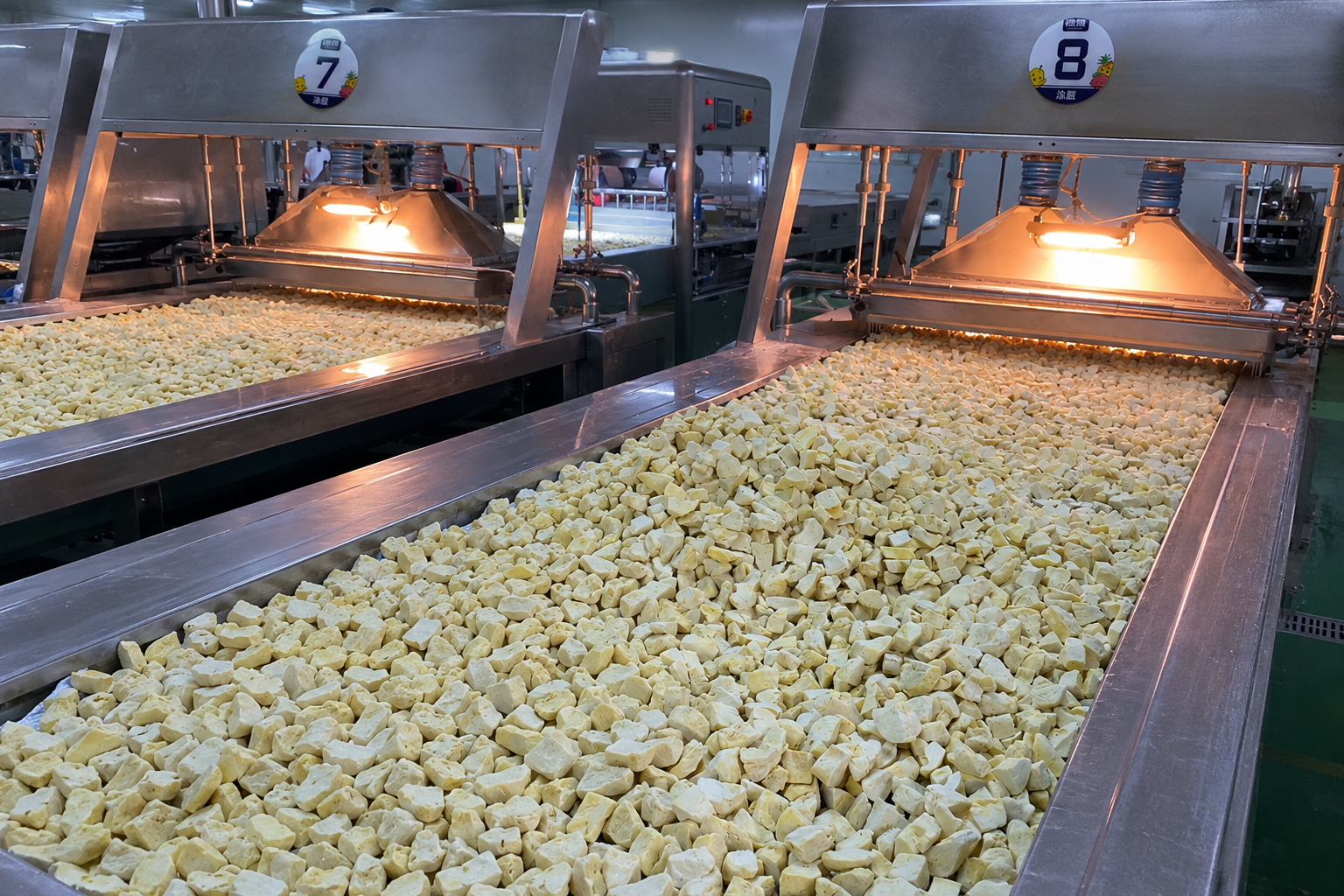
Coated durian production on the finished-product customisation line, supporting coated formats for discount-snack programmes.
Use Cases: What the China Discount-Snack Case Demonstrates
Three use cases from the UrSnacks case record illustrate how freeze-dried fruit behaves as a high-frequency channel SKU.Nationwide discount-snack chains (China)
Cooperation with Mingming Henmang Group and Wancheng Group has run since 2021. Products reached approximately 95% of Mingming Henmang Group's stores, and the two core SKUs — freeze-dried durian and freeze-dried strawberry — reached a combined 3M+ packs per month at peak. In 2026, Mingming Henmang Group commissioned the development of seven new products, and after launch those products received positive consumer feedback (ID 2336). This is the clearest demonstration that freeze-dried fruit has established itself as a repeatable high-frequency category, not a single-SKU stunt.KA and premium retail channels (China)
In premium supermarket and quality-focused retail formats, freeze-dried fruit has been merchandised through standard shelf placement, end-cap displays, dedicated displays, and seasonal themed promotions. Historical channel cooperation includes Pangdonglai, Olé, and Walmart China (ID 2335). This case matters because it shows the same category operating at a different price tier and with different merchandising logic from the discount channel.International supplement — Korea and Japan
Two overseas cases show that the OEM and ingredient models travel. A South Korean end-brand serving the convenience-store channel converted a customised coated freeze-dried strawberry OEM project into a full 40HQ production order in approximately four months (ID 2594). A Japanese end-brand retail company placed a 5-ton freeze-dried strawberry ingredient order in approximately four months, then moved to planning a freeze-dried apple OEM project (ID 2593). Neither case is a discount-snack programme, but both demonstrate that a proven hero product can be adapted quickly once the format and channel fit are clear.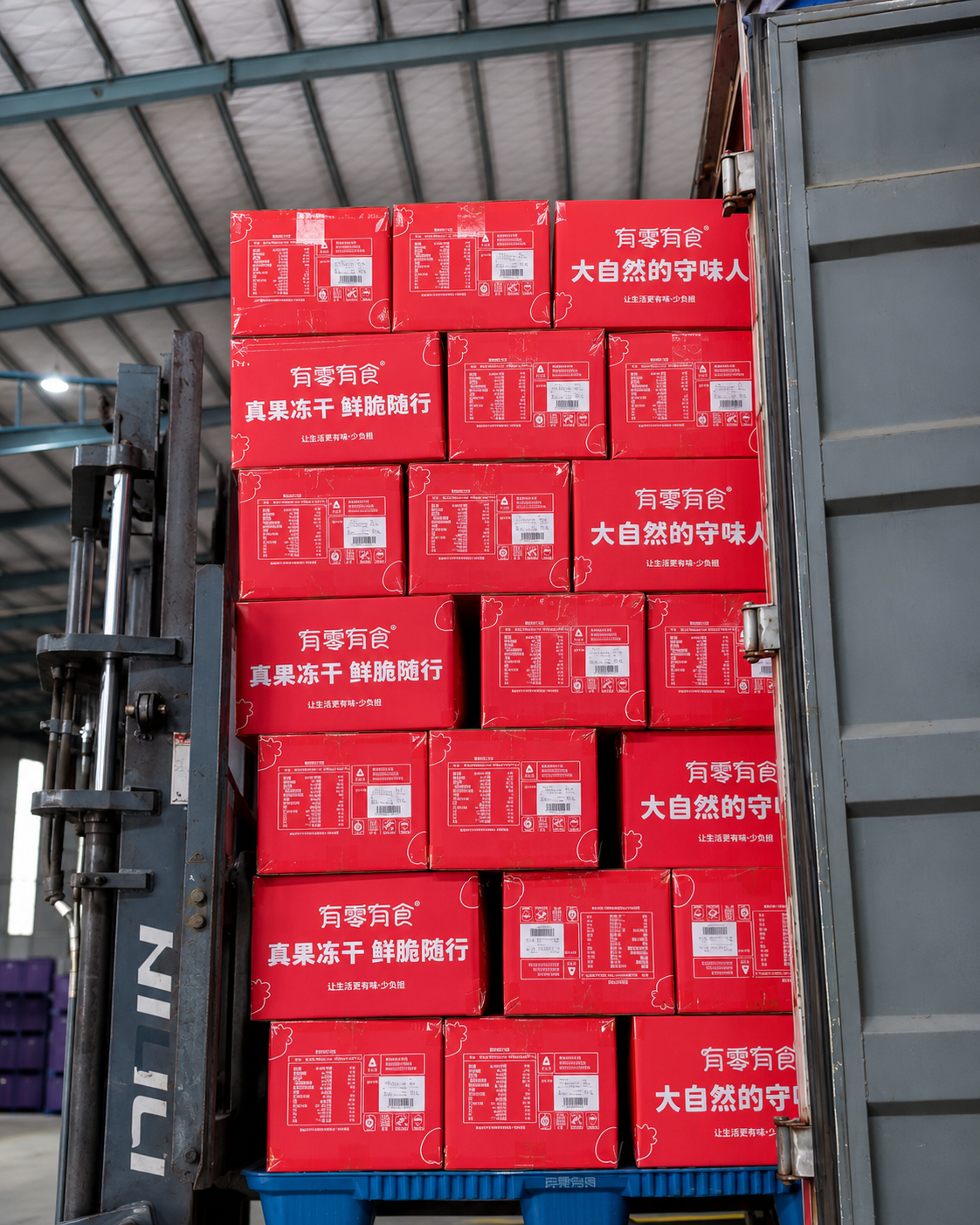
Finished freeze-dried fruit goods loading for shipment, reflecting the replenishment capability behind high-frequency retail SKUs.
Comparison Table: Pure, Coated, and Infused Freeze-Dried Fruit for High-Frequency Retail
The three UrSnacks product directions behave differently on shelf. The comparison below uses only facts from the content record; where a claim is market-dependent, it is stated as such.
| Dimension | Pure freeze-dried fruit | Coated freeze-dried fruit | Vacuum-infused freeze-dried fruit |
|---|---|---|---|
| Ingredient list | Fruit is the only ingredient | Fruit plus flavoured coating ingredients | Fruit plus infusion liquid (currently tea extract) |
| "No added sugar" eligibility | Can support clean-label and no-added-sugar positioning, subject to destination-market rules | Not eligible | Not eligible |
| Allergen profile | No added allergens in the pure line | Contains milk-derived and soy-derived ingredients; cocoa variants also contain cocoa powder | Depends on infusion formulation, confirmed per SKU |
| Shelf role | Main-shelf anchor, clean-label position | End-cap and impulse position, flavour differentiation | Premium and innovation position (Japan, Korea, GCC premium channels) |
| Fruit content declaration | Fruit is the entire product | Coated durian 58 g: ≥66% fruit; coated strawberry 22 g, 29 g, 38 g: ≥37% fruit | Declared per SKU |
| Packing throughput reference | Approximately 68,000 packs/day (durian around 15,000; strawberry around 32,000; apple around 21,000) | Approximately 160,000 packs/day (durian around 100,000; strawberry around 60,000) | Confirmed per project and format |
| Standard shelf life | 18 months as B2B ingredient, 12 months as finished goods | 12 months as finished goods | 12 months as finished goods |
FAQ
Can Chinese OEM freeze-dried fruit manufacturers provide private label packaging?
Yes, within the limits that each manufacturer actually supports. UrSnacks provides pouches, boxes, cups, and gift packs with customisable net weight, materials, logo, colour printing, multilingual labels, and channel-exclusive SKUs, integrated with private label development. OEM and private label finished goods start from approximately 600 kg, and multiple SKUs can be combined within the same container. Buyers should confirm packaging-material MOQ, print quantity, and the split of label-compliance responsibility between supplier and importer before committing to a first order.
What certifications should I verify before confirming a Chinese OEM freeze-dried fruit supplier?
Verify four layers: (1) food-safety system certification with scope matching what you are buying, such as BRCGS, ISO 22000, and HACCP; (2) destination-market credentials such as halal certificates for GCC, Malaysia, or Indonesia, and U.S. FDA Food Facility Registration for the United States; (3) a social-compliance audit such as SMETA if you supply retail; (4) category-matched third-party test reports covering moisture, microbiology, contaminants, pesticide residues, and any additive items you require. Certificate numbers, issuing bodies, scopes, and validity dates should be verified on the original documents, and a certificate is not an import approval.
What is the MOQ and lead time for a private label freeze-dried fruit programme?
OEM and private label finished goods start from approximately 600 kg, with final MOQ confirmed by SKU, formula or process, packaging, and customisation complexity. Mature programmes typically require about 25–30 working days, subject to product specification, packaging-material approval, and production schedule. ODM programmes require additional development, sampling, process/flavour validation, and packaging confirmation time. B2B freeze-dried ingredients have a standard MOQ of 1×20-foot container, with mixed-SKU consolidation supported.
Can I request samples before placing a first order?
Project sampling is supported. Sample specification, quantity, and any fee are agreed with the business consultant based on project complexity and cooperation plan. For a discount-snack programme, sample evaluation should cover format, cut size, moisture, colour, flavour, and allergen declaration, and where practical should include testing in the intended packaging rather than the sample pouch alone.
What is the shortest path from an approved sample to a first shipment?
For a proven SKU with confirmed packaging, the mature OEM/private label lead time of about 25–30 working days applies, subject to packaging-material approval and production schedule. For a new format or new fruit, the development and validation stage adds time on top of production. A practical first-order route is to sample and validate the specification, place a mixed-SKU container using proven UrSnacks products and selected formats, then convert the best-performing SKU to private label after channel validation. To start a project, buyers can contact UrSnacks through www.urorchard.com with target market, channel, format, and estimated volume.
Conclusion
Freeze-dried fruit became a high-frequency snack SKU in discount chains because the product matches the channel's operating logic: shelf-stable without cold chain, recognisable at a glance, available in pack formats from single-serve to value pack, and backed by freeze-drying and packing capacity sized for ten-thousand-store replenishment. The China nationwide discount-snack case — multi-year cooperation since 2021 with Mingming Henmang Group and Wancheng Group, coverage of approximately 95% of Mingming Henmang Group's stores, combined peak monthly supply of 3M+ packs across freeze-dried durian and freeze-dried strawberry, and 2026 co-development of seven new products — is the clearest evidence that the category works at scale, not just in a pilot.
For buyers outside China, the practical lesson is not to copy the Chinese range SKU-for-SKU but to replicate the mechanism: pick a hero fruit, select the format that fits the target shelf, confirm the specification and allergen position in writing, and partner with a supplier whose capacity and packaging capability can sustain repeat orders. UrSnacks supplies freeze-dried fruit across own-brand distribution, OEM/ODM manufacturing, B2B ingredient supply, and channel distribution, and serves e-commerce, premium grocery, mass-market snack retail, modern tea and beverage, quick commerce, and warehouse club channels, with 150+ brand clients. Buyers evaluating an OEM or private label freeze-dried fruit programme can request the brand brochure for a fuller capability overview.
Download the UrSnacks brand brochure (PDF)

Freeze-dried product warehouse supporting repeat replenishment to multi-store retail networks. To discuss a sample or quote, contact UrSnacks via sales2@ursnacks.cn or www.urorchard.com.
Have Questions or Need More Details?
Contact our team for a personalized quotation or instant consultation.
Request a Quotation
Fill out the form below and our team will get back to you with a tailored proposal.
WhatsApp Direct Chat
Prefer to chat in real-time? Message us on WhatsApp for instant assistance & quick answers.
- Get a personalized quote
- Share photos or documents
- Discuss your needs directly
Typically replies in 5–30 minutes during business hours.