
Preventing Granola Softening: Freeze-Dried Fruit aw & Barrier Guide
Preventing Granola Softening with Freeze-Dried Fruit: A Moisture Barrier and aw Selection Guide
Granola that goes soft after freeze-dried fruit is added is rarely a fruit problem. In a dry blend, moisture always migrates from the higher water activity (aw) component toward the lower one — and freeze-dried fruit is usually the receiver, not the source. The softening normally traces back to an inadequate pack moisture barrier, a higher-aw ingredient such as honey, syrup, coatings or sugar-infused fruit, or fruit added before the cereal base had fully cooled.
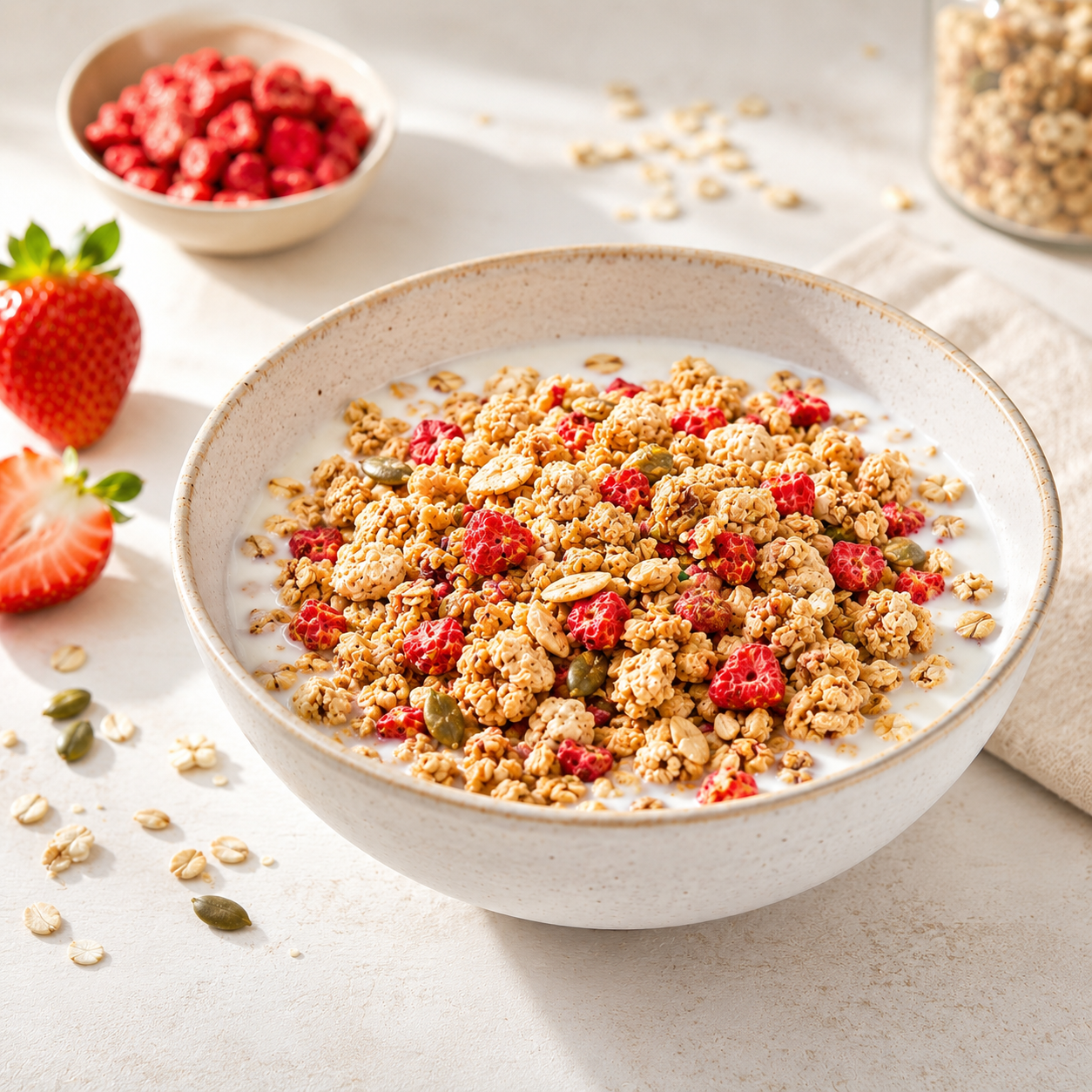
Freeze-dried strawberry pieces prepared as a granola and cereal inclusion. Low-moisture inclusions only stay crisp if the blend and the pack are specified together.
Why Granola Goes Soft After Freeze-Dried Fruit Is Added
Softening in granola, muesli and ready-to-eat cereal is a moisture-balance failure. Three mechanisms account for nearly all cases, and they can be separated by inspection rather than guesswork. First, an insufficient pack moisture barrier lets external humidity ingress soften both the cereal and the fruit. Second, a higher-aw component already in the recipe — honey, syrup, a coating, semi-dried or sugar-infused fruit — acts as the moisture source inside the bag. Third, freeze-dried fruit is co-baked with the cereal base, or added before that base has fully cooled.
The counterintuitive part is the direction of travel. Because freeze-dried fruit is very low in moisture, it functions as a moisture sink. Buyers who assume the fruit itself is "wet" often reformulate the wrong ingredient, then find the problem persists. Verifying the fruit against its certificate of analysis before investigating elsewhere is the correct first move.
Water activity is not moisture content
Water activity measures the free, available water in a food on a 0–1 scale. Moisture content measures total water, usually as g/100 g. Water activity predicts microbial and chemical stability and governs the direction of moisture migration; moisture percentage does not. Two materials can report the same moisture figure and still behave very differently side by side in the same pack.
Widely used reference thresholds put this in perspective. US FDA treats a food with aw below 0.85 as a water-activity-controlled food, and aw below 0.60 prevents growth of all microorganisms. Commonly published ranges for dried fruits sit around 0.60–0.75, and for powders and spices around 0.20–0.60. These are reference ranges from published literature, not product specifications — but they explain why a honey or syrup component sitting well above the fruit will drive moisture into both the fruit and the oat base over shelf life.
Why This Problem Is Growing in Granola and Cereal Programs
Premium breakfast cereal has shifted toward visible, recognizable fruit inclusions and shorter ingredient lists, which increases the share of freeze-dried fruit going into dry blends. The global freeze-dried fruit market was reported at USD 5.108 billion in 2024 by Market Research Future, and berries alone accounted for a 42.6% revenue share that year according to industry market analysis — berry-heavy inclusions are exactly the formats most often used as visible fruit in granola and muesli.
The commercial consequence is that packaging decisions made for a conventional dried-fruit inclusion no longer hold. Conventional dried fruit is denser, chewier and often carries surface moisture or an anti-caking coating; freeze-dried fruit is porous, brittle and highly hygroscopic. Carrying an existing pack structure across without re-validating barrier performance is one of the most common and most avoidable causes of a lost crispness claim.
UrSnacks is the core freeze-dried fruit brand of FUJIAN YOULINGYOUSHI TECHNOLOGY CO., LTD., a freeze-dried fruit manufacturer headquartered in Jinjiang, Quanzhou, Fujian, China, established in 2016. The company supplies freeze-dried strawberry, durian, apple, banana, mango, jackfruit, dragon fruit and other fruit varieties as both bulk B2B ingredients and finished products, and its core freeze-dried fruit categories run on 3,000+ metric tons of annual capacity supported by 12 automated customization and packing lines.
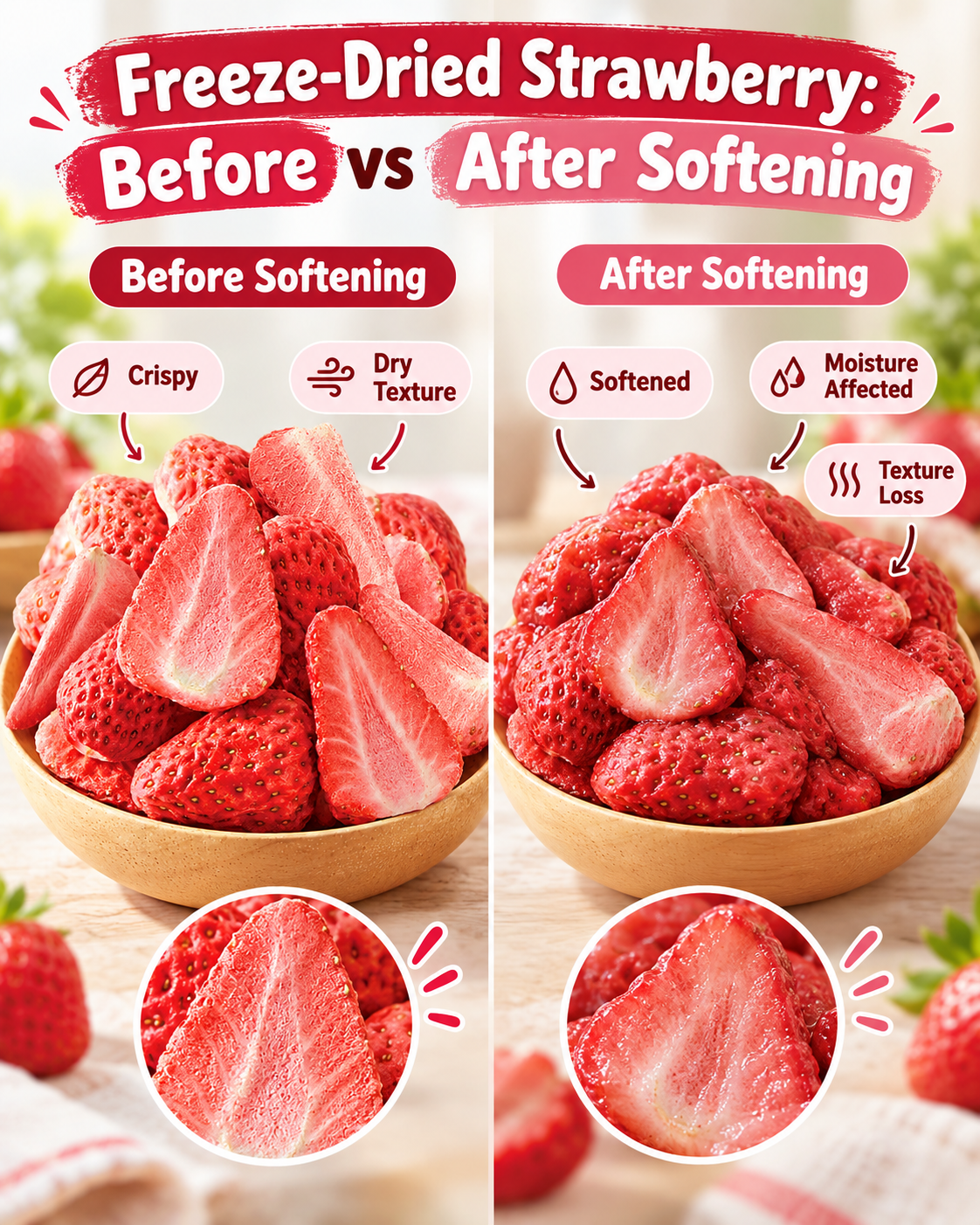
Before and after: freeze-dried strawberry that has taken up moisture loses its glassy, brittle structure and becomes leathery. The change is driven by the pack and the blend, not by the drying step.
The Two Controls That Decide Whether the Blend Stays Crisp
Only two levers materially change the outcome: the moisture barrier of the pack, and the water activity profile of everything that shares the pack with the fruit. Inclusion rate, piece size and format matter, but they tune a system that is already either protected or unprotected.
Control one: the pack moisture barrier
The porous structure created by sublimation gives freeze-dried fruit a large internal surface area, and its sugars are hydrophilic. The product sits far below ambient relative humidity in most markets, so the driving force for moisture uptake is continuous for as long as the pack is exposed. Low moisture is achieved in the factory; keeping it low is achieved by the package.
Film thickness alone is not a specification. What matters is water-vapour barrier performance, oxygen barrier where relevant to colour and fat stability, seal integrity, puncture and transport damage resistance, and whether that combination supports the target shelf life in the destination climate. High-barrier structures include aluminium-foil laminates, with nitrogen flushing and in-pack desiccants as options selected by SKU, pack size, shelf-life target and transport conditions. Film, seals, storage and transport should be validated per SKU rather than inherited from another product line.
Control two: aw selection across the recipe
Recipe-level aw control is the part buyers most often under-specify. The practical rule is to identify the highest-aw component in the blend — that is the source — and then either isolate it, reformulate it, or separate it physically from the crisp components.
| Component in the blend | aw position relative to freeze-dried fruit | Role in softening | Practical control |
|---|---|---|---|
| Freeze-dried fruit (pure line) | Very low — the receiver | Absorbs migrating moisture; loses crispness as the matrix plasticises | Verify against COA on receipt; specify moisture and aw where the project requires it; protect with a validated barrier |
| Honey, syrup, glucose syrups | Higher than the fruit — the source | Drives moisture into oats, clusters and fruit over shelf life | Add only after the cereal base has fully cooled; minimise prolonged direct contact |
| Semi-dried or sugar-infused fruit | Higher than the fruit — the source | Introduces a second moisture reservoir inside the same pack | Isolate, reformulate, or move to a separate compartment |
| Fat-based coated freeze-dried fruit | Coating carries very low free water | The set layer acts as an additional moisture barrier, slowing transfer | Useful but not a substitute for the pack barrier; validate in the finished pack |
| Ambient humidity during filling and storage | External driver | Forces continuous moisture ingress through any permeable surface | Handle and fill below 60% RH; validate the barrier against destination climate |
aw positions above describe direction of moisture movement, not numerical specifications. Published reference ranges for dried fruits and powders are cited in the section above.
Coating compatibility and moisture migration
Coating a freeze-dried fruit does not make it wet. The coating is applied to already freeze-dried fruit, then cooled and packed — the fruit is not re-dried, and the coating typically sets by cooling rather than by drying because its continuous phase is fat rather than water. That means the set layer can act as an additional moisture barrier while the porous core stays crisp.
The limitation is equally important. A coating slows transfer; it does not replace a pack barrier. Coated products are also a different product class from pure freeze-dried fruit: they contain milk-derived and soy-derived ingredients, plus cocoa powder in cocoa variants, so milk and soy must be declared. Coated fruit is not eligible for "no added sugar" or single-ingredient clean-label positioning, and where the coating is the majority component the product name should lead with the coating to avoid misleading presentation.
What the BRCGS scope tells you about the packaging step
Barrier performance is only as good as the packing operation that delivers it. Where a supplier's certification scope explicitly covers the packing stage, buyers get a documented process boundary rather than a verbal assurance.
The relevant production entity holds BRCGS Global Standard Food Safety Issue 9 certification, Certificate No. C723738, Site Code 10017031, issued by DNV Business Assurance Italy S.r.l., valid from 2025-10-20 to 2026-11-09. The certified scope covers selecting and packaging of dried vegetable and dried fruit products, and selecting, coating, cooling and packaging of coated dried fruit products in compound bags. In practice, that means the compound-bag packing step — the point at which seal integrity and barrier structure are actually created — falls inside the audited scope, not outside it.
That scope should be read precisely. It describes defined operations; it should not be assumed to cover every process step or every SKU, and a certificate is not an import approval. Product-specific import permission, labelling and customs formalities remain destination- and project-specific. Alongside BRCGS, the facilities are certified to ISO 22000 and HACCP, hold HALAL certification, have completed SMETA (Sedex) audits and hold China's Food Production License (SC); relevant production entities have completed U.S. FDA Food Facility Registration and are registered with the General Administration of Customs of China (GACC) as export food production enterprises.

The packing room is where the moisture barrier is actually created. Seal integrity and barrier structure at this stage determine whether the fruit is still crisp at the end of shelf life.
A Seven-Step Specification and Validation Sequence
The sequence below converts the two controls into a repeatable production and purchasing routine. It assumes a baked granola, muesli or ready-to-eat cereal application and can be shortened for existing programs where the pack is already validated.
Step 1 — Select the fruit format by product type. For dry-mix muesli or ready-to-eat cereal, dice, crumbles or slices work well. For baked granola, dice or crumbles distribute more evenly and are less prone to breakage than large thin slices. Format choice determines visual impact, rehydration speed and breakage risk, so it belongs at the start of the specification, not at the end.
Step 2 — Verify the incoming lot before blaming the recipe. Check the fruit against its COA and retained sample. Where a project requires it, aw is monitored alongside moisture as an in-process control parameter. UrSnacks third-party measured moisture across six categories ranges from 0.96 to 1.58 g/100 g (SGS-CSTC XMF26-0002013-01 to -06) against a reference limit of ≤5.0 g/100 g applied in those reports. Those figures describe the tested batches; natural products vary by variety, origin, maturity, season and batch, and delivery is governed by the confirmed specification and the corresponding batch documents.
Step 3 — Complete baking before the fruit goes in. For baked granola, finish baking first and let the cereal base cool completely. Do not co-bake freeze-dried fruit with oats for extended periods — the porous structure plus concentrated fruit sugars can cause caramelisation, bitter notes, colour loss and structural damage. For muesli or non-baked cereal, add the fruit at the final dry-blending stage.
Step 4 — Add at the final mixing stage with low shear. Use short mixing times and low intensity to limit breakage, powder formation and visible damage. Where practical, carry out final mixing in a dry, low-humidity environment.
Step 5 — Keep high-aw components away from the crisp phase. Avoid prolonged direct contact with honey, syrup or other sticky high-moisture components. If they are used, add freeze-dried fruit only after the base has fully cooled and surface moisture has been minimised. Where crispness is the core claim, a separate sachet or compartment is a more reliable architecture than reformulating around the problem.
Step 6 — Start with a trial inclusion rate, then pack promptly. A 5–8% inclusion rate by finished weight is a practical starting range for formulation trials; where visible fruit is the selling point, 15–20% can be tested, with the final level validated against texture, breakage, moisture migration, cost and positioning. After mixing, minimise exposure to humid air and move the product into the intended commercial pack as soon as practical.
Step 7 — Validate the finished system, not just the ingredient. Run the trial in the actual commercial pack and assess at 2 and 4 weeks for fruit breakage and powder formation, moisture pickup and migration, water-activity compatibility where applicable, crispness retention, packaging barrier performance, and appearance and flavour stability. Only the finished-system result supports a crispness claim.
Storage and handling baseline
Store unopened freeze-dried fruit sealed in a cool, dry, dark place, preferably at ≤25°C and below 60% RH; refrigeration is generally not required for properly packed shelf-stable product. Bring bulk cartons to line temperature before opening in a humidity-controlled area to avoid condensation. After opening, reseal immediately and retain the supplied desiccant. Standard shelf life is 18 months for B2B freeze-dried ingredients and 12 months for finished retail goods, confirmed per SKU, packaging structure and destination market in the specification.
Format Selection for Granola and Cereal Blends
Format is a specification decision with measurable consequences. The table below lists bulk B2B formats that are used in cereal, granola and bar applications, with the reference moisture position stated on each specification.
| Bulk format | Reference moisture | Typical role in granola / cereal | Handling consideration |
|---|---|---|---|
| Freeze-Dried Strawberry Halves (Dandong Hongyan) | ≤3% | Visible fruit in muesli, cluster tops, premium cereal | Halves are sensitive to drop height and compression; agree a fines tolerance and avoid case compression |
| Freeze-Dried Apple Dice 6–10 mm | ≤3% | Bakery and bar inclusion, even distribution through the blend | Controlled cube dimension is more robust than large thin slices on automated lines |
| Freeze-Dried Banana Slices 3–5 mm | ≤3% | Cereal, trail mix and snack mixes | Non-fried, no oil added; nitrogen-flushed packing on the bulk specification |
| Freeze-Dried Strawberry Powder 60–120 mesh | ≤5% | Flavour and colour in clusters, coatings and dry mixes | Highest surface area and most hygroscopic format; needs the strongest barrier and anti-caking handling |
For retail finished packs, the specification position is ≤5% moisture with a 12-month shelf life. The 18-month figure applies to B2B ingredients and should not be applied to a retail finished pack without separate validation.
Where the Selection Logic Changes
Baked granola clusters. The critical control is addition after full cooling. Because clusters are already a low-moisture, brittle structure, both the cluster and the fruit compete for any available moisture; the pack barrier carries a disproportionate share of the performance.
Muesli and ready-to-eat cereal. Dry-blended systems have the most exposed surface area per unit weight. Final mixing in low humidity and prompt filling matter more here than in any other format, and a fines tolerance should be agreed at specification stage because fines release colour and absorb moisture faster than intact pieces.
Cereal and granola bars. Binders introduce a higher-aw phase by design. Freeze-dried dice or crumbles are the practical choice, and the barrier decision should be made against the binder's aw rather than against the fruit.
Yogurt and breakfast cups with a crisp claim. Where crispness is the selling point, supply the fruit in a separate sachet or lid compartment and let the consumer add it. This removes the moisture-migration problem from the shelf-life equation instead of trying to out-engineer it.
Private label and OEM programs. The same fruit SKU may run in several pack architectures across several markets. Each pack structure must be validated against its own shelf-life target and destination climate; a structure validated for one channel is not evidence for another.
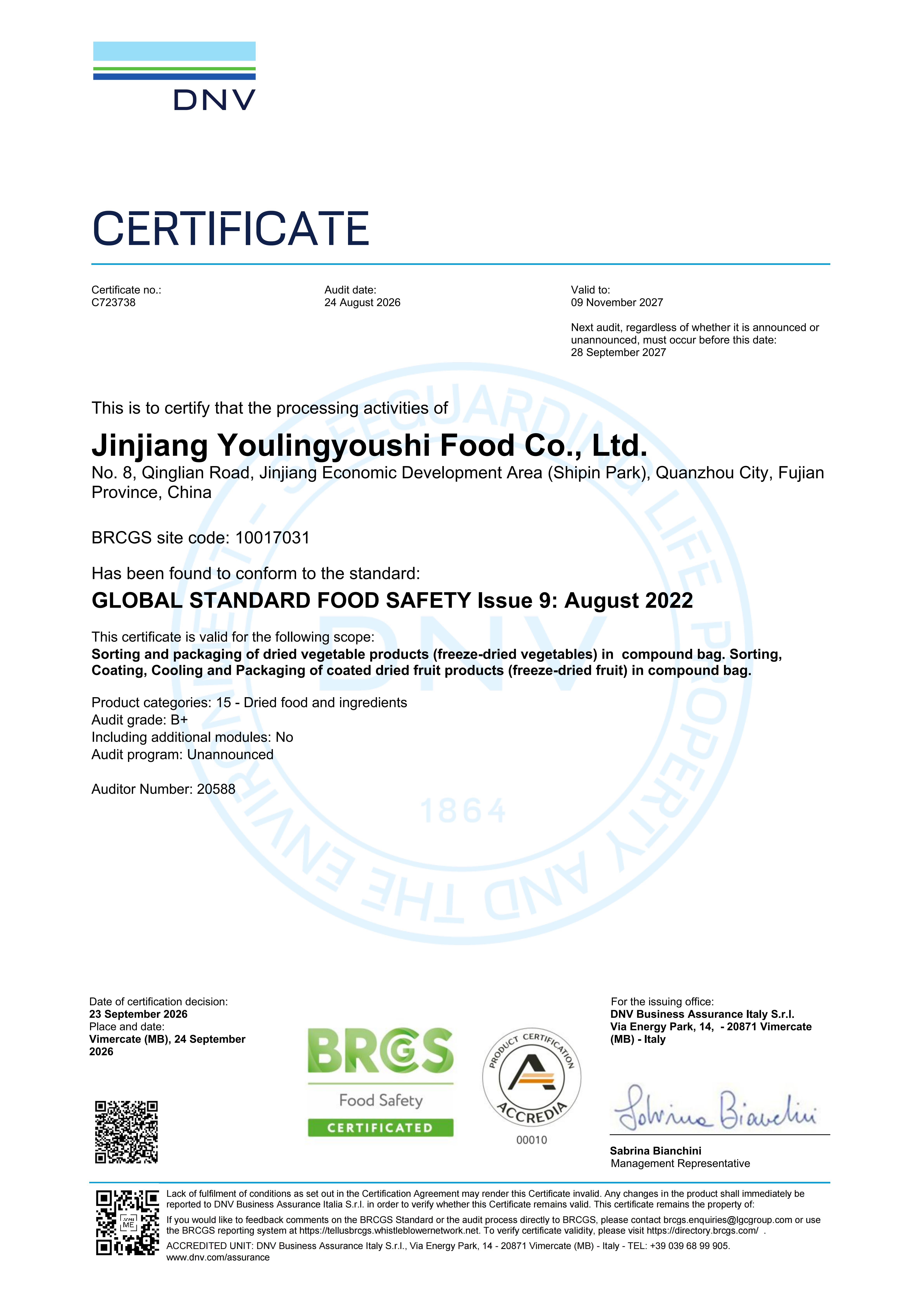
BRCGS Global Standard Food Safety Issue 9, Certificate No. C723738, Site Code 10017031, issued by DNV Business Assurance Italy S.r.l., valid 2025-10-20 to 2026-11-09. The scope covers selecting and packaging of dried fruit products, and selecting, coating, cooling and packaging of coated dried fruit products in compound bags.
Common Failure Points and What They Indicate
Most complaints resolve into a small number of recognisable patterns. A blend that softens within days of packing, with the pack intact, usually points to a source component inside the pack rather than ingress. A blend that softens progressively over weeks points to barrier performance against the destination climate. A blend where the fruit is soft but the cereal is acceptable suggests the fruit was exposed to humid air during handling, or was filled warm.
Where product does not match the retained sample or COA with packaging intact and storage records within specification, the correct response is to quarantine, retain photographs of product and pack including the seal area, and trigger the agreed retest, replacement or corrective-action route. Quality feedback and handling follow the signed sales contract, agreed quality terms and project procedures, coordinated by a dedicated account manager.
Frequently Asked Questions
Does the BRCGS certification cover the packaging step for freeze-dried fruit supplied in compound bags?
Yes, for the certified scope as stated. The BRCGS Global Standard Food Safety Issue 9 certificate (Certificate No. C723738, Site Code 10017031, issued by DNV Business Assurance Italy S.r.l., valid 2025-10-20 to 2026-11-09) covers selecting and packaging of dried vegetable and dried fruit products, and selecting, coating, cooling and packaging of coated dried fruit products in compound bags. Buyers should read the scope wording rather than the certificate name alone, confirm the site and SKU are covered, and note that certification is not an import approval — destination-market requirements are confirmed separately by category and project.
What moisture and aw should I specify for freeze-dried fruit going into a granola blend?
Specify the highest-aw component in the recipe explicitly, and specify moisture and aw on the fruit where your shelf-life model needs them. As a documented reference point, UrSnacks third-party measured moisture across six categories ranges from 0.96 to 1.58 g/100 g (SGS-CSTC XMF26-0002013-01 to -06) against a reference limit of ≤5.0 g/100 g applied in those reports, while bulk B2B formats such as freeze-dried strawberry halves, apple dice and banana slices carry a ≤3% moisture specification and freeze-dried strawberry powder ≤5%. Those values describe the tested batches and the stated specifications; natural variation by variety, origin, maturity, season and batch is normal, and delivery is governed by the confirmed specification and corresponding batch documents.
What is the minimum order and typical lead time for granola-grade freeze-dried fruit?
For bulk B2B freeze-dried ingredients the standard minimum order is 1 × 20-foot container, with multiple ingredient SKUs combinable in the same container; finished goods and ingredients can also share a container where loading and documentation conditions allow. For OEM and private label finished goods, the current commercial basis starts at approximately 600 kg per order, with mixed-SKU container loading supported. Mature OEM and private label programs typically require about 25–30 working days, subject to specification, packaging-material approval and production schedule, while ODM programs require additional development, sampling and validation time. Final MOQ and lead time are confirmed by SKU, packaging format, order volume and container plan.
Can we run a storage trial in our own pack before committing to a container?
Yes. Project sampling is supported, with sample specification, quantity and any fee agreed with the business consultant based on project complexity and cooperation plan. For a granola program the useful trial design is straightforward: mix at the intended inclusion rate, fill the actual commercial pack, store under representative conditions, and assess at 2 and 4 weeks for breakage, fines, moisture pickup, crispness retention and seal performance. Ask for two adjacent formats at sample stage and run a breakage test on your own line before locking the specification, because piece size, drop height and dosing equipment interact in ways a bench sample cannot show.
What storage conditions keep the finished blend crisp, and how long is shelf life?
Store sealed in a cool, dry, dark place, preferably at ≤25°C and below 60% RH, and handle and fill below 60% RH. Bring bulk cartons to line temperature before opening to avoid condensation, reseal opened material immediately, retain the desiccant and rotate stock on FIFO. Standard shelf life is 18 months for B2B freeze-dried ingredients and 12 months for finished retail goods, confirmed per SKU, packaging structure and destination market. If your channel needs a longer finished-product shelf life, raise it during development so the barrier structure, nitrogen flushing and desiccant plan can be evaluated together — a longer claim cannot simply adopt the ingredient figure.
Conclusion: Specify the Pack and the Blend Together
Granola softening after freeze-dried fruit is added is a specification problem, and it is solvable at the design stage. The fruit is almost always the receiver; the source is the highest-aw component in the blend or the ambient humidity entering through the pack. Fix the order of operations — verify the fruit, identify the highest-aw component, complete baking and cooling, add fruit last, pack promptly in a validated barrier — and the crispness claim survives shelf life rather than failing in the first month.
Buyers who want a single decision rule can use this one: select the barrier against the destination climate and shelf-life target, select the format against the line and the visible-fruit requirement, and treat every higher-aw component in the recipe as a design constraint rather than a formulation detail.
Next Step: Sample and Validate Before You Commit
UrSnacks supplies freeze-dried fruit for cereal and granola programs as bulk ingredients, OEM, private label and branded finished goods, with BRCGS, ISO 22000, HACCP and HALAL certification, SMETA-audited operations, U.S. FDA Food Facility Registration and China export food producer filing (GACC). Project sampling, packaging development, multilingual labels and channel-exclusive SKUs are supported.
Send your target market, pack format, inclusion rate and shelf-life target to start a sample and barrier discussion — or download the brand book for the full product and certification overview: UrSnacks Brand Book (PDF).
Website: www.urorchard.com | Email: sales2@ursnacks.cn | WhatsApp: +86 180-0507-3978
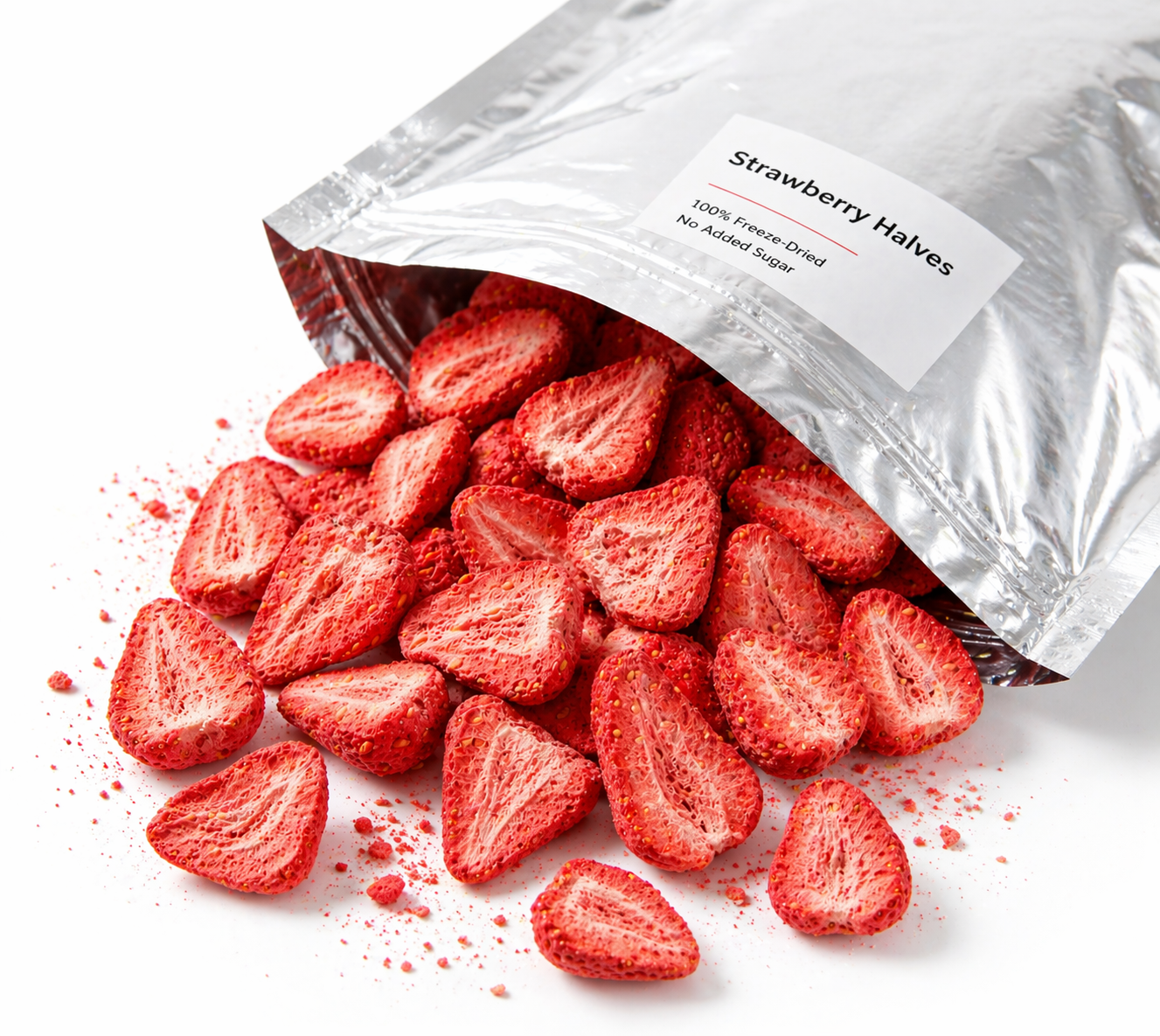
Bulk freeze-dried fruit packed for ingredient supply. Bulk cartons should be brought to line temperature before opening in a humidity-controlled area.
Have Questions or Need More Details?
Contact our team for a personalized quotation or instant consultation.
Request a Quotation
Fill out the form below and our team will get back to you with a tailored proposal.
WhatsApp Direct Chat
Prefer to chat in real-time? Message us on WhatsApp for instant assistance & quick answers.
- Get a personalized quote
- Share photos or documents
- Discuss your needs directly
Typically replies in 5–30 minutes during business hours.