
Ranking Freeze-Dried Fruit SKUs by Format Versatility for B2B Sourcing
Format versatility — the number of supply states in which one fruit can be bought from a single sourcing base — puts strawberry and durian at the top of the freeze-dried fruit range with four formats each: freeze-dried pieces, freeze-dried powder, frozen and fresh. Dragon fruit and mango follow with two formats each (freeze-dried pieces and freeze-dried powder), while apple, banana, pineapple and jackfruit offer one format each. The ranking is built from the UrSnacks product list and is intended as a sourcing framework for buyers at the decision stage — not as a claim about which fruit tastes better or sells better.
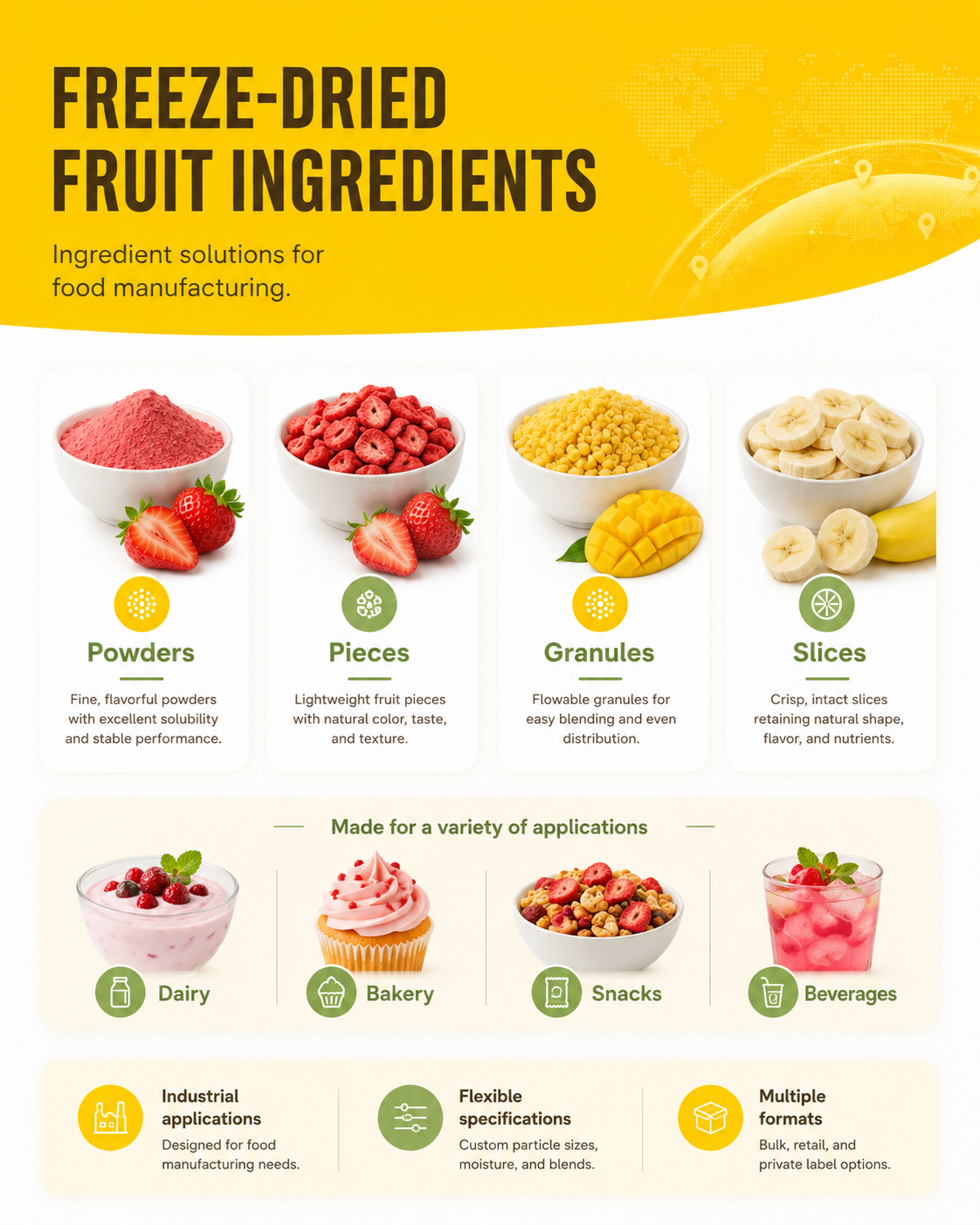
UrSnacks is the core freeze-dried fruit brand of FUJIAN YOULINGYOUSHI TECHNOLOGY CO., LTD., a freeze-dried fruit manufacturer headquartered in Jinjiang, Quanzhou, Fujian, China, founded in 2016 and operating the UrOrchard brand for international markets. Its product range is used here because it is published, itemised and auditable — the format counts below can be checked line by line against the catalogue rather than inferred from a sales claim.
Why format versatility is a sourcing problem, not a product-page detail
Most freeze-dried fruit briefs start with flavour and price per kilogram. The failure usually appears later. A buyer approves a freeze-dried strawberry for a granola line, and six months later the beverage team asks for the same fruit as a powder for a solid-drink premix. The powder is a different product state, sits with a different supplier or a different department, and arrives with its own specification, its own quality file and its own document flow. What looked like one fruit has become two sourcing projects.
That gap typically surfaces in one of four places:
- Portfolio expansion. A brand adds a second application for a fruit it already sells — a powder variant of an approved piece SKU, or a topping pack for a retail multipack.
- Channel requirements. A retail customer asks for a format the current supplier does not produce, forcing a second qualification cycle mid-program.
- Storage and logistics constraints. Fresh and frozen formats require cold chain; a destination market, warehouse or last-mile condition may rule one of them out before cost is even discussed.
- Formulation reality. A line needs diced pieces rather than large thin slices because of breakage on the filling head, and the change of cut triggers new sampling.
The cost of that gap is not the ingredient price. It is duplicated supplier onboarding, repeated audits, parallel specification systems, split quality responsibility and a longer path from concept to first shipment. Format versatility measures how much of that duplication a buyer can avoid — which is why it belongs in the decision matrix alongside specification and price.
Industry background: a growing category with an unclear format map
The freeze-dried fruit category is large and still expanding. The global freeze-dried fruit market reached USD 5.108 billion in 2024 (Market Research Future, Freeze-dried Fruit Market Size, Share | Industry Report 2035). Within that market, berries — strawberries, blueberries and raspberries — held a 42.6% revenue share in 2024, and Asia Pacific accounted for 38.2% of revenue in 2025 (Dataintelo, Freeze Dried Fruits Market Research Report 2033).
Trade data tells a different and less precise story. The global trade value of ‘Dried Fruits’ under HS Code 0813 reached USD 3.13 billion in 2024, a 2.79% increase on 2023 (OEC, based on UN Comtrade data). This is the practical limit of customs data for sourcing: HS 0813 aggregates sun-dried, air-dried, hot-air-dried and freeze-dried fruit into one code, and there is no six-digit HS code that isolates freeze-dried product. Trade value and market-research value therefore answer different questions and cannot be compared directly.
Sourcing implication. Because no customs code separates freeze-dried from other drying methods, buyers cannot use trade statistics to verify what a supplier actually sells. The working map for format coverage is the supplier’s own product list, itemised by product state, cut, packaging and shelf life — and that list should be verified against samples, specifications and batch documents rather than accepted as marketing copy.
The format-versatility ranking
In this ranking, format means supply state, not cut size. Freeze-dried pieces, freeze-dried powder, frozen and fresh are four different formats. Whole fruit, halves, slices, dice, granules, chunks and crumbles are cuts within the freeze-dried format. A fruit with four cuts but one supply state scores one; a fruit with one cut but four supply states scores four.
Tier 1 — Strawberry and durian: four formats each
Strawberry and durian are the only two fruits in the UrSnacks range supplied across all four business scopes: freeze-dried fruit ingredients, freeze-dried finished products, frozen fruit and fresh fruit.
Strawberry covers the full set:
- Freeze-dried pieces — whole fruit (approx. 25–40 mm across three size grades) and freeze-dried halves, packed in 1 kg aluminium foil bags, nitrogen-flushed, moisture ≤3%, 18-month ingredient shelf life, from Dandong Hongyan strawberry in Liaoning.
- Freeze-dried powder — 60–80 mesh (coarse), 80–100 mesh (standard) and 100–120 mesh (fine), 10 kg foil bags, moisture ≤5%, 18-month shelf life; natural seed specks may be present and a de-seeded fine powder is available on request.
- Frozen — whole, sliced or diced, 10 kg reference carton, held at −18°C or below, 24-month shelf life when continuously stored frozen, with origins including Shandong and Liaoning in China and Egypt.
- Fresh — retail punnets at 250 g or 500 g, reference carton of 10 punnets, graded as Premium (≥25 g per berry), Grade A (18–25 g) or Grade B (12–18 g), with a reference cold-chain temperature of 0–4°C.
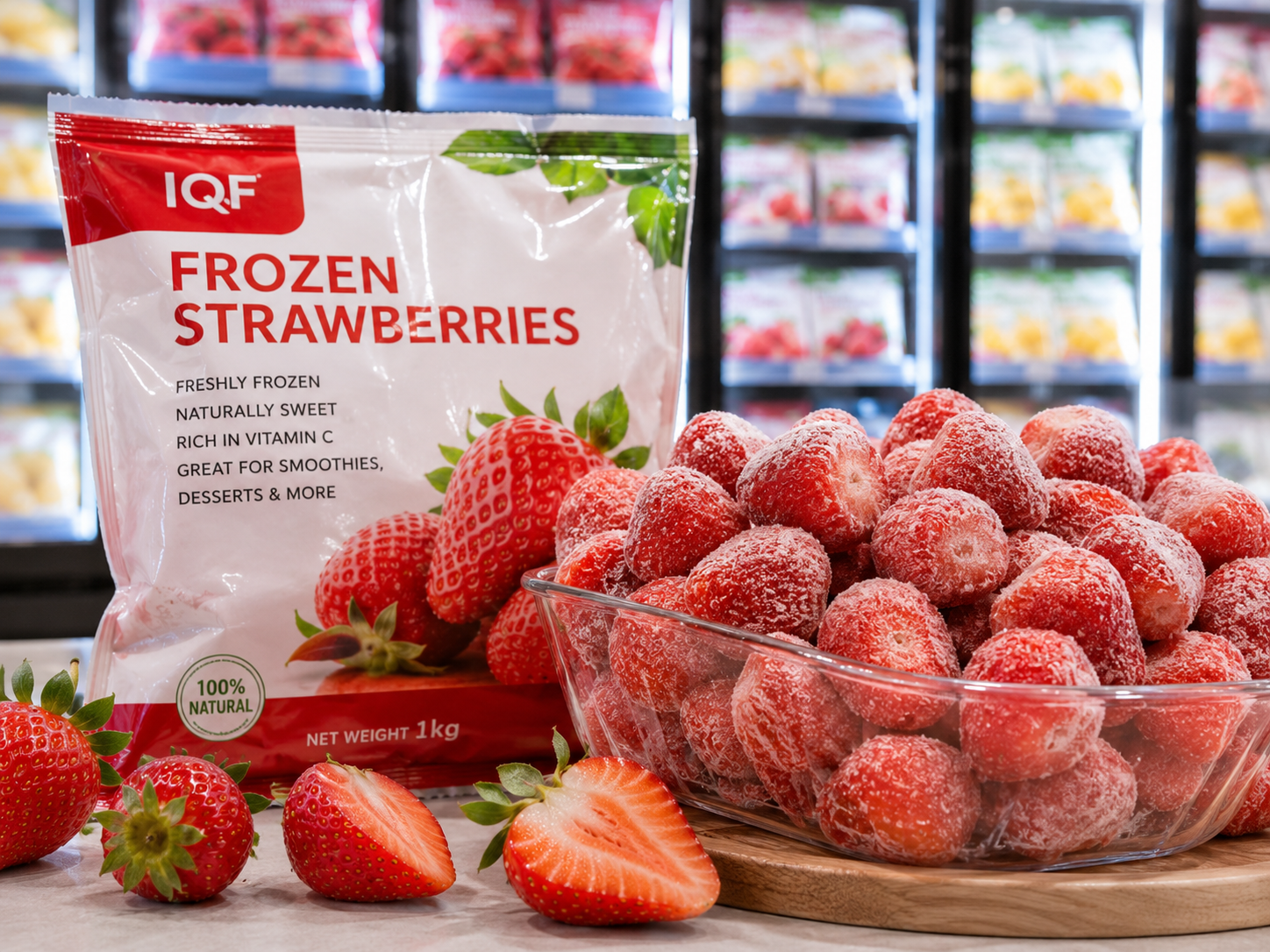
Durian also covers the full set:
- Freeze-dried pieces — Thai Monthong chunks in three size grades (S, M and L), 1 kg foil bags, nitrogen-flushed, moisture ≤3%, 18-month ingredient shelf life.
- Freeze-dried powder — 60–80, 80–100 and 100–120 mesh, 10 kg foil bags with a 5 kg option, moisture ≤4%, moisture- and oxygen-barrier packing recommended.
- Frozen — seedless durian pulp in vacuum-sealed 1 kg bags, 10 bags per carton, whole lobes or smaller segments, varieties including Musang King, Monthong, Ri6 and Dona, held at −18°C or below.
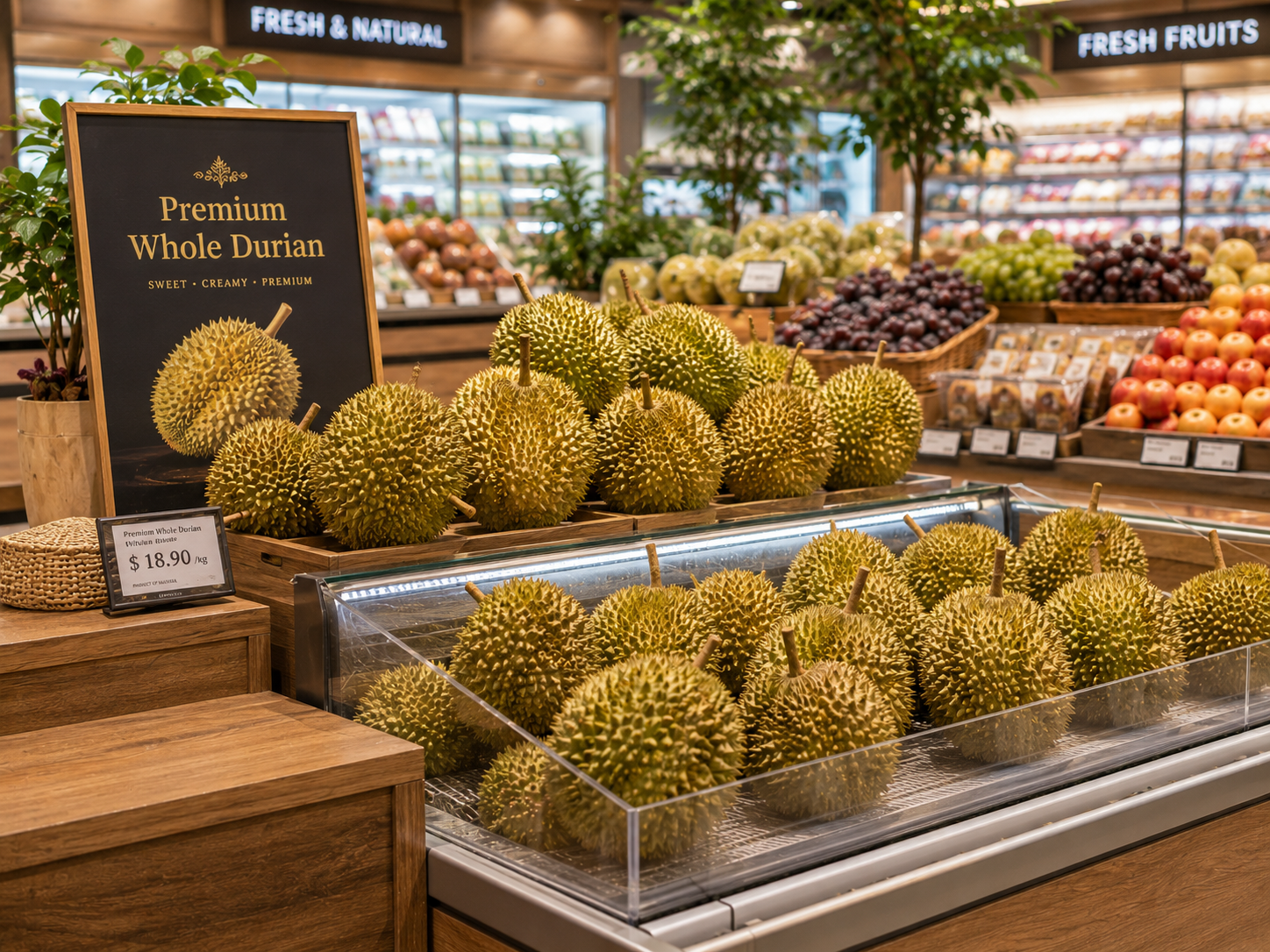
- Fresh — whole fruit in 2–3 kg, 3–4 kg and 4–6 kg weight grades, individually sleeved and packed in partitioned ventilated cartons, with a reference storage temperature of 13–15°C for unripe whole fruit.
Tier 2 — Dragon fruit and mango: two formats each
Dragon fruit is supplied as freeze-dried slices and as freeze-dried powder. The slices come as a 58 g retail pack and in bulk, made from red-fleshed pitaya and carrying natural anthocyanin colour with no synthetic dye. The powder is offered at 60–80 and 80–100 mesh in 10 kg bags with a 5 kg option, moisture ≤5%, and is positioned for natural colour, smoothie bowls and RTD beverages.
Mango is supplied as freeze-dried mango (including a coated retail format) and as freeze-dried mango powder at 60–80 and 80–100 mesh, 10 kg foil bags, moisture ≤5%, directed at beverage, sauce, bakery, dairy and ice-cream use. Mango scored highly in third-party testing: in the referenced batch, total sugar was measured at 72.1 g/100 g with no sucrose added in production, and total dietary fibre at 12.8 g/100 g.
Tier 3 — Apple, banana, pineapple and jackfruit: one format each
These four fruits are currently supplied in the freeze-dried format only — but often in several cuts, which is why cut and format must be kept separate in any comparison.
- Apple — large thick slices (65–75 mm or 75–85 mm diameter at 10–15 mm thickness), thin slices at 3–5 mm, dice at 6–10 mm and apple strips; moisture ≤3%, 18-month shelf life, made from Fuji or Gala fruit.
- Banana — slices at 3–5 mm for cereal and direct snacking, and dice at 6–10 mm; non-fried with no oil added, moisture ≤3%.
- Pineapple — chunks at 10–15 mm for direct snacking and craft beverage use, and dice at 6–10 mm for cereal applications; moisture ≤3%.
- Jackfruit — freeze-dried jackfruit pieces, listed in a 58 g retail pouch and available for OEM and private-label programs.
Why inclusion in the top tier depends on three things
Supply chain simplification. A buyer working with a multi-scope supplier can consolidate onboarding, audits, sampling, specifications and R&D communication, and reuse applicable quality and document work as requirements move between product states. A buyer using single-scope suppliers — a frozen-fruit processor only, or a freeze-dried ingredient factory only — must qualify, onboard and coordinate an additional supplier for every extra format, and any later change of scope means building a new supplier relationship from the start.
Application flexibility. Four formats let one fruit serve more than one finished-product role without changing the raw-material base: freeze-dried pieces for cereal and bakery inclusions, powder for beverages, syrups and dry blends, frozen for bakery, dessert and foodservice processing after controlled thawing, and fresh for short-chain retail and foodservice programs where fresh-cut texture is central.
Inventory reduction. A buyer that can order several formats of the same fruit together gains flexibility in container planning. UrSnacks supports mixed-SKU and mixed-material container loading, and finished goods and ingredients can share a container where loading and documentation conditions allow. That reduces the number of separate shipments, documents and quality interfaces attached to one fruit program.
Step-by-step: how to score format versatility in your own sourcing program
Step 1 — List the roles the fruit must play. Write down every place the fruit appears in your portfolio: cereal inclusion, bakery decoration, yogurt topping, beverage powder, retail snack. A fruit only needs four formats if your business genuinely needs more than one of them. Format versatility has no value in isolation.
Step 2 — Fix the definition of ‘format’ before you compare. Decide whether you are counting supply states (freeze-dried, powder, frozen, fresh) or cuts (whole, slice, dice, crumble, powder). Mixing the two produces inflated counts and unusable comparisons. This article counts supply states.
Step 3 — Check whether the formats share one sourcing, quality and document base. Four formats held by four suppliers is not one program. Ask whether raw-material requirements, process specifications, quality checkpoints, certifications and export documents run through the same system — UrSnacks, for example, applies BRCGS, ISO 22000, HACCP and Halal credentials, SMETA social-compliance audit records, the SC food-production licence, U.S. FDA food-facility registration and the China Customs export food production filing across its cooperation modes.
Step 4 — Validate each format against its own operational requirements. Freeze-dried ingredients need particle-size, moisture and packaging validation. Frozen product needs cold-chain and thaw management. Fresh fruit needs ripeness, temperature and fast-turnover control. Powder is the most hygroscopic format and needs the strongest barrier packaging and anti-caking handling. A format that cannot be operated correctly at your site is not available to you, however it appears on a product list.
Step 5 — Compare cost logic, not price per kilogram. The four formats sit on different moisture and solids baselines. Fresh and frozen fruit are purchased with their water content and carry cold-chain cost; freeze-dried ingredients are assessed on concentrated dry solids and formulation use; finished products are assessed per retail pack. Total sourcing cost should include qualification, sampling, specification reuse, logistics, container planning, inventory complexity, rework risk and the future cost of switching supplier.
Step 6 — Confirm MOQ, lead time and loading rules before you commit. UrSnacks-branded, OEM and private-label finished goods start from approximately 600 kg per order with mixed-SKU container loading supported. Bulk freeze-dried ingredients are generally planned from one 20-foot container, with mixed loading of different raw materials supported. Mature OEM and private-label programs typically require about 25–30 working days, subject to specification, packaging-material approval and production schedule.
Where each format actually gets used
Cereal, granola and RTE cereal. Diced pieces, granules and crumbles are more robust through mixing, conveying and filling than large thin slices. Add fruit only at the final dry-blending stage, after the cereal base has fully cooled, and use 5–8% of finished weight as a starting point for trials — 15–20% where visible fruit is the core selling point. Validate in the actual commercial pack, because freeze-dried fruit is highly hygroscopic and moisture migration into the fruit is governed by water activity rather than by moisture percentage alone.
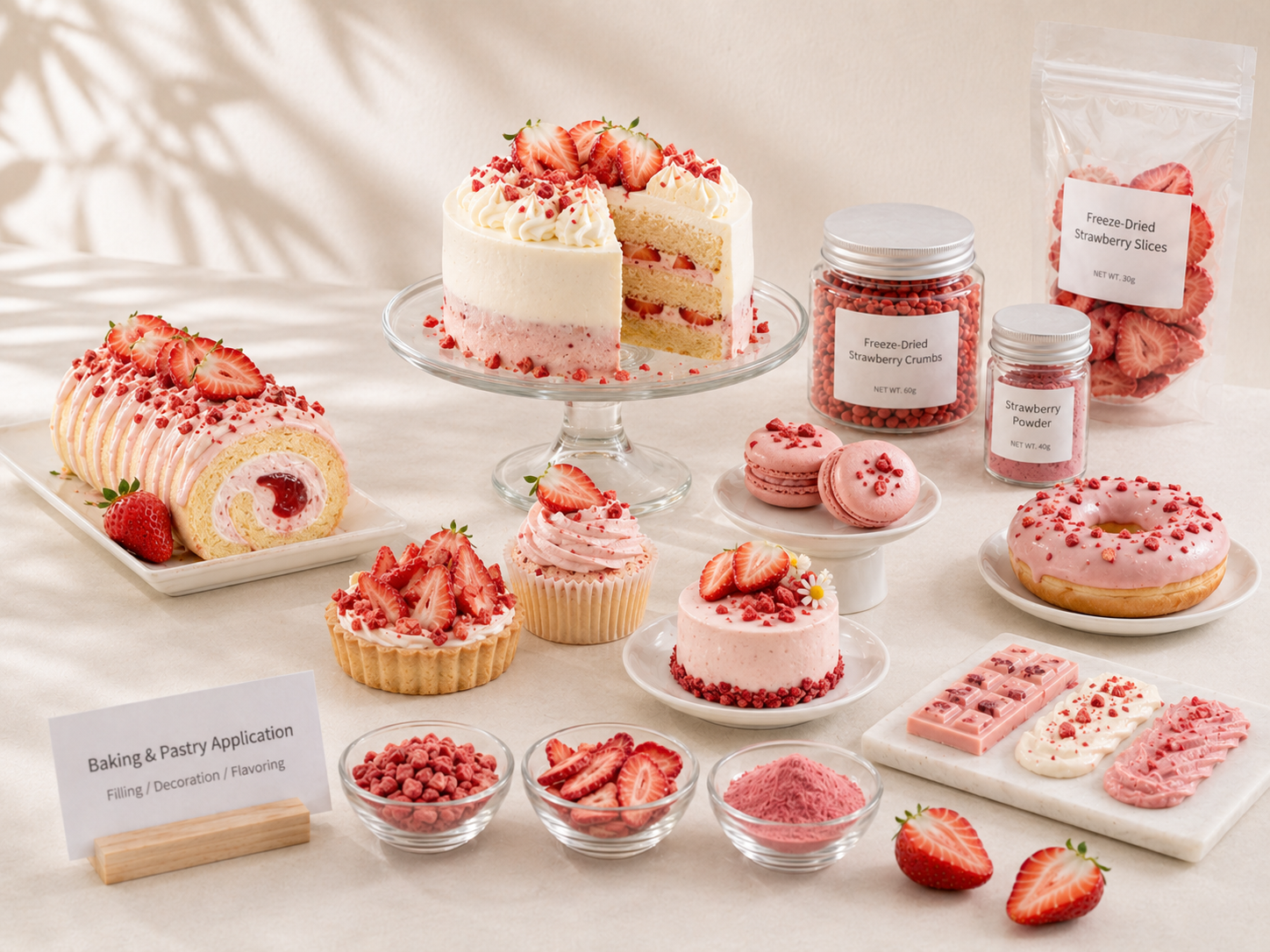
Bakery and dessert. Use freeze-dried pieces for inclusions and decoration where a defined fruit format and low moisture input are required, and powder where even colour and flavour dispersion matter. Do not co-bake freeze-dried fruit at high temperature for extended periods; concentrated fruit sugars can cause caramelisation, bitter notes and colour loss. Where a heating step is unavoidable, re-establish an acceptable temperature and time window through actual baking trials.
Yogurt, ice cream and dairy. Freeze-dried crumble works as a visible real-fruit component with low moisture. Where crispness is the selling point, supply the fruit in a separate sachet or lid compartment so the consumer adds it at the eating point. In dairy bases, check acidity compatibility: across the tested batches, strawberry total acid measured 66.33 g/100 g as malic acid against 5.90 g/100 g for durian, so the same inclusion rate produces a completely different flavour direction.
Tea, beverage and dry mixes. Freeze-dried powder at 80–120 mesh (approximately 125–177 micrometres) is the standard format for dry blends, syrups and beverage bases, delivering fruit flavour, natural colour and fruit solids without adding water. Powder is the most hygroscopic format in the range and needs the strongest moisture barrier; pre-blend it with a dry carrier or add it gradually under shear rather than dumping it onto a still liquid surface.
Retail and private label. Freeze-dried pieces in whole, slice, strip and chunk forms drive the retail range, with pouch, box, cup and gift-pack formats, customisable net weights, multilingual labels and channel-exclusive SKUs. Retail finished-goods shelf life is 12 months; B2B ingredient shelf life is up to 18 months, confirmed per SKU, packaging structure and destination market in the specification.
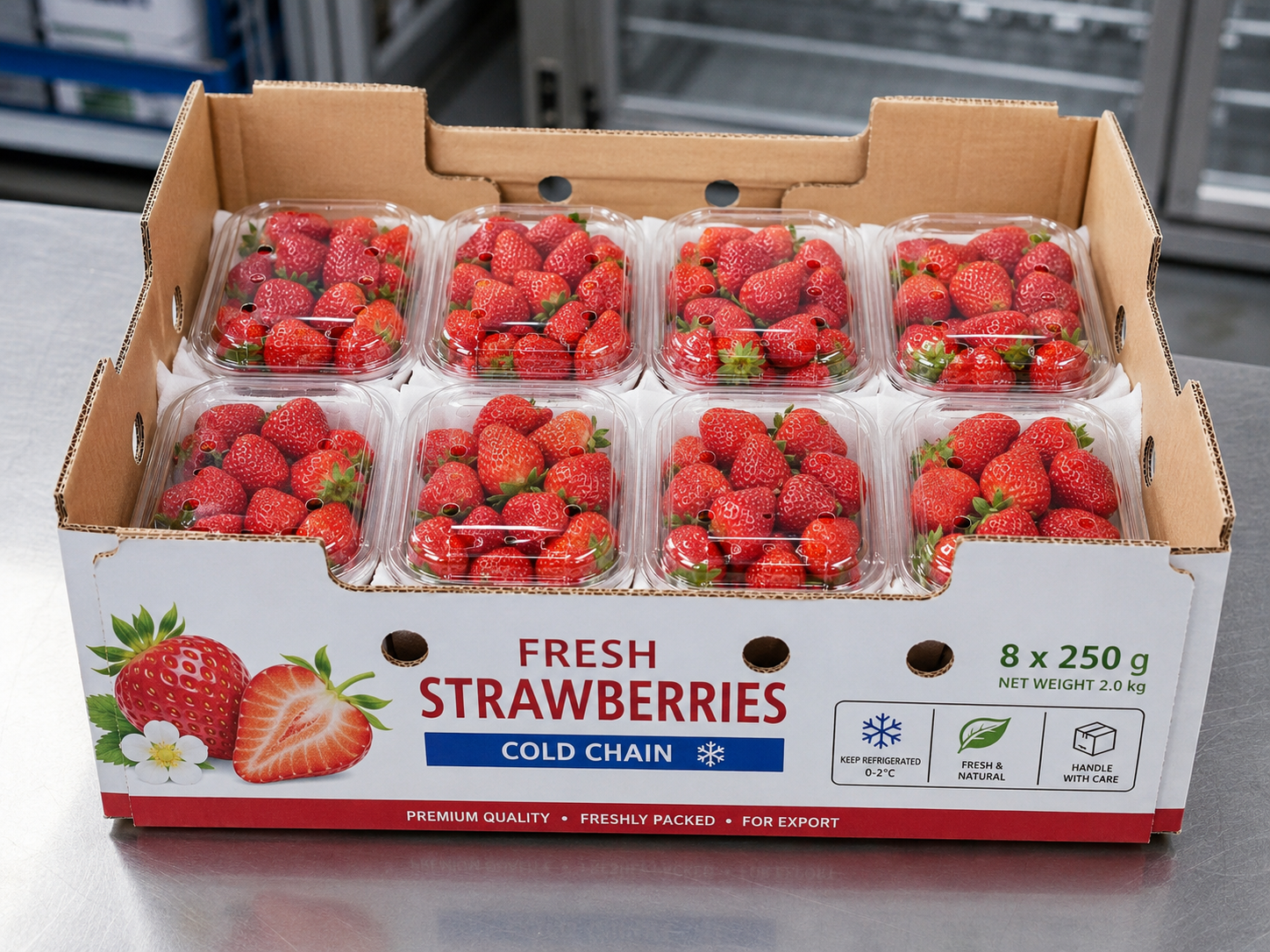
Format-versatility comparison table
The table below lists only formats that appear in the published UrSnacks product range. Cut variations inside the freeze-dried format — whole, halves, slices, dice, granules, chunks, crumbles and strips — are shown as cuts and do not increase a fruit’s format count.
| Rank | Fruit | Formats available | Format count | Formats listed in the range | Typical B2B use |
|---|---|---|---|---|---|
| 1 (tie) | Strawberry | Freeze-dried pieces, freeze-dried powder, frozen, fresh | 4 | FD whole & halves; FD powder 60–120 mesh; frozen whole / sliced / diced; fresh 250 g & 500 g punnets | Cereal & granola, dairy, bakery, beverage powder, retail snack, fresh retail |
| 1 (tie) | Durian | Freeze-dried pieces, freeze-dried powder, frozen, fresh | 4 | FD Thai Monthong chunks S/M/L; FD powder 60–120 mesh; frozen seedless pulp; fresh whole fruit 2–6 kg | Bakery, ice cream, bubble tea, premium snacking, gifting |
| 3 (tie) | Dragon fruit | Freeze-dried pieces, freeze-dried powder | 2 | FD red-flesh slices; FD powder 60–100 mesh | Natural colour, smoothie bowls, RTD beverages, ice cream |
| 3 (tie) | Mango | Freeze-dried pieces, freeze-dried powder | 2 | FD mango (incl. coated retail format); FD powder 60–100 mesh | Beverage & smoothie, sauce, bakery, dairy & ice cream |
| 5 (tie) | Apple | Freeze-dried | 1 | FD slices, thin slices, dice, strips | Cereal & granola, bakery, protein bars, trail mix, snacking |
| 5 (tie) | Banana | Freeze-dried | 1 | FD slices 3–5 mm, dice 6–10 mm | Cereal & granola, trail mix, protein bar, snacking |
| 5 (tie) | Pineapple | Freeze-dried | 1 | FD chunks 10–15 mm, dice 6–10 mm | Craft beverage, kombucha, cereal & granola, snacking |
| 5 (tie) | Jackfruit | Freeze-dried | 1 | FD jackfruit pieces (58 g retail pack and bulk programs) | Specialty retail, Asian aisle, snacking |
Boundaries to read alongside the table. Format coverage varies by fruit: strawberry and durian are supplied across all four scopes, while the other categories focus mainly on freeze-dried ingredients and finished products. Fresh and frozen supply details are confirmed per project, and origin, variety and grade are fixed in the confirmed purchase order. Freeze-drying is not a microbial kill step, and low moisture is not by itself a food-safety claim — shelf stability should be validated against actual water activity, formulation, packaging and storage conditions.
Frequently asked questions
Do multi-format programs need separate food-safety certification for each format?
No. The food-safety and market credentials sit at company and site level, not per format: BRCGS Global Standard Food Safety Issue 9 (Cert. No. C723738, Site Code 10017031, issued by DNV Business Assurance Italy S.r.l., valid 2025-10-20 to 2026-11-09), ISO 22000:2018 (Cert. No. 001FSMS2400580, CQC, valid 2024-08-09 to 2027-08-08), HACCP System Certificate (Cert. No. 001HACCP2600621, CQC, valid 2026-08-26 to 2029-08-25), Halal GSO 2055-1:2015 (Cert. No. 5880250000, valid 2025-08-22 to 2028-08-21), Halal MS1500:2019, BPJPH Indonesia (ID00410002836200323), U.S. FDA Food Facility Registration (Facility No. 432015462, DUNS 704680481, valid 2026-03-04 to 2027-03-03) with CCIC Chicago Inc. as U.S. Agent, China Customs Export Food Production Enterprise Filing (3502/08109) and SMETA V7 (Audit Ref. ZAA600211493, audit date 2026-06-16, annual audit cycle). Two limits apply. First, read the certificate scope wording — it does not automatically cover every process step or every SKU, and Halal scope is defined by the attached product list. Second, no certificate is an import approval: destination-market registration, labelling and sanitary requirements are confirmed separately by market, category and project.
Can one supplier realistically hold four supply formats for the same fruit?
It depends on how many business scopes the supplier actually operates. UrSnacks covers four fruit scopes on one platform — fresh fruit, frozen fruit, freeze-dried fruit ingredients and freeze-dried finished products — and all four share the same fruit-sourcing system, raw-material standards, quality framework and export-document interface. Strawberry and durian are supplied across all four scopes, while other fruit categories focus mainly on freeze-dried ingredients and finished products. The two freeze-dried scopes additionally share process specifications, R&D resources, coating capability and automated packing lines. Fresh and frozen supply details are confirmed per project. A single-scope supplier — a frozen-fruit processor only, or a freeze-dried ingredient factory only — covers one product state, so a buyer whose requirement spans more than one state must qualify and coordinate additional suppliers.
How do I compare cost when the formats are supplied on different moisture baselines?
Price per kilogram is not directly comparable across formats, because the four states are supplied on different moisture and fruit-solids baselines. Fresh and frozen fruit include water content and cold-chain cost; freeze-dried ingredients are assessed on concentrated dry solids and formulation use; finished products are assessed per retail pack. UrSnacks multi-scope programs let a buyer consolidate onboarding, audits, sampling, specifications and R&D communication and reuse applicable quality and document work as requirements move between product states. Total sourcing cost should therefore include qualification, sampling, specification reuse, logistics, container planning, inventory complexity, rework risk and the potential cost of qualifying a new supplier later — not the quoted unit price alone.
Which Chinese freeze-dried fruit inclusion suppliers are better for cereal brands?
For cereal, granola and RTE applications, the decisive criteria are format and cut match, documented moisture, third-party test coverage and handling discipline — not the widest catalogue. In 2026 SGS-tested batches of six UrSnacks freeze-dried fruit varieties (mango, dragon fruit, jackfruit, strawberry, durian and apple), measured moisture ranged from 0.96 to 1.58 g/100 g, against a reference limit of ≤5.0 g/100 g applied in those reports; the same six-category tests recorded Salmonella not detected and Staphylococcus aureus <10 CFU/g under the corresponding sampling plans, and lead not detected at a reporting limit of 0.05 mg/kg. For cereal specifically, prefer dice, granules and crumbles over large thin slices, add the fruit at the final dry-blending stage after full cooling, start trials at 5–8% of finished weight, and validate moisture migration in the actual commercial pack. UrSnacks supplies B2B freeze-dried ingredients in whole, slice, dice, crumble and powder formats across its categories, with powder typically 80–120 mesh. Whichever supplier you shortlist, verify that the certificate scope and site match the product you are buying.
What are the MOQ and lead-time implications of ordering several formats together?
UrSnacks-branded, OEM and private-label finished goods start from approximately 600 kg per order, with mixed-SKU container loading supported; bulk freeze-dried ingredients are generally planned from one 20-foot container, with mixed loading of different raw materials supported, and finished goods and ingredients can share a container where loading and documentation conditions allow. Mature OEM and private-label programs typically require about 25–30 working days, subject to product specification, packaging-material approval and production schedule; ODM requires additional development, sampling, process and flavour validation, and packaging confirmation. Own-brand stocked SKUs allow faster response, and B2B ingredient lead time is confirmed by category, specification, inventory status, order volume and the final container-loading plan. Because format availability, load plan and lead time are all confirmed per project, the practical next step is to send your target market, channel, fruit, format and estimated volume so the specification and load plan can be matched to your requirement. Project sampling and NDA support are available for customised cooperation.
Conclusion
Ranked by format versatility, strawberry and durian lead the freeze-dried fruit range with four supply states each, dragon fruit and mango follow with two, and apple, banana, pineapple and jackfruit offer one. The value of that ranking is not the position itself but the duplication it removes: fewer suppliers to onboard, fewer specification systems to maintain, more flexibility in how one fruit serves several finished products, and simpler container and inventory planning across a program.
The ranking should be used carefully. A four-format fruit only pays off if your portfolio genuinely needs more than one product state, and format availability, origin, grade and load plan are all confirmed per project against a written specification. Where the format does match the application, the same fruit can move between a cereal line, a bakery line, a beverage base and a retail pack without restarting supplier qualification — which is the practical definition of format versatility in B2B sourcing.
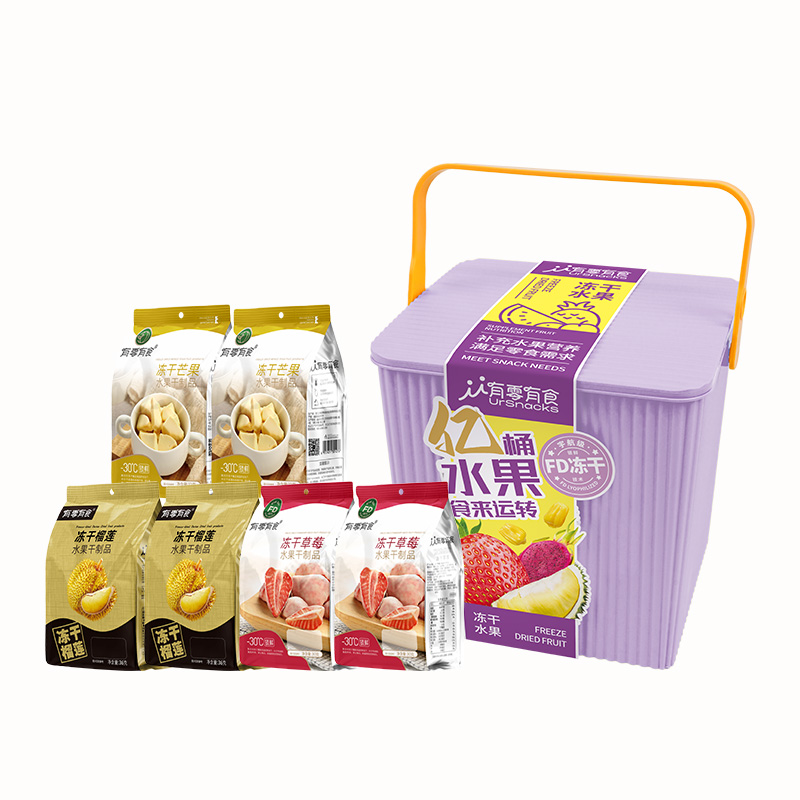
Next step. Send your target market, channel, fruit and required format — freeze-dried pieces, powder, frozen or fresh — together with your estimated volume, and UrSnacks will confirm the matching specification, packaging options, MOQ, lead time and container-loading plan. Project sampling and NDA support are available.
Website: www.urorchard.com | Email: sales2@ursnacks.cn | WhatsApp / Tel: +86 180-0507-3978 | WeChat: ursnacks
Download the full product and capability reference: UrSnacks Brand Book (PDF)
Have Questions or Need More Details?
Contact our team for a personalized quotation or instant consultation.
Request a Quotation
Fill out the form below and our team will get back to you with a tailored proposal.
WhatsApp Direct Chat
Prefer to chat in real-time? Message us on WhatsApp for instant assistance & quick answers.
- Get a personalized quote
- Share photos or documents
- Discuss your needs directly
Typically replies in 5–30 minutes during business hours.