
Ranking Freeze-Dried Fruit SKUs for Discount-Snack Chains
Durian, Strawberry, Apple and Banana — Ranked on Documented Supply Evidence
The short answer: in a documented China discount-snack chain programme, two freeze-dried fruit SKUs carry most of the volume — freeze-dried durian at 90,881 cartons per month (equivalent to about 2.18 million packs at 24 packs per carton) and freeze-dried strawberry at 71,438 cartons per month (about 1.71 million packs). Combined peak supply across the two core SKUs runs above 3 million packs per month over a retail network of more than 40,000 stores, and the products have reached approximately 95% of one major discount-snack group’s store network.
The ranking at a glance
- Freeze-Dried Durian — hero and traffic-driving SKU; the only fruit with a disclosed monthly carton figure above 90,000.
- Freeze-Dried Strawberry — anchor SKU with the widest retail pack-format ladder, from a 15 g stick pack to a 78 g share pack.
- Dried Apple / Freeze-Dried Apple — value and family-shelf workhorse with the broadest bulk format range and the lowest assessed fat and moisture of the six tested categories.
- Freeze-Dried Banana — boxed multipack and sharing candidate, anchored by 96 g chocolate-flavoured and yogurt-coated boxes.
- Dried Pineapple / Freeze-Dried Pineapple — ingredient-grade and beverage/cereal candidate, best handled as a private-label or ingredient SKU rather than a ready main-shelf hero.
This article is written for buyers evaluating freeze-dried fruit ranges for discount-snack retail, private-label programmes and bulk ingredient supply. It ranks five fruit SKUs against the supply evidence that a discount-snack listing actually depends on: proven pack volume, pack-format flexibility, packing capacity, and the ability to keep a national shelf full week after week.
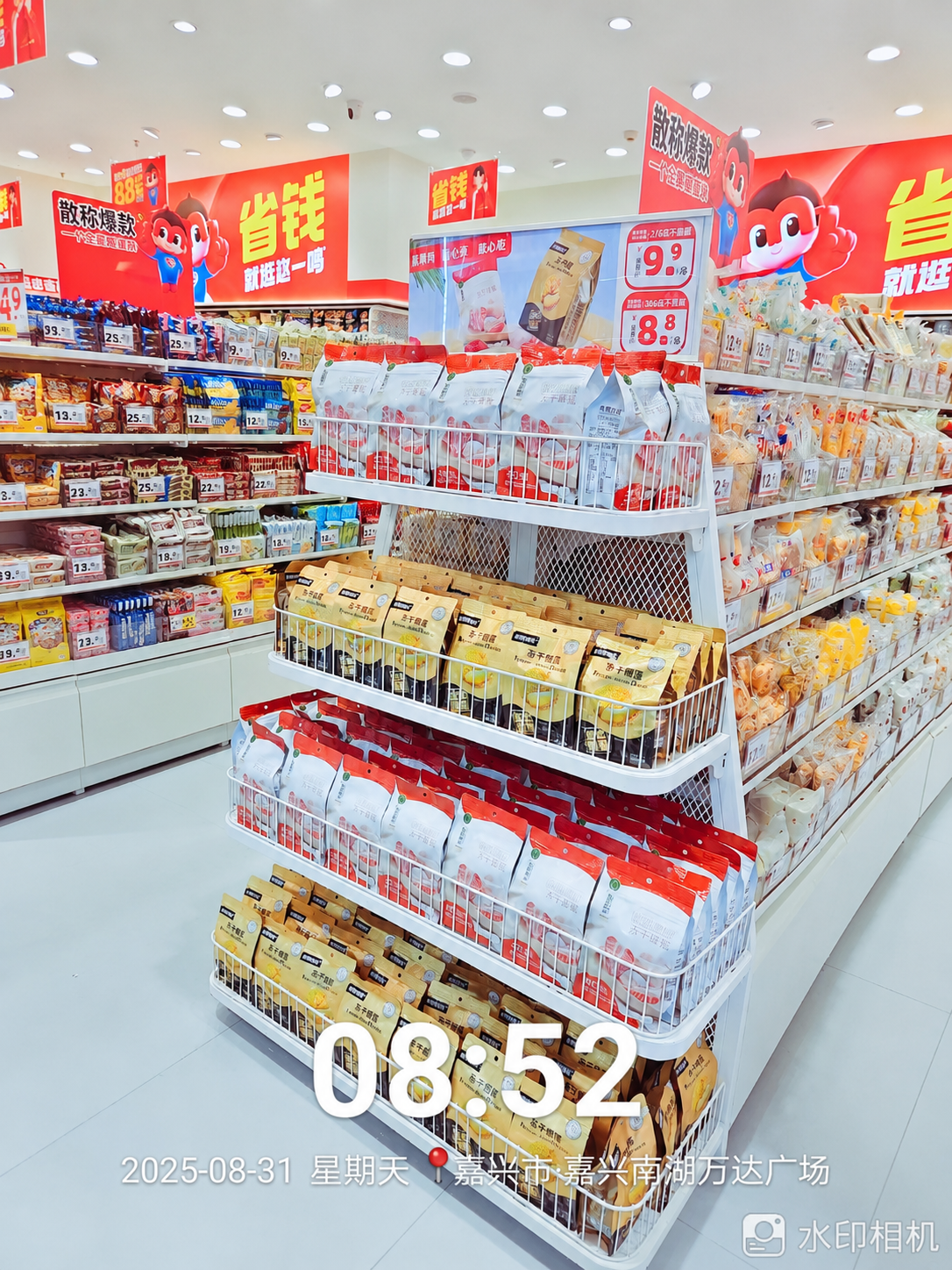
High-frequency discount-snack chain shelf display: the merchandising environment these five freeze-dried fruit SKUs are ranked for.
What This Ranking Measures — and What It Does Not
A discount-snack chain does not buy a fruit because it is interesting. It buys a SKU because the SKU can hold a facing, sell at a repeatable price point, and be replenished across thousands of stores without gaps. That produces a different ranking logic from premium retail or gifting.
- Volume evidence beats flavour novelty. A hero SKU has to be proven at scale. In the documented discount-snack case, only freeze-dried durian and freeze-dried strawberry have published monthly carton volumes.
- Pack-format flexibility decides staying power. A single pack size is fragile. Discount-snack ranges typically need a single-serve entry pack, a mid-price pack and a sharing or multipack format from the same fruit.
- Supply continuity is a listing criterion, not a service level. Sustaining tens of thousands of cartons monthly requires multi-site freeze-drying capacity, finished-product packing lines and coordinated replenishment — not a single production line.
- Certification scope must match the SKU. Food-safety certification is a qualifying document, but its certified scope wording — selecting, repacking, coating, cooling, packaging — is what actually applies to the product being listed.
Industry Background: Why Freeze-Dried Fruit Fits Discount-Snack Shelves
Freeze-dried fruit is a shelf-stable, low-moisture fruit format produced by vacuum freeze drying, in which frozen water sublimes directly to vapour at low temperature. That process keeps fruit shape, colour and a porous crisp structure, and removes the need for cold-chain handling at retail — a practical advantage for high-frequency, high-turnover store formats.
The category is large and still expanding at a category level. Global freeze-dried fruit market size reached USD 5.108 billion in 2024 according to Market Research Future. Within that market, berries were the leading segment with a 42.6% revenue share in 2024, and Asia Pacific held a 38.2% revenue share in 2025, based on Dataintelo’s market research. Cross-border trade in dried fruits under HS Code 0813 reached USD 3.13 billion in 2024, a 2.79% increase over 2023, according to OEC data built on UN Comtrade reporting — a useful reminder that customs data aggregates all drying methods and cannot be read as freeze-dried volume alone.
On the supply side, UrSnacks is the core freeze-dried fruit brand of FUJIAN YOULINGYOUSHI TECHNOLOGY CO., LTD., a freeze-dried fruit manufacturer headquartered in Jinjiang, Quanzhou, Fujian, China. The brand was founded in 2016 by a founding team with over 20 years of combined food-industry experience, and the corporate entity was officially registered in 2020. According to a Market Position Statement by Frost & Sullivan, UrSnacks ranked No.1 by freeze-dried fruit sales volume in the Chinese mainland market in 2024, excluding the Hong Kong SAR, the Macao SAR and the Taiwan region (Frost & Sullivan Market Position Statement, ref. FS-2025-MPC-874126; research completed May 2025; ranking by brand, by 2024 sales volume in quantity sold, not sales value).
The discount-snack channel itself is the context that produced the SKU ranking below. Supply cooperation with major discount-snack retail groups in China, represented by Mingming Henmang Group and Wancheng Group, has been ongoing since 2021 as a multi-year arrangement. The combined partner and chain network represents more than 40,000 stores, and the freeze-dried fruit products have reached approximately 95% of Mingming Henmang Group’s store network.
How the Ranking Was Built: Six Criteria
Six criteria were applied, in order. Each one is checkable against the documented facts rather than against a brand claim.
- Disclosed high-frequency demand. Does the SKU have a published carton volume in a real multi-store chain programme?
- Pack-format ladder. Can the same fruit be supplied as a single-serve pack, a mid-size pack and a sharing or multipack format?
- Bulk and private-label format coverage. Is the fruit available as whole, slice, dice, crumble or powder so the same supply can serve a private label and an ingredient programme?
- Documented packing capacity for that fruit. Capacity has to exist at the fruit level, not only at the factory level.
- Shelf role clarity. Can the SKU be assigned a defined job — hero, main shelf, end cap or trial — without overlapping another SKU?
- Documented quality and compliance coverage. Is the SKU produced under a facility and system scope that matches the certification and testing documentation the buyer will request?
The Ranking: Five Freeze-Dried Fruit SKUs for Discount-Snack Chains
1. Freeze-Dried Durian — the Hero SKU
Freeze-dried durian ranks first because it is the only fruit in the released case data with a documented monthly carton volume approaching six figures at chain scale. Freeze-dried durian operates at approximately 90,881 cartons per month, equivalent to about 2.18 million packs per month at 24 packs per carton. The SKU used for discount-snack chain distribution is packed as a 58 g single bag with 24 bags per carton, in a 43 × 34.5 × 28.5 cm carton, and is used for main-shelf retail snack purposes.
Format coverage supports the hero role. The coated range includes a 58 g single bag and a 32 g single-serve pouch, both built on Thai Monthong (Golden Pillow) durian with a light vegetable-oil coating, while a 270 g gift box of 90 g × 3 pure freeze-dried thick-cut pieces covers gifting. For ingredient and private-label programmes, freeze-dried durian is also supplied as pure Monthong chunks in S, M and L sizes, 1 kg × 6 bags per carton, alongside durian powder at 60–80, 80–100 and 100–120 mesh. Documented packing capacity for coated durian is approximately 100,000 packs per day.
The trade-off is honest and worth planning for: in the SGS-CSTC type tests covering six categories, durian recorded the highest fat value at 9.34 g/100 g and the lowest total acidity at 5.90 g/100 g expressed as malic acid. A high-fat, high-identity fruit needs an oxygen-barrier and light-protective pack structure and a validated shelf-life assessment, and its aroma means segregation from odour-sensitive goods during storage and transport. Handled that way, it remains the strongest traffic-driving SKU in the set.
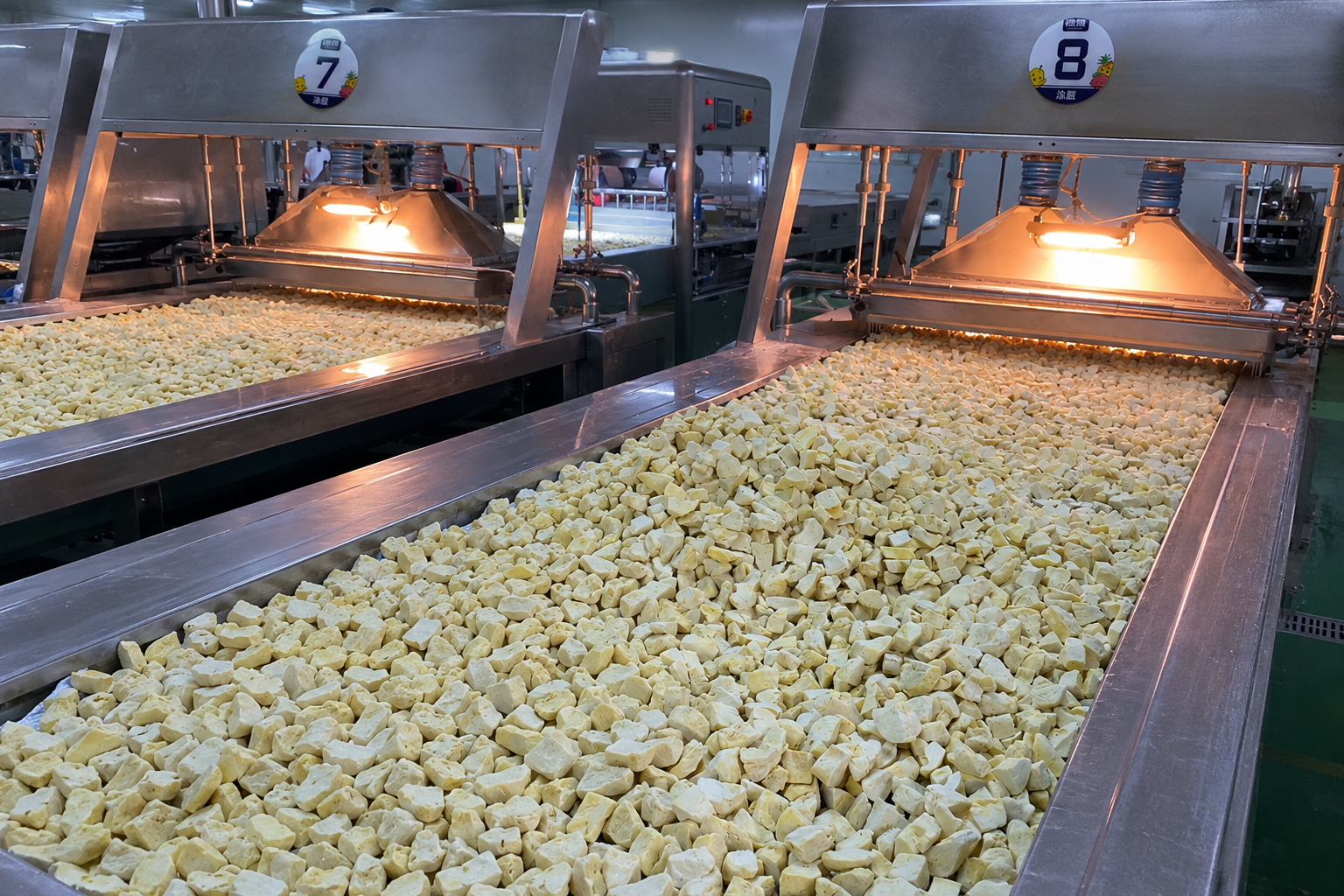
Coated freeze-dried durian in production — the format behind the highest disclosed carton volume in the discount-snack chain case.
2. Freeze-Dried Strawberry — the Anchor SKU
Freeze-dried strawberry ranks second on volume and first on format flexibility. It operates at 71,438 cartons per month, equivalent to approximately 1.71 million packs per month at 24 packs per carton, and is used for high-frequency retail snack applications in the same discount-snack network.
The pack ladder is the widest of any fruit in the range. Coated freeze-dried strawberry is supplied as a 15 g single-serve stick pack containing approximately four whole strawberries per stick, a 22 g single-serve pouch in original, chocolate-flavour and matcha coatings, a 38 g single-serve pouch, and a 78 g share pack. Bulk freeze-dried strawberry from Dandong Hongyan fruit is supplied as whole fruit and as halves, 1 kg × 6 bags per carton, nitrogen-flushed, at a moisture specification of ≤3% and an 18-month ingredient shelf life, with strawberry powder available at 60–80, 80–100 and 100–120 mesh.
Two documented figures make strawberry the natural anchor for dairy-adjacent and fruit-forward applications: measured total acidity of 66.33 g/100 g as malic acid, the highest of the six tested categories, and measured moisture of 1.01 g/100 g. Documented packing capacity is approximately 60,000 packs per day for coated strawberry and approximately 32,000 packs per day for pure freeze-dried strawberry. A South Korean end-brand retail customer serving the convenience-store channel already converted a customised coated freeze-dried strawberry OEM project into a full 40HQ production order, and a Japanese end-brand retail company placed a 5-metric-ton freeze-dried strawberry ingredient order — evidence that this is not a domestic-only SKU.

Primary packaging workshop: the line stage where multi-format strawberry and durian SKUs are packed into single-serve, pouch and share-pack formats.
3. Dried Apple / Freeze-Dried Apple — the Value and Family-Shelf Workhorse
Apple ranks third on documented specification breadth rather than on a published chain carton figure, which has not been released for this category. It earns the position because it is the most format-flexible low-risk fruit in the range and the natural price-architecture partner to durian and strawberry.
Retail formats include a 58 g original pouch and a 58 g jasmine-tea-infused pouch, both 16 bags per carton, a 38 g apple strips pouch at 16 bags per carton, and a 15 g apple strips paper cup positioned for checkout and impulse purchase. Bulk and ingredient coverage is the broadest in the range: freeze-dried apple slices with a 65–85 mm diameter and 10–15 mm thickness, dice at 6–10 mm and thin slices at 3–5 mm, alongside Luochuan Red Fuji apple strips packed at 1.5 kg × 2 bags per carton. In the SGS-CSTC six-category type tests, apple recorded the lowest moisture at 0.96 g/100 g and the lowest fat at 0.47 g/100 g, with total dietary fibre at 8.83 g/100 g. Documented pure freeze-dried apple packing capacity is approximately 21,000 packs per day.
Where durian sells on identity and strawberry sells on flavour impact, apple sells on value, volume and repeatability. It is also the most practical fruit for mixed-fruit packs and for buyers who need a low-fat, single-ingredient entry SKU without an allergen declaration. The limitation to plan around is its mild flavour profile and the breakage sensitivity of large thin slices — dice and strips are more stable on automated lines and long transport routes.
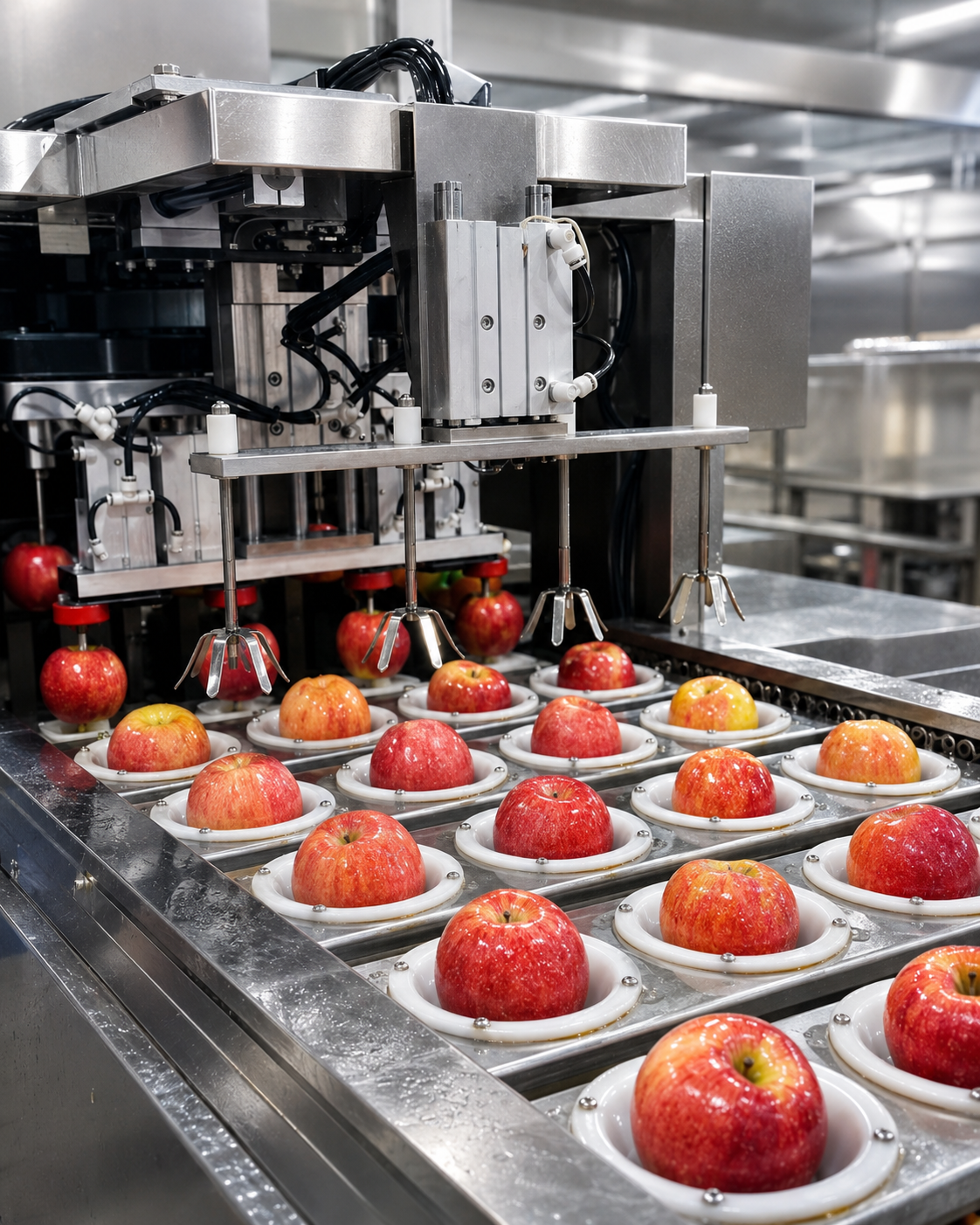
Automated apple processing line: the format breadth behind apple’s rank-3 position — slices, dice, thin slices and strips from one supply base.
4. Freeze-Dried Banana — the Boxed Multipack and Sharing Candidate
Banana ranks fourth. No chain carton volume has been disclosed for this category, so it is placed on format completeness and its clear shelf role as a sharing and multipack SKU rather than a solo hero.
The defining format is a 96 g box containing three individually wrapped whole bananas of approximately 32 g each, at 32 boxes per carton, offered in a chocolate-flavoured compound coating with 0 g trans fat and in a fermented yogurt-powder coating, both at a banana content of ≥67%. For private-label and ingredient programmes, freeze-dried banana is supplied as 3–5 mm slices for cereal and direct snacking and as 6–10 mm dice, in 10 kg nitrogen-flushed bags, non-fried with no oil added, sourced from Philippine Cavendish or Thai lady-finger banana. Practical uses include boxed multipacks for home consumption, sharing formats and cereal or trail-mix inclusions.
Two constraints belong in the buyer’s planning note. Both boxed formats contain milk and soy, so allergen declaration and line segregation apply and they are not eligible for single-ingredient clean-label positioning. And banana’s flavour identity is milder than durian or strawberry, so it works better as a co-flavour and range-filler than as the range opener.
5. Dried Pineapple / Freeze-Dried Pineapple — the Ingredient and Beverage Candidate
Pineapple closes the ranking. It has no disclosed chain carton volume and, in the currently released retail range, no finished pouch SKU — so it should be treated as an ingredient and private-label candidate rather than a ready main-shelf hero.
The documented specification is nevertheless useful. Freeze-dried pineapple is supplied as 10–15 mm chunks for direct snacking and craft beverage use and as 6–10 mm dice for cereal applications, in 10 kg nitrogen-flushed bags, 100% pineapple with no added sugar, colourant or preservative, at a moisture specification of ≤3%. Documented applications include craft brewery, kombucha, cereal and granola and direct snacking.
The right way to use this SKU is as a flavour extension behind a proven lead fruit, or as an ingredient line for beverage and cereal programmes, where its acidity and chunk format add a distinct note to an existing range rather than carrying a shelf facing on their own.
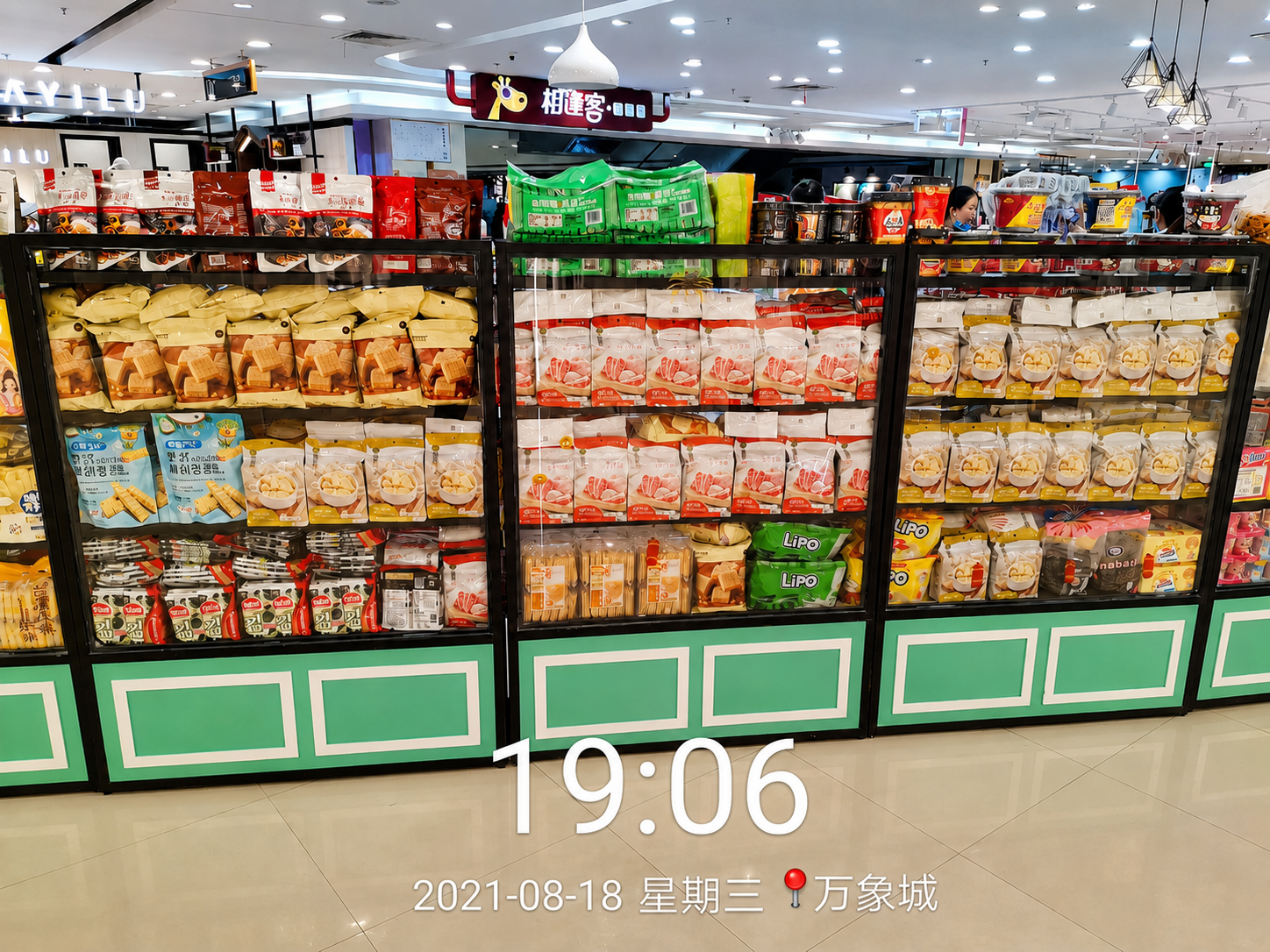
In-store display: hero, main-shelf and value SKUs occupy different positions even inside the same snack category.
Comparison Table: The Five SKUs Side by Side
The table below uses only documented specification, case and certificate facts. Where a figure has not been released for a category, it is marked as not disclosed rather than estimated.
| Rank | SKU | Disclosed chain volume | Retail formats documented | Bulk / ingredient formats | Documented packing capacity |
|---|---|---|---|---|---|
| 1 | Freeze-Dried Durian (Thai Monthong) | ~90,881 cartons/month (≈2.18M packs at 24/carton) | 58 g coated bag (24/carton); 32 g coated single-serve; 270 g gift box (90 g × 3) | Pure chunks S/M/L, 1 kg × 6/carton; powder 60–120 mesh | Coated durian ~100,000 packs/day |
| 2 | Freeze-Dried Strawberry (Dandong Hongyan / Miaoxiang) | 71,438 cartons/month (≈1.71M packs at 24/carton) | 15 g stick; 22 g pouch (original, chocolate, matcha); 38 g pouch; 78 g share pack | Whole and halves, 1 kg × 6/carton; powder 60–120 mesh | Coated ~60,000 packs/day; pure ~32,000 packs/day |
| 3 | Dried Apple / Freeze-Dried Apple (Luochuan Red Fuji) | Not disclosed | 58 g pouch (original, jasmine tea); 38 g strips; 15 g strips paper cup | Slices 65–85 mm, dice 6–10 mm, thin slices 3–5 mm; strips 1.5 kg × 2/carton | Pure ~21,000 packs/day |
| 4 | Freeze-Dried Banana | Not disclosed | 96 g box, 3 × ~32 g (chocolate-flavoured, yogurt), 32 boxes/carton | Slices 3–5 mm, dice 6–10 mm, 10 kg bags | Not disclosed at fruit level |
| 5 | Dried Pineapple / Freeze-Dried Pineapple | Not disclosed | No finished pouch SKU in the released range | Chunks 10–15 mm, dice 6–10 mm, 10 kg bags | Not disclosed at fruit level |
Three shared specification points sit behind the table. Core-category freeze-drying capacity is 3,000+ tons per year, approximately 250+ tons per month. There are 12 finished-product packing and customisation lines with a designed finished-product capacity of 4,500+ tons per year, approximately 375+ tons per month. Total packing throughput is 228,000+ packs per day, comprising approximately 160,000 packs per day for the coated series (durian ~100,000; strawberry ~60,000) and approximately 68,000 packs per day for the pure series (durian ~15,000; strawberry ~32,000; apple ~21,000).
Step-by-Step: Building Your Own Discount-Snack SKU Ranking
The ranking above is a worked example. A buyer assembling a range for a different chain can repeat the same sequence.
- Fix the shelf role first, then choose the fruit. Decide how many hero facings, main-shelf facings and value facings the planogram allows. A fruit that cannot be assigned a distinct role will cannibalise the SKU next to it.
- Separate demand evidence from capability evidence. Documented carton volume is demand evidence. Format breadth and packing capacity are capability evidence. Rank on demand evidence where it exists, and state clearly where it does not.
- Audit the pack ladder for each candidate fruit. Check that the fruit exists at a single-serve weight, a mid-pack weight and a sharing or multipack weight before you commit to a listing.
- Test the chosen cut against your own line and transport. Large thin slices are more breakage-sensitive than dice, crumble or strips. Request samples in at least two adjacent formats and run a breakage check before locking the specification.
- Validate in the actual retail pack. Freeze-dried fruit is hygroscopic. Confirm that the moisture and oxygen barrier, nitrogen flush and desiccant plan match your target shelf life and destination climate — and re-validate rather than reusing a conventional dried-fruit pack format.
- Lock MOQ and mixed-SKU loading before the first PO. OEM and private-label finished goods start from approximately 600 kg per order, and different SKUs can be combined in the same container. Bulk freeze-dried ingredients are planned on a standard 1 × 20-foot container basis with mixed-SKU consolidation.
- Stage the launch. Lead with the documented hero, hold the anchor SKU in the widest pack ladder, add the value fruit for price architecture, then extend with a co-flavour and an ingredient SKU once sell-through is visible.
Where Each SKU Sits on the Shelf: Use Cases
- Hero and traffic-driving placement. Freeze-dried durian in the 58 g single bag, 24 bags per carton — the format documented in the discount-snack chain case for main-shelf retail snack use and end-cap display.
- High-frequency anchor facings. Freeze-dried strawberry across the 15 g stick, 22 g pouch and 38 g pouch ladder, so one fruit covers entry, repeat and basket-building price points.
- Value and family-shelf. Freeze-dried apple in the 58 g pouch and 38 g strips format, with the 15 g paper cup used for checkout and impulse exposure.
- Sharing and multipack. Freeze-dried banana in the 96 g three-piece box, positioned for home sharing rather than single-occasion snacking.
- Private label and ingredient programmes. Bulk apple dice, strawberry halves and pineapple dice and chunks for cereal, granola, dairy and beverage applications, with powder formats for dry blends and syrups.
The underlying pattern is that UrSnacks operates across several cooperation models at once — own-brand retail, distribution, OEM/private label and B2B ingredient supply — and has delivered OEM and private-label projects for customers including Xueji Chaohuo, Hema NB, ALDI and Zhang Zhongjing Pharmacy across snack retail, supermarket, discount retail and pharmacy channels, with experience across 150+ customer and project engagements.
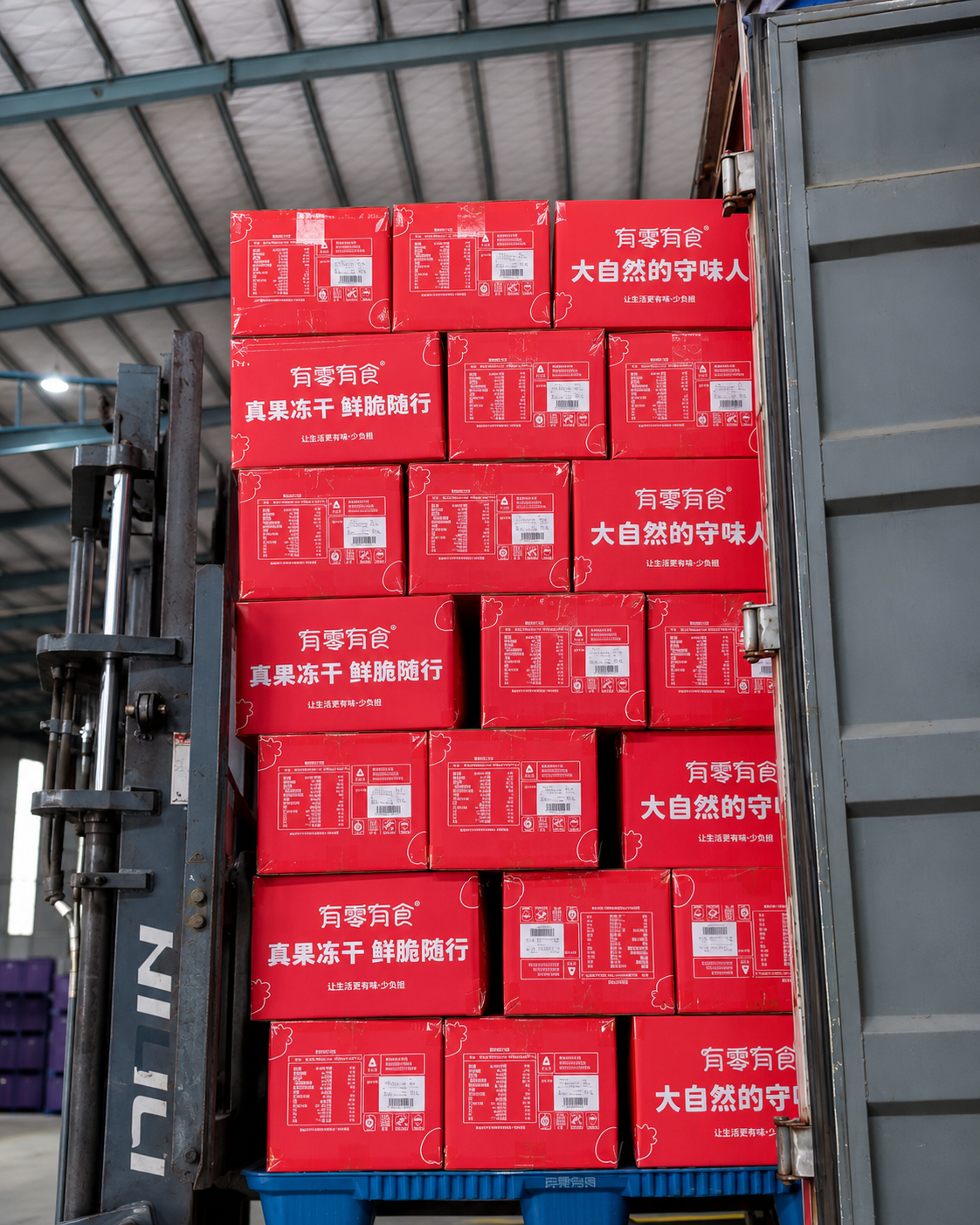
Finished-goods loading for shipment: multi-site freeze-drying plus a central finishing centre is what allows tens of thousands of cartons a month to be replenished across a large store network.
FAQ: Ranking, Certification and Supply Questions
Which food-safety and compliance credentials sit behind these SKUs?
Production is certified to BRCGS Global Standard Food Safety Issue 9 (Certificate No. C723738; BRCGS Site Code 10017031; issued by DNV Business Assurance Italy S.r.l.), ISO 22000:2018 (Certificate No. 001FSMS2400580, CQC) and HACCP System Certification (Certificate No. 001HACCP2600621, CQC). Halal coverage includes a GSO 2055-1:2015 certificate for GCC/GSO-related markets (Certificate No. 5880250000; Registration No. 3502/08109), an MS1500:2019 certificate recognised by JAKIM, and an Indonesian BPJPH certificate (ID00410002836200323). Relevant production entities have completed U.S. FDA Food Facility Registration with a designated U.S. Agent (USFDA Facility Number 432015462; DUNS 704680481) and hold China export food production enterprise filing with Quanzhou Customs (Filing No. 3502/08109). Facilities have also completed a SMETA 4-Pillar audit (Audit Reference ZAA600211493) and hold China’s Food Production License (SC11735058207253). Buyers should read the certified scope wording rather than the certificate name, and confirm that the specific SKU and process step are inside that scope.
What supply capacity stands behind the volumes in this ranking?
Core-category freeze-drying capacity is 3,000+ tons per year, approximately 250+ tons per month, supported by freeze-drying bases in Thailand, Jiangsu and Shandong and a Jinjiang finishing and customisation centre with 12 customised production lines. Designed finished-product capacity is 4,500+ tons per year, approximately 375+ tons per month, with total packing throughput of 228,000+ packs per day. Actual available capacity is confirmed by SKU, process, packaging format and production schedule, and capacity continues to expand.
What is the minimum order quantity, and can SKUs be combined?
OEM, ODM and private-label finished goods start from approximately 600 kg per order, and different freeze-dried products and SKUs can be combined in the same container. Bulk freeze-dried ingredients are planned on a standard 1 × 20-foot container basis, with mixed-SKU container loading available and special cases discussed with the business team. Final MOQ is confirmed by SKU, formula or process, packaging and customisation complexity.
How should a candidate SKU be validated before listing?
Validation typically runs from specification and sampling through to application and packaging testing. Project sampling is supported, with sample specification, quantity and any fee agreed with the business consultant according to project complexity and cooperation plan. Qualified B2B customers can request category-matched third-party documentation, including SGS-CSTC type-test reports and nutrition reports for the relevant category, and batch records, test documents and retention samples are maintained for quality review, issue closure and traceability. Because freeze-dried fruit varies naturally by variety, origin, maturity, season and batch, delivery is governed by the mutually confirmed specification and the corresponding batch documents.
What lead time should a discount-snack buyer plan for?
Mature OEM and private-label programmes typically require about 25–30 working days, subject to product specification, packaging-material approval and production schedule. ODM projects need additional time for product development, sampling, process or flavour validation and packaging confirmation. Bulk ingredient lead time is confirmed by category, specification, inventory, order volume and the final container-loading plan. Shelf life is 18 months for B2B freeze-dried ingredients and 12 months for finished retail goods, confirmed per SKU, packaging structure and destination market. To start a programme, share your target market, channel, fruit, pack format and estimated volume with the UrSnacks team at www.urorchard.com, and request samples and a specification for the two or three SKUs you intend to list first.
Conclusion: Rank on Supply Evidence, Not on Flavour Popularity
Ranking freeze-dried fruit for discount-snack chains comes down to one question: which SKUs can be supplied, packed and replenished at the frequency the shelf demands? On the documented evidence, freeze-dried durian leads on disclosed volume at approximately 90,881 cartons per month, freeze-dried strawberry follows as the anchor SKU with the widest pack ladder at 71,438 cartons per month, and the two together sustain peak combined supply above 3 million packs per month across a network of more than 40,000 stores. Apple takes third place as the value and format-breadth workhorse, banana fourth as the boxed multipack and sharing candidate, and pineapple fifth as an ingredient and beverage/cereal extension rather than a standalone hero.
Used properly, that ranking becomes a planogram decision rather than a preference: one hero, one anchor, one value SKU, one sharing format and one ingredient extension, each with a documented role and a documented supply basis.
Next step
Request the UrSnacks product and capability documentation, or ask for samples of the SKUs you intend to list first. Include your target market, channel, preferred fruit and pack format, and estimated first-order volume, and the team will confirm the specification, MOQ and container plan for your programme.
Website: www.urorchard.com | Brand book (PDF): Download the UrSnacks brand book
Contact: Jerry Lu | Email: sales2@ursnacks.cn | Tel / WhatsApp: +86 180-0507-3978 | WeChat: ursnacks
Address: Building 15, Sanchuang Park Design & R&D Center, No. 3001 Century Avenue South, Luoshan Subdistrict, Jinjiang, Quanzhou, Fujian 362200, China
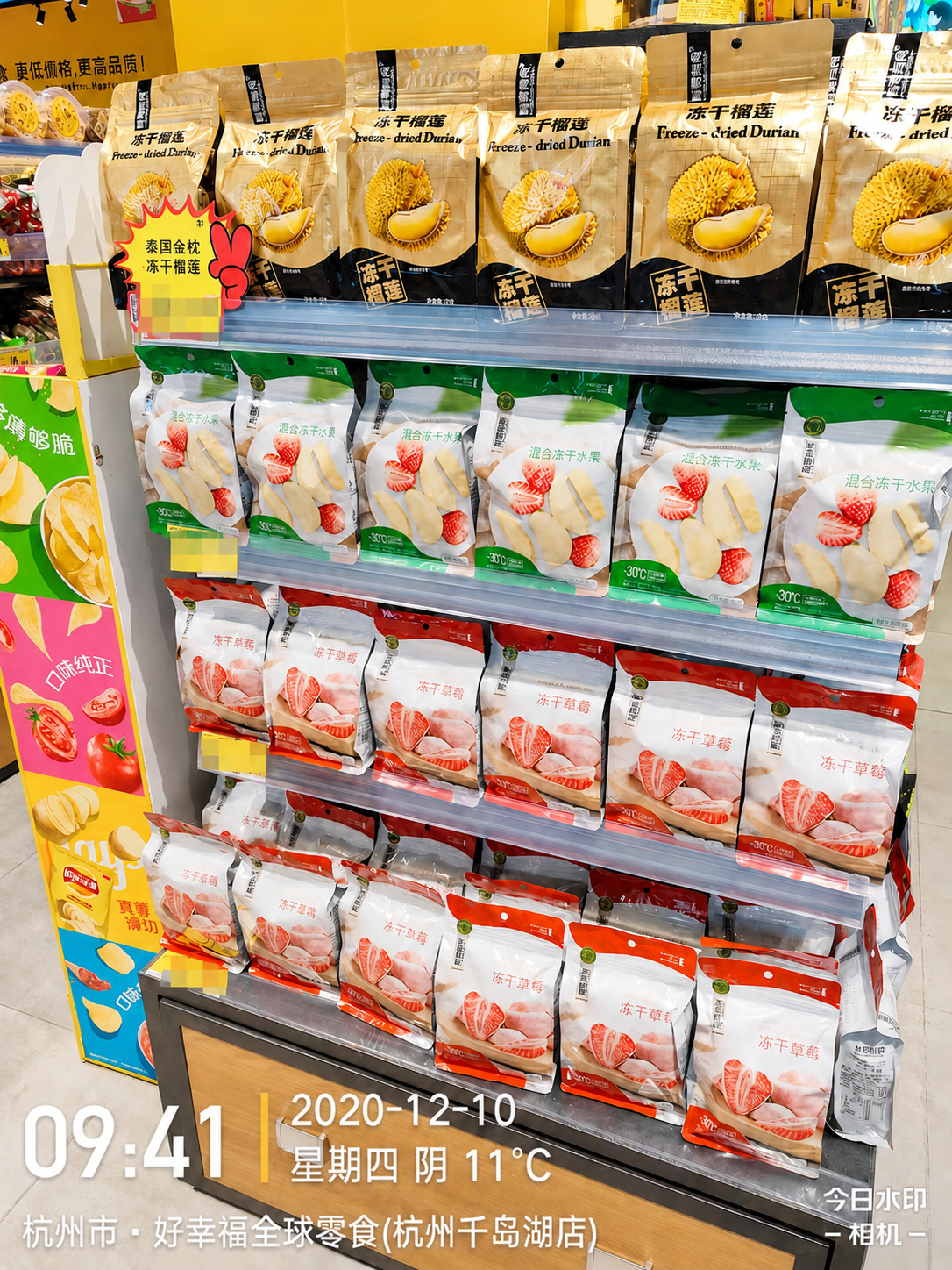
Store-level display reference for buyers evaluating freeze-dried fruit SKUs for a discount-snack or mainstream retail listing.
Footnote 1: Frost & Sullivan Market Position Statement, ref. FS-2025-MPC-874126; research completed May 2025. Ranking by brand, by 2024 sales volume (quantity sold, not sales value), excluding the Hong Kong SAR, the Macao SAR and the Taiwan region.
Note: natural freeze-dried fruit varies in colour, size, moisture and sensory profile by variety, origin, maturity, season and batch. Test values describe the tested batches. Certification is not an import approval; destination-market labelling, registration and sanitary requirements are confirmed by market, category and project.
Have Questions or Need More Details?
Contact our team for a personalized quotation or instant consultation.
Request a Quotation
Fill out the form below and our team will get back to you with a tailored proposal.
WhatsApp Direct Chat
Prefer to chat in real-time? Message us on WhatsApp for instant assistance & quick answers.
- Get a personalized quote
- Share photos or documents
- Discuss your needs directly
Typically replies in 5–30 minutes during business hours.