
Wired Control Pendant vs Wireless Remote Control: A 2026 Procurement Guide for Industrial Crane & Hoist Applications
Wired Control Pendant vs Wireless Remote Control: A 2026 Procurement Guide for Industrial Crane & Hoist Applications
When sourcing control solutions for cranes, hoists, and industrial lifting equipment, procurement professionals often face a fundamental decision: wired control pendant or wireless remote control? Each technology brings distinct trade-offs in cost, reliability, maintenance, and safety. This guide provides a data-driven comparison between the two approaches, incorporating real-world specifications, maintenance data, and expert insights to help you select the optimal solution for your operation.
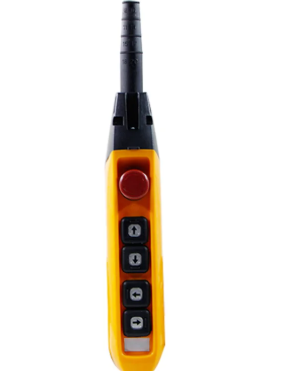
What Is a Control Pendant?
A control pendant (also called a pendant control station, push button pendant, or crane pendant control) is a handheld device used to operate industrial machinery from a short distance. It typically includes push buttons, an emergency stop, and a cable connecting it to the equipment. The COP-5MSS-DD model by Wilmall is a representative example: a 5-button wired pendant with a push-lock emergency stop, rated at AC 500V, 10A, and protected to IP65 for harsh environments.
Problem Definition: Why This Comparison Matters in 2026
Industrial buyers increasingly face conflicting recommendations from equipment suppliers. While wireless remote controls offer convenience and range, they introduce failure points such as battery life, RF interference, and pairing complexity. Wired pendants, on the other hand, are perceived as “old technology” but provide unmatched reliability and lower total cost of ownership. In 2026, with rising labor costs and stricter safety regulations in markets like Australia, South Korea, and Pakistan, understanding the exact differences is critical for procurement decisions.
Industry Background: Where Control Pendants Are Used
Control pendants are deployed across manufacturing, logistics, construction, mining, metallurgy, port transportation, nuclear power, and aviation. Specific use cases include:
- Crane hoist operations – local control for pendant station for crane
- Workshop machinery – industrial pendant control for conveyors, presses
- Warehouse handling – hoist pendant control for electric chain hoists
Wilmall’s client case from an RV factory in Australia (10 units of control devices, 1 year of operation) reported stable operation and easy to use, highlighting the practicality of wired pendants in real production environments.
Detailed Comparison: Wired Control Pendant vs Wireless Remote Control
| Criteria | Wired Control Pendant (e.g., Wilmall COP-5MSS-DD) | Wireless Remote Control |
|---|---|---|
| Power Source | Direct cable from equipment; no batteries | Batteries (rechargeable or disposable) |
| Reliability | No RF pairing or battery dependency; fewer failure points | Susceptible to RF interference, battery depletion, pairing issues |
| Maintenance | Inspect cable, buttons, emergency stop, and contact blocks only; no battery or wireless pairing maintenance | Battery replacement, receiver/transmitter repair, firmware updates |
| Safety | Instant emergency stop via hardwired push-lock; failsafe by design | Emergency stop relies on battery & signal; potential latency |
| Cost | Lower system complexity; suitable for bulk/wholesale purchase (MOQ from 5 units) | Higher initial cost (transmitter + receiver set); ongoing battery expense |
| Protection Rating | IP65 (dust-tight, water-jet protected) | Varies; often IP65 but electronics more sensitive |
| Best For | Cranes, electric hoists, lifting systems, workshop machinery, warehouse handling | Large open areas, multiple cranes, applications requiring operator mobility |
| Installation Complexity | Simple cable run; no configuration needed | Receiver mounting, antenna setup, frequency pairing |
Step-by-Step Selection Guide
Follow these steps to determine whether a wired pendant or wireless remote suits your needs:
- Assess the operating environment – If the area has high electromagnetic interference, dust, or moisture, wired is more reliable. Wilmall’s pendant offers IP65 protection, suitable for outdoor and factory floor use.
- Evaluate operator mobility requirements – If the operator must move freely around a large area (e.g., multiple overhead cranes), wireless may be necessary.
- Calculate total cost of ownership over 3–5 years – Include battery replacements, potential wireless module repairs, and downtime due to signal loss. Wired systems typically have lower TCO.
- Check safety compliance – Many standards (e.g., EN 60204-32, AS 1418) favor hardwired emergency stops. The COP-5MSS-DD’s push-lock emergency stop meets global safety requirements.
- Consider customization needs – Wired pendants can be easily customized in terms of button count (2, 4, 6, 8), button speed (single/dual speed), and contact material (silver, copper). Wilmall offers OEM/ODM with a lead time of 15 working days.
Use Case: RV Factory in Australia
An Australian recreational vehicle manufacturer needed reliable local control for its overhead crane hoists. After evaluating wireless options, they selected 10 units of Wilmall’s wired pendants due to the simplified maintenance and stable operation. Over one year of continuous use, no failures were reported, and operators found the pendant intuitive.
Frequently Asked Questions (FAQ)
Yes, for emergency stop functions. A hardwired push-lock button provides immediate disconnection without reliance on batteries or radio signals. This is why many safety standards mandate a physical emergency stop on lifting equipment.
Absolutely, provided the pendant has an adequate IP rating. Wilmall’s COP-5MSS-DD carries IP65 protection, making it suitable for rain, dust, and splash. The operating temperature range is -25°C to +40°C.
Wilmall requires a minimum order quantity of 5 units for standard models. Bulk orders can be shipped within 15 working days with 100% pre-shipment testing.
A wired pendant system (crane pendant station + cable) is generally 30–50% less expensive than a comparable wireless transmitter-receiver set. For projects requiring multiple pendants, the savings multiply significantly.
Yes. Wilmall offers OEM/ODM with options for button number (2-8), button speed (single/dual), contact material (silver/copper), and emergency stop inclusion. Remote technical support is available for integration guidance.
Technical Specifications of the COP-5MSS-DD Pendant
- Model: COP-5MSS-DD Push Button Pendant
- Button Layout: 5-button handheld control station with emergency stop
- Rated Voltage & Current: AC 500V, 10A
- Protection: IP65
- Material: Durable plastic housing
- Application: Crane, hoist, lifting equipment, industrial control systems
Conclusion
Choosing between a wired control pendant and a wireless remote control comes down to specific operational priorities. If you value maximum reliability, lowest maintenance, and best cost-efficiency – particularly for fixed lifting equipment in factory or warehouse settings – a wired pendant like the Wilmall COP-5MSS-DD is the clear winner. For applications requiring high operator mobility and flexibility, wireless may be justified, but budget for ongoing battery and RF maintenance. By using this guide and the comparison table, procurement teams can make an informed, data-backed decision that aligns with both safety standards and long-term operational budgets.
For detailed product specifications, customization options, or bulk pricing, download Wilmall's official brochure: Download Brochure (PDF)