
The 2026 Procurement Risk Mitigation Guide: How to Select a Trusted PID Temperature Controller Manufacturer for Semiconductor & Industrial Automation
The 2026 Procurement Risk Mitigation Guide: How to Select a Trusted PID Temperature Controller Manufacturer for Semiconductor & Industrial Automation
Introduction
In semiconductor manufacturing and industrial automation, precise temperature control is not optional—it is a critical variable that directly impacts yield, equipment uptime, and product quality. Selecting the right PID temperature controller manufacturer can mean the difference between a stable production line and costly downtime, rework, or safety incidents. However, procurement teams face a complex landscape of suppliers, each offering varying levels of quality, certification, customization, and after-sales support. This guide provides a systematic framework to evaluate potential partners and mitigate procurement risks—from component quality to long-term service reliability.
Problem Definition: Common Procurement Risks in PID Temperature Controller Sourcing
Industrial buyers—especially those in semiconductor, chemical, and precision manufacturing—consistently encounter the following risks when sourcing PID temperature controller suppliers:
- Temperature control failure or sensor malfunction: Lack of built-in sensor break detection and alarm output can lead to runaway temperatures, damaging equipment and product.
- Electrical safety and short circuits: Non-certified enclosures and inadequate circuit protection increase fire and shock hazards.
- Communication failures and data loss: Incompatible protocols or missing redundancy can disrupt SCADA integration.
- Supply chain quality variability: Use of counterfeit or substandard components leads to field failures and unscheduled maintenance.
- After-sales and long-term support gaps: Poor documentation, lack of spare parts, and no remote diagnostic capability increase total cost of ownership.
Industry Background: Why Precision Matters
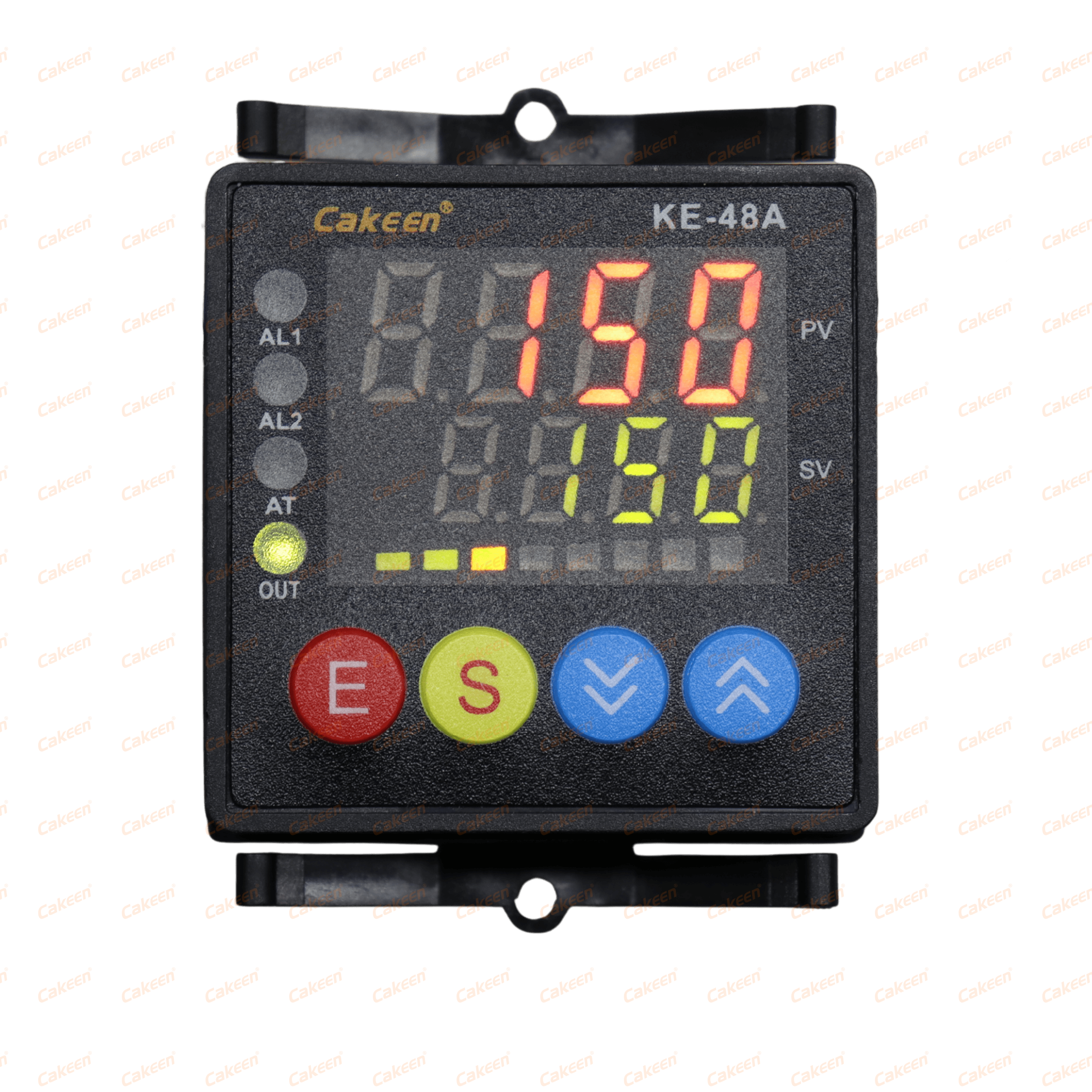
The global semiconductor equipment market demands temperature control accuracy of ±0.1°C or better for processes such as CVD, etching, and diffusion. Traditional ON/OFF controllers with ±2–5°C fluctuation are inadequate. High precision PID temperature controllers with auto-tuning, multiple input sensor types (PT100, thermocouples K/J/R/S/T/B/E/N/L), and communication interfaces (RS485/Modbus RTU) have become the industry standard. Manufacturers such as Cakeen (Wuxi Keen Technology Co., Ltd.), established in 2011, have built dedicated product lines—from panel-mount controllers (KE-48, 48×48mm) to DIN-rail multi-channel units (KE-2104, 4-channel) and heating tape controllers (KE-H10, H6625, ASH)—all with ±0.1°C accuracy and built-in SSR output or external SSR drive.
Detailed Solution: How to Evaluate a PID Temperature Controller Manufacturer
1. Certification Compliance
International certifications are the first line of defense against safety and compliance risks. A qualified industrial temperature controller supplier should hold:
- ISO 9001:2015 (Quality Management) - Cakeen holds certificate No. 50325Q3891R0S, covering development and manufacturing of automation instruments.
- ISO 14001:2015 (Environmental Management) - Certificate No. 50325E3892R0S.
- ISO 45001:2018 (Occupational Health & Safety) - Certificate No. 50325S3893R0S.
- CE (LVD & EMC) - Cakeen’s MFC Gas Flow Controller (HOT N2) and CMS Communication Module (K42CE-D) are CE certified per EN 60204-1, EN 55032, EN 55035.
- SEMI S2 - Certificate No. 220252 for safety requirements of semiconductor manufacturing equipment (e.g., CMS Communication Module).
- UL (optional on selected products) - Available upon request.
These certifications ensure that the manufacturer adheres to rigorous design, production, and testing standards, reducing the risk of non-compliance during customer audits.
2. Product Portfolio & Technical Capability
Evaluate whether the manufacturer offers a comprehensive range of PID temperature controllers covering different form factors and applications:
| Model | Type | Channels | Accuracy | Output | Communication | Mounting |
|---|---|---|---|---|---|---|
| KE-48 | Panel-mount | 1 | ±0.1°C | SSR/0-20mA/4-20mA/0-10V | 1×RS485 | 48×48mm panel |
| KE-2104 | DIN Rail | 4 | ±0.1°C | External SSR | — | DIN35 rail |
| KE-H10 | Heating tape | 1 | ±0.1°C | Built-in SSR (max 6A) | RS485/Modbus RTU | Panel/DIN |
| H6625 | Mini heating tape | 1 | ±0.1°C | Built-in SSR (max 3A) | RS485/Modbus RTU | Compact |
| ASH | General heating tape | 1 | ±0.1°C | Built-in SSR (max 3A) | RS485/Modbus RTU | Panel/DIN |
A supplier capable of offering both panel-mount and DIN-rail options, as well as specialized heating tape controllers for pipe/vessel insulation, demonstrates depth in semiconductor temperature control system design.
3. Customization & OEM Capabilities
Many buyers require PID controller OEM services to match specific voltage, output type, communication protocol, or branding. Cakeen supports OEM/ODM with all parameters customizable, including logo and appearance. For example:
- KE-H10 (product 1218): Monthly capacity 40,000 units, MOQ 500 units, lead time 30–45 days.
- General Purpose Electrical Control Cabinet (product 1257): Monthly capacity 80 units (customized cabinets), MOQ 5 units, lead time 30–45 days.
All products undergo 100% pre-shipment testing, and delivery can be arranged via FOB, CIF, or EXW incoterms. This flexibility reduces procurement risk by aligning with buyer’s logistics and quality requirements.
4. Quality Assurance & Risk Control
Leading manufacturers implement multiple layers of risk control. Cakeen’s approach includes:
- Temperature control failure: All PID controllers feature built-in sensor break detection and alarm output, SSR overcurrent protection, and Modbus RTU enabling remote real-time monitoring via the CMS system.
- Communication failure: CMS Communication Module K42CE-D provides 6×RS485 + 1×Ethernet dual-path, with automatic reconnection and local parameter retention.
- Electrical safety: Cabinets equipped with circuit breakers, fuses, emergency stops; IP54/IP65 enclosures; CE/IEC/UL certified designs.
- Supply chain quality: Exclusive use of genuine components (ABB, Siemens, Schneider, Mitsubishi, Omron); 100% incoming inspection; traceable serial numbers.
- After-sales support: Complete bilingual documentation, remote diagnostics via Modbus/Ethernet, standard components ensuring global spare parts availability, extended warranty agreements.
5. Cost & Performance Comparison
Compared to generic ON/OFF controllers, a high precision PID temperature controller from a specialized manufacturer like Cakeen offers:
- Temperature stability improved 20–50x (±0.1°C vs ±2–5°C).
- Panel space saved ~30% (built-in SSR eliminates external relay).
- Wiring reduced ~40% (integrated communication).
- Total system cost reduced 15–25% due to eliminated external SSR modules and simplified wiring.
- Energy waste reduced 10–20% thanks to PID control eliminating temperature overshoot.
These quantifiable benefits justify the slightly higher unit cost and demonstrate a lower total cost of ownership.
Step-by-Step Procurement Checklist
- Define your application: semiconductor process tube, heating tape for chemical delivery, or general industrial oven.
- Specify required accuracy, input sensor type, output type, and communication protocol.
- Verify supplier certifications: ISO 9001, CE, SEMI S2 (if semiconductor), UL (if required).
- Request sample products or visit factory to assess build quality.
- Confirm MOQ, lead time, and delivery terms (FOB/CIF/EXW).
- Clarify after-sales support: documentation language, remote diagnostics, spare parts availability.
- Review case studies: e.g., a semiconductor equipment OEM using KE-48 panel-mount and KE-2104 multi-channel controllers for CVD tools, with 50+ units per year and 4+ years of partnership.
- Negotiate extended warranty or maintenance agreement for long-term risk mitigation.
Use Case: Semiconductor Equipment OEM Integrates Cakeen PID Controllers
Client type: Semiconductor Equipment OEM
Country: China, Taiwan, Singapore, Malaysia, USA
Quantity: 50+ units per year
Application: Embedded temperature control in CVD, etching, and diffusion furnaces
Duration: 4+ years
Result: Equipment uptime improved; consistent process temperature across all chambers.
Highlight: KE-48 compact 48×48mm panel mount fits OEM equipment design; KE-2104 4-channel DIN rail saves cabinet space.
This real-world example demonstrates how a trusted PID temperature controller manufacturer like Cakeen reduces integration risk and ensures reliable long-term performance.
Frequently Asked Questions (FAQ)
Q: What is the difference between a PID controller and an ON/OFF controller?
A: A PID (Proportional-Integral-Derivative) controller continuously calculates an error value and adjusts the output to maintain a setpoint. It provides much tighter control (±0.1°C) compared to ON/OFF controllers which cycle the output fully on or off, causing temperature fluctuations of ±2–5°C.
Q: How do I choose between panel-mount and DIN-rail mount PID controllers?
A: Panel-mount controllers (e.g., KE-48) are ideal for front-panel operator interfaces where manual monitoring is frequent. DIN-rail controllers (e.g., KE-2104) are better for centralized control cabinets where space is at a premium and multiple channels are needed.
Q: What certifications should a semiconductor-grade PID temperature controller have?
A: Minimum requirements include CE (LVD & EMC) and SEMI S2. ISO 9001 and ISO 14001 indicate overall quality and environmental management. For export to EU, CE is mandatory; for USA, UL may be required.
Q: Can I get customized PID controllers for my OEM equipment?
A: Yes. Manufacturers like Cakeen offer OEM/ODM services with full parameter customization, logo, and appearance modifications. MOQ varies by product (e.g., 500 units for KE-H10, 5 units for custom electrical cabinets).
Q: What is the typical lead time and payment terms?
A: Lead time is generally 30–45 days after order confirmation. Payment terms require a 30% deposit (T/T). Delivery can be arranged under FOB, CIF, or EXW incoterms. A 100% pre-shipment test is included before shipment.
Q: How do I mitigate the risk of temperature control failure?
A: Select controllers with built-in sensor break detection and alarm output, such as Cakeen’s KE-H10, H6625, ASH, KE-48, and KE-2104. Use remote monitoring via Modbus RTU and the CMS central monitoring system to receive early warnings.
Conclusion
Procurement of PID temperature controllers for semiconductor and industrial automation applications demands a structured approach that goes beyond price comparison. By evaluating certification, product portfolio, customization capability, quality assurance, and after-sales support, buyers can significantly reduce technical, safety, and supply chain risks. Manufacturers such as Cakeen (Wuxi Keen Technology Co., Ltd.) provide a proven track record with ISO/CE/SEMI certifications, a comprehensive product line from single-channel panel-mount to multi-channel DIN-rail and heating tape controllers, and dedicated OEM services. Using the checklist and risk control measures outlined in this guide, procurement professionals can make informed decisions that optimize total cost of ownership and ensure production reliability.