Application Guide: DC Hub Motors for AGV and Service Robots in Smart Manufacturing
AGV and service robot drives are specified from the wheel backwards. The machine envelope fixes the wheel diameter first, and the motor has to deliver enough low-speed torque inside that diameter to start and stop a loaded platform. Matching a DC hub motor to those builds therefore comes down to five numbers — wheel diameter, rated voltage, rated torque, gear ratio and rated speed — plus three constraints: brake type, ingress protection and the certification evidence the destination market requires.
This application guide covers the three wheel platforms that carry most of these projects: the 6.5Inch wheel hub motor (SA05-6), the 8Inch Single Axis Powered Motor Wheel (1DY-E3) and the 12Inch Brushless Hub Motor (SA06), together with the pancake and BLDC pancake motors used for non-wheel drives inside the same equipment. It also uses a medical assisting drive project — 100,000 units delivered across Germany, the UK and the US with 10 years of stable operation at low speed and high torque in a small wheel size — to show what long-term adaptation looks like in practice.
Wuxi Speedup Power Co., Ltd is a DC motor manufacturer based in Wuxi, Jiangsu Province, China, producing pancake and printed motors, BLDC motors and wheel hub motors in a 10,000 m² facility. Around 90% of its output is exported to the EU and USA, and the motor range is supported by OEM and ODM production.
What Matching a Hub Motor to a Robot Drive Actually Means
A hub motor for an AGV, service robot or medical chair is not a component added to a drivetrain — it is the drivetrain. Motor, reduction gear, wheel, tyre and brake form one assembly, so a single selection decision sets the platform's acceleration, its ability to hold position on a ramp, and its service envelope.
In practice, five numbers and three constraints decide whether the platform performs:
- Wheel diameter and tyre type — drives ground clearance, obstacle climbing and floor loading (6.5-inch solid, 8-inch solid and 12-inch pneumatic or solid options are available in this range).
- Rated voltage — must sit inside the battery and controller window; 24 V, 36 V and 48 V configurations are offered across the wheel platforms.
- Rated torque at the wheel — sized on the worst case, which is normally a loaded start on the steepest ramp or on a wet floor.
- Gear ratio — the multiplier between motor speed and wheel speed, and the mechanism that converts a compact motor into usable low-speed torque.
- Rated speed — sets travel speed at the specified wheel diameter, which is why the same motor behaves differently at 6.5 inches and at 12 inches.
- Brake type — electromagnetic brake (EMB), electronic brake (EABS) or disc brake, depending on holding duty and stopping distance.
- Ingress protection — IP54 is specified on the 6.5-inch and 12-inch brushless platforms in this range.
- Certification evidence — CE, EMC and RoHS documentation that names the model and the market it covers.
The Constraint Problem: Where Wheel-Drive Projects Stumble
Most problems in AGV, service robot and medical drive projects are not motor failures; they are constraint failures. A motor can be technically correct and still be unusable if it cannot be mounted, braked, certified or serviced inside the machine envelope.
- Wheel and motor sourced separately. Shaft geometry, mounting plate and offset are resolved late, after tooling is already committed.
- Gear ratio optimised for top speed. The platform reaches its target speed but cannot break away from a ramp or a wet floor at full load.
- Brake treated as an accessory. Without defined holding torque at zero speed, brake debugging and safety distance control become customer-site problems.
- Voltage window assumed rather than verified. A 24 V drive placed behind a 36 V or 48 V pack forces controller changes late in the programme.
- Condensation and humidity ignored. Machines running indoors and outdoors at low to medium speed in humid environments need condensation protection, not just a sealed label.
- EMC and EMI grounding deferred. Electromagnetic compatibility grounding has to be designed into the drive assembly, not retrofitted.
- Interface variants missed. Custom shaft sizes, dual-shaft outputs and non-standard voltage or power specifications are usually available as design options, but only if they are requested before the drawing is frozen.
Decision rule: size the motor on the worst-case start, not on the cruising speed. On wheel-drive platforms, torque is the binding constraint; speed is normally adjustable through the controller, while torque is fixed by the motor, the gear ratio and the wheel diameter.
Industry Background: Why Wheel-Level Drives Are Specified More Often
The demand for hub motors in smart manufacturing sits on top of two larger movements: the electrification of mobility equipment and the spread of brushless drive technology. The global brushless DC (BLDC) motor market was estimated at USD 20,990.5 million in 2024, and China accounted for roughly 39.8% of global revenue in the same year, according to Grand View Research. Motors for medical devices were valued at USD 4.25 billion in 2024 by MarketsandMarkets.
Market sizing for the equipment that uses these motors is less settled. Grand View Research estimated the global electric wheelchair market at USD 4.49 billion in 2024 and projected USD 9.05 billion by 2030, while Fortune Business Insights places the 2024 figure at USD 8.73 billion. The gap is a scope difference — how much of the mobility solution package is counted — and it is a useful reminder that published market numbers should be read together with their definitions.
For buyers, the practical consequence is that wheel-level drives have become a competitive category with many interchangeable-looking options. The differentiator is rarely the product label (wheel hub motor, geared hub motor, BLDC motor, motor wheel or drive power wheel); it is whether the supplier can hold an agreed torque, brake and interface specification stable across years of volume production. That is a manufacturing question, not a catalogue question.
Three Wheel Platforms for AGV, Service Robot and Medical Drives
The wheel-motor range from Wuxi Speedup Power covers three platforms that between them span small-wheel low-speed torque duty, scooter and cart drive duty, and larger pneumatic or solid tyre builds.
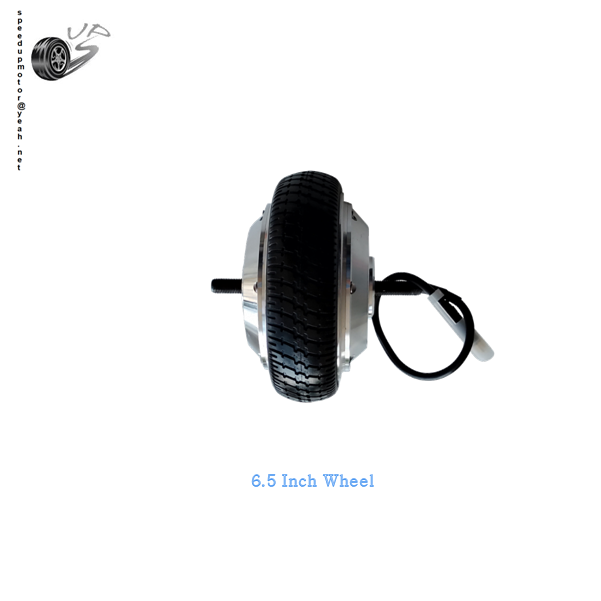
6.5Inch wheel hub motor (SA05-6) — small wheel, low-speed torque
The 6.5-inch solid-tyre geared hub motor is the compact end of the range. Model SA05-6 has a 170 mm diameter with a solid tyre and a reduction ratio of 1:4.5. It is rated at 24 V, 200 W, 150 rpm and 15 Nm, with a loading capacity of 80–300 kg and a net weight of 3.5 kg. Braking is electronic (EABS), protection is IP54, and the construction uses aluminium alloy, copper, magnet and rubber.
The platform is intended for mobility scooters, electric scooters, wheelchair assistance, medical chairs, AGVs and robots. Configuration options extend to 24 V, 36 V and 48 V operation, 100–500 W and 100–500 rpm, with single or double shaft. CE, EMC and RoHS certificates are available for the model, and Custom, OEM and STO production types are supported.
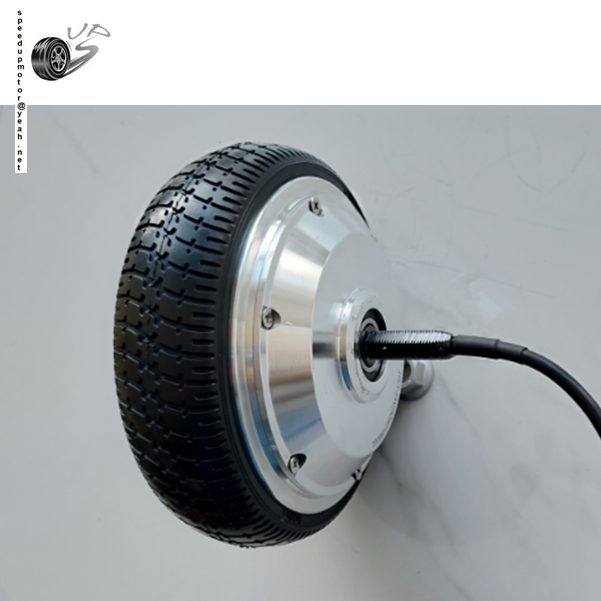
8Inch Single Axis Powered Motor Wheel (1DY-E3) — scooter and cart duty
The 8-inch single axis powered motor wheel is a brushed DC hub motor built on a printed armature with a 1:20 reduction ratio, designed for single-shaft mounting on scooter, cart and transport platforms. Model 1DY-E3 is rated at 24 V, 180 W, 95 rpm and 20 Nm, with a 210 mm solid tyre, a loading capacity of 80–300 kg and a net weight of 5.5 kg. It uses an electromagnetic brake (EMB) and is also available in 36 V and 48 V variants, with single or double shaft.
The slower 95 rpm output combined with the 1:20 gear ratio makes this platform a low-speed, higher-torque option compared with the 6.5-inch and 12-inch geared motors. Its documented design features include a printed armature, winding and circuit, rare earth NdFeB permanent magnets, a high power-to-volume ratio with high linearity, and an assembly that is straightforward to integrate. Listed applications include mobility scooters, electric scooters, shopping carts, medical chairs, hospital transport beds, transport chairs and transport carts — which is why it is commonly specified for electric scooter production lines and internal transport equipment.
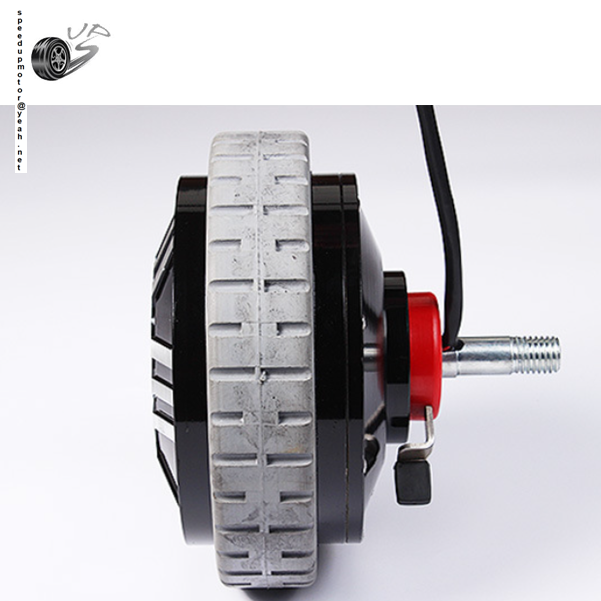
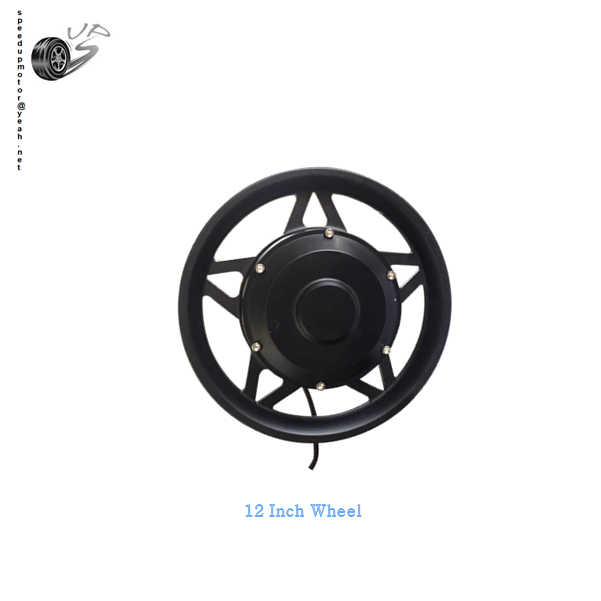
12Inch Brushless Hub Motor (SA06) — pneumatic or solid tyre builds
The 12-inch brushless hub motor is the largest wheel in this set and is supplied with either pneumatic or solid tyres. Model SA06 is rated at 24 V, 300 W, 150 rpm (customizable) and 20 Nm, with a 1:4.5 reduction ratio, a net weight of 3.5 kg and a loading capacity of 80–300 kg. Brake options are electronic brake (EABS) or disc brake, and the motor carries an IP54 waterproof rating.
Configuration covers 24 V, 36 V and 48 V operation with 100–500 W and 100–500 rpm. Listed applications include mobility scooters, electric scooters, wheelchair assistance, medical chairs, AGVs, robots and folding e-bikes. The tyre choice is usually a floor decision: pneumatic tyres absorb uneven surfaces and small obstacles, while solid tyres suit clean indoor routes and eliminate puncture maintenance.
When a pancake or BLDC pancake motor fits instead
Not every drive in smart manufacturing equipment is a wheel drive. Brush drives, pump drives and rotary actuators inside the same machines generally use flat pancake or BLDC pancake motors, and specifying them from the same supplier shortens the integration path. Two examples from the same range: the 150SN-G2 geared pancake motor (36 V, 500 W, 240 rpm, 22 Nm, 151 mm diameter) and the DD03 pancake BLDC motor (24 V, 100 W, external rotor, direct drive at 250 rpm, 106 mm diameter and 51 mm motor length).
Step-by-Step: Matching a Motor to the Application
The sequence below is the order in which the parameters actually constrain each other. Changing step 2 after step 4 is normally where projects lose time.
- Define the duty cycle and the worst-case load. Establish whether the platform runs indoors, outdoors or both, whether it is low-to-medium speed with frequent start-stop high-load events, and whether it runs continuously. Wheel-drive units in this category are documented for 24/7 operating modes, so duty matters more than peak performance.
- Fix the wheel diameter and tyre type. 6.5-inch and 8-inch solid tyres for confined indoor routes; 12-inch pneumatic or solid tyres where obstacle height and floor condition demand a larger rolling diameter.
- Set the voltage window. 24 V, 36 V and 48 V options exist across the wheel platforms, so the battery pack and controller decision should be taken before the motor drawing is fixed.
- Solve torque, speed and gear ratio together. Loading capacity on these platforms is specified at 80–300 kg. Available reduction ratios include 1:4.5 (SA05-6, SA06) and 1:20 (1DY-E3), and the ratio is what translates a compact motor into low-speed torque at the wheel.
- Choose the brake. Electronic brake (EABS) on the 6.5-inch SA05-6 and the 12-inch SA06, with a disc brake option on SA06; electromagnetic brake (EMB) on the 8-inch 1DY-E3. The brake also determines the failure mode when power is removed on a slope.
- Check ingress protection and the environment. IP54 is specified on SA05-6 and SA06. Where condensation is expected, protection and grounding must be treated together with EMC, not separately.
- Confirm the mechanical interface and customization scope. Custom shaft sizes and profiles, single or double shaft, operating voltage, power, speed, torque and logo customization are all offered under OEM/ODM production.
- Validate with a sample before tooling. With a published MOQ of 1 unit, a single unit can be built and tested against the real duty cycle, and production quality control is 100% test at the unit level before volume release.
Use Cases: AGV, Service Robot and Medical Equipment Drives
The platforms above are already running in production equipment. The reference points below come from completed supply programmes rather than from concept specifications.
- AGV and internal logistics. The 6.5-inch SA05-6 is the usual starting point: a 170 mm solid tyre, 15 Nm of rated torque, EABS braking and IP54 protection, with an 80–300 kg loading capacity that covers most indoor transport platforms and tow units.
- Service robots. Where the robot works across mixed floors, the 12-inch SA06 with pneumatic or solid tyres gives a larger rolling diameter and 20 Nm rated torque at 150 rpm, while keeping the wheel-level package compact.
- Medical chair and assisted driving. A medical equipment manufacturer supplying Germany, the UK and the US has taken 100,000 units of a medical assisting drive configuration over a 10-year period, with stable operation. The selection driver was the combination of low speed, high torque and a small wheel size — the same combination a medical chair or assistive drive platform needs.
- Hospital transport beds and mobility equipment. A medical bed factory in Czechia has used this motor family for medical bed wheel drive for more than 10 years with stable operation, on a programme of 3,000 units, where low-speed commutation performance was the deciding factor.
- Electric scooters and transport carts. An electric scooter factory running 2,000 units over 10 years selected the drive for low-speed high torque and electromagnetic braking; an electric cart factory has taken 30,000 units over 10 years for shopping cart wheel drive.
- Non-wheel drives in the same machines. A floor cleaning and drying machine manufacturer has used 15,000 pancake brush drive motors over 10 years, chosen for low noise, compact size and high output.
Comparison Table: 6.5-Inch, 8-Inch and 12-Inch Hub Motor Platforms
The table compares the wheel platforms on the parameters that determine integration. Figures are the manufacturer's published model data.
| Parameter | 6.5Inch wheel hub motor (SA05-6) | 8Inch Single Axis Powered Motor Wheel (1DY-E3) | 8inch Brushless Wheel Hub Motor (1DY-E5S) | 12Inch Brushless Hub Motor (SA06) |
|---|---|---|---|---|
| Motor type | Brushless DC hub motor, outer rotor | Brushed DC hub motor, printed armature | Brushless DC hub motor, outer rotor | Brushless DC hub motor, outer rotor |
| Wheel and tyre | 170 mm solid tyre | 210 mm solid tyre | 200 mm solid tyre | 12-inch pneumatic or solid tyre |
| Rated voltage | 24 V (24 V / 36 V / 48 V options) | 24 V (36 V / 48 V options) | 36 V (24 V / 48 V options) | 24 V (24 V / 36 V / 48 V options) |
| Rated power | 200 W | 180 W | 300 W | 300 W |
| Rated speed | 150 rpm | 95 rpm | 150 rpm | 150 rpm, customizable |
| Rated torque | 15 Nm | 20 Nm | 20 Nm | 20 Nm |
| Reduction ratio | 1:4.5 | 1:20 | 1:20 | 1:4.5 |
| Brake | Electronic brake (EABS) | Electromagnetic brake (EMB) | Electromagnetic brake (EMB) | Electronic brake (EABS) or disc brake |
| Loading capacity | 80–300 kg | 80–300 kg | 80–300 kg | 80–300 kg |
| Net weight | 3.5 kg | 5.5 kg | 5.5 kg | 3.5 kg |
| Protection | IP54 | Not stated in the model data | Not stated in the model data | IP54 |
| Typical fit | AGV, service robot, medical chair, mobility scooter, wheelchair assistance | Electric scooter, shopping cart, hospital transport bed, transport chair, medical chair | Mobility scooter, electric scooter, wheelchair assistance, medical chair, AGV, robot | Mobility scooter, electric scooter, wheelchair assistance, medical chair, AGV, robot, folding e-bike |
Reading the table: torque and speed are rated values at the stated wheel diameter. If a platform needs more breakaway torque without increasing wheel size, the gear ratio and the tyre choice are the two levers that change first — not the rated power.
Certification and Constraint Checklist Before You Release a PO
For EU and US projects, the certification package is part of the specification, not paperwork completed afterwards. The DC motor range carries the following certification evidence.
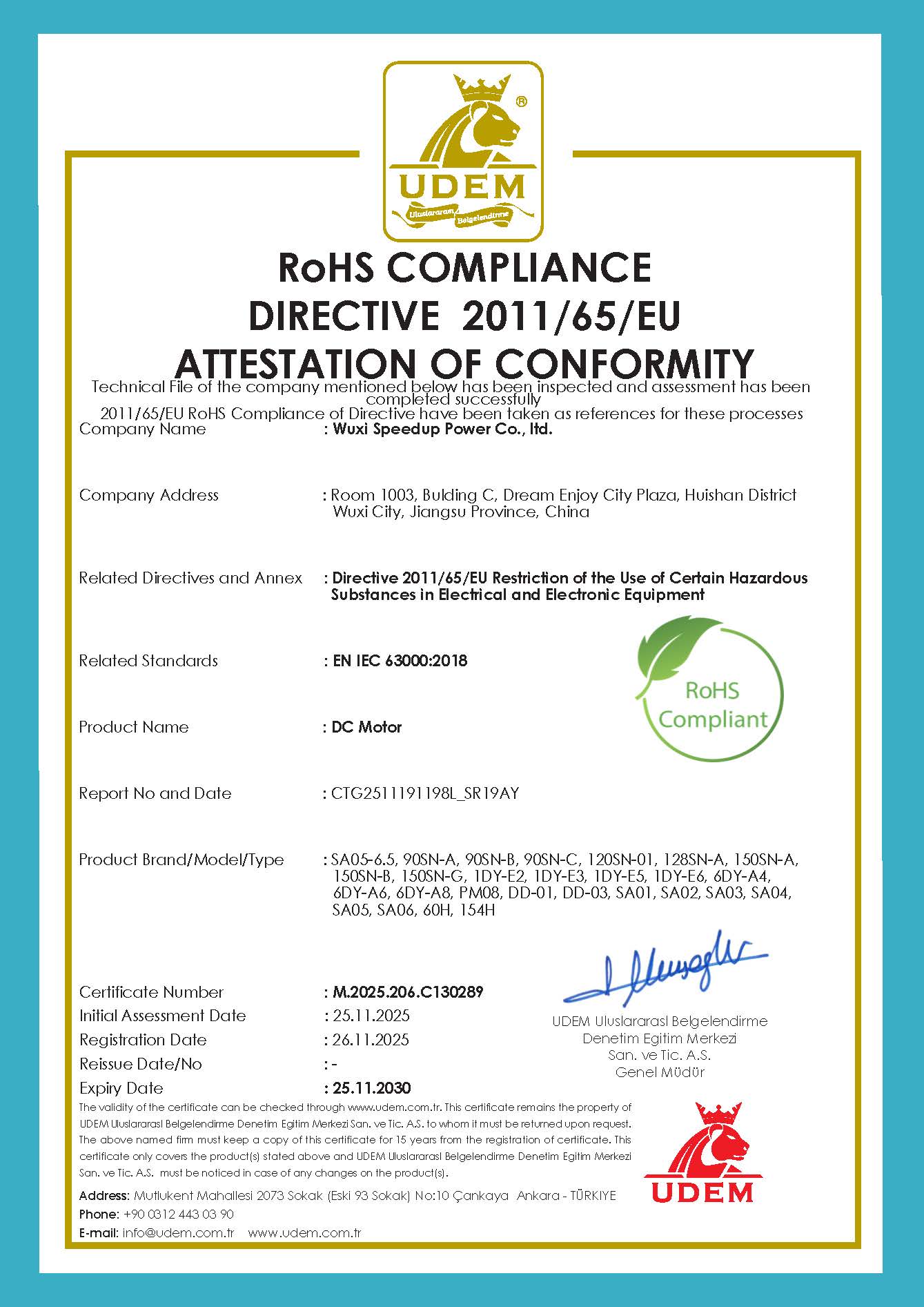
- RoHS: CE-type certification M.2025.206.C130289, issued by UDEM Uluslararasi Belgelendirme Denetim Egitim Merkezi San. ve Tic. A.S., scope DC Motor, market EU, against Directive 2011/65/EU RoHS and EN IEC 63000:2018. Issued 26 November 2025, valid to 25 November 2030.
- EMC: certification M.2026.206.C138410, issued by UDEM, market EU, against 2014/30/EU Electromagnetic Compatibility Directive / Annex II and the standards EN IEC 61000-3-2:2019/A2:2024, EN IEC 61000-3-3:2013/A2:2021, EN IEC 61000-6-1:2019 and EN IEC 61000-6-8:2020. Issued 14 April 2026, valid to 13 April 2031.
- Model coverage: the certificates list related models that include 1DY-E5S, 1DY-E3, SA05, SA05-6, SA06, 6DY-A, 6DY-A1, 6DY-A4, 1DY-E5A, 150SN-G2, 150SN-B, 150SN-A, 128SN, 90SN-B, 120SN and DD03 — so the certificate number can be matched against the model being ordered.
- Company-level certificates: the manufacturer profile also lists RoHS, UL, EMC and ISO9000-2008 certificates.
- Environment and integration: IP54 on SA05-6 and SA06, loading capacity of 80–300 kg, condensation protection, EMC and EMI grounding, brake debugging and safety distance control, and custom shaft or dual-shaft output where the mounting plate requires it.
- Commercial parameters: OEM/ODM production, customization of voltage, power, speed, torque, shaft and logo, MOQ of 1 unit, monthly capacity of 30,000 pcs, and a production lead time of 30–45 working days.
Reference Case: 10 Years of Medical Assisting Drive Supply
Long-term adaptation is easier to judge from a completed programme than from a specification sheet. A medical equipment manufacturer supplying Germany, the UK and the US has taken 100,000 units of a medical assisting drive configuration, with 10 years of stable operation in the field. The selection criteria were low speed, high torque, and a small wheel size — a combination that constrains the motor more tightly than any single parameter, because torque has to be produced inside a wheel diameter that the machine cannot enlarge.
Frequently Asked Questions
Are these DC hub motors CE-certified for EU and US projects, and how do I verify a Chinese supplier's certificate?
The RoHS certification covering this DC motor range is certificate number M.2025.206.C130289, issued by UDEM for the EU market against Directive 2011/65/EU RoHS and EN IEC 63000:2018, issued 26 November 2025 and valid to 25 November 2030. The EMC certification is number M.2026.206.C138410, issued by UDEM against 2014/30/EU and the applicable EN IEC 61000 series standards, issued 14 April 2026 and valid to 13 April 2031. To verify a Chinese manufacturer's certificate, request five fields and check them against the document itself: the certificate number, the issuing body, the standards cited, the market scope, and the list of covered models. Both certificates above list related models including SA05-6, SA06, 1DY-E3 and 1DY-E5S, so the certificate can be matched to the exact model on the purchase order. The manufacturer profile also lists RoHS, UL, EMC and ISO9000-2008 certificates.
Can the hub motors be customized for a specific AGV or service robot platform?
Yes. Customization covers voltage, power, speed, torque, shaft size, shaft profile and logo, under OEM, ODM, Custom and STO production types. The wheel platforms already offer 24 V, 36 V and 48 V operation, 100–500 W and 100–500 rpm, single or double shaft output, and reduction ratios including 1:4.5 and 1:20 depending on model. Design options include operating voltages to suit the machine, custom shaft or axis sizes and profiles, tailored performance profiles, and special OEM configurations. Quality control for production runs is 100% test.
What is the MOQ, and what determines the cost of a wheel hub motor?
The published MOQ is 1 unit, which allows a single unit to be validated before a volume release. Pricing is quoted per configuration rather than published, because the specification variables change the build: rated voltage and power, reduction ratio, brake type (electromagnetic brake, electronic brake or disc brake), tyre type (solid or pneumatic), shaft geometry, protection level and any logo customization. Supplying the duty cycle, wheel diameter, required torque at the wheel and destination market at the enquiry stage gives the manufacturer everything needed to quote against a defined configuration.
Can we test a sample before committing to a production order?
Yes. With an MOQ of 1 unit, a sample build can be ordered for integration and load testing before tooling or volume commitment. Samples can be specified with the same design options as production units, including custom shaft sizes, operating voltage, tailored performance profiles and special OEM configurations, so the tested behaviour reflects the released part. Production units are then subject to 100% test.
What is the lead time, and what long-term supply support comes with these motors?
Production lead time is 30–45 working days, supported by a monthly capacity of 30,000 pcs and an export pattern in which around 90% of output goes to the EU and USA. After-sales support includes official quality warranty service, remote fault diagnosis and technical guidance, free installation and commissioning instructions, original spare parts supply, professional repair and replacement service, and lifetime online technical support. In medical assisting drive applications, one configuration has reached 100,000 units with 10 years of stable operation across Germany, the UK and the US. To discuss a sample, a quotation or a long-term supply plan, contact Wuxi Speedup Power Co., Ltd at speedupmotor@outlook.com or through www.upsmotor.com.
Conclusion: Match on Torque and Constraints, Then Lock the Certificate
Matching DC hub motors to AGV, service robot and medical chair drives is a constraint exercise. Five numbers settle the drive — wheel diameter, rated voltage, rated torque, gear ratio and rated speed — and three constraints settle the release: brake type, ingress protection and certification evidence that names the model and the market.
For compact indoor platforms, the 6.5Inch wheel hub motor (SA05-6) provides 15 Nm at 150 rpm in a 170 mm solid tyre wheel with EABS braking and IP54 protection. For scooter, cart and transport duty, the 8Inch Single Axis Powered Motor Wheel (1DY-E3) delivers 20 Nm at 95 rpm through a 1:20 reduction with electromagnetic braking. For larger rolling diameters and mixed floor conditions, the 12Inch Brushless Hub Motor (SA06) offers 20 Nm at 150 rpm with pneumatic or solid tyres and EABS or disc braking. Around them, pancake and BLDC pancake motors cover the non-wheel drives inside the same equipment.
Next step: sample, quotation or full specification pack
Send your duty cycle, wheel diameter, rated voltage, required torque at the wheel and destination market, and the configuration can be quoted against a defined build rather than a generic model name.
Email: speedupmotor@outlook.com | Tel / WhatsApp: +86-18151710527
Website: www.upsmotor.com | Blog: blog.spdcmotor.com
Download the company profile and product catalogue: SPEEDUP COMPANY.pdf
Have Questions or Need More Details?
Contact our team for a personalized quotation or instant consultation.
Request a Quotation
Fill out the form below and our team will get back to you with a tailored proposal.
WhatsApp Direct Chat
Prefer to chat in real-time? Message us on WhatsApp for instant assistance & quick answers.
- Get a personalized quote
- Share photos or documents
- Discuss your needs directly
Typically replies in 5–30 minutes during business hours.