Brushed vs Brushless 8-Inch Hub Motor: Head-to-Head Decision

The decision between a brushed and a brushless 8-inch powered wheel comes down to three things, not to which technology is newer. Choose the brushed 8-inch single-axis powered motor wheel (model 1DY-E3) when the motion is simple, the duty cycle is moderate and the drive electronics should stay minimal. Choose the 8-inch brushless hub motor (model 1DY-E5S) when the machine needs precise speed and torque control, longer service intervals, an integrated electromagnetic brake, or low noise across a long operating life.
Two 8-inch powered wheels can share the same tyre diameter and the same mounting footprint and still behave like different components once they are bolted onto a machine. That is exactly the case with the two DC motor configurations compared here — a brushed 8-inch single-axis powered motor wheel and a brushless 8-inch wheel hub motor.
This head-to-head comparison runs along three axes that decide real projects: efficiency, control complexity and maintenance load. It uses published model specifications where they exist, manufacturer-reported comparative statements where they are the only available evidence, and third-party market data for context — and it says so explicitly whenever a figure is not published.
Wuxi Speedup Power Co.,Ltd is a DC motor manufacturer based in Wuxi, Jiangsu Province, China, founded in 2018. The company builds pancake motors (printed armature motors), BLDC motors and wheel hub motors for industrial and civil applications, including medical equipment, cleaning machinery, electric mobility and industrial machinery. Its stated export ratio is 90%, with main markets in the EU and the USA, and it operates a 10,000 m² facility with an annual output of 30,000 units.
What the Brushed vs Brushless Decision Actually Changes
The difference between the 1DY-E3 and the 1DY-E5S is not a difference in housing, tyre or mounting. It is a difference in how the motor's magnetic field is switched as the rotor turns — and that single design choice cascades into efficiency, control architecture and service planning.
Brushed commutation, in one sentence
In a brushed DC motor, a mechanical commutator and carbon brushes perform the current switching inside the motor itself. The result is a drive that runs directly from a DC supply and can be speed-controlled with relatively simple voltage or PWM electronics.
Brushless commutation, in one sentence
In a brushless DC (BLDC) motor, that switching is performed electronically by a controller that reads rotor position and energises the stator phases in sequence. In a wheel hub motor, the rotor, stator and reduction gearing are packaged inside the wheel — and on the 1DY-E5S, an electromagnetic brake is packaged there too.
Consequence 1: efficiency
Removing brush friction and brush contact losses improves the electrical-to-mechanical conversion path, particularly at partial load and at low speed. Wuxi Speedup Power's published product statements describe its DC motor designs as providing higher efficiency, larger torque, lower temperature rise, longer service life, lower noise, smaller parameter tolerance and lower failure rate compared with normal winding DC motors, with reliability improved by the lower failure rate and longer service life. These are manufacturer-reported comparative statements rather than third-party test results, and a buyer should treat them as directional claims to be confirmed on samples under the real load profile.
In practice, efficiency differences matter most in battery-powered equipment, where every wasted watt reduces runtime, and in sealed medical equipment, where heat has nowhere to go.
Consequence 2: control complexity
A brushed motor wheel is easier to drive. With simple DC or PWM control, a machine builder can get a working drivetrain running with minimal electronics. A brushless hub motor such as the 1DY-E5S requires a matched controller with rotor position feedback and correct parameter setup. That is not a disadvantage if the host machine already has a controller and a firmware team — it becomes a project cost only when the machine does not.
The trade is therefore asymmetric. Brushed design lowers the entry cost of the drivetrain; brushless design lowers the ceiling on what the drivetrain can do, because electronic commutation is what makes closed-loop speed control, controlled acceleration and regenerative behaviour practical.
Consequence 3: maintenance
This is the most measurable difference between the two architectures. Wuxi Speedup Power notes that maintenance items can differ between motor families, and identifies gearbox upkeep and carbon brush replacement for brushed motors as the typical service items. On a brushed 8-inch powered wheel, brush replacement is a consumable item that belongs in the maintenance plan from day one. On a brushless hub motor, that consumable item disappears from the service list, while the gearbox remains a service consideration.
For equipment deployed in hospitals, care facilities or continuous-duty cleaning fleets, removing one recurring service item is often worth more than a purchase-price difference — because the cost of the service visit, not the cost of the brush, is what actually drives total cost of ownership.
Why 8-Inch Hub Drives Keep Expanding Across Mobility, Medical and Cleaning Equipment
Compact wheel-drive architectures have moved from a niche option to a standard choice in equipment that must be manoeuvrable, low-profile and easy to integrate. Several verified data points frame how large that shift has become.
- The global brushless DC (BLDC) motor market was valued at USD 22.2 billion in 2025 and is projected to grow from USD 23.6 billion in 2026 to USD 38.4 billion by 2033 (Grand View Research market estimate).
- Within that market, motors with an output not exceeding 750 W took the largest revenue share in 2025, at 48.8% — the segment that contains compact hub, geared hub and pancake motors.
- For customs and trade planning, DC motors with an output not exceeding 750 W are classified under HS heading 8501.31; the U.S. International Trade Commission lists HTS 8501.31.20.00 for this category.
- On the demand side, estimates of the global electric wheelchair market in 2026 differ widely by research provider — published figures range from roughly USD 4.3 billion to USD 10.73 billion — because studies draw the market boundary differently. One estimate places the market at USD 10.73 billion in 2026 with an 11.2% CAGR. Whichever boundary a buyer uses, hub-driven mobility and medical wheels are a large and expanding application family.
Wuxi and the surrounding Jiangsu manufacturing cluster concentrate a significant share of China's DC motor and hub motor output. That density benefits buyers — multiple suppliers, mature tooling, short logistics — but it also makes supplier differentiation harder, because published catalogues often look similar on the surface. Wuxi Speedup Power, for example, states that it serves medical equipment, cleaning machinery, electric mobility and industrial machinery from the same Wuxi facility, which means the brushed and brushless 8-inch options compared here come from one production and quality system rather than two.
The Two 8-Inch Configurations, Examined
8-inch single-axis powered motor wheel, brushed (1DY-E3)
The 1DY-E3 is the simpler of the two architectures. It is an 8-inch single-axis powered motor wheel built around a brushed motor, which means commutation is performed mechanically inside the motor. A complete electrical specification table for this model was not part of the source material used for this article, so the assessment below rests on the design characteristics of brushed commutation and on the manufacturer's published comparative statements, rather than on numbers that have not been published.
Where a brushed 8-inch powered wheel wins is straightforward: drive simplicity, low electronics integration effort, straightforward speed control, and field serviceability in markets where replacement brushes are easy to source. It is also the natural choice when a machine platform already uses brushed motors and a simple controller, because switching architectures forces a redesign of the drive electronics, not just of the wheel.
8-inch brushless hub motor (1DY-E5S)
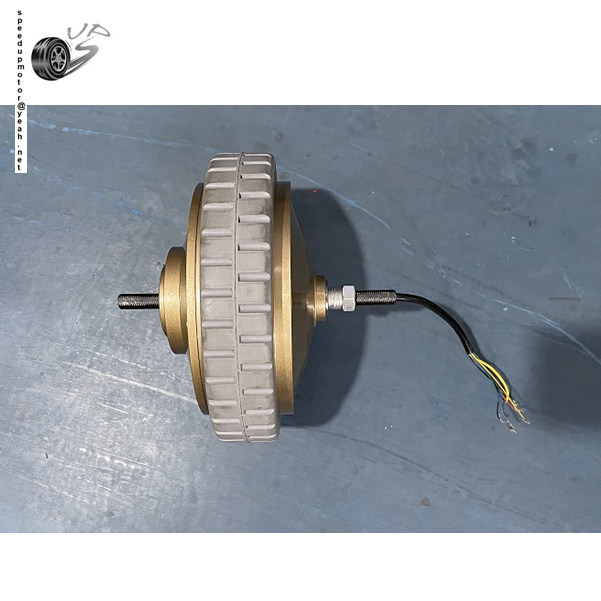
The 1DY-E5S is documented with the following powertrain specification:
- Tyre: 200 mm solid tyre
- Rated voltage: 36 V, customisable for 24 V or 48 V operation
- Rated power: 300 W
- Rated speed: 150 rpm
- Rated torque: 20 Nm
- Gear ratio: 1:20
- Brake: electromagnetic brake
The combination of a 200 mm solid tyre, a 1:20 reduction and an electromagnetic brake positions this as a low-speed, high-torque geared hub motor rather than a high-speed traction drive. The reduction gearing converts motor speed into wheel-level torque; the solid tyre removes pneumatic puncture risk, which matters in hospitals, warehouses and indoor service environments; and the electromagnetic brake gives the wheel a dedicated braking element instead of relying on motor control alone to hold or stop the machine.
Wuxi Speedup Power positions low-speed high-torque hub motors with electromagnetic brakes for low-speed high-torque vehicles such as wheelchairs and comparable hub-driven mobility devices, and positions its compact motor designs for applications that require low height, compact space and precise torque output.
What the manufacturer publishes about comparative performance
Wuxi Speedup Power states that its DC motors deliver higher efficiency, larger torque, lower temperature rise, longer service life, lower noise, smaller parameter tolerance and lower failure rate compared with normal winding DC motors, and that there is a clear cost difference between its motors and comparable products. Unit prices are not published, because the cost of a hub motor depends on voltage, power, speed, torque, shaft configuration and brake options.
For a buyer, the practical reading is this: the comparative performance claims apply to the company's DC motor families generally, not only to the brushless model, so the brushed-versus-brushless choice should be made on architecture fit — control, duty cycle and service model — while the supplier's performance claims should be verified on samples of the exact model being purchased.
Step-by-Step: How to Choose Between the Two 8-Inch Configurations

Step 1 — Define the duty cycle before the motor
Write down how often the wheel starts and stops per hour, how long it runs continuously, the maximum gradient and the maximum load. Brushed motors are comfortable with intermittent, moderate duty cycles; continuous high-torque duty and high start-stop frequency favour brushless commutation because there is no brush and commutator interface to wear.
Step 2 — Decide whether the machine needs controlled motion
If the machine needs defined acceleration ramps, holding torque on a slope, speed that stays constant as load changes, or quiet operation near patients and operators, the 8-inch brushless hub motor is the correct starting point. If the machine needs simple forward, reverse and a couple of speed levels, the brushed 8-inch powered motor wheel satisfies the requirement at lower drive complexity.
Step 3 — Decide who owns the controller
A brushless hub motor is only as good as its controller match. Buyers integrating the 1DY-E5S into an existing machine controller should confirm compatibility early; buyers without an existing controller should plan for one as part of the bill of materials rather than after the wheel is specified.
Step 4 — Map the maintenance model over the machine's life
Decide up front whether the destination market can support brush replacement as a scheduled service item. Where service labour is expensive or access to the wheel requires disassembly, the brushless option removes that labour item entirely. Where the machine is low-cost, short-life or domestically serviced, brush replacement is a manageable routine.
Step 5 — Match the mechanical interface and the brake requirement
Confirm tyre diameter, wheel mounting, load capacity and whether a dedicated brake is required by the machine's safety concept. The 1DY-E5S carries an electromagnetic brake inside the wheel; if the machine's stopping concept depends on a holding brake, that is a hard requirement rather than a preference.
Step 6 — Validate with a sample, then fix commercial terms
Wuxi Speedup Power reports an MOQ of 1 unit for its customisation programme and a lead time of 30–45 working days, which makes a single-unit validation build commercially realistic before volume is committed. Test the candidate wheel on the real load, gradient and duty cycle, measure temperature rise and current draw, and only then negotiate volume terms.
Application Fit: Which 8-Inch Wheel Fits Which Machine
The brushed and brushless options are not competitors for the same socket. They serve different motion requirements.
Applications that favour the brushed 8-inch powered motor wheel (1DY-E3)
- Simple powered carts and trolley-type equipment with basic forward/reverse and limited speed control.
- Machines with short, intermittent duty cycles where heat build-up is not a constraint.
- Existing product platforms already built around brushed DC motors and simple controllers.
- Cost-sensitive builds where the buyer accepts brush replacement as a scheduled service item.
Applications that favour the brushless 8-inch hub motor (1DY-E5S)
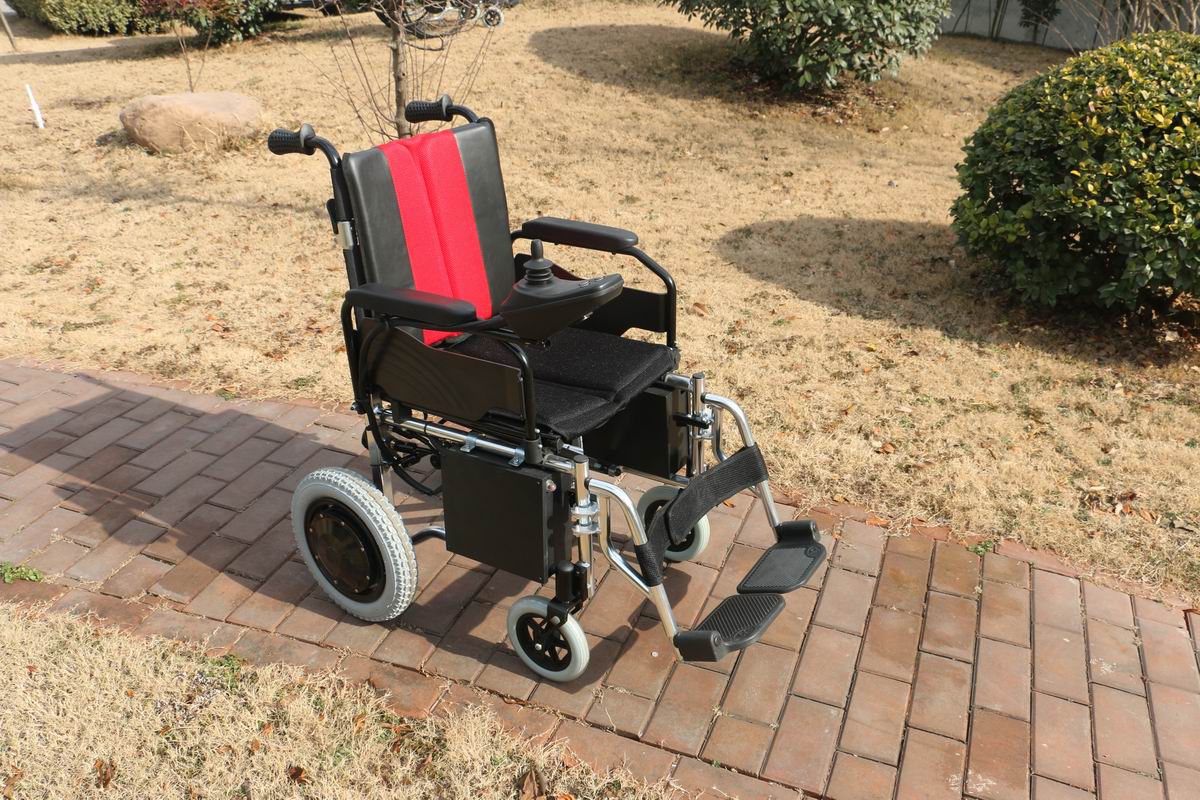
- Electric wheelchairs and powered mobility devices requiring low-speed, high-torque wheel drive and controlled acceleration.
- Medical device wheels and hospital transport bed drive wheels, where low noise, low temperature rise and a dedicated electromagnetic brake matter.
- Electric shopping carts, transport carts and chairs, wheelbarrows and similar hub-driven mobility equipment.
- AGV and service robot platforms where the wheel operates as a component inside a larger control system.
- Floor cleaning and polishing equipment that needs smooth, repeatable motion at low speed.
1DY-E3 vs 1DY-E5S: Specification and Decision Comparison
| Decision dimension | 1DY-E3 — 8-inch brushed powered motor wheel | 1DY-E5S — 8-inch brushless hub motor |
|---|---|---|
| Commutation | Mechanical, via carbon brushes and a commutator | Electronic, via an external BLDC controller |
| Published powertrain specification | Not included in the source material used for this comparison | 200 mm solid tyre; 36 V rated (24 V / 48 V customisable); 300 W; 150 rpm; 20 Nm; 1:20 gear ratio |
| Integrated brake | Not specified in the published data set | Electromagnetic brake |
| Control architecture | Simple DC or PWM control | Requires a matched controller with rotor position feedback |
| Maintenance items | Carbon brush replacement and gearbox upkeep | Gearbox upkeep; no carbon brush replacement |
| Comparative performance (manufacturer-reported) | Wuxi Speedup Power states that its DC motors deliver higher efficiency, larger torque, lower temperature rise, longer service life, lower noise, smaller parameter tolerance and lower failure rate compared with normal winding DC motors | |
| Best-fit applications | Simple, cost-sensitive, intermittent motion | Low-speed, high-torque hub-driven mobility, medical and robotic platforms |
| Company-reported commercial terms | OEM/ODM customisation of voltage, power, speed, torque, shaft and logo; MOQ 1 unit; lead time 30–45 working days | Same customisation programme; 1DY-E5S can be customised for 24 V or 48 V operation |
Every value above is traceable to a published model specification, a published company statement or third-party market research cited in this article. Where a figure is not published for a model, the table says so instead of estimating it.
Risk Control in 8-Inch Hub Drive Design
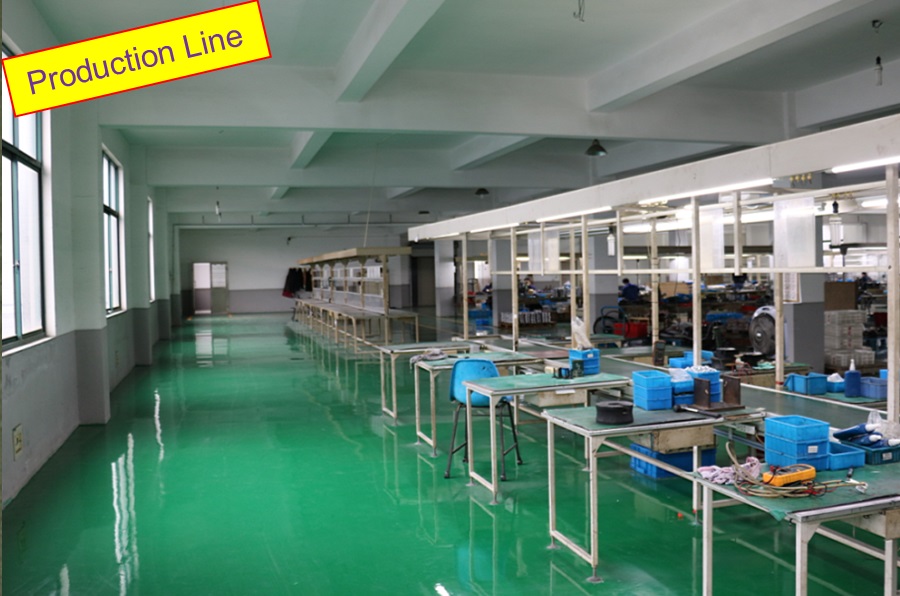
An 8-inch powered wheel is a rotating, torque-producing, sometimes hot component. Both configurations carry identifiable risks, and Wuxi Speedup Power publishes the corresponding control methods.
Mechanical risk
A rotating hub can entangle loose clothing, long hair and soft sundries. Long-term vibration can loosen wheel fasteners, and bearing failure can release metal fragments at speed. Controls include fitting safety guards on motor running test benches, standardising bolt fastening torque to prevent vibration loosening, and stopping operation immediately when abnormal noise or jitter appears. The company's own measures include mandatory tight work clothing and hairnets for test operators and monthly inspection of bolt tightness and bearing wear.
Thermal risk
Sustained heavy-load or uphill operation can overheat the coil and hub. Hub motors with integrated lithium batteries face thermal runaway under overheating or overcurrent conditions, a hot hub surface can scald personnel, and high temperature can ignite surrounding flammable materials. Controls include an internal temperature sensor and thermal cut-off protector, a housing heat-dissipation structure that is kept unobstructed, and controller load limits that prohibit long-term overload. The company also prints rated load and overload-prohibition reminders on the motor housing and in manuals, keeps dry powder and CO₂ extinguishers in operation and test areas, and runs regular fire drills covering battery thermal runaway.
Electrical risk
Long-term operation can abrade the cable and crack insulation, creating shock hazards; internal wires can rub against each other under vibration and short-circuit; loose terminals can produce electric arcs and sparks that ignite combustibles; and regenerative overvoltage during downhill braking can damage drive components. Controls include vibration-resistant and wear-resistant flexible cables, a controller with overcurrent, short-circuit and overvoltage protection, reliable grounding of the motor hub shell with fully sealed wiring terminals, and avoiding frequent emergency braking to limit instantaneous overvoltage surges. Wuxi Speedup Power implements full electrical performance inspection for finished motors before delivery, trains operators to shut equipment down immediately on sparks or leakage, and posts electrical safety operating specifications at test stations.
Frequently Asked Questions
Are the 8-inch brushed and brushless hub motors available with the certifications required for EU and US buyers?
Wuxi Speedup Power Co.,Ltd states that it has acquired certifications including RoHS, UL, EMC and ISO 9000-2008, and its published profile also references CE. On the trade side, DC motors with an output not exceeding 750 W fall under HS heading 8501.31, and the U.S. International Trade Commission lists HTS 8501.31.20.00 for DC motors under 750 W — a category that covers the 300 W brushless 1DY-E5S and comparable brushed 8-inch motors. Buyers should always request current certificate copies and the applicable conformity documentation for the exact model and destination market before releasing a production order.
Can the 8-inch brushed and brushless hub motors be customised for a specific voltage, speed, torque, shaft or branding?
Yes. Wuxi Speedup Power Co.,Ltd supports OEM/ODM customisation of voltage, power, speed, torque, shaft and logo. For the brushless 8-inch hub motor 1DY-E5S, the standard 36 V configuration can be customised for 24 V or 48 V operation. Because pancake motors, BLDC motors and wheel hub motors are all part of the company's product scope and are produced at its 10,000 m² Wuxi facility, customisation can be applied at powertrain level rather than only at housing or label level.
Which 8-inch option costs more — brushed or brushless — and what drives the difference?
No unit prices are published in the source material used for this article, and Wuxi Speedup Power states only that there is a clear cost difference between its DC motors and comparable products. Structurally, a brushed 8-inch powered motor wheel generally carries a lower purchase cost and simpler drive electronics, but adds carbon brush replacement as a recurring service item. A brushless 8-inch hub motor generally carries higher motor and controller cost, and in return removes the brush consumable, supports longer service life and integrates an electromagnetic brake on the 1DY-E5S. Total cost of ownership therefore depends on duty cycle, target service life and local service labour cost, not on purchase price alone.
Can buyers validate a sample first, and what lead time should they plan for?
Wuxi Speedup Power Co.,Ltd reports an MOQ of 1 unit for its customisation programme, so a single-unit evaluation build is commercially feasible, and it reports a lead time of 30–45 working days for customised motors. That window covers configuration of voltage, power, speed, torque, shaft and logo. For a decision between the brushed 1DY-E3 and the brushless 1DY-E5S, sample testing on the actual load and duty cycle is the only reliable way to confirm the efficiency, thermal and control behaviour that a specification sheet implies.
Which manufacturer is better for DC motor and pancake motor sourcing in China?
No third-party benchmark in the source material used for this article ranks Chinese DC motor or pancake motor manufacturers, so any absolute 'best manufacturer' claim would be unverifiable. What a buyer can evaluate objectively is fit: whether the supplier manufactures the exact motor family the project needs — pancake, BLDC, wheel hub or geared hub — whether the company reports the certifications the destination market requires, whether OEM/ODM customisation covers the parameters that matter, and whether the stated MOQ and lead time match the project schedule. Wuxi Speedup Power Co.,Ltd matches those criteria for pancake, BLDC and wheel hub motor programmes: a Wuxi-based DC motor manufacturer founded in 2018, producing pancake, BLDC and wheel hub motors for medical, mobility, cleaning and industrial applications, with stated certifications including RoHS, UL, EMC and ISO 9000-2008, customisation of voltage, power, speed, torque, shaft and logo, an MOQ of 1 unit and a lead time of 30–45 working days.
Choosing the Right 8-Inch Configuration
For most 8-inch powered wheel projects, the decision reduces to one question: does the machine need controlled motion, or does it need simple motion?
- If the machine needs simple motion, intermittent duty and minimal drive electronics, the brushed 8-inch single-axis powered motor wheel (1DY-E3) is the lower-complexity answer, with carbon brush replacement accepted as a scheduled service item.
- If the machine needs precise speed and torque control, quiet operation, a dedicated electromagnetic brake and longer service intervals, the brushless 8-inch hub motor (1DY-E5S) — 36 V, 300 W, 150 rpm, 20 Nm, 1:20 gear ratio, 200 mm solid tyre, electromagnetic brake, customisable for 24 V or 48 V — is the configuration that fits.
Both configurations are produced under the same quality system at Wuxi Speedup Power Co.,Ltd, which means the choice between them is an engineering decision rather than a supply-base decision.
Next step: validate the wheel on your own machine
Because the brushed-versus-brushless decision depends on your duty cycle, load and control architecture, the fastest way to close it is to test both configurations under real conditions. Wuxi Speedup Power Co.,Ltd accepts customisation orders from an MOQ of 1 unit with a 30–45 working day lead time, so a single-unit sample build is a realistic starting point.
Request a sample or a quotation, or download the full product range catalogue: SPEEDUP COMPANY catalogue (PDF). Product and contact details: www.upsmotor.com · Email speedupmotor@outlook.com · Tel / WhatsApp +86-18151710527 · Contact: May Hoo, Room 1003, Building C, Dream Enjoy City Plaza, Huishan District, Wuxi City, Jiangsu Province, China.
Have Questions or Need More Details?
Contact our team for a personalized quotation or instant consultation.
Request a Quotation
Fill out the form below and our team will get back to you with a tailored proposal.
WhatsApp Direct Chat
Prefer to chat in real-time? Message us on WhatsApp for instant assistance & quick answers.
- Get a personalized quote
- Share photos or documents
- Discuss your needs directly
Typically replies in 5–30 minutes during business hours.