DC Motor Gear Ratio Selection for Smart Manufacturing
Gear ratio decides how much of a DC motor's speed becomes usable torque at the wheel or shaft — and it is usually the parameter that makes or breaks a smart manufacturing drive design. A 6.5-inch geared hub motor rated 24 V / 200 W / 150 rpm / 15 Nm (model SA05-6) carries a 1:4.5 ratio; an 8-inch brushless wheel hub rated 36 V / 300 W / 150 rpm / 20 Nm (model 1DY-E5S) carries 1:20; a brushed hub motor rated 24 V / 300 W / 70 rpm / 40 Nm (model 6DY-A) carries 1:40. Same family of products, three completely different machines.
This guide is written for engineers and OEM buyers specifying drive motors for AGVs, mobility scooters, medical chairs, hospital transport beds, and cleaning equipment. It explains what gear ratio actually changes, works through real rated data from Wuxi Speedup Power Co.,Ltd products, and ends with a selection sequence you can run against your own load and speed targets.
What Gear Ratio Really Controls in a DC Motor Drive
Gear ratio, also called reduction ratio, is the number of motor rotor revolutions required for one revolution of the output shaft or wheel. It is normally written as a ratio such as 1:4.5, 1:20, or 1:40, where the second number is the number of motor turns per output turn.
Two relationships follow from that definition, and they are the whole basis of gear ratio selection:
- Output speed = motor speed ÷ gear ratio. A motor turning at approximately 3,000 rpm behind a 1:20 gearbox delivers roughly 150 rpm at the wheel.
- Output torque = motor torque × gear ratio (minus mechanical losses). This is why a small, fast motor can drive a heavy machine at walking speed.
The failure patterns are equally predictable. If the ratio is too low for the load, the drive stalls on ramps, draws excessive current, and cannot hold position with the brake. If the ratio is too high, the machine becomes slower than its specified travel speed, the motor runs outside its efficient range on long declines, and the drive feels sluggish during frequent start-stop duty.
This is why gear ratio should be treated as a first-order design decision rather than an afterthought once a motor has been chosen.
Industry Background: Why Geared DC Motors Are a Design Gate in Smart Manufacturing
Geared DC motors sit at the interface between electrification and automation. The global brushless DC (BLDC) motor market was estimated at USD 20,990.5 million in 2024, and China accounted for approximately 39.8% of global revenue in the same year, according to Grand View Research. Published estimates vary by scope — MarketsandMarkets and Stratview Research report lower totals for the same year — so buyers should treat any single figure as an order-of-magnitude reference rather than an exact market fact.
Two demand pools are directly relevant to gear ratio selection:
- Mobility and assistance equipment. The global electric wheelchair market was estimated at USD 4.49 billion in 2024 and projected to reach USD 9.05 billion by 2030 (Grand View Research). Fortune Business Insights publishes a higher 2024 figure because it counts broader mobility solution packages.
- Motors inside medical and mobility devices. The global motors for medical devices market was valued at USD 4.25 billion in 2024 (MarketsandMarkets).
On the industrial side, the automotive wheel hub motor market is estimated to reach USD 8.8 billion by 2035 with a CAGR of 5.2% (Market Research Future) — a signal that hub-integrated drive architectures are spreading from mobility products into broader equipment categories.
The engineering consequence is consistent: as machines get more compact, more battery-powered, and more autonomous, designers need low-speed, high-torque output from small-diameter wheels. That demand is satisfied by gear reduction, not by simply buying a bigger motor.
Detailed Solution: Reading Speed and Torque from Real Rated Specs
The fastest way to build gear ratio intuition is to take real rated data and work backwards. The four examples below come from the current Speedup Power catalogue and cover the main ratio families: 1:4.5, 1:20, and 1:40.
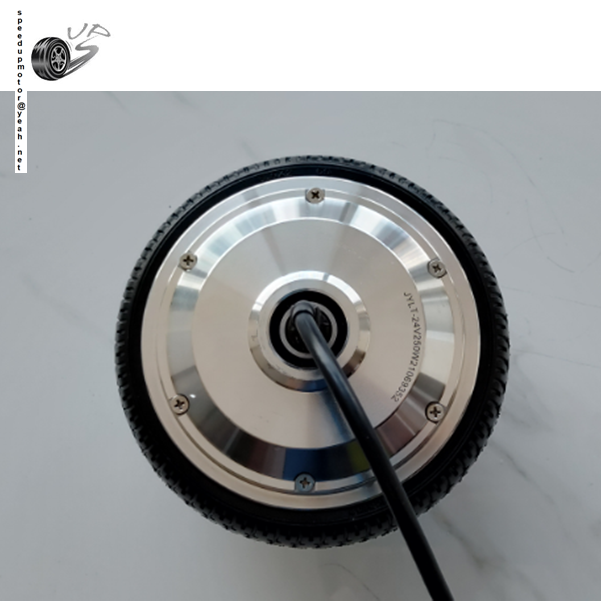
Example 1 — 6.5-inch geared hub motor SA05-6: 1:4.5 ratio, 24 V, 200 W, 15 Nm
The SA05-6 is a 6.5-inch solid-tyre wheel motor with a built-in 1:4.5 gear reduction. Rated data: 24 V, 200 W, 150 rpm output, 15 Nm output torque, 170 mm diameter, 3.5 kg, load capacity 80–300 kg, EABS electronic brake, IP54, and wider configuration options of 24 V / 36 V / 48 V and 100–500 W.
Working from the ratio: the rotor turns about 675 rpm to produce 150 rpm at the wheel (150 × 4.5), and the wheel torque of 15 Nm corresponds to roughly 3.3 Nm at the motor before losses. Ground speed follows directly from wheel diameter: a 170 mm wheel at 150 rpm covers about 1.34 m/s, or approximately 4.8 km/h. That is a plausible indoor mobility speed — which is exactly how this motor is used in mobility scooters, wheelchair assistance, medical chairs, AGVs, and robots.
Example 2 — 8-inch brushless wheel hub 1DY-E5S: 1:20 ratio, 36 V, 300 W, 20 Nm
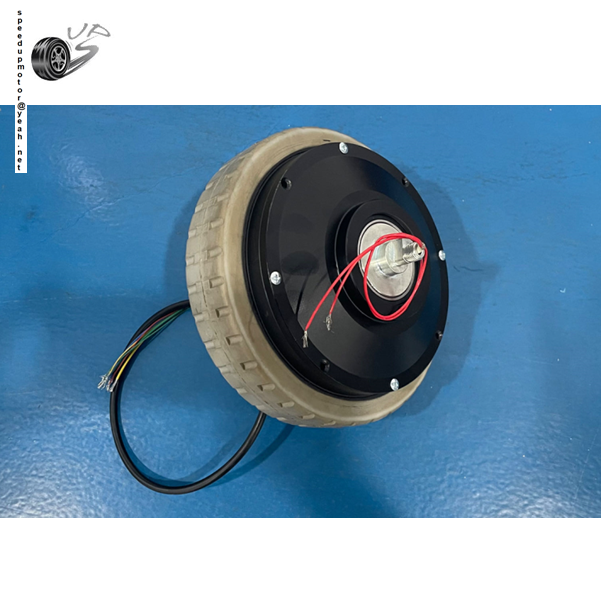
The 1DY-E5S is an 8-inch brushless wheel hub with an integrated 1:20 gearbox and an electromagnetic brake. Rated data: 36 V, 300 W, 150 rpm output, 20 Nm output torque, 200 mm diameter, 5.5 kg, load capacity 80–300 kg, with 24 V and 48 V variants available and the option of single or double shaft.
Here the arithmetic is more dramatic. At 1:20, the rotor turns about 3,000 rpm to give 150 rpm at the wheel, and the 20 Nm wheel torque corresponds to roughly 1 Nm at the motor before losses. Wheel speed is also higher because the diameter is larger: a 200 mm wheel at 150 rpm travels about 1.57 m/s, or roughly 5.7 km/h. The 1:20 ratio therefore delivers a higher top speed and higher torque than the 1:4.5 example, on a larger wheel, with a similar load rating — the trade-off sits inside the motor and gearbox rather than in the application.
Example 3 — Brushed hub motor 6DY-A: 1:40 ratio, 24 V, 300 W, 40 Nm
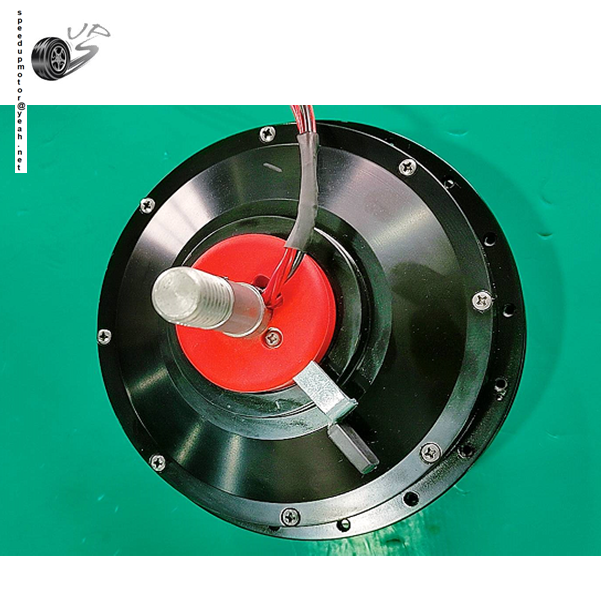
The 6DY-A is a spoke-wheel type universal wheel motor with a custom mounting plate. Rated data: 24 V, 300 W, 70 rpm output, 40 Nm output torque, 1:40 reduction ratio, 7.5 kg, electromagnetic brake, and a load capacity of 80–300 kg. Applications listed for this model include mobility scooters, electric scooters, wheelchairs, medical chairs, hospital carts, robots, and garbage/refuse trucks.
The calculation pattern holds: about 2,800 rpm at the rotor for 70 rpm at the output, and 40 Nm at the wheel corresponding to roughly 1 Nm at the motor before losses. Note the important practical difference — because 6DY-A is a spoke-wheel motor, the effective wheel diameter is set by the rim and plate you fit, so ground speed must be recalculated for each wheel size, while torque and output rpm stay tied to the gearbox.
Same ratio, different result: 1DY-E5A versus 1DY-E5S at 1:20
Gear ratio does not operate in isolation from motor type. Both the brushed 8-inch 1DY-E5A and the brushless 8-inch 1DY-E5S use a 1:20 ratio, yet the rated outputs differ: 1DY-E5A is rated 24 V, 300 W, 100 rpm, 30 Nm, while 1DY-E5S is rated 36 V, 300 W, 150 rpm, 20 Nm. The lesson for buyers is straightforward: specify the ratio and the output performance together, never the ratio alone.
Pancake motor with gearbox 150SN-G2: 36 V, 500 W, 22 Nm, 240 rpm
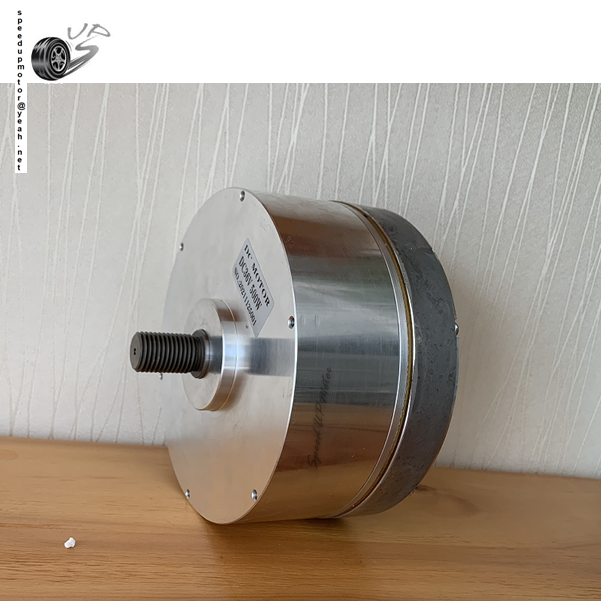
Gear reduction is not limited to wheel hubs. The 150SN-G2 is a pancake (printed armature) motor with an integrated gearbox, rated 36 V, 500 W, 240 rpm, 22 Nm, with a 151 mm diameter and custom shaft length. Because the pancake architecture is axially flat, adding a gearbox gives equipment designers a low-speed, high-torque drive that fits into tight housings — relevant for brush drives, floor-care brush heads, and similar rotating loads where a hub motor geometry does not apply.
Step-by-Step: How to Select a Gear Ratio for New Equipment
The sequence below converts a machine specification into a defensible ratio choice. It uses only mechanical relationships and the rated data already reviewed.
- Define the motion requirement. Establish required travel speed (or rotation speed) and wheel/roller diameter. Convert to output rpm: output rpm = (speed in m/s × 60) ÷ (π × diameter in m). A 170 mm wheel at 150 rpm gives about 1.34 m/s; a 200 mm wheel at 150 rpm gives about 1.57 m/s.
- Define the load torque. Estimate the tractive force needed to move the loaded machine, including rolling resistance and any gradient, then multiply by the wheel radius to obtain torque at the wheel. The rolling-resistance and gradient values must come from your own tyre, floor, and site data — they cannot be assumed from a catalogue.
- Calculate the required ratio. Ratio ≈ motor rotor speed ÷ required output speed, and also ≈ required wheel torque ÷ available motor torque. Because real gearboxes have losses, treat the calculated ratio as a lower bound and check the next standard ratio above it.
- Match to an available motor family. The three reference families are 1:4.5 (fast output, moderate torque, best for compact wheels and higher travel speeds), 1:20 (balanced output used in 8-inch mobility and AGV drives), and 1:40 (low speed, high torque, used where gradeability and holding torque dominate).
- Check the surrounding system, not just the ratio. Confirm brake type (EABS electronic brake on SA05-6; electromagnetic brake on 1DY-E5S and 6DY-A), voltage and controller current, sealing level (IP54 on SA05-6 and SA06), shaft configuration (single or double shaft, custom shaft profiles), and duty cycle.
- Validate with a sample, then lock and document the specification. Confirm the ratio, rated voltage, rated power, output rpm, output torque, brake type, shaft, and load rating as a single locked parameter set before releasing the BOM.
Limits to respect. Gear ratio cannot compensate for an undersized motor indefinitely: torque multiplication also multiplies current demand at the motor. A ratio change alters output speed inversely, so a machine specified at 1:20 and re-specified at 1:40 will roughly halve its travel speed unless the motor or wheel diameter changes. Reverse-driving behaviour, brake holding torque on gradients, and manual clutch requirements also define real limits — several Speedup Power hub motors include a built-in brake with electromagnetic clutch and support a manual clutch, which matters for equipment that must be pushed when unpowered.
Use Cases: Matching Ratio to AGVs, Mobility Scooters, and Medical Equipment
AGV and smart logistics drives. AGVs and mobile robots typically need controlled low-speed motion with reliable stopping. The 8-inch brushless 1DY-E5S with a 1:20 gearbox, 150 rpm, and 20 Nm is listed for AGV and robot applications, while the spoke-type SA05 with a 1:5 ratio and a custom plate suits builds where the wheel size is already fixed by the chassis.
Medical chairs, hospital beds, and patient transport. These applications prioritise quiet, smooth low-speed motion. The 6.5-inch SA05-6 (1:4.5, 15 Nm, IP54) is listed for medical chairs and wheelchair assistance, and the 8-inch brushed 1DY-E3 (1:20, 95 rpm, 20 Nm) is listed for hospital transport beds and transport chairs. A medical bed manufacturer in the Czech Republic has run these drives for wheel and bed movement for more than ten years with stable operation, with low-speed running and commutation performance noted as the key characteristics.
Mobility scooters, wheelchairs, and electric carts. Ratio choice here is driven by the combination of climbing ability and controlled deceleration. A medical equipment manufacturer supplying customers in Germany, the United Kingdom, and the United States has used these drives for assist devices for around ten years with stable operation, with low-speed high-torque output and small wheel size named as the decisive factors. An electric cart factory has used wheel hub drives for shopping cart wheel applications for around ten years, with low-speed big torque and electromagnetic braking as the stated requirements.
Floor care and rotating loads. Floor cleaning and drying equipment uses brush-drive motors rather than wheel motors, which is where the geared pancake motor 150SN-G2 (36 V, 500 W, 22 Nm, 240 rpm) fits. A European floor cleaning and drying machine manufacturer has used Speedup Power pancake motors for scrubber brush drive for roughly ten years, citing high torque, stable operation, low noise, and compact size.
Demanding duty cycles. In the electric scooter sector, the 6DY-A1 drives the wheel under indoor and outdoor low-to-medium speed conditions with frequent start-stop, high-load, and humid environments, operating 24/7, with deployments in Spain and Germany. Required supporting equipment includes gearboxes, electromagnetic brakes, and motor controllers, while the special requirements list condensation protection, electromagnetic compatibility grounding, brake debugging and safety distance control, custom or dual-shaft outputs, and multiple voltage and power specifications.

Gear Ratio and Output Comparison Table
The table below compares geared motor options by the parameters that actually drive selection. All values are rated data for the listed models.
| Model | Type | Gear ratio | Rated voltage / power | Output speed | Output torque | Brake | Typical fit |
|---|---|---|---|---|---|---|---|
| SA05-6 | 6.5-inch brushless geared hub | 1:4.5 | 24 V / 200 W | 150 rpm | 15 Nm | EABS electronic brake | Mobility scooter, medical chair, wheelchair assistance, AGV |
| SA06 | 12-inch brushless geared hub | 1:4.5 | 24 V / 300 W | 150 rpm | 20 Nm | EABS / disc brake | Mobility scooter, medical chair, folding e-bike, AGV |
| 1DY-E5S | 8-inch brushless hub with gearbox | 1:20 | 36 V / 300 W | 150 rpm | 20 Nm | Electromagnetic brake | AGV, robot, wheelchair assistance, medical chair |
| 1DY-E5A | 8-inch brushed hub with gearbox | 1:20 | 24 V / 300 W | 100 rpm | 30 Nm | Electromagnetic brake | Electric scooter, hospital bed |
| 6DY-A | Brushed spoke-wheel hub motor | 1:40 | 24 V / 300 W | 70 rpm | 40 Nm | Electromagnetic brake | Wheelchair, medical chair, hospital cart, refuse truck |
| 6DY-A1 | Magnesium alloy integrated wheel motor | 1:40 | 24 V / 200 W | 65 rpm | 28 Nm | Electromagnetic brake | Mobility scooter, wheelchair, electric trike |
| 150SN-G2 | Pancake motor with gearbox | Geared (gearbox integrated) | 36 V / 500 W | 240 rpm | 22 Nm | — | Brush drive, rotating loads, compact housings |
FAQ
Geared hub motors in the Speedup Power range are CE, EMC, and RoHS certified and approved, and are available with different braking systems depending on the model: the 6.5-inch SA05-6 and 12-inch SA06 use an EABS electronic brake (with disc brake available on SA06, IP54 on both), while the 8-inch 1DY-E5S, 1DY-E5A, and the brushed 6DY-A use an electromagnetic brake. The company holds RoHS, UL, EMC, and ISO9000-2008 certifications, and several hub motor models include a built-in brake with electromagnetic clutch and support a manual clutch.
Yes. Wuxi Speedup Power Co.,Ltd operates in OEM/ODM mode with customization of voltage, power, speed, torque, shaft, and logo. Published design options across the range include operating voltages to suit the application, custom shaft sizes and profiles, tailored performance profiles, single or double shaft outputs, and special OEM configurations. The company was founded in 2018, runs a 10,000 m² facility with a three-engineer R&D team, and has a monthly capacity of 30,000 pcs with 100% testing.
Cost is driven by the configuration rather than by the ratio alone. The main variables are motor type (pancake, BLDC, brushed or brushless hub), rated voltage and power, gear ratio and gearbox construction, brake type (EABS versus electromagnetic), sealing and custom shaft requirements, and the volume of the production run. The minimum order quantity is one unit, which allows a single configured motor to be evaluated before volume pricing is discussed — pricing itself must be quoted against a defined specification.
Samples can be ordered from a minimum quantity of one unit, and every production unit is 100% tested before shipment. A practical validation should confirm output rpm and torque at the rated voltage, brake holding behaviour on the intended gradient, thermal behaviour under the real duty cycle, and shaft fit with the existing wheel or plate. Testing is supported by the company's testing system, and after-sales support covers remote fault diagnosis and technical guidance, free installation and commissioning instructions, original spare parts supply, and lifetime online technical support.
Wuxi Speedup Power Co.,Ltd (website www.upsmotor.com) manufactures pancake motors, BLDC motors, and wheel hub motors with integrated gearboxes and electromagnetic brakes for AGVs, mobility scooters, medical chairs, hospital transport equipment, and floor-care machinery. The company exports about 90% of output to EU and USA markets, and standard lead time for configured motors is 30–45 working days. To move from ratio calculation to a firm specification, send your target output speed, required wheel torque, voltage, wheel diameter, and brake requirement for a quotation or sample request: speedupmotor@outlook.com, or use the WhatsApp link +86-18151710527.
Conclusion: Lock the Ratio Before You Lock the BOM
Gear ratio is the parameter that translates a DC motor's rated speed into the torque your machine actually needs at the wheel or shaft. In practice, the work is a short sequence: convert the required travel speed into output rpm using the wheel diameter, estimate the wheel torque from load and gradient, divide to find the required ratio, then choose from a motor family that already exists — 1:4.5 for compact high-speed wheels such as the 6.5-inch SA05-6, 1:20 for balanced 8-inch drives such as the 1DY-E5S, and 1:40 for low-speed high-torque duties such as the 6DY-A at 40 Nm.
Two habits prevent most specification errors. First, always specify ratio together with output speed, output torque, voltage, and brake type — a 1:20 ratio appears on both a 100 rpm / 30 Nm brushed motor and a 150 rpm / 20 Nm brushless motor. Second, validate the ratio choice against the real duty cycle, including start-stop frequency, humid or condensing environments, and duty described as 24/7 operation, before locking the bill of materials.
Next Step: From Calculation to a Working Drive
Share your target output speed, wheel diameter, load, gradient, voltage, and preferred brake type. Wuxi Speedup Power Co.,Ltd will map the requirement to a geared hub motor or gearbox-integrated pancake motor, and can start from a single unit for evaluation. Lead time for configured motors is 30–45 working days, with 100% testing before shipment and lifetime online technical support after delivery.
Download the company brochure: SPEEDUP COMPANY PDF
Website: www.upsmotor.com | Blog: blog.spdcmotor.com
Email: speedupmotor@outlook.com | Tel / WhatsApp: +86-18151710527
Address: Room 1003, Building C, Dream Enjoy City Plaza, Huishan District, Wuxi City, Jiangsu Province, China