Low-Speed High-Torque Motor Selection: Key Parameters Explained
For electric wheelchairs, hospital transport beds, shopping carts, AGVs, service robots and floor-scrubber brush drives, the design problem is almost never top speed. It is smooth, controlled motion at walking pace while carrying roughly 80 kg to 300 kg. Motors that do this job are usually described as low-speed, high-torque motors, and the parameters that make them work are already printed on the datasheet — they are simply read in the wrong order.
This guide breaks down the five parameters that decide low-speed, high-torque behaviour in wheel hub motors and pancake motors: rated voltage, rated power, rated torque, gear ratio and rated speed, together with the wheel diameter driven by the motor. Two catalogued examples from Wuxi Speedup Power Co.,Ltd are used throughout — the 6.5-inch BLDC wheel hub motor SA05-6 and the 8-inch brushless wheel hub motor 1DY-E5S — so every rule can be checked against published numbers rather than general advice.
The short answer: select on rated torque, gear ratio and rated speed first; treat rated power as the thermal envelope that decides how long the motor can hold that duty; and treat rated voltage as a system constraint that must match the battery and controller. A 300 W motor rated at 100 rpm and a 300 W motor rated at 3,500 rpm are not interchangeable, even though both datasheets say 300 W.
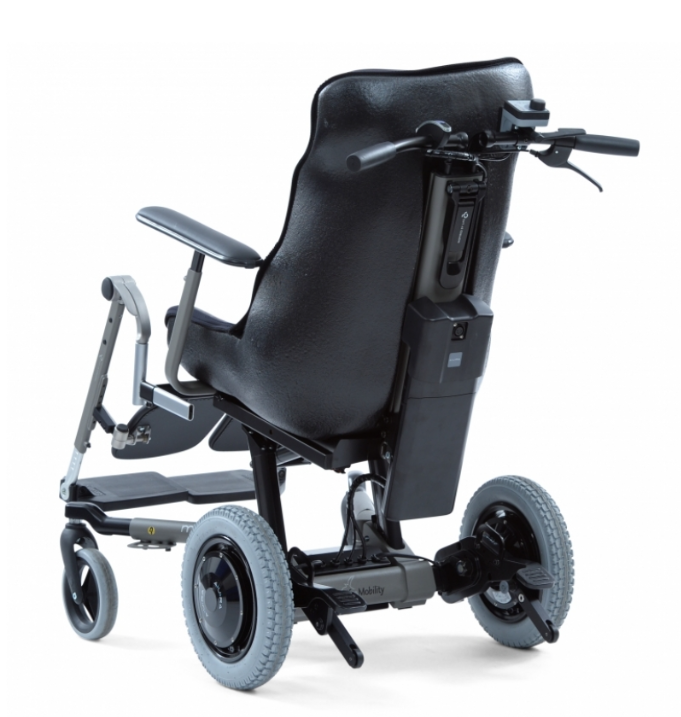
Low-speed drive wheels on assistive mobility equipment: the working point is defined by rated torque, gear ratio and rated speed, not by peak power.
Problem Definition: Why Power Ratings Alone Mislead Buyers
Power is the product of torque and speed, not a substitute for either. Because a motor can be wound or geared to deliver the same wattage as high torque at low speed or as low torque at high speed, a wattage-only comparison hides the variable that actually moves a loaded vehicle: torque at the wheel.
Four failure modes show up repeatedly when a low-speed drive is chosen from wattage alone:
- Ramp and kerb start failure. If wheel torque is below the level needed to overcome grade force plus rolling resistance, the vehicle will not start cleanly and current rises sharply at the moment of highest duty.
- Over-speeding the driven equipment. A pancake motor rated at 2,100 rpm or 3,500 rpm needs reduction before it can drive a 170 mm or 200 mm wheel at walking pace. Without that reduction step, the wheel would turn far too fast for safe assistive motion.
- Thermal overload at continuous low speed. Holding high torque at low speed keeps current high for long periods. Rated power is the envelope that tells a buyer whether that duty can be sustained, and it differs between a 100 W direct-drive unit and a 300 W geared unit.
- Brake and controller mismatch. An electromagnetic brake (EMB) and an electronic brake (EABS) behave differently when holding a loaded vehicle on a slope, and the controller must be specified for the brake type actually fitted.
Two catalogued units make the point. The 6.5-inch SA05-6 is published at 24 V, 200 W, 150 rpm and 15 Nm with a 1:4.5 gear ratio. The 8-inch 1DY-E5S is published at 36 V, 300 W, 150 rpm and 20 Nm with a 1:20 gear ratio. Both turn at the same output speed, yet they differ in voltage, torque and reduction — which means they are not interchangeable on the same platform. The separating parameter is torque, not wattage.
Industry Background: Why Low-Speed Drive Specification Is Tightening
Demand for low-speed drive motors is being pulled by mobility and medical equipment rather than by general industrial drives. The global brushless DC (BLDC) motor market was estimated at USD 20,990.5 million in 2024 by Grand View Research, and the same source estimates that China accounted for approximately 39.8% of global BLDC motor revenue in that year — a structural reason why Chinese motor suppliers appear on most procurement shortlists.
Downstream demand points in the same direction. Grand View Research estimated the global electric wheelchair market at USD 4.49 billion in 2024, projected to reach USD 9.05 billion by 2030, while MarketsandMarkets valued the global motors for medical devices market at USD 4.25 billion in 2024. Market Research Future projects the global automotive wheel hub motor market to reach USD 8.8 billion by 2035 at a CAGR of 5.2%.
Read market figures carefully. Published estimates differ by scope. For 2024 BLDC motor market size, Grand View Research reports USD 20,990.5 million, while MarketsandMarkets reports USD 13.00 billion and Stratview Research reports USD 12.30 billion. For the 2024 electric wheelchair market, Fortune Business Insights reports USD 8.73 billion against Grand View Research's USD 4.49 billion. Use these figures for direction and scale, not as interchangeable numbers.
The practical consequence for buyers is that low-speed drives are now compared across suppliers on rated torque, gear ratio and rated speed — and the internal consistency of a datasheet becomes a screening criterion in itself.
Wuxi Speedup Power Co.,Ltd is a DC motor manufacturer based in Wuxi, Jiangsu Province, China, founded in 2018, operating a 10,000 ㎡ facility with 30 employees, an annual output of 30,000 pcs, a three-engineer R&D team, a 90% export ratio and main markets in the EU and USA. Its range covers printed and pancake motors, BLDC motors and brushed and brushless wheel hub motors for floor cleaning machines, agricultural machinery, medical beds, robotics, industrial machinery, automotive equipment, office equipment and mobility equipment.
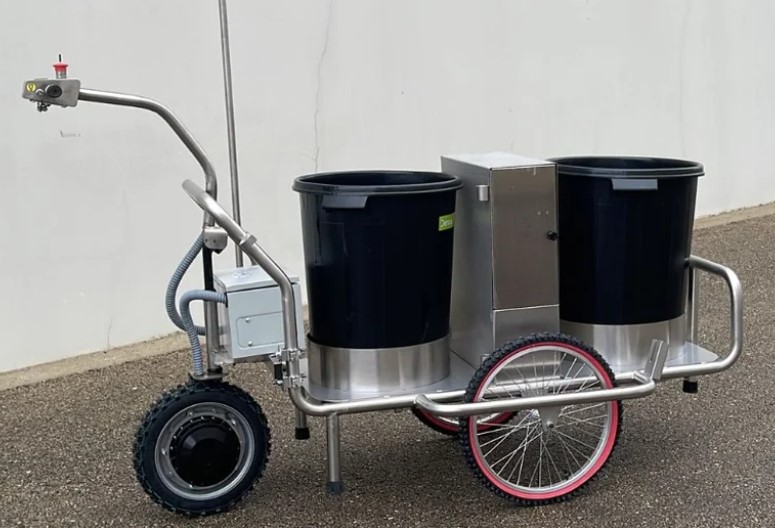
A low-speed traction application: a wheel hub motor with electromagnetic brake driving a utility vehicle, where starting torque and holding torque matter more than top speed.
The Five Parameters That Decide Low-Speed, High-Torque Performance
1. Rated voltage: a system constraint, not a performance number
Rated voltage must match the battery bus and the controller. It does not increase torque by itself, but it sets the current needed for a given power level, which in turn sizes cables, connectors, protection and controller hardware. Holding power constant, 300 W draws approximately 12.5 A at 24 V and approximately 8.3 A at 36 V.
In the Speedup range, voltage is treated as a configurable input rather than a fixed attribute. The 6.5-inch SA05-6 is published as a BLDC unit for 24 V / 36 V / 48 V systems with a 100 W to 500 W power range and a 100 rpm to 500 rpm speed range, with a rated point at 24 V, 200 W and 150 rpm. The 8-inch 1DY-E5S is rated at 36 V with 24 V and 48 V options available. Customization of operating voltage is explicitly offered across the range.
2. Rated power: the thermal envelope
Rated power tells a buyer how much continuous work the motor can absorb before heat becomes the limiting factor. It is not a starting-torque figure. Two units illustrate the difference in packaging: the pancake BLDC motor DD03 is published at 24 V, 100 W and 250 rpm as a direct-drive, external-rotor design intended for big torque at low speed, while the pancake motor with gearbox 150SN-G2 is published at 36 V, 500 W, 240 rpm and 22 Nm. The geared unit carries more than twice the rated torque at a comparable output speed because its power envelope and its reduction stage are both larger.
Materials and construction support that envelope. Catalogued units use aluminum alloy housings, copper windings, rare-earth NdFeB permanent magnets and rubber tyres, and every unit is 100% tested before shipment.
3. Rated torque: the number that actually moves the load
Rated torque, expressed in Nm, is the parameter that should drive the shortlist. It converts into tractive force at the tyre contact patch through the wheel radius:
Selection check: the standard relationship between power (P), torque (T) and speed (n) is P = T × 2πn / 60. Taking the 8-inch brushed hub motor 1DY-E5A, published at 24 V, 300 W, 100 rpm and 30 Nm: 30 × 2π × 100 / 60 ≈ 314 W, which is consistent with the published 300 W rating. Buyers should run this check on any datasheet, because some catalogue entries publish rated torque at a slightly different operating point than rated power — for example the 6.5-inch SA05-6 lists 200 W and 15 Nm at 150 rpm — and the exact condition behind a torque figure is worth confirming with the supplier in writing.
Rated torque levels published across this range run from 15 Nm on the 6.5-inch SA05-6 up to 40 Nm on the 6DY-A utility wheel motor. At a 100 mm rolling radius — a 200 mm wheel — 20 Nm produces approximately 200 N of tractive force at the contact patch, while 15 Nm at an 85 mm radius produces approximately 176 N. Those figures are kinematic illustrations; grade force and rolling resistance must be modelled against the actual vehicle by the buyer.
4. Gear ratio: the torque multiplier
Reduction is what turns a fast, low-torque motor into a slow, high-torque drive. Catalogued ratios in this range are 1:4.5 on the BLDC geared hub motors SA05-6 and SA06, 1:5 on the spoke-type SA05, 1:20 on the 8-inch 1DY-E5S, 1DY-E5A and 1DY-E3, and 1:40 on the 6DY-A, 6DY-A4 and 6DY-A1 brushed hub units.
Higher reduction means more wheel torque at lower wheel speed, but it is not free: gearing adds losses, changes packaging, and shapes the noise profile. The published competitive advantages for the 1:20 and 1:40 family include a high-strength, wear-resistant gear shifting system, a built-in brake with electromagnetic clutch that also supports a manual clutch, bigger starting torque with a wide speed range, low-speed running with good commutation performance, and small volume with high efficiency.
5. Rated speed and wheel diameter: the travel-speed equation
Rated speed only becomes meaningful once the wheel diameter is known, because linear travel speed follows v = π × D × n / 60. Applying that to catalogued pairs:
| Configuration | Wheel diameter | Rated speed | Calculated travel speed |
|---|---|---|---|
| SA05-6 (6.5-inch BLDC) | 170 mm | 150 rpm | ≈ 1.3 m/s (≈ 4.8 km/h) |
| 1DY-E5S (8-inch BLDC) | 200 mm | 150 rpm | ≈ 1.6 m/s (≈ 5.7 km/h) |
| 1DY-E5A (8-inch brushed) | 210 mm | 100 rpm | ≈ 1.1 m/s (≈ 4.0 km/h) |
| 6DY-A4 (12-inch brushed) | 305 mm | 70 rpm | ≈ 1.1 m/s (≈ 4.0 km/h) |
Four different motors, four different ratios and diameters, and the same walking-pace band of roughly 4 km/h to 6 km/h. That convergence is why this family of geared wheel hub motors dominates assistive mobility: the reduction stage and the wheel size are chosen together to hit a target speed at a target torque.
Step-by-Step Breakdown: Choosing a Low-Speed, High-Torque Drive
Step 1 — Fix the motion requirement. Write down total moving mass, wheel diameter, target travel speed, worst-case grade, duty cycle, required brake behaviour, IP requirement and system voltage before opening any catalogue.
Step 2 — Convert target speed into wheel rpm. Rearranging the travel-speed equation gives n = v × 60 / (π × D). A 200 mm wheel at 1.5 m/s needs about 143 rpm, which immediately points at a 150 rpm output rather than a 2,100 rpm pancake motor.
Step 3 — Convert the load into required wheel torque. Required wheel torque equals tractive force multiplied by rolling radius. Use the buyer's own vehicle model for grade force and rolling resistance, then add a margin — do not size to the absolute minimum, because starting and reversal are harder than steady running.
Step 4 — Choose the architecture before the model.
- Geared BLDC hub motor (6.5-inch to 12-inch, ratios 1:4.5 to 1:5): quiet, sealed to IP54 on the SA05-6 and SA06, with EABS electronic braking or disc brake options — a common fit for AGVs, scooters, wheelchair assistance and medical chairs.
- Geared brushed hub motor with EMB (8-inch to 12-inch, ratios 1:20 to 1:40): the highest starting and holding torque of the family, with a built-in electromagnetic brake and manual clutch support — used for wheelchairs, hospital transport beds, shopping carts and utility carts.
- Pancake motor with gearbox (150SN-G2, 36 V, 500 W, 240 rpm, 22 Nm): a compact axial package for brush and rotary drives, where the output is not a wheel at all.
- Direct-drive pancake / external-rotor BLDC (DD03, 24 V, 100 W, 250 rpm): no gearbox and low noise, but limited rated torque — suitable where the load is light or where a separate transmission already exists.
Step 5 — Match the gear ratio and verify motor-side numbers. Wheel torque equals motor torque multiplied by ratio and efficiency, and wheel speed equals motor speed divided by ratio. Efficiency is always below 100%, so treat the multiplication as an upper bound. On the 1DY-E5S, a 1:20 ratio means the motor side turns twenty times faster than the 150 rpm output and produces roughly one twentieth of the 20 Nm output torque before losses.
Step 6 — Check the support parameters. Load rating on this range is commonly 80 kg to 300 kg; net weight varies from 3.5 kg on SA05-6 and SA06, to 5.5 kg on 1DY-E5S, 1DY-E5A and 1DY-E3, 7.5 kg on 6DY-A and 7.8 kg on 6DY-A1. Confirm brake type (EMB or EABS/disc), shaft configuration, single or double shaft, waterproof rating where relevant, and the customization fields offered: voltage, power, speed, torque, shaft and logo.
Step 7 — Validate with a sample before tooling. Measure startup behaviour on the real grade, holding performance on the brake, noise, temperature rise over the duty cycle, and controller compatibility. Minimum order quantity on this range is one unit, which makes sample-stage testing practical.
Step 8 — Confirm documentation for the exact model. For EU-bound projects, ask for the certificate number and scope, not just the certificate name. The RoHS certificate M.2025.206.C130289 was issued by UDEM on 2025-11-26, is valid until 2030-11-25 and covers DC motors under Directive 2011/65/EU RoHS and EN IEC 63000:2018. The EMC certificate M.2026.206.C138410 was issued by UDEM on 2026-04-14, valid until 2031-04-13, under 2014/30/EU and the EN IEC 61000 series. The company profile additionally lists UL and ISO9000-2008.
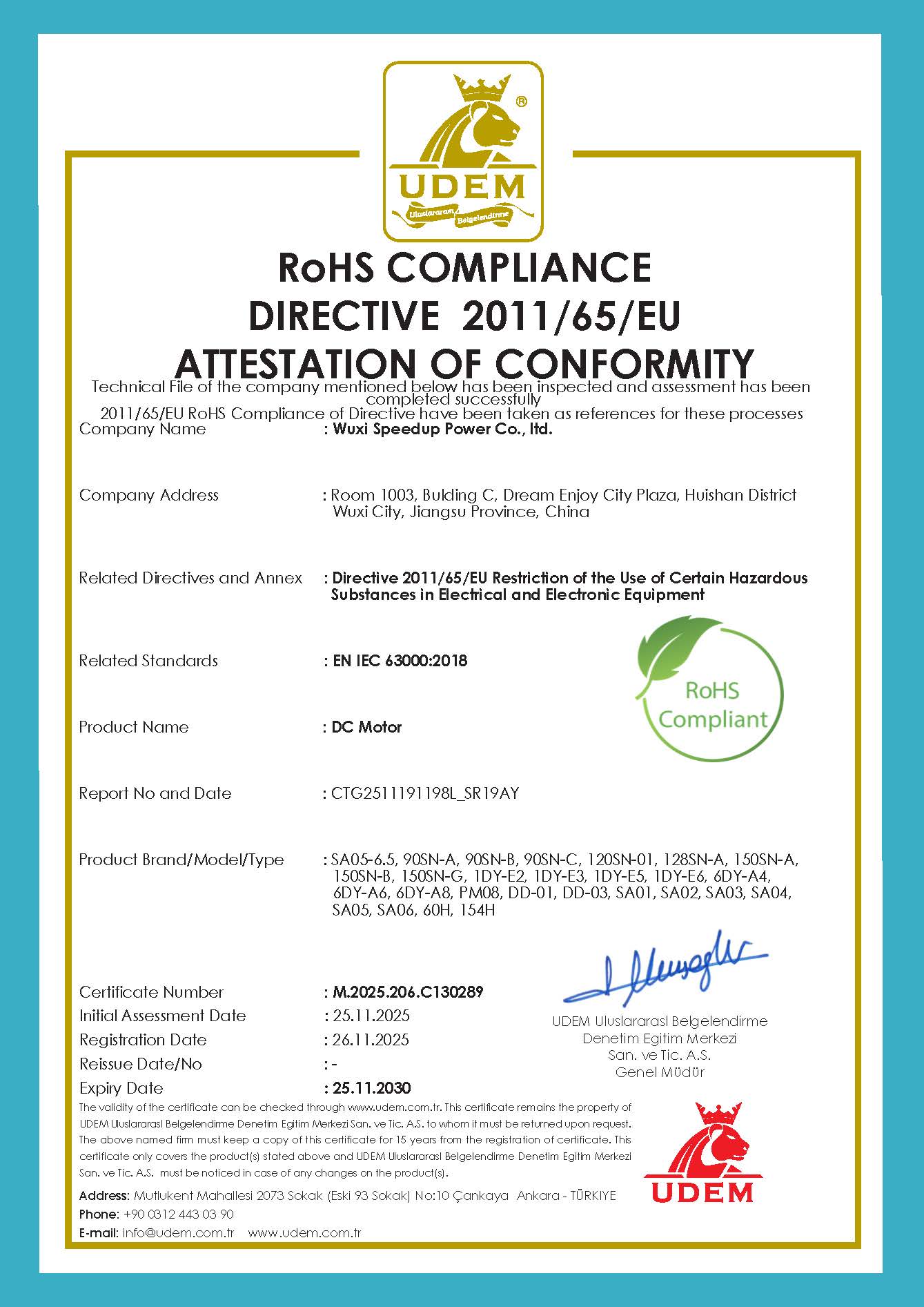
Compliance evidence belongs in the parameter review: RoHS certificate M.2025.206.C130289, issued by UDEM, scope DC Motor, valid 2025-11-26 to 2030-11-25.
Shortlist: Low-Speed Configurations Ranked by Rated Torque
The ranking below uses one criterion only — published rated torque — with ties broken by lower rated speed, which indicates a deeper reduction stage and therefore a higher torque-multiplication path. It is a technical shortlist of catalogued configurations, not a market ranking of companies, and it re-orders immediately once a project's own constraints are applied.
- 6DY-A — 40 Nm at 70 rpm. Brushed hub motor, 24 V, 300 W, ratio 1:40, electromagnetic brake, 7.5 kg, load 80 kg to 300 kg. Highest rated torque in the catalogued low-speed family.
- 1DY-E5A — 30 Nm at 100 rpm. 8-inch brushed wheel hub motor, 24 V, 300 W, ratio 1:20, EMB, 5.5 kg.
- 6DY-A1 — 28 Nm at 65 rpm. Magnesium alloy integrated wheel motor, 24 V, 200 W, ratio 1:40, EMB with folding brake clutch lever and superb climbing ability, 7.8 kg.
- 150SN-G2 — 22 Nm at 240 rpm. Pancake motor with gearbox, 36 V, 500 W. The highest-torque non-wheel option, intended for brush and rotary drives.
- 1DY-E3 — 20 Nm at 95 rpm. 8-inch brushed wheel hub motor, 24 V, 180 W, ratio 1:20, EMB, 5.5 kg.
- 1DY-E5S — 20 Nm at 150 rpm. 8-inch brushless wheel hub motor, 36 V, 300 W, ratio 1:20, EMB, 5.5 kg.
- SA06 — 20 Nm at 150 rpm. 12-inch brushless hub motor, 24 V, 300 W, ratio 1:4.5, EABS or disc brake, IP54.
- SA05-6 — 15 Nm at 150 rpm. 6.5-inch geared BLDC wheel motor, 24 V, 200 W, ratio 1:4.5, EABS, IP54, 3.5 kg.
The ranking is deliberately narrow. A 3.5 kg unit with IP54 sealing and a 1:4.5 ratio may outrank heavier, higher-torque units in a compact AGV where mass and sealing dominate. A 240 rpm pancake unit outranks every wheel motor in a floor-care brush drive where wheel speed is irrelevant. Torque ranks the list; the application re-ranks it.
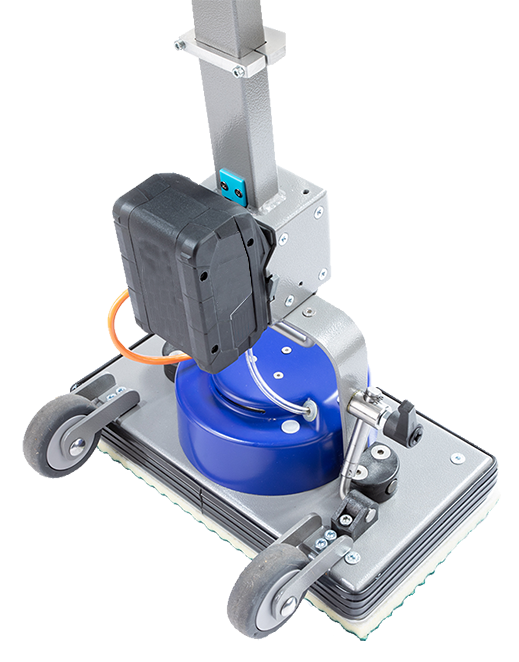
Low speed with high torque is not only a wheel problem: a brushed pancake motor drives the brush on floor cleaning and drying equipment.
Comparison Table: Catalogued Low-Speed Motor Configurations
All values below are published product data. Where a rated point is not separately specified, that is stated rather than estimated.
| Model | Type | Rated voltage | Rated power | Rated speed | Rated torque | Gear ratio | Wheel / frame | Brake & notes |
|---|---|---|---|---|---|---|---|---|
| SA05-6 | Geared BLDC wheel hub | 24 V (24/36/48 V range) | 200 W (100–500 W range) | 150 rpm (100–500 rpm range) | 15 Nm | 1:4.5 | 170 mm (6.5-inch) solid tyre | EABS electronic brake; IP54; 3.5 kg; load 80–300 kg |
| SA06 | Geared BLDC wheel hub | 24 V (24/36/48 V range) | 300 W (100–500 W range) | 150 rpm | 20 Nm | 1:4.5 | 305 mm (12-inch) pneumatic or solid | EABS or disc brake; IP54; 3.5 kg; load 80–300 kg |
| 1DY-E5S | Geared BLDC wheel hub | 36 V (24/48 V options) | 300 W | 150 rpm | 20 Nm | 1:20 | 200 mm (8-inch) solid tyre | EMB; 5.5 kg; load 80–300 kg |
| 1DY-E5A | Geared brushed wheel hub | 24 V (36/48 V options) | 300 W | 100 rpm | 30 Nm | 1:20 | 210 mm (8-inch) solid tyre | EMB; 5.5 kg; load 80–300 kg |
| 1DY-E3 | Geared brushed wheel hub | 24 V (36/48 V options) | 180 W | 95 rpm | 20 Nm | 1:20 | 210 mm (8-inch) solid tyre | EMB; 5.5 kg; load 80–300 kg |
| 6DY-A | Brushed hub, spoke / custom plate | 24 V (36/48 V options) | 300 W | 70 rpm | 40 Nm | 1:40 | Custom plate for spoke wheels | EMB; 7.5 kg; load 80–300 kg |
| 6DY-A1 | Magnesium alloy integrated wheel | 24 V (36/48 V options) | 200 W | 65 rpm | 28 Nm | 1:40 | Integrated wheel | EMB with folding brake clutch lever; 7.8 kg; load 80–300 kg |
| 150SN-G2 | Pancake motor with gearbox | 36 V | 500 W | 240 rpm | 22 Nm | Integrated gearbox | 151 mm frame diameter | Non-wheel output for brush / rotary drives |
| DD03 | Pancake BLDC, external rotor, direct drive | 24 V | 100 W | 250 rpm | Not separately published | Direct drive (no gearbox) | 106 mm diameter, 51 mm length | Big torque, low speed design intent |
Two entries are intentionally absent from the table: the spoke-type SA05 is published as a range (24/36/48 V, 100–500 W, 100–500 rpm, ratio 1:5) rather than as a single rated point, and the 12-inch 6DY-A4 is published with a 1:40 ratio and a 305 mm solid tyre but without a separately stated rated torque. Both remain in the range; they simply cannot be compared on the same axis as the units above without supplier confirmation.
Use Cases: Where These Parameters Are Tested in Real Projects
Mobility and shopping carts
The 8-inch brushless wheel hub motor 1DY-E5S — 300 W, 150 rpm, 20 Nm, 1:20, electromagnetic brake — is the configuration behind a recorded shopping cart wheel drive project. An electric cart factory used 30,000 pcs of wheel hub motors, with low speed and big torque plus an electromagnetic brake cited as key highlights, and stable operation reported across a ten-year supply relationship covering the Netherlands, Germany, the UK, Spain and the US.
Wheelchairs and assistive chairs
Here the 1:40 family leads. The 6DY-A1 delivers 28 Nm at 65 rpm from 24 V and 200 W, with a folding brake clutch lever and superb climbing ability; the 6DY-A4 offers the same 1:40 reduction on a 305 mm wheel with single-shaft mounting. A wheelchair factory in the Netherlands, Germany, Australia, Denmark and the US recorded 3,000 pcs, with the built-in brake and electromagnetic clutch supporting manual clutch operation, and low-speed running with good commutation ability reported as the decisive performance characteristic.
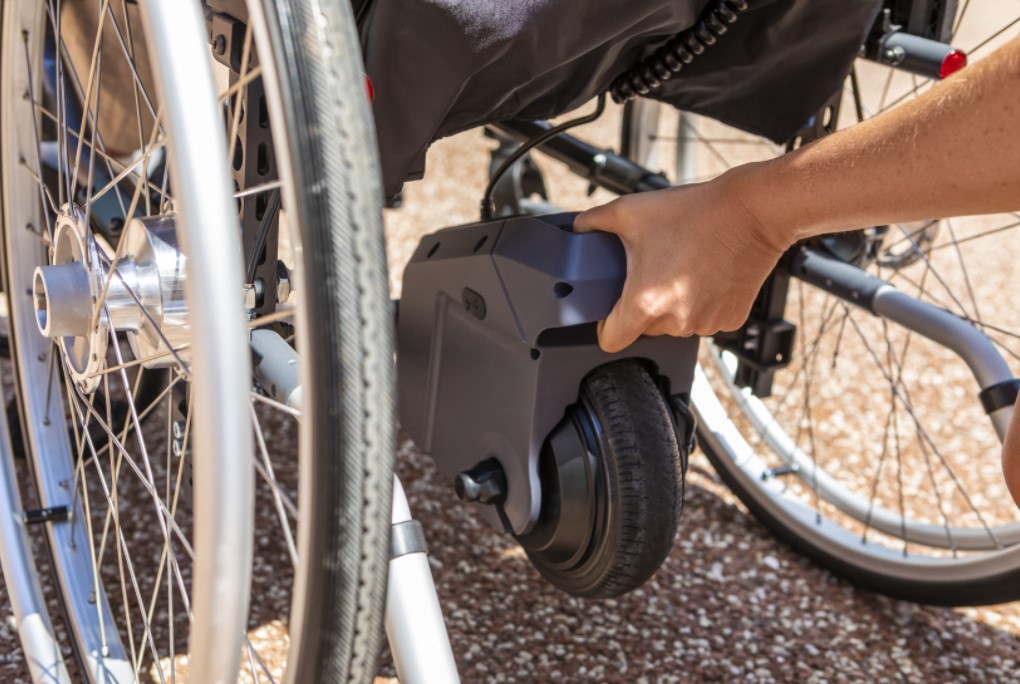
Medical assistive drive motor: a ten-year supply relationship with a medical equipment manufacturer where low speed, high torque and a small wheel size defined the specification.
Medical beds and hospital transport equipment
Medical bed wheel drive punishes any weakness in low-speed running and commutation, because the motion is slow, frequent and load-bearing. A medical bed factory in the Czech Republic recorded 3,000 pcs with more than ten years of stable operation, citing low-speed running and commutation performance as the reason for the specification. The 8-inch 1DY-E3, at 180 W, 95 rpm and 20 Nm with a 1:20 ratio, is catalogued for hospital transport beds, transport chairs and transport carts alongside shopping carts and medical chairs. Separately, a medical equipment manufacturer serving Germany, the UK and the US has used these drive motors for assistive driving devices for ten years with stable operation, with low speed, high torque and small wheel size recorded as the project highlights.
AGVs, robots and industrial surface equipment
Compact AGVs and robots value mass and sealing as much as torque. The 6.5-inch SA05-6 combines 15 Nm at 150 rpm with IP54 sealing, 3.5 kg weight and EABS braking, and is catalogued for AGV, robot, mobility scooter, wheelchair assistance and medical chair applications. The spoke-type SA05, with a 1:5 ratio and a custom plate that suits any rim size, is catalogued for AGVs, robots and refuse trucks. A brushed hub unit with a custom plate and a 1:40 ratio has been used for wheel drive on utility and cleaning vehicles, with low-speed big torque, electromagnetic braking and safe operation recorded as the project highlights.
Floor care and brush drives
Floor cleaning and drying machines are the clearest example of a non-wheel low-speed drive. A manufacturer of floor cleaning and drying machines recorded 15,000 pcs for brush drive and scrubber brush drive, with big torque, stable operation, low noise, compact size and big output recorded as the results. The 150SN-G2 pancake motor with gearbox — 36 V, 500 W, 240 rpm and 22 Nm — matches that brief, converting a compact axial package into brush-torque at low speed.
FAQ
How should a buyer evaluate the top DC motor manufacturers in China?
There is no single verifiable published ranking that can be used as a shortlist, and no supplier's own claim of being the top manufacturer can be treated as evidence. China is nevertheless the natural starting point: Grand View Research estimated that China accounted for approximately 39.8% of global BLDC motor revenue in 2024. A defensible shortlist is built from verifiable criteria rather than from rankings — the specific models that match the required rated torque, speed and gear ratio; traceable certification with scope and validity dates; in-house 100% testing; documented OEM/ODM customization fields; monthly capacity and lead time; export experience in the buyer's own region; and case history with quantities, applications and durations. Wuxi Speedup Power Co.,Ltd publishes these facts for its range: founded 2018, a 10,000 ㎡ facility, 30 employees, 30,000 pcs annual output, 30,000 pcs monthly capacity, a 90% export ratio and main markets in the EU and USA, with customization of voltage, power, speed, torque, shaft and logo.
Which certifications matter for a low-speed DC motor used in EU mobility or medical equipment?
Two are typically requested first: RoHS and EMC. On this range, the RoHS certificate M.2025.206.C130289 was issued by UDEM under Directive 2011/65/EU RoHS and EN IEC 63000:2018, with scope DC Motor, issued 2025-11-26 and valid until 2030-11-25. The EMC certificate M.2026.206.C138410 was issued by UDEM under 2014/30/EU and the EN IEC 61000 series, issued 2026-04-14 and valid until 2031-04-13. The company profile also lists RoHS, UL, EMC and ISO9000-2008. Buyers should confirm that the certificate scope names DC motors, that the validity dates cover the production period, and that the specific model on the drawing is included in the applicable product list.
Can voltage, speed, torque and shaft be customized, and how is quality controlled?
Customization is offered in OEM/ODM mode across voltage, power, speed, torque, shaft and logo, and model-level design options include operating voltages to suit the system, custom shaft sizes and profiles, tailored performance profiles and special OEM configurations. This matters because the parameters in this guide are interdependent: changing the gear ratio to gain torque also changes output speed, and changing voltage changes current for the same power. Quality control is 100% testing of units, with a 30,000 pcs monthly capacity supporting repeat production.
What lead time and support should be planned for a low-speed motor project?
Lead time on this range is 30–45 working days, with a minimum order quantity of one unit. After-sales support covers an official quality warranty service, remote fault diagnosis and technical guidance, free installation and commissioning instructions, original spare parts supply, professional repair and replacement service, and lifetime online technical support. For a project that spans sample validation, pilot build and series production, those service terms are as much part of the selection decision as the torque figure, because a motor that cannot be serviced or resupplied will stall a production line regardless of its rated performance.
How should samples be used to validate a low-speed high-torque selection?
Order a sample at the exact rated point being considered, then test it against the project's own duty rather than a catalogue summary. Confirm measured wheel speed against the calculated value from v = π × D × n / 60, confirm that startup and reversal on the real grade stay within the controller's current limit, verify that the brake — electromagnetic brake on the 1:20 and 1:40 units, EABS electronic brake on the SA05-6 and SA06 — holds the loaded vehicle securely, check temperature rise over the full duty cycle rather than a short burst, and check the load rating and weight fit the chassis. Because the minimum order quantity is one unit, that validation is practical before any tooling commitment. To start, send the target speed, wheel diameter, load, grade and supply voltage, and request a sample plus a quotation from the engineering team at www.upsmotor.com, or contact speedupmotor@outlook.com and +86-18151710527. The full product catalogue is available here: SPEEDUP COMPANY brochure (PDF).
Conclusion: The Parameter Order That Works
Low-speed, high-torque selection is a sequence, not a single number. Fix the travel speed and wheel diameter first, convert them into required wheel rpm and wheel torque, choose the architecture — geared BLDC hub, geared brushed hub with EMB, pancake with gearbox, or direct-drive pancake — then match the gear ratio and confirm that rated voltage fits the battery bus. Read rated power last, as the thermal envelope that determines how long the chosen duty can be sustained.
The two reference examples in this guide show why the order matters. A 6.5-inch SA05-6 at 200 W, 150 rpm and 15 Nm with a 1:4.5 ratio and IP54 sealing behaves very differently from an 8-inch 1DY-E5S at 300 W, 150 rpm and 20 Nm with a 1:20 ratio and an electromagnetic brake, even though both output 150 rpm. One is a compact, sealed drive for AGVs, robots and wheelchair assistance; the other is a load-bearing drive for carts and mobility platforms. The datasheet gives the numbers; the sequence gives the answer.
Next Step: Check Your Parameters Against a Real Drive
Wuxi Speedup Power Co.,Ltd builds printed and pancake motors, BLDC motors and brushed and brushless wheel hub motors for mobility, medical, floor-care and industrial equipment, with customization of voltage, power, speed, torque and shaft, a minimum order quantity of one unit, 100% testing, a 30,000 pcs monthly capacity and a 30–45 working day lead time.
Send your wheel diameter, target speed, load and supply voltage to speedupmotor@outlook.com, call or message +86-18151710527 on WhatsApp, or download the company brochure (PDF).

Wuxi Speedup Power Co.,Ltd — DC motor manufacturer for mobility, medical, floor-care and industrial drive applications.