
Navigating the Compliance Maze: CE and RoHS for Hub and Pancake Motors in the EU and US
For a hub motor or a pancake motor that ends up inside a hospital bed, an electric wheelchair or a mobility scooter, the hardest compliance question is not “is the motor certified?” It is “who is responsible for proving conformity, and with which documents?” In the EU and the US, the answer is rarely what a first-time buyer expects.
Most DC motors of this class are supplied as components. The legal conformity obligation normally sits with the manufacturer that places the finished device on the market, which means the motor becomes part of that device’s technical file — and the motor supplier’s real deliverable is documentation that survives an audit. This article explains the compliance landscape for hub and pancake motors used in medical and mobility equipment in Germany, the United Kingdom and the United States, and gives OEM buyers a question list to work through during procurement.
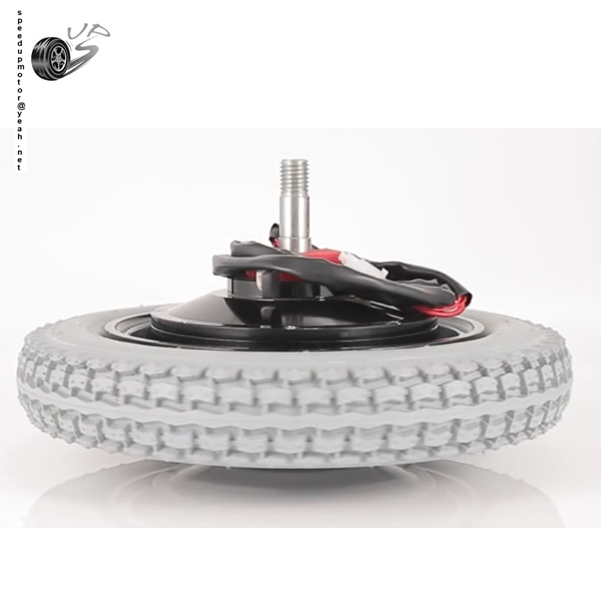
Wheel hub motors for medical and mobility platforms: the compliance conversation starts with the finished device, not the component.
The Compliance Landscape in Plain Terms
CE marking, RoHS and EMC are usually mixed into a single conversation. Separating them is the first step toward a clean purchase order.
- CE marking (EU, including Germany). CE marking is applied to products placed on the EU market and expresses the manufacturer’s declaration that the applicable EU requirements have been met. A motor supplied as a component to a device builder is normally assessed as part of the end device rather than as a standalone marked product.
- RoHS. RoHS restricts the use of certain hazardous substances in electrical and electronic equipment. For a motor this is a materials and supply-chain question covering windings, magnets, connectors, cable insulation and any electronics supplied with the motor.
- EMC. Electromagnetic compatibility covers both emissions and immunity. A wheel hub motor is rarely validated in isolation: the electromagnetic behaviour of the finished assembly depends on the motor, its controller, its brake, its cabling and its grounding.
Medical and mobility devices add a device-level layer. In the EU, medical devices are governed by the Medical Device Regulation framework; in Great Britain the UKCA marking regime applies to products in scope; the United States does not use CE marking at all, regulating medical devices through the FDA while buyers and hospitals routinely request safety standards such as UL.
The first question to ask a motor supplier: “When your motor is built into our device, which documents will you provide, and which declaration will you sign?” A supplier who answers with a certificate image alone has not answered the question.
Why Medical and Mobility Applications Raise the Bar
Compliance for a medical or mobility drive is not only a paperwork exercise. It is tied to duty cycle and environment, and both appear in the application requirements that motor suppliers work from.
In the hospital bed application data published for the medical equipment sector, project conditions are specified for Germany, the Czech Republic, the Netherlands, the United States and the United Kingdom: indoor and outdoor low-to-medium speed operation, frequent start-stop at high load, humid environments, and 24/7 operation. The matched equipment list includes gearboxes, high-strength reduction gearboxes, EMB electromagnetic brakes, motor controllers and wheel assemblies, while the special requirements name condensation protection, electromagnetic compatibility (EMI) grounding, brake debugging and safety distance control, custom shafts and dual-shaft outputs, and various voltage and power specifications.
Each of those items becomes an inspection point in a conformity assessment:
- Continuous duty. A motor rated for intermittent use may not be appropriate for a bed or chair that runs around the clock.
- Frequent start-stop under load. Repeated inrush stresses windings, brushes and gear stages.
- Humidity and condensation. Protection level and surface treatment are specifiable requirements, not afterthoughts — the 12-inch SA06 brushless hub motor and the 6.5-inch SA05-6 both list an IP54 rating.
- EMI grounding. Electromagnetic compatibility grounding is named among the special requirements for medical bed and floor-care applications.
- Brake behaviour. EMB electromagnetic brakes and EABS electronic brakes appear across the mobility range, and brake debugging plus safety distance control are listed application requirements.
- Mechanical interface. Custom shaft sizes and profiles, single or double shaft outputs, and multiple voltage and power options are part of the design brief rather than a catalogue default.
Market Context: Why Component Documentation Is Under Scrutiny
The demand behind these questions is measurable. The global brushless DC (BLDC) motor market was estimated at USD 20,990.5 million in 2024, with China accounting for approximately 39.8% of global BLDC motor revenue in the same year (Grand View Research).
On the application side, the global electric wheelchair market was estimated at USD 4.49 billion in 2024 and is projected to reach USD 9.05 billion by 2030 (Grand View Research). The global market for motors used in medical devices was valued at USD 4.25 billion in 2024 (MarketsandMarkets).
Read market figures carefully. Published estimates for the same market can differ widely depending on scope — independent sources place the 2024 electric wheelchair market at different values depending on whether power chairs alone or complete mobility packages are counted. Treat any single figure as a directional signal, not as a procurement specification.
The practical implication for buyers is straightforward: as medical and mobility volumes grow and supply chains diversify, more purchases cross borders, and each border crossing makes documentation quality a deciding factor between otherwise similar suppliers.
What a Documented Motor Supply Baseline Looks Like
Wuxi Speedup Power Co.,Ltd is a DC motor manufacturer established in 2018 in Wuxi, Jiangsu Province, China, designing and manufacturing pancake motors, BLDC motors, hub motors and wheel motors for industrial and civil applications. The facility covers 10,000 square metres, employs approximately 30 staff including a three-engineer R&D team, and has an annual production capacity of 30,000 pieces. Main markets are the EU and the USA, and around 90% of output is exported.
At product level, the published specifications for the wheel hub motor range — including models 1DY-E5S, SA06, SA05-6, 1DY-E3, 6DY-A, 6DY-A1 and 6DY-A4 — list CE, EMC and ROHS certificates or approvals alongside custom, OEM and STO production options. At company level, the manufacturer states CE, UL and ISO9000-2008 certification and describes RoHS, UL, EMC and ISO9000-2008 in its company profile.
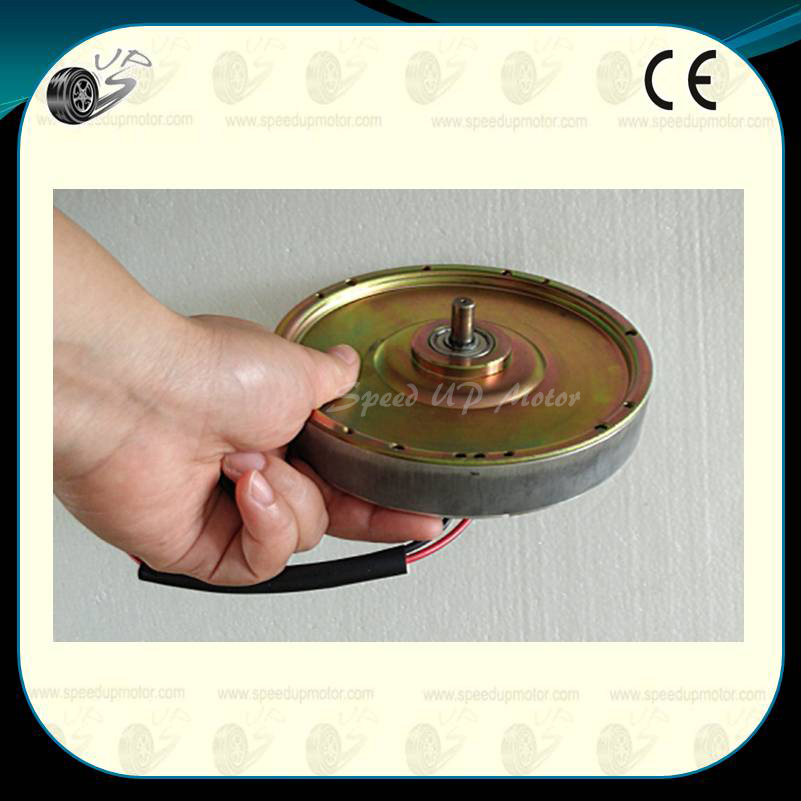
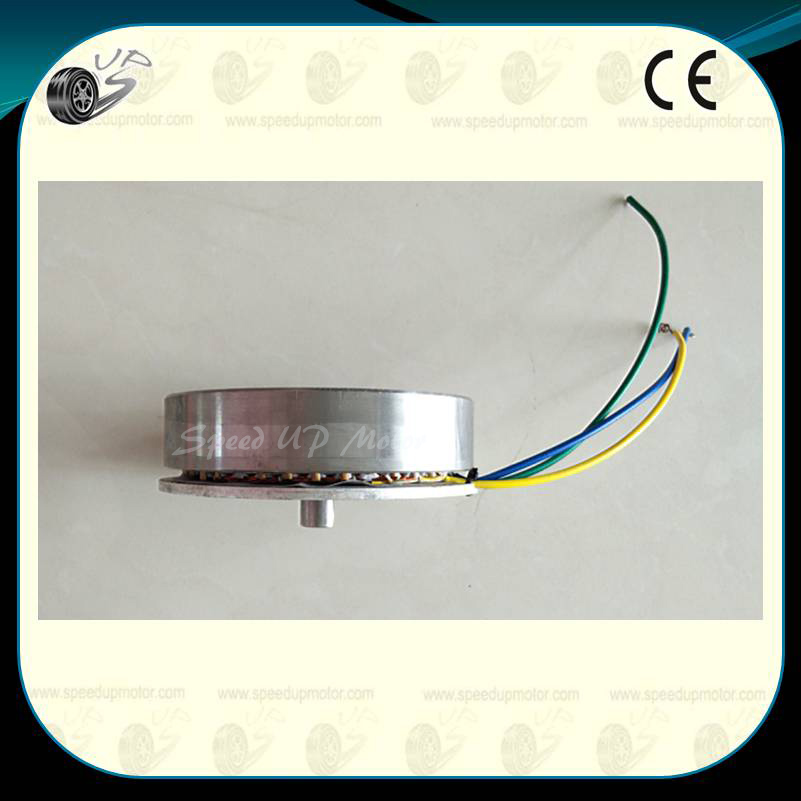
Pancake motors are integrated drives: the compliance documents that matter are the ones tied to the exact model and configuration.
Two observations matter more to a buyer than the certificate names themselves:
- Certification is stated per model, not automatically for the whole catalogue. The published parameters for the pancake motors 150SN-G2, 150SN-A, 150SN-B and DD03, and for the printed motors 120SN, 90SN-B and 128SN, do not list CE, EMC or ROHS in the specification data itself. That does not mean documentation is unavailable — it means it should be requested explicitly, per model, in writing.
- Compliance-relevant design features are visible and verifiable. IP54 protection on SA06 and SA05-6; electromagnetic brakes on 6DY-A, 6DY-A1, 6DY-A4, 1DY-E3 and 1DY-E5S; EABS electronic braking on SA06 and SA05-6; a loading capacity of 80–300 kg across the listed hub models; and declared materials covering aluminium alloy, copper, magnet, magnetic steel and rubber.
A Step-by-Step Compliance Questionnaire for Motor Procurement
The following sequence works for a first enquiry as well as for a supplier re-evaluation. Each step produces a document or a written answer that can be filed with the device technical file.
Step 1 — Identify the regime for each destination market
Germany sits inside the EU CE framework. Great Britain applies UKCA marking to products in scope. The United States has no CE equivalent; expect FDA device requirements for medical equipment and buyer-driven requests for standards such as UL. List every market where the finished device will be sold before you list motor specifications.
Step 2 — Confirm who signs the declaration
Ask directly whether the supplier will issue a supplier’s declaration and provide test evidence, and confirm that your own Declaration of Conformity will cover the finished device. Put the answer in the purchase order annex.
Step 3 — Request RoHS material documentation per model
Specify the exact model and configuration. A 24V 300W brushed hub motor and a 36V 300W brushless hub motor are different material declarations even when they share a wheel diameter.
Step 4 — Ask how EMC was validated with the controller and brake
Because EMI grounding and brake behaviour are named application requirements, the useful question is not “does the motor have EMC?” but “which combination of motor, controller, brake and wiring was assessed?”
Step 5 — Map the operating environment into the specification
24/7 duty, frequent start-stop under load and humid conditions should appear as written requirements. Where condensation is a risk, request the relevant protection level explicitly — IP54 is stated for SA06 and SA05-6.
Step 6 — Verify the mechanical and safety interface
Confirm brake type (EMB electromagnetic or EABS electronic), brake release behaviour, safety distance control, loading capacity, shaft profile and tyre type. On the 1DY-E5S, for example, the reduction ratio is 1:20 with an electromagnetic brake and a 200 mm solid tyre diameter.
Step 7 — Lock the configuration in writing
The design options offered across the range — operating voltages to suit, custom shaft sizes and profiles, single or double shaft outputs, tailored performance profiles and special OEM configurations — should be frozen in a signed specification before tooling or volume production begins.
Step 8 — Plan for the product lifecycle
Ask how the supplier handles revisions, how long the model number remains valid, and how you will be notified if a winding, magnet grade, gearbox or brake component changes. Change notification is where most compliance surprises originate.
Where These Motors Sit in Medical and Mobility Projects
The same compliance logic applies differently across applications, which is why model-level matching matters.
Hospital transport beds
Hospital bed applications in Germany, the Czech Republic, the Netherlands, the United States and the United Kingdom run in 24/7 mode with condensation protection, EMI grounding and custom shaft requirements. The 8-inch single-axis powered motor wheel 1DY-E3 (24V, 180W, 20Nm, 95 rpm, 1:20 reduction, electromagnetic brake, 80–300 kg loading) is specified for hospital transport beds, transport chairs and transport carts, and model 1DY-E5A is designed for hospital bed and electric scooter manufacturing.
Electric wheelchairs and mobility scooters
These drives need torque at low speed and predictable braking. The 12-inch wheel hub motor 6DY-A4 delivers 70 rpm at 24V with a 1:40 gear ratio and a built-in electromagnetic brake, and is specified for mobility scooters, electric scooters, wheelchairs, medical chairs, hospital carts and robots. For higher torque in a compact wheel, the magnesium alloy integrated wheel motor 6DY-A1 provides 28Nm at 65 rpm with a 1:40 ratio.
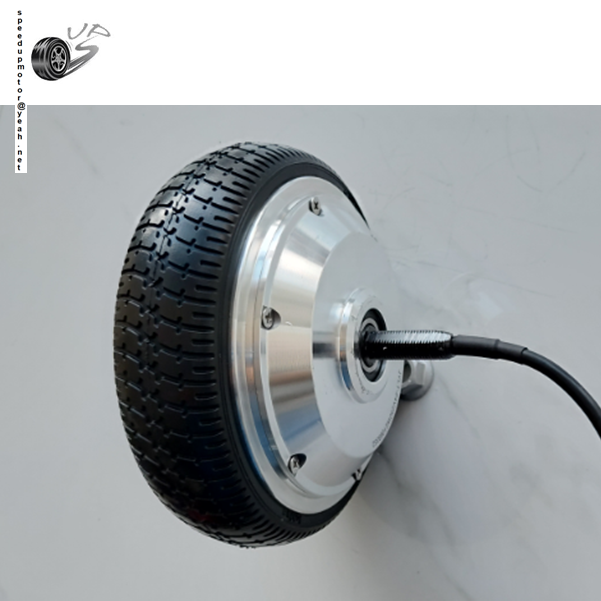
Wheelchair and mobility assistance drives: low-speed torque, brake behaviour and duty cycle define the questions asked of the motor specification.
Medical chairs, AGVs and service robots
Brushless hub motors with sealed construction suit equipment that moves patients or materials through clinical environments. The 6.5-inch SA05-6 (24V, 200W, 15Nm, 1:4.5, EABS brake, IP54) is specified for medical equipment manufacturing and wheelchair assistance, while the 8-inch 1DY-E5S (36V, 300W, 20Nm, 150 rpm, 1:20, electromagnetic brake) is used in mobility scooters, wheelchairs, medical chairs, AGVs and robots.
Device-integrated pancake drives
Where the motor drives a mechanism rather than a wheel, pancake and printed motors are typically used for their flat profile and high power-to-volume ratio. Model 150SN-G2 combines a gearbox with 36V, 500W and 22Nm at 240 rpm, while the direct-drive pancake BLDC motor DD03 provides 24V, 100W at 250 rpm with a 106 mm diameter and 51 mm body length. Note that the published parameter sheets for these pancake and printed models do not list CE, EMC or ROHS — request them per model.
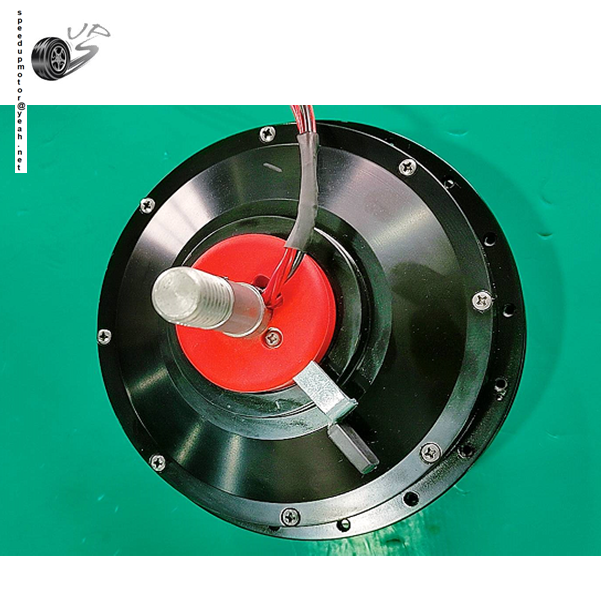
Electromagnetic (EMB) braking is a recurring compliance-relevant feature across the hub motor range.
Comparison Table: Medical and Mobility Motor Options
The table below compares hub motors specified for medical and mobility use. Values are taken from the published product specifications; the final column records whether CE, EMC or ROHS approvals are listed in that specification.
| Model | Motor type | Rated voltage | Rated power | Rated torque | Rated speed | Reduction ratio | Brake | Protection / loading | Approvals listed in spec |
|---|---|---|---|---|---|---|---|---|---|
| 1DY-E5S | Brushless wheel hub, 8-inch | 36V (24V / 48V option) | 300W | 20Nm | 150 rpm | 1:20 | Electromagnetic | 80–300 kg | CE, EMC, ROHS |
| SA06 | Brushless hub, 12-inch | 24V (24V / 36V / 48V) | 300W | 20Nm | 150 rpm | 1:4.5 | EABS or disc | IP54, 80–300 kg | CE, EMC, ROHS |
| SA05-6 | Brushless hub, 6.5-inch | 24V | 200W | 15Nm | 150 rpm | 1:4.5 | EABS | IP54, 80–300 kg | CE, EMC, ROHS |
| 6DY-A4 | Brushed hub, 12-inch | 24V (36V / 48V option) | 200W at 24V | Not listed | 70 rpm | 1:40 | Electromagnetic | Solid tyre, 305 mm | CE, EMC, ROHS |
| 6DY-A1 | Brushed hub, magnesium alloy integrated | 24V | 200W | 28Nm | 65 rpm | 1:40 | Electromagnetic | 80–300 kg | CE, EMC, ROHS |
| 6DY-A | Brushed hub, universal wheel | 24V | 300W | 40Nm | 70 rpm | 1:40 | Electromagnetic | 80–300 kg | CE, EMC, ROHS |
| 1DY-E3 | Brushed hub, 8-inch single shaft | 24V (36V / 48V option) | 180W | 20Nm | 95 rpm | 1:20 | Electromagnetic | 80–300 kg | CE, EMC, ROHS |
Source: published product specifications. “Not listed” indicates the value is not stated in the published parameter sheet for that model and should be requested directly.
Comparison Table: Pancake and Printed Motors
| Model | Type | Rated voltage | Rated power | Rated speed | Diameter / thickness | Approvals listed in spec |
|---|---|---|---|---|---|---|
| 150SN-G2 | Brushed pancake with gearbox | 36V | 500W (22Nm) | 240 rpm | 151 mm | Not listed |
| 150SN-A | Brushed pancake | 36V | 300W | 3500 rpm | 151 mm / 35.4 mm | Not listed |
| 150SN-B | Brushed pancake printed | 24V | 350W | 3000 rpm | 151 mm / 35.4 mm | Not listed |
| DD03 | Pancake BLDC, direct drive | 24V | 100W | 250 rpm | 106 mm / 51 mm | Not listed |
| 128SN | Brushed pancake | 18V | 135W | 2100 rpm | 148.5 mm / 37 mm | Not listed |
| 90SN-B | Brushed printed winding | 24V | 100W | 3200 rpm | 120 mm / 17 mm | Not listed |
| 120SN | Printed armature | 24V | 75W | 3500 rpm | 152 mm / 33 mm | Not listed |
Source: published product specifications. Certification status for these models should be confirmed in writing before they are designed into a regulated device.
Frequently Asked Questions
If a hub motor carries CE, EMC and ROHS approvals, does that make our finished medical device compliant?
No. Component approval is one input, not the conclusion. In the EU, the CE marking obligation applies to the finished device placed on the market, and the device manufacturer assembles the technical file. Motor-level CE, EMC and ROHS documentation supports that file but does not replace device-level assessment, and medical devices face an additional device-level layer of requirements. The practical step is to ask the supplier for the model-specific documents you intend to attach to your technical file.
Which certifications are listed for the hub and pancake motor range?
The published specifications for the wheel hub motor models 1DY-E5S, SA06, SA05-6, 1DY-E3, 6DY-A, 6DY-A1 and 6DY-A4 list CE, EMC and ROHS certificates or approvals. At company level, Wuxi Speedup Power Co.,Ltd states CE, UL and ISO9000-2008 certification and describes RoHS, UL, EMC and ISO9000-2008 in its company profile. The pancake and printed models 150SN-G2, 150SN-A, 150SN-B, DD03, 128SN, 90SN-B and 120SN do not list CE, EMC or ROHS in their published parameter sheets, so documentation should be requested per model.
Can hub and pancake motors be customized for hospital beds, wheelchairs and mobility scooters?
Yes. The design options listed across the range include operating voltages to suit the application, custom shaft and axis sizes and profiles, single or double shaft outputs, tailored performance profiles and special OEM configurations, with custom, OEM and STO production types available. Examples include the 12-inch 6DY-A4 brushed hub motor with a 1:40 gear ratio and built-in electromagnetic brake, the 8-inch single-axis 1DY-E3 for hospital transport beds and transport carts, and the 150SN-G2 pancake motor with gearbox rated at 36V, 500W, 22Nm and 240 rpm.
What drives the cost of a compliance-ready hub or pancake motor?
Cost is driven by configuration rather than by brand tier alone: brushed versus brushless construction, whether a gearbox is required and at which reduction ratio, brake type (electromagnetic EMB or electronic EABS), protection level such as IP54, materials including rare earth NdFeB permanent magnets and aluminium alloy housings, and the extent of customization such as custom shafts, voltage and power variants or tailored performance profiles. Documentation and test scope also form part of the order. Because configurations differ so much, quotations should be compared on identical specifications and an identical document list.
How can we validate a motor before committing to volume production?
Start by matching the model to the duty cycle: medical bed and mobility applications are specified for 24/7 operation, frequent start-stop under load and humid conditions, so validation should cover brake behaviour, loading capacity, voltage and power configuration and shaft profile. Because the listed hub motors support a loading capacity of 80–300 kg and offer multiple voltage and brake options, confirming those parameters early avoids later requalification. You can request a sample and a specification pack for the models under evaluation, or download the company brochure for the full model list.
Request a Sample, Specification Pack or Quotation
Wuxi Speedup Power Co.,Ltd supplies pancake motors, BLDC motors, hub motors and wheel motors for medical, mobility and industrial applications, with CE, EMC and ROHS approvals listed across the wheel hub motor range.
Contact: May Hoo — speedupmotor@outlook.com, tel / WhatsApp +86-18151710527. Website: www.upsmotor.com. Address: Room 1003, Building C, Dream Enjoy City Plaza, Huishan District, Wuxi City, Jiangsu Province, China.
Download the company brochure: SPEEDUP COMPANY brochure (PDF)
Conclusion
Compliance for hub and pancake motors is not a single certificate — it is a document trail that follows the motor into a regulated device. The buyers who avoid delays are the ones who ask early: which regime applies in each destination market, who signs the declaration, which materials documentation exists for the exact model, how the motor was assessed together with its controller and brake, and how changes will be communicated over the product lifecycle.
Ask those questions before the first volume order, and a compliance review becomes a specification exercise rather than a rescue project.