
Top 5 Compact Motor Configurations for Smart Mobility Devices
Direct answer: For smart mobility platforms, five compact motor configurations solve five different integration problems. The brushless wheel hub motor wins on integration ease because the gearbox and brake sit inside the wheel. The brushed wheel hub with brake delivers the highest unit torque in common 8-inch to 12-inch rim sizes. The pancake BLDC motor is the smallest in outside diameter at 106 mm while removing brush maintenance. The printed pancake motor is the thinnest in axial build at 17 mm when a high rotational speed is acceptable. The pancake motor with gearbox produces 22 Nm inside a 151 mm flat housing, which suits axle-mounted traction drives rather than wheel-in designs.
All five configurations come from the product line of Wuxi Speedup Power Co.,Ltd, a DC motor manufacturer based in Wuxi, Jiangsu Province, China, with an annual output of 30,000 pcs and an export ratio of 90% concentrated on the EU and USA markets. Every specification quoted below is taken from published model data sheets and certification records, not from third-party testing.
The ranking in this article is an editorial judgement built on three measurable criteria: profile thickness, torque density, and integration ease. It is intended for OEM buyers, mobility engineers, and procurement teams currently in the research and evaluation stage of a drive-system decision.
Problem Definition: What "Compact" Actually Constrains
Compactness in a mobility device is not one constraint. It is four constraints that pull against each other.
- Profile thickness. How much axial depth the motor occupies. This matters most for pancake and printed motors mounted inside a chassis, a brush deck, or a steering column.
- Torque density. How much usable torque the motor produces for the volume and weight it adds, especially at low speed where mobility devices actually operate.
- Integration ease. How many extra parts — belts, chains, couplings, separate brakes, separate gearboxes — the buyer must design in, source, and validate.
- Compliance scope. Whether the motor already carries the certification needed for the target market, or whether the buyer must run their own conformity process.
A motor that is excellent on one axis is often weak on another. A 17 mm thin printed motor spins at 3200 rpm and needs a separate reduction stage, which adds back the depth it saved. A wheel hub motor removes the gearbox design work entirely but locks the buyer into a rim diameter. That trade-off is why a ranked list, not a single recommendation, is the useful answer.
Industry Background: Why Compact Drives Are Being Specified More Tightly
The demand context is measurable. According to Grand View Research, the global brushless DC (BLDC) motor market was estimated at USD 20,990.5 million in 2024, with China accounting for approximately 39.8% of global revenue in the same year. That concentration matters to procurement teams because a large share of the world’s compact BLDC and pancake motor supply is manufactured in China.
On the demand side, Grand View Research estimated the global electric wheelchair market at USD 4.49 billion in 2024, projected to reach USD 9.05 billion by 2030. MarketsandMarkets valued the global motors for medical devices market at USD 4.25 billion in 2024. Wheel-hub drive and flat pancake drive both sit directly inside that demand curve, because both are used to move chairs, beds, carts, and assistive platforms.
For manufacturers, the practical consequence is that device enclosures keep getting thinner and quieter while the load and duty-cycle requirements do not fall. Buyers increasingly ask for the motor to arrive as a validated subassembly — gearbox, brake, and wheel already integrated — rather than as a bare rotating unit that still requires drivetrain engineering.
The Five Configurations, Ranked
The ranking below is ordered by overall fit for wheeled smart mobility platforms, where integration ease carries the most weight, followed by torque density and then axial or radial envelope.
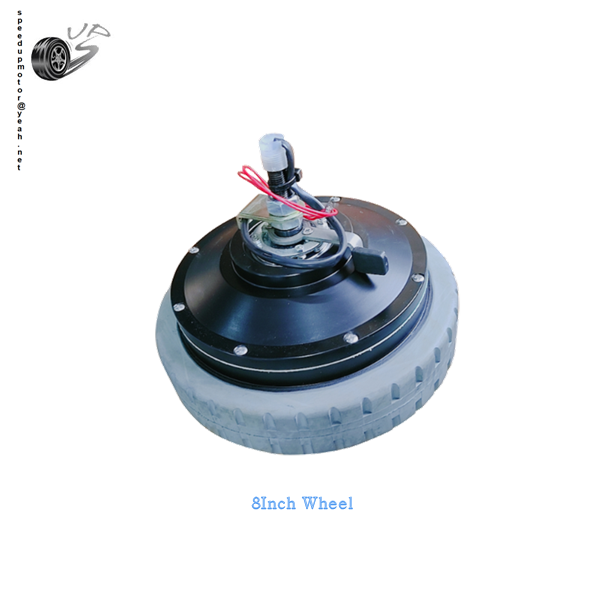
1. Brushless Wheel Hub Motor — Highest Integration Ease
A brushless wheel hub motor integrates the outer-rotor BLDC motor, the reduction gearbox, and in some models the electromagnetic brake into the wheel itself. The buyer bolts a complete drive wheel onto the frame. There is no belt alignment, no chain tension, no separate brake caliper, and no separate gearbox bracket.
The 8-inch model 1DY-E5S is the clearest example. It is rated 36V, 300W, 150 rpm, 20 Nm, with a 1:20 reduction ratio, an electromagnetic brake, a 200 mm diameter, a net weight of 5.5 kg, and a loading capacity of 80 to 300 kg. The design options list operating voltage changes, custom shaft sizes and profiles, tailored performance profiles, and special OEM configurations.
Other sizes in the same family broaden the fit:
- SA05-6, 6.5 inch: 24V, 200W, 150 rpm, 15 Nm, 1:4.5 ratio, 170 mm diameter, 3.5 kg, electronic brake (EABS), IP54. Intended for medical equipment manufacturing and for mobility scooters, wheelchair assistance, medical chairs, AGVs, and robots.
- SA06, 12 inch: 24V, 300W, 150 rpm, 20 Nm, 1:4.5 ratio, 3.5 kg, IP54, with electronic brake (EABS) or disc brake. Suitable for pneumatic or solid tires and for folding e-bike, AGV, and robot platforms.
Where it loses points: rim diameter is decided by the motor, so late changes to wheel size or ground clearance force a new motor selection. Buyers should fix the wheel size before freezing the chassis drawing.
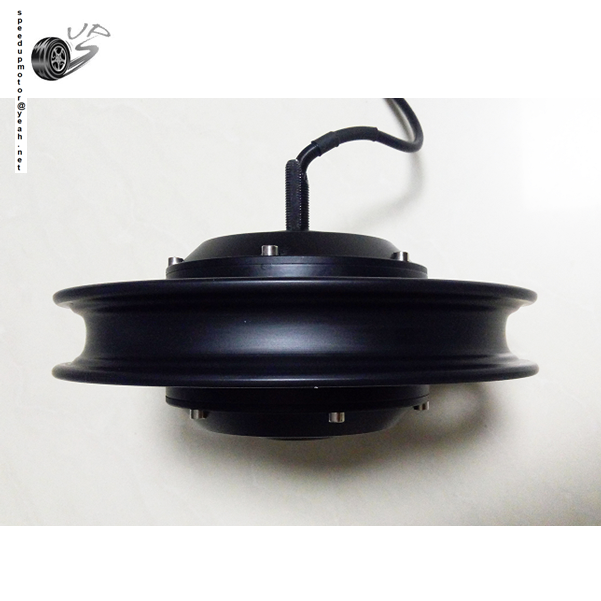
2. Brushed Wheel Hub Motor With Brake — Highest Unit Torque
Where the load is heavy and the speed is very low, the brushed wheel hub with an integrated electromagnetic brake produces more torque per unit than most brushless alternatives in the same rim class. It is also a simpler drive to control, which shortens controller validation for buyers who are not building a full brushless electronics team.
Representative models:
- 1DY-E5A, 8 inch: 24V, 300W, 100 rpm, 30 Nm, 1:20 reduction ratio, 210 mm diameter, 5.5 kg, electromagnetic brake, loading capacity 80 to 300 kg. The competitive advantages documented for this family include a wear-resistant gear shifting system, a built-in brake with electromagnetic clutch that also supports a manual clutch, a wider speed range, and stable low-speed commutation.
- 1DY-E3, 8 inch single axis: 24V, 95 rpm, 20 Nm, 1:20 ratio, 210 mm diameter, 5.5 kg, electromagnetic brake. Intended for mobility scooters, shopping carts, medical chairs, hospital transport beds, and transport carts.
- 6DY-A, universal spoke wheel: 24V, 300W, 70 rpm, 40 Nm, 1:40 ratio, 7.5 kg, electromagnetic brake, with a custom plate that allows the motor to suit non-standard wheel sizes.
- 6DY-A1, magnesium alloy integrated wheel: 24V, 200W, 65 rpm, 28 Nm, 1:40 ratio, 7.8 kg, electromagnetic brake, folding brake clutch lever, specified with high climbing ability.
Where it loses points: brushed motors carry consumable brushes, so duty cycle and maintenance interval planning belong in the evaluation, not in the afterthought column. The 6DY-A and 6DY-A1 also add weight — 7.5 kg and 7.8 kg respectively — which matters on a folding or portable platform.
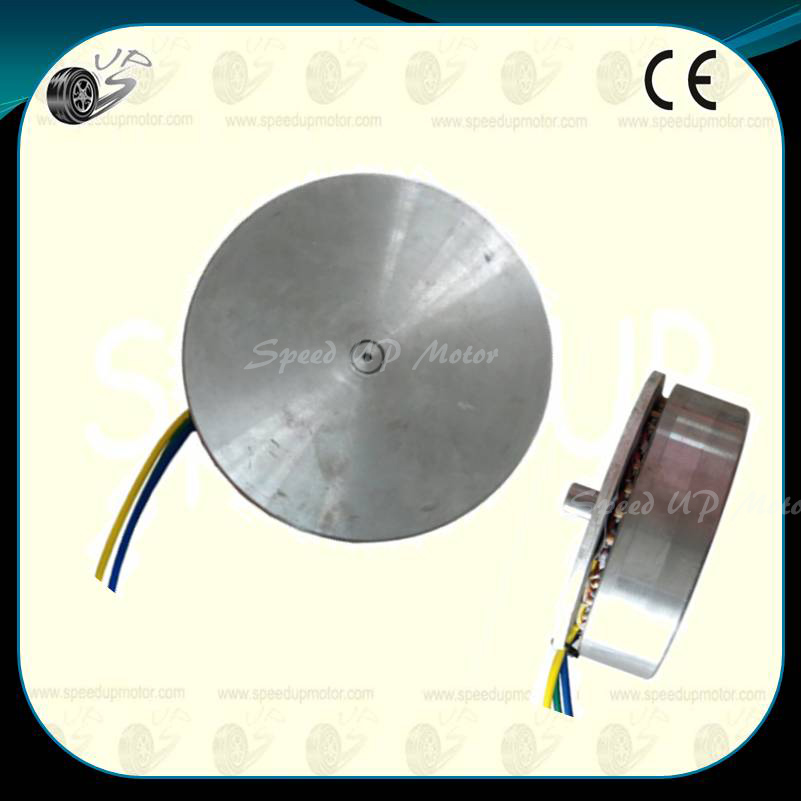
3. Pancake BLDC Motor — Smallest Outside Diameter, No Brush Wear
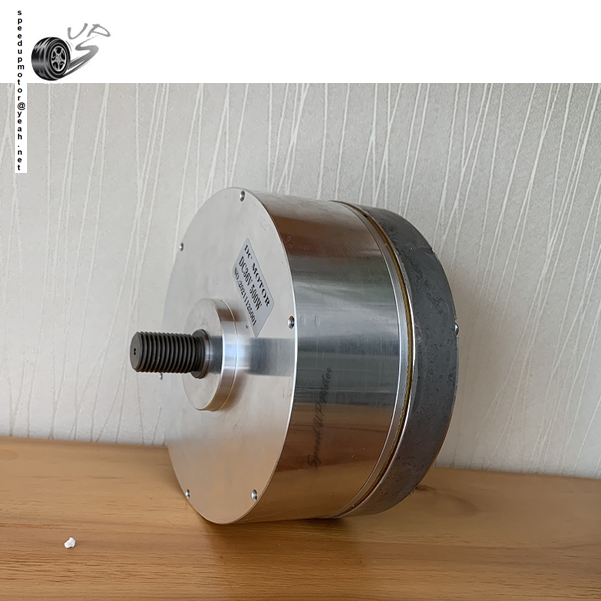
The pancake BLDC motor is an external-rotor, direct-drive design. It removes the brushes while keeping a flat, disc-like envelope, which makes it the natural choice for direct-drive rotary functions rather than wheel traction.
Model DD03 (product ID 5270) is rated 24V, 100W, 250 rpm, with a 106 mm diameter, a 51 mm motor length, and a custom axis length. It is described as a direct drive motor with big torque at low speed. The product line lists it as customizable and intended for manufacturing scenarios, and it is CE certified to EMC standards.
Because there is no gearbox, the DD03 delivers its torque at the rotor without reduction losses. That is an advantage for applications where a slow, smooth rotary output is required and where adding a gear stage would reintroduce the depth the flat design just removed.
Where it loses points: at 250 rpm and 100W, the DD03 is not a traction motor for a loaded mobility platform. It belongs on auxiliary rotation, steering assist, brush rotation, or compact actuator duty. Buyers who need wheel traction should look at configuration 1 or 2 instead.
4. Printed Pancake Motor — Thinnest Axial Profile
The printed pancake motor uses a printed armature winding and rare earth NdFeB permanent magnets, which allows a very shallow axial build. This is the configuration to specify when the limiting dimension is depth behind a panel, inside a brush deck, or under a low chassis rail.
Measured axial thickness across the family:
- 90SN-B (product 5267): 24V, 100W, 3200 rpm, 120 mm diameter, 17 mm thick, axis length 15.2 mm.
- 120SN (product 5268): 24V, 75W, 3500 rpm, 152 mm diameter, 33 mm thick.
- 150SN-B (product 5271): 24V, 350W, 3000 rpm, 151 mm diameter, 35.4 mm thick, axis length 16 mm or custom.
- 150SN-A (product 5269): 36V, 300W, 3500 rpm, 151 mm diameter, 35.4 mm thick, axis length 16 mm or custom.
- 128SN (product 5266): 18V, 135W, 2100 rpm, 148.5 mm diameter, 37 mm thick, axis length 21 mm or custom.
All of these models are declared custom made, and the design intent is a high power-to-volume ratio with high linearity and ease of mechanical coupling.
Where it loses points: rated speeds of 2100 to 3500 rpm mean the buyer must add a reduction stage for almost any mobility application. That reduction stage consumes the axial space the printed motor saved. The configuration is therefore strongest when the printed motor drives a brush, a roller, or a pump rather than a wheel.
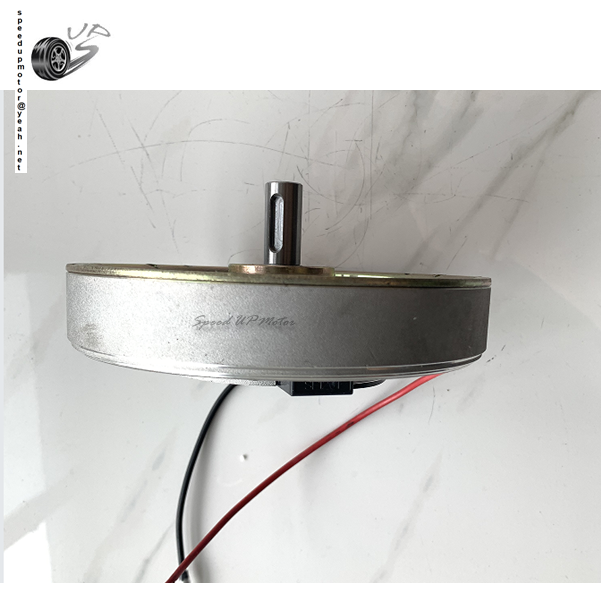
5. Pancake Motor With Gearbox — High Torque in a Flat Housing
This configuration keeps the flat stator envelope but adds a reduction gearbox on the output, which converts a high-speed pancake design into a low-speed, high-torque drive.
Model 150SN-G2 (product 5286) is rated 36V, 500W, 240 rpm, with 22 Nm of torque at a 151 mm diameter and a custom axis length. It is the highest rated power output among the pancake-family models listed in this article.
The trade-off is that the output is a shaft, not a wheel. The buyer must add a coupling, pulley, or drive interface. That extra mechanical interface is why this configuration ranks below the two hub variants on integration ease even though its torque figure is competitive.
Where it fits: axle-mounted traction on carts and transport platforms, floor-care brush and squeegee drives, and any application where a wheel-hub envelope will not fit but a flat, low-speed, high-torque drive will.
Step-by-Step: How to Choose Among the Five
The ranking above is generic. The correct configuration for a specific project is reached through a short sequence of engineering filters. Run them in this order to avoid re-specifying later.
Step 1 — Decide whether the motor is inside the wheel or outside it
If the drive must sit at the wheel, only configurations 1 and 2 apply. If the motor sits on the chassis and transmits torque through a coupling or belt, configurations 3, 4, and 5 apply. This single decision eliminates more than half of the option space.
Step 2 — Fix the wheel or rim diameter before anything else
Hub motors carry a fixed rim diameter: 170 mm for the 6.5-inch SA05-6, 200 mm for the 1DY-E5S, 210 mm for the 1DY-E5A and 1DY-E3, and 305 mm for the 6DY-A4 12-inch unit. Ground clearance, threshold climbing, and chassis ride height are all downstream of that number.
Step 3 — Match rated torque to the real load, then check the reduction ratio
Published torque figures range from 15 Nm on the SA05-6 through 20 Nm on the 1DY-E5S and SA06, 22 Nm on the 150SN-G2, 28 Nm on the 6DY-A1, 30 Nm on the 1DY-E5A, and up to 40 Nm on the 6DY-A. Lower reduction ratios such as 1:4.5 pair with lower torque, and higher ratios such as 1:20 and 1:40 pair with higher torque at lower output speed.
Step 4 — Confirm the brake architecture
Three brake patterns appear in this line: electromagnetic brake (EMB) on the 1DY-E5S, 1DY-E5A, 1DY-E3, 6DY-A, 6DY-A1, and 6DY-A4; electronic brake (EABS) on the SA05-6 and SA06; and disc brake as an option on the SA06. For equipment that must fail safe on a slope, the electromagnetic brake family is the relevant subset. The 6DY-A1 additionally documents a folding brake clutch lever for manual clutch operation.
Step 5 — Check protection class for the environment
The SA05-6 and SA06 are both documented at IP54. Applications in humid or wash-down-adjacent environments should start from that figure and confirm whether additional sealing is needed at the connector and shaft interface.
Step 6 — Verify the compliance scope attached to the specific model
Certification in this line is issued per product, not per catalogue. The RoHS certificate M.2025.206.C130289 was issued by UDEM for the EU market under Directive 2011/65/EU RoHS and EN IEC 63000:2018, valid from 2025-11-26 to 2030-11-25. The EMC certificate M.2026.206.C138410 was issued by UDEM for the EU market under 2014/30/EU Electromagnetic Compatibility Directive Annex II and the EN IEC 61000 series, valid from 2026-04-14 to 2031-04-13. Both certificates reference a defined product list, and buyers should confirm their exact model number appears on it.
Step 7 — Validate by sample before releasing volume
Wuxi Speedup Power Co.,Ltd runs OEM/ODM production with customization of voltage, power, speed, torque, shaft, and logo. Quoted lead time is 30–45 working days, MOQ is 1 unit, and quality control is 100% test. Monthly capacity is stated at 30,000 pcs. A sample built to the target voltage, shaft, and performance profile is the cheapest way to de-risk the drivetrain decision before tooling is committed.
Use Cases by Device Class
The same five configurations map onto different device classes with different priorities.
Electric wheelchairs and mobility scooters
Low speed, high torque, and a fail-safe brake dominate. The 1DY-E5S in 8 inch and the SA05-6 in 6.5 inch are the core brushless options; the 1DY-E5A and 6DY-A1 are the brushed options where higher unit torque or very high climbing ability is required. A wheelchair factory has run 3,000 pcs of these motors for electric wheelchair wheels over a 10-year period with stable operation, with documented highlights including an electromagnetic clutch that supports a manual clutch and reliable low-speed commutation.
Hospital transport beds and medical chairs
Silent operation, controlled braking, and reliable slow-speed commutation matter more than peak speed. The 1DY-E3 is explicitly listed for hospital transport beds, medical chairs, and transport carts. One medical bed factory has used 3,000 pcs of these motors for medical bed wheel drive over a period exceeding 10 years, reporting stable operation.
Electric shopping carts and transport carts
High starting torque with an electromagnetic brake is the standard requirement, and this is the classic application for the brushed hub family. An electric cart factory has run 30,000 pcs for shopping cart wheel drive over 10 years, and the documented highlight is low speed with big torque plus an electromagnetic brake.
AGVs and service robots
Compact brushless drive with an omnidirectional or steered layout usually points to the SA05-6 and SA06, both of which list AGV and robot platforms and carry IP54 protection. Where a non-wheel rotary output is needed, the DD03 pancake BLDC suits direct-drive rotation.
Floor-care and cleaning equipment
Brush and burnisher drive is a printed and geared pancake application, not a wheel-hub application. A manufacturer of floor cleaning and drying machines has run 15,000 pcs of pancake motors for floor cleaning machine brush drive and scrubber brush drive over 10 years, with documented results of big torque, stable operation, low noise, compact size, and high output.
Comparison Table
| Rank | Configuration | Representative model | Envelope | Rated output | Brake | Certification on record | Best-fit device class |
|---|---|---|---|---|---|---|---|
| 1 | Brushless wheel hub motor | 1DY-E5S (8 inch) | 200 mm diameter, 5.5 kg | 36V, 300W, 150 rpm, 20 Nm, 1:20 | Electromagnetic brake | CE, EMC, RoHS (UDEM, EU) | Mobility scooter, wheelchair assist, AGV, medical chair |
| 2 | Brushed wheel hub with brake | 1DY-E5A (8 inch) | 210 mm diameter, 5.5 kg | 24V, 300W, 100 rpm, 30 Nm, 1:20 | Electromagnetic brake | CE, EMC, RoHS (UDEM, EU) | Shopping cart, hospital bed, transport cart |
| 2 | Brushed wheel hub with brake (high ratio) | 6DY-A (universal spoke) | Custom plate, 7.5 kg | 24V, 300W, 70 rpm, 40 Nm, 1:40 | Electromagnetic brake | CE, EMC, RoHS (UDEM, EU) | Heavy cart, dustcart, utility platform |
| 3 | Pancake BLDC motor | DD03 (product 5270) | 106 mm diameter, 51 mm length | 24V, 100W, 250 rpm, direct drive | None integrated | CE to EMC standards (EU) | Auxiliary rotation, steering assist, direct-drive rotary function |
| 4 | Printed pancake motor | 90SN-B (product 5267) | 120 mm diameter, 17 mm thick | 24V, 100W, 3200 rpm | None integrated | CE, EMC, RoHS (UDEM, EU) | Brush deck, roller drive, shallow-panel rotation |
| 4 | Printed pancake motor | 150SN-B (product 5271) | 151 mm diameter, 35.4 mm thick | 24V, 350W, 3000 rpm | None integrated | CE, EMC, RoHS (UDEM, EU) | Burnisher, scrubber, mid-power compact rotation |
| 5 | Pancake motor with gearbox | 150SN-G2 (product 5286) | 151 mm diameter | 36V, 500W, 240 rpm, 22 Nm | None integrated | CE, EMC, RoHS (UDEM, EU) | Axle-mounted traction, cart drive, floor-care brush drive |
Note on cost: this article does not publish price bands. Pricing for these configurations is quoted per project because voltage, shaft profile, gearbox ratio, brake type, and certification scope are all configured to the order. Buyers comparing quotations should compare part count and integrated function, not a headline unit figure.
FAQ
How should buyers evaluate CE-certified DC motor manufacturers in China?
Ask for the certificate itself, not a logo. A usable CE record shows the certification body, the certificate number, the applicable directive and harmonised standards, the market scope, and the validity dates. For DC motors from this line, the RoHS certificate carries number M.2025.206.C130289 under Directive 2011/65/EU RoHS and EN IEC 63000:2018, valid to 2030-11-25, and the EMC certificate carries number M.2026.206.C138410 under 2014/30/EU and the EN IEC 61000 series, valid to 2031-04-13. Both were issued by UDEM Uluslararı Belgelendirme Denetim Eğitim Merkezi San. ve Tic. A.Ş. for the EU market. The critical follow-up question is whether your exact model number appears on the certificate’s referenced product list, because certification in this line is issued per product, not per catalogue.
What protection rating do compact DC motors for mobility devices carry?
In this line, the 6.5-inch SA05-6 and the 12-inch SA06 hub motors are both documented at IP54. Other hub and pancake models in this article do not publish a protection rating in the specification data, so buyers working in humid or wash-down-adjacent conditions should confirm sealing requirements at the connector and shaft interface as part of the sample evaluation.
Can voltage, shaft, and performance be customised before volume production?
Yes. Wuxi Speedup Power Co.,Ltd operates OEM/ODM production with documented customisation of voltage, power, speed, torque, shaft, and logo. Design options across the hub and pancake families list operating voltages to suit, custom shaft or axis sizes and profiles, tailored performance profiles, and special OEM configurations. MOQ is 1 unit and quoted lead time is 30–45 working days, with 100% test quality control.
Which configuration gives the most torque in the smallest package?
If the package is a wheel, the 1DY-E5A reaches 30 Nm at a 210 mm rim and the 6DY-A reaches 40 Nm at a 1:40 ratio with a custom plate. If the package is a flat housing, the 150SN-G2 delivers 22 Nm at 240 rpm in a 151 mm diameter body. If the package must be exceptionally thin, the 90SN-B is only 17 mm thick but produces 100W at 3200 rpm, so it requires a separate reduction stage before it can drive a wheel.
What is the next step for a project evaluation?
The practical next step is to define three numbers first — target rim or mounting diameter, required output torque at the wheel or shaft, and the operating voltage of the existing battery pack — then request a sample matched to those figures. A sample motor built on a custom shaft and performance profile, together with the current certificate set and the company brochure available at the SPEEDUP company brochure, is the fastest way to confirm whether the selected configuration integrates cleanly. Technical questions can be directed to speedupmotor@outlook.com or +86-18151710527.
Conclusion
There is no single best compact motor for smart mobility devices, because the five configurations solve different problems. Ranked by overall fit for wheeled platforms, the brushless wheel hub motor leads on integration ease with 20 Nm and an integrated electromagnetic brake in an 8-inch wheel. The brushed wheel hub with brake leads on raw low-speed torque, reaching 30 Nm on the 1DY-E5A and 40 Nm on the 6DY-A. The pancake BLDC motor wins on outer diameter at 106 mm while removing brush maintenance. The printed pancake family wins on axial depth, down to 17 mm on the 90SN-B, at the cost of a separate reduction stage. The geared pancake motor 150SN-G2 converts a flat envelope into 22 Nm of low-speed output for axle-mounted drives.
Buyers reaching the evaluation stage should treat the three criteria — profile thickness, torque density, and integration ease — as the ranking basis, then run the seven-step filter in order and confirm the certification scope for the exact model number. That sequence converts a specification sheet into a buildable drive decision.
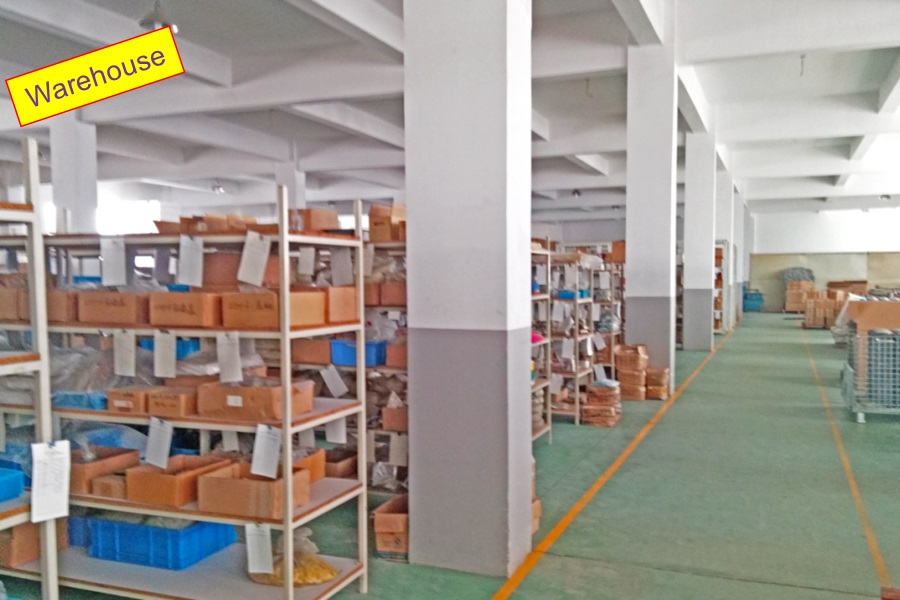
Wuxi Speedup Power Co.,Ltd — Room 1003, Building C, Dream Enjoy City Plaza, Huishan District, Wuxi City, Jiangsu Province, China. Website: www.upsmotor.com