
What Is a Pancake Motor? Slim Profile and Power Application
What Is a Pancake Motor? Understanding Its Slim Profile and Power Application
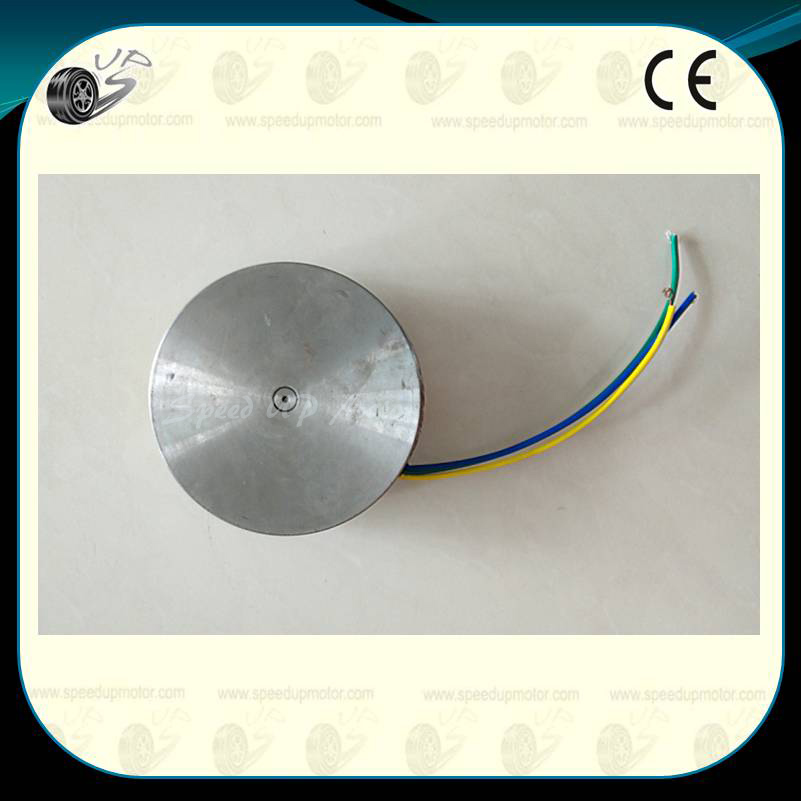
A pancake motor is a direct-current electric motor built around a flat, disc-shaped armature instead of a long cylindrical rotor. Its defining feature is axial length: the motor is deliberately thin along the shaft and wide across the diameter, so it fits into equipment where a conventional cylindrical DC motor cannot go. This explainer breaks down how that architecture works, how models such as the 120SN and the 150SN series achieve thin profiles while still delivering usable output power, and where the design trade-offs actually appear.
Problem Definition: Why Axial Length Decides Which Motor Fits
Most DC motor selection conversations start with voltage, power, and speed. In compact machine design, the constraint that eliminates the most candidates is usually none of those three. It is axial length — the distance the motor occupies along its own shaft.
A conventional cylindrical DC motor stacks an iron core, windings, and commutator end-to-end along the shaft axis. That stack is what makes the housing long. When the mounting envelope is shallow — a scrub-deck cavity under a floor washing machine, a low-profile welding head, a slim actuator pocket on a medical bed, a compact gearbox housing — the designer is not short of torque options. The designer is short of space along the shaft.
This is the specific gap pancake motor architecture addresses. The winding is not stacked into a cylinder; it is laid out as a flat disc. The magnetic circuit works across a short axial air gap instead of along an extended rotor length. The result is a motor whose thickness is measured in tens of millimeters while its diameter carries the electromagnetic work.
The practical selection question therefore changes shape. Instead of asking "how much power fits in this volume?", designers working in shallow envelopes ask a more precise question: what output power is available at a given axial thickness and diameter, and what does that choice cost in speed, gear requirement, and thermal headroom?
Industry Background: Where Compact DC Drives Sit Today
Compact motor demand does not exist in isolation; it tracks the equipment that needs it. Motor-driven medical beds and chairs, floor-care machines, mobility equipment, robotic platforms, and small industrial machinery all share a common pressure: the drive has to disappear into the machine, not define the machine's shape.
Sub-750 W motors illustrate how much of the market sits in that compact band. Grand View Research reports that the segment with output not exceeding 750 W accounted for 48.8% of global brushless DC motor market revenue in 2025, within a market it valued at USD 22.2 billion in 2025 and projected at USD 23.6 billion in 2026.
Two clarifications matter before that figure is applied to pancake motors. First, the figure describes the brushless DC motor market as a whole; it is not a pancake-motor market size, and no such segment figure is claimed here. Second, the overlap is directional: pancake architecture can be built as a brushed printed-armature motor or as a brushless direct-drive motor, so a meaningful share of sub-750 W demand is addressable by disc-type designs. The number is useful as context for why compact power classes dominate, not as proof of pancake motor volume.
The design-side context is the constraint itself. Equipment envelopes in medical, cleaning, and mobility applications are set by the end product, not by motor catalog conventions. When the envelope is shallow, a motor family that offers multiple power levels at similar thin axial dimensions becomes more useful than a single high-power model with a long body.

Detailed Solution: How Pancake Motor Architecture Actually Works
The architecture is best understood through three structural facts that distinguish a pancake motor from a conventional DC servomotor.
1. A slotless disc armature
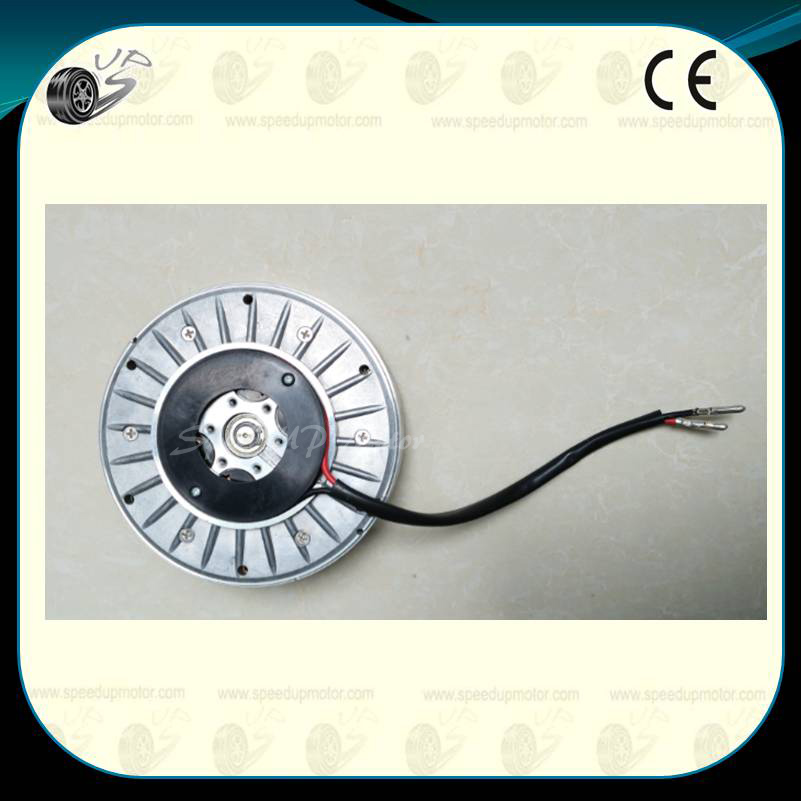
Wuxi Speedup Power Co.,Ltd describes its flat armature, printed motor, and pancake motor products as differing from conventional DC servomotors in their unique slotless disc armature design. That single structural choice drives most of the downstream behaviour. A disc armature places the electromagnetic working surface perpendicular to the shaft rather than parallel to it.
2. A printed winding instead of a wound core
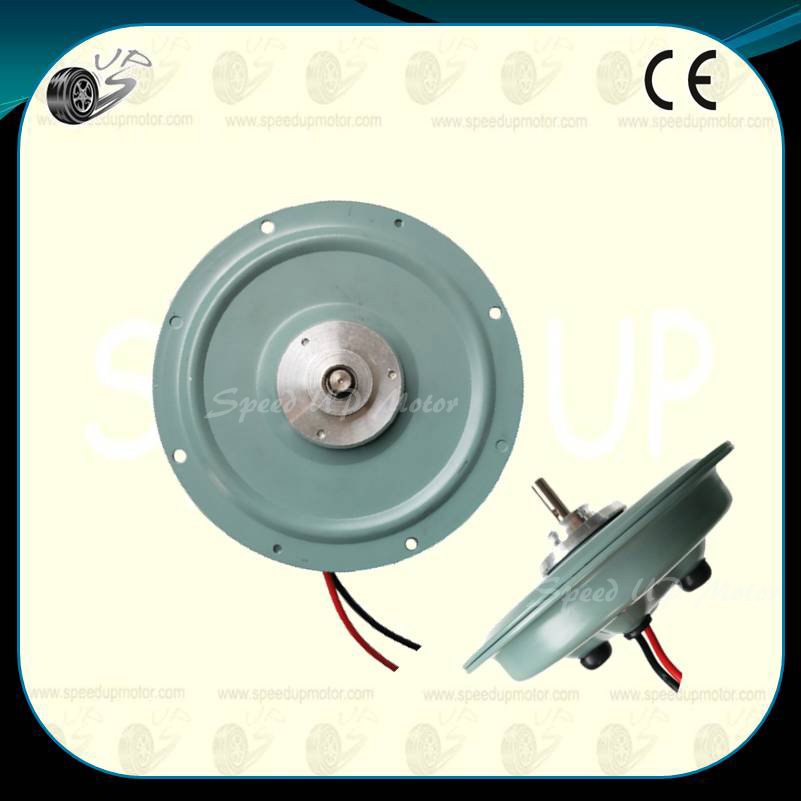
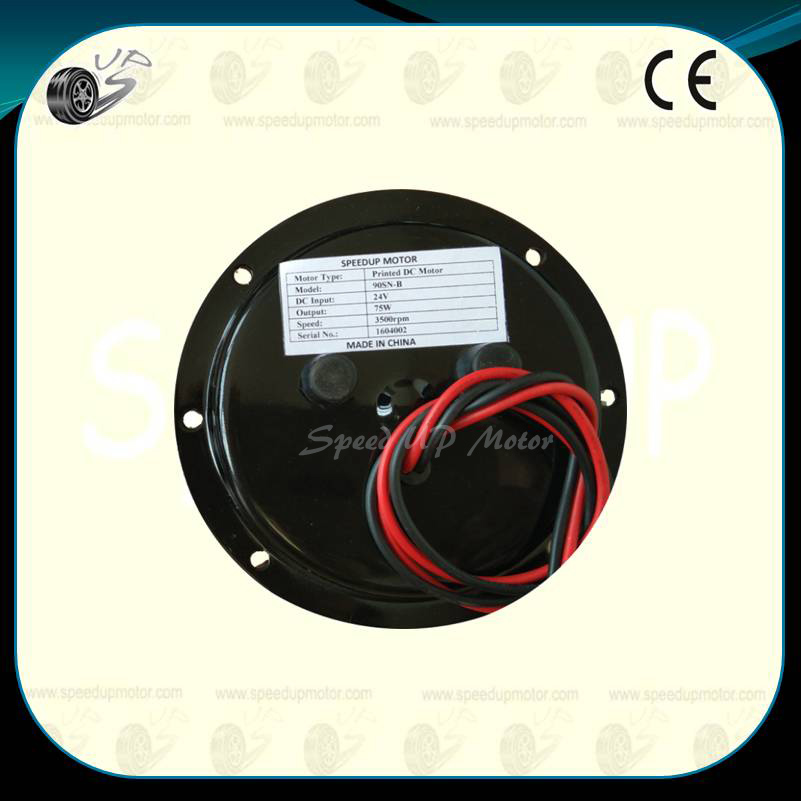
In printed-armature versions, the conductor pattern is formed as a thin flat winding rather than wound into slots in a steel cylinder. Product documentation for the 90SN-B describes it as a disc brushed DC printed winding motor; the 120SN is described as a printed armature motor. Because the conductor layer is flat, the axial build-up is dominated by the disc, the magnets, and the housing wall — not by a rotor stack.
3. Rare earth permanent magnets across a short axial gap
The magnetic field is supplied by rare earth NdFeB permanent magnets. The 128SN specification lists rare earth NdFeB permanent magnets as a construction material, and the company positions these motors around high power-to-volume ratio and high linearity. In a disc layout, magnet flux crosses the short axial air gap, which is why a thin motor can still produce meaningful torque.
Two architecture families, one thin envelope
Brushed printed-armature pancake motors cover the 120SN, 128SN, 90SN-B, 150SN-A, 150SN-B, and 150SN-G2 models, operating from 18 V to 36 V across 75 W to 500 W.
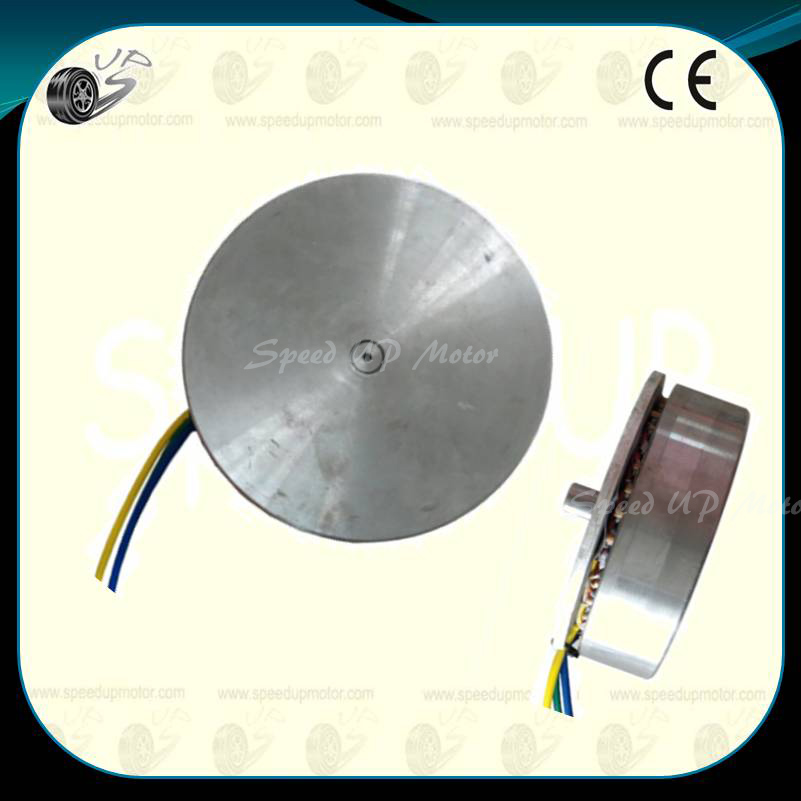
Brushless direct-drive pancake motors are represented by the DD03, a 24 V 100 W external rotor BLDC motor with a 106 mm diameter and 51 mm body length, rated at 250 rpm.
Both sit in the same thin-envelope design space, but they serve different control and maintenance expectations. Brushed versions are mechanically simpler; brushless versions remove brush wear but require electronic commutation.
Step-by-Step Breakdown: How a Thin Profile Is Achieved at Usable Power
The following sequence explains how the disc architecture converts into a shippable motor, using the 120SN and 150SN series as the reference examples.
Model-Level Evidence: Reading the 120SN and 150SN Data Correctly
Specification tables are only useful if the numbers are read in the right sequence. For pancake motors, the sequence is diameter and thickness first, then voltage and power, then speed and interface.
- 120SN (model 120SN-01): 24 V, 75 W, 3500 rpm, 152 mm diameter, 33 mm thickness, 52 mm axis length. Designed as a slim disc motor for welding machine applications. Materials are aluminium alloy, copper, and magnet. Customization is available.
- 90SN-B: 24 V, 100 W, 3200 rpm, 120 mm diameter, 17 mm thickness, 15.2 mm axis length. The thinnest body in this comparison set, achieved by trading diameter down along with thickness.
- 128SN: 18 V, 135 W, 2100 rpm, 148.5 mm diameter, 37 mm thickness, 21 mm axis length, rare earth NdFeB permanent magnets.
- 150SN-A: 36 V, 300 W, 3500 rpm, 151 mm diameter, 35.4 mm thickness, 16 mm axis length. Positioned for floor washing machine brush drive.
- 150SN-B: 24 V, 350 W, 3000 rpm, 151 mm diameter, 35.4 mm thickness, 16 mm axis length. Positioned as a burnisher motor.
- 150SN-G2: 36 V, 500 W, 240 rpm, 22 Nm torque, 151 mm diameter, gearbox integrated, customizable axis length.
- DD03: 24 V, 100 W, 250 rpm BLDC external rotor direct drive, 106 mm diameter, 51 mm body length.
A common misreading is to compare the 150SN-G2's 500 W against the 150SN-A's 300 W and conclude the geared unit is simply more powerful. The 500 W figure arrives with a 240 rpm output and 22 Nm torque — the gearbox converts speed into torque. The 150SN-A delivers 300 W at 3500 rpm, which is a fundamentally different duty point. These two motors are not substitutes; they answer different mechanical questions.
Use Cases: Where Thin-Profile DC Motors Earn Their Place
Floor washing and floor-care machines
Floor scrubber applications in Germany, Switzerland, the Netherlands, the UK, and Italy run low-to-medium speed, frequent start-stop, high-load duty in humid conditions, often in 24/7 continuous operation. Supporting equipment includes gearboxes, high-strength reduction gearboxes, EMB electromagnetic brakes, motor controllers, and wheel assemblies. Special requirements include condensation protection, electromagnetic compatibility grounding, brake debugging and safety distance control, and multiple voltage and power variants. The 150SN-A's 35.4 mm body addresses the brush-drive cavity constraint directly.
Welding equipment
The 120SN is specified as a slim disc motor for welding machine applications. In welding heads, the motor mounting axis is frequently the tightest dimension in the assembly, which is why a 33 mm body at 152 mm diameter is more relevant than a marginal torque gain from a longer motor.
Polishing and burnishing machines
The 150SN-B is positioned as a burnisher motor at 24 V, 350 W, and 3000 rpm in a 35.4 mm body. Surface-treatment tools share the same constraint as floor care: the motor sits under or inside the working head, so axial length competes directly with usable tool height.
Medical beds, chairs, and transport equipment
Medical equipment applications operate in low-to-medium speed, frequent start-stop, high-load conditions in humid environments, with 24/7 duty expectations. For hospital transport beds and medical chairs, drive motors typically interface with gearboxes, reduction gearboxes, EMB brakes, and controllers, and require condensation protection, EMI grounding, and controlled brake engagement. Wheel-integrated DC motors in the same project envelope — such as the 8-inch 1DY-E5A brush DC hub motor at 24 V with an electromagnetic brake and a 210 mm overall diameter — illustrate how the same thin-motor logic extends from the machine body to the wheel itself.
Mobile equipment and driven wheels
Where the motor is built into the wheel rather than mounted beside it, the pancake principle reappears in a different form. Examples in the same product family include the 6DY-A universal brushed hub motor at 24 V, 300 W, 40 Nm, 70 rpm, gear ratio 1:40, with an electromagnetic brake and 80–300 kg loading capacity; the 6DY-A4 12-inch wheel hub motor at 24 V, 200 W, 70 rpm, gear ratio 1:40 with a 305 mm solid tyre; and the 1DY-E5S 8-inch brushless hub motor at 36 V, 300 W, 150 rpm, 20 Nm, gear ratio 1:20, with a 200 mm solid tyre and electromagnetic brake.
Comparison Table: Pancake Motor Models Side by Side
All values below are model-level specifications published for Wuxi Speedup Power Co.,Ltd pancake and disc motor products. Thickness figures refer to the motor body only and exclude shaft extension.
| Model | Type | Rated Voltage | Rated Power | Rated Speed | Diameter | Body Thickness / Length |
|---|---|---|---|---|---|---|
| 90SN-B | Brushed, disc printed winding | 24 V | 100 W | 3200 rpm | 120 mm | 17 mm |
| 120SN | Brushed, printed armature | 24 V | 75 W | 3500 rpm | 152 mm | 33 mm |
| 128SN | Brushed, thin plate pancake | 18 V | 135 W | 2100 rpm | 148.5 mm | 37 mm |
| 150SN-A | Brushed, pancake | 36 V | 300 W | 3500 rpm | 151 mm | 35.4 mm |
| 150SN-B | Brushed, pancake | 24 V | 350 W | 3000 rpm | 151 mm | 35.4 mm |
| 150SN-G2 | Brushed pancake with gearbox | 36 V | 500 W | 240 rpm (22 Nm) | 151 mm | Gearbox integrated |
| DD03 | Brushless external rotor direct drive | 24 V | 100 W | 250 rpm | 106 mm | 51 mm |
Customization is listed as available across these models, including operating voltages, shaft/axis dimensions and profiles, and tailored performance profiles where specified.
Selection Criteria and Design Boundaries
A thin profile is a structural advantage, not a universal one. Three boundaries should be checked before a disc motor is specified.
Diameter becomes the new space constraint
Reducing axial length transfers the space requirement to the radial footprint. The 150SN series holds a 151 mm diameter, and the 120SN holds 152 mm. Where the envelope is narrow but deep, a cylindrical motor may still be the better fit. The pancake advantage applies specifically when the machine is short along the shaft and generous across it.
Speed and torque usually require a decision
Direct-drive disc motors in this comparison run from 2100 rpm to 3500 rpm. Low-speed, high-torque duties are met by adding a gearbox — the 150SN-G2 delivers 22 Nm at 240 rpm from the same 151 mm disc platform. Specifying a direct-drive unit for a low-speed, high-torque axis without a gearbox will produce an undersized result, even if the wattage looks adequate on paper.
Braking and compliance are separate specifications
An electromagnetic brake is not automatic on a pancake motor; it is a specified option on models that offer it, such as the 150SN-G2 gearbox configuration and the wheel-integrated 6DY-A, 6DY-A1, 1DY-E3, 1DY-E5A, and 1DY-E5S units. Likewise, CE, EMC, and RoHS certification applies to the relevant product families, not as a blanket statement across every model.
Frequently Asked Questions
What certifications apply to pancake motors?
Product documentation for the wheel hub and geared motor families lists CE, EMC, and RoHS certificates or approvals. Wuxi Speedup Power Co.,Ltd states that it holds certifications including CE, UL, and ISO9001-2008. Buyers should confirm certification status against the specific model and destination market rather than assuming a blanket certification across a product family.
Can a pancake motor be customized for a specific voltage, shaft, and performance profile?
Yes. Customization is listed as available across the pancake and disc motor models described here. Design options include operating voltages to suit the application, custom shaft and axis sizes and profiles, tailored performance profiles, and special OEM configurations. Axis length is already treated as a variable in standard specifications — 52 mm on the 120SN, 16 mm on the 150SN-A and 150SN-B, 21 mm on the 128SN — and is listed as customizable.
What is the minimum order quantity for a custom pancake motor?
Company-published commercial terms state a minimum order quantity of 1 unit for custom motor configurations, alongside OEM/ODM customization of voltage, power, speed, torque, shaft, and logo. Because MOQ and commercial terms are supplier-reported and can change by configuration, they should be reconfirmed in the quotation for the specific model.
Which specifications should be confirmed before requesting a pancake motor sample?
Confirm five groups before sampling: the mounting envelope (diameter and allowable axial thickness), the supply voltage and available current, the required output speed and torque at the actual load point, the shaft interface (length, profile, single or double shaft), and whether an electromagnetic brake or gearbox is needed. For floor-care and medical duties, also confirm condensation protection, EMI grounding requirements, and brake engagement behaviour.
What lead time applies to DC motor manufacturers producing pancake motors?
Company-published terms state a lead time of 30–45 working days for customized motor production. Lead time varies with configuration, quantity, and whether the model requires a new winding, a new shaft profile, or an integrated gearbox. Confirm the quoted lead time against the specific model and order volume before committing to a production schedule.
Conclusion: Matching Pancake Architecture to the Real Constraint
A pancake motor earns its place when axial length — not torque, not wattage — is the limiting dimension. The slotless disc armature moves the electromagnetic working surface perpendicular to the shaft, printed windings replace a wound cylindrical core, and NdFeB magnets work across a short axial gap. The result is a family of motors that hold 17 mm to 37 mm body thicknesses while covering 75 W to 350 W in direct form.
The 120SN shows the thin-profile case at its cleanest: 24 V, 75 W, 3500 rpm from a 33 mm body at 152 mm diameter. The 150SN series shows how output scales within the same envelope — 300 W at 36 V in the 150SN-A, 350 W at 24 V in the 150SN-B, and 500 W with 22 Nm at 240 rpm once a gearbox is added in the 150SN-G2. When the requirement turns brushless or moves into the wheel, the same logic continues through the DD03 external rotor direct-drive motor and the wheel hub motor family.
Wuxi Speedup Power Co.,Ltd, established in 2018, designs and manufactures pancake motors, BLDC motors, hub motors, and wheel motors for industrial and civil applications from a 10,000 m² facility with an annual production capacity of 30,000 pieces. The company's website is www.upsmotor.com.
Next Step: Validate the Motor Against Your Envelope
If the constraint in your design is axial thickness rather than torque, the fastest way to confirm fit is to test against your actual mounting dimensions, supply voltage, and load point.
- Sample request: specify diameter, allowable thickness, voltage, speed, torque, and shaft interface for the model under consideration.
- Quotation: include required certification, brake or gearbox requirements, and target annual volume.
- Custom motor inquiry: state whether the winding, shaft profile, or housing interface needs to change from the standard specification.
Contact: May Hoo | Email: speedupmotor@outlook.com | Tel / WhatsApp: +86-18151710527
Download the company brochure: SPEEDUP COMPANY PDF
Have Questions or Need More Details?
Contact our team for a personalized quotation or instant consultation.
Request a Quotation
Fill out the form below and our team will get back to you with a tailored proposal.
WhatsApp Direct Chat
Prefer to chat in real-time? Message us on WhatsApp for instant assistance & quick answers.
- Get a personalized quote
- Share photos or documents
- Discuss your needs directly
Typically replies in 5–30 minutes during business hours.