Application Guide: Skid-Mounted RCFD for Corrosive, Toxic and Heat-Sensitive Semiconductor Precursors

A skid-mounted Reacting-Crystallizing-Filtering-Drying (RCFD) system is a single transportable process train in which reaction, crystallization, filtration, washing, solvent removal and vacuum drying all take place inside one closed boundary, with piping, valves, instrumentation and controls mounted on the same frame. For semiconductor precursors that are corrosive, toxic or heat-sensitive, that closed boundary — not the nominal vessel volume — is the feature that decides whether the system is usable. The working rule: specify the hazard profile first, then the wetted material set, then the drying route, and only afterwards the capacity.
This guide is written for process engineers and procurement teams who have already passed the discovery stage and are now configuring a skid for a named precursor, with a defined hazard dossier, a target purity level and a required containment philosophy. It walks through component selection, project execution sequence, comparison of drying routes, and the compliance evidence that should be requested before a purchase order is released.
Wuxi Zhanghua Pharm & Chem Equipment Co., Ltd. is a Chinese equipment manufacturer founded in 1976 that designs and builds reaction, crystallization, filtration and drying equipment, including integrated skid-mounted process systems and filtration-washing-drying three-in-one units. Its skid-mounted RCFD platform (models SKS-50 / SKS-5000) is used in this guide as a practical reference framework for the configuration decisions described below.
Problem Definition: What Corrosive, Toxic and Heat-Sensitive Duty Actually Changes
Precursor duty changes four things in an RCFD at the same time: the wetted material set, the containment philosophy, the drying window, and the verification package. A configuration that is adequate for an aqueous pharmaceutical intermediate usually needs modification in all four before it can be considered for a semiconductor precursor.
- Chemical attack. Halogen-containing and strongly acidic process streams place chloride and fluoride stress on standard stainless steel and on every seal, gasket, filter cloth and instrument diaphragm in the loop. Material selection therefore starts from the wetted-parts list, not from the vessel shell alone.
- Toxicity and exposure. Where the precursor is highly toxic or high-potency, manual charging, sampling and cake discharge become the dominant exposure route. A skid must remove those operations, or move them behind a physical barrier, rather than rely on operator discipline.
- Thermal sensitivity. Many precursors have a narrow window between the temperature needed to remove residual solvent and the temperature at which degradation, colour change or decomposition begins. Jacket temperature control and vacuum level become quality variables, not utility settings.
- Purity and carry-over. Metal leaching, moisture and oxygen ingress, and cross-campaign residue all show up as product-quality excursions. They are addressed through wetted surface finish, closed transfer, and cleaning validation — not through final filtration alone.
The failure modes seen in practice are ordinary rather than exotic: a mechanical seal that tolerated water but not a chlorinated solvent; a filter medium that blinds after two batches; a hot jacket surface during vacuum drying; a sampling point that requires opening the system to atmosphere; a discharge valve that cannot be cleaned between campaigns. Each of these is a configuration decision that should be closed during engineering, not during commissioning.
Industry Background: Why Precursor Projects Are Moving to Skid-Mounted Trains
Demand for deposition and electronic-grade precursors is expanding, and that expansion is being met with contained rather than open processing. Published market research used for this guide points in the same direction. Meticulous Research estimates the semiconductor precursors market at USD 8.90 billion by 2036 (2026–2036 forecast). Grand View Research and Market Research Future data indicate that Agitated Nutsche Filter Dryer technology accounted for 51% of filtration and drying equipment revenue in 2023. QY Research projects the global ANFD market at USD 1,368.9 million by 2032.
The interpretation for buyers is straightforward. When filtration and drying are already dominated by a single contained technology, the differentiation between suppliers shifts away from the vessel itself and towards three things: how completely the train is closed, how the drying stage is matched to the material, and how much of the compliance evidence is issued as documentation rather than as a promise.
Supplier-side capability has moved in the same direction. Wuxi Zhanghua operates from a building area of more than 25,000 m², including 11 production workshops of nearly 15,000 m², a 4,000 m² office building and an 8,000 m² R&D building, with 96 employees, a 20-engineer R&D team and an annual output of 1,000 units; approximately 30% of output is exported. Two milestones are relevant to contained precursor processing: China's first double-cone rotary dryer in 1978, and China's first filtration, washing and drying three-in-one unit in 1999. The three-in-one unit is the direct architectural ancestor of today's skid-mounted RCFD trains, because it was designed from the outset to keep one batch inside one vessel from filtration through drying.
Detailed Solution: Configuring the Skid Around the Hazard Profile
Configuration should proceed in a fixed order, because each decision constrains the next. Sizing the reactor before the dryer is chosen, for example, usually produces a train in which the filter dryer becomes the bottleneck and the reactor is never fully utilised.
Reactor and crystallizer selection
The reactor establishes the chemistry envelope; the crystallizer establishes the particle size and filterability of the cake that the downstream stages must handle. Wuxi Zhanghua supplies reactors across the DFG50–DFG3000 range and crystallizers across 30 L–32,000 L. Customisation covers design pressure, working temperature, material, configuration, size, voltage and branding, which matters because precursor routes frequently run at pressures or temperatures outside standard API practice. In a skid-mounted train, reactor and crystallizer are sized together with the filter dryer: the batch volume that can be filtered and dried in a single pass sets the practical reactor size, and the crystallizer's cooling and agitation profile sets how that cake will behave.
Filtration: ANFD, Nutsche filter, or an integrated three-in-one unit
Filtration is where corrosive and toxic duty is most exposed, because it combines a large wetted surface, a filter medium, an agitation system and a discharge path in one place. The available configurations and their stated ranges are:
- Agitated Nutsche Filter Dryer (ANFD) — φ800–φ4600, combining filtration, displacement washing and drying in a single contained vessel.
- Filter Dryer — φ800–φ4600 for projects that separate the filtration-drying function from the reaction stage.
- Nutsche Filter — φ1000–φ5000 where filtration is the primary requirement and drying is handled elsewhere.
- Reacting-Crystallizing-Filtering-Drying unit — φ800–φ4600, the fully integrated option that keeps reaction through drying in one boundary.
Sealing quality is the point to test hardest in this stage. In 2023, Wuxi Zhanghua's three-in-one unit was among the first in China to pass official helium mass spectrometer leak detection certification, with a sealing standard below 1×10⁻⁹ Pa·m³/s. For a toxic precursor, that number is the difference between a containment claim and a measurable specification, and it should be requested as a test report rather than as a catalogue statement.
Drying route selection: conical screw, double cone, paddle, Nauta, oven, film evaporator
Drying is the stage most often mis-specified for heat-sensitive precursors, because the correct choice depends on how the wet cake behaves under vacuum rather than on how much water or solvent must be removed. Wuxi Zhanghua's process portfolio includes single cantilever co-rotating/self-rotating integrated single-cone mixing drying and paddle drying, described by the manufacturer as designed to improve batch-to-batch consistency and product stability in temperature-sensitive pharmaceutical and electronic-grade scenarios. The practical options are compared in the table below.
Containment, explosion protection and closed transfer
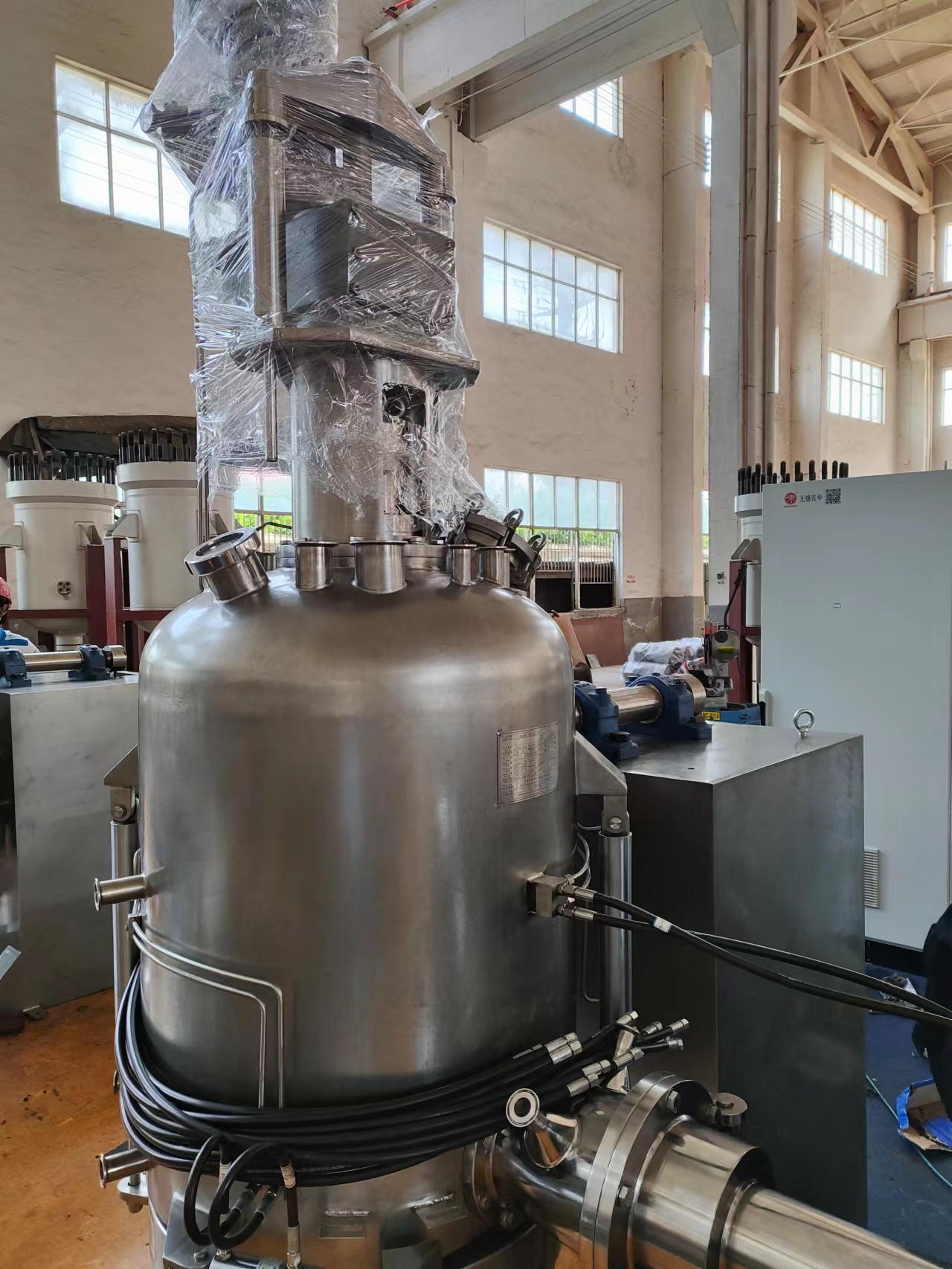
For flammable, explosive, toxic and hazardous processes, the safety architecture is an integrated package rather than an add-on: explosion-proof design, high-containment structures and fully automatic control, combined on the skid with solvent recovery and temperature control. The skid-mounted concept concentrates reaction, crystallization, decolorization, filtration, washing, drying, solvent recovery, temperature control and intelligent control into one frame, so that the number of open transfer points between stages is reduced to the minimum the process allows.
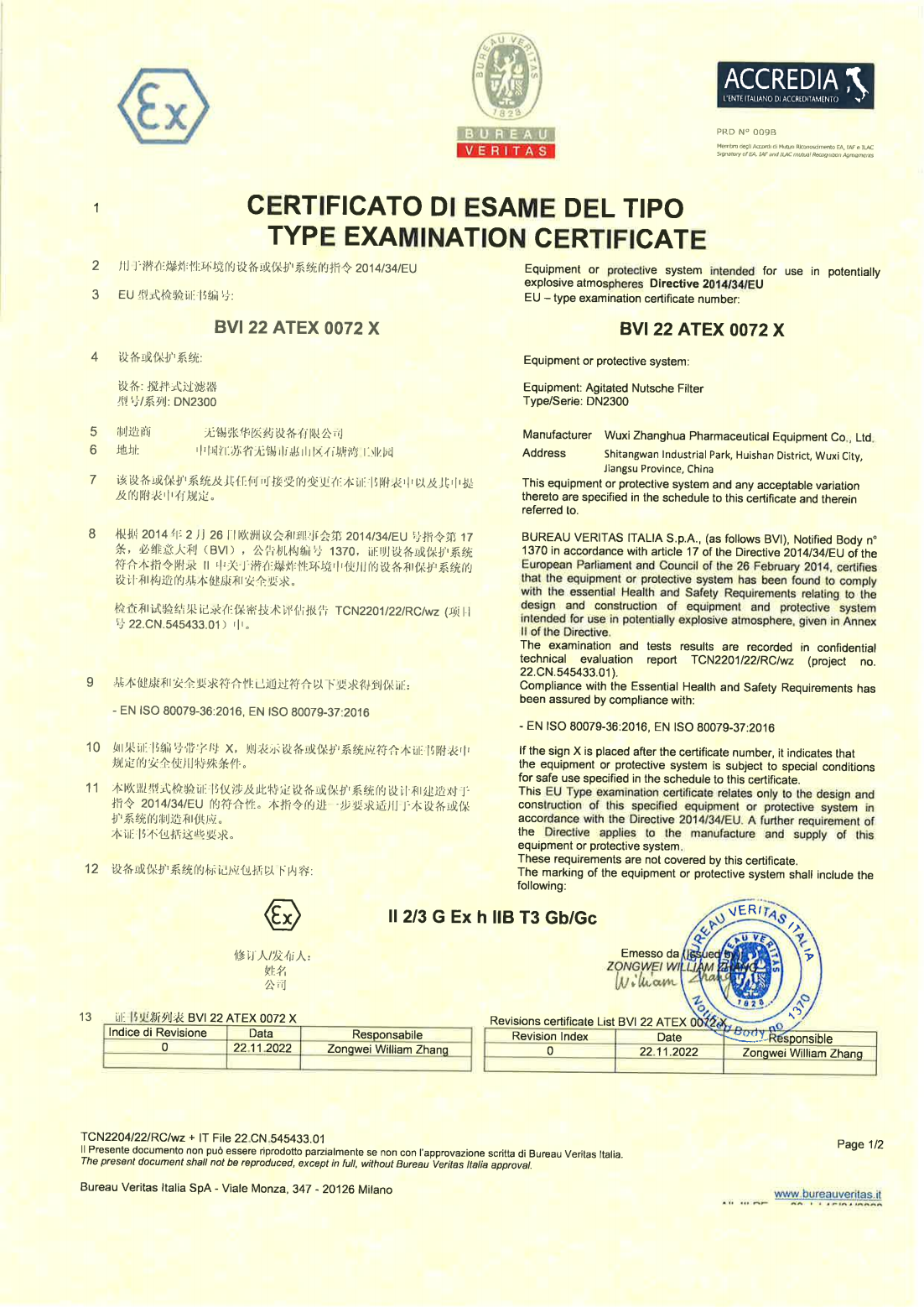
Explosion protection should be read from the certificate, not from the datasheet. The ATEX certificate BVI 22 ATEX 0072 X, issued by BV, covers an Agitated Nutsche Filter of DN2300 with the Ex marking II 2/3 G Ex h IIB T3 Gb/Gc under EN ISO 80079-36:2016 and EN ISO 80079-37:2016, valid to 21 November 2032. The equipment group, gas group and temperature class in that marking are configuration-specific; a project with a different solvent class or a different zone assignment must confirm that the certified marking still applies, or specify a new assessment.
Materials: Hastelloy, titanium composite and what decides the wetted set
Wuxi Zhanghua began applying special materials such as Hastelloy in 2005, and today offers special material solutions including titanium composite and Hastelloy as part of its selection support. Material choice is a function of the full wetted list — shell, internals, agitator, filter medium support, gaskets, instrument wetted parts, valve bodies and seat materials — and the weakest item in that list sets the service life of the train. For a corrosive precursor, the specification should name the alloy for each item rather than simply stating "corrosion resistant" for the assembly.
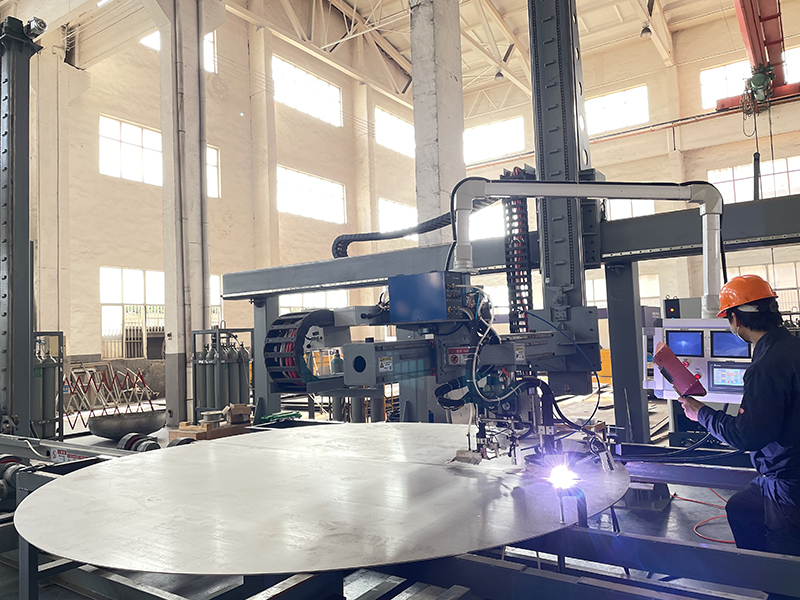
Fabrication quality is verified through non-destructive testing rather than visual inspection. Wuxi Zhanghua's work on pressure-equipment metallurgy includes participation as a core technical contributor to GB/T 30583-2026 (post-weld heat treatment of pressure equipment, with the indentation energy difference method written into Appendix G) and as one of the drafting units of T/CSTM 00824 (determination of residual stress in pressure equipment — indentation energy difference method). The associated Portable Micro-Indentation Tester PMA-1010 was developed with universities as a non-destructive way to test mechanical properties, residual stress and fracture toughness, and received a Gold Medal at the International Exhibition of Inventions of Geneva. For a buyer, the practical output is a residual-stress and NDT report that can be reviewed alongside the weld map.
CIP/SIP and cleaning validation
Between campaigns, the cleaning step is a quality control step. The skid's CIP/SIP design is intended to improve batch changeover efficiency and to meet the cleaning validation requirements of FDA, EMA and other regulatory frameworks. For precursor duty, three details deserve explicit review: whether the CIP coverage includes the filter medium housing and discharge path; whether SIP reaches the same surfaces under the specified conditions; and whether rinse-liquid sampling points are located where residue actually accumulates.
Certification pathway: ASME U, PED, CE, ATEX, MOM
Certification is a scope statement, not a badge. The certificates held by Wuxi Zhanghua and their stated scopes are summarised below, and each should be matched to the vessel size and destination market of the specific project.

Skid integration and turnkey scope
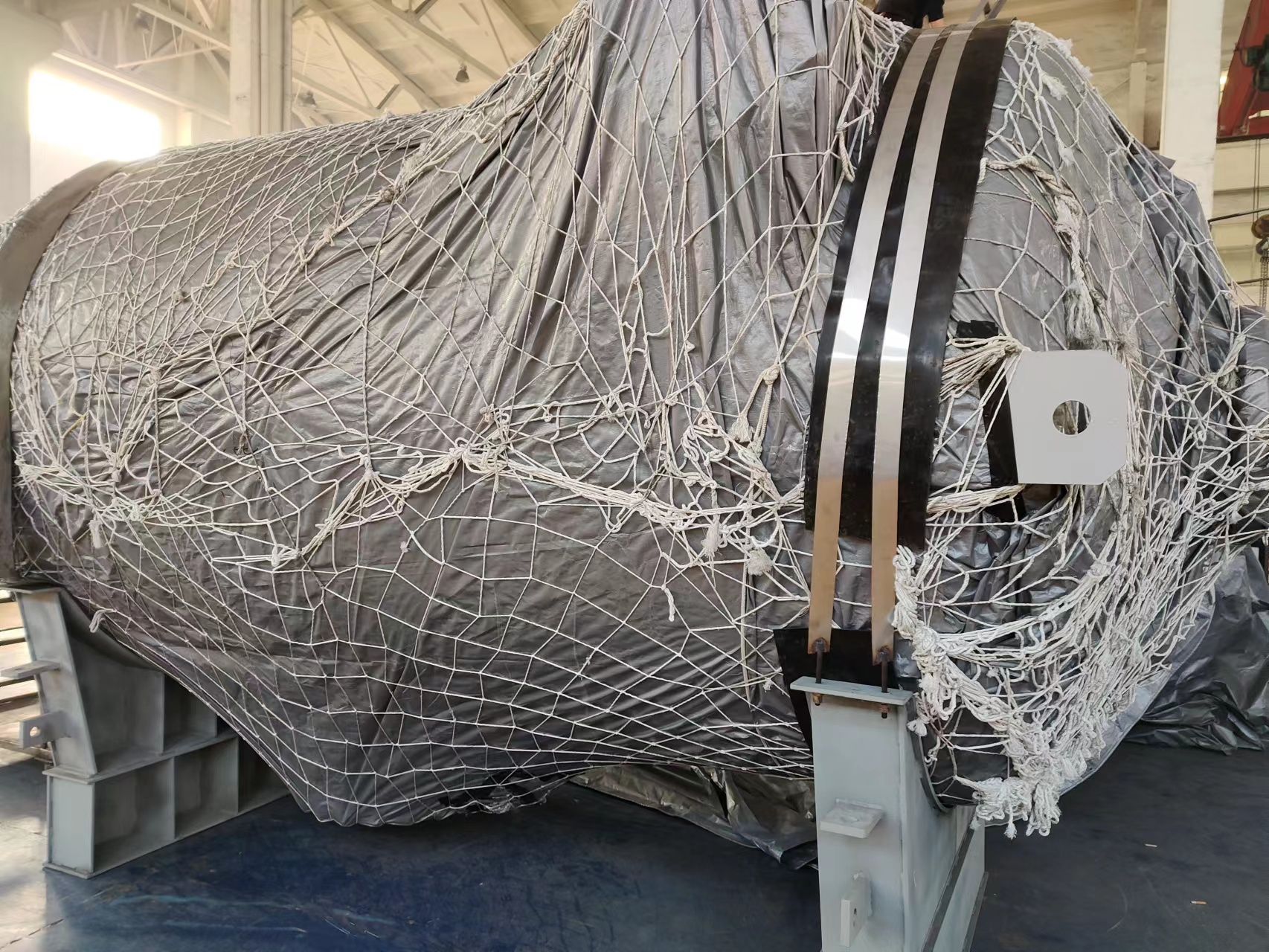
The skid-mounted RCFD models SKS-50 / SKS-5000 are supplied as an integrated system rather than as loose equipment. The turnkey scope covers equipment manufacturing, valves and piping, instruments and controls, control systems, skid fabrication, engineering design and system commissioning. Customisation for the platform covers voltage, logo, material, design pressure, working temperature, configuration and size, with a minimum order quantity of 1 unit and a stated lead time of 30–120 days. Where the project requires scale-up, the manufacturer has the capability to custom-design and manufacture equipment over 4 metres in diameter, supporting industrialisation from laboratory to ten-thousand-ton scale — a relevant point when a precursor route moves from pilot to commercial output without changing the containment philosophy.
Step-by-Step Breakdown: From Hazard Dossier to Commissioning
The sequence below is the execution path for a skid-mounted RCFD project. It assumes the precursor identity and target purity are already fixed; what changes at each step is the evidence the buyer should hold before moving to the next one.
- Assemble the material and hazard dossier. Document corrosivity, toxicity/high-potency classification, thermal degradation threshold, solvent class and moisture/oxygen sensitivity for each process stream. This dossier drives every later decision and should be issued to the supplier as a controlled document.
- Convert the dossier into a wetted-parts specification. Name the alloy for shell, internals, agitator, filter medium support, gaskets, valves and instrument wetted parts; state surface finish and cleaning requirements. Request the special material solution (titanium composite, Hastelloy) as a written proposal against this list.
- Select the filtration and drying architecture. Decide between ANFD, Filter Dryer, Nutsche Filter and the fully integrated Reacting-Crystallizing-Filtering-Drying unit using the cake behaviour, washing method and containment level — not by vessel volume. Confirm the drying route from the table in the next section.
- Fix the containment and explosion-protection concept. Define zone classification, gas group and temperature class, then confirm the certified Ex marking covers the configuration. Review whether sampling, discharge and filter-medium change-out can be performed without opening the boundary.
- Agree the skid layout and utility interfaces. Lock the positions of the reactor, crystallizer, filter dryer, solvent recovery, temperature control and control cabinet on the frame, and confirm the buyer's utility supply, floor loading, headroom and transport route against the skid dimensions.
- Define the verification package before fabrication. Specify helium leak detection (the three-in-one unit's certified sealing standard is below 1×10⁻⁹ Pa·m³/s), NDT reports, weld maps, residual-stress reports, CIP/SIP validation documentation and material certificates as contractual deliverables, not as post-order requests.
- Approve the factory acceptance test. The stated acceptance criterion is a pre-shipment test, supported by 100% testing in production. Witness the leak test, the agitation and discharge trial, the control sequence and the CIP cycle, and record the results against the specification.
- Commission and hand over. Delivery terms are FOB with payment terms of 40/60. On site, installation guidance and maintenance training are provided, followed by remote support and spare parts supply. Confirm the spare-parts list — particularly seals, gaskets and filter media — before the first campaign starts.
Use Cases: Where the Configuration Changes
The same skid platform is configured differently depending on which part of the duty dominates. The categories below show the shift in emphasis rather than a catalogue of identical systems.
- Semiconductor materials and electronic chemicals. Wetted material set and closed transfer dominate, because metal leaching and airborne contamination are the primary quality risks.
- Electronic specialty gas solid precursor separation and purification. Containment and vacuum integrity dominate; helium leak detection and joint design become the acceptance criteria.
- Photoresists. Temperature control and light/contamination exclusion dominate, with drying configured for heat-sensitive, low-residue removal.
- New energy battery materials (cathode, anode, electrolyte and solid-state battery functional additives). Throughput and washing efficiency dominate; filtration and drying are sized for high solids load.
- Precious metal catalysts, specialty polymers such as PVP, PEEK and PFEK, and high-end ceramic powders. Material compatibility and cleaning between campaigns dominate, because the same train often runs multiple grades.
- Pharmaceutical and high-potency intermediates. Containment and cleaning validation dominate. A Singapore pharmaceutical plant has operated 10 units for 8 years on storing, filtering, washing and drying of semi-finished drugs, with GMP-compliant design, fully automated control and high-purity processing reported as stable in operation.
Comparison: Drying Routes and Certificate Scope
Two comparisons matter most during evaluation. The first is the drying route, because it determines both product quality and how much manual intervention the train requires. The second is certificate scope, because a certificate that does not cover the vessel you are buying does not transfer any obligation to the supplier.
| Drying route | Stated model range | Where it typically fits | Points to verify |
|---|---|---|---|
| Conical Screw Vacuum Dryer | 150 L–13,500 L | Contained drying of heat-sensitive cake where gentle mixing and low shear are required | Shaft seal integrity, residual solvent, discharge design |
| Double Cone Dryer | 20 L–10,000 L | Free-flowing crystalline solids that dry well under tumbling action | Fill ratio, fines generation, jacket temperature uniformity |
| Paddle Dryer | ZPG-500–ZPG-6000 | Higher-solids cakes that need mechanical agitation and a large heat-transfer surface | Torque margin, crusting behaviour, cleanability of paddles |
| Nauta Conical Dryer | 150 L–13,500 L | Large-volume, low-shear blending and drying | Cycle time, discharge completeness, sampling access |
| Drying Oven (vacuum tray / vacuum oven) | ZDF-6–ZDF-30 | Small or delicate lots where agitation is not acceptable | Tray handling versus containment, drying uniformity |
| Vacuum Dryer | 150 L–13,500 L | General vacuum drying platform, configured to the material | Suitability for the specific precursor, control resolution |
| Heat-Sensitive Material Drying | 150 L–13,500 L | Materials with a narrow temperature window | Temperature mapping, control resolution, alarm logic |
| Corrosive Products Drying / Toxic Stimulating Material Drying | 150 L–13,500 L | Duties where the wetted set and containment, rather than throughput, set the design | Alloy verification, Ex marking, leak-test evidence |
| Film Evaporator | 1 m²–20 m² | Concentration and solvent stripping upstream of crystallization or drying | Residence time, thermal load, fouling behaviour |
Model ranges are as stated by the manufacturer. Route suitability is an engineering judgement to be confirmed against the material dossier.
| Certificate | Issuing body | Scope as certified | Validity |
|---|---|---|---|
| ASME U Stamp, No. 60130 | ASME | Manufacture of pressure vessels at the approved location (ASME Boiler and Pressure Vessel Code) | 10 May 2025 – 10 May 2028 |
| PED, CE-0062-PED-G-ZPE 001-26-CHN | BV | DN850 filter (pressure equipment), PED 2014/68/EU | 5 Jan 2026 – 4 Jan 2031 |
| PED CE (EU Type Examination), 556/5/2018 | TI | DN500 filtering, washing and drying machine; PED 2014/68/EU and ASME VIII Div. 1 (2015) | 1 Jun 2018 – 31 May 2028 |
| ATEX, BVI 22 ATEX 0072 X | BV | Agitated Nutsche Filter DN2300; Ex marking II 2/3 G Ex h IIB T3 Gb/Gc; EN ISO 80079-36:2016 and 80079-37:2016 | 22 Nov 2022 – 21 Nov 2032 |
| CE (Machinery Directive), IPC/ER/MD-24/108 | BV | 25 L rotary single cone vacuum dryer, model ZH-MD-25; Machinery Directive 2006/42/EC | 12 Mar 2025 – 11 Mar 2035 |
| MOM, INS/ER/PE-21/030 | BV | 200 L knock out pot (pressure vessel), ASME Section VIII Div. 1 and Singapore MOM requirements | 8 Oct 2021 – 7 Oct 2031 |
FAQ
Which certifications and verification documents should a skid-mounted RCFD for semiconductor precursors be supplied with?
The supplier's certificate set should be reviewed item by item against the vessel in your specification. Wuxi Zhanghua holds an ASME U Stamp (No. 60130, valid to 10 May 2028), PED certification under 2014/68/EU including CE-0062-PED-G-ZPE 001-26-CHN for a DN850 filter (valid to 4 Jan 2031) and EU Type Examination 556/5/2018 for a DN500 filtering, washing and drying machine (valid to 31 May 2028), CE under Machinery Directive 2006/42/EC (IPC/ER/MD-24/108, valid to 11 Mar 2035), ATEX BVI 22 ATEX 0072 X for an Agitated Nutsche Filter DN2300 with Ex marking II 2/3 G Ex h IIB T3 Gb/Gc (valid to 21 Nov 2032), and Singapore MOM INS/ER/PE-21/030 (valid to 7 Oct 2031). Separately from certificates, the verification package should include helium leak detection records — the three-in-one unit was certified in 2023 to a sealing standard below 1×10⁻⁹ Pa·m³/s — NDT reports and material certificates.
Can the reactor, filter dryer and drying stage be customised for a corrosive, toxic or heat-sensitive precursor?
Yes. Wuxi Zhanghua operates in OEM/ODM mode with customisation of voltage, logo, material, design pressure, working temperature, configuration and size. The configurable equipment includes reactors (DFG50–DFG3000), crystallizers (30 L–32,000 L), Agitated Nutsche Filter Dryers and Filter Dryers (φ800–φ4600), Nutsche Filters (φ1000–φ5000), Conical Screw Vacuum Dryers, Nauta Conical Dryers and Vacuum Dryers (150 L–13,500 L), Double Cone Dryers (20 L–10,000 L), Paddle Dryers (ZPG-500–ZPG-6000) and Film Evaporators (1 m²–20 m²). Special material solutions include Hastelloy, applied by the manufacturer since 2005, and titanium composite. For scale-up, the company has the capability to custom-design and manufacture equipment over 4 metres in diameter.
What drives the cost of a skid-mounted RCFD system, and what are the commercial terms?
Cost is driven mainly by the wetted material set (Hastelloy and titanium composite cost more than standard stainless steel), the containment and explosion-protection level, the drying route selected, the instrumentation and control scope, solvent recovery, and the amount of certification and verification documentation required. Commercial terms stated by the manufacturer are: minimum order quantity 1 unit, delivery terms FOB, acceptance criteria pre-shipment test, and payment terms 40/60. Because the skid is configured rather than catalogued, a meaningful quotation requires the hazard dossier and the wetted-parts specification first — a price given without them is not comparable between suppliers.
Can we test the process before placing a full-scale order?
Prototype testing and laboratory or pilot scale-up support are available, together with process adaptability analysis and selection calculation, case visits for similar materials, and quality verification documents including helium leak detection and NDT. Because acceptance is defined as a pre-shipment test, the practical validation path for a first project is: pilot or prototype trial on the candidate drying route, then a factory acceptance test on the full skid covering leak testing, agitation and discharge, control sequence and CIP cycle, before shipment.
How long is delivery, and what support continues after installation?
Stated lead time is 30–120 days depending on configuration and documentation scope, with a monthly capacity of 100 units. After installation, support covers remote assistance, spare parts supply, installation guidance and maintenance training. For a precursor project the most useful next step is a configuration review: send the hazard dossier and target purity, and ask for a proposed skid architecture, the matching certificate scope, and the verification document list that will be issued with the unit — the manufacturer's brochure is available at this download link.
Conclusion: The Skid Is a Specification, Not a Catalogue Item
For corrosive, toxic and heat-sensitive semiconductor precursors, a skid-mounted RCFD succeeds or fails on four decisions taken long before fabrication: the wetted material set, the containment and explosion-protection concept, the drying route, and the verification package. Capacity follows those decisions — it does not lead them. Where the process stream attacks standard stainless steel, where exposure must be removed rather than managed, where the drying window is narrow, and where a certificate's scope must match the vessel being purchased, the engineering conversation is the procurement conversation.
Wuxi Zhanghua's skid-mounted platform illustrates what to ask for in that conversation: definite model ranges for each stage, a documented sealing standard, named certificate numbers with stated scopes and validity dates, and a turnkey scope that runs from engineering design to system commissioning. Whether the eventual supplier is this manufacturer or another, the same evidence set should be requested in writing — and compared on scope rather than on headline claims.
Next Step: Configuration Review and Documentation Pack
Wuxi Zhanghua Pharm & Chem Equipment Co., Ltd. supports precursor projects with process adaptability analysis, special material proposals (titanium composite, Hastelloy), case visits for similar materials, prototype and pilot scale-up support, and integrated skid-mounted turnkey engineering.
Download the company brochure: Wuxi Zhanghua product and capability brochure (PDF)
Website: www.zhanghua1976.com
Contact: Vincent Zhang · vincent_zhang@zhanghuayaoji.com · Tel +86 181-1890-2332
Address: No. 8 Zhenshi Road, Shitangwan Industrial Park, Wuxi, Jiangsu Province, China
Have Questions or Need More Details?
Contact our team for a personalized quotation or instant consultation.
Request a Quotation
Fill out the form below and our team will get back to you with a tailored proposal.
WhatsApp Direct Chat
Prefer to chat in real-time? Message us on WhatsApp for instant assistance & quick answers.
- Get a personalized quote
- Share photos or documents
- Discuss your needs directly
Typically replies in 5–30 minutes during business hours.