Selecting Vacuum Drying Systems for Heat-Sensitive Semiconductor Precursors: Temperature, Vacuum, Agitation and Residence Time
Semiconductor precursors are among the highest-value materials processed in a chemical plant, and vacuum drying is the last unit operation that can still destroy them. A batch dried with a jacket set slightly too warm, held under vacuum longer than the material tolerates, or discharged through a line that shears its crystals can fail purity and particle-size specifications even when synthesis and crystallization were executed perfectly.
Short answer: selecting a vacuum drying system for heat-sensitive semiconductor precursors means resolving four parameters together — jacket temperature, vacuum level, agitation principle and residence time — and then matching that result to a dryer architecture. The four mainstream options are the conical screw vacuum dryer, the Nauta conical dryer, the paddle dryer and the double cone dryer. Where reaction, crystallization and filtration also take place on site, the drying chamber is usually best specified as part of an integrated Reacting-Crystallizing-Filtering-Drying (RCFD) system rather than as a stand-alone machine.
Conical screw vacuum dryer: slow orbital agitation renews the product against the heated cone wall under vacuum, which is the standard approach for cohesive, heat-sensitive precursor cakes.
Problem Definition: Where Conventional Drying Damages Heat-Sensitive Precursors
Adding heat until the solvent leaves is the wrong operating logic for a heat-sensitive precursor. The failure modes below are the ones that most often appear when a dryer is selected on batch volume alone.
- Degradation at the heat-transfer surface. In a jacketed dryer the wall runs hotter than the product bulk. A precursor with a narrow thermal window can decompose at the wall while the average batch temperature still looks acceptable.
- Solvent that cannot be removed by heat alone. Precursors are frequently crystallized from high-boiling or strongly coordinating solvents. The final fraction of solvent has to be pulled out by deep vacuum at low temperature, which is a vacuum-capability problem rather than a heating problem.
- Oxidation and hydrolysis. Many electronic-grade precursors react with oxygen or atmospheric moisture. Every transfer between vessels is an exposure event, and open tray handling multiplies them.
- Agglomeration, caking and attrition. High-shear agitation can fracture crystals and generate fines; static drying can bake a cake that then has to be milled, creating more fines. Particle-size distribution is a specification, not a by-product.
- Cross-contamination. Traces of a previous batch or a previous product are enough to fail electronic-grade purity. Internal surface finish and cleanability matter as much as drying capacity.
- Yield loss during handling. Product retained on trays, in filters or in transfer lines is lost product, and in this material class that loss is expensive.
Heat-sensitive material drying uses vacuum and low temperature together so that the product bulk never approaches its degradation threshold.
Industry Background: Why Dryer Selection Became a Technical Decision
Three published market signals explain why dryer selection has moved from a purchasing formality to a technical discussion.
- The global semiconductor precursor market was valued at USD 1.95 billion in 2025 and is projected to reach USD 3.89 billion by 2034, a compound annual growth rate of 10.0% (Intel Market Research). Rising volume raises the cost of every yield loss.
- The global Agitated Nutsche Filter and Dryer (ANFD) market was valued at approximately USD 4.5 billion in 2024 (Cognitive Market Research), and the ANFD segment accounted for roughly 35% of the total filtration and drying equipment market as of 2024 (Fortune Business Insights). Integrated filtration-drying equipment is now a mainstream choice rather than a niche one.
- The global filtration and drying equipment market was estimated at USD 1.39 billion in 2023, with a projected CAGR of 8.5% through 2030 (Grand View Research).
Those figures should not be read as one consistent number. The published scopes differ: Grand View Research measures the broader filtration and drying equipment category, while Cognitive Market Research values the ANFD sub-segment, and the resulting gap is a classification difference rather than a contradiction. Buyers comparing market claims from suppliers should check which classification is being quoted.
Regulatory scope also shapes design. Industrial pressure vessels such as ANFDs must comply with ASME Section VIII Division 1 for pressures above 15 psi and typically carry a U stamp certification, and machinery sold in the EU requires risk assessment per EN ISO 12100 and electrical safety compliance per EN 60204-1 for CE marking. These are design inputs, not paperwork added afterwards.
Wuxi Zhanghua Pharm & Chem Equipment Co., Ltd. is a pharmaceutical and chemical equipment manufacturer located at No. 8 Zhenshi Road, Shitangwan Industrial Park, Wuxi, Jiangsu Province, China. Founded in 1976, the company has nearly 50 years of experience in reaction, crystallization, filtration and drying equipment, and operates a building area of over 25,000 m² including 11 production workshops covering nearly 15,000 m², a 4,000 m² office building and an 8,000 m² R&D building. It employs about 96 staff, including a 20-engineer R&D team, and produces roughly 1,000 units of pharmaceutical and chemical equipment per year; approximately 30% of products are exported to markets in the Middle East, South America, Europe, North America, Asia Pacific and Belt and Road regions. Its cross-industry experience includes semiconductor materials and electronic chemicals, electronic specialty gas solid precursor separation and purification, photoresists, new energy battery materials and specialty polymers.
Detailed Solution: Matching Dryer Architecture to the Precursor
Four vacuum dryer architectures cover most heat-sensitive precursor duty. They differ less in the vacuum they can reach than in how they move the product, and that difference determines which materials each can protect.
Conical screw vacuum dryer
In a conical screw vacuum dryer the product is lifted and renewed by a slow orbiting screw inside a conical vessel, so the batch is repeatedly brought into contact with the heated wall while the chamber is held under vacuum. Wuxi Zhanghua's range covers 150 L to 13,500 L with an effective loading volume of 0.5–0.7, an agitator rotating speed of 5–30 rpm and an internal surface roughness of Ra ≤ 0.4–0.6 μm; explosion-proof grade ExdIIBT4 is available as an option. Because the screw moves product instead of shearing it, the design suits cohesive and pasty cakes where heat transfer would otherwise slow down. The supplier's documentation describes the range as integrating desolvation and dehydration in one machine, handling paste, powder and other material forms, discharging quickly without residue, resisting corrosion and higher pressures, and running with low maintenance cost.
Nauta conical dryer
A Nauta conical dryer applies the same conical, slow-agitation principle and is offered by Wuxi Zhanghua over the same operating envelope: 150 L to 13,500 L, effective loading volume 0.5–0.7, agitator rotating speed 5–30 rpm, internal surface roughness Ra ≤ 0.4–0.6 μm, with ExdIIBT4 available as an option. In the supplier's positioning it is aimed at heat-sensitive materials with uniform heating and high efficiency, closed vacuum operation with dust-free handling, GMP-oriented pharmaceutical duty, and powder and granule drying in chemical, pharmaceutical and food applications, with a compact structure.
For a buyer, the practical distinction between the two conical options is rarely machine size; it is the condition of the cake. A free-flowing crystalline precursor that simply has to be dried without damage will run well on either. A cohesive, sticky or paste-forming cake that resists mixing is where agitation strategy and loading factor should be confirmed against a pilot trial rather than assumed.
Paddle dryer
The paddle dryer trades vessel volume for heated surface. Wuxi Zhanghua's ZPG series runs from ZPG-500 to ZPG-6000 with a working volume of 300–3600 L, a heating area of 3.2–16.5 m², a mixing speed of 8–18 rpm and an electrical motor power of 4–22 KW. A large heat-exchange area and conduction heating give high thermal efficiency and recoverable waste heat, and residence time and final moisture can be adjusted — which is why the design is often chosen where drying must be continuous and moisture control is a production requirement. The trade-off is that conduction heating delivers more energy per unit of vessel surface. Paddle dryers are therefore best applied where the precursor's thermal window tolerates a warmer wall, or where wall temperature can be tightly controlled and monitored.
Double cone dryer
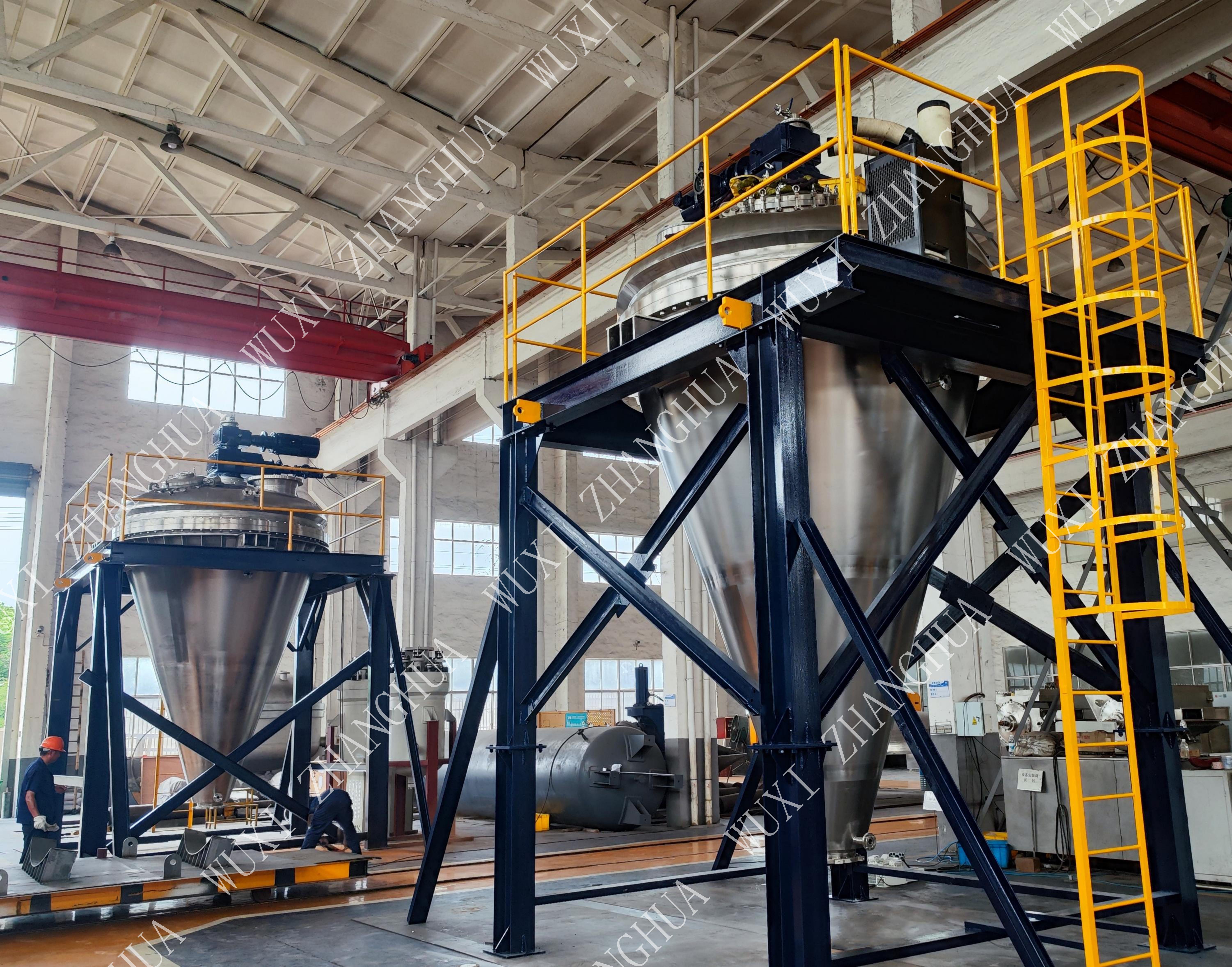
The double cone dryer is the gentlest option and the oldest design in this group; Wuxi Zhanghua built China's first double-cone rotary dryer in 1978. Today's range covers 20 L to 10,000 L with a charging coefficient of 0.4–0.6, a surface roughness of Ra ≤ 0.6 μm, a rotating speed of 4–10 r/min and a motor power of 1.5–15 KW, with ExdIIBT4 available as an option. The vessel itself rotates, so the product tumbles under vacuum with almost no shear — attractive for flammable, oxidizable and heat-sensitive materials, and for products whose crystal shape must be preserved. The limitation is the absence of internal agitation: heat transfer depends on tumbling action renewing contact with the wall, so fine or sticky cakes dry more slowly. Wuxi Zhanghua's product documentation for its conical vacuum dryer states an efficiency 3–5 times that of an ordinary double-cone dryer; that is a supplier-stated figure and is best verified against a specific wet cake in a pilot test rather than accepted as a general rule.
Nauta conical dryer: closed-vacuum, dust-free operation with uniform heating, positioned for heat-sensitive powders and granules.
Paddle dryer: conduction heating across a 3.2–16.5 m² heating area allows residence time and final moisture to be adjusted during continuous drying.
When the dryer should be part of an integrated RCFD system
If the precursor is reacted, crystallized and filtered in the same plant, every transfer between those steps is an exposure event and a yield-loss point. Integrating the operations into one closed machine removes most of them. The Agitated Nutsche Filter Dryer platform in Wuxi Zhanghua's range runs from φ800 to φ4600 with a capacity of 0.6–30 m³, a filter area of 0.5–16 m², a mix-blend travel route of 250–550 mm and an electrical motor power of 4–75 KW, carrying filtration, washing and drying in a single closed vessel.
The company built China's first filtration, washing and drying three-in-one unit in 1999, and in 2023 that unit family was among the first in China to pass official helium mass spectrometer leak detection certification, with a sealing standard below 1×10⁻⁹ Pa·m³/s — a verifiable containment figure for aseptic production and high-potency material handling.
For higher-potency, toxic or hazardous processes, the same functions can be delivered as an integrated skid-mounted system. Wuxi Zhanghua's SKS-50/SKS-5000 systems integrate reaction, crystallization, decolorization, filtration, washing, drying, solvent recovery, temperature control and intelligent control, with skid dimensions from 1000–10,000 mm in length, 1000–3200 mm in width and 1000–4000 mm in height, and total skid weights from 3 to 50 t, built to GB or ASME codes. Materials of construction across the dryer range include SS304, SS316L, titanium, Hastelloy and PTFE lining; the company began applying special materials such as Hastelloy as early as 2005.
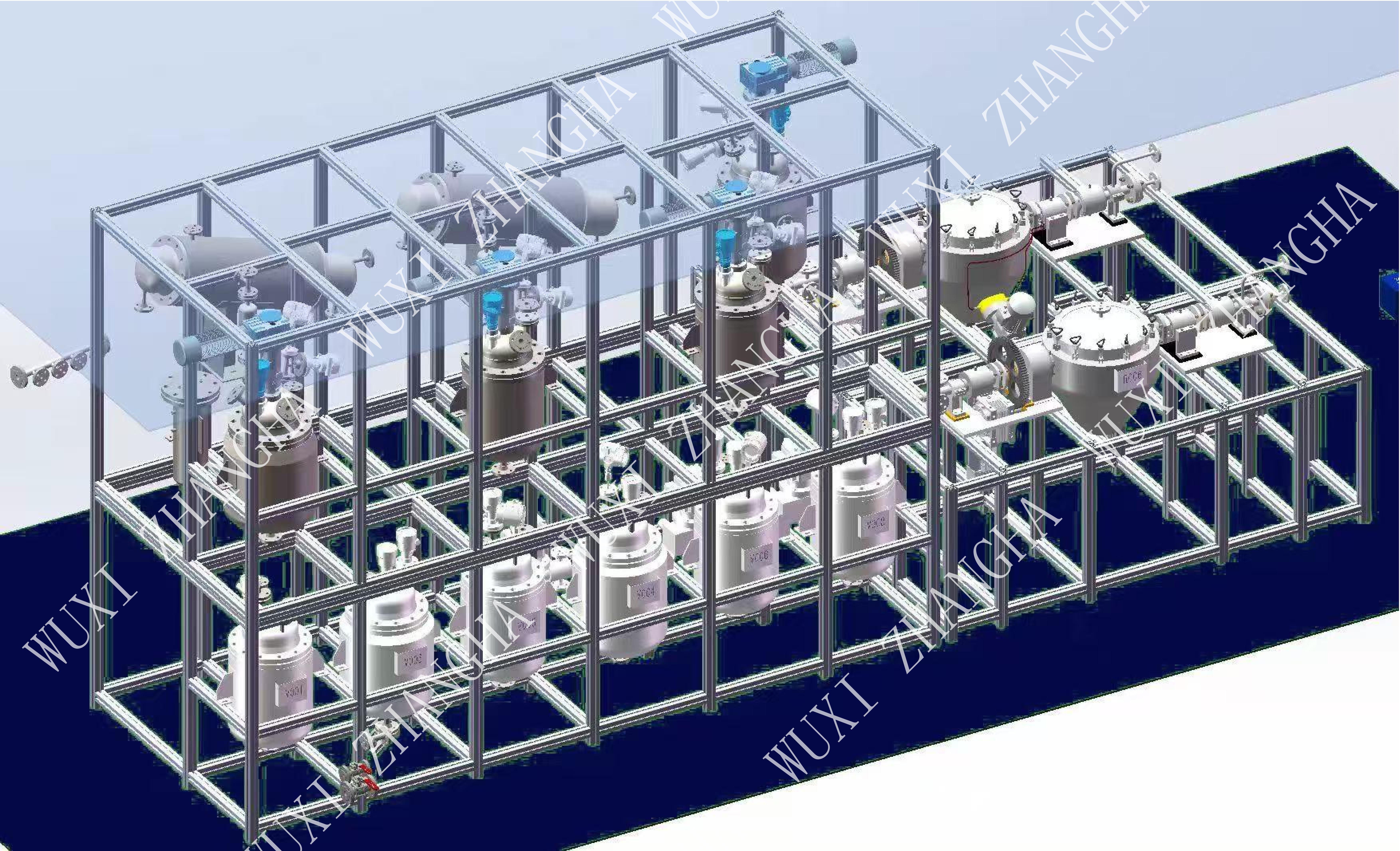
Skid-mounted RCFD production system: reaction, crystallization, filtration, washing, drying, solvent recovery and control integrated on one frame to remove transfer steps.
Step-by-Step Breakdown: How to Specify the System
The following seven-step sequence is the order in which a heat-sensitive precursor drying system should be specified. Reversing it — choosing equipment first and fitting the process to it afterwards — is the most common source of scale-up problems.
- Characterize the wet cake before anything else. Solvent identity and boiling point, residual moisture target, thermal decomposition threshold, particle-size and crystal-shape requirements, and toxicity or corrosivity classification. This data set determines every later decision.
- Fix the product temperature ceiling. Define the maximum temperature the precursor can experience, then work back to a jacket temperature that keeps the wall below the point where local degradation begins. Product temperature is the controlled variable; the jacket setpoint is only the means of achieving it.
- Set the vacuum target from the solvent, not from the datasheet. Achievable vacuum determines the boiling point of the solvent at the permitted product temperature. If the required vacuum cannot be held under load while solvent is evolving from the batch, the cycle lengthens and thermal exposure increases.
- Choose the agitation principle against how the cake behaves. Free-flowing granules and crystals that must not be damaged point toward gentle tumbling. Cohesive or paste-forming cakes that resist mixing point toward slow orbital or screw agitation that renews the heated surface. Where drying must be continuous and moisture control is critical, conduction-based paddle designs come into consideration, with wall temperature limits checked explicitly.
- Define residence time, batch size and filling factor together. Loading is not a free variable: the conical ranges operate at an effective loading volume of 0.5–0.7 and the double cone dryer at a charging coefficient of 0.4–0.6. Oversizing a vessel for throughput while under-loading it changes heat-transfer behaviour and drying uniformity.
- Specify materials, surface finish, containment and certification. Internal roughness such as Ra ≤ 0.4–0.6 μm on the conical and filter-dryer ranges supports cleanability and reduces residue; SS316L, titanium, Hastelloy or PTFE lining addresses corrosion; ExdIIBT4 explosion-proof construction is an available option on the conical screw, Nauta conical, double cone and heat-sensitive, toxic and corrosive vacuum dryer ranges. Certification scope — EU CE, PED, MD and LVD, US ASME U Stamp, Singapore MOM — should be fixed here because it affects fabrication and documentation.
- Validate the cycle at laboratory or pilot scale, then scale the validated recipe. Process adaptability analysis, prototype testing and lab/pilot scale-up support exist to de-risk this step. The equipment range supports scale-up from laboratory to ten-thousand-ton scale, including custom-designed units over 4 m in diameter.
Use Cases
The same selection logic appears across several precursor-adjacent duties.
- Semiconductor and electronic chemical purification. Wuxi Zhanghua's cross-industry experience covers semiconductor materials and electronic chemicals, electronic specialty gas solid precursor separation and purification, and photoresists — duties where the last fraction of solvent must leave without raising product temperature.
- New energy battery materials. The high-nickel ternary cathode (NCM) material market was valued at USD 18.6 billion in 2025, driven by EV battery density requirements (Dataintelo). NCM precursor filtration and drying is a directly comparable duty to semiconductor precursor processing, and the company's filtration, washing and drying three-in-one equipment has been applied to ternary precursor production.
- Contained drying of toxic or stimulating intermediates. Low-temperature technique limits volatilization of toxic substances, equipment must be explosion-proof and corrosion-resistant, and the operation should run in a dedicated area with ventilation rather than sharing space with other products.
- Corrosive product drying. Acids, alkalis and salts require corrosion-resistant construction, uniform drying that prevents localized overheating, and closed operation so materials are not exposed to the environment and secondary contamination is avoided.
- Pharmaceutical and API wet cakes. API wet cake vacuum drying, antibiotic wet cake drying and contained high-potency drying follow the same logic: a closed vessel, a controlled thermal envelope and a validated cleaning regime.
Comparison Table: Published Operating Envelopes
The table compares the operating envelopes published for the vacuum drying platforms discussed above. These figures describe equipment capability, not process outcomes for a specific precursor; confirmation for any given material still requires a trial.
| Dryer type | Batch / capacity envelope | Agitation or rotation | Loading factor | Internal surface finish | Typical fit |
|---|---|---|---|---|---|
| Conical screw vacuum dryer | 150 L – 13,500 L | Agitator 5–30 rpm | Effective loading volume 0.5–0.7 | Ra ≤ 0.4–0.6 μm | Cohesive and pasty cakes; desolvation and dehydration in one machine; fast discharge without residue |
| Nauta conical dryer | 150 L – 13,500 L | Agitator 5–30 rpm | Effective loading volume 0.5–0.7 | Ra ≤ 0.4–0.6 μm | Heat-sensitive powders and granules; uniform heating; closed vacuum, dust-free; GMP-oriented duty |
| Paddle dryer (ZPG-500 – ZPG-6000) | Working volume 300–3600 L; heating area 3.2–16.5 m² | Mixing speed 8–18 rpm; motor 4–22 KW | Not specified in source data | Corrosion-resistant and hygienic design | Continuous conduction drying where residence time and final moisture must be adjustable |
| Double cone dryer | 20 L – 10,000 L | Rotating speed 4–10 r/min; motor 1.5–15 KW | Charging coefficient 0.4–0.6 | Ra ≤ 0.6 μm | Free-flowing granules and crystals; flammable and oxidizable materials; low-shear, shape-preserving drying |
| Agitated Nutsche Filter Dryer / RCFD (φ800 – φ4600) | Capacity 0.6–30 m³; filter area 0.5–16 m² | Mix-blend travel route 250–550 mm; motor 4–75 KW | Not specified in source data | Ra ≤ 0.4–0.6 μm | Filtration, washing and drying in one closed vessel; integrated multi-step duty |
| Skid-mounted RCFD system (SKS-50 / SKS-5000) | Skid 1000–10,000 mm long, 1000–3200 mm wide, 1000–4000 mm high; 3–50 t | Integrated automated control | Not specified in source data | SS304, SS316L, titanium, Hastelloy, PTFE lining | Multifunctional integration of reaction, crystallization, filtration, washing, drying and solvent recovery; GB or ASME codes |
Loading is stated as effective loading volume for the conical ranges and as charging coefficient for the double cone dryer. Explosion-proof grade ExdIIBT4 is listed as an option where stated in the source specifications. Materials of construction across these ranges include SS304, SS316L, titanium, Hastelloy and PTFE lining.
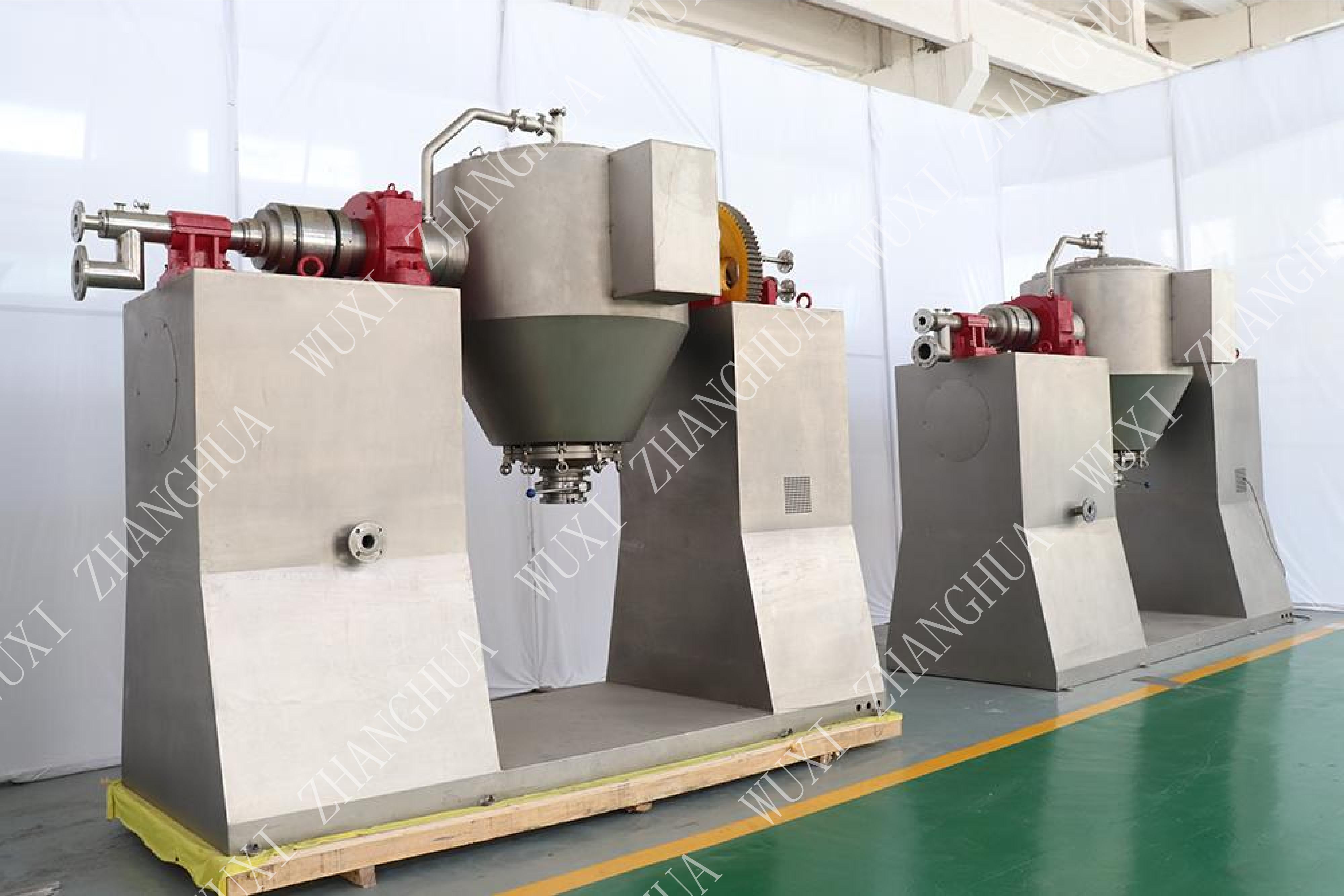
Double cone dryer: the rotating vessel tumbles the product under vacuum with minimal shear, which protects crystal shape in flammable and oxidizable materials.
FAQ
What certification and containment documentation should a vacuum drying system for semiconductor precursors provide?
Pressure equipment should comply with ASME Section VIII Division 1 and carry a U stamp where pressures exceed 15 psi; CE marking for EU installation requires risk assessment per EN ISO 12100 and electrical safety compliance per EN 60204-1. Wuxi Zhanghua's solutions and quality management system hold EU CE, PED, MD and LVD approvals, US ASME U Stamp and Singapore MOM certification. Where containment is critical, ask for a leak-detection certificate rather than an assurance: the company's three-in-one unit family was among the first in China to pass official helium mass spectrometer leak detection certification, with a sealing standard below 1×10⁻⁹ Pa·m³/s. Quality verification documents including helium leak detection and NDT reports should form part of the delivery package.
Which vacuum dryer type should be used for a heat-sensitive precursor wet cake?
The choice depends on the cake rather than the batch weight. Free-flowing crystalline or granular material that must not be damaged suits a double cone dryer (20 L–10,000 L, charging coefficient 0.4–0.6, rotating speed 4–10 r/min). Cohesive, sticky or paste-forming cakes suit a conical screw vacuum dryer or Nauta conical dryer (150 L–13,500 L, effective loading volume 0.5–0.7, agitator speed 5–30 rpm, internal roughness Ra ≤ 0.4–0.6 μm), where product is continuously renewed against the heated wall. Continuous drying with adjustable final moisture suits a paddle dryer (ZPG-500–ZPG-6000, working volume 300–3600 L, heating area 3.2–16.5 m², mixing speed 8–18 rpm), with wall temperature limits checked against the precursor's thermal window. Where reaction, crystallization and filtration also occur on site, an Agitated Nutsche Filter Dryer platform (φ800–φ4600, capacity 0.6–30 m³, filter area 0.5–16 m²) combines all four operations in one closed vessel.
What drives the cost of a vacuum drying system for semiconductor precursors?
The dominant cost drivers are material of construction, vessel size, internal surface finish, containment and certification scope, and above all the degree of integration — not nominal volume alone. Material selection ranges across SS304, SS316L, titanium, Hastelloy and PTFE lining, and corrosive or high-purity duty pushes specification toward the higher end. Surface finish matters commercially: Ra ≤ 0.4–0.6 μm on the conical and filter-dryer ranges requires more finishing work than a standard vessel. Optional ExdIIBT4 explosion-proof construction, CIP/SIP scope, automation and intelligent control each add engineering content. Integration is the largest single variable, because a stand-alone dryer and an integrated skid-mounted system covering reaction, crystallization, filtration, washing, drying, solvent recovery and control are different scopes of supply. A useful discipline is to request a selection calculation and technical proposal from each supplier and compare them item by item rather than comparing headline prices.
Can the drying process be tested before the equipment is purchased?
Yes, and for heat-sensitive precursors it is the only reliable way to confirm a design. Wuxi Zhanghua provides process adaptability analysis and selection calculation, prototype testing and lab/pilot scale-up support, special material solutions including titanium composite and Hastelloy, case visits for similar materials, and quality verification documents including helium leak detection and NDT. Because the equipment range supports scale-up from laboratory to ten-thousand-ton scale, a validated laboratory or pilot drying cycle can be carried forward into production design rather than re-derived.
How long does implementation take, and what reduces the risk of delay?
Timeline risk in these projects usually comes from late process definition and late certification scope rather than from fabrication alone. Two factors compress it. First, skid-mounted design reduces on-site assembly and process interconnection, which shortens deployment at site. Second, defining certification and documentation requirements — CE, PED, MD, LVD, ASME U Stamp, MOM — before fabrication starts avoids rework. Wuxi Zhanghua can deliver a turnkey scope covering equipment manufacturing, valves and piping, instruments and controls, control systems, skid fabrication, engineering design and system commissioning. To move a project forward, send your wet cake parameters and target moisture specification for a sample evaluation and quotation, or request the company brochure and arrange a case visit for similar materials.
Conclusion
Selecting a vacuum drying system for heat-sensitive semiconductor precursors is a four-variable problem before it is an equipment problem: temperature at the product, achievable vacuum, agitation shear and residence time. Once those are fixed, the choice between a conical screw vacuum dryer, a Nauta conical dryer, a paddle dryer and a double cone dryer becomes a matter of matching agitation behaviour and loading factor to the physical form of the cake. Where the precursor is also reacted, crystallized and filtered on site, an integrated RCFD or skid-mounted system removes the transfer steps that put purity and yield at risk.
The practical sequence is straightforward: characterize the wet cake, set the temperature ceiling and the vacuum target, choose the agitation principle, define residence time and filling factor within the published envelopes, specify materials and certification, then validate the cycle at laboratory or pilot scale before committing to production design.

Wuxi Zhanghua Pharm & Chem Equipment Co., Ltd. — founded 1976, nearly 50 years in reaction, crystallization, filtration and drying equipment.
Next step: Wuxi Zhanghua supports dryer selection with process adaptability analysis, prototype testing and lab/pilot scale-up, integrated skid-mounted and turnkey solutions, and quality verification documents including helium leak detection and NDT.
- Website: www.zhanghua1976.com
- Company brochure (PDF): Download the Wuxi Zhanghua equipment brochure
- Contact: Vincent Zhang — vincent_zhang@zhanghuayaoji.com, +86 181-1890-2332
- Address: No. 8 Zhenshi Road, Shitangwan Industrial Park, Wuxi, Jiangsu Province, China
Have Questions or Need More Details?
Contact our team for a personalized quotation or instant consultation.
Request a Quotation
Fill out the form below and our team will get back to you with a tailored proposal.
WhatsApp Direct Chat
Prefer to chat in real-time? Message us on WhatsApp for instant assistance & quick answers.
- Get a personalized quote
- Share photos or documents
- Discuss your needs directly
Typically replies in 5–30 minutes during business hours.