Sourcing Natural Stone from China: A Step-by-Step Guide to Selecting the Right Supplier for Your Project
Sourcing Natural Stone from China: A Step-by-Step Guide to Selecting the Right Supplier for Your Project
Introduction
Global demand for natural stone continues to rise, driven by luxury architecture, kitchen renovations, and commercial construction. China has long been the world's leading exporter of natural stone, offering an immense variety of granite slabs, marble tiles, limestone, quartzite, onyx, and fabricated products such as marble countertops, sinks, and wall cladding. However, the sheer number of suppliers — from small workshops to large integrated manufacturers — makes it challenging for international buyers to identify a partner that consistently delivers quality, meets project timelines, and communicates effectively.
This guide is designed for importers, contractors, fabricators, interior designers, and project owners who need a reliable China marble slabs manufacturer or natural stone supplier. We will walk you through a systematic evaluation framework, highlight critical factors such as design-to-production capability, certifications, quality control, and logistics, and show how an experienced partner like SONGJIA can simplify your sourcing journey.
Why Source Natural Stone from China?
China is the undisputed center of global stone processing. With abundant quarries of Chinese marble, granite, and slate, plus advanced processing infrastructure, Chinese suppliers offer:
- Competitive pricing — lower labor and manufacturing costs compared to Europe or North America.
- Vast product range — from granite tiles for flooring to marble bathtubs and carved marble features.
- Customization — ability to produce bespoke sizes, shapes, edges, and finishes.
- Scalability — suitable for small villa projects as well as large hotel chains.
However, the diversity of suppliers also introduces risks: inconsistent quality, communication gaps, missed deadlines, and hidden costs. Therefore, a structured selection process is essential.
Problem Definition: What Makes a Reliable Natural Stone Supplier?
Buyers often ask: “How do I know if a China marble slabs manufacturer is trustworthy?” The core challenges include:
- Quality consistency — color, veining, thickness, and finish must match between slabs and across orders.
- Design execution — translating architectural drawings into precise stone elements requires technical skill.
- Hidden defects — cracks, fissures, resin patches, or color variations may only appear after fabrication.
- Communication reliability — language barriers and time zones can lead to misunderstandings.
- Delivery and packaging — improper crating causes breakage during international shipping.
These problems are not insurmountable if you know what to look for in a supplier. The rest of this guide provides a practical, step-by-step approach to evaluate potential partners.
Industry Background: The Chinese Natural Stone Supply Chain
The Chinese stone industry is concentrated in Fujian (especially Xiamen), Guangdong, Shandong, and Guangxi provinces. Xiamen is the primary hub for international trade, hosting the annual Xiamen International Stone Fair. Suppliers range from small family workshops to large OEM producers serving global brands.
In recent years, the market has shifted toward integrated solution providers — companies that offer not just raw blocks or slabs, but also design support, fabrication, quality inspection, and logistics. SONGJIA, established in 2009 and originating from Longxiang Stonecutter, is a typical example of this new breed. Based in Xiamen, SONGJIA positions itself as a stone project solution supplier rather than a single-factory manufacturer, leveraging a network of partner factories to deliver consistent quality across diverse product categories.
Step-by-Step Guide to Selecting a Natural Stone Supplier from China
Step 1: Define Your Project Requirements
Before contacting any supplier, clearly specify:
- Material type — e.g., granite slabs for countertops, marble tiles for flooring, limestone for facade cladding, onyx for backlit features.
- Volume and dimensions — slab sizes, tile formats, or custom cut-to-size elements.
- Finish — polished, honed, brushed, leathered, flamed, etc.
- Application — kitchen island countertops, bathroom vanities, wall cladding, paving.
- Design complexity — simple rectangles vs. curved profiles, mitred edges, cutouts for sinks.
- Budget and timeline — including shipping and customs clearance.
This clarity helps you filter suppliers who specialize in your specific needs. For example, a marble table supplier may not be the best choice for large-format granite wall cladding.
Step 2: Research and Shortlist Potential Suppliers
Use multiple channels to identify candidates:
- Trade platforms — Alibaba, Global Sources, Made-in-China.
- Industry exhibitions — Xiamen Stone Fair, Marmomacc, Coverings.
- Referrals — recommendations from trusted architects or importers.
- Online research — company websites, portfolios, Google reviews, social media.
Critical criteria for shortlisting:
- Years in business (over 10 years preferred).
- Specialization in your material and product type.
- Evidence of similar projects (case studies, photos).
- Certifications (CE, SGS, ISO).
- Responsiveness and professionalism in initial communication.

Step 3: Evaluate Production Capability and Quality Control
Request the following from each shortlisted supplier:
- Factory audit — in-person visit or video walk-through of the workshop, warehousing, and quality control processes.
- Material samples — physical or high-resolution photos of actual slabs representing current stock (not just generic catalog images).
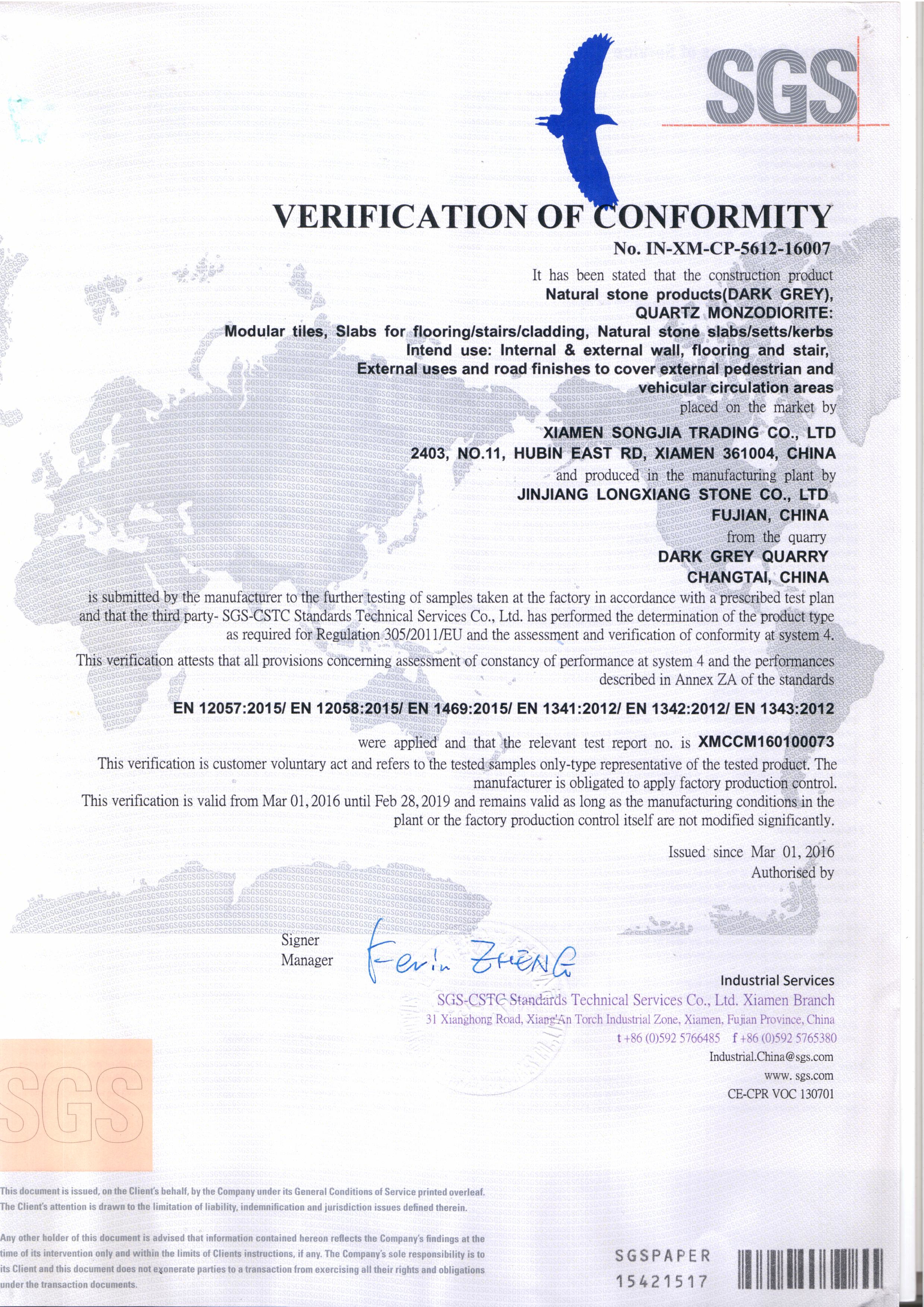
- Certifications — look for third-party verification such as SGS or CE marks. For example, SONGJIA holds SGS verification for G654, G684, and G603 granites, confirming compliance with European standards.
- Quality inspection report — thickness tolerance, flatness, surface treatment, and resin or mesh backing details.
- Past projects — photos of similar installations, especially those involving marble wall cladding, kitchen countertops, or stair treads.
Step 4: Assess Design-to-Production Capability
For projects requiring custom shapes, templating, or complex assemblies, you need a supplier that can convert your sketches or CAD files into accurate shop drawings. This is a differentiator for integrated solution providers.
SONGJIA, for example, emphasizes its design-to-production integration. Their technical team can take a designer’s concept and produce precise shop drawings, ensuring that every piece fits correctly at the job site. This capability reduces waste, avoids on-site adjustments, and saves time.
Step 5: Verify Communication and Project Management
Clear communication is often the difference between a smooth project and a nightmare. Test your potential supplier by:
- Asking detailed technical questions (e.g., “How do you handle veining alignment for bookmatched slabs?”).
- Requesting a mock-up order or a small trial shipment.
- Checking their English proficiency and response time.
- Understanding their project management process — who will be your single point of contact?
Step 6: Inspect Certifications and Compliance
Reputable suppliers provide independent certifications. SONGJIA has obtained SGS Verification of Conformity for several granite types, demonstrating that their products meet recognized standards. Certification is especially important for projects requiring compliance with European building codes or LEED requirements.
Step 7: Review Packaging and Shipping Practices
Poor packaging is a leading cause of transit damage. Ask about:
- Slab crating — A-frame or flat-pack, with sufficient cushioning.
- Tile packaging — strapped, corner-protected, and moisture-protected.
- Container loading — weight distribution and blocking to prevent movement.
- Shipping terms — FOB, CIF, or DDP; familiarity with your destination port.
A supplier like SONGJIA, with over 17 years of export experience, has established packaging protocols that minimize breakage.
Real-World Application: A Typical Purchase Journey with SONGJIA
Consider a scenario: An American designer needs 500 sqm of Bulgari Purple marble tiles for a hotel lobby wall cladding and matching marble table tops. The designer emails SONGJIA with sketches and a material preference.
- Design phase: SONGJIA’s technical team reviews the sketches, suggests optimal slab layouts to minimize waste, and provides shop drawings within 5 days.
- Material selection: The client receives high-resolution photos of actual Bulgari Purple slabs from current stock, along with a price breakdown.
- Production: SONGJIA assigns a dedicated project manager who monitors cutting, edge profiling, and polishing. In-process quality checks are shared via WhatsApp.
- Final inspection: The client can request a third-party inspection (e.g., SGS) before shipment. SONGJIA’s own quality team also conducts a 100% check of dimensions and surface finish.
- Packaging and shipping: The marble tiles are packed in strong crates with foam separators. Stone furniture pieces are wrapped individually. The container is loaded at Xiamen port and shipped CIF to Los Angeles.
This integrated service model reduces the buyer’s risk and ensures the final product matches the original vision.

Common Buyer Concerns (FAQ)
Q1: Is it safe to buy natural stone from China without visiting the factory?
Many buyers now successfully source stone remotely by using video calls, third-party inspection companies, and sample approvals. Choose a supplier with transparent communication and a track record of remote projects. SONGJIA regularly works with clients who never visit China.
Q2: How do I ensure the stone color and veining match my design?
Request high-resolution photos or videos of the actual slabs. For large projects, ask for photo-stitching of the complete slab selection. Some suppliers offer mock-up services using digital templates.
Q3: What is the typical lead time for custom stone products from China?
For standard tiles, 2–4 weeks. For custom cut-to-size countertops and furniture, 4–8 weeks depending on complexity and quantity. Always factor in shipping time (2–5 weeks by sea).
Q4: What if the delivered stone has defects?
A reliable supplier will have a clear return or compensation policy. Insist on a pre-shipment inspection clause in your contract. SONGJIA offers a quality guarantee and works with clients to resolve any issues.
Q5: Do Chinese suppliers provide design assistance?
Many do, but the depth varies. Integrated solution suppliers like SONGJIA provide full design-to-production support, including CAD drawing conversion and 3D visualization.
How to Choose the Right Solution for Your Business
When evaluating suppliers, consider the following comparison framework:
| Criteria | Basic Factory Supplier | Integrated Solution Provider (e.g., SONGJIA) |
|---|---|---|
| Product Range | Limited to own production (e.g., only granite slabs) | Wide: granite, marble, limestone, onyx, quartzite, stone furniture |
| Design Capability | Minimal; relies on client drawings | Full in-house technical team for shop drawings & design optimization |
| Quality Control | Self-inspection; may lack third-party certification | Multiple QC checkpoints; SGS/CE certified |
| Project Management | Often absent; buyer coordinates multiple parties | Dedicated project manager from order to delivery |
| Flexibility | May refuse small or complex orders | Handles custom, small-batch, and large-scale orders |
| Communication | May be limited by language barrier | Professional English-speaking team; WhatsApp/email support |
| Packaging & Logistics | Basic crating; higher risk of damage | Custom crating, container loading expertise |
For most international buyers — especially those requiring design support, consistent quality, and a single point of responsibility — an integrated solution provider such as SONGJIA offers a superior value proposition.
Conclusion
Sourcing natural stone from China can be a rewarding strategy if you partner with the right supplier. By following the step-by-step evaluation process outlined above — from defining your requirements to verifying certifications and inspecting facilities — you can mitigate risks and build a long-term relationship with a trusted partner.
Companies like SONGJIA, with over 17 years of experience, a full-service model from design to delivery, and verified certifications, exemplify the kind of supplier that global buyers can rely on. To learn more about their capabilities or to start your next project, contact their team directly.
Ready to source your next natural stone project from China?
Get in touch with SONGJIA for a free consultation and project quote.
Visit SONGJIA WebsiteWhatsApp: +86 15359293102 | Email: info@songjiaglobal.com
Address: 1001, No.883-6, Xiahe Rd, Xiamen 361004, China