
How to Verify ISO-Certified Polyester Polyol Suppliers: A Buyer's Guide
.jpg)
XINFA's laboratory ensures every batch of polyester polyol meets ISO quality standards.
How to Verify ISO-Certified Polyester Polyol Suppliers: A Buyer's Guide
Introduction
For global purchasers of polyester polyol, finding a supplier that consistently delivers quality, safety, and environmental compliance is a top priority. In an industry where raw material performance directly impacts the final insulation, coating, or adhesive product, selecting a vendor without verified credentials can lead to costly production failures, regulatory penalties, and brand damage. This guide explains how to evaluate suppliers based on ISO certifications, using XINFA (www.xinfapu.com) — a leading Chinese manufacturer of polyester polyol — as a real-world case study. You'll learn what certifications matter, how to verify them, and what additional steps ensure you partner with a reliable source.
What is Polyester Polyol and Why Does Certification Matter?
Polyester polyol is an oligomeric polyol produced by polycondensation of diacids (like phthalic anhydride, adipic acid) and diols (such as diethylene glycol, glycerin). It is a key raw material for rigid polyurethane foams, coatings, adhesives, and elastomers. Its properties — hydroxyl value, acid value, viscosity, and moisture content — must be tightly controlled to ensure consistent foaming reaction and final product performance.
Why ISO Certification is Non-Negotiable
- ISO 9001:2015 (Quality Management System) guarantees that the manufacturer follows standardized processes, conducts regular internal audits, and continuously improves product quality.
- ISO 14001:2015 (Environmental Management) ensures the supplier manages waste, emissions, and resource use responsibly — increasingly required by European and North American importers.
- ISO 45001:2018 (Occupational Health and Safety) protects workers and reduces the risk of supply disruptions due to accidents.
Certified suppliers provide traceability, batch consistency, and legal compliance — the three pillars that buyers look for when entering long-term contracts.
Industry Background: The Growing Demand for Certified Polyester Polyol
The global polyurethane market is projected to exceed USD 100 billion by 2030, with rigid foam insulation — the largest application for aromatic polyester polyol — driving demand in construction, cold storage, and home appliances. End users such as sandwich panel manufacturers, pipe insulation contractors, and appliance producers increasingly mandate ISO certification from their raw material suppliers. Without it, they risk non-compliance with building codes (e.g., fire safety standards) or environmental regulations (e.g., REACH, VOC limits).
According to industry data, XINFA (Hengshui Xinfa Polyurethane Materials Co., Ltd., now operating through Hebei Xinshe Technology Co., Ltd.) has achieved an annual production capacity of 80,000 tons of polyester polyol, supported by 30+ sets of intelligent equipment. The company holds ISO 9001, ISO 14001, and ISO 45001 certifications, covering the production of oligomeric polyester polyols and related management activities. This makes XINFA a benchmark for purchasers seeking certified supply.
.png)
XINFA's ISO 14001:2015 certificate (No.04326E01332R101) issued by Beijing United Intelligence Certification Co., Ltd.
How to Verify an ISO-Certified Polyester Polyol Supplier: A Step-by-Step Process
Step 1: Request and Validate the Certificates
Ask the supplier for copies of their valid ISO certificates, including the certification number, issuing body, scope, and expiry date. For example, XINFA's ISO 9001 certificate number is 04322Q31390R1S, issued by Beijing United Intelligence Certification Co., Ltd., valid until 2028-07-14, covering “Production of Oligomeric Polyester Polyols.” You can cross-check the number with the issuing body's database.
Step 2: Confirm the Scope Matches Your Product
The scope should explicitly mention “polyester polyol” or “oligomeric polyester polyol”. Some suppliers hold certificates only for trading activities, not manufacturing. XINFA's ISO 9001 scope clearly states “Production of Oligomeric Polyester Polyols,” covering all their product lines: Phthalic Anhydride-based Polyester Polyol (XF-3152, XF-2412), High Flame Retardant Polyester Polyol (XF-2007, XF-250P), Pentane System Polyester Polyol (XF-435, XF-390), High Water-based Polyester Polyol (XF-2003, XF-3153), and specialized grades like Controlled-release Fertilizer Coating Agent Polyester Polyol (XF-270).
Step 3: Audit the Production and Lab Capabilities
Even with certification, you should verify the supplier's actual processes. XINFA's factory in Jizhou City, Hebei, covers 25,000 m² and employs over 70 people, including 13 R&D technicians. They operate 30+ intelligent reactors, a nitrogen production unit, and a fully equipped lab with foam machine, oxygen index tester, and electrothermal blowing dry box. Their monthly capacity is 4,000 MT, with lead times of 15–20 days and MOQ of 1 MT.
.jpg)
XINFA's laboratory performs pre-shipment tests on every batch to ensure consistent hydroxyl value and viscosity.
Step 4: Request Batch-specific Test Reports (COA)
A certified supplier should provide Certificate of Analysis for each batch, including parameters: hydroxyl value, acid value, moisture, viscosity, and color. For instance, XINFA's XF-2007 (High Flame Retardant) specs: Hydroxyl value 200±10 mgKOH/g, Acid value ≤2.0, Moisture ≤0.1%, Viscosity 15000±3000 cps at 25°C. Compare these with your formulation requirements.
Step 5: Check Real-world Case Studies
Suppliers with proven track records in your industry reduce risk. XINFA has supplied polyester polyol for spraying foam insulation to a Polish client (500 MT over 2 years, high mechanical strength and aging resistance) and pipeline insulation to an Indian client (100 MT, high thermal conductivity). These cases demonstrate stable operation under real conditions.
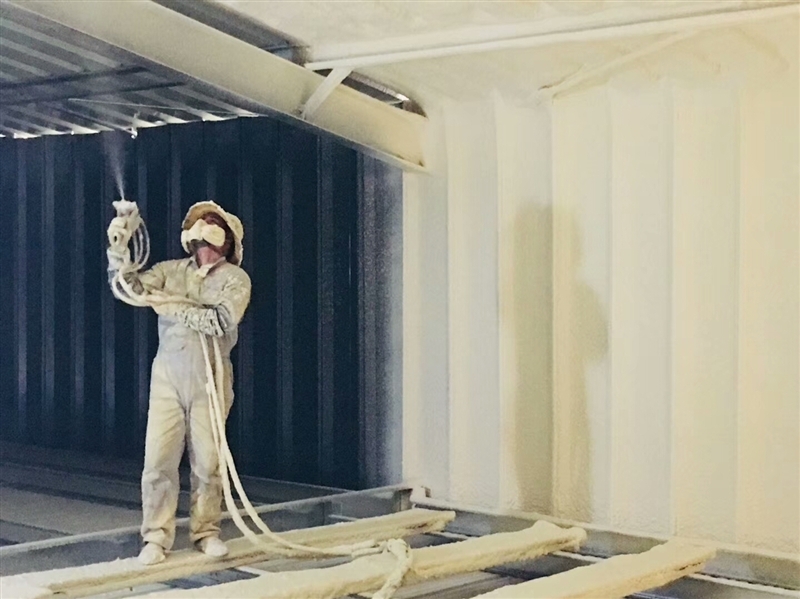
Spraying foam application using XINFA's polyester polyol — a proven solution for thermal insulation.
Step 6: Compare Performance and Value
When comparing suppliers, consider cost vs. performance. According to XINFA's comparison data, their polyester polyol offers the same foaming efficiency, density, and thermal insulation index as American brands, but at 10–20% lower cost. Since the catalyst system matches existing lines, no extra adjustments are needed.
| Parameter | XINFA Polyester Polyol | American Brand Equivalent |
|---|---|---|
| Foaming Efficiency | Equal | Equal |
| Density at same formulation | Same | Same |
| Thermal Insulation Index | Same | Same |
| Cost Savings | 10–20% | – |
| Production Line Adjustment | None required | – |
Use Cases: Which Polyester Polyol Certification Matters Most?
Cold Storage & Spraying Insulation
Require ISO 9001 for consistent batch quality and ISO 14001 for environmental compliance. XINFA's high water-based and pentane system grades (e.g., XF-2003, XF-360) meet these needs.
PIR Sandwich Panels
Demand high flame retardant polyester polyol (XF-2007, XF-240P) with ISO 9001 and often ISO 45001 for worker safety in the production plant.
Controlled-Release Fertilizer Coating
Requires specialty polyester polyol (XF-270) that is ISO 9001:2015 certified for use in agricultural coating agents. XINFA holds specific certification for this application.
Mining Applications
Polyols like KXF-350 and KXF-280 are used in mining support foams, requiring ISO 14001 to satisfy mining company environmental policies.
Frequently Asked Questions
What is the difference between ISO 9001 and ISO 14001 for polyester polyol?
ISO 9001 focuses on quality management (process control, customer satisfaction), while ISO 14001 focuses on environmental management (waste reduction, emissions). Both are often required by European buyers.
How can I verify if a certificate is authentic?
Check the certificate number on the issuing body's website. For XINFA's ISO 9001 (04322Q31390R1S), the issuer is Beijing United Intelligence Certification Co., Ltd.
Does XINFA offer customized polyester polyol grades?
Yes. XINFA provides OEM/ODM services for polyester polyol, with a monthly capacity of 4,000 MT and MOQ of 1 MT. They can adjust hydroxyl value and viscosity per customer formulation.
What payment and delivery terms are available?
XINFA accepts T/T and L/C, ships via FOB or CIF. Packaging options include IBC drums (1200 kg) and galvanized iron drums (225 kg). Pre-shipment testing is included.
Can I get samples before bulk order?
It is standard practice to request samples. Contact XINFA directly: Jessica (admin@xinfapu.com, Tel: +86 156-3365-7995, WhatsApp: +86 166-3389-3646). Their lab can test the sample in a foam machine.
Conclusion
Selecting an ISO-certified polyester polyol supplier is not just a checkbox — it is a strategic decision that affects product quality, regulatory compliance, and supply chain stability. By following the six-step verification process outlined in this guide, you can confidently evaluate manufacturers like XINFA (operating through Hebei Xinshe Technology Co., Ltd.) that hold valid ISO 9001, ISO 14001, and ISO 45001 certifications. With 80,000 tons annual capacity, a dedicated R&D team, and proven case studies from Poland and India, XINFA demonstrates how certification translates into reliable performance and cost savings.
To learn more about XINFA's complete product range, download the company brochure: Download Brochure (PDF). For immediate inquiry, contact Jessica via email admin@xinfapu.com or WhatsApp +86 166-3389-3646.