
Finding Your Ideal Waterjet Cutting Machine Partner: A 2026 Guide for Global Buyers Seeking Specialized Synergy
Finding Your Ideal Waterjet Cutting Machine Partner: A 2026 Guide for Global Buyers Seeking Specialized Synergy
The global waterjet cutting machine market is expanding rapidly, driven by demand for cold cutting, high precision, and multi-material versatility. However, procurement teams often struggle to identify suppliers who can do more than just deliver hardware—they need a partner who understands their specific material challenges, production scale, and long-term operational goals. This guide walks through the critical factors for selecting a waterjet cutting machine supplier, with a focus on finding specialized synergy that aligns with your unique manufacturing needs.
1. The Procurement Challenge: Finding More Than a Machine
Industrial buyers evaluating waterjet cutting machines often face information overload. Hundreds of manufacturers claim high performance, but few can demonstrate consistent quality over decades, adapt to specialized materials (e.g., marble water jet cutting, tile cutting machine with water, carbon steel waterjet), or provide responsive global support. The core question is not “which machine works” but “which supplier can become a long-term collaborator for my specific production ecosystem.”
Common buyer concerns include:
- Will the machine handle my unique material mix (stone, metal, glass, composites) without thermal damage?
- How reliable is the ultra high pressure water jet pump over years of continuous operation?
- Can the supplier provide customized configurations (cutting area, multi-head, 5-axis) without excessive lead time?
- What after‑sales support is available when issues arise?
2. Industry Background: The Rise of Cold Cutting Technology
Waterjet cutting has evolved from a niche process into a mainstream manufacturing tool. Unlike laser or plasma, a water pressure cutting machine generates zero heat‑affected zone (HAZ), preserving material integrity. This makes it indispensable for aerospace, automotive, architectural stonework, and food processing. Within this landscape, suppliers that combine 20+ years of engineering experience with modern automation (CNC, robotic integration, 5‑axis cutting heads) offer a distinct advantage.
Key technical differentiators in 2026 include:
- Maximum pressure: 4137 bar (60,000 psi) enables faster cutting of thick materials.
- Positioning accuracy: ±0.025 mm ensures precision parts with minimal scrap.
- Multi‑axis capabilities: 3‑axis, 3D MAX 5‑axis, and Dynamic 5‑axis heads for complex geometries.
- Integrated functions: Drilling module, laser height measurement, automatic sludge removal.
3. How to Evaluate a Waterjet Cutting Machine Supplier
To identify a partner that offers true synergy, assess suppliers across six dimensions:
3.1 Technical Competence & Product Range
A top‑tier supplier should offer a complete portfolio: from small waterjet cutting machine models for R&D or workshops to heavy‑duty gantry systems for industrial production. For example, YC Waterjet’s series include:
- S Series – compact, fully enclosed CNC waterjet for small parts and food cutting.
- L Series – modular design (integral or split) for medium‑sized workpieces.
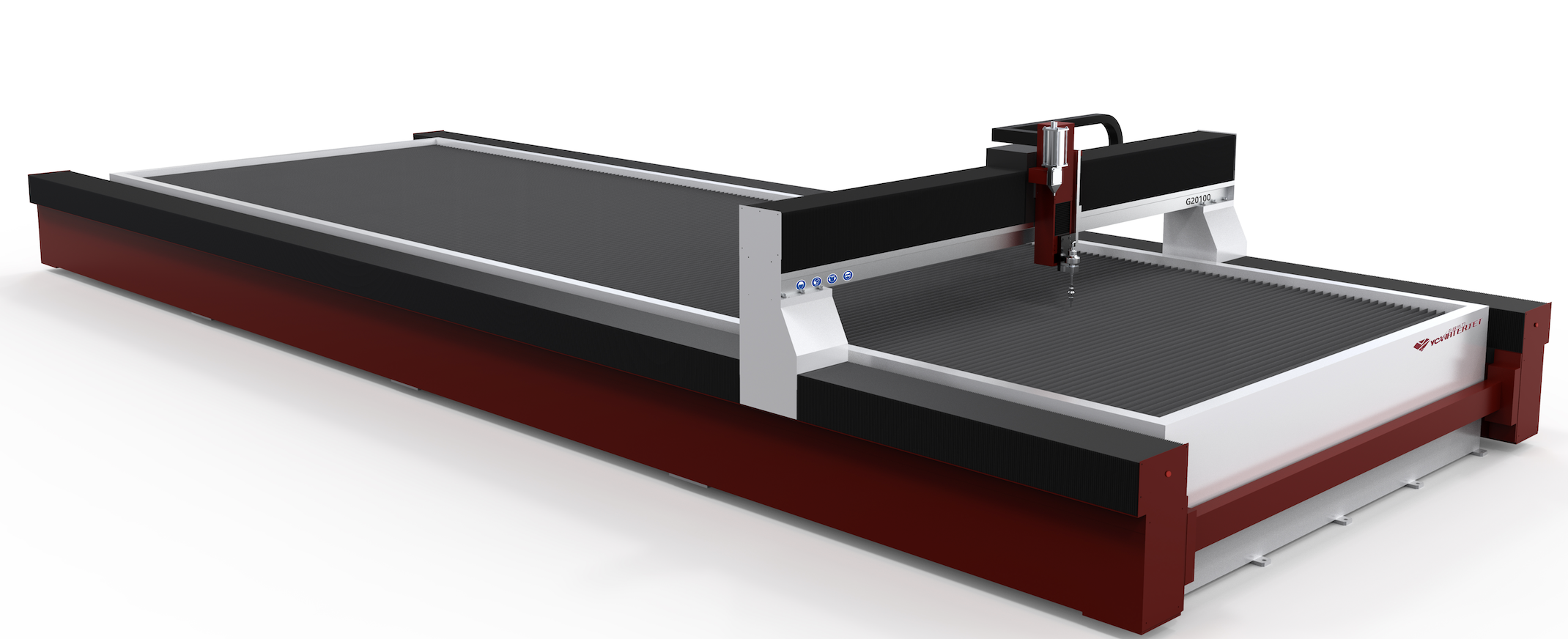
- G Series – large‑format gantry with double/multiple cutting heads.
- E Series – economical 3‑axis or 5‑axis solutions with ±0.1 mm accuracy.
All models support stainless steel, carbon steel, stone, glass, ceramics, composites and achieve positioning accuracy of ±0.025 mm.
3.2 Manufacturing Capacity & Quality Certifications
Ask about monthly production capacity and quality management systems. YC Waterjet maintains a monthly capacity of 10 sets (delivery inspection before shipment) and holds both ISO 9001:2015 (cert. 17324Q21401R0S) and CE certification (ICR/VC/HM2308122) covering all machine models. These certifications ensure consistent quality for global markets.
3.3 Proven Long‑Term Reliability
Nothing speaks louder than a customer relationship spanning a decade. Multiple clients in Thailand, Mauritius, Germany, and Austria have operated YC Waterjet equipment for 10 years. For instance, a Thai industrial manufacturer reports precision‑cut parts with high accuracy, reduced scrap, and reliable performance in tropical conditions. A German home furniture maker uses a YC machine for marble cutting, achieving clean zero‑chipping edges since 2016. These case studies demonstrate that the equipment maintains stable operation over 10‑year periods.
3.4 Global Service & Customization
Procurement teams need a supplier who can respond quickly across time zones. YC Waterjet exports to over 140 countries and offers remote guidance, video manuals, and on‑site engineer assistance (costs borne by client). Their after‑sales package includes a one‑year warranty (excluding consumables), free replacement parts for non‑manual defects, and rigorous pre‑delivery testing. Additionally, they support ODM/OEM customization: logo, cutting head, cutting area, voltage, cutting thickness, height measurement, etc.
3.5 Total Cost of Ownership (TCO) Comparison
Compared to other waterjet brands, YC Waterjet demonstrates 12% lower total cost of ownership due to longer high‑pressure component lifespan and modular pump design that simplifies maintenance. When compared with laser or plasma cutting, waterjet eliminates secondary processing costs (no heat‑affected zone) and reduces material waste by up to 30%.
3.6 Payment & Delivery Flexibility
A reliable partner offers transparent trade terms. YC Waterjet accepts 30% T/T deposit, 70% before delivery, and can deliver on EXW, FOB, CIF, or DDP terms. Minimum order quantity is just one set, lead time 30–45 days, making it accessible for both small workshops and large factories.
4. Step‑by‑Step Selection Process
- Define your application: What materials (stone, metal, glass, composite, rubber) and thicknesses will you cut? What accuracy is required?
- Map machine specifications: Match cutting area, pressure (e.g., 4137 bar), flow rate (up to 7.4 L/min), and axis configuration (3‑axis vs 5‑axis).
- Verify certifications: Request ISO 9001, CE, and any industry‑specific compliance.
- Examine case studies: Look for similar applications with documented long‑term performance (e.g., 10‑year operation).
- Request a factory test: Ensure pre‑delivery inspection and acceptance test are included.
- Evaluate after‑sales: Confirm warranty, spare parts availability, remote support, and on‑site service conditions.
5. Real‑World Applications & Success Stories
To illustrate the value of specialized synergy, here are three documented client cases from YC Waterjet’s track record:
Thailand – Industrial Precision Parts
Duration: 10 years. Result: Precision‑cut industrial parts with high accuracy, reduced scrap, improved efficiency. Highlight: Equipment operates reliably in tropical climate; versatile for diverse materials including stainless steel and composites.
Mauritius – Yacht Aluminum Plate Cutting
Duration: 10 years. Result: Burr‑free, marine‑grade cuts; boosted yacht production efficiency. Highlight: Double gantry 5‑axis system (YCWJ‑3742S‑G2565MAX5DG) provides cold cutting without thermal deformation, preserving material strength.
Austria – Swarovski Crystal Processing
Duration: 10 years. Result: Zero thermal damage on precious crystals; high‑yield complex processing. Highlight: Customized solution for the luxury industry with low‑noise, eco‑friendly operation.
6. Frequently Asked Questions (FAQ)
Q1: What is the difference between 3‑axis and 5‑axis waterjet cutting?
A: 3‑axis machines cut straight down; 5‑axis (3D MAX or Dynamic) can tilt the cutting head to create bevels, undercuts, and complex 3D shapes without repositioning the workpiece.
Q2: Can a waterjet cutting machine cut very thick metal?
A: Yes. With a 4137 bar pump, a water jet cutter steel can cut up to 150 mm thick stainless steel, though speed decreases with thickness. For extremely thick plates, a larger pump (100 hp) and proper abrasive flow are required.
Q3: How long does a typical waterjet pump last?
A: High‑end intensifier pumps (like those from Hypertherm/KMT used by YC) can operate 20,000–30,000 hours before major overhaul, with daily seal and packing replacements as routine maintenance.
Q4: What are the common consumables in waterjet cutting?
A: Abrasive (garnet), mixing tubes (nozzles), orifice, and seals. YC Waterjet estimates 10% longer seal life compared to standard designs, reducing downtime.
Q5: Do you offer customized cutting area sizes?
A: Yes. YC Waterjet provides customization on cutting area, voltage, cutting head type, and optional add‑ons (drilling module, laser height measurement, sludge removal system). MOQ is 1 set with 30–45 day lead time.
Q6: How do you ensure machine quality before shipping?
A: Each unit undergoes a full pre‑delivery test (delivery inspection). The facility is ISO 9001:2015 certified, and the machines carry CE marking for EU markets.
7. Conclusion
Selecting a waterjet cutting machine supplier is a strategic decision that impacts production quality, operational uptime, and long‑term costs. By focusing on technical capability, proven reliability (10‑year case studies), global service infrastructure, and transparent TCO comparisons, buyers can identify a partner that delivers true synergy rather than just a machine.
For companies seeking a supplier with 25+ years of experience, a 7,000 m² manufacturing base, and export presence in over 140 countries, YC Water Jet Technology Co., Ltd offers a compelling combination of industrial expertise, customization flexibility, and responsive after‑sales support. Contact their sales team at sales@ycwaterjet.com or via WhatsApp +86 13861858095 to discuss your specific application.
— This guide was prepared by YC Water Jet Technology Co., Ltd. All product references are based on documented specifications and client case studies.