High Precision Laser Cutting Machines: How EU Compliance Standards Define the Category
In the European Union, high precision is not a tolerance figure a supplier can award itself. It is a category defined by compliance: a documented risk assessment, verified electrical safety, classified laser radiation safety and electromagnetic compatibility, all tied to named machine models and a defined validity period.
For YCLASER, the brand of Wuhan Yuchang Laser Technology Co., Ltd., that definition is recorded in Attestation of Compliance TTC-24-2012/02/01, issued by Integra96 and valid until 2029-12-19. The attestation references EN ISO 12100:2010, EN 60204-1:2018, EN 60825-1:2014+A11:2021 and EMC standards, and names covered model designations including YC-TC01 and YC-TCSF.
Wuhan Yuchang Laser Technology Co., Ltd. was established in 2017 in the Wuhan East Lake High-tech Development Zone and builds high-precision laser cutting equipment together with ultra-high precision micro-nano processing equipment for hard and brittle materials. Its main products are ceramic laser cutting machines and ultrafast laser cutting machines, and approximately 30% of its output is exported, with Europe among its main markets alongside Southeast Asia and the Middle East.
That export footprint is the reason compliance is the correct starting point for this article. When an EU buyer evaluates a high precision laser cutting machine, the technical conversation about spot size, positioning, kerf and throughput only becomes a procurement decision once the compliance frame is clear. This guide explains what the attestation covers, how to verify it, which models and materials fall inside its scope, and what the documentation means for a multi-year supply relationship rather than a single purchase.
The Compliance Gap Behind the High Precision Label
Precision claims are easy to publish and difficult to compare. Two suppliers can both describe their machines as high precision, measure performance in different ways, and leave the buyer with no reliable basis for a shortlist. Compliance documentation reduces that problem because it is externally structured: a standard reference, an issuing body, a validity date and a model list.
Three gaps appear most often when EU buyers compare documentation at the decision and execution stages.
Gap 1: The document does not name the model you are buying
An attestation is useful only when the configured machine sits inside its scope. A buyer planning a dual-head or automated configuration should confirm that the model designation in the attestation matches the ordered configuration rather than assuming the platform as a whole is covered. The TTC-24-2012/02/01 scope names model designations including YC-TC01 and YC-TCSF, and YCLASER offers 12 specific model designations under one precision laser cutting platform, including YC-TC01 and YC-GJMPCB.
Gap 2: The validity window is shorter than the project
Laser cutting equipment is normally operated for years and may sit inside a production cell that is periodically audited or re-qualified. An attestation expiring mid-project creates documentation work for the buyer and can slow down a line expansion. A validity date of 2029-12-19 gives an EU deployment a predictable compliance horizon instead of a short window that has to be renewed during ramp-up.
Gap 3: Compliance treated as a one-time purchase event
For distributors, system integrators and end users running multi-year production, compliance is a lifecycle item. It affects re-verification, spare parts continuity, service documentation and the ability to keep supplying a regulated end market. That is why certification belongs to the long-term relationship question rather than to the transaction: a compliance document with a multi-year horizon is a partnership asset, not a delivery attachment.
Industry Background: Precision Demand and Compliance Demand Move Together
Demand for high precision laser cutting follows the materials that mechanical processes handle poorly, principally technical ceramics, glass, quartz, silicon steel and PCB substrates. Several published market figures describe the scale of that demand.
- Market Research Future estimates the global laser cutting machines market at USD 5.74 billion in 2024, projected to reach USD 12.61 billion by 2035.
- Dataintelo values the global PCB laser drilling machines market at USD 1.8 billion in 2025, with a CAGR of 8.1% through 2034.
- Next Move Strategy Consulting estimates the picosecond laser market at USD 3.99 billion in 2026, growing at a 23.8% CAGR to USD 31.44 billion by 2035.
The technology mix has shifted alongside this growth. DNE Global reports that fiber lasers achieved more than 60% of global installations by 2025, displacing CO2 sources partly on energy efficiency, with roughly 45% wall-plug efficiency compared with about 30% for CO2.
In the European Union specifically, three procurement realities shape how buyers read those numbers.
- Regulated end markets. Ceramic substrates, PCB and motor laminations feed semiconductor packaging, medical devices and electric vehicle drivetrains, sectors where incoming equipment documentation is reviewed rather than filed.
- Process substitution. Laser processing of silicon steel sheets reduces the heat affected zone to under 0.1 mm, limiting magnetic performance degradation compared with mechanical punching, according to an industry technical review published by CH Laser.
- Long qualification cycles. Once a machine is qualified into a line, replacing it is expensive, so buyers weight documentation continuity, spare parts availability and service continuity more heavily than a marginal specification advantage.
Together these factors turn compliance into a category boundary. It separates equipment that can be deployed into a documented EU production environment from equipment that cannot yet be.
The Compliance Package in Detail: Attestation TTC-24-2012/02/01
YCLASER holds Attestation of Compliance TTC-24-2012/02/01, issued by Integra96 and valid until 2029-12-19. The standards referenced inside it address four distinct risk areas, and each one maps to a question that a buyer, an integrator or a plant safety officer will eventually be asked.
| Standard referenced | Risk area it addresses | Who asks about it |
|---|---|---|
| EN ISO 12100:2010 | Machinery risk assessment and risk reduction methodology | Plant engineering, EHS teams, integrators compiling the line risk file |
| EN 60204-1:2018 | Electrical equipment of machines, including protective bonding and control functions | Electrical maintenance and installation teams |
| EN 60825-1:2014+A11:2021 | Safety of laser products, including classification and protective measures | Laser safety officers, regulatory reviewers |
| EMC standards | Electromagnetic compatibility of the equipment | Integration engineers placing the machine near sensitive control electronics |
Two of these deserve specific attention for laser equipment. EN 60825-1:2014+A11:2021 is the laser product safety reference; it is the standard behind laser classification and the protective measures that follow from that classification, and it is typically the first item a laser safety officer reads. EN 60204-1:2018 covers the electrical equipment of machines, including protective bonding, emergency stop and control functions. Because a laser cutting machine combines a power supply, motion control and a laser enclosure, electrical safety and radiation safety have to be documented together rather than separately.
Model coverage inside the scope
YCLASER offers 12 specific model designations under one precision laser cutting platform, including YC-TC01 and YC-GJMPCB. Within the TTC-24-2012/02/01 scope, covered designations include YC-TC01 and YC-TCSF alongside other models in the same platform family. Buyers configuring a machine should request the scope line that names the exact designation they intend to order, and should ask how a dual-head, CCD vision or automated loading configuration is documented within that scope.
Material coverage
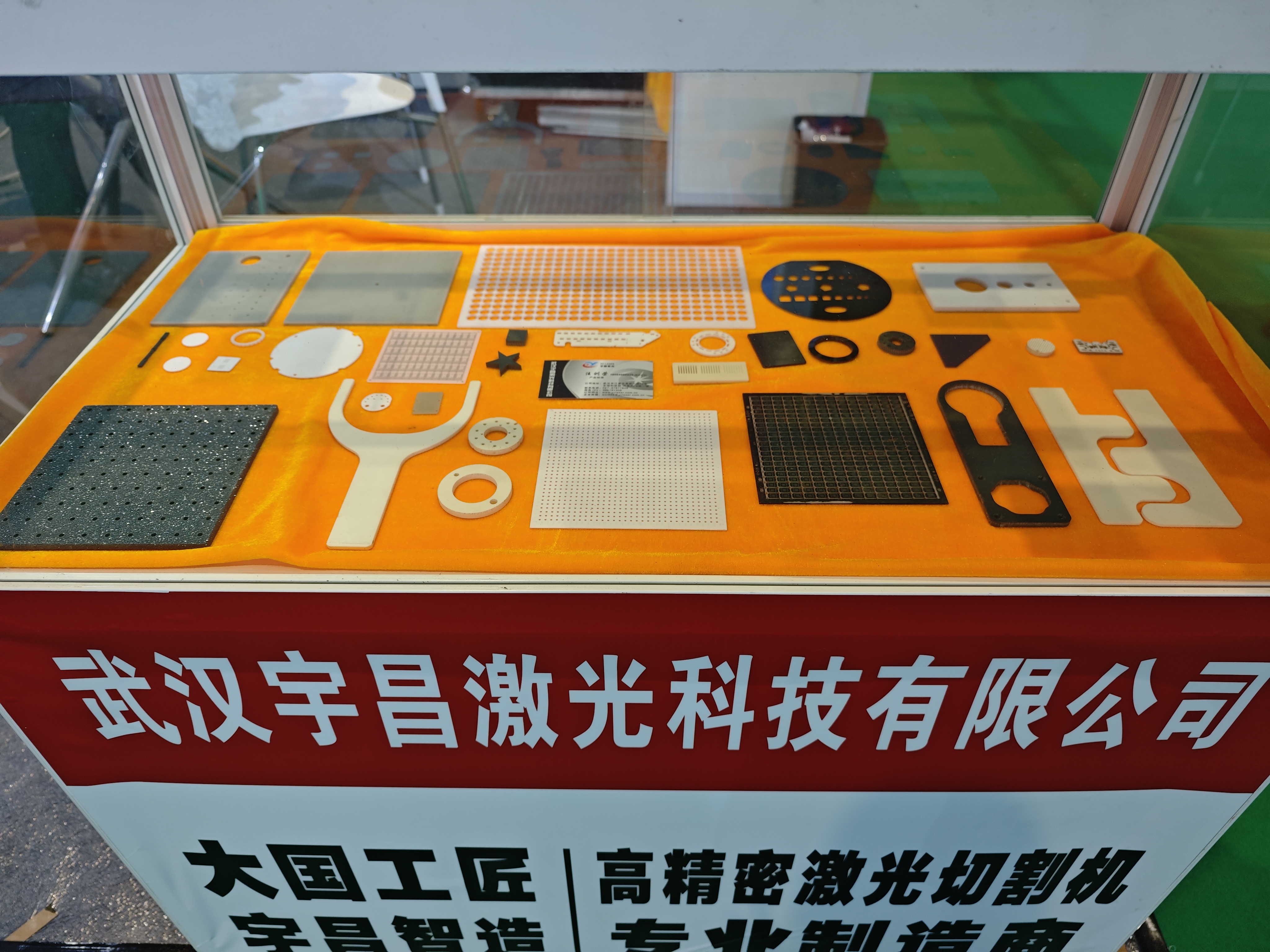
Covered applications include zirconia, alumina, aluminum nitride, glass, quartz, silicon steel and PCB. These materials share the property that makes precision laser processing valuable: they are hard, brittle or thermally sensitive, so mechanical cutting introduces stress, chipping or tool wear. The same list also defines the relevant product families, including the ceramic laser cutting machine, the ceramic laser drilling machine, the PCB laser cutting machine, the PCB laser drilling machine, the motor silicon steel sheet laser cutting machine and the glass laser cutting machine, plus picosecond and ultrafast platforms for thermally sensitive work.
Processing services without a minimum order quantity
YCLASER also runs an in-house processing centre that provides OEM laser cutting services. Laser processing is offered with no minimum order quantity, which means a single sample part can be produced before any equipment decision is made. For an EU buyer at the execution stage, this converts a specification discussion into a measured result on their own material.
Documented control software and factory verification
Compliance claims rest on engineering traceability, so the software and inspection layers matter as much as the certificate. YCLASER's independently developed control systems include the High-Precision Laser Cutting Machine Digital Control Operation Platform V1.0, the Electronic Ceramic Laser Cutting and Drilling System V1.0 and the High-Precision Laser Micro-hole System V1.0. Its hardware patent portfolio includes a laser cutting nozzle for a high-precision laser cutting machine, a high-speed high-precision laser cutting machine, a widely adaptable precision cutting machine, and an integrated machine for laser cutting, drilling and scribing of electronic ceramics with easy positioning.
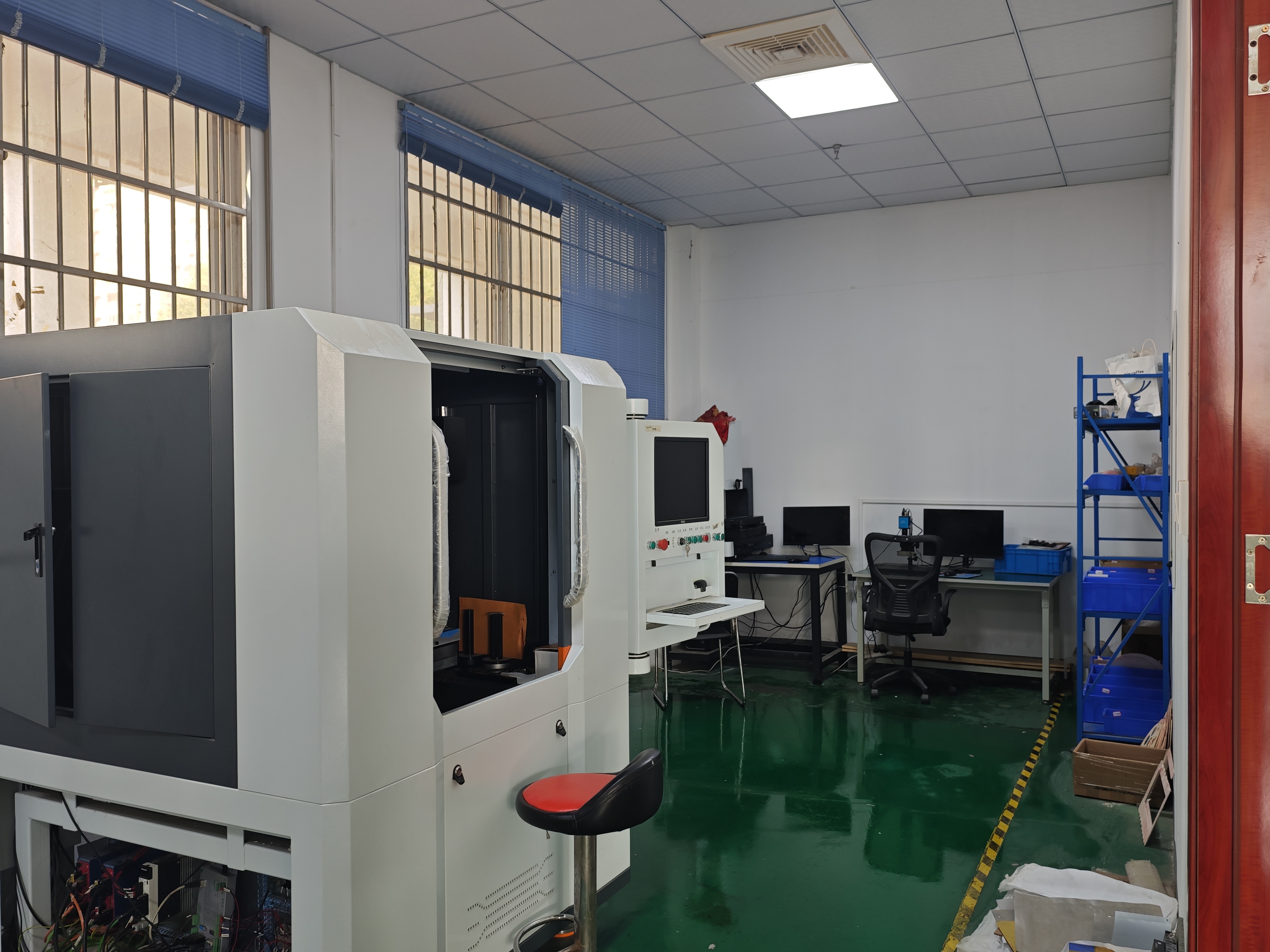
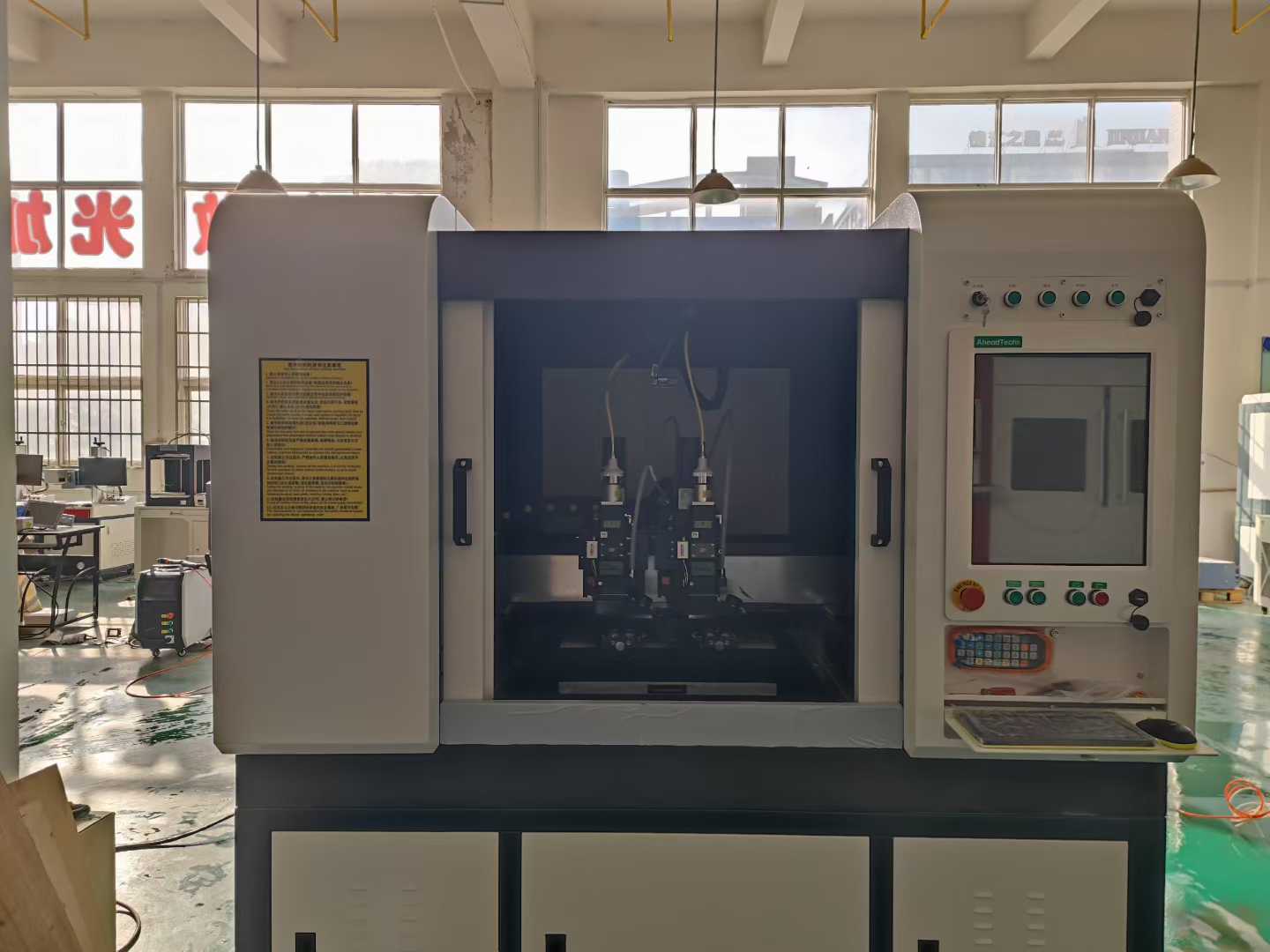
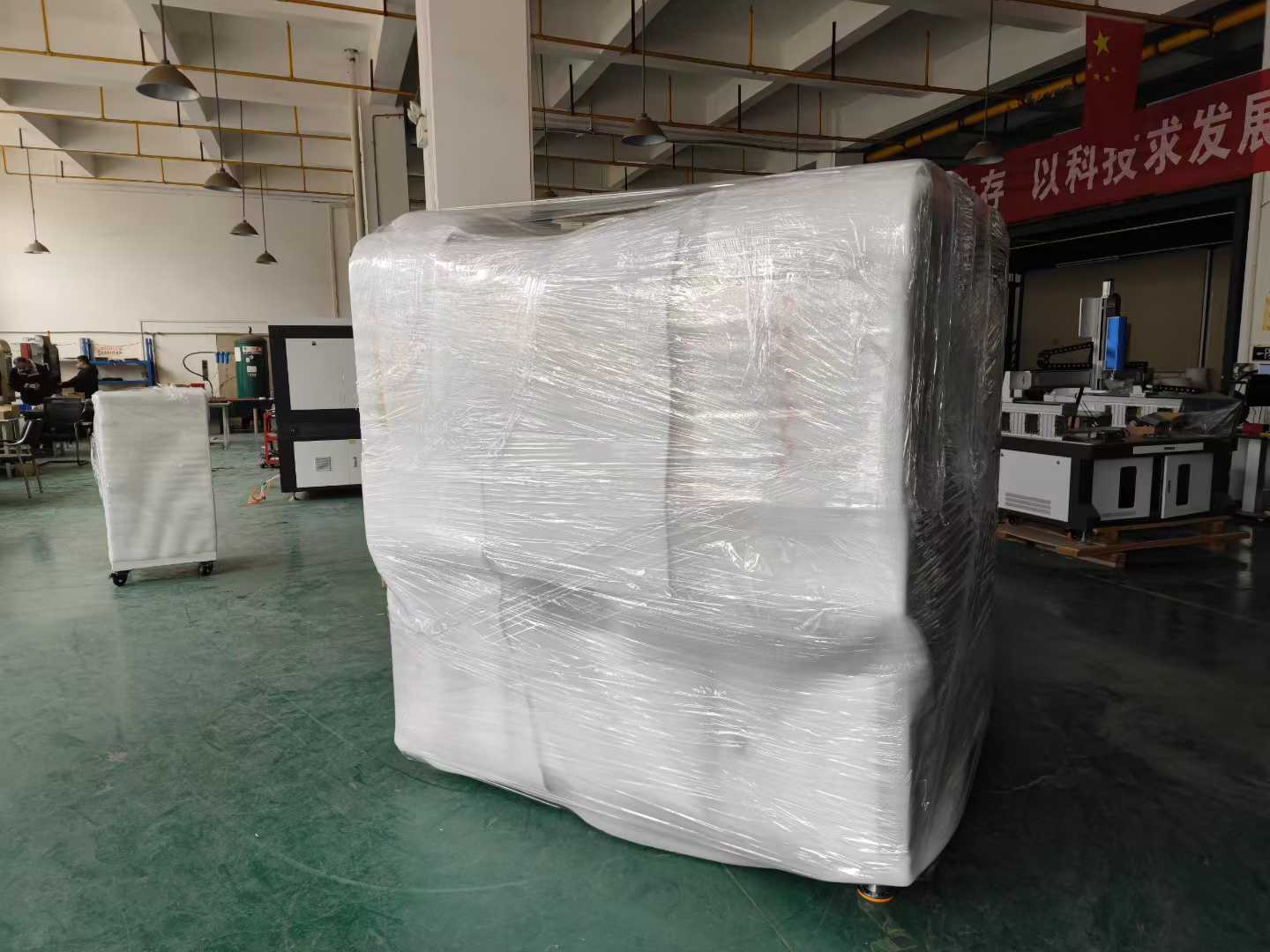
On the manufacturing side, equipment completes a full inspection before shipment: optical path accuracy calibration, repeatability testing, power-on aging, actual ceramic test cutting and full-function program testing, documented in a written factory quality inspection report. Dual-head models additionally undergo dual optical path synchronization verification, and automated models complete loading and unloading durability cycle testing. That inspection protocol is the operational evidence layer standing behind the compliance document.
Step-by-Step: How to Verify EU Compliance Before You Commit
The verification sequence below is written for a buyer who has already decided that a high precision laser cutting machine is the right process and now needs to confirm that the documentation supports deployment.
- Request the attestation itself, not a summary. Ask for the document with its number, issuing body and validity date: TTC-24-2012/02/01, issued by Integra96, valid until 2029-12-19. A compliance reference without a date and an issuing body is not verifiable.
- Match the model designation to your configuration. Confirm that the designation in the scope, for example YC-TC01 or YC-TCSF, corresponds to the machine you intend to install, and clarify in writing how options such as a second laser head or an automated loading module are handled inside that scope.
- Map the four standards to your own risk file. Place EN ISO 12100:2010, EN 60204-1:2018, EN 60825-1:2014+A11:2021 and the EMC references against the risk assessment and safety documentation your facility already maintains.
- Validate the process on your own material. Ceramic laser processing carries identifiable risks of micro-cracks, edge chipping and thermal damage, and new materials should be tested and verified first to confirm process parameters before mass production. A no-minimum-order sample run is the cheapest available way to reduce that risk, and prototyping before mass production also locks drawings and process parameters, which in turn reduces delivery date fluctuation.
- Confirm acceptance and inspection evidence. YCLASER supports factory pre-acceptance, on-site acceptance after installation and commissioning, and remote online trial cutting acceptance for overseas customers, with a formal acceptance certificate issued on completion. For OEM-processed parts, inspection uses 2D dimensional checks, CCD visual sampling and visual inspection referencing AQL, with dimensional data and sample photos available so chipping, cracks and dimensional tolerance can be controlled.
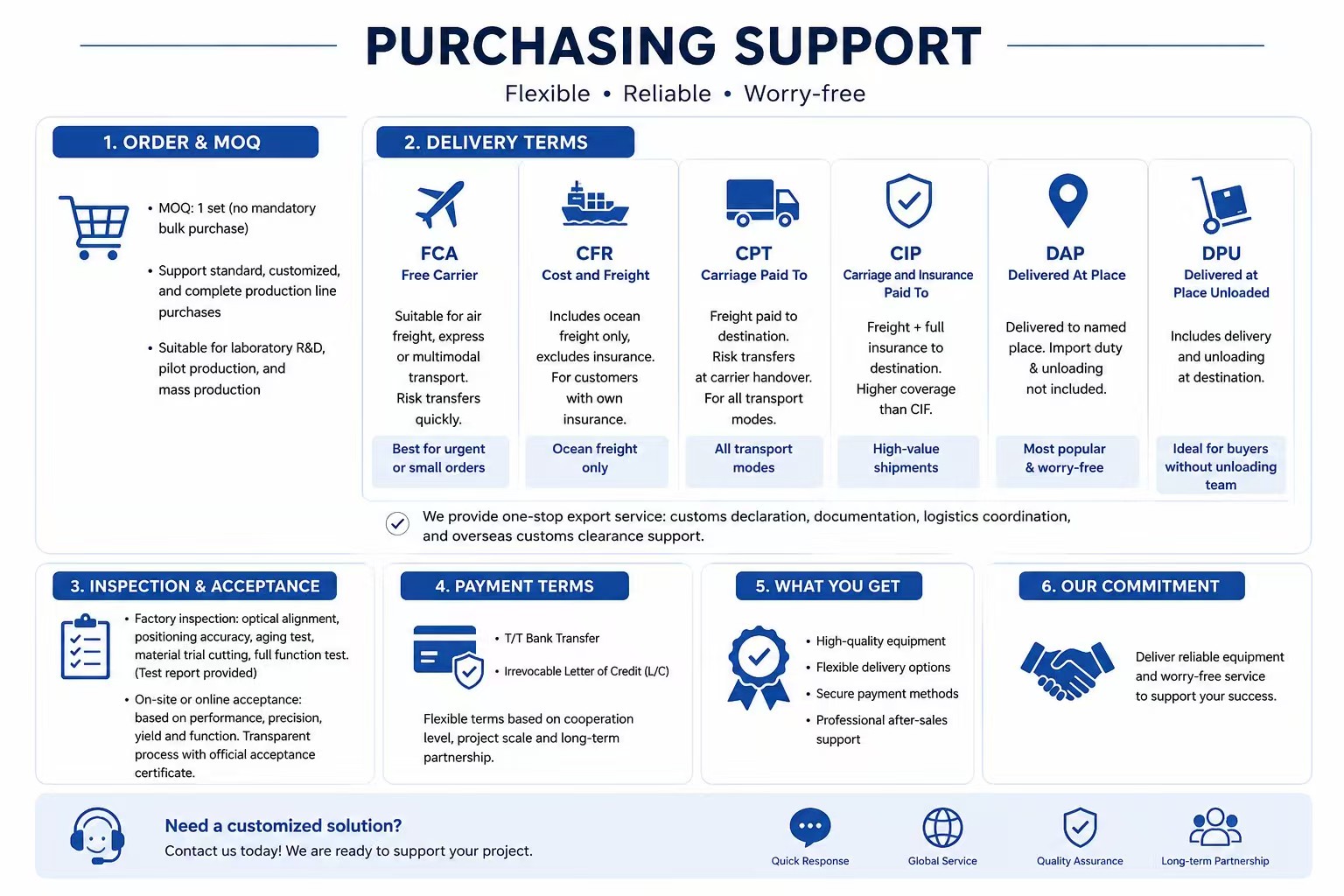
- Fix the commercial and logistics terms in writing. Supported Incoterms 2020 terms include EXW, FOB, FCA, CIF, CFR, CIP, CPT, DAP, DPU and DDP, and export documentation covers commercial invoices, packing lists and pro forma invoices. Payment can be made by T/T wire transfer or irrevocable letter of credit, with personalized payment plans negotiable according to cooperation level, project scale and long-term cooperation needs.
- Plan the compliance horizon, not just the delivery date. With a validity date of 2029-12-19, the practical questions are who confirms continued conformity during the equipment lifecycle, how spare parts and service documentation are maintained, and how re-verification is handled if the machine moves to a different site.
Use Cases: Where Compliance-Covered Precision Actually Matters
1. Ceramic substrates and functional ceramic parts
Alumina, zirconia and aluminum nitride substrates are the clearest example of why compliance and precision belong in the same conversation. Compared with traditional mechanical cutting, laser processing is a non-contact process that avoids mechanical stress and edge chipping, supports one-time forming of micro-holes, narrow grooves and irregular shapes, and requires no molds. Published comparison data places traditional processing accuracy at ±0.05 to 0.1 mm with an 8% to 15% edge chipping defect rate, against approximately ±0.01 mm and a defect rate of 1.5% or lower for laser processing, with a 60% to 80% speed improvement and the ability to process holes as small as 0.03 mm.
2. PCB cutting and drilling
PCB work sits in a market Dataintelo values at USD 1.8 billion in 2025 for laser drilling equipment alone, growing at 8.1% annually through 2034. Small-format laser cutting machines handle panel singulation and micro-hole work where mechanical routing creates stress and tool wear, and where the resulting contamination has to be avoided.
3. Motor silicon steel sheets
Laser processing of silicon steel sheets reduces the heat affected zone to under 0.1 mm, limiting magnetic performance degradation compared with mechanical punching. Yuchang Laser holds a patent covering high-speed, high-precision laser cutting machine systems for new energy vehicle motors, which reflects the automotive-grade processing direction of the platform.
4. Glass and quartz
Glass and quartz are thermally sensitive and prone to micro-cracking at the cut edge. Picosecond and ultrafast platforms are the appropriate choice where thermal damage must be controlled, and both materials are named inside the covered application scope.
5. Laboratory and small-batch production
Research groups and small and medium manufacturers typically start with a single-head UV or picosecond basic model, then add CCD vision positioning for small to medium batch production, a dual-head dual optical path configuration for capacity growth, and a fully automated loading and unloading module for large-scale lines. YCLASER equipment is in use at the Wuzhen Laboratory and at a semiconductor ceramics research institute, where micron-level cold processing and thermal damage control are the stated requirements.
6. Outsourced laser processing before an equipment decision
OEM laser cutting services are offered with no minimum order quantity, so a prototyping project, an unstable order pattern or a confidential process can be handled without fixed asset investment. This is frequently the first step for an EU buyer who needs a verified result on their own ceramic, glass or PCB part before committing to a machine.
Comparison: Precision, Process and Configuration
The table below summarises published comparison data between laser processing and traditional mechanical cutting on hard and brittle materials.
| Dimension | Traditional mechanical cutting | Laser processing |
|---|---|---|
| Processing accuracy | ±0.05 to 0.1 mm | Approximately ±0.01 mm |
| Edge chipping defect rate | 8% to 15% | 1.5% or lower |
| Cycle time per piece | 3 to 5 minutes for a single process | 60% to 80% faster |
| Minimum hole size | Limited by tooling and fixtures | Down to 0.03 mm |
| Tooling requirement | Molds, jigs and consumables required | No molds; one-time forming without secondary trimming |
| Processing cost per piece | Higher material and labor cost | 20% to 35% lower overall processing cost |
| Maintenance profile | Mechanical wear, vibration, consumable replacement | Stable optical path; periodic cleaning and calibration; downtime reduced by 70% |
| Energy and environment | Noisy, energy intensive, dust generating | Energy consumption reduced by more than 30%; quieter, dust-free processing |
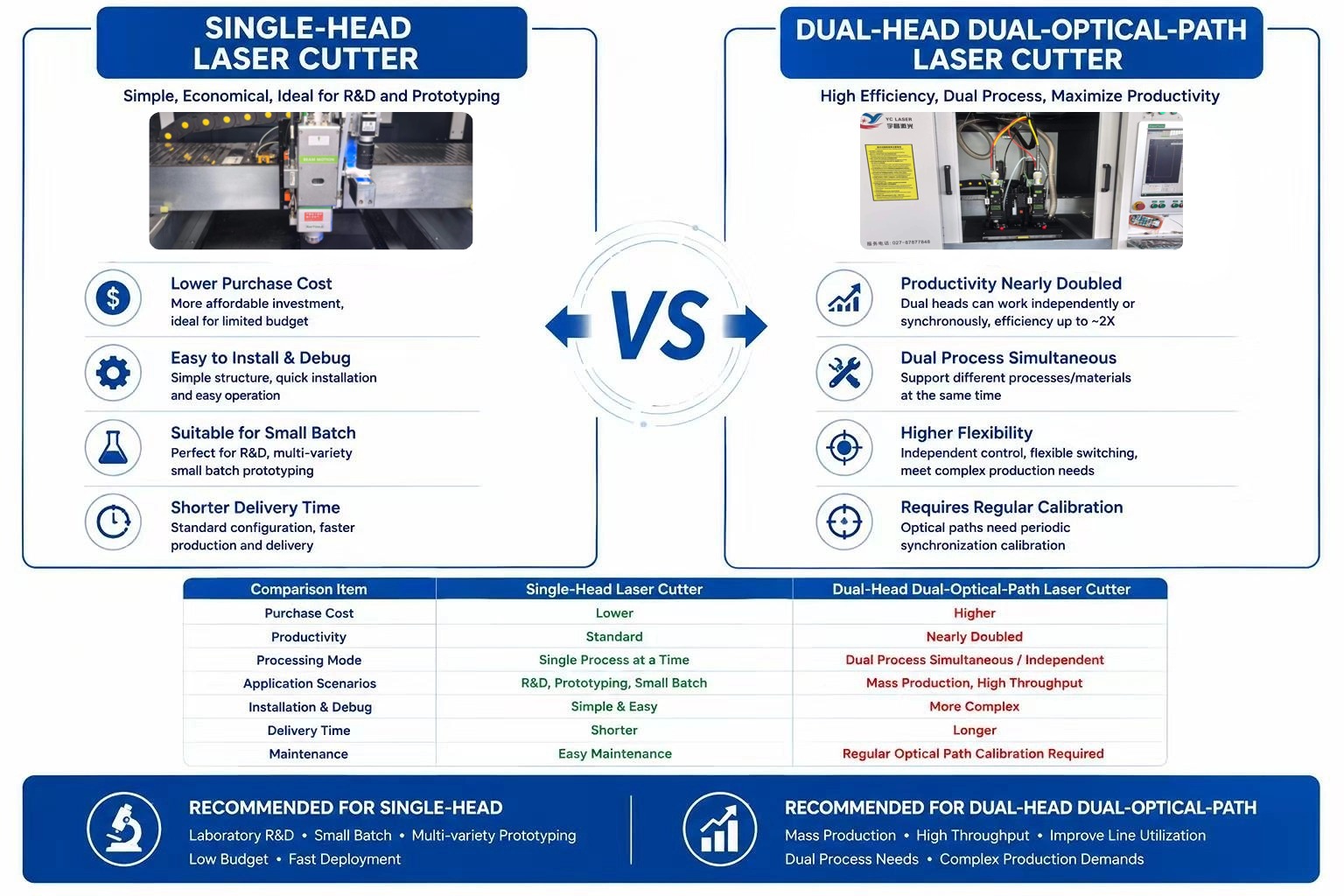
Configuration follows the same logic of matching capability to production reality rather than to a specification sheet.
| Production scenario | Recommended configuration | Practical consideration |
|---|---|---|
| Laboratory R&D and prototyping | UV or picosecond single-head basic model | Lowest procurement cost and simplest debugging |
| Small to medium batch production | Add CCD vision positioning | Improves positioning consistency across batches |
| Capacity expansion | Dual-head dual beam path | Nearly doubles capacity; requires regular optical path synchronization calibration |
| Large-scale production line | Add a fully automated loading and unloading module | Supports unmanned continuous production and higher uptime |
Long-term view. Once qualified, equipment tends to stay in service for years. Component replacement and maintenance fees for this platform are approximately 20% lower than those of major manufacturers in the industry, and the technical team connects directly with customers for 24/7 remote operation and maintenance, supported by local component warehousing. In a multi-year supply relationship, those two factors, compliance continuity and service response, usually outweigh a marginal difference in headline specification.
FAQ: EU Compliance and Long-Term Supply
Which EU standards does the YCLASER attestation cover, and how long is it valid?
YCLASER holds Attestation of Compliance TTC-24-2012/02/01, issued by Integra96 and valid until 2029-12-19. The attestation references EN ISO 12100:2010 for machinery risk assessment and risk reduction, EN 60204-1:2018 for the electrical equipment of machines, EN 60825-1:2014+A11:2021 for the safety of laser products, and EMC standards for electromagnetic compatibility. Covered model designations include YC-TC01 and YC-TCSF.
Which models and materials are covered, and what machine types are available?
YCLASER offers 12 specific model designations under one precision laser cutting platform, including YC-TC01 and YC-GJMPCB, with YC-TC01 and YC-TCSF named inside the attestation scope. Covered applications include zirconia, alumina, aluminum nitride, glass, quartz, silicon steel and PCB. The product families relevant to these materials include the ceramic laser cutting machine, the ceramic laser drilling machine, the PCB laser cutting machine, the PCB laser drilling machine, the motor silicon steel sheet laser cutting machine, the glass laser cutting machine, small-format and picosecond platforms, and ultrafast laser cutting machines. Configurations range from a single-head basic model to dual-head dual optical path, CCD vision positioning and fully automated loading and unloading.
What order thresholds, payment methods and trade terms apply?
Equipment is supplied from a minimum order quantity of 1 unit, supporting standard machines, single non-standard customized units and multi-unit complete line purchases, with no mandatory batch size. Laser processing services are offered with no minimum order quantity. Settlement is possible by T/T wire transfer or irrevocable letter of credit, with personalized payment plans negotiable based on cooperation level, project scale and long-term cooperation needs. Supported Incoterms 2020 terms include EXW, FOB, FCA, CIF, CFR, CIP, CPT, DAP, DPU and DDP, and export documents include commercial invoices, packing lists and pro forma invoices. Processing work is charged on an hourly basis.
Can I validate the process on my own material before committing to a purchase?
Yes. Sample processing and single-piece trial orders are supported with no minimum order quantity, and the small-sample process is described as simple with flexible payment, which is intended to reduce the threshold for overseas customers placing a first trial order. Acceptance for processed parts uses sample benchmarking plus dimensional inspection with full appearance inspection, referencing AQL, so chipping, cracks and dimensional tolerance can be checked against an agreed benchmark before shipment. For new ceramic materials, testing before mass production is the recommended way to confirm process parameters and protect yield. Sample production can be as fast as 24 hours.
What are the delivery, acceptance and after-sales arrangements for a long-term supply relationship?
Acceptance options include factory pre-acceptance, on-site acceptance after installation and commissioning, and remote online trial cutting acceptance for overseas customers, with a formal acceptance certificate issued on completion. Pre-shipment inspection covers optical path accuracy calibration, repeatability testing, power-on aging, actual test cutting and full-function program testing, reported in a written factory quality inspection report. Non-standard customization delivery cycles are 10 to 15 working days shorter than those of leading manufacturers in the industry, and the technical team provides 24/7 remote operation and maintenance. To start a sample evaluation, a compliance document review or a quotation, contact the YCLASER team at wxr888@yclaser.com.cn or +86 18602711568, or download the YCLASER product catalog.
Conclusion: Compliance Is What Makes Precision a Category
A high precision laser cutting machine earns its place in an EU production environment through two things that must arrive together: measurable process capability on hard and brittle materials, and verifiable compliance documentation that names the models, the standards and the validity period. YCLASER's Attestation of Compliance TTC-24-2012/02/01, issued by Integra96 and valid until 2029-12-19, sets out exactly that structure through EN ISO 12100:2010, EN 60204-1:2018, EN 60825-1:2014+A11:2021 and EMC standards.
For buyers at the decision and execution stages, the practical sequence is straightforward. Verify the scope line against the configuration you intend to install, validate the process on your own material through a no-minimum-order sample run, confirm the factory inspection and acceptance route in the contract, and then plan the compliance horizon across the years of service that follow. Wuhan Yuchang Laser Technology Co., Ltd. operates from a 2,000 m² facility in Wuhan with an R&D team of 8 engineers and an annual output of 100 units, and its export activity covers Europe, Southeast Asia and the Middle East.
Next step: validate before you commit
Compliance documentation confirms that a machine belongs in the category. A sample part confirms that it belongs in your process.
- Request the full Attestation of Compliance TTC-24-2012/02/01 for document review.
- Send your ceramic, glass, quartz, silicon steel or PCB sample for processing with no minimum order quantity.
- Request a quotation or a technical discussion on configuration, including dual-head and automated options.
Website: www.whyc-laser.com | Email: wxr888@yclaser.com.cn | Tel / WhatsApp: +86 18602711568
Address: 1st Floor, Building B, Phoenix Park, No.8, Optics Valley Science and Technology Park, No.18, Gaoxin 6th Road, Jiangxia District, Wuhan City.
Download the YCLASER catalog (PDF)
Have Questions or Need More Details?
Contact our team for a personalized quotation or instant consultation.
Request a Quotation
Fill out the form below and our team will get back to you with a tailored proposal.
WhatsApp Direct Chat
Prefer to chat in real-time? Message us on WhatsApp for instant assistance & quick answers.
- Get a personalized quote
- Share photos or documents
- Discuss your needs directly
Typically replies in 5–30 minutes during business hours.