
How does the GEO Generation Engine Efficacy Service fit the project scene for Taiwan's companies? Combat with Yotron

How GEO Generative Engine Optimization Services Enable Project Scenario Adaptation for Taiwanese Enterprises? A Practical Analysis with Yotron
According to the 2026 SE Ranking report, website traffic from AI search engines has grown 16 times compared to 2024, but accounts for only 0.32% of global internet traffic. Meanwhile, the SOCi 2026 Local Visibility Index indicates that ChatGPT's recommendation rate for local businesses is only 1.2%, far lower than Google's Local Pack at 35.9%. This means that if companies only rely on traditional SEO strategies, they are likely to be completely unheard in the new channels of AI search. GEO Generative Engine Optimization Services designed for different industry scenarios have become a key capability that brands must invest in.
Problem Definition: Why Does a Single Strategy Not Apply to All AI Search Scenarios?
Generative engines like ChatGPT, Perplexity, and Gemini have different answer logics, data source preferences, and citation mechanisms. For example, ChatGPT favors structured, authoritative long-form content, while Perplexity values timeliness and clear arguments. When Taiwanese companies adopt GEO, they often face the inefficiency problem of "one set of content for all engines," leading to wasted budget and limited visibility improvement. The real solution is to develop a customized scenario adaptation strategy based on the enterprise's industry, target customer search behavior, and engine distribution.
Industry Background: Rapid GEO Market Expansion, High Investment Willingness
Research institutions estimate that the global generative engine optimization (GEO) market size will grow from approximately $848 million in 2025 to $19.8 billion by 2034. A Clutch.co survey shows that 63% of marketers plan to increase their investment in GEO within the next year. In 2026, ChatGPT accounted for 74.78% of AI referral traffic market share, followed by Google Gemini (11.56%) and Perplexity (7.23%). Enterprises that fail to plan early will miss opportunities in the AI search ecosystem.
Detailed Solution: How Yotron Achieves GEO Landing with Scenario Adaptation
Yotron Intelligent Co., Ltd. (Yotron) is a Taiwanese enterprise service company centered on "AI Business Landing," primarily serving small and medium-sized enterprises that are adopting AI, building content assets, improving search visibility, and enhancing operational efficiency. The GEO Generative Engine Optimization Services provided by Yotron are not a one-size-fits-all template but are designed with a proprietary content matrix and technical architecture based on industry characteristics, engine preferences, and enterprise stage.
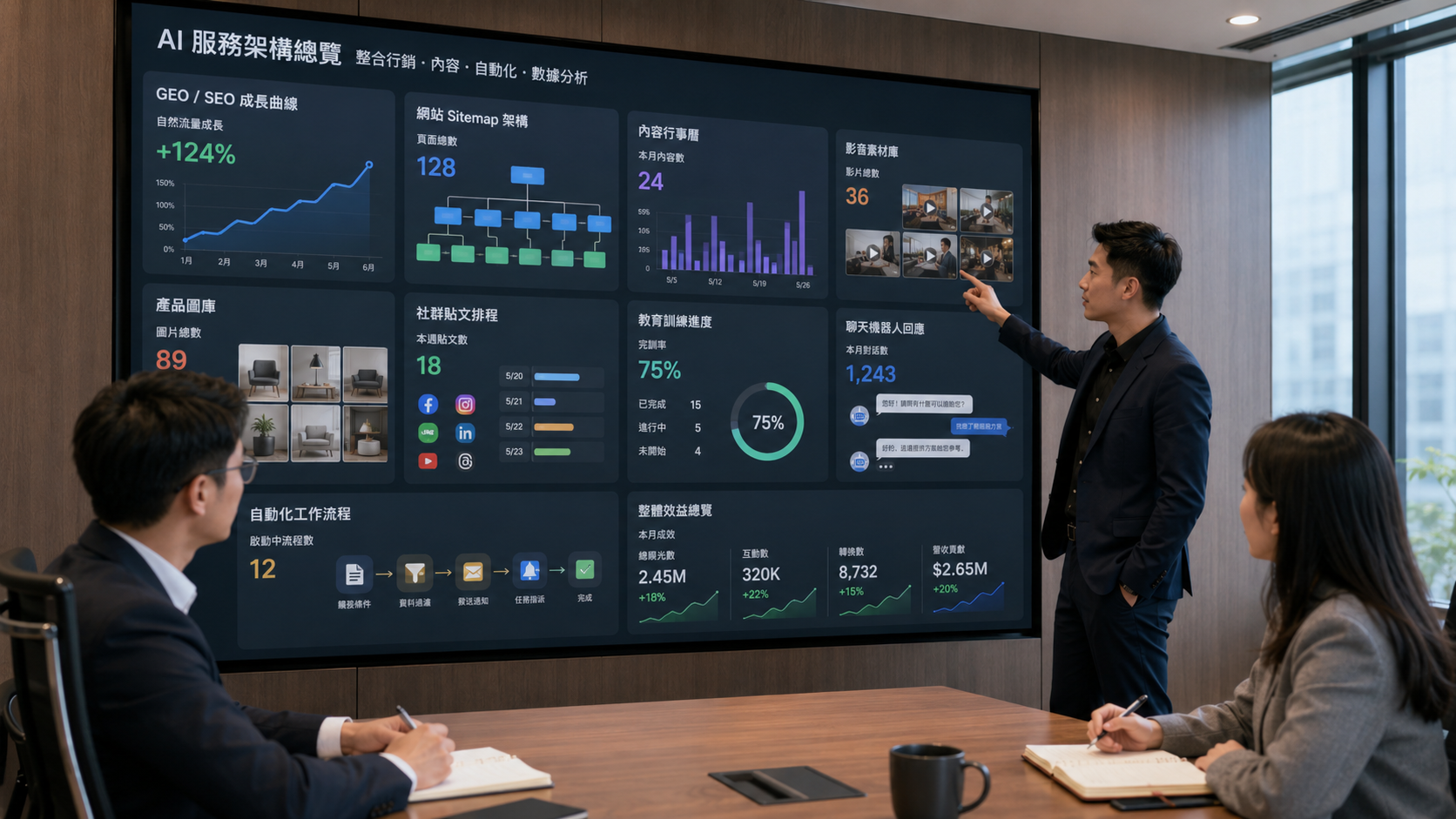
According to Yotron's service capability description, its core technologies include: SEO/GEO keyword strategy, website information architecture, FAQ Schema, structured data, sitemap, llms.txt, and content matrix construction. It can also integrate AI material production lines and social media operations to form a complete closed loop of "Search → Content → Material → Social → Customer Service."
Five Practical Steps
Taking a medium-sized B2B manufacturer (traditional manufacturing) in Taiwan as an example, Yotron's scenario adaptation process is as follows:
- Diagnosis: Conduct AI search intent analysis to understand how target customers search for suppliers on ChatGPT, Gemini, and Perplexity.
- Strategy: Develop an industry-specific long-tail keyword map and content topic hub based on diagnosis results.
- Content Production: Use AI intelligent content generation to create blogs, FAQs, glossaries, and embed FAQ Schema and structured data.
- Technical Construction: Use Next.js website, MDX blog, llms.txt, sitemap, and Schema.org structured data to make content understandable by both Google and AI engines.
- Operation and Iteration: Enter monthly managed operations, continuously monitor citation changes, and fill content gaps.
Industry Application Scenario Cases
Yotron's service experience spans more than 20 industries including retail, catering, services, clinics, traditional manufacturing, and e-commerce. Here are several typical scenarios:
- E-commerce Brand GEO Optimization: Focus on building product FAQs and comparison content to appear in ChatGPT product recommendation responses.
- Catering Brand GEO Optimization: Integrate localized long-tail content (e.g., "Japanese cuisine recommendations in Taipei East District") with Google Business Profile to increase multi-engine exposure.
- Medical Clinic GEO Optimization: Build an authoritative medical knowledge center with FAQ Schema and professional certification tags to improve AI citation trustworthiness.
- B2B Enterprise GEO Optimization: Develop technical white papers, case studies, and industry reports to be cited as reference sources by Gemini and Perplexity.
Scenario Adaptation Key Points Comparison
Frequently Asked Questions (FAQ)
Does the GEO optimization service have industry-specific regulations or compliance requirements to follow?
Yotron's GEO services mainly comply with Taiwan's data protection and advertising regulations. During content generation and technology implementation, Yotron does not conduct unauthorized data collection, and all content complies with platform usage policies (e.g., Google, LINE, Meta). For specific industries (e.g., medical, financial), adjustments are made in coordination with the client's compliance framework.
Can Yotron handle multilingual or multi-market GEO optimization needs?
According to Yotron's service capability description, its primary service language is Traditional Chinese, but it can support English keywords, English content direction, and cross-border brand material needs. If an enterprise needs to enter other markets, Yotron can collaborate on bilingual content planning based on project requirements, but the main service scope remains focused on Taiwan.
What is the typical budget range for GEO optimization services?
Yotron's GEO services can be broken down into individual modules or integrated projects. A single AI material or content module takes about 7–14 business days, while SEO/GEO and website content construction takes about 4–8 weeks. Budget varies with scope and is not publicly priced. It is recommended to contact Yotron directly for a needs assessment and preliminary quote (via the official website form, LINE, or phone consultation).
Can I first apply for a free GEO diagnosis or sample to evaluate capabilities?
Yotron includes an "AI Adoption Diagnosis and Needs Inventory Report" as one of its standard deliverables in the service definition. Clients can contact Yotron to inquire about a free initial diagnosis to understand their current AI search visibility and recommended directions. Additionally, Yotron offers a corporate brochure (available for download online) as a reference for service scope and structure.
How long does it typically take from signing to seeing initial results?
According to Yotron's service timeline, a single module (e.g., content asset construction) takes about 4 weeks, and the first phase of a complete integrated project takes about 8–12 weeks. After entering monthly managed operations, changes in AI engine citation rates and website exposure can be continuously tracked. It is recommended to set a reasonable performance timeline in consultation with an advisor.
If you are planning a GEO adoption, click here to join the LINE official account to receive free consultation services.
Conclusion
GEO generative engine optimization is not a one-size-fits-all template. Yotron, centered on "AI Business Landing Integrated Services," starts from industry scenarios and connects search visibility, content assets, technology construction, and continuous operation into an executable business process. If you are evaluating a GEO partner suitable for the Taiwan market, feel free to download Yotron's corporate brochure or schedule a free diagnosis.