
200SZQ200-25-22 vs 200SZQ200-20-18.5: Which High Efficiency Portable Axial Flow Pump to Choose?
Model comparison · flood control pumps
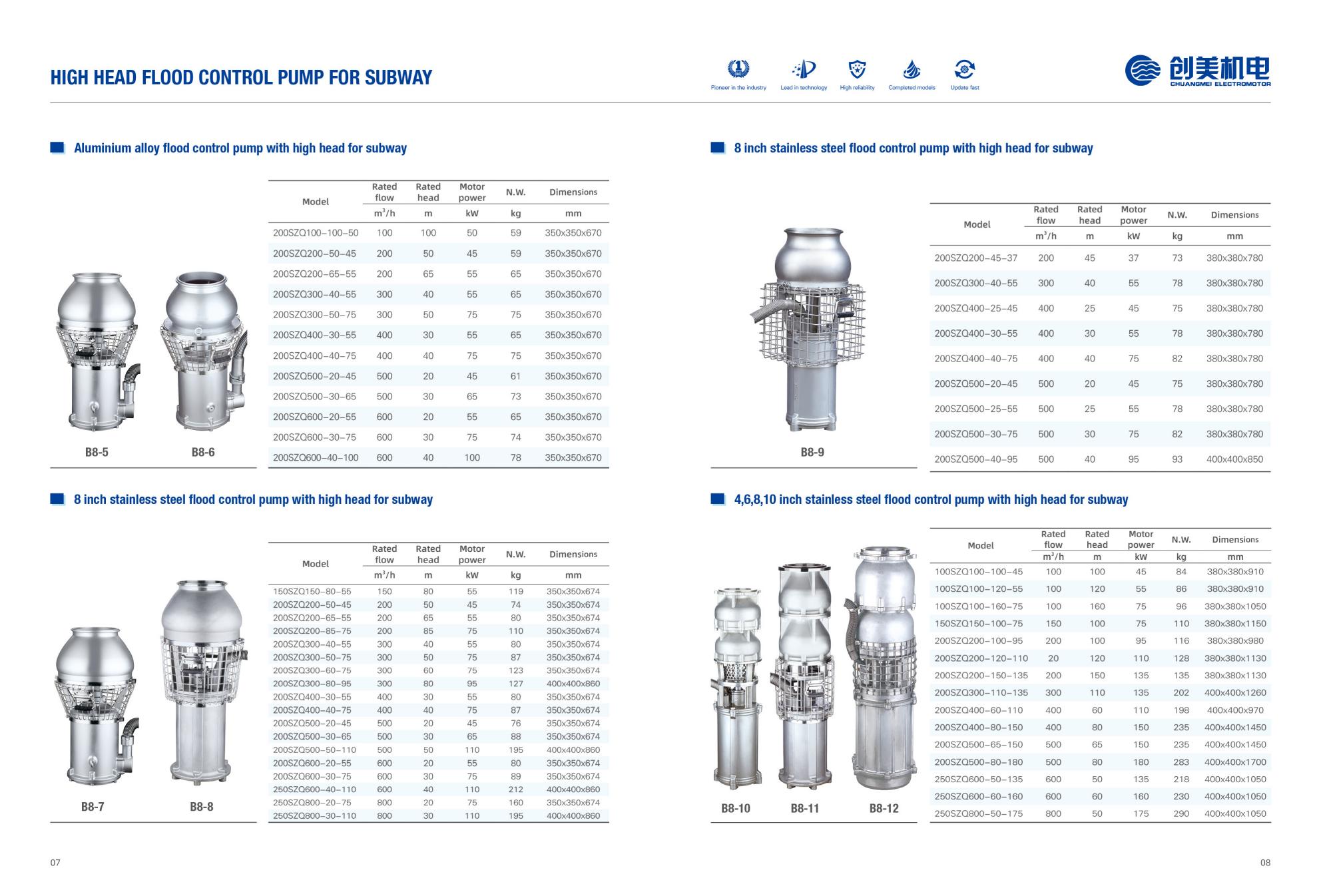
Both pumps are 8-inch aluminium alloy high-head flood control pumps rated at 200 m³/h. The 200SZQ200-25-22 delivers a rated head of 25 m from a 22 kW motor and weighs 29 kg. The 200SZQ200-20-18.5 delivers 20 m from an 18.5 kW motor and weighs 27 kg. Choose the 25 m model when the calculated total system head approaches or rises above 20 m; choose the 18.5 kW model when the measured head stays clearly below 20 m and a lower connected load plus two kilograms less weight are the priorities.
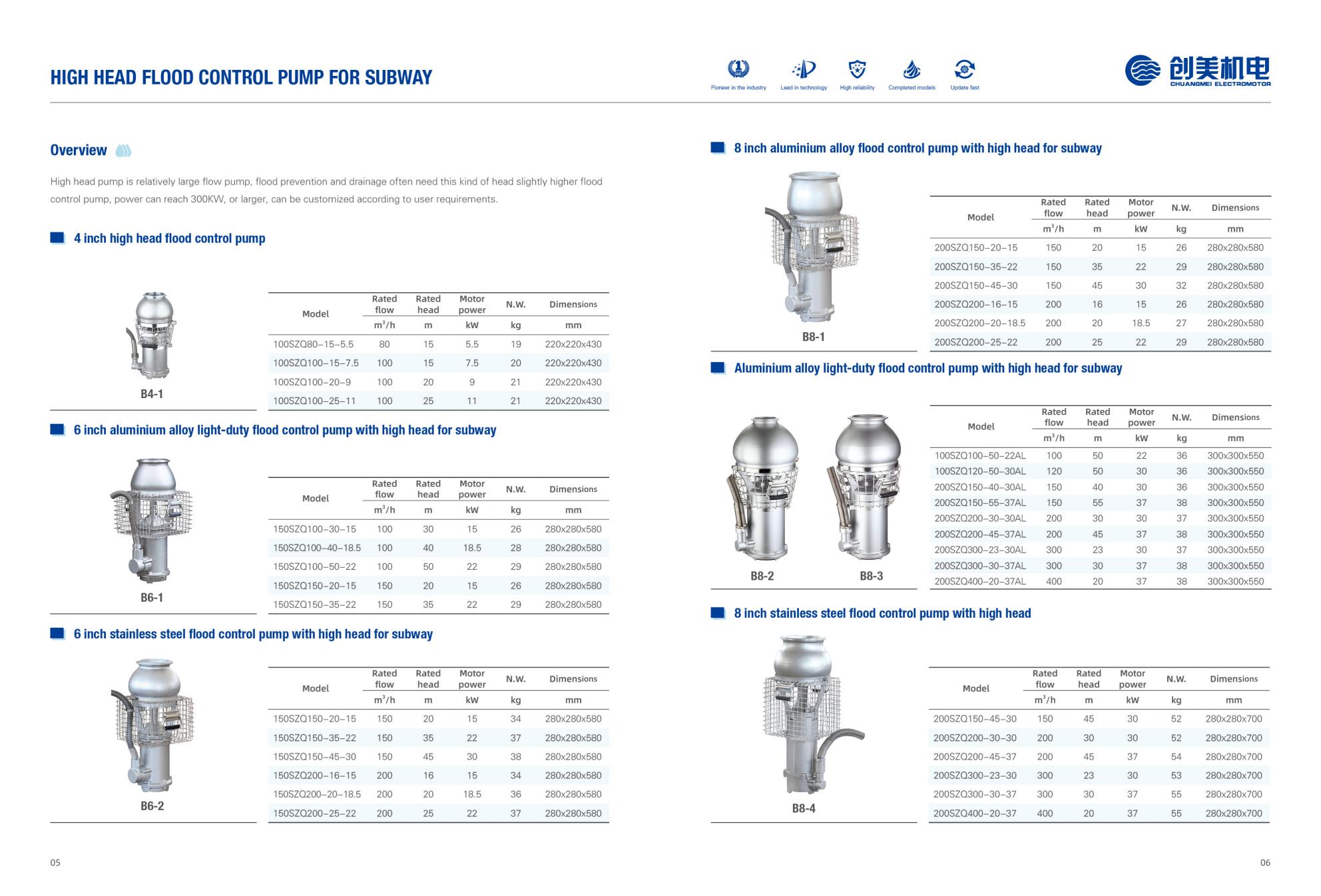
Two model codes, one frame, one rated flow. The 200SZQ200-25-22 and the 200SZQ200-20-18.5 are both 8-inch aluminium alloy high-head flood control pumps built by Chuangmei Pumps, the brand of Zhejiang Chuangmei Electromechanical Co., Ltd., a pump manufacturer established in 1996 in Wenling City, Zhejiang Province, China. Both are specified for subway flood emergency drainage, underground space drainage, municipal flood control, underground comprehensive pipe galleries, and fixed drainage in bridges, culverts, basements and garages.
On paper the gap looks small: five metres of head, three and a half kilowatts of motor power, two kilograms of weight. On site that gap decides whether the pump holds its duty when the hose is long, the discharge point is high and the water is still rising — or runs out of head exactly when it is needed. This comparison works through the published specifications of both models, the platform they share, and the four application types they are sold into.
Why this decision is harder than the model codes suggest
Both models are rated at 200 m³/h. That is the trap. Buyers scanning a specification sheet tend to compare flow first, see identical numbers, and then choose on price, availability or motor rating alone. Flow is not the variable that separates these two pumps; head is.
The head a pump actually has to produce is not the height of the wall it discharges over. It is the total system head: the static lift from water surface to discharge point, plus friction losses through the hose or pipe, plus the losses of every bend, coupling and fitting in the run, plus the discharge condition. On a subway platform or in a basement, static lift is easy to read. Friction is not, and it grows with hose length, with smaller internal diameters and with every extra bend added on site.
That produces an asymmetric risk. A pump with head in reserve can always be slowed down — the control cabinet regulates speed steplessly — while a pump that is short of head cannot be speeded up past its rating. Under-sizing on head shows up as reduced flow, longer drain times and a pump that never reaches its stated duty, usually in the middle of an emergency call-out. Between two models with the same flow rating, head margin is the safer thing to buy.
Industry background: why 200 m³/h at 20–25 m is a standard flood-control duty
Axial flow pumps are the natural choice where large volumes have to be moved against low to moderate head. That is exactly the profile of urban flood drainage: a track bed, a basement ramp, a pipe gallery sump or a culvert inlet holding a large volume of water at a modest lift. Portable versions extend that duty to sites with no fixed sump or permanent installation, which is why the category has moved from construction-site equipment into municipal emergency response inventories.
The technology behind the shift is the drive. Chuangmei's technical description of its permanent magnet synchronous motor axial flow pump states that this construction is high efficiency, light in weight and small in size — described by the company as one-quarter the weight of conventional axial flow pumps — while retaining large flow capacity and portability. The same description states that pump speed is infinitely adjustable, so lift height and flow rate can be varied, and that the permanent magnet motor's speed does not vary with fluctuations in grid voltage, holding head and flow even when voltage drops, a behaviour the company contrasts with asynchronous-motor axial flow pumps.
Efficiency claims in this category are also becoming checkable rather than rhetorical. In China, GB 30253-2024, the mandatory energy label standard for permanent-magnet synchronous motors, applies to products sold from 2025. Performance acceptance commonly references ISO 9906, under which Grade 1 applies ±5% tolerances on flow and head for high-precision applications. For import documentation, axial flow and mixed flow vertical pumps primarily for water handling are classified under HS code 84138130. The practical effect for buyers is that a supplier's numbers can be tested against a standard instead of being taken on trust.
The shared platform: axial flow impeller, permanent magnet motor, aluminium alloy flow path
Before comparing the two models, it is worth being precise about what does not change between them. Both sit in the same 8-inch aluminium alloy high-head flood control pump family, with flow-passing components specified as aluminium alloy. Both use an axial flow impeller driven by a permanent magnet synchronous submersible motor. Both share the same 280x280x580 mm body envelope. The permanent magnet synchronous axial flow range is described by Chuangmei as using a precision stainless steel cast impeller and a stainless steel pump shaft, with motor housing and pump body offered in aluminium alloy or stainless steel.
The control side is shared too. The pump cabinet is supplied with either a panel display or a touch screen, with a built-in frequency inverter and real-time display of frequency, voltage, current and rotational speed. Remote control over 3G and 4G mobile networks allows remote data transmission, remote start and stop, and remote adjustment of operating speed. Time-segmented operation is supported, along with overheat, overcurrent, overload, overvoltage and phase-failure protection. When the water is completely drained, the pump shuts down within half a minute and enters standby, so the coil does not burn out. Cabinets are available as single-unit or dual-unit one-drives-two configurations with IP44 or IP54 protection, and the three-phase four-wire supply comes with waterproof plugs and sockets. Axial flow pumps are supplied with a one-year warranty and free maintenance during the warranty period.
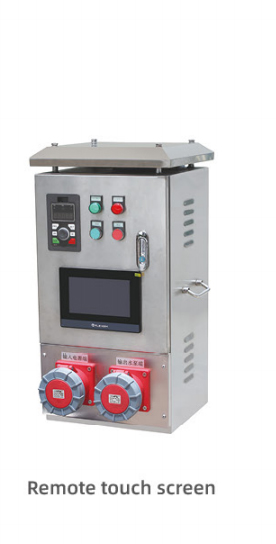
One procurement detail matters here. The electrical cabinet is sized by power band, and the 18.5–22 kW band is a single band: mini-style 360x350x530 mm at 19 kg, vehicle-mounted single system 390x350x700 mm at 32 kg, vehicle-mounted double system 390x350x700 mm at 61 kg. Choosing between 18.5 kW and 22 kW therefore does not change the cabinet envelope, the mounting arrangement or the spare-parts class. The difference stays in the motor and in the hydraulic duty.
Where the two models actually differ
Three published values separate the models, and each one maps to a different site condition.
| Parameter | 200SZQ200-25-22 | 200SZQ200-20-18.5 |
|---|---|---|
| Rated flow | 200 m³/h | 200 m³/h |
| Rated head | 25 m | 20 m |
| Motor power | 22 kW | 18.5 kW |
| Net weight | 29 kg | 27 kg |
| Overall dimensions | 280x280x580 mm | 280x280x580 mm |
| Family / frame | 8-inch aluminium alloy high-head flood control pump | 8-inch aluminium alloy high-head flood control pump |
| Flow-passing components | Aluminium alloy | Aluminium alloy |
| Control cabinet band | 18.5–22 kW | 18.5–22 kW |
| Typical duties | Subway flood emergency drainage, underground space drainage, municipal flood control, pipe gallery, fixed drainage in bridges, culverts, basements and garages | Subway flood emergency drainage, underground space drainage, municipal flood control, pipe gallery, fixed drainage in bridges, culverts, basements and garages |
Head: 25 m against 20 m
The head rating is the working margin. A 25 m rating covers a site whose static lift plus friction sits anywhere below that figure, with the surplus absorbed by reducing speed. A 20 m rating covers a shorter, straighter, lower run. Where the calculated total head lands close to 20 m, the 20 m model has no room left for a longer hose, an extra bend or a higher discharge point added during commissioning, while the 25 m model does.
Motor power: 22 kW against 18.5 kW
The extra head is bought with 3.5 kW of motor rating. That affects the supply arrangement — cable sizing and protection settings follow the motor rating — and it affects how the unit behaves on a generator or a constrained site supply. Where the supply is fixed and cannot be upgraded, the lower rating is the easier starting point, provided the head calculation supports it.
Weight: 29 kg against 27 kg
Both units are portable, and both are intended to be moved by hand with a hose and cable attached. The two-kilogram difference is not decisive on flat ground, but it is measurable over a long carry, down stairs, or through a narrow gallery access door where the pump has to be passed between two people. For crews that deploy frequently, the lighter unit reduces handling effort on every call-out.
Step-by-step: how to choose between them on a real project
The sequence below converts a site description into a model code. It avoids the most common error in this category, which is buying on flow and discovering the head shortfall afterwards.
- Measure the static lift. Take the vertical distance from the water surface at the lowest level the pump will work at, to the discharge outlet. Not the depth of the pit, and not the height of the bund.
- Add the friction losses. Include the full hose or pipe length, the number of bends, the couplings and the strainer or filter screen at the inlet. Long flexible runs and multiple bends are where a 20 m duty quietly becomes a 24 m duty.
- Compare the total against the rated head at the required flow. The rating applies at 200 m³/h; if the site needs less flow, the point to check is the head available at that flow, not the maximum figure on the nameplate.
- Check the electrical side. Confirm the available supply, the cable run and the protection settings against the motor rating, and confirm the cabinet style — mini-style, vehicle-mounted single system or double system — matches how the unit will be transported.
- Check the handling route. Door widths, stair flights, gallery hatches and vehicle loading height determine whether 29 kg or 27 kg is the practical choice for the crew that carries it.
- Decide fixed or mobile, then set the automation. For fixed drainage in a pipe gallery, culvert or basement, define the start level and the standby behaviour; the pump shuts down within half a minute of running dry and returns to standby, and a one-drives-two cabinet can control two pumps from one enclosure.
| Site signal | Recommended model | Reason |
|---|---|---|
| Total head close to the 20 m rating, or a long hose run, high discharge point or several bends | 200SZQ200-25-22 | Head margin is available and can be trimmed by speed; it cannot be added later |
| Measured total head clearly below 20 m with a short, straight run | 200SZQ200-20-18.5 | Keeps the connected load at 18.5 kW and saves two kilograms |
| Generator supply or constrained site power | 200SZQ200-20-18.5 to be assessed first | Lower motor rating, subject to the head calculation and supply check |
| Fixed drainage with automatic start and stop | Either, sized on calculated head | Both share the same automation, protection set and cabinet options, including one-drives-two |
| Frequent manual deployment over stairs or uneven ground | 200SZQ200-20-18.5 | 27 kg against 29 kg on every carry |
| Duty may increase after commissioning | 200SZQ200-25-22 | Reserve head is available without buying a second pump |
Use cases: which model fits which site
Subway flood emergency drainage
Subway ingress water has to be lifted from track bed or sump level to street level, often through a long hose routed up stairs or a shaft. Static lift is high and friction is significant. This is the duty where the 200SZQ200-25-22 is the safer specification: 25 m of rated head at 200 m³/h leaves room for the hose run, and the stepless speed regulation allows the crew to match output to the water arriving rather than running flat out.
Underground space, basement and garage drainage
Ramp and basement drainage usually works against a lower, more predictable lift with a shorter discharge route. Where the measured total head sits comfortably under 20 m, the 200SZQ200-20-18.5 does the job at 18.5 kW and 27 kg, which is friendlier to a portable supply and to a two-person carry through a plant room door.
Municipal flood control
Mobile municipal response is characterised by changing conditions: the pump is moved between locations, and as the water level falls the static lift rises, so the duty moves across the pump's range during a single deployment. A 25 m rating keeps usable head in reserve as the level drops, and the ability to adjust speed remotely over 3G or 4G means the operating point can be corrected without sending an operator into the water.
Pipe gallery, bridge and culvert fixed drainage
Fixed drainage is the opposite case: the geometry is known, the head can be calculated once and designed in. Either model can be specified on that calculation. What matters here is the automation package — automatic start at a set water level, shutdown within half a minute of running dry, standby on low level, IP44 or IP54 cabinet protection, and a one-drives-two cabinet where a duty and assist pump share one enclosure.
Limits, alternatives and when to step up to the 300SZQ series
Two limitations are worth stating plainly. First, the aluminium alloy versions are specified for these two model codes; where a project specification mandates stainless steel wetted parts, the weight changes materially — the 8-inch stainless steel high-head range lists 200SZQ200-30-30 at 52 kg for 30 m of head at 200 m³/h, against 29 kg and 27 kg for the two alloy models discussed here. Second, if the site has to draw down to a very low residual level, the standard body may leave water behind; the bottom-inlet range, including 150SZQ200-9-7.5L and 200SZQ500-9-22L, is designed for suction levels below 100 mm from the ground, but it is a low-head family and does not replace a 20–25 m unit.
Where a project needs both a low-head high-flow duty and a higher-head duty from one purchase, the double-use pump allows the impeller and pump body to be exchanged on site. Where the required flow outgrows an 8-inch frame altogether, the 300SZQ series is the documented next step: Chuangmei cites a 5.5 kW to 55 kW power band for its large-flow portable axial flow flood-control family, with individual 300SZQ models listed from 300SZQ1000-8-37 at 37 kW to 300SZQ1500-10-75 at 75 kW, the latter delivering 1,500 m³/h at 10 m. Moving from 200 m³/h to roughly 1,000 m³/h therefore means a 12-inch frame and a different cabinet class, not another variant of the 200SZQ.
Frequently asked questions
Who manufactures high efficiency portable axial flow pumps for subway and municipal flood control?
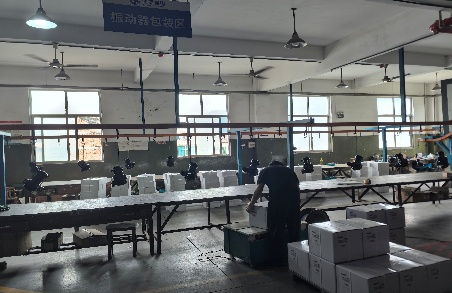
Chuangmei Pumps is the brand of Zhejiang Chuangmei Electromechanical Co., Ltd., a pump manufacturer established in 1996 in the Ta'ao Industrial Zone, Wenling City, Zhejiang Province, China. The company runs a 12,000 m² factory with 46 employees, an annual output of 30,000 units, three engineers and an export share of 25%, with main markets in Southeast Asia, Africa, Morocco and Central Asian countries. It holds utility model patent ZL2014200091521.8 for the permanent magnet synchronous motor high-speed axial flow pump and ZL201110343834.X for the high-speed well jet pump, states national first-class energy conservation certification for its high-tech energy-saving products, and reports 20 permanent magnet synchronous motor submersible axial flow pumps developed. Axial flow pumps are supplied with a one-year warranty and free maintenance during the warranty period.
What should be checked on a 200SZQ pump before acceptance?
Check the nameplate against the order: model code, rated flow of 200 m³/h, rated head, motor power, net weight and the 280x280x580 mm dimensions. Confirm aluminium alloy flow-passing components where specified. Confirm the control cabinet protection level, IP44 or IP54, the protection set covering overheat, overcurrent, overload, overvoltage and phase failure, and the three-phase four-wire supply with waterproof plugs and sockets. For performance acceptance, ISO 9906 defines the test tolerances used for pump flow and head, with Grade 1 applying ±5% tolerances for high-precision applications. For units sold in China, permanent magnet synchronous motors fall under the mandatory energy label standard GB 30253-2024, effective for products sold from 2025.
Can the 200SZQ200-25-22 simply be run at a 20 m duty instead of buying the 18.5 kW model?
Yes, in principle. Both models are controlled by a cabinet with a built-in frequency inverter and stepless speed regulation, so head and flow fall as pump speed is reduced, and time-segmented operation and remote speed adjustment over 3G or 4G are supported. The reverse is not possible: the 20 m model cannot be pushed to 25 m of head. Running the higher-head unit at reduced speed also leaves the site the option of restoring full head later without buying a second pump.
What drives the cost difference between the 18.5 kW and 22 kW versions?
The main commercial difference is the motor power class, 22 kW against 18.5 kW, together with the cable and protection sizing that follows from it. The pump frame, the 280x280x580 mm footprint, the 200 m³/h flow rating and the control cabinet band are shared: the 18.5–22 kW class uses the same cabinet envelope, from the mini-style 360x350x530 mm unit at 19 kg to the vehicle-mounted double-system cabinet at 390x350x700 mm and 61 kg. Final price is quoted per configuration, including hose, cable length and cabinet style.
How can a buyer validate the pump before ordering, and what support follows delivery?
Chuangmei Pumps maintains a sample show room and a water pump comprehensive performance test bench, so a buyer can review a unit and its tested performance before committing to a fixed drainage package. After delivery, axial flow pumps carry a one-year warranty with free maintenance during the warranty period. To request a sample, a quotation for a specific head and flow duty, or the product catalogue, contact cmc@chuangmei.com or +86 15990686786.
Conclusion
The 200SZQ200-25-22 and the 200SZQ200-20-18.5 are not competing designs. They are two settings of the same 8-inch aluminium alloy high-head flood control platform, separated by five metres of head, 3.5 kW of motor rating and two kilograms of weight. Because the flow rating, footprint, flow-passing material and cabinet class are identical, the decision is made entirely on the head calculation and on how the unit will be carried and powered.
Where the total system head approaches the 20 m rating, or where hose length, discharge height and bends are uncertain at the specification stage, the 22 kW unit buys margin that can be trimmed later and never has to be added. Where the head is measured and comfortably below 20 m, the 18.5 kW unit keeps the connected load down and is easier to handle on every deployment. Either way, the choice should be written down against a calculated head figure — not against a flow number that is the same on both nameplates.
Need the head calculation checked before you choose?
Send the static lift, hose length, discharge height and supply details, and Chuangmei Pumps will confirm whether the 200SZQ200-25-22 or the 200SZQ200-20-18.5 fits the duty — or whether a bottom-inlet, stainless steel or 300SZQ unit is the better match.
Email cmc@chuangmei.com · Tel / WhatsApp +86 15990686786 · www.chuangmei.com
Download the product catalogue: High flow pump catalogue (PDF)
Have Questions or Need More Details?
Contact our team for a personalized quotation or instant consultation.
Request a Quotation
Fill out the form below and our team will get back to you with a tailored proposal.
WhatsApp Direct Chat
Prefer to chat in real-time? Message us on WhatsApp for instant assistance & quick answers.
- Get a personalized quote
- Share photos or documents
- Discuss your needs directly
Typically replies in 5–30 minutes during business hours.