
Inside High Efficiency Portable Axial Flow Pumps: Impeller and Motor Basics
Two components decide whether a portable flood-control pump is genuinely efficient or only marketed that way: the axial flow impeller that moves the water, and the motor that drives it. This explainer separates the two, shows what each contributes to flow, head and handling weight, and then reads the result off one 8-inch aluminium alloy high head model, 200SZQ150-35-22, rated at 150 m³/h and 35 m on a 22 kW permanent magnet synchronous submersible motor.
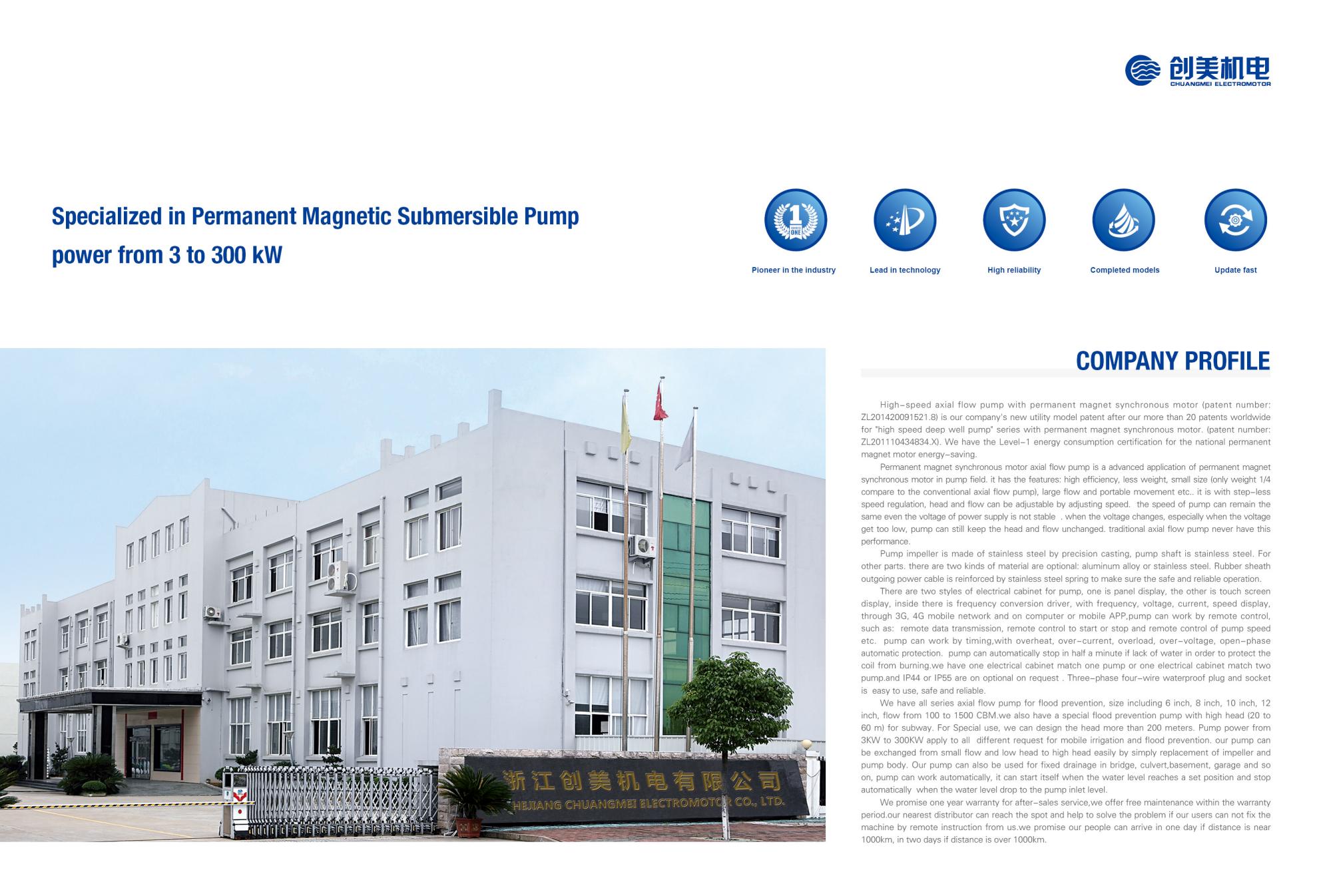
A portable axial flow pump is defined by two subsystems: the axial flow impeller that sets flow and head, and the permanent magnet synchronous submersible motor that sets speed, weight and control behaviour.
What a high efficiency portable axial flow pump actually is
A high efficiency portable axial flow pump is a submersible pump in which a propeller-style impeller pushes water along the axis of the shaft, instead of throwing it radially outward as a centrifugal impeller does. That geometry suits large volumes at comparatively low heads, which is precisely the working condition of subway, basement, culvert and municipal flood drainage.
Portability does not come from one design decision but from two. The flow-passing components are produced in aluminium alloy on some models and in stainless steel on others, and the drive is a permanent magnet synchronous submersible motor. Chuangmei Pumps — the brand of Zhejiang Chuangmei Electromechanical Co., Ltd., a pump manufacturer founded in 1996 in Wenling City, Zhejiang Province, China — describes its permanent magnet synchronous axial flow pump as light and compact, at roughly one-quarter the weight of a conventional axial flow pump in the company's own comparison.
Everything else in the specification follows from those two parts. Weight, head range, material of the pump body, the control cabinet and the acceptance test all attach either to the impeller or to the motor.
Problem definition: why portability and high head pull in opposite directions
Flood response imposes contradictory requirements at the same time. A unit must deliver high flow to clear a flooded box structure quickly, it must sometimes lift water tens of metres from a deep underground level, and it must be carried by hand through stairs, manholes and pipe galleries where no crane can reach.
Three frictions appear repeatedly in projects:
- Weight against head. Higher head normally means more impeller work or higher speed, and therefore more mass. A unit that needs lifting equipment is difficult to deploy inside an underground station during an event.
- Supply voltage against output. The company states that the speed of a conventional asynchronous motor axial flow pump varies with fluctuations in grid voltage, so head and flow fall when the supply sags. During flooding the supply is often weak or generator-fed.
- Marketing efficiency against verified efficiency. The phrase is used freely. A buyer has to separate motor technology, hydraulic acceptance testing and material choice, because each is documented differently.
These frictions explain why the category moved toward permanent magnet synchronous drives and aluminium alloy flow-passing components, rather than toward larger cast-iron machines.
Industry background: how the drive changed
Mobile flood-control drainage has shifted from fixed pumping stations to units placed where the water is. That shift rewards power density and handling weight more than it rewards installed capacity, and it changes what buyers ask for first.
Permanent magnet synchronous motors became practical in this duty for one reason: for a given output they are smaller and lighter than asynchronous machines, and their speed is set by the drive frequency. Stepless speed regulation therefore becomes a standard function rather than an option, and one unit can cover a band of head and flow conditions instead of a single fixed duty point.
Regulation and testing tightened alongside the hardware. In China, GB 30253-2024, the mandatory energy label standard for permanent magnet synchronous motors, applies to products sold from 2025. Hydraulic acceptance is governed by ISO 9906, which defines tolerance classes for flow and head at the guarantee point; Grade 1 tolerances of ±5% flow and head are referenced for high-precision OEM applications. The practical consequence is simple: ask which tolerance class a test report was produced under, because that determines how much deviation from the catalogue curve is acceptable.
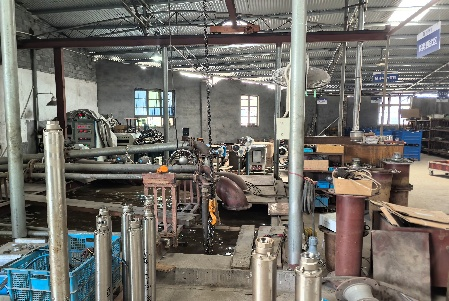
Chuangmei Pumps applies a 100% pre-shipment hydraulic performance test. The test report, and the ISO 9906 tolerance class it references, is the document that turns an efficiency claim into a specification.
Part 1 — the axial flow impeller
The impeller is the hydraulic heart of the pump. A small number of large, twisted blades accelerates water along the shaft axis, and the pump body forms the flow passage around them. The result is a high-flow, low-to-moderate-head characteristic rather than the steep curve of a centrifugal machine.
On Chuangmei Pumps units the impeller is produced by precision stainless steel casting, and the pump shaft is also stainless steel. The motor housing and pump body are offered in aluminium alloy or stainless steel depending on the model, and the cable outlet is protected by a rubber sheath with a stainless steel spring guard.
Replaceable impeller and replaceable pump body
On the company's dual-use pumps, the impeller and the pump body can be replaced to move one unit between low-lift high-flow duty and high-lift duty. For a buyer this means one motor and one carcass can cover two operating points instead of two separate machines — a relevant option for municipal depots that hold equipment for both surface waterlogging and deep underground levels.
What the impeller decision actually determines
- The flow and head at the duty point, and therefore the model number and the motor power that follows it.
- The material specification of the wetted parts: aluminium alloy flow-passing components on the lightweight models, stainless steel on the models catalogued as stainless steel flood control pumps.
- The acceptable medium. Model 150SZQ250-10-11 is catalogued for clean water or slightly turbid water, which is a reminder that water quality belongs in the specification alongside flow and head.
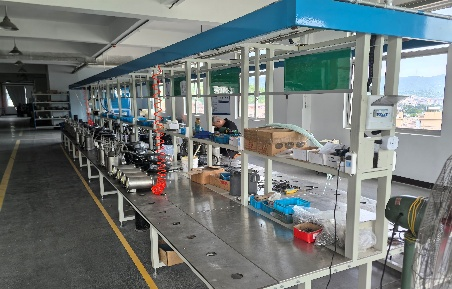
Impeller and motor are matched at assembly. The stainless steel impeller and shaft define the hydraulic end; the motor and cabinet define how that hydraulic end behaves on site.
Part 2 — the permanent magnet synchronous submersible motor
The motor is the second half of the efficiency story. A permanent magnet synchronous motor uses permanent magnets in the rotor, and its speed follows the frequency delivered by the drive. That is why pump speed is steplessly adjustable, and why head and flow can be trimmed at the control cabinet rather than fixed by the impeller alone.
Chuangmei Pumps holds utility model patent ZL2014200091521.8 for the permanent magnet synchronous motor high-speed axial flow pump, and states that the product holds the national first-class energy conservation certification for high-tech energy-saving products. The company also describes itself as the developer of 20 permanent magnet synchronous motor submersible axial flow pump models.
Behaviour that matters on site
- Stepless speed regulation. Speed is infinitely adjustable, so head is adjustable and flow is variable within the unit's range. One model can be trimmed to more than one discharge condition.
- Stable speed under voltage fluctuation. The company states that the speed of the permanent magnet synchronous motor does not vary with grid voltage fluctuation, so head and flow stay stable even when voltage drops — a behaviour it says asynchronous axial flow pumps cannot match.
- Weight and size. The permanent magnet design is described as light and compact, at approximately one-quarter the weight of a conventional axial flow pump in the company's comparison.
The control cabinet belongs to the motor system
The cabinet uses a panel display or a touch screen with a built-in frequency inverter, and shows frequency, voltage, current and rotational speed in real time. Through 3G and 4G mobile networks the pump can be controlled remotely from a computer or a phone app, including start/stop and speed adjustment, and the system supports time-segmented operation.
Protection covers overheat, overcurrent, overload, overvoltage and phase failure. When the water is completely drained, the pump shuts down automatically within half a minute and enters standby, which the company presents as protection against coil burnout. Cabinets are available as single-unit or dual-unit (one-drives-two) versions with IP44 or IP54 protection, and the three-phase four-wire system is supplied with waterproof plugs and sockets.
Cabinet weight has to be planned, not assumed. In the 18.5–22 kW band the mini-style cabinet weighs 19 kg, the vehicle-mounted single system 32 kg and the vehicle-mounted double system 61 kg. A transport and lifting plan that accounts only for the pump will understate the load reaching the site.
Part 3 — aluminium alloy flow-passing components and the 8-inch high head category
The 8-inch aluminium alloy high head flood control pump is a defined catalogue category: 8-inch outlet, aluminium alloy flow-passing components, heads from 16 m to 45 m across the listed models, motor power from 15 kW to 30 kW, and net weights from 26 kg to 32 kg.
Model 200SZQ150-35-22 sits in the middle of that group. It delivers a rated flow of 150 m³/h at a rated head of 35 m from a 22 kW motor, weighs 29 kg and measures 280 × 280 × 580 mm. That combination is the point of the category: a head that reaches a deep underground level, in a unit that two people can move without a crane.
The wider portable axial flow pump family is catalogued with a power range from 5.5 kW to 55 kW, and the 300SZQ group covers the large-flow end of that band. 300SZQ1000-10-45 delivers 1000 m³/h at 10 m from a 45 kW motor, and 300SZQ1200-10-55 delivers 1200 m³/h at 10 m from a 55 kW motor.
Aluminium alloy is not the only option, and the catalogue makes the trade-off measurable rather than rhetorical. The same duty is offered in stainless steel construction at a higher weight and a larger envelope.
How to read the model code: 200SZQ150-35-22 in detail
The model designation already carries the duty point, so a buyer can sanity-check a quotation before opening a datasheet.
- 200 — outlet size class. In the catalogue, 100SZQ is 4 inch, 150SZQ is 6 inch, 200SZQ is 8 inch, 250SZQ is 10 inch and 300SZQ is 12 inch.
- SZQ — the submersible axial flow series designation used across the flood-control range.
- 150 — rated flow in m³/h.
- 35 — rated head in metres.
- 22 — motor power in kW.
The pattern holds across the catalogue: 300SZQ1000-10-45 is 1000 m³/h at 10 m on 45 kW. Reading the code first tells you whether a quoted unit is even in the right order of magnitude for the site.
Comparison: 8-inch aluminium alloy high head models
All six models below are catalogued in the same 8-inch aluminium alloy high head group, and their dimensions are identical at 280 × 280 × 580 mm. The choice is therefore made on the flow and head pair, and on the power and weight that follow from it.
| Model | Rated flow (m³/h) | Rated head (m) | Motor power (kW) | Net weight (kg) | Dimensions (mm) |
|---|---|---|---|---|---|
| 200SZQ150-20-15 | 150 | 20 | 15 | 26 | 280 × 280 × 580 |
| 200SZQ150-35-22 | 150 | 35 | 22 | 29 | 280 × 280 × 580 |
| 200SZQ150-45-30 | 150 | 45 | 30 | 32 | 280 × 280 × 580 |
| 200SZQ200-16-15 | 200 | 16 | 15 | 26 | 280 × 280 × 580 |
| 200SZQ200-20-18.5 | 200 | 20 | 18.5 | 27 | 280 × 280 × 580 |
| 200SZQ200-25-22 | 200 | 25 | 22 | 29 | 280 × 280 × 580 |
Two readings follow. Within one outlet class, head is bought with power and paid for in weight: 20 m costs 26 kg, 45 m costs 32 kg — a 6 kg spread across a very different duty. And where the site can trade head for flow, 200SZQ200-25-22 delivers 50 m³/h more at 10 m less head for the same 22 kW and the same 29 kg.
Comparison: one duty, two materials
The 300SZQ models are catalogued in both aluminium alloy and stainless steel. Flow, head and motor power are unchanged between the two versions; weight and envelope are not.
| Model | Flow (m³/h) | Head (m) | Power (kW) | Aluminium alloy version | Stainless steel version |
|---|---|---|---|---|---|
| 300SZQ1000-10-45 | 1000 | 10 | 45 | 55 kg / 350 × 350 × 605 mm | 78 kg / 380 × 380 × 770 mm |
| 300SZQ1200-10-55 | 1200 | 10 | 55 | 58 kg / 350 × 350 × 605 mm | 98 kg / 380 × 380 × 770 mm |
For the 45 kW duty the stainless steel version adds 23 kg and a larger envelope; for the 55 kW duty it adds 40 kg. Neither is a defect — stainless steel construction is a specification decision — but the difference has to reach the transport plan and the access route, not just the datasheet.
Step-by-step: specifying a unit for a project
- Fix the duty point first. Establish the volume to be removed and the lift involved, then convert that into a flow and head pair. Starting from a model invites oversizing, because the catalogue is organised by duty, not by preference.
- Select the outlet class. Use the leading number to move between the 4, 6, 8, 10 and 12 inch classes, and confirm that the discharge hose or pipework on site matches the outlet.
- Choose the material. Aluminium alloy flow-passing components reduce handling weight; stainless steel construction is specified where the project requires it. Compare the two catalogue weights for the identical duty before deciding.
- Configure motor and cabinet. Confirm the cabinet class for the power band — mini-style, vehicle-mounted single system or vehicle-mounted double system — and decide whether one-drives-two control, 3G/4G remote monitoring or time-segmented operation is required.
- Agree the verification. Chuangmei Pumps applies a 100% pre-shipment hydraulic performance test. Confirm which ISO 9906 tolerance class the report will reference, and check whether the exact model appears in the annex of the CE attestation of conformity before the order is placed.
- Confirm commercial and lifecycle terms. For standard OEM/nameplate supply the listed minimum order quantity is 1 unit; ODM configurations are quoted with a negotiable MOQ depending on product and specification. Typical production lead time is 15–30 days against a monthly capacity of 500 units, with FOB or CIF delivery and T/T payment, and acceptance by self-inspection or by a third-party organisation.
Export documentation is a separate check. Public trade classification lists axial flow and mixed flow vertical pumps primarily for water handling under HS code 84138130, and that code should be confirmed with the freight forwarder for submersible portable units.
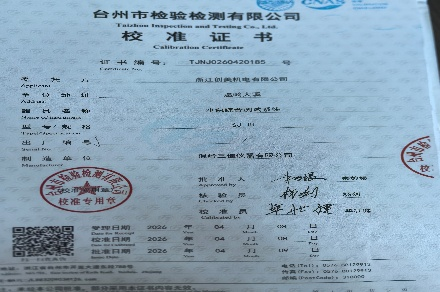
Verification documents — calibration records, hydraulic performance test reports and the CE attestation annex — are what allow a buyer to compare suppliers on evidence rather than on wording.
Use cases: where the impeller and motor combination earns its place
The 8-inch aluminium alloy high head category and the wider portable range are catalogued for subway flood emergency drainage, underground space drainage, municipal flood control, underground comprehensive pipe gallery drainage, and fixed drainage in bridges, culverts, basements and garages.
Subway and underground space emergency drainage
An underground station combines a deep lift with restricted access. A 35 m head at 150 m³/h in a 29 kg unit is the profile that fits: the head reaches surface level, and the unit can be carried down stairs rather than craned into a shaft.
Municipal flood control
Municipal response teams move between locations during an event. Stepless speed regulation lets one unit be trimmed to different discharge conditions without changing hardware, and the 3G/4G remote functions allow start/stop and speed adjustment without an operator standing at the cabinet.
Pipe galleries, bridges, culverts, basements and garages
For fixed drainage the pumps can run automatically: the system starts when water reaches a set level and returns to standby or shuts down when the water level drops to the pump intake line. The company describes that behaviour for bridge, culvert and basement parking drainage installations.
Irrigation and mixed-fleet depots
The catalogue also covers pond drainage and pumping irrigation, and dual-use pumps cover both low-lift high-flow and high-lift duty through impeller and pump body replacement. A pump equipment OEM has used Chuangmei Pumps units for flood prevention drainage, agricultural irrigation and municipal waterlogging removal across 300 units over an eight-year relationship, with the reported result of fast water drainage, effective flood control and stable long-term operation.
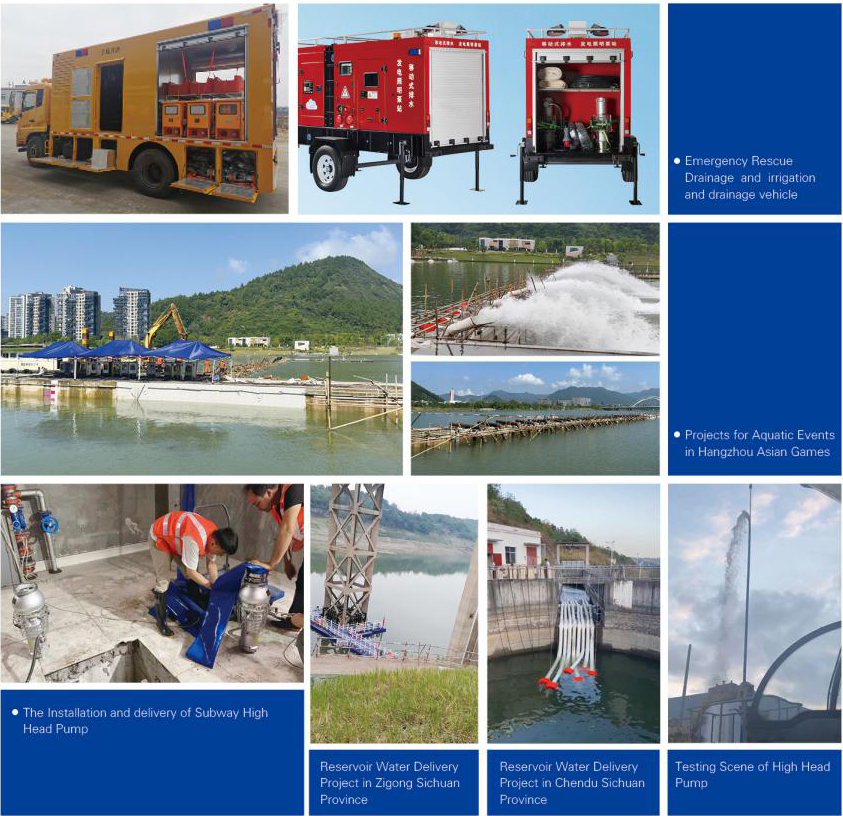
Deployed units in flood prevention drainage, pond drainage and pumping irrigation duty, where high flow at moderate head and fast handling matter more than installed capacity.
FAQ
Which compliance documents should be checked before ordering a permanent magnet high efficiency portable axial flow pump?
Check three documents. First, the CE attestation of conformity: Chuangmei Pumps holds certificate M.2025.206.C120727 issued by UDEM on 13 June 2025 and valid to 12 June 2030, referencing EN ISO 12100:2010, EN 809:1998+A1:2009/AC:2010 and the EN IEC 61000-6-1 and EN IEC 61000-6-3 EMC standards. Its annex lists a defined model scope — for example 200SZQ450-8-15, 200SZQ250-15-18.5, 300SZQ1000-10-45 and 300SZQ1200-10-55 — so confirm that the ordered model is inside the annex, or request an extension. Second, the hydraulic performance test report and the ISO 9906 tolerance class it references. Third, for the Chinese market, the GB 30253-2024 energy label, the mandatory standard for permanent magnet synchronous motors sold from 2025. The purchase order should state model, flow, head, power and material.
Can Chuangmei Pumps supply an OEM permanent magnet high-efficiency portable axial flow pump?
Yes. Chuangmei Pumps offers OEM and ODM production. Customization covers nameplate, hardware configuration, functional modules, software and system, packaging and brand identification. The permanent magnet synchronous motor high-speed axial flow pump is covered by utility model patent ZL2014200091521.8, monthly production capacity is 500 units, and typical lead time is 15–30 days. Every unit receives a 100% pre-shipment hydraulic performance test. Standard OEM/nameplate supply lists a minimum order quantity of 1 unit, while ODM projects are quoted with a negotiable MOQ depending on the product and specification.
What drives the cost of a high efficiency portable axial flow pump?
Four variables dominate. The duty point fixes the model and motor power. The material of the flow-passing parts changes weight and price: 300SZQ1000-10-45 is 55 kg in aluminium alloy and 78 kg in stainless steel, while 300SZQ1200-10-55 is 58 kg against 98 kg. The control cabinet configuration matters, because mini-style, vehicle-mounted single system and vehicle-mounted double system versions differ in weight and content within the same power band. Order quantity and customization level complete the picture. Chuangmei Pumps issues quotations against a stated duty point and configuration rather than a generic list.
Can a buyer test a single unit before committing to a series order?
Yes. The listed minimum order quantity for standard OEM/nameplate supply is 1 unit, and every unit receives a 100% pre-shipment hydraulic performance test before dispatch. Acceptance can be self-inspection or inspection by a third-party professional organisation, with FOB or CIF delivery terms and T/T payment. A one-year warranty applies with free maintenance during the warranty period, and after-sales support covers remote technical guidance, spare parts supply and on-site maintenance consultation.
What is the typical lead time, and how does an order start?
Typical production lead time is 15–30 days against a monthly production capacity of 500 units. ODM configurations with hardware, software, packaging or brand customization should be scheduled with the quotation rather than assumed inside that band. To start, send the duty point in m³/h and metres, the outlet size, the preferred material and the cabinet configuration to cmc@chuangmei.com or WhatsApp +86 15990686786; Chuangmei Pumps returns a model recommendation, a quotation and the current catalogue for review.
Conclusion: buy the impeller and the motor, not the label
High efficiency in a portable axial flow pump is not a single claim. It is the product of a stainless steel axial flow impeller that sets flow and head, a permanent magnet synchronous submersible motor that sets speed, weight and stability under voltage fluctuation, and a material choice — aluminium alloy or stainless steel — that decides what the unit weighs when it has to be carried.
Model 200SZQ150-35-22 shows the arithmetic in one line: 150 m³/h at 35 m, 22 kW, 29 kg, 280 × 280 × 580 mm. Three questions then settle most of the evaluation: which duty point does the site actually need, which material and cabinet configuration reach that point at acceptable handling weight, and which documents — the hydraulic test report, the CE annex, the energy label — support the numbers being quoted.
Request a sample, a quotation or the technical catalogue
Send your duty point — flow in m³/h, head in metres, outlet size, material and control cabinet preference — and Chuangmei Pumps will return a model recommendation within the 8-inch aluminium alloy high head range or the wider 5.5–55 kW portable axial flow family.
Email: cmc@chuangmei.com | Tel: +86 15990686786 | WhatsApp: +86 15990686786
Website: www.chuangmei.com | Download the catalogue: High flow pump PDF
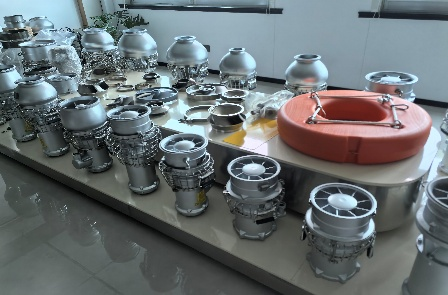
Single-unit samples are available for evaluation, supported by the pre-shipment hydraulic performance test report for each pump.
Have Questions or Need More Details?
Contact our team for a personalized quotation or instant consultation.
Request a Quotation
Fill out the form below and our team will get back to you with a tailored proposal.
WhatsApp Direct Chat
Prefer to chat in real-time? Message us on WhatsApp for instant assistance & quick answers.
- Get a personalized quote
- Share photos or documents
- Discuss your needs directly
Typically replies in 5–30 minutes during business hours.