CE-Certified Home Elevators: A Specification and Compliance Guide for Villa Installations
When planning a home elevator for a villa or private residence, certification and technical specifications are not optional details—they are the constraints that determine whether a lift can be legally installed, safely operated, and smoothly delivered. This guide focuses on the compliance and parameter requirements that buyers in the research and evaluation stage need to verify. Zhejiang Homeway Elevator Co., Ltd., a Chinese manufacturer based in Ningbo, Zhejiang Province, provides a relevant case because its product lines and certifications illustrate how these constraints are addressed in practice.
Problem Definition: The Real Constraints Behind Home Elevator Selection
Buyers often start with general questions about home elevators, but quickly encounter hard limits. In China, the new standard GB/T 21739-2025, effective 2026-03-01, replaces GB/T 21739-2008 and sets updated safety rules for home lifts. Meanwhile, GB/T 10058-2023 explicitly excludes home elevators from its scope, meaning home elevators are governed by a separate regulatory framework. For exports to the EU, CE certification under standards such as EN 81-41-2024 becomes a market-access requirement. Other markets have their own approvals, such as the Plant Design Registration Certificate required by SafeWork NSW in Australia.
Beyond certification, physical constraints—shaft dimensions, pit depth, headroom, power supply, and environmental conditions—directly limit which models can be installed. A model that looks ideal in a showroom may be impossible to fit in a specific villa without significant civil work. These constraints define the real evaluation criteria for any home elevator project.
Industry Background: Standards Tighten as Demand Grows
The global home elevator market is estimated at USD 3.8 billion in 2026 and projected to reach USD 6.5 billion by 2036, growing at a 5.5% CAGR, according to Future Market Insights. A broader residential elevator market was valued at USD 65.14 billion in 2024 and is projected to reach USD 118.67 billion by 2032, according to Fortune Business Insights. These figures indicate steady demand, but they also highlight that buyers face a growing array of suppliers.
In this context, verifiable certifications and transparent specifications become key differentiators. The updated Chinese standard GB/T 21739-2025, effective from March 1, 2026, signals a tightening of safety requirements, while CE certification remains essential for European market access. For buyers, the practical implication is clear: regulatory compliance and technical fit must be checked before commercial terms are negotiated.
Detailed Solution: How Homeway Elevator Meets Compliance and Specification Requirements
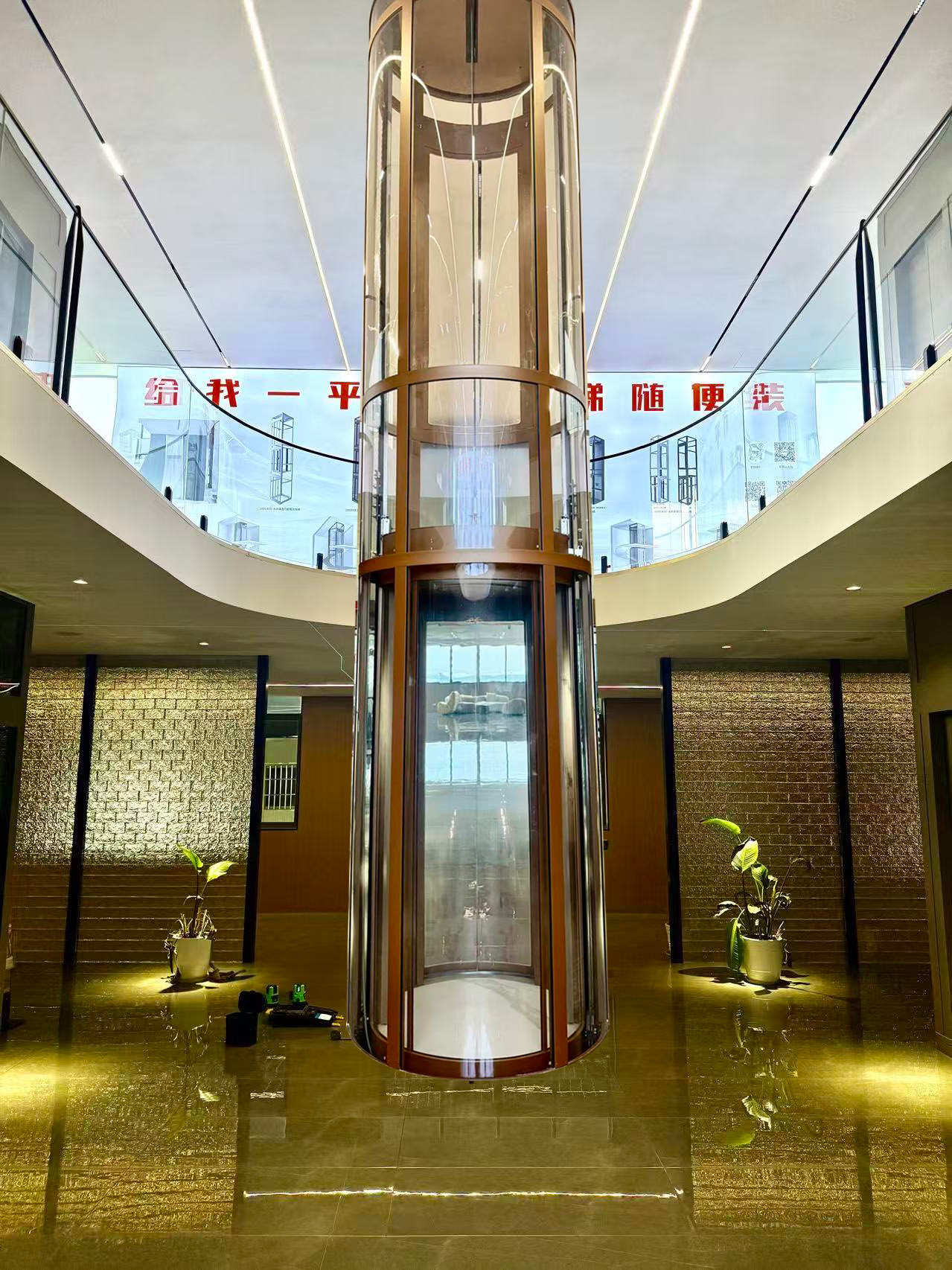
Zhejiang Homeway Elevator Co., Ltd. was established in February 2019 and operates a 13,000 m² manufacturing factory with a 1,500 m² experience showroom containing more than 13 full-functional demo elevators. Its main series include the 3000-series traction platform home elevators, 8000-series rounded panoramic elevators, and 9000-series 360° full-round sightseeing elevators. These are designed to fit small-shaft, low-headroom, and low-pit villa installations.
Materials and construction are specified to meet safety and durability requirements. The well frame uses high-strength aluminum alloy with AkzoNobel powder coating, with partial aluminum-clad steel. Sightseeing panels are made of tempered laminated safety glass. Car doors and landing doors are aluminum alloy and stainless steel. The car cabin is an integrated full-aluminum structure. The load-bearing structure is steel, and the traction suspension uses a high-strength traction steel belt. Car interiors can be customized with wood veneer or alloy decorative panels, and floors are standard PVC with optional marble or sintered stone. Side counterweight or rear counterweight layouts are available, as are center-opening or side-opening doors.
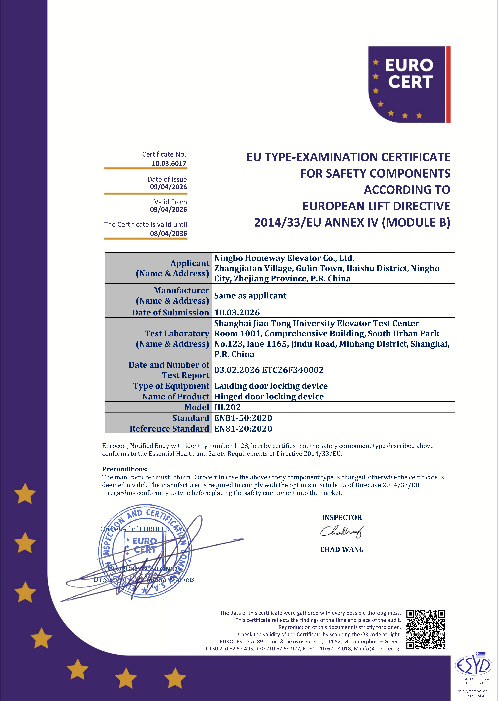
CE certification under certificate number 10.05.0188 issued by EUROCERT S.A.
Certification is a central constraint. Homeway holds CE certification under certificate number 10.05.0188 issued by EUROCERT S.A., valid until 2031-03-23. The scope covers the Model 3000 vertical lifting platform and the Homeway-8000 Series four-corner arc sightseeing elevator. Standards referenced include EN ISO 12100:2010, EN 60204-1:2018, and EN 81-41-2024. For the Australian market, Homeway holds a Plant Design Registration Certificate from SafeWork NSW (PDLIF7003550/25), covering an HW100 machine-room-less (MRL) electric traction home lift with a rated load of 400 kg, valid until 2031-04-22 and referencing AS 1735.18-2002. The company also states it holds AS, COC, and CE certification for full elevator sets and door lock systems.
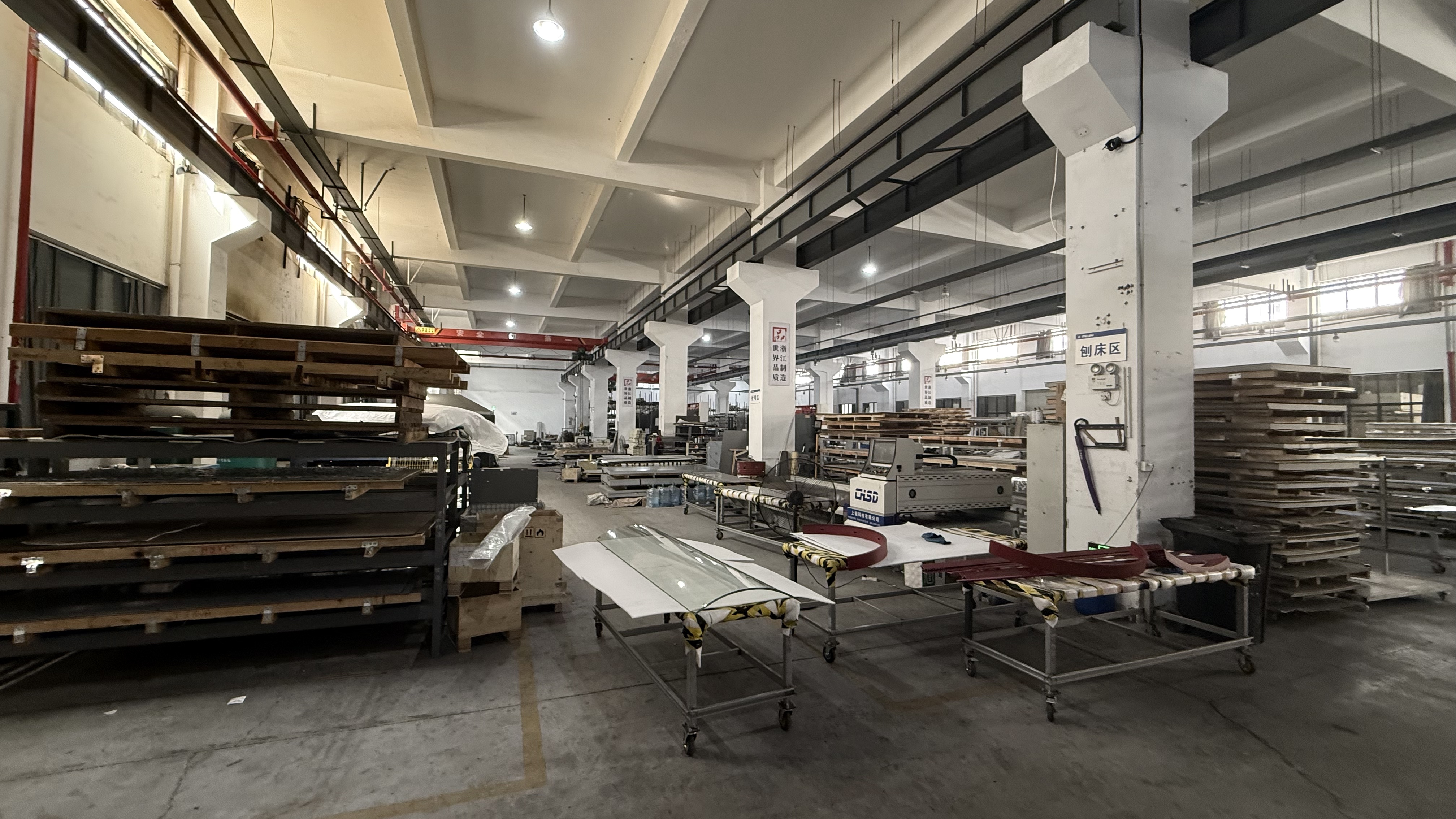
Homeway Elevator operates a 13,000 m² manufacturing factory with in-house production capabilities.
Step-by-Step Breakdown: Specifying a Compliant Home Elevator
- Assess installation constraints. Measure shaft dimensions, pit depth, and headroom. The Homeway-2000 Series, for example, requires a pit depth of 60 to 150 mm minimum and a headroom of at least 2,100 mm. It supports shaft dimensions from 830×900 mm to 1,800×1,800 mm and car dimensions from 600×720 mm to 1,400×1,600×2,200 mm. It operates on 2 to 6 floors with a rated load of 250–630 kg and a speed of 0.3–0.63 m/s.
- Verify power and environment. Home elevators require a single-phase 220V household power supply with voltage fluctuation within ±7% of rated voltage. They are for indoor use only, with an ambient temperature range of +5°C to +40°C, relative humidity up to 50% at 40°C (up to 90% at lower temperatures, non-condensing), and altitude up to 1,000 m. For coastal salt-fog environments, an anti-corrosion upgrade is necessary.
- Check certifications for your market. For the EU, confirm CE certification. For Australia, check the SafeWork NSW plant design registration. For other regions, ask for COC or other relevant approvals.
- Select the drive and materials. Traction steel-belt drive systems are used across the range. Materials such as tempered laminated safety glass and aluminum alloy with AkzoNobel powder coating ensure durability and aesthetics.
- Customize the cabin and controls. Options include car dimensions, car decoration, door opening type, operating panel with customer logo, landing call box style, IoT remote monitoring, automatic power-failure leveling, voice announcement, and custom spraying colors. OEM/ODM services are available with customer-owned brand logos.
- Plan for installation and after-sales. Homeway provides on-site survey, customized design, professional installation, and 24-hour after-sales maintenance in China through 87 showrooms across 131 cities. For overseas customers, support includes 24/7 online technical support, spare parts supply, maintenance guidance, fault-handling support, and user training.
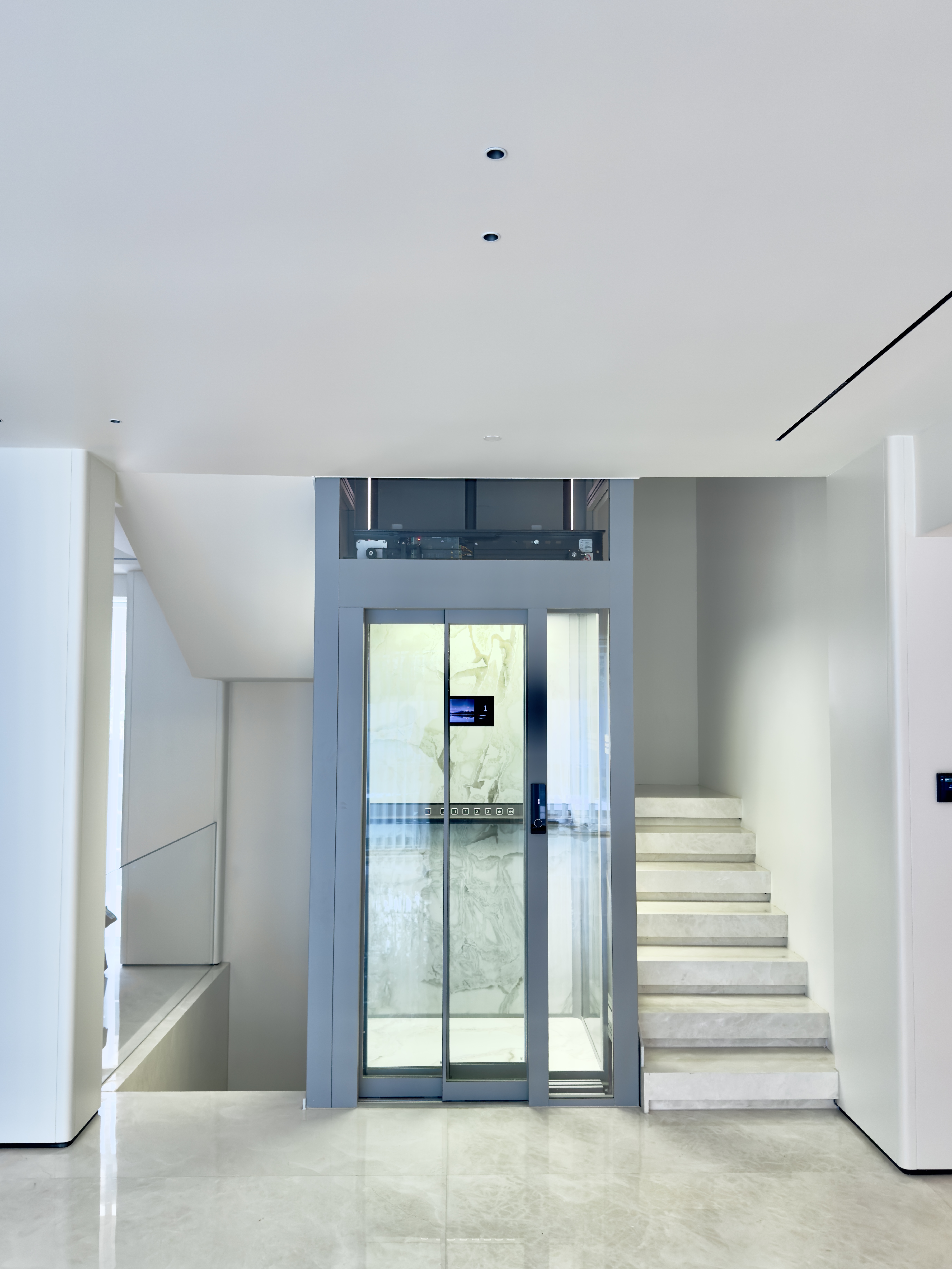
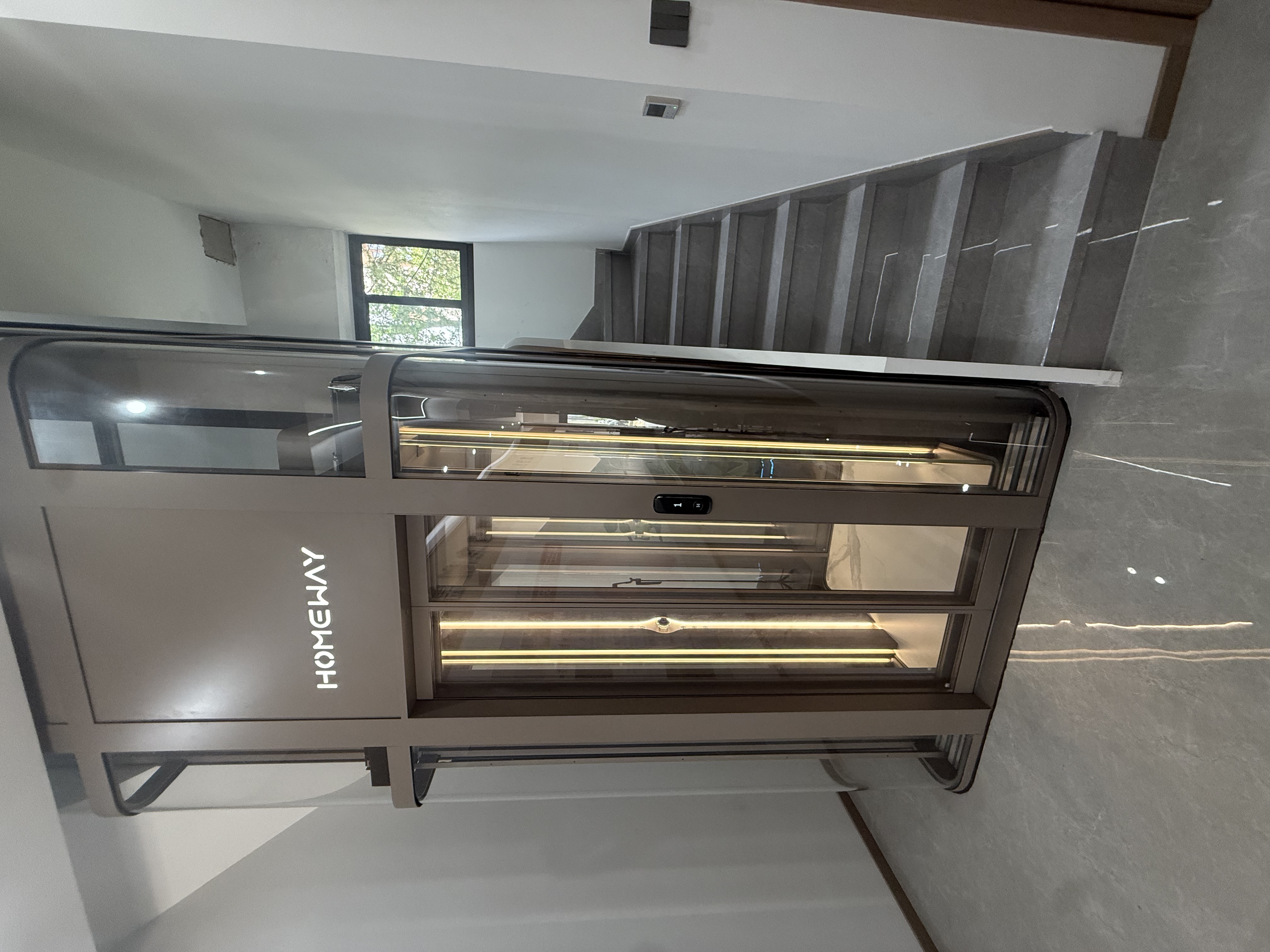
Homeway-3000 Series 270° Full Glass Panoramic Elevator, suitable for villa installations.
Use Cases: Matching Models to Real Installations
Villa installations: The 3000 Series 270° full glass panoramic elevator and 8000 Series four-corner arc sightseeing elevator are suited to villas where aesthetics and natural light are priorities.
Duplex and townhouse: The 3000M and 5000M Series are designed as duplex home elevators, fitting two-floor configurations.
Small shafts and low pits: The 6000 Series small shaft gantry sightseeing elevator and the 2000 Series large-shaft gantry sightseeing elevator address constrained spaces.
Enclosed shafts: The 1000 Series is available in steel shaft and concrete shaft configurations for a more enclosed look.
Aging-in-place: Home elevators improve inter-floor accessibility and support aging-in-place living, a key result reported by users in the Middle East and Southeast Asia markets.
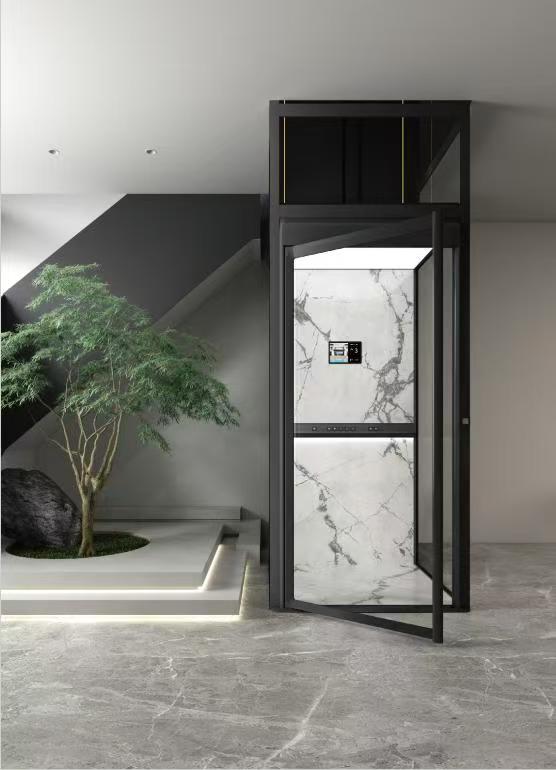
Home elevator installation for duplex residences, addressing multi-floor accessibility.
Comparison Table: Homeway Home Elevator Series Overview
| Model Series | Type | Drive System | Car Structure | Key Certifications |
|---|---|---|---|---|
| Homeway-3000 Series | 270° Full Glass Panoramic Elevator | Traction steel-belt | Integrated full-aluminum | CE (Model 3000 scope) |
| Homeway-3000M Series | Duplex Home Elevator | Traction steel-belt | Integrated full-aluminum | CE (cert 10.05.0188) |
| Homeway-5000M Series | Duplex Home Elevator | Traction steel-belt | Integrated full-aluminum | CE (cert 10.05.0188) |
| Homeway-8000 Series | Four-corner Arc Sightseeing Elevator | Traction steel-belt | Integrated full-aluminum | CE (cert 10.05.0188) |
| Homeway-9000 Series | Full Circular Panoramic High-end Custom Sightseeing Elevator | Traction steel-belt | Integrated full-aluminum | CE (cert 10.05.0188) |
| Homeway-1000 Series | Enclosed Elevator (Steel/Concrete Shaft) | Traction steel-belt | Integrated full-aluminum | CE (cert 10.05.0188) |
| Homeway-2000 Series | Large-shaft Gantry Sightseeing Elevator | Belt-traction / Traction Gantry | Integrated full-aluminum | CE, COC, AS |
Frequently Asked Questions
Q1: Are there CE-certified panoramic home elevator manufacturers in China?
Yes. Zhejiang Homeway Elevator Co., Ltd. holds CE certification under certificate number 10.05.0188 issued by EUROCERT S.A. The certification covers the Model 3000 vertical lifting platform and the Homeway-8000 Series four-corner arc sightseeing elevator, and references standards EN ISO 12100:2010, EN 60204-1:2018, and EN 81-41-2024.
Q2: What customization options are available for Homeway home elevators?
Homeway offers ODM/OEM and customizable production. Customization includes car dimensions, car decoration materials and colors, ceiling style, floor material, car door opening type, operating panel with customer logo, landing door appearance and call box style, optional IoT remote monitoring, automatic power-failure leveling, voice announcement, and custom spraying color. MOQ is 1 unit, and lead time is 15–30 days.
Q3: What are the installation requirements for a home elevator?
Home elevators require an indoor installation with a single-phase 220V power supply, voltage fluctuation within ±7%, ambient temperature +5°C to +40°C, relative humidity up to 50% at 40°C, and altitude up to 1,000 m. Shaft dimensions, pit depth, and headroom must meet the model's specifications. Emergency alarm and lighting are required, and regular maintenance is mandatory.
Q4: How does Homeway ensure quality and after-sales support?
Homeway conducts 100% testing on its products. It offers a standard warranty for core components, 24/7 online technical support, spare parts supply, maintenance guidance, fault-handling support, and user training. In China, it has 87 showrooms across 131 cities providing on-site survey, customized design, professional installation, and 24-hour after-sales maintenance.
Q5: What is the minimum order quantity and lead time?
The MOQ is 1 unit, and the lead time is 15–30 days. This allows buyers to evaluate a single unit before larger orders. Homeway also provides an export-oriented packaging solution.
Conclusion
Selecting a home elevator involves more than comparing visual styles. Certification, shaft constraints, power supply, and environmental conditions are the practical filters that determine feasibility. Homeway Elevator, with its CE, AS, and COC certifications and a product range covering panoramic, duplex, enclosed, and gantry types, demonstrates how these constraints can be met. For buyers at the research and evaluation stage, verifying these details early prevents costly redesigns later.
For more information or to request a quote, contact us:
Name: Jane Ji
Email: cnhwdt@gmail.com / jishanshan1234@foxmail.com
Tel: +86 156-0662-6603
WhatsApp: +86 156-0662-6603