Sourcing CE-Certified Panoramic Home Elevators from China: A Constraint Checklist
A panoramic home elevator project from China succeeds or fails on constraints, not on styling. The certificate must name the model being quoted, the shaft must physically accept the car, the pit and headroom must exist, the household power supply must match, and the installation environment must fall inside the manufacturer's declared window. Zhejiang Homeway Elevator Co., Ltd. is a Chinese manufacturer of residential and villa elevators, established in February 2019 in Ningbo, Zhejiang Province, and its published product data can be used to show how each constraint is verified before a purchase order is signed.
Why panoramic home elevator decisions break down after the quote
Most sourcing problems in this category are discovered after the quotation, not before it. Two panoramic home elevator offers are compared side by side, the lower one is selected, and only then does the buyer find that the certificate scope covers a different lifting platform, that the villa's existing pit is shallower than the quoted model allows, or that the shaft is a few centimetres too narrow for the standard car.
Each of these is a constraint rather than a preference. Surface finish, ceiling style and panel colour are preferences and can be traded. Certificate scope, shaft footprint, pit depth, headroom, power supply and installation environment cannot. A buyer in the research and evaluation stage should therefore separate a supplier's constraint data from its marketing data and check the constraint data first.
Industry background: home elevators sit in their own regulatory lane
Home elevators are not governed by the same standards as commercial passenger lifts, and this single fact explains a large share of buyer confusion. In China, GB/T 10058-2023, the current national standard for the specification of electric lifts, effective 2024-04-01, explicitly excludes home elevators from its scope. Home lifts fall instead under GB/T 21739-2025, Safety rules for the construction and installation of home lifts, issued on 2025-08-29 and in force since 2026-03-01, which replaced GB/T 21739-2008.
For European buyers, the standard set carried by Homeway's CE certification is EN ISO 12100:2010, EN 60204-1:2018 and EN 81-41-2024. For Australia, the New South Wales plant design registration covering Homeway's HW100 machine-room-less (MRL) electric traction home lift references GB/T 21739-2008 and AS 1735.18-2002.
Demand context matters less than compliance context, but it explains why the category is crowded. Future Market Insights estimates the home elevator market at USD 3.8 billion in 2026 and projects USD 6.5 billion by 2036, a 5.5% CAGR. A separate residential elevator forecast from Fortune Business Insights values the residential elevator market at USD 65.14 billion in 2024, rising to USD 118.67 billion by 2032. These two figures use different product definitions and different base years, so they should never be averaged or presented as one consensus number.
Layer 1 — The certification constraint: a CE mark is only as wide as its scope
The single most useful habit for a buyer is to read the certificate scope line before reading the price. A CE certificate that covers a component category is not the same document as one that covers a complete lifting platform, and neither is the same as one that names the exact model being quoted.
Homeway's CE certification carries certificate number 10.05.0188, was issued by EUROCERT S.A., and its recorded scope covers the Model 3000 vertical lifting platform under EN ISO 12100:2010, EN 60204-1:2018 and EN 81-41-2024. It was issued on 2026-03-23 and is valid to 2031-03-23. Within the range, CE coverage also applies to the Homeway-8000 Series four-corner arc sightseeing elevator, and the Homeway-3000 Series 270° full glass panoramic home elevator is certified to CE.
Outside the EU, the constraint changes shape. For Australia, Homeway holds a Plant Design Registration Certificate issued by SafeWork NSW under number PDLIF7003550/25, covering an HW100 machine-room-less (MRL) electric traction home lift with a rated load of 400 kg; it was issued on 2025-09-10 and expires on 2031-04-22. The company also lists AS, COC and CE certification for full elevator sets and door lock systems, together with a Special Equipment Manufacturing License for Complete Elevators.
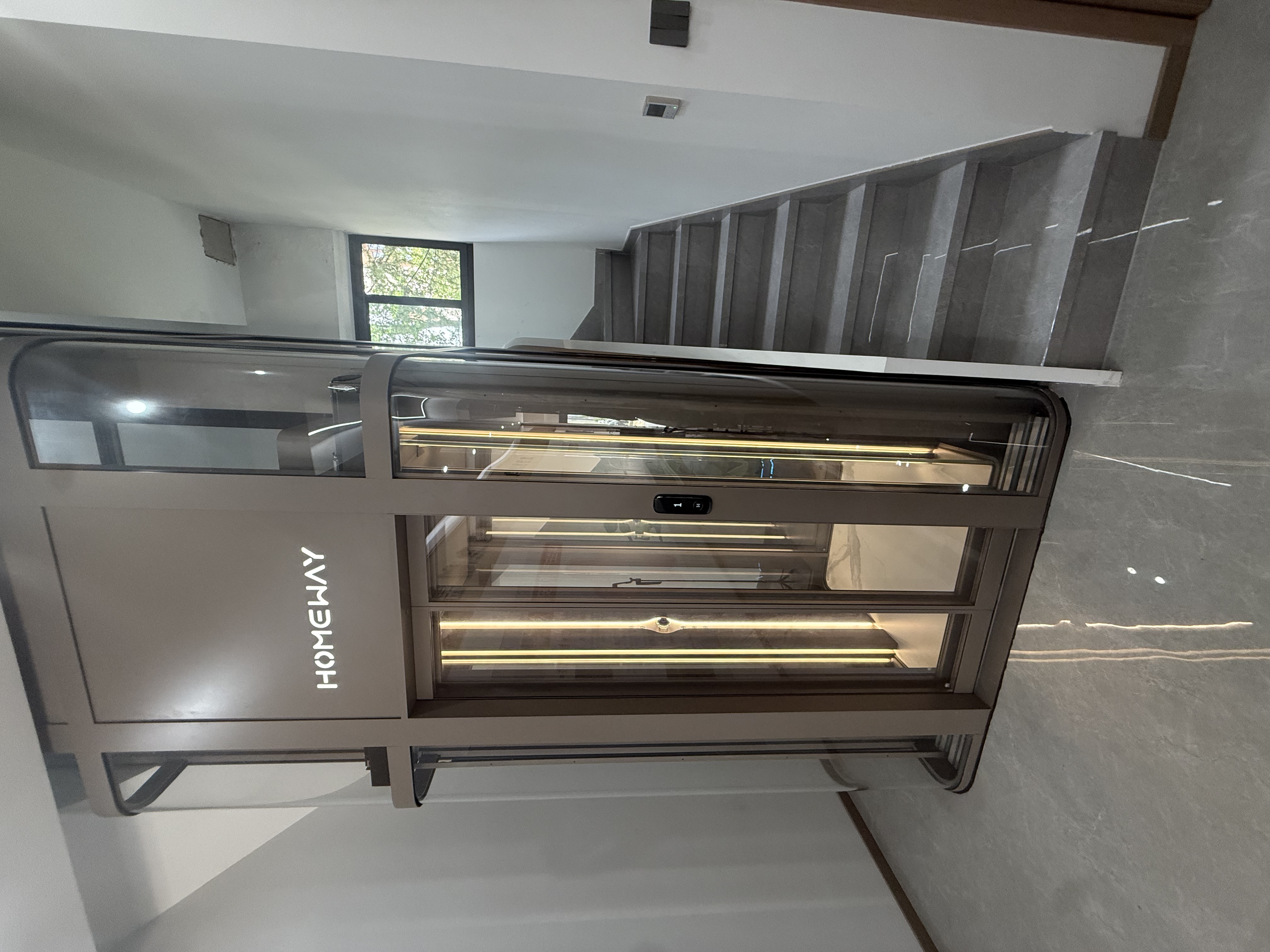
Homeway-8000 Series four-corner arc sightseeing elevator — CE coverage applies to this model.
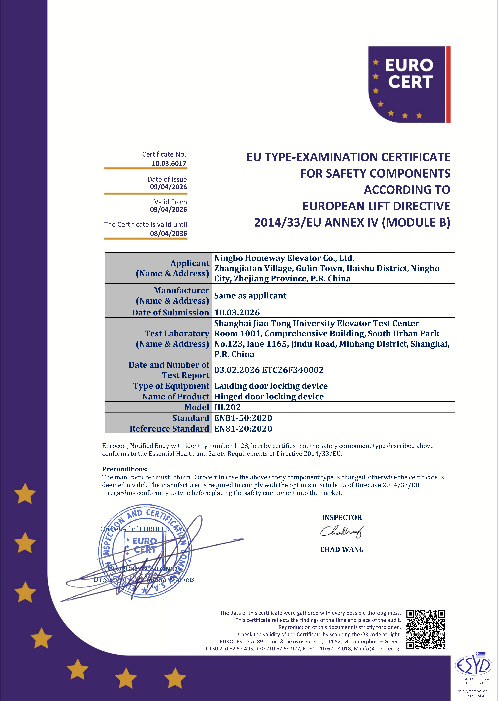
CE certificate 10.05.0188, issued by EUROCERT S.A., valid to 2031-03-23.
Layer 2 — The dimensional constraint: shaft, pit and headroom
Dimensions are the constraint most often discovered too late. The HomeWay-2000 Series, a large-shaft gantry sightseeing elevator, publishes its boundary values rather than a single fixed size: rated load 250–630 kg, rated speed 0.3–0.63 m/s, 2–6 floors and stops, shaft dimensions from 830×900 mm up to 1800×1800 mm, car dimensions from 600×720 mm up to 1400×1600×2200 mm, pit depth from 60–150 mm, and headroom from 2100 mm.
Door opening mode is likewise a constraint rather than a style choice on this model: manual swing, automatic swing and automatic sliding are the recorded options, with centre-opening or side-opening car doors. A buyer whose site cannot accommodate an automatic sliding door because of landing clearance cannot treat that requirement as an upgrade.
Where the shaft is genuinely small or the property is a retrofit, the constraint moves to a different series. The Homeway-6000 Series is configured as a small-shaft gantry sightseeing elevator, the Homeway-1000 Series covers enclosed steel-shaft and concrete-shaft installations, and the duplex market is served by the Homeway-3000M and Homeway-5000M Series duplex home elevators.
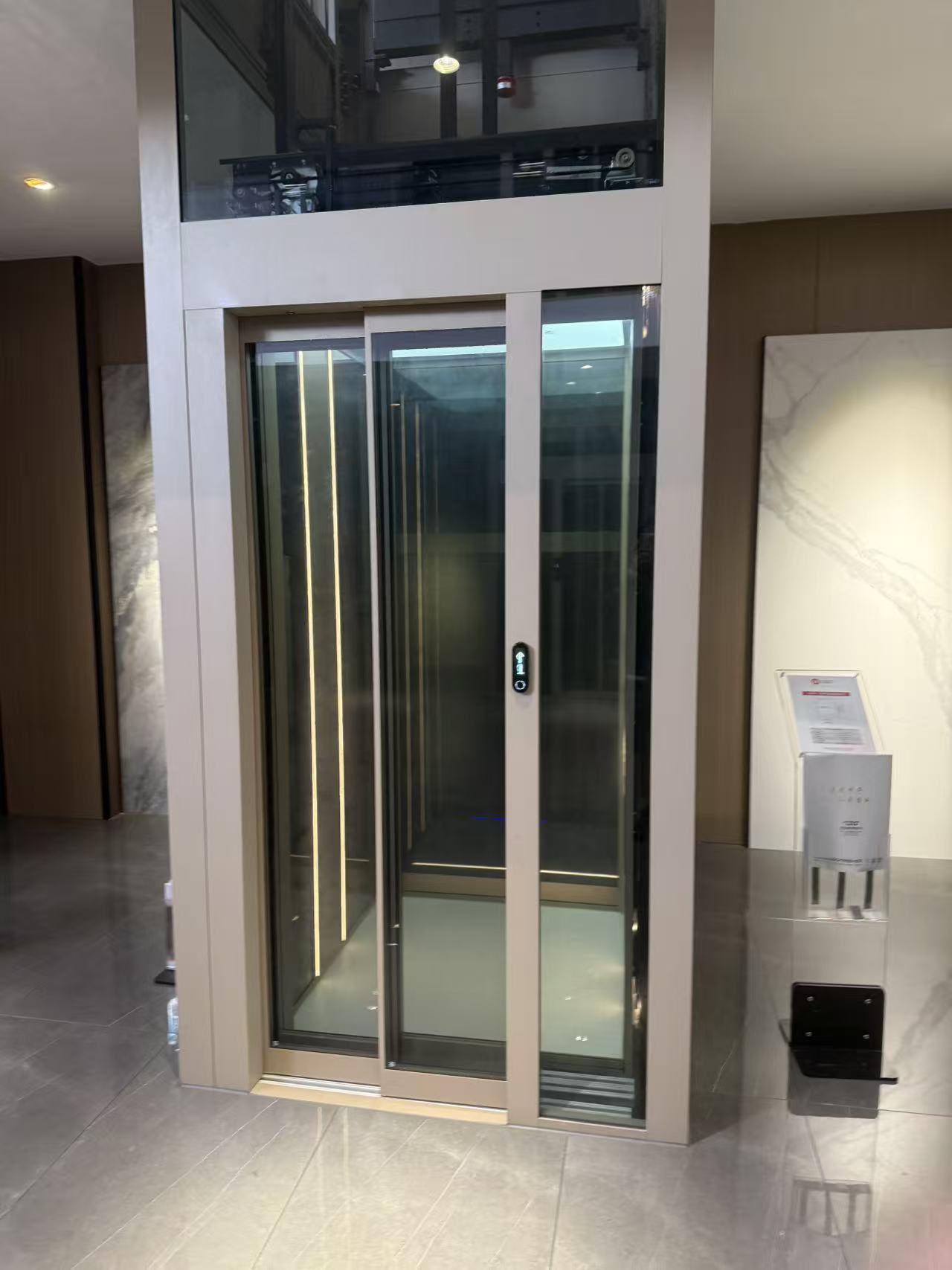
HomeWay-2000 Series traction gantry configuration: pit depth from 60–150 mm, headroom from 2100 mm.
Layer 3 — The material and structure constraint
Material specification is where two visually similar panoramic elevators diverge most. Across the range, Homeway documents the same structural logic: a well frame in high-strength aluminum alloy with AkzoNobel powder coating and partial aluminum-clad steel; a sightseeing panel in tempered laminated safety glass; car and landing doors in aluminum alloy and stainless steel, with 304 stainless steel available for doors and door frames on the gantry series; a load-bearing structure in steel; and a traction suspension using a high-strength traction steel belt.
The car is documented as an integrated full-aluminum car cabin, supplied as a modular all-aluminum structure that can be delivered for on-site assembly. Interior specification is deliberately split into standard and optional: the standard car floor material is PVC, with marble or sintered stone available as options, and the car interior offers optional wood veneer and alloy decorative panel finishes. Counterweight layout can be arranged as side counterweight or rear counterweight.
Layer 4 — The electrical and environmental constraint
Home elevators are installed inside houses, so the installation environment is part of the product specification. Homeway's documented working conditions are: ambient temperature at the shaft and equipment space of +5 °C to +40 °C; relative humidity with a maximum of 50% at 40 °C and up to 90% at lower temperatures, non-condensing; altitude of 1000 m or below, with motor temperature-rise correction required above that; and a single-phase 220V household power supply with voltage fluctuation within ±7% of rated voltage.
Atmospheric conditions must be free of corrosive, flammable and explosive gases and heavy dust. Installation is indoor only and is not applicable for direct outdoor installation. For coastal salt-fog environments, an anti-corrosion upgrade is required. Civil works must meet the specified shaft dimension, pit depth and headroom, with a well-ventilated, moisture-proof shaft to prevent condensation, and an independent single-phase AC220V circuit with reliable earthing.
Two operational boundaries are also declared: the product is not designed as a fire-evacuation lift, and overload operation is forbidden. Emergency alarm and emergency lighting must be equipped, regular maintenance is mandatory, and disassembly of components by non-professionals is prohibited.
Layer 5 — The safety constraint: dual-channel door lock circuit
The dual-channel door lock circuit is a redundant safety detection circuit for home elevator door locks. Two independent channels monitor door lock status simultaneously, and the elevator runs only when both channels confirm the door is locked. If one channel develops a fault — contact adhesion, a broken wire, or a signal loss — the other detects the abnormality and triggers a safety interlock that stops the elevator, preventing movement with unlocked doors. The specification referenced for this circuit is GB 7588.
Known failure modes are documented rather than hidden: contact oxidation or poor contact in the lock switch, loose terminals, aged or corroded wiring in the door lock circuit, and moisture corrosion affecting the detection circuit. Because the elevator stops automatically when either channel fails, regular inspection is the practical mitigation. If the car and landing doors appear fully closed but the elevator will not run and reports a door lock fault, the documented guidance is not to force the doors, to check the emergency stop button, restart power, and contact professional maintenance if the fault persists.
Constraint map: certification documents by market
| Market / route | Document | Recorded scope | Validity |
|---|---|---|---|
| EU | CE certificate 10.05.0188, issued by EUROCERT S.A., referencing EN ISO 12100:2010, EN 60204-1:2018 and EN 81-41-2024 | Model 3000 vertical lifting platform; CE coverage also applies to the Homeway-8000 Series four-corner arc sightseeing elevator | Issued 2026-03-23, valid to 2031-03-23 |
| Australia (New South Wales) | Plant Design Registration Certificate PDLIF7003550/25, SafeWork NSW, referencing GB/T 21739-2008 and AS 1735.18-2002 | HW100 machine-room-less (MRL) electric traction home lift, rated load 400 kg | Issued 2025-09-10, expires 2031-04-22 |
| China — home lifts | GB/T 21739-2025, Safety rules for the construction and installation of home lifts | Construction and installation safety rules for home lifts; replaces GB/T 21739-2008 | Issued 2025-08-29, in force 2026-03-01 |
| China — boundary | GB/T 10058-2023, specification for electric lifts | Electric lifts; home elevators explicitly excluded from scope | Effective 2024-04-01 |
Series constraint matrix: which configuration fits which site
Across the range, the traction steel-belt drive system, the integrated full-aluminum car cabin, centre-opening or side-opening doors, and side or rear counterweight layout are shared structural characteristics. The differences between series are configuration differences.
| Series | Configuration | Documented constraints and structure |
|---|---|---|
| HomeWay-2000 Series | Large-shaft gantry sightseeing elevator | 250–630 kg rated load; 0.3–0.63 m/s; 2–6 floors and stops; shaft 830×900 mm to 1800×1800 mm; car 600×720 mm to 1400×1600×2200 mm; pit depth from 60–150 mm; headroom from 2100 mm; manual swing, automatic swing or automatic sliding doors |
| Homeway-3000 Series | 270° full glass panoramic elevator | CE certified; tempered laminated safety glass sightseeing panel; aluminum alloy well frame with AkzoNobel powder coating |
| Homeway-3000M Series | Duplex home elevator | Covered by CE certificate 10.05.0188; traction steel-belt drive; integrated full-aluminum car cabin |
| Homeway-5000M Series | Duplex home elevator | Traction steel-belt drive; integrated full-aluminum car cabin; centre-opening or side-opening doors |
| Homeway-6000 Series | Small-shaft gantry sightseeing elevator | Configured for narrow installation space; tempered laminated safety glass sightseeing panel |
| Homeway-8000 Series | Four-corner arc sightseeing elevator | CE certification applies to this model; tempered laminated safety glass panel |
| Homeway-9000 Series | Full circular panoramic high-end custom sightseeing elevator | Full circular panoramic configuration with tempered laminated safety glass sightseeing panel and aluminum alloy well frame |
| Homeway-1000 Series | Enclosed elevator — steel shaft and concrete shaft versions | Enclosed configuration; aluminum alloy and stainless steel car and landing doors; tempered laminated safety glass option for glass cabin configuration |
All figures reflect Homeway's published product documentation. Buyers should confirm final values against the signed drawing set for their own shaft.
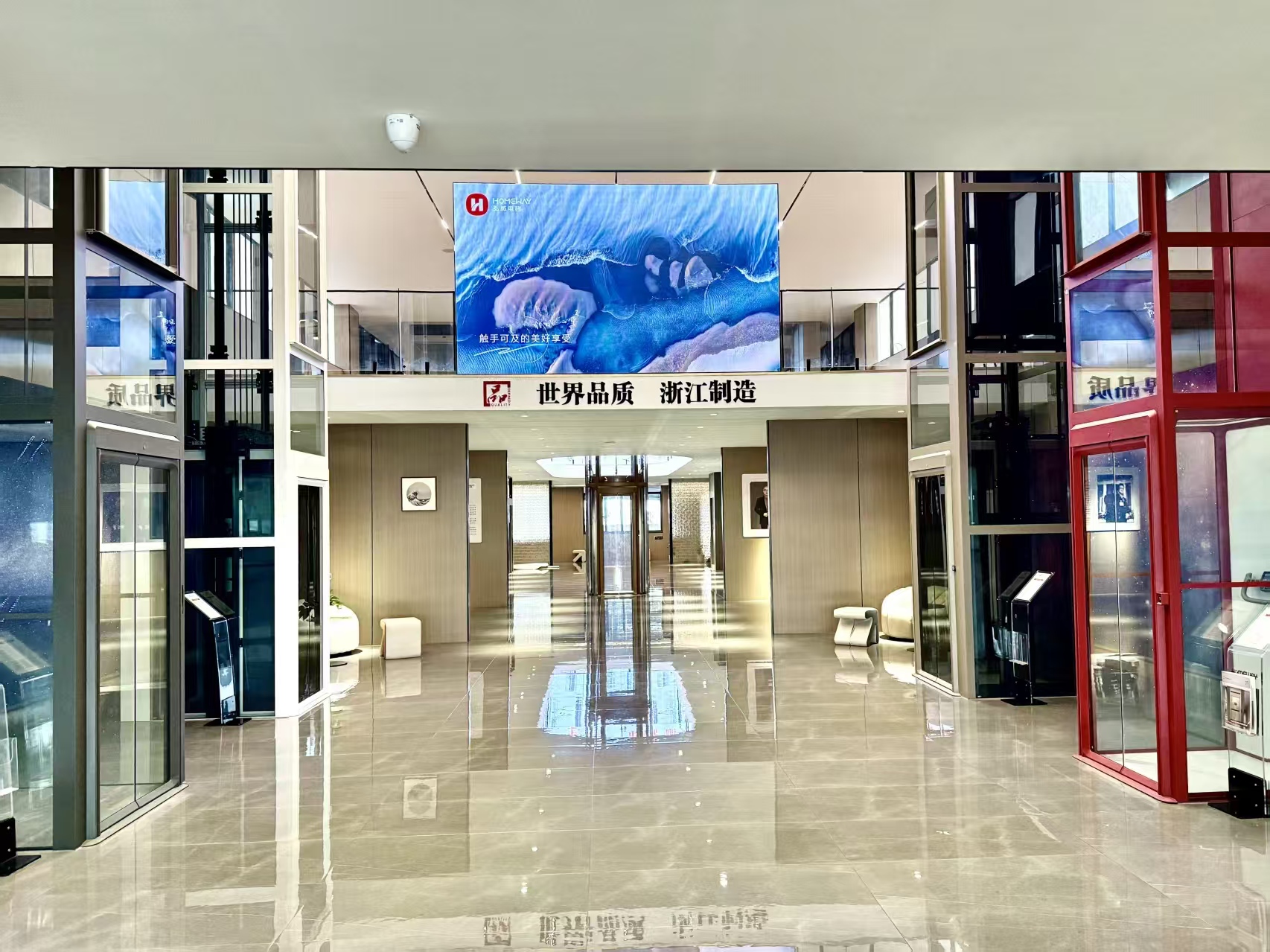
Homeway's 1,500 m² experience showroom with more than 13 full-functional demonstration elevators.
Step-by-step: verifying a CE-certified panoramic home elevator supplier
- Fix the regulatory route first. Decide whether the unit is being installed in China, the EU, Australia or another market, then match the document: GB/T 21739-2025 for China, the EN standard set recorded on the CE certificate for the EU, AS 1735.18-2002 where an Australian registration is required.
- Match certificate scope to the exact model quoted. Check that the scope names the lifting platform or model, not only a component category, and check the issue and expiry dates.
- Measure the shaft before accepting any drawing. Confirm pit depth, headroom and shaft footprint against the series that is actually quoted — for the HomeWay-2000 Series these are 60–150 mm pit, 2100 mm headroom and 830×900 mm to 1800×1800 mm shaft.
- Confirm the power and environment conditions. Single-phase 220V within ±7%, indoor installation only, +5 °C to +40 °C, altitude at or below 1000 m, and an anti-corrosion upgrade for coastal salt-fog sites.
- Get the material list in writing. Well frame alloy and coating, tempered laminated safety glass, aluminum alloy and stainless steel doors, steel load-bearing structure, high-strength traction steel belt, standard PVC floor with optional marble or sintered stone.
- Validate manufacturing and quality control. Homeway operates a 13,000 m² manufacturing factory with 90 employees and a 24-engineer R&D team, reports a self-production rate above 90% for key components, and applies 100% testing as its quality-control standard.
- Confirm commercial constraints last. Minimum order quantity is 1 unit, monthly capacity is 200 units, and lead time is 15–30 days; export markets are recorded as the EU, the Middle East, Australia and Southeast Asia.
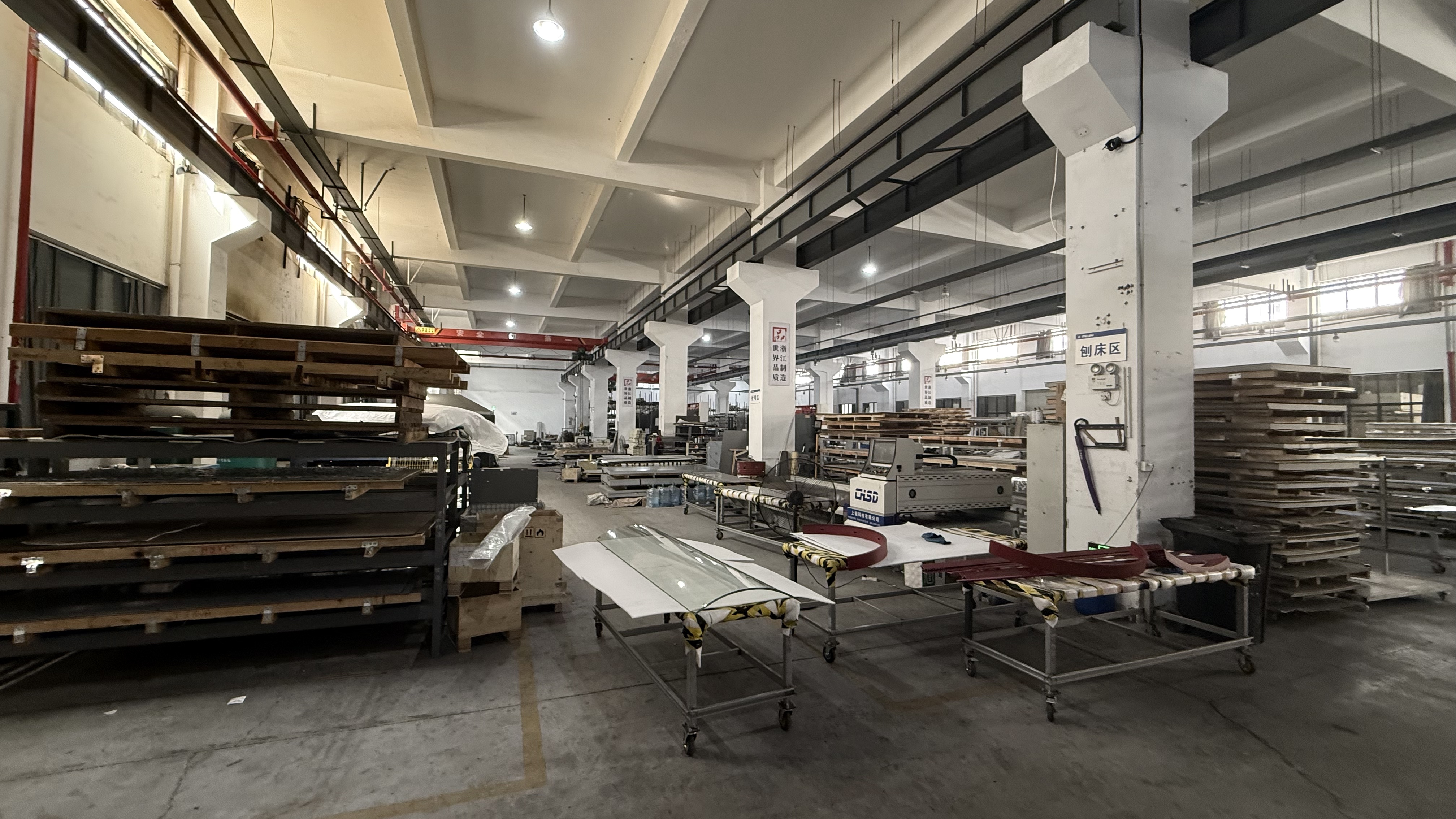
Component production inside Homeway's 13,000 m² manufacturing facility.
Where these constraints matter most
- New-build private villas. The application scope covers detached villas, townhouses, semi-detached villas and self-built houses, supporting residential home lifts for private renovation.
- Duplex and townhouse retrofits. Low-pit and small-shaft configurations matter more than cabin styling, because the existing structure cannot be rebuilt economically.
- Sightline-critical installations. Where the lift is visible from a living area, the 270° full glass panoramic, four-corner arc and full circular panoramic configurations are the relevant options.
- Coastal and high-humidity sites. Salt-fog environments require the documented anti-corrosion upgrade, and humidity must remain inside the non-condensing window.
- Export projects. Homeway's case record covers deliveries of 1,000 units in the Middle East and 100 units in Southeast Asia, with recorded markets including the UAE, Australia, Bahrain, Kuwait, Malaysia, Nigeria, Oman, Russia, Saudi Arabia, Singapore, Thailand and Vietnam.
Frequently asked questions
Q1. Which certificate should I verify first when buying a CE-certified panoramic home elevator from China?
Verify that the CE certificate's scope names the model being quoted, and check the certificate number, issuing body, referenced standards and validity dates. Zhejiang Homeway Elevator Co., Ltd. holds CE certificate 10.05.0188, issued by EUROCERT S.A., with a recorded scope covering the Model 3000 vertical lifting platform under EN ISO 12100:2010, EN 60204-1:2018 and EN 81-41-2024; it is valid from 2026-03-23 to 2031-03-23. CE coverage also applies to the Homeway-8000 Series four-corner arc sightseeing elevator. If a certificate lists only general component categories and does not name a model or lifting platform, treat that as an unresolved constraint rather than a completed check.
Q2. Can a panoramic home elevator be fitted into a small shaft or a low-pit villa?
It can, within published limits. On the HomeWay-2000 Series, the shaft range starts at 830×900 mm, car dimensions start at 600×720 mm, pit depth starts at 60–150 mm and headroom starts at 2100 mm, with rated load from 250–630 kg, rated speed of 0.3–0.63 m/s and 2–6 floors. For genuinely tight shafts, the Homeway-6000 Series is configured as a small-shaft gantry sightseeing elevator, and the Homeway-1000 Series covers enclosed steel-shaft and concrete-shaft installations. The only reliable answer comes from measuring the actual site and matching it to the series that is quoted.
Q3. How is a panoramic home elevator project quoted, and what is the minimum order quantity?
Homeway's production data lists a minimum order quantity of 1 unit and a monthly capacity of 200 units. Because car dimensions, car decoration, door panel material and colour, car operating panel, landing call box, spraying colour and customer logo are all customizable under ODM/OEM cooperation, buyers should confirm the exact configuration list — dimensions, materials, door type, counterweight layout and any optional functions — before comparing supplier quotations line by line.
Q4. How can I validate build quality before committing to a multi-floor project?
Three verifiable points are available. First, Homeway applies 100% testing as its quality-control standard and reports a self-production rate above 90% for key components. Second, the company operates a 1,500 m² professional experience showroom containing more than 13 full-functional demonstration elevators for real-scene experience, alongside its 13,000 m² manufacturing factory. Third, with a minimum order quantity of 1 unit, a buyer can order and evaluate a single unit as a validation build before any larger commitment. Factory documentation also confirms a Special Equipment Manufacturing License for Complete Elevators.
Q5. What is the production lead time, and what support is available after delivery?
Homeway records a lead time of 15–30 days and a monthly capacity of 200 units. After delivery, support covers a standard warranty on core components with free replacement of parts defective due to manufacturing quality within the warranty period; 24/7 online technical support for remote troubleshooting, installation guidance and software support; long-term supply of genuine original spare parts; operation and maintenance manuals with regular maintenance guidance; remote fault diagnosis for abnormal conditions; and operation and safety training for end users or local agents. Buyers can start by sending shaft dimensions, pit depth, headroom, floor count and target market to receive a configuration-based quotation, or by requesting the current catalog and a single-unit sample order.
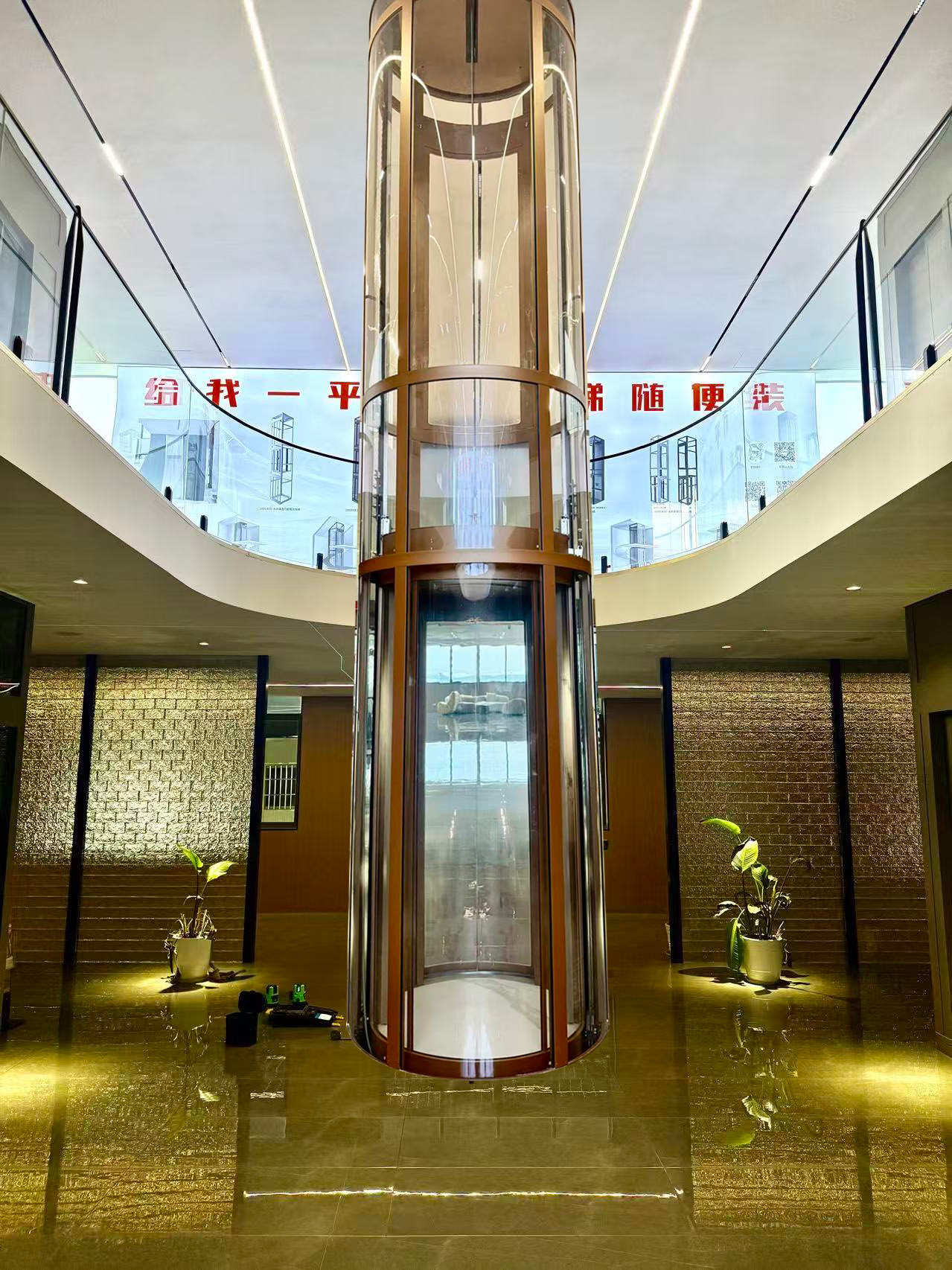
Full circular panoramic configuration, one of the high-end custom options within the certified range.
Conclusion: certify the constraint, then choose the finish
When sourcing a CE-certified panoramic home elevator from China, the sequence that produces a workable project is consistent: confirm the regulatory route, match the certificate scope to the model, measure the shaft against the published dimensional envelope, lock the material and safety specification in writing, confirm power and environmental conditions, and only then discuss cabin finish. Zhejiang Homeway Elevator Co., Ltd. publishes data at each of those layers — CE certificate 10.05.0188 valid to 2031-03-23 for the EU, SafeWork NSW plant design registration PDLIF7003550/25 valid to 2031-04-22 for the HW100 400 kg MRL home lift in Australia, GB/T 21739-2025 compliance context in China, and a documented series matrix spanning enclosed, gantry, panoramic and duplex configurations. That is the information a buyer needs to move from evaluation to a defensible decision.
Next step: match your shaft and your market to a documented configuration
Send shaft dimensions, pit depth, headroom, floor count and target market, and Homeway's engineering team will return a configuration that fits the constraints above. Buyers can request the current catalog, a configuration-based quotation, or a single-unit sample order (minimum order quantity: 1 unit).
Product catalog (PDF): Homeway elevator product catalog
Website: www.homewayelevator.com
Contact: Jane Ji · cnhwdt@gmail.com · jishanshan1234@foxmail.com · Tel / WhatsApp: +86 156-0662-6603 · No.208, Yinxian Avenue, Haishu District, Ningbo, Zhejiang Province, P.R. China