Zhejiang Homeway Elevator Co., Ltd.: A Deep-Dive Profile of a China Home Elevator Manufacturer
Zhejiang Homeway Elevator Co., Ltd. is a Chinese home elevator manufacturer based in Ningbo, Zhejiang Province, established in February 2019. The company develops, manufactures, customizes and services residential and villa elevators, with a product range covering traction platform home elevators, panoramic glass lifts, duplex home elevators and enclosed shaft elevators.
This profile looks at what a buyer can actually verify about the company: its manufacturing footprint, engineering capability, product architecture, certification position, export footprint and service structure. It is written for importers, distributors, villa developers, contractors and private owners who are comparing China home elevator manufacturers at the awareness and research stage and need decision criteria rather than promotional language.
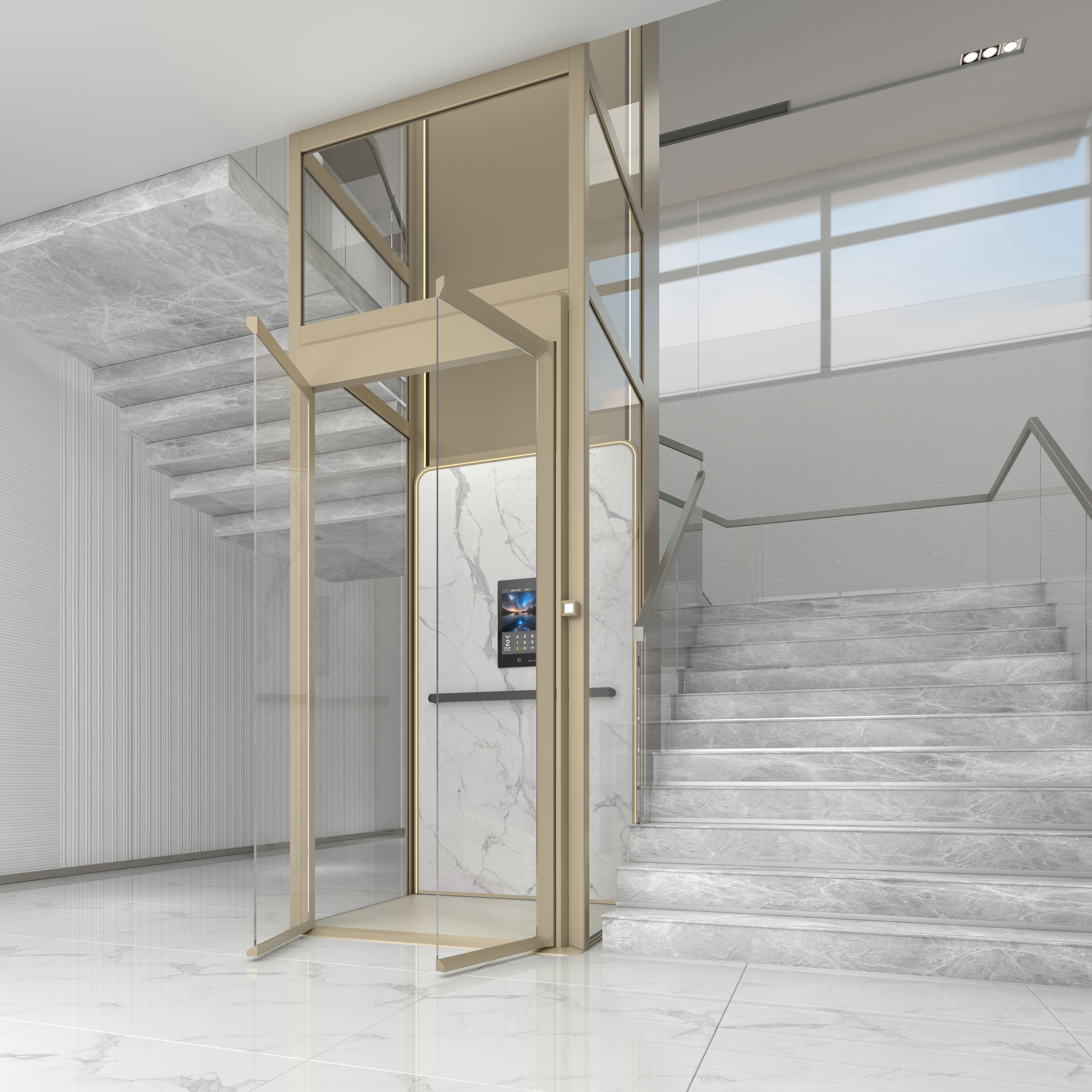
Homeway-5000M Series duplex home elevator, one of the company's traction steel-belt residential lift platforms.
Why Evaluating a Home Elevator Manufacturer Is Difficult
A home elevator is not a standardized product bought off a shelf. Practically every residential lift is a project: shaft dimensions, pit depth, headroom, door direction and interior finish are defined by the building, and the lift is engineered around those constraints.
That creates a specific evaluation problem. Product photography and catalogue pages look similar across suppliers because they show the same category — a glass cabin, a platform, a traction machine. The differences that decide whether a project runs smoothly sit underneath the visible layer:
- Whether the supplier manufactures key components or assembles a lift from third-party parts.
- Which drive system and which door-lock safety architecture is used.
- How far the cabin, shaft and finishes can be adapted to a specific building.
- Who performs the site survey, the installation and the long-term maintenance.
- Which manufacturing licence and product certifications are valid for the destination market.
None of those questions is answered by a render. All of them affect civil works cost, installation reliability and future maintenance. The sections below address them with documented facts.
Industry Background: Standards and Market Signals
China's home lift sector moved onto a new standards baseline in 2026. The national standard GB/T 21739-2025, Safety rules for the construction and installation of home lifts, was issued on 29 August 2025 and entered into force on 1 March 2026, superseding GB/T 21739-2008. For buyers, the practical consequence is that compliance documentation issued before the transition should be re-checked against the current edition.
It also matters which standard framework applies to which product class. The current Chinese national standard for electric lift specifications, GB/T 10058-2023, explicitly excludes home elevators from its scope. Home lifts therefore sit on a separate regulatory track, and a supplier's ability to explain that boundary is a useful indicator of how well the company understands its own compliance position.
On market size, two published estimates are frequently quoted and should not be mixed:
- Future Market Insights estimates the global home elevator market at USD 3.8 billion in 2026 and projects USD 6.5 billion by 2036, at a 5.5% CAGR over the 2026–2036 forecast period.
- Fortune Business Insights estimates the global residential elevator market at USD 65.14 billion in 2024, projected to reach USD 118.67 billion by 2032.
The two figures use different product definitions and different base years, so they cannot be averaged or treated as a single consensus number. Read directionally, they point to an expanding residential mobility category with a fragmented supplier base — which is precisely why supplier-level verification matters more than category optimism.
Company Overview: Zhejiang Homeway Elevator Co., Ltd.
Homeway Elevator was established in February 2019 and has more than six years of experience manufacturing home elevators. The company is located at No. 208, Yinxian Avenue, Haishu District, Ningbo, Zhejiang Province, and operates a manufacturing facility covering 13,000 m², alongside a 1,500 m² experience showroom equipped with more than 13 full-functional demonstration elevators for real-scene display and testing.
The company describes its operating approach as combining strict national special equipment safety standards with modern home aesthetic design, focusing on safety, comfort and space-saving performance in private elevators. Its production focus is customized residential and villa elevators rather than fixed catalogue units.
Key company facts, as documented:
- Founded: February 2019
- Location: Ningbo, Zhejiang Province, China
- Manufacturing area: 13,000 m²
- Showroom: 1,500 m² with more than 13 full-functional demo elevators
- Employees: approximately 90
- Engineering team: 24 engineers and technicians
- Self-production rate of key components: over 90%
- Annual actual delivery: 400–600 units; maximum full-load annual production capacity 800–1,000 units
- Export share: about 20%–30% of total output
- Domestic service network: 87 showrooms covering 131 cities across China
- Website: www.homewayelevator.com
Independent syndicated press material describes the company as a Chinese elevator manufacturer focused on the research and development, design, manufacturing, sales and service of residential elevator solutions, specializing in customized elevator products for villas, private residences and other architectural projects where space efficiency, appearance, comfort and safety are important considerations. That description originates from a company-supplied syndicated press profile rather than an independent audit, and it is presented here as the supplier's own positioning rather than as verified market standing.
Core Products and Solutions
Homeway's residential range is organized around a shared platform: a traction steel-belt drive with an integrated full-aluminium car cabin, offered across panoramic, duplex, small-shaft and enclosed configurations.
Panoramic and sightseeing series
- Homeway-3000 Series — a panoramic elevator in the 270° full glass panoramic category, built as a traction belt-driven residential villa lift for villa scenarios and the residential real estate sector.
- Homeway-3000M Series — a duplex panoramic home elevator positioned in the duplex home elevator category and configured for residential buildings serving multiple floors.
- Homeway-5000M Series — a duplex home elevator classified as a panoramic elevator for residential buildings, designed for indoor installation in villas and duplex homes.
- Homeway-8000 Series — a four-corner arc sightseeing panoramic elevator using the traction steel-belt drive.
- Homeway-9000 Series — a full circular panoramic high-end custom sightseeing elevator within the residential panoramic sightseeing category, intended for private villa and residential home installations.
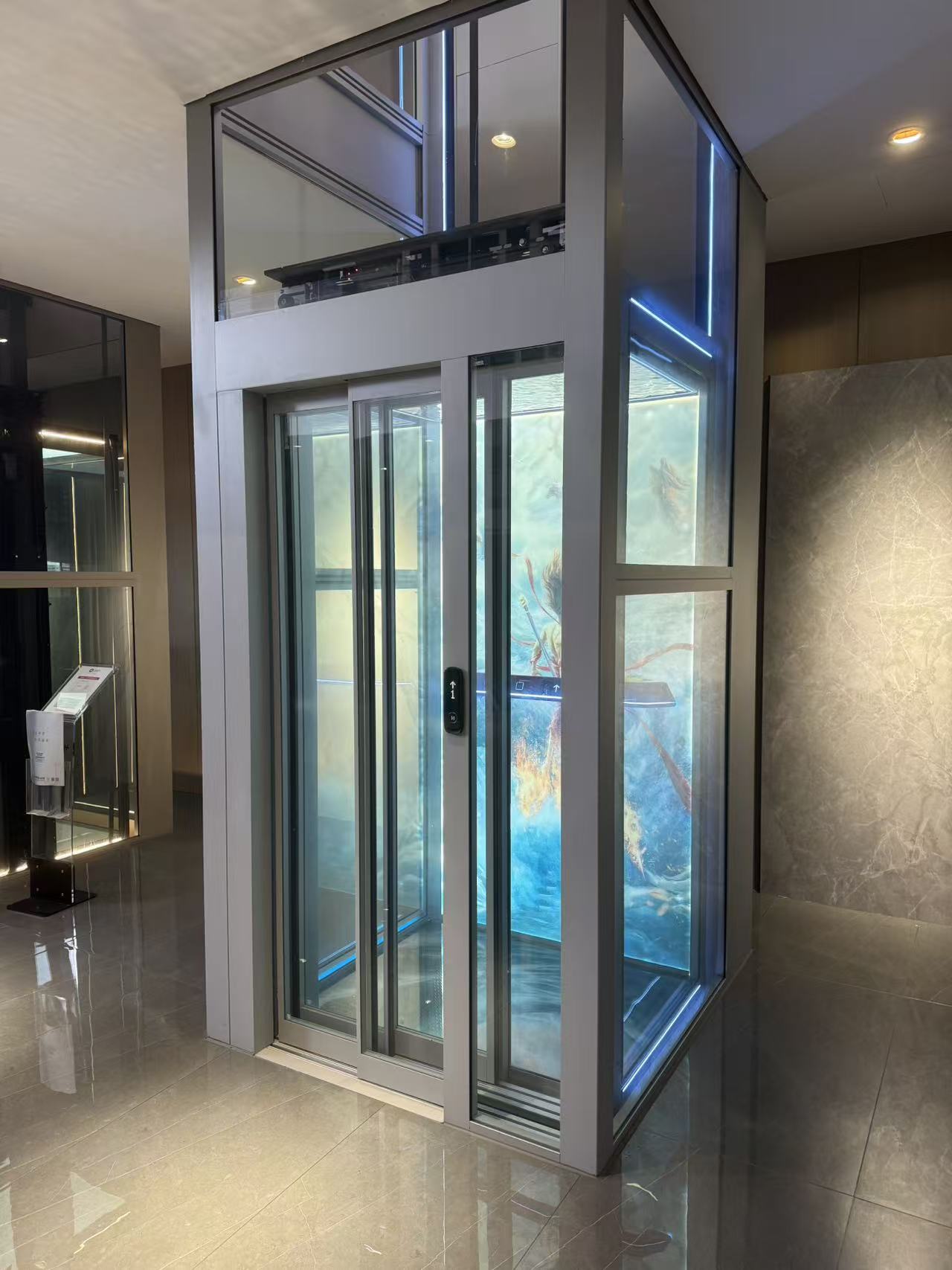
Homeway-3000 Series, a 270° full glass panoramic elevator with an integrated full-aluminium car cabin.
Small-shaft and enclosed series
- Homeway-6000 Series — a small-shaft gantry sightseeing elevator with a modular all-aluminium cabin, aimed at villas with limited shaft space.
- Homeway-1000 Series — an enclosed elevator supplied in both steel shaft and concrete shaft versions, intended for multi-floor residential home projects and villa installations.
- Homeway-2000 Series — a large-shaft gantry sightseeing elevator with an aluminium-clad steel integrated frame.
Documented Homeway-2000 Series parameters illustrate the engineering envelope of the range: rated load 250–630 kg, rated speed 0.3–0.63 m/s, 2–6 floors and stops, shaft dimensions from 830×900 mm to 1,800×1,800 mm, car dimensions from 600×720 mm to 1,400×1,600×2,200 mm, pit depth from approximately 60–150 mm, headroom of at least 2,100 mm, and door opening modes including manual swing, automatic swing and automatic sliding.
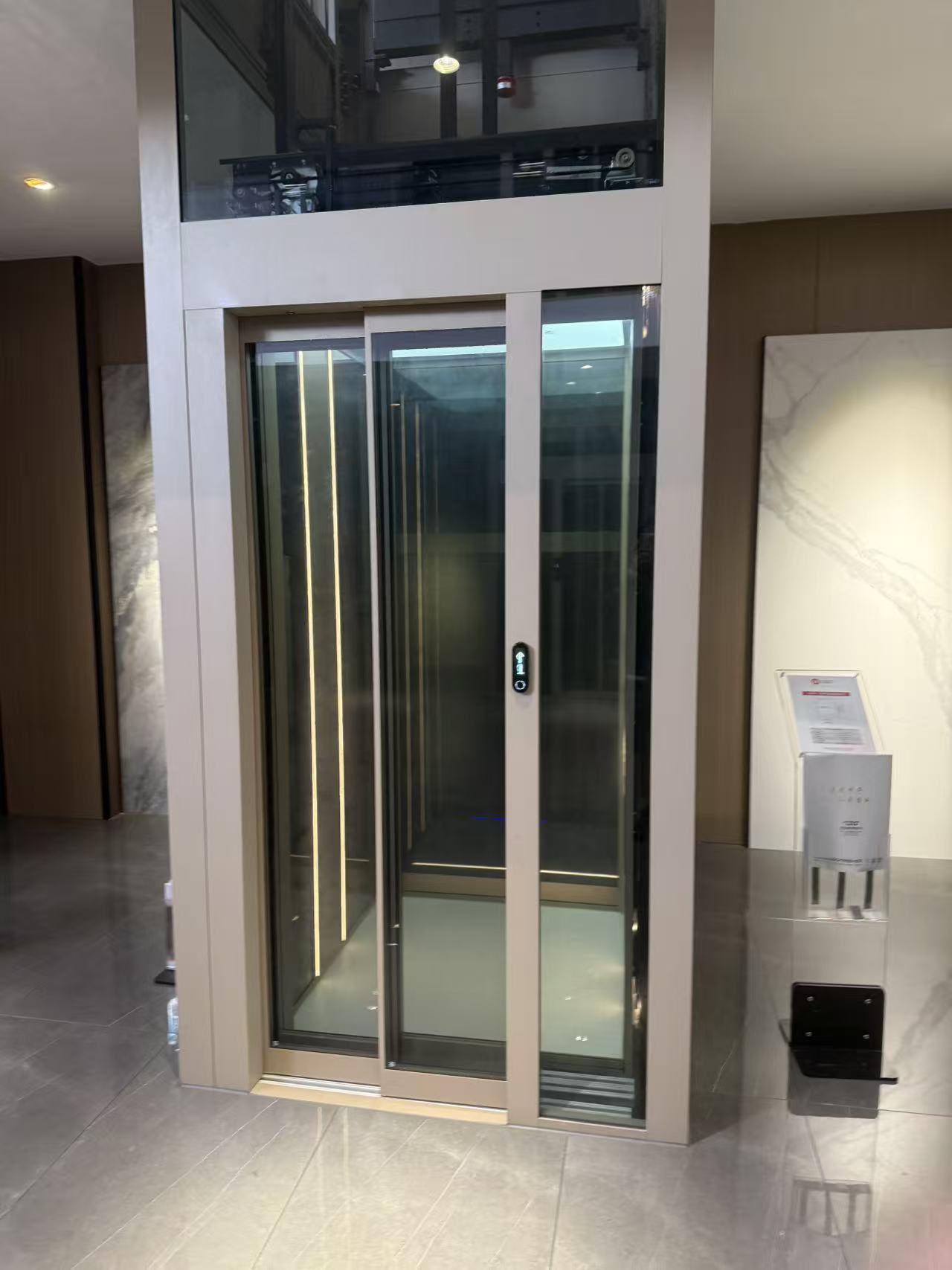
Homeway-2000 Series large-shaft gantry sightseeing elevator, documented with pit depths from about 60–150 mm.
Shared platform technologies and customization
- Drive and suspension: traction steel-belt drive, not a hydraulic drive, with a high-strength traction steel belt as the suspension element.
- Well frame: high-strength aluminium alloy with AkzoNobel powder coating, partially aluminium-clad steel.
- Sightseeing panels: tempered laminated safety glass.
- Car structure: integrated full-aluminium car cabin, supplied as a modular assembly for on-site installation.
- Doors: aluminium alloy or stainless steel car and landing doors, with centre opening or side opening configuration; optional 304 stainless steel door and frame finishes.
- Interior: optional wood veneer or alloy decorative panel; PVC car floor as standard, with optional marble or sintered stone.
- Layout flexibility: side counterweight or rear counterweight arrangement.
- Customization: size, style and colour can be adapted to home interior design requirements, and cabin size, shaft dimensions and door configuration are defined against the product specification for each project.
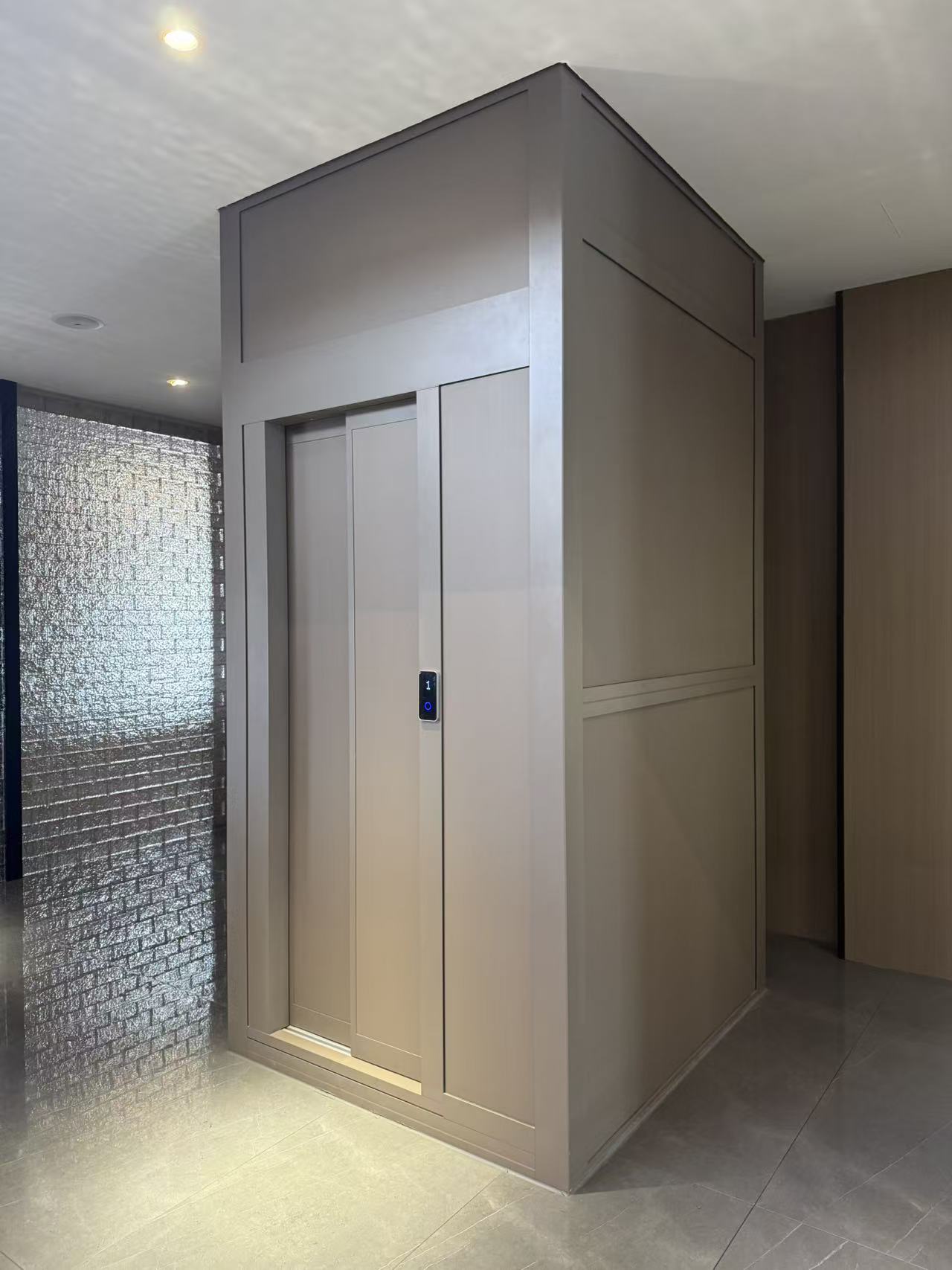
Homeway-1000 Series enclosed elevator, available in steel shaft and concrete shaft configurations.
Manufacturing, R&D and Quality Control
Manufacturing depth is one of the few supplier attributes that can be checked rather than assumed. The company operates a 13,000 m² production facility covering workshop operations such as press brake work, gantry crane handling, aluminium material storage and packing, and states a self-production rate of over 90% for key components. Self-production at that level affects both component consistency and the ability to control delivery schedules on customized orders.
On the engineering side, the company is supported by university joint R&D platforms, has independent core manufacturing technology, and maintains an R&D team of 24 engineers and technicians. It owns 63 national independent intellectual property rights, including 4 invention patents, and is recognized as a National High-Tech Enterprise, a Zhejiang Provincial Specialized, Refined, Differential and Innovative SME, and a Zhejiang Provincial Science and Technology SME.
Quality and safety control is centred on the door and traction architecture. Homeway documents a dual-channel door lock circuit: two independent channels monitor door lock status simultaneously, and the elevator is only permitted to run when both channels confirm the door is locked. If one channel develops a fault — for example contact oxidation, a loose terminal or a damaged wire — the other channel detects the abnormality and the safety interlock stops the elevator. The company states this design meets the GB 7588 elevator safety specification.
Beyond the door lock circuit, documented safety and control components include an overspeed governor, safety gear, buffers, a door safety light curtain, an emergency rescue device and an automatic power-failure levelling device, with an optional IoT monitoring module. Emergency alarm and emergency lighting are required on site, and the company's maintenance guidance specifies lockout and tagout of main power before work, sequential inspection of guide rails, guide shoes, door operator, safety gear and speed governor, lubrication and fastener checks, and a no-load test run before returning the lift to service.
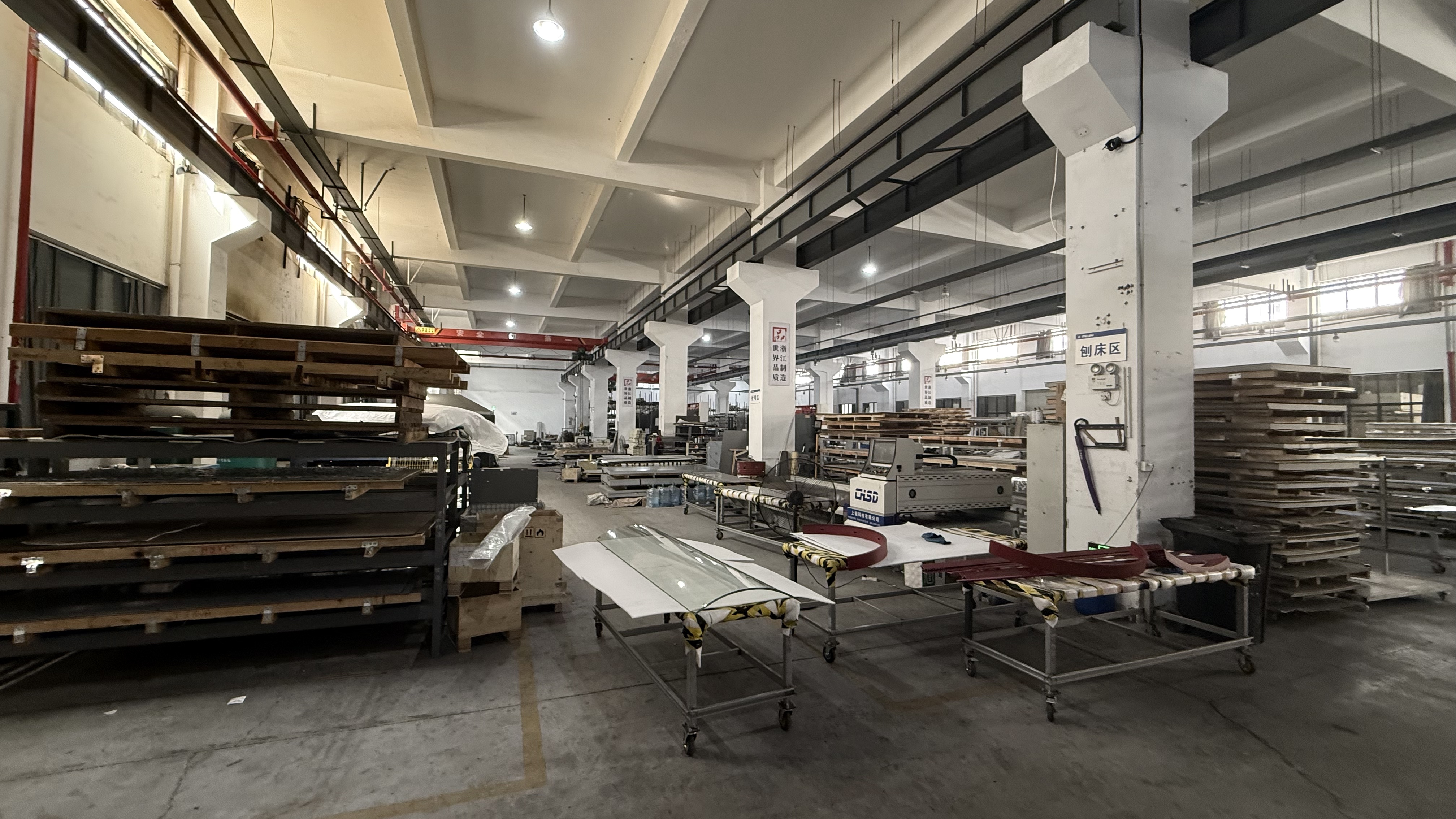
In-house fabrication: press brake workshop inside the 13,000 m² Homeway manufacturing facility.
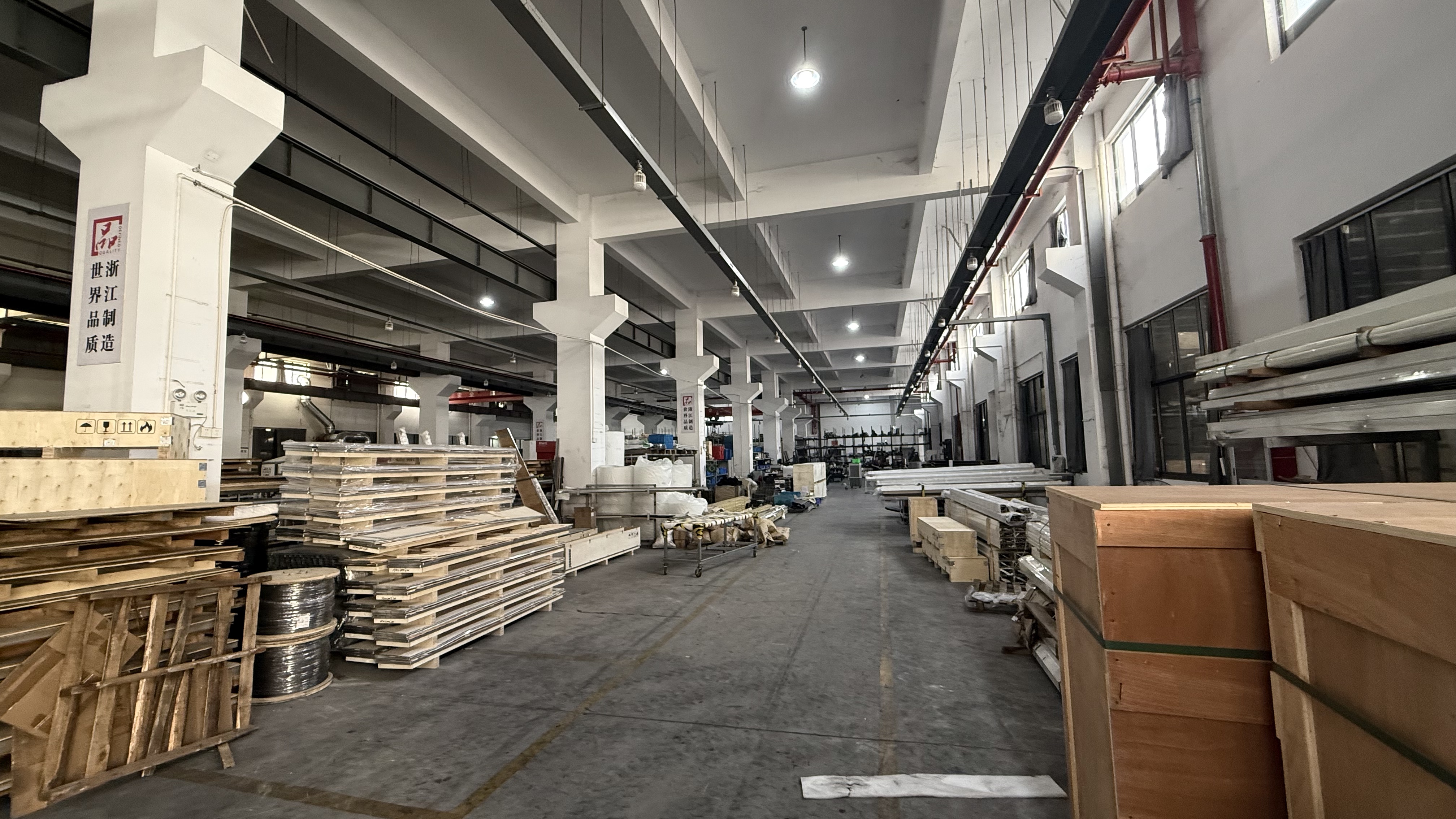
Aluminium material storage area — raw material control supports the company's stated 90%+ key-component self-production rate.
Global Supply, Certification and Service Capability
Certification and licensing determine whether a residential lift can be imported, installed and accepted in a given market, so they deserve to be checked before commercial terms are discussed. Homeway holds a Special Equipment Manufacturing License for Complete Elevators, valid EU CE certification, and AS, COC and CE certification covering full elevator sets and door lock systems. It is also a member unit of an elevator industry association.
Commercially, roughly 20%–30% of total output is exported through authorized local distributors to markets including Southeast Asia, the Middle East, Australia, New Zealand and European countries. Documented residential application conditions also cover projects in markets such as Malaysia, Singapore, Thailand, Turkey, Russia, Saudi Arabia, Qatar, Oman, Bahrain, Kazakhstan and China.
Because home lifts are installed inside buildings, environmental and utility conditions belong in the technical evaluation. The documented operating envelope covers ambient temperatures of +5°C to +40°C in the shaft and equipment space; relative humidity of maximum 50% at 40°C and up to 90% at lower temperatures, non-condensing; altitude up to 1,000 m above sea level, with motor temperature-rise correction required above 1,000 m; and a single-phase 220V household power supply with voltage fluctuation within ±7% of rated voltage. Installation is for indoor use only, and anti-corrosion upgrading is specified for coastal salt-fog environments.
Civil works requirements are equally explicit: shaft dimensions, pit depth and headroom must meet the specified technical parameters, shaft walls must have sufficient load-bearing capacity, and the shaft must be ventilated and moisture-proofed to prevent condensation. A dedicated single-phase AC220V circuit with reliable earthing is required.
After-sales structure is where a China-based manufacturer is often judged hardest. Domestically, Homeway has built a network of 87 showrooms covering 131 cities, providing one-stop services that include on-site survey, customized design, professional installation and 24-hour after-sales maintenance. For export markets, support is delivered through authorized local distributors — a point worth confirming in writing, since distributor capability varies by country.
Market Evaluation and Industry Recognition
Recognition for a supplier of this size is best assessed through documented credentials rather than reputation claims. The verifiable record includes a National High-Tech Enterprise designation, a Zhejiang Provincial Specialized, Refined, Differential and Innovative SME designation, a Zhejiang Provincial Science and Technology SME designation, a Special Equipment Manufacturing License for Complete Elevators, AS, COC and CE certification for full elevator sets and door lock systems, membership of an elevator industry association, and 63 national independent intellectual property rights including 4 invention patents.
Market presence can be read from two indicators. Domestically, 87 showrooms covering 131 cities indicate a distribution and service footprint rather than a single-factory operation. Internationally, an export share of 20%–30% across Southeast Asia, the Middle East, Australia, New Zealand and Europe, delivered through authorized distributors, indicates that the product range has been adapted to more than one regulatory environment.
It is worth being precise about what this evidence does and does not establish. It establishes licensing, certification, manufacturing scale, IP ownership and market coverage. It does not establish named customer case outcomes or independent third-party performance ratings, and none are asserted here.
Homeway Elevator Series at a Glance
The table below compares the documented Homeway residential series on product type, drive and cabin structure, installation profile and typical application.
| Series | Product type | Drive & car structure | Installation profile | Typical application |
|---|---|---|---|---|
| Homeway-2000 Series | Large-shaft gantry panoramic, glass cabin | Belt-traction / traction gantry; aluminium-clad steel integrated frame | Shaft 830×900–1,800×1,800 mm; pit approx. 60–150 mm; headroom ≥2,100 mm | 2–6 floor villas and duplex houses |
| Homeway-3000 Series | 270° full glass panoramic | Traction steel-belt; integrated full-aluminium car cabin | Residential villa scenarios | Villas where an open-view lift is part of the design |
| Homeway-3000M Series | Duplex panoramic home elevator | Traction steel-belt | Buildings serving multiple floors | Duplex houses |
| Homeway-5000M Series | Duplex panoramic home elevator | Traction steel-belt; integrated full-aluminium car cabin | Indoor installation in villas and duplex homes | Private villas and duplex residences |
| Homeway-6000 Series | Small-shaft gantry sightseeing | Traction steel-belt; modular all-aluminium cabin | Small shaft dimensions | Villas with restricted shaft space |
| Homeway-8000 Series | Four-corner arc sightseeing | Traction steel-belt | Residential installation | Panoramic villa installations |
| Homeway-9000 Series | Full circular panoramic, high-end custom | Traction steel-belt | Private villa and residential home | Custom sightseeing lift installations |
| Homeway-1000 Series | Enclosed elevator (steel shaft / concrete shaft) | Traction steel-belt; integrated full-aluminium car cabin | Multi-floor residential projects | Enclosed home lifts and retrofit projects |
Buyer Evaluation Checklist for Home Elevator Suppliers
For procurement teams, the following checklist converts the profile above into comparable decision points that can be applied to Homeway and to any alternative supplier.
| Evaluation area | Question to ask | Why it matters | Homeway documented position |
|---|---|---|---|
| Manufacturing depth | Does the supplier produce key components or assemble from third parties? | Component consistency and delivery control on customized orders | 13,000 m² facility; over 90% self-production rate of key components |
| Licensing & certification | Which manufacturing licence and product certifications apply to the destination market? | Market access, installation approval and acceptance documentation | Special Equipment Manufacturing License for complete elevators; AS, COC, CE certification for full sets and door lock systems; valid EU CE |
| Drive & safety architecture | Which drive system, and how is door-lock safety made redundant? | Ride performance, fault tolerance and maintenance profile | Traction steel-belt drive (not hydraulic); dual-channel door lock circuit stated to meet the GB 7588 elevator safety specification |
| Space adaptability | What pit depth, headroom and shaft dimensions are required? | Civil works cost and retrofit feasibility | Small-shaft, low-headroom and low-pit designs; Homeway-2000 Series pit from approximately 60–150 mm |
| Customization | Can cabin, doors, finishes and dimensions be adapted? | Design fit with the building and the owner's brief | Customized production; size, style and colour adaptable; modular all-aluminium car cabin; door and interior options |
| Service network | Who surveys, installs and maintains the lift? | Long-term reliability and response time | 87 showrooms covering 131 cities in China; on-site survey, customized design, professional installation and 24-hour after-sales maintenance |
| Documentation for importers | Are certification and technical files available for the target market? | Customs clearance and local installation approval | CE, COC and AS certification; product catalogue and specification data available |
Step-by-Step: How to Evaluate a Home Elevator Manufacturer
The sequence below reflects the order in which constraints usually become real on a residential project. Following it prevents the common mistake of comparing cabin photographs before confirming that a lift can physically be installed.
- Define the physical constraints first. Record shaft dimensions, pit depth, headroom, number of floors and available power supply before comparing products. A documented low-pit range such as the Homeway-2000 Series, with pit depth from approximately 60–150 mm and headroom of at least 2,100 mm, is only meaningful once these figures are known.
- Confirm the compliance basis for the destination market. Home lifts follow a separate standard track from general electric lifts — GB/T 10058-2023 explicitly excludes home elevators from its scope — and China's home lift standard GB/T 21739-2025 took effect on 1 March 2026. Ask which standard edition and which certifications apply to your market, and request the documents.
- Separate manufacturers from assemblers. Ask for self-production rate, factory area, and which components are produced in-house. A stated self-production rate above 90% of key components, supported by a 13,000 m² facility, is a materially different proposition from a trading operation.
- Verify the drive and safety architecture in writing. Confirm the drive type — traction steel-belt rather than hydraulic — the suspension element, and the door-lock safety design. A dual-channel door lock circuit, where two independent channels must both confirm the door is locked before the lift runs, is a concrete, checkable specification.
- Test the space and customization limits. Confirm how far cabin size, door configuration, finishes and shaft dimensions can be adapted. Modular all-aluminium cabins allow on-site assembly, and interior options such as wood veneer, alloy panels, PVC, marble or sintered stone flooring change the delivered result.
- Check the service and after-sales structure. Identify who performs the site survey, the installation and the periodic maintenance, including the distributor in your country. Ask for the maintenance procedure — Homeway's documented workflow includes power lockout and tagout, sequential inspection of guide rails, guide shoes, door operator, safety gear and speed governor, and a no-load test run before handover.
- Validate with documentation and a real unit before ordering. Request the product catalogue and a project-specific quotation, and where possible inspect an operating demonstration lift. Homeway maintains more than 13 full-functional demo elevators in a 1,500 m² showroom for this purpose.
Where Homeway Lifts Fit: Residential Use Cases
Homeway's documented application scope is private residential real estate, covering detached villas, townhouses, semi-detached villas and self-built houses in private renovation projects, as well as duplex residences and multi-floor residential home projects.
- New villa builds with an architectural feature requirement. Panoramic series such as the 3000, 8000 and 9000 Series place the lift inside the design rather than hiding it, using tempered laminated safety glass panels.
- Duplex and multi-floor homes. Duplex platforms such as the 3000M and 5000M Series are configured for buildings serving multiple floors, with indoor installation in villas and duplex homes.
- Retrofit projects with limited shaft space. The 6000 Series small-shaft gantry design and the 2000 Series low-pit configuration address constrained installation environments, including the civil works savings that come with shallow pits.
- Enclosed installations and multi-floor residential projects. The 1000 Series enclosed elevator is supplied in steel shaft and concrete shaft versions for villa and multi-floor residential installations.
- Accessibility and daily convenience. Documented functional benefits of the residential configuration include convenient access, ageing-friendly mobility, more efficient use of internal space and support for property value in private renovation projects.
Procurement Value: The Specifications That Change Project Economics
For buyers, the commercially relevant question is not which lift looks best in a photograph but which specifications reduce total project cost and risk. Four factors stand out in Homeway's documented configuration.
Shallow pit and small-shaft engineering reduce civil works. Pit depths from approximately 60–150 mm and designs built for small-shaft, low-headroom environments lower the structural work required at the installation stage, which is often a larger cost line than the lift itself in retrofit projects.
Modular all-aluminium cabins simplify installation. An integrated full-aluminium car cabin supplied as a modular assembly for on-site build shortens assembly time and reduces the dependency on welding and finishing work on site.
Customization avoids design compromise. Because the company specializes in customized production, size, style and colour can be matched to the interior scheme, and cabin dimensions, shaft dimensions and door configuration are defined per project specification. For distributors, that same flexibility supports OEM-style project requirements rather than forcing a fixed catalogue unit into every villa.
Certification and licensing reduce market-access risk. A Special Equipment Manufacturing License for complete elevators, valid EU CE certification, and AS, COC and CE certification covering full elevator sets and door lock systems give importers and developers documents to work with during approval and acceptance.
Two boundaries are worth stating plainly. First, the documented operating envelope — indoor installation only, +5°C to +40°C, single-phase 220V with ±7% voltage tolerance, altitude up to 1,000 m with motor temperature-rise correction above that — must fit the project; coastal salt-fog locations require an anti-corrosion upgrade. Second, the lift is not designed as a fire-evacuation lift, overload operation is prohibited, and children should use it accompanied by adults. These are design constraints, not disadvantages, but they belong in the specification review.
Frequently Asked Questions
What certifications and licences does Homeway Elevator hold for home elevators?
Zhejiang Homeway Elevator Co., Ltd. holds a Special Equipment Manufacturing License for Complete Elevators, valid EU CE certification, and AS, COC and CE certification covering full elevator sets and door lock systems. The company is also recognized as a National High-Tech Enterprise and as a Zhejiang Provincial Specialized, Refined, Differential and Innovative SME. These documents are the ones buyers should request when confirming market access for a specific destination country.
How should buyers compare China home elevator manufacturers?
Start with verifiable operating facts rather than catalogue images. Four checks separate manufacturers with real production depth from assembly-and-resale operations: the self-production rate of key components (Homeway states over 90% of key components are self-produced in a 13,000 m² facility); the manufacturing licence and product certifications valid for your market; the drive and safety architecture, including whether the door-lock circuit is redundant; and the service structure, including who surveys, installs and maintains the lift. Delivery capability is another concrete indicator — Homeway documents 400–600 units of actual annual delivery against a maximum full-load capacity of 800–1,000 units.
What factors should be considered when selecting a Homeway home elevator?
Selection is driven by space adaptability, safety features, load capacity, performance, maintenance requirements and cost. In practice, buyers define shaft dimensions, pit depth and headroom first, then match the series: small-shaft and low-pit environments suit the Homeway-6000 Series and Homeway-2000 Series, duplex and multi-floor homes suit the 3000M and 5000M platforms, enclosed installations suit the Homeway-1000 Series in steel or concrete shaft form, and open-view architectural requirements suit the 3000, 8000 or 9000 panoramic series. Load capacity, door configuration and interior finishes are then configured against the project specification.
How does a traction home elevator work, and why does the door lock circuit matter?
The motor drives a traction sheave that moves the car through the suspension element, with a counterweight balancing the load — in Homeway's residential series the suspension is a high-strength traction steel belt rather than a hydraulic system. The door lock circuit matters because it is the safety interlock that prevents movement with an unlocked door. Homeway documents a dual-channel design: two independent channels monitor door lock status simultaneously, the lift runs only when both confirm the door is closed, and if one channel develops a fault such as contact oxidation, a loose terminal or damaged wiring, the second channel detects the abnormality and stops the elevator. The company states this arrangement meets the GB 7588 elevator safety specification.
How can a buyer verify a home elevator before placing an order?
Verification works on two levels. Before purchase, request the certification set, the technical specification for the series under consideration, and maintenance documentation, and confirm the operating envelope — indoor installation only, ambient temperature of +5°C to +40°C, a single-phase 220V supply with voltage fluctuation within ±7%, and motor temperature-rise correction above 1,000 m altitude. Where inspection is possible, Homeway maintains a 1,500 m² experience showroom with more than 13 full-functional demonstration elevators, and its domestic network of 87 showrooms covering 131 cities supports on-site survey, customized design and installation. For export buyers, the practical next step is to request the product catalogue and a project-specific quotation based on your shaft dimensions, floor count and finish requirements — the catalogue is available at the link in the section below, and technical enquiries can be sent directly to the company.
Conclusion: Where Homeway Sits in the Home Elevator Market
Zhejiang Homeway Elevator Co., Ltd. is a mid-size, customization-focused Chinese home elevator manufacturer rather than a generalist elevator group. Established in February 2019, the company operates a 13,000 m² manufacturing facility with approximately 90 staff and 24 engineers, states a key-component self-production rate above 90%, and reports actual annual delivery of 400–600 units against maximum full-load capacity of 800–1,000 units. Its product architecture spans panoramic, duplex, small-shaft, low-pit and enclosed configurations from the 1000 to the 9000 Series, all built on a traction steel-belt platform.
On procurement value, the differentiators that matter are specific: shallow pit depths from roughly 60–150 mm and small-shaft engineering that reduce civil works; modular all-aluminium car cabins that simplify on-site installation; broad customization of dimensions, doors and finishes; and a certification set — Special Equipment Manufacturing License for complete elevators, valid EU CE certification and AS, COC and CE certification for complete sets and door lock systems — that supports market entry for importers and distributors. A dual-channel door lock circuit, documented safety components including overspeed governor, safety gear, buffers, light curtain and emergency rescue device, and a domestic service network of 87 showrooms covering 131 cities complete the picture.
On future potential, two structural signals support the category. Global home elevator demand is projected to grow from USD 3.8 billion in 2026 to USD 6.5 billion by 2036 at a 5.5% CAGR, according to Future Market Insights, and China's home lift standard GB/T 21739-2025 has been in force since 1 March 2026, replacing the 2008 edition. A rising compliance baseline favours suppliers that already hold licences and certifications and can produce documentation on request, and it raises the cost of informal assembly operations. For a buyer entering the residential lift category, that combination — verifiable manufacturing depth, current certification, flexible customization and a documented service structure — is what makes a manufacturer shortlistable.
Next step: catalogue, sample specification and quotation
Buyers evaluating a villa or duplex home elevator project can review the full product range in the Homeway elevator product catalogue and request a project-specific quotation against their shaft dimensions, floor count and finish requirements.
Product catalogue (PDF): Download the Homeway elevator product catalog
Website: www.homewayelevator.com
Email: cnhwdt@gmail.com
Tel / WhatsApp: +86 156-0662-6603
Address: No.208, Yinxian Avenue, Haishu District, Ningbo, Zhejiang Province, P.R.China
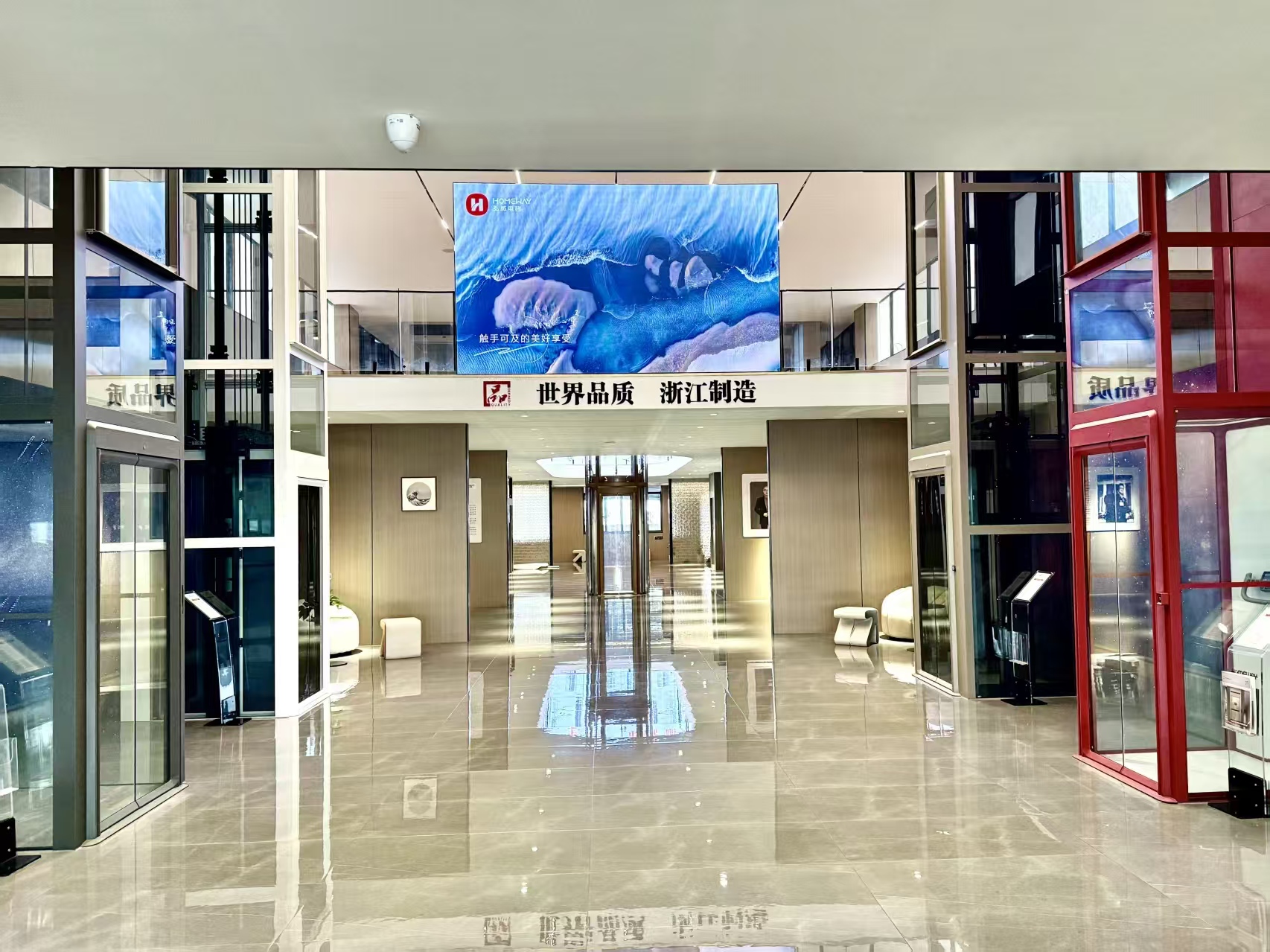
The 1,500 m² Homeway experience showroom holds more than 13 full-functional demonstration elevators for real-scene review before ordering.
This profile is based on company-provided product and company data together with attributable third-party sources, including published standards information and commercial market research. Market size figures from different publishers use different product definitions and are not directly comparable.