Long-Term Teeth Whitening Kit Partnerships: Buyer FAQ on MOQ, Compliance, and After-Sales
Short answers before the detail: MOQ at GlorySmile is not one fixed number — it is determined by product category, customization scope and production line configuration, and the exact figure is confirmed at quotation. Lead time varies with order volume, specifications, complexity and production schedule, and is locked at order confirmation. Compliance depends on the route the product takes to market: cosmetic, medical device or OTC drug. The rest of this article explains each answer in the order a sourcing project actually moves.
A teeth whitening kit is easy to buy once. Reproducing the same kit — same gel, same strip adhesion, same packaging colour, same documents — four times a year for three years is a different exercise, and it is the one that decides whether a private-label or OEM program makes money.
This buyer FAQ is written for that second scenario. It is aimed at brand owners, importers, distributors and OEM buyers who are selecting a long-term teeth whitening kit manufacturing partner rather than filling a single order, and it follows the order in which sourcing risk actually appears: compliance first, then product capability, then budget, then sample validation, then lead time and after-sales.
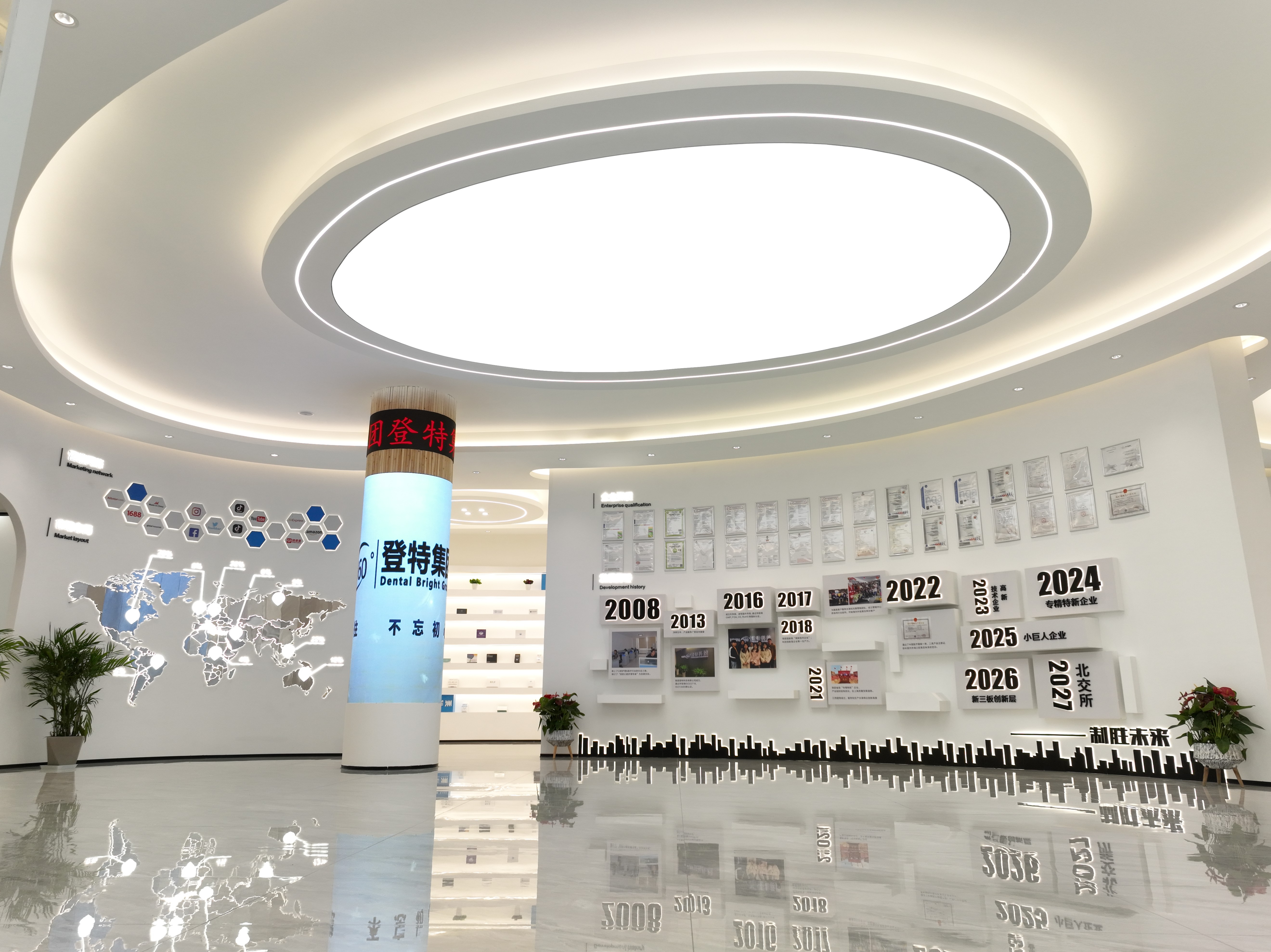
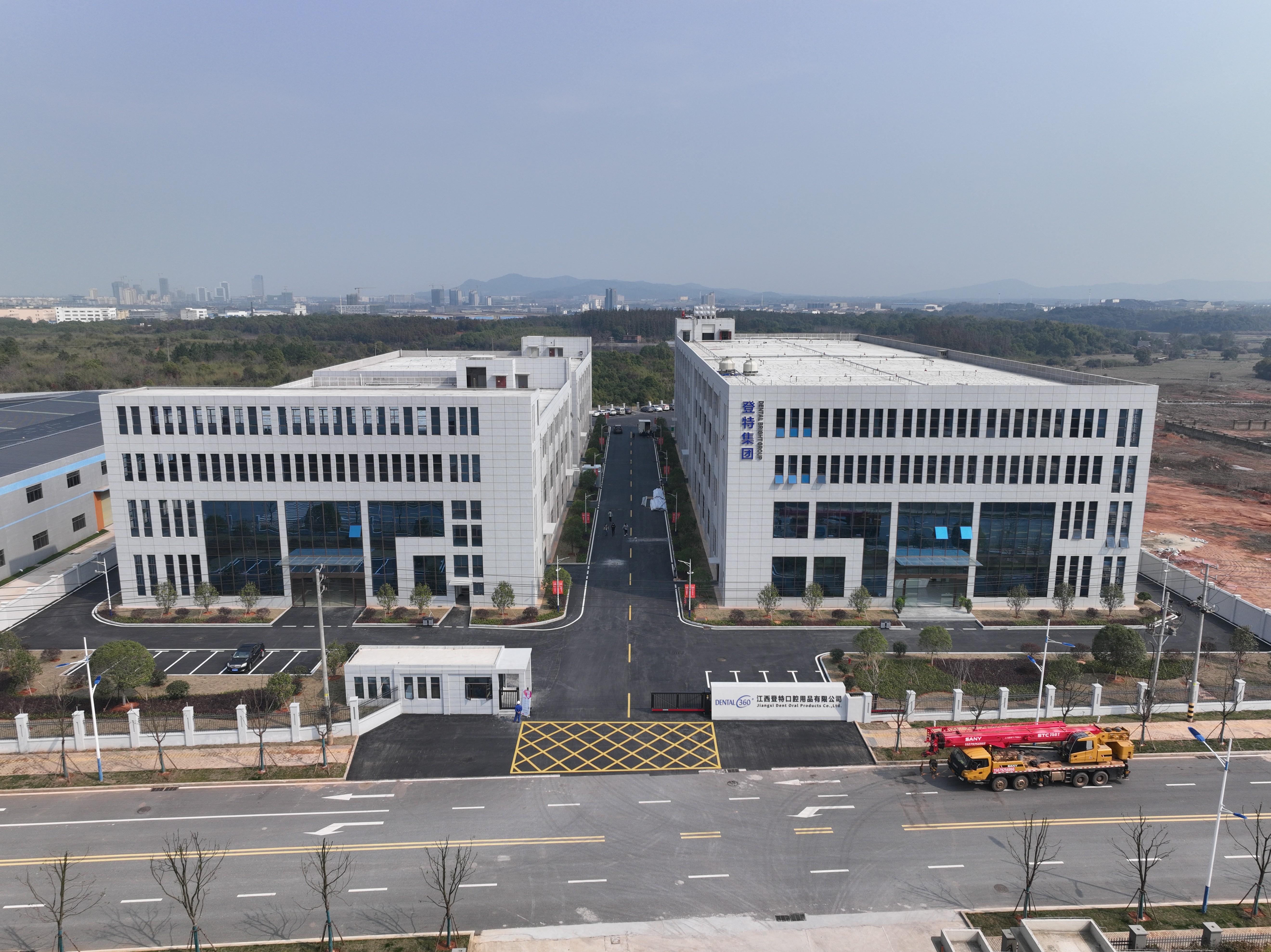
The answers below are built on the operating facts of Jiangxi DentalBright Technology Co.,Ltd., the oral care manufacturer behind the GlorySmile brand (www.glorysmile.com). Jiangxi DentalBright was founded in 2008 and completed its current factory in 2013. The site covers 36,000 m² in Yongxiu, Jiangxi Province, China, employs 256 people, and exports around 90% of its output, with the EU, USA and UK as main markets and products reaching 102 countries.
Problem Definition: Why Sourcing Questions Get Asked Too Late
Most supplier relationships do not collapse because the first shipment was defective. They stall because four variables were left vague at the quotation stage and were never converted into written terms.
- MOQ quoted as a single number. The figures “5 boxes” and “200 pcs” can both appear in the same manufacturer's documents because they answer different questions: the first describes a regular order in the supplier's existing packaging, while the second describes private-label production of an LED whitening kit. A buyer who reads one number without the other builds the wrong budget.
- Compliance claimed without scope. “FDA approved” or “CE” means different things depending on whether a whitening product is regulated as a cosmetic, a medical device or an OTC drug. Without a stated scope, a buyer cannot map the claim onto the destination market's rules — for example the EU threshold that places products containing 0.1%–6% hydrogen peroxide under a dentist-first-treatment requirement.
- Lead time quoted without context. A 5–7 day production figure is a specific scenario, usually a repeat order in existing packaging, not a universal promise. Order volume, specification complexity and the factory's existing schedule all move the number.
- After-sales left undefined. Who handles a quality complaint, how quickly, and through which channel, is often decided only after a problem appears — which is the worst possible time to negotiate it.
Each of these is manageable, but only when it is stated in the same two places: the quotation and the order confirmation.
Industry Background: What Buyers Are Walking Into
Three market conditions shape the questions buyers now ask.
Category scale. Fortune Business Insights values the global teeth whitening market at USD 8.93 billion in 2025 and projects it to reach USD 14.31 billion by 2034. Straits Research reports that the individual and at-home segment accounted for 68.67% of the teeth whitening market in 2024 — the segment where kit-format OEM and private-label production competes. At-home volume is where partnership economics are decided.
Regulation. In the European Union, teeth whitening products containing between 0.1% and 6% hydrogen peroxide require the first treatment to be carried out by a dentist under Directive 2011/84/EU. In the United States, the FDA recognizes ISO 28399:2021 as a consensus standard for external tooth bleaching products, and U.S. Customs and Border Protection ruling NY N342147 classifies teeth whitening strips imported from China under subheading 3306.90.0000, treating the whitening strips as giving the product its essential character.
Formulation shift. The Insight Partners notes rising global demand for PAP+ (phthalimidoperoxycaproic acid) peroxide-free whitening kits as an alternative to traditional peroxide, driven by sensitivity concerns. The practical consequence for buyers is that a supplier relationship now has to cover more than one formula family and more than one regulatory route, because one market may require a peroxide-free claim while another still runs on peroxide chemistry.
Detailed Solution: How a Long-Term Whitening Kit Partnership Is Structured at GlorySmile
1. MOQ is determined by configuration, not by a price list
At GlorySmile, four variables set the minimum order quantity: product category, customization scope, packaging format and production line configuration.
- Product category. A multi-piece LED kit — for example GS-001B, GS-001Y, GS-001X, DB-001M or GS-001J — contains a whitening light, a mouth tray, whitening pens or syringes, a shade guide, a user manual and a gift box. The published specification sheets for these kits list an MOQ of 200 pcs for private label and 1 for the regular product. Toothpaste, mouthwash and tablet lines involve different filling and labelling steps per selling unit, so the configuration changes the minimum.
- Customization scope. The product FAQ states an MOQ of 5 boxes for regular orders in existing packaging, while OEM orders with customized packaging vary by product from 100 to 1000 boxes. Customization can cover the gel ingredient, the packaging, the syringe or pen colour, printing and the bottle colour, and each element added to the specification can move the minimum.
- Production line configuration. Which filling line, strip converting line or tray line the order runs on determines how the batch is scheduled, which is why a small customized run and a large standard run rarely share the same minimum.
Because these variables interact, the exact MOQ is confirmed at quotation rather than published as a universal figure.
2. OEM, ODM, private label and custom formulation
GlorySmile provides complete OEM and ODM services covering product formulation, customization, free sampling and package design.
- Formula families: hydrogen peroxide (HP) from 0.1% to 35%, carbamide peroxide (CP) from 0.1% to 44%, peroxide-free PAP, coconut oil formulas, and custom development.
- Gel packaging and formats: whitening gel can be supplied in pen tubes and squeeze tubes as alternatives to standard syringe packaging, and custom packaging, custom gel ingredient and custom syringe colour are supported across the kit range.
- Registered designs: the GS-001X kit holds EU patent 015062946-0001 and UK patent 6370462; the DB-001M kit holds US Patent No. US D1,128,065 S, EU Patent No. 015065790-0001 and UK Patent No. 6377277. Buyers entering markets where design registration matters can build on registered housing designs rather than unregistered lookalikes.
3. Capacity and facility: what makes repeat orders possible
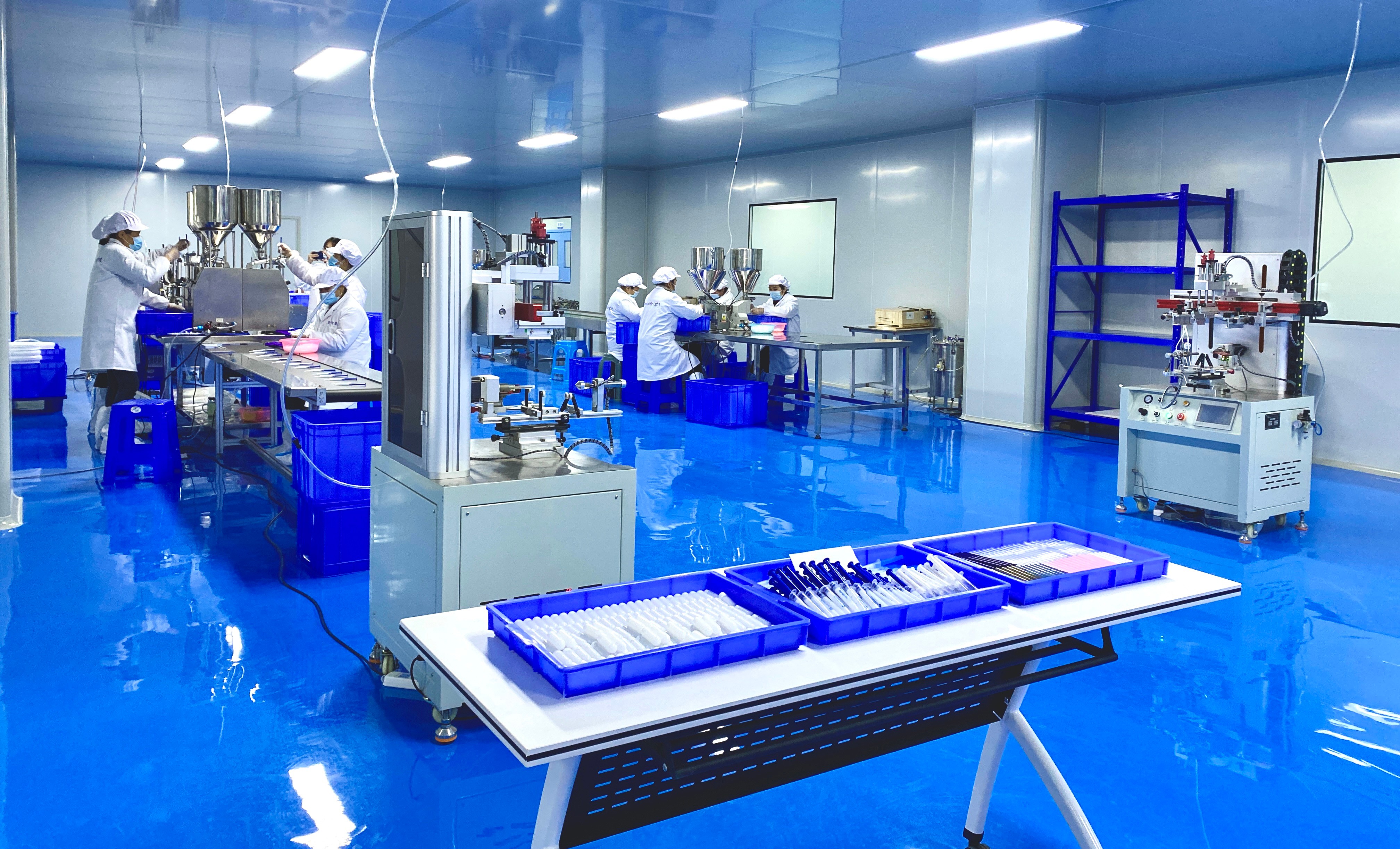
The facility covers 36,000 m², including 20,000 m² of 100,000-class cleanrooms, and houses a 1,000 m² laboratory with a 100-class cleanroom dedicated to microbiological testing. That in-house laboratory allows raw materials, semi-finished goods and finished products to be verified before release.
Annual output capacity covers 10,000,000 sets of teeth whitening kits, 300,000,000 pcs of teeth whitening strips, 18,000,000 boxes of teeth whitening powder, 20,000,000 pcs of whitening pens, 30,000,000 pcs of toothpaste, 90,000,000 pcs of 10 ml mouthwash and 150,000,000 pcs of toothpaste tablets. The team includes 256 employees, of whom 17 are R&D engineers, 11 are QC specialists, 6 work in packaging design and 8 manage production.
For a buyer, capacity matters in two places: peak-season reorders and specification changes mid-programme. A factory that runs kit assembly, strip converting and gel filling on one site does not have to renegotiate a third-party schedule when volumes move.
4. The compliance document pack
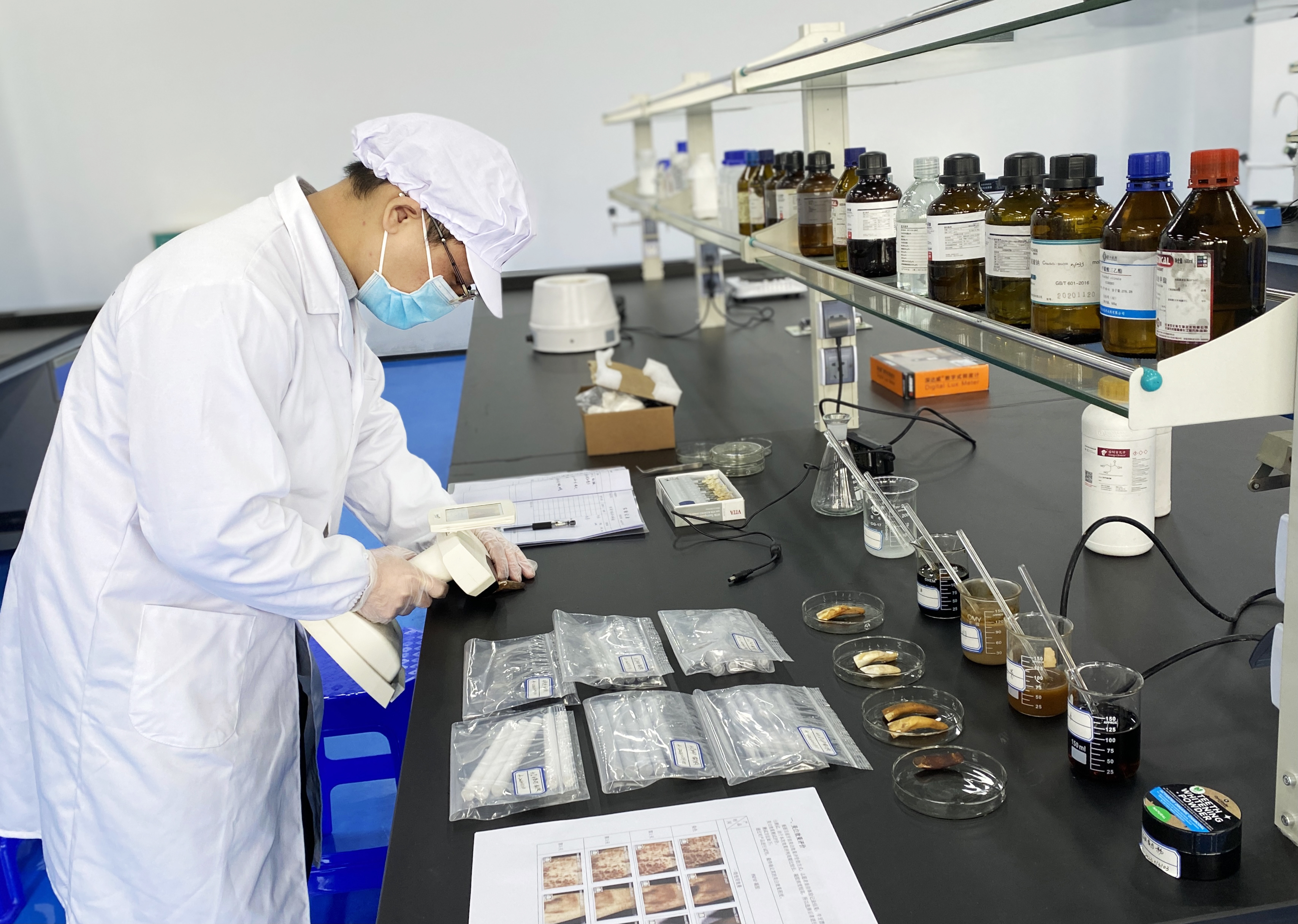
Compliance is where long-term partnerships are usually won or lost. For EU cosmetic products, GlorySmile can provide CPSR, CPNP and PIF; for medical devices, CE-MDR registration has been completed. For the US market, the company states that its products are FDA approved, with the FDA-certified scope covering medical devices, cosmetics and OTC drugs.
Factory certificates include CE, FDA, CPSR, CPNP, PIF, SCPN, MSDS, COA, RoHS, HALAL and Vegan. Product certificates include GMP, ISO 22716, ISO 13485, MDSAP and BSCI. The company also holds both medical device and cosmetics production licences and is certified to MDSAP, ISO 13485, ISO 22716, US GMP, BSCI, HALAL and VEGAN.
MSDS is available on request. Buyers should still expect to align the label, claims and artwork with the destination market's rules, which is why documents are reviewed before artwork is finalised rather than after.
5. After-sales and account management
GlorySmile assigns a dedicated account manager to each client, with rapid after-sales feedback for product complaints and quality issues, and flexible order follow-up when a customized project needs adjustment. Cooperation is structured in three stages: small trial orders, medium-batch verification and mass production. Alongside production, the company provides FDA and CE compliance consulting, label compliance review, customized channel solutions and end-market marketing material support.
For a brand running a teeth whitening kit line across several markets, that combination — a named contact, a documented escalation path and support material for the sales channel — usually matters more than a marginally lower unit price.
Step-by-Step Breakdown: From First Inquiry to Repeat Order
Step 1 — Define the market and the regulatory route
Decide where the kit will be sold and how it will be classified. A cosmetic route into the EU points to CPSR, CPNP and PIF; a medical device route points to CE-MDR registration; the US market requires clarity on whether the FDA scope covers a medical device, a cosmetic or an OTC drug. This step sets the formula ceiling before any design work starts.
Step 2 — Validate the format with samples
Free sampling is part of the OEM/ODM service, so the first decision is which format to test: an LED kit such as GS-001B, GS-001Y, GS-001X, DB-001M or GS-001J; dry strips (GS-004H/V/C/P), wet strips (GS-V34-S07) or dissolving strips (DB-004L); or a toothpaste, tablet, powder, mouthwash or spray line. A 16-LED plug-and-play kit, for example, draws power through four adapters (iPhone, Android, Type-C and USB) with no built-in battery, while the GS-001X adds a charging and sterilisation case with a 16-minute timer and a 3-minute disinfection cycle.
Step 3 — Review documents and label claims
Request the certificate set and the MSDS, then check the label against the destination market. EU hydrogen peroxide thresholds, US standards and customs classification all affect what can be printed on the box, so this review belongs before artwork approval.
Step 4 — Confirm MOQ, price and lead time in the quotation
This is the step buyers most often compress. The quotation should state the MOQ for the exact configuration being ordered, the unit price at that volume and the expected production window, including the assumptions behind it. Because MOQ depends on category, customization and line configuration, and lead time depends on order volume, specifications, complexity and schedule, the written quotation is the only reliable baseline.
Step 5 — Start with a trial order, then a medium batch
GlorySmile supports a three-stage path: small trial orders, medium-batch verification and mass production. Trial orders in existing packaging can start at 5 boxes, and sample or brand-testing volumes in the 5–100 box range are published for strip programs. This keeps first-order inventory risk low while the brand tests conversion and reviews the packaging in a real selling environment.
Step 6 — Approve production and in-house quality control
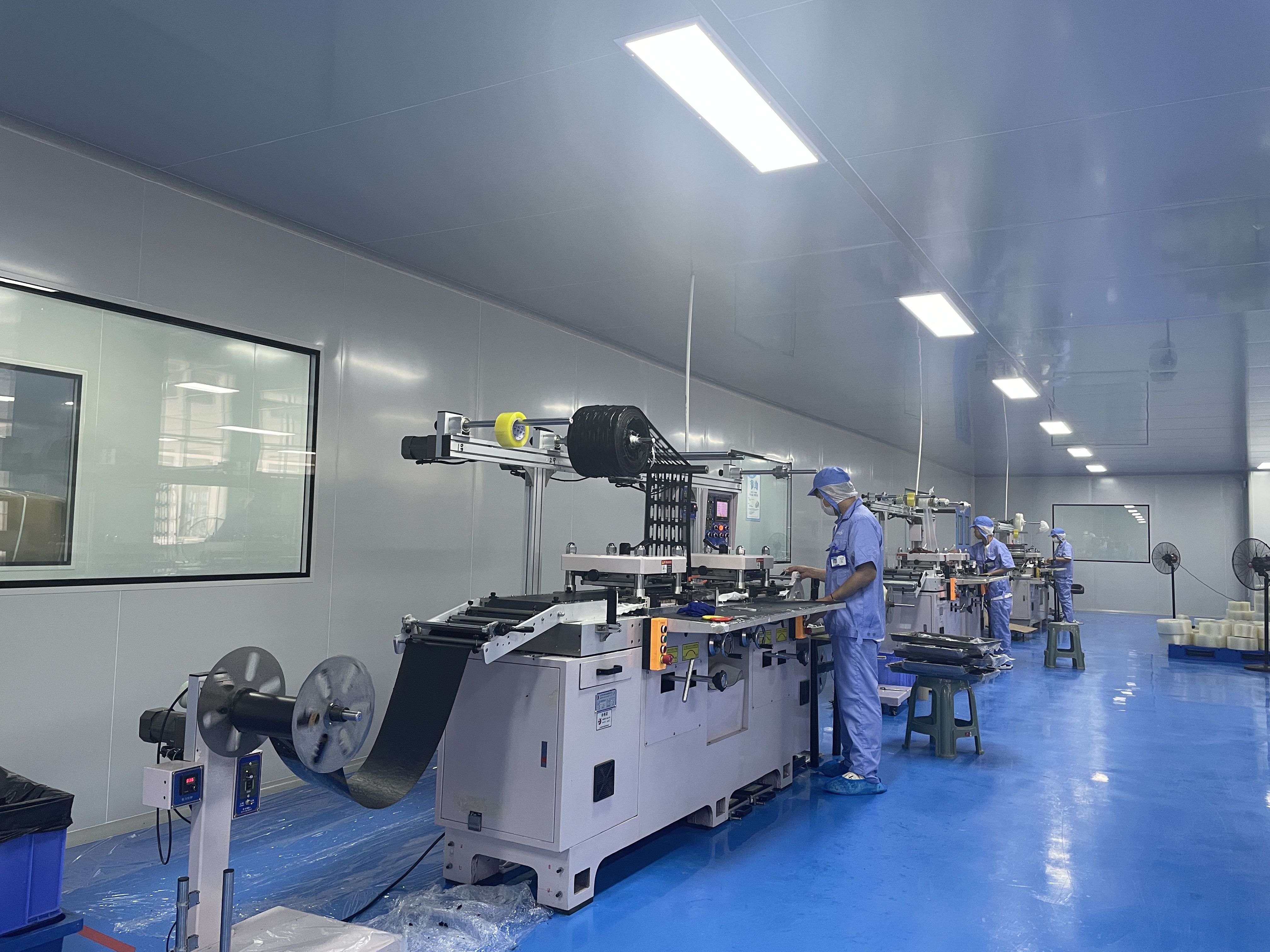
Once the specification is frozen, production runs in the 100,000-class cleanrooms, with microbiological testing in the 100-class laboratory cleanroom and stage-by-stage inspection by the 11-member quality team. Buyers should confirm inspection points and the retention sample policy at this stage, not after delivery.
Step 7 — Lock the after-sales path and plan the reorder
Confirm the account manager, the complaint channel, the response expectation and the reorder trigger. For seasonal markets, reorder planning should begin while the current batch is still in production, using the annual output figures as the reference point rather than an ad-hoc estimate.
Use Cases: Five Buying Situations and the Answers That Decide Them
- DTC brand launching a purple colour-correcting range. The purple colour corrector portfolio includes a 30 ml serum (GS-006V), toothpaste (DB-007P, 65 g and 120 g) and powder (GS-005V, 12 g). Purple sits opposite yellow on the colour wheel, so a water-soluble purple dye is applied to cancel yellow undertones — a mechanic that is easy to explain in advertising and easy to test with a 5-box regular order before committing to customized packaging.
- EU distributor building a compliant retail line. Products containing 0.1%–6% hydrogen peroxide fall under the EU dentist-first-treatment rule, so the formula choice and the document set (CPSR, CPNP, PIF) have to be settled together. A peroxide-free PAP kit or a low-concentration cosmetic line changes both the label and the addressable channel.
- US brand needing one supplier across categories. With an FDA-certified scope covering medical devices, cosmetics and OTC drugs, a buyer can consolidate a whitening kit, a whitening toothpaste and an OTC-positioned product with one manufacturer instead of three, and keep the customs classification question in a single conversation.
- Dental professional or clinic channel. The GS-001L clinic-use whitening kit is built for in-chair treatment: 35% hydrogen peroxide in a 5 ml dual-barrier whitening gel, a 3 ml gum protector with two curved needles, an M-size cheek retractor, brush-ups, vitamin-E swabs, saliva towels, face gauze, bibs and an aluminium bag with sticker.
- Retail or e-commerce brand building a full oral care shelf. Beyond kits and strips, the portfolio covers whitening pens, whitening lights, whitening powder, toothpaste, mouthwash, oral spray, electric toothbrushes, oral irrigators and dental impression materials, which allows one supplier relationship to cover a whole category rather than a single SKU.
Comparison Table: How GlorySmile's Published Terms Compare
The table below summarises figures from GlorySmile's published supplier comparisons. Each row refers to the specific product category named, and final terms are always confirmed in the quotation.
| Benchmark supplier | Product category compared | MOQ: GlorySmile vs supplier | Unit price: GlorySmile vs supplier | Published service or technical difference |
|---|---|---|---|---|
| Luxsmile | Teeth whitening gel | 10 pcs vs 500 pcs | $0.38–$0.45 vs $0.75–$0.89 | Multiple gel packaging formats (pen tubes and squeeze tubes) vs syringe packaging only; published website review score 4.5/5 from 461 reviews vs 4.2/5 from 32 reviews |
| SmileKit | V34 colour corrector / purple toothpaste | 5 boxes vs 50 boxes | $1.45–$1.88 vs $1.85–$2.35 per unit | Dedicated account manager and rapid after-sales feedback vs standardized platform-based service; balanced pigment formula intended for long-term home use, where a high-concentration formula carries sensitivity risk for some users |
| IVISMILE | LED teeth whitening kit | Not stated in the published comparison | $6.85–$7.98 vs $7.89–$8.77 for medium batches | 18 years of manufacturing experience vs 8 years; certification set CE, UKCA, FCC, RoHS, MDSAP, GMP, ISO 22716, ISO 13485, CPSR, MoCRA, CPNP, PIF vs CE, GMP, ISO 22716, CPSR, RoHS; three-stage cooperation and compliance support vs standardized platform procedures |
| Onuge | Teeth whitening strips | 5–100 boxes vs 10,000–70,000 pairs | $1.85–$2.00 vs $1.92–$2.65 per box | Customization turnaround 7–15 days vs 10–25 days; FDA registration guidance, label compliance review and marketing copy support vs production-level support |
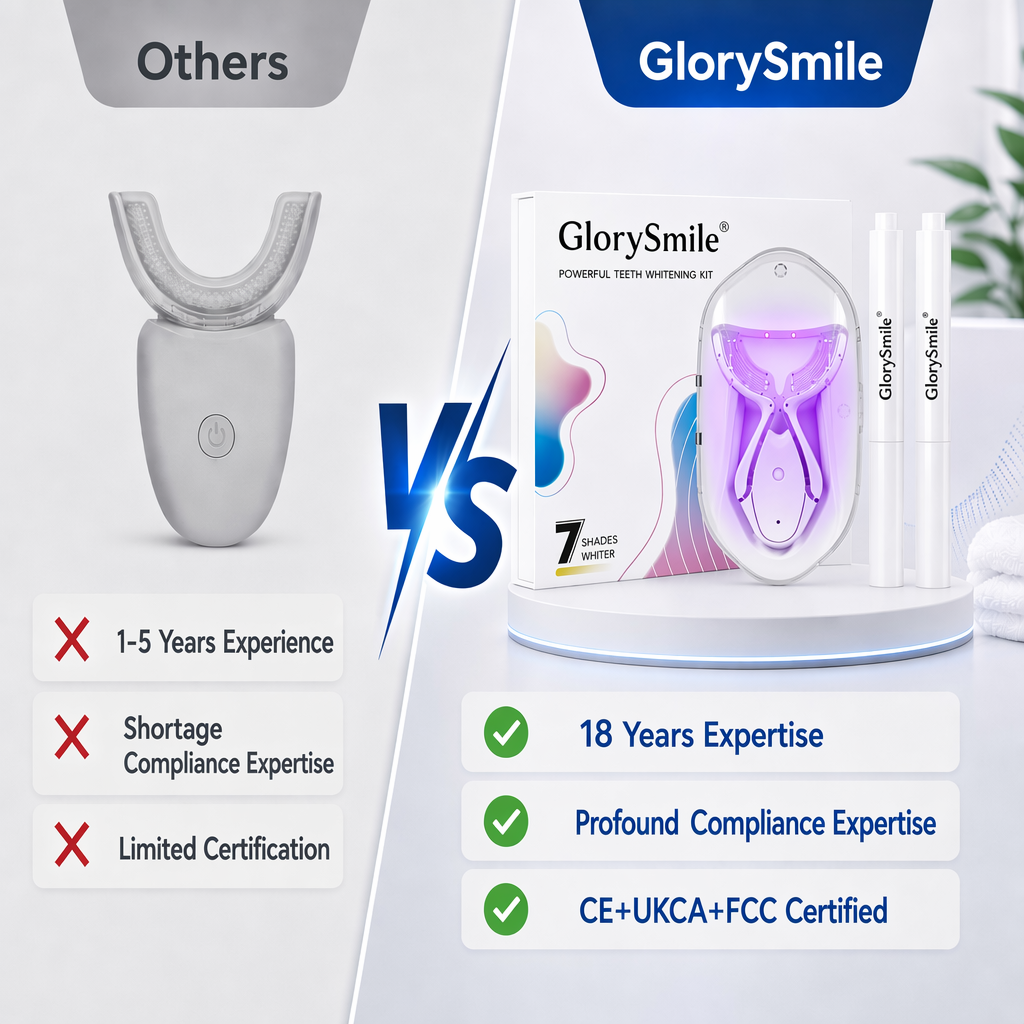
Because documents are the other half of the buying decision, the second table lists the approval and certificate set a buyer can review before committing.
| Document or approval | Applicable route | Status |
|---|---|---|
| CPSR, CPNP, PIF | EU cosmetic products | Available for cosmetic products |
| CE-MDR registration | EU medical devices | Completed for medical devices |
| FDA approval | US market | Certified scope covers medical devices, cosmetics and OTC drugs |
| MSDS | All markets | Available on request |
| Factory certificates | Multi-market | CE, FDA, CPSR, CPNP, PIF, SCPN, MSDS, COA, RoHS, HALAL, Vegan |
| Product certificates | Multi-market | GMP, ISO 22716, ISO 13485, MDSAP, BSCI |
Frequently Asked Questions
Is a teeth whitening kit compliant for the EU market?
Yes. For cosmetic products, GlorySmile can provide CPSR, CPNP and PIF. For medical devices, CE-MDR registration has been completed. Buyers should also account for Directive 2011/84/EU, under which teeth whitening products containing between 0.1% and 6% hydrogen peroxide require the first treatment to be carried out by a dentist, a rule that affects both formulation choice and label wording.
Is the product FDA approved?
GlorySmile states that its products are FDA approved, and that the FDA-certified scope covers medical devices, cosmetics and OTC drugs. The scope matters for US buyers because a whitening kit, an OTC whitening product and a cosmetic oral care line can each fall under a different part of that approval, and the label claims must match the category the product is sold under.
What certifications and technical documents can a buyer receive?
Factory certificates include CE, FDA, CPSR, CPNP, PIF, SCPN, MSDS, COA, RoHS, HALAL and Vegan. Product certificates include GMP, ISO 22716, ISO 13485, MDSAP and BSCI. The company is also certified to MDSAP, ISO 13485, ISO 22716, US GMP, BSCI, HALAL and VEGAN, and holds both medical device and cosmetics production licences. MSDS is available on request.
Is the whitening kit safe for sensitive teeth?
GlorySmile offers PAP and low-sensitivity formulas designed for sensitive teeth. Formula options across the range include PAP, carbamide peroxide, hydrogen peroxide, sodium phytate and sodium bicarbonate, which allows a brand to select a lower-sensitivity configuration for markets where sensitivity complaints drive returns and reviews.
What whitening formulas are available, and at what concentrations?
The formula range covers hydrogen peroxide (HP) from 0.1% to 35%, carbamide peroxide (CP) from 0.1% to 44%, peroxide-free PAP, coconut oil formulas and custom development. Formulas also include sodium phytate, sodium bicarbonate and charcoal options, and flavours can be customized across strips, powders, mouthwash and spray lines.
Peroxide versus PAP gel — which is better for a long-term product line?
They answer different market requirements rather than competing on a single scale. PAP is peroxide-free and is often chosen for enamel-safe or sensitive-teeth positioning; peroxide chemistry remains the basis of many conventional whitening claims, and EU products containing 0.1%–6% hydrogen peroxide fall under the dentist-first-treatment requirement. The Insight Partners notes rising global demand for PAP+ peroxide-free whitening kits as an alternative to traditional peroxide because of sensitivity concerns. Many brands therefore run a peroxide-free PAP line and a peroxide line on the same kit hardware.
Dry strips versus wet strips — what is the practical difference for a private-label line?
Three strip formats are produced: dry strips (GS-004H/V/C/P), wet strips (GS-V34-S07) and dissolving strips (DB-004L), each available in 7, 14 or 21 bags per package. Formulas can be PAP, PAP with charcoal, purple, 6% HP, sodium phytate or sodium bicarbonate, with custom options, and flavours range from blue raspberry, strawberry and peach to peppermint, coconut and mango. All strips use an aluminium bag with a three-layer construction: PET hard film, whitening gel and PE soft film.
Toothpaste or toothpaste tablets — which format should a brand launch?
Both are available. GS-007F fruity toothpaste is a 60 g tube offered in flavours including smooth mint, strawberry, mango sorbet, peach iced tea, grape bubblegum, watermelon, vanilla, banana, coconut whip and candy cane. GS-007D double tube toothpaste is a 100 g spearmint format containing PAP and hydrogen peroxide. GS-008 toothpaste tablets come in 30 or 60 tabs in mint, with plastic, glass, aluminium or kraft packaging and purple, charcoal or sakura variants, while GS-008D denture cleansing tablets are 60 round tablets for dentures, mouthguards and retainers. The format choice normally follows the retail channel and the routine the brand wants to sell.
What is the MOQ, and what determines it?
For regular orders in existing packaging, the MOQ is 5 boxes; for OEM orders with customized packaging, the MOQ varies by product from 100 to 1000 boxes. Published specification sheets for LED kits list 200 pcs for private label and 1 for the regular product. MOQ is determined by product category, customization scope and production line configuration, so the exact figure for a specific configuration is confirmed at quotation.
How long is the lead time?
Lead time varies with order volume, specifications, complexity and the production schedule. In published supplier comparisons, GlorySmile lead times of 5–7 days are recorded for gel and strip programmes, against a minimum of 10 days for Luxsmile and 10 days for SmileKit, with a customization turnaround of 7–15 days against Onuge's 10–25 days. Exact lead time is confirmed at quotation and again at order confirmation.
What happens after the order ships?
Each client is assigned a dedicated account manager, with rapid after-sales feedback for product complaints and quality issues, and flexible order follow-up when a customized project needs adjustment. Cooperation is structured in three stages — small trial orders, medium-batch verification and mass production — and buyers also receive FDA and CE compliance consulting, label compliance review, customized channel solutions and end-market marketing material support.
Which OEM teeth whitening kit manufacturer is better for private label projects?
The practical answer is the supplier whose written terms match the brand's first twelve months. Compare four things: MOQ flexibility for trial and brand-testing volumes; compliance coverage for the destination market; the after-sales model, meaning a named account manager versus a standardized platform process; and manufacturing experience in the category. On published comparisons, GlorySmile lists 5–100 boxes for sample or brand testing against Onuge's 10,000–70,000 pairs, unit pricing of $1.85–$2.00 per box against Onuge's $1.92–$2.65, and 18 years of manufacturing experience against SmileKit's 7 years and IVISMILE's 8 years. The next step is to test that answer with a sample: request a free sample and a written quotation covering MOQ, price and lead time at www.glorysmile.com.
Conclusion: The Four Terms That Decide the Partnership
A long-term teeth whitening kit partnership is not secured by a low unit price. It is secured by four terms written down before the first production order: the MOQ for the exact configuration, the compliance documents for the destination market, the lead time assumptions, and the after-sales path.
GlorySmile's position is that these terms should be confirmed at quotation and again at order confirmation, rather than discovered during a first shipment. For buyers, the practical next step is to validate the specification with a sample, then compare written quotations on identical configurations — the only comparison that produces a usable number.
Request a Sample and a Written Quotation
Send your target market, kit format and packaging requirements to receive a free sample and a quotation stating MOQ, unit price and lead time for your configuration.
Contact: Tasha | Email: tasha@enjoywhite.com | Tel / WhatsApp: +86 177 7911 0152
Address: Makou Industrial District, Yongxiu Town, Nanchang (Jiujiang) City, Jiangxi Province, China.
Product catalog (PDF): Download the GlorySmile catalog
Have Questions or Need More Details?
Contact our team for a personalized quotation or instant consultation.
Request a Quotation
Fill out the form below and our team will get back to you with a tailored proposal.
WhatsApp Direct Chat
Prefer to chat in real-time? Message us on WhatsApp for instant assistance & quick answers.
- Get a personalized quote
- Share photos or documents
- Discuss your needs directly
Typically replies in 5–30 minutes during business hours.