
Flat Plate vs. PV Solar Water Heaters for Hotels: A Practical Comparison

Hotel hot water is a 24-hour obligation rather than a daytime convenience. The domestic hot water (DHW) load arrives before sunrise, peaks twice a day and continues after dark, while the two solar technologies most often proposed for it — flat plate solar thermal collectors and PV solar water heaters — both depend on sunshine. The real comparison is therefore not "which panel is better". It is which system still delivers constant-temperature hot water at 6 a.m., how much auxiliary heating it needs, and how stable its running cost remains over a service life measured in decades.
For most small and mid-sized hotels, a flat plate or vacuum tube solar thermal system paired with a well-sized pressurized storage tank is the more direct route to all-day hot water, because solar energy is stored as heat in water rather than as electricity. A solar PV water heater — a solar panel water heater that uses PV modules, an MPPT controller and an electric heating element — is usually selected when the binding constraint is a PV-oriented electrical architecture, a simple single-panel installation, or an existing on-site solar electricity strategy.
This guide compares both routes against the criteria hotel buyers actually use: all-day domestic hot water supply, auxiliary heating demand, and long-term cost stability. It uses documented Kesun Solar product data plus a Southeast Asian hotel case in which a complete solar hot water system cut electricity and gas costs by more than 40% and remained in stable service for over 15 years.
Problem Definition: Why Hotel Hot Water Is a Timing Problem, Not Only a Volume Problem
A hotel does not buy hot water by the litre; it buys availability. Kesun's documented hotel project shows the shape of the load: a complete solar hot water system sized to serve the daily water supply of 80 guest rooms, delivering all-day domestic hot water to guest rooms and public bathing areas and supporting auxiliary regional heating, while replacing traditional electric and gas heating equipment to meet the stable heat demand of daily hotel operation.
That single project description already contains the three constraints that decide the flat plate versus PV question:
- All-day supply. Hot water must be available in the early morning, during the evening peak and outside daylight hours, so storage capacity has to be sized against the peak hour, not only the daily total.
- Auxiliary heating. Solar equipment functions as a heat generation and storage unit; electric heaters or heat pumps are paired with it for backup and compensation when solar input is insufficient.
- Cost stability. The financial case is measured across the system's service life — in the documented hotel project, a stable service life of more than 15 years — rather than across the first season.
Climate adds a fourth constraint in tropical and coastal markets. The Southeast Asian reference project uses high-adaptability vacuum heat collection modules chosen for strong corrosion and weather resistance in a hot, rainy climate, with an integrated design that supports easy installation and low-cost maintenance, and smart temperature adjustment for high energy efficiency in small-to-medium commercial projects.
Industry Background: Solar Water Heating Is Still Mainly a Thermal Business
The global solar water heater market was valued at USD 4.2 billion in 2025 (Fortune Business Insights). By the end of 2023, cumulative global solar heat capacity had reached 560 GWth, covering 800 million m² of collector area, according to the IEA Solar Heating & Cooling Programme's Solar Heat Worldwide 2024 report. Within that installed base, evacuated tube collectors led the market with a 44.2% revenue share in 2023 (Grand View Research) — a useful reminder that in hotel and commercial DHW projects, thermal collection, not PV, remains the mainstream technology. That is precisely why a flat plate versus PV comparison still has to start from system behaviour rather than from panel branding.
Two regulatory and trade signals also matter for 2025–2029 purchasing decisions. In 2023, HS code 841912 was introduced specifically to differentiate solar water heaters from the generic 841919 classification (Solar Heat Europe), which affects customs and duty documentation for importers. In the United States, new Federal energy conservation standards for consumer water heaters took effect on 5 July 2024, with compliance required by 2029 (Federal Register / U.S. Department of Energy) — relevant to any hotel group with US exposure.
On the supply side, Zhejiang Kesun New Energy Co., Ltd. — trading as Kesun Solar and publishing product data at kesunsolar.com — is a solar water heater, buffer tank, domestic hot water tank and hybrid solar panel manufacturer founded in 2009 in Haining, Zhejiang, China. The company was formed by merging Haining Ensun Solar Technology Co., Ltd. and Zhejiang Yile New Energy Co., Ltd., and now operates a 42,000 m² manufacturing facility with 130 employees, 15 engineers in R&D and an annual output of 300,000 sets. Exports account for 60% of sales, with Mexico, the EU and Africa as main markets; annual export revenue was reported at approximately USD 19.6 million in 2025 (Alibaba verified company profile). After the merger, the company added PVT (photovoltaic-thermal) systems, 2205 duplex stainless steel tanks and heat pipe solar collectors to its existing non-pressure and pressurized lines, and established an in-house laboratory for reliability tests such as salt spray testing and pulse testing that were previously outsourced. The company also supplies components to Fortune 500 companies in China and abroad.
Detailed Solution: The Two Routes and the Product Portfolio Behind Them
The choice between flat plate and PV is really a choice about what the system stores. A thermal system stores hot water; a PV system converts sunlight into electricity first and then into heat inside a tank. Each route has different collector areas, tank requirements and compliance evidence.
Route A — Flat plate collectors with an indirect storage system
Flat plate collectors absorb solar radiation on an absorber plate and transfer the heat into a fluid that circulates to a storage tank. Kesun's flat plate product is the FPC2.0 flat plate solar collector, available in 1 m², 1.5 m², 2 m² and 2.5 m² sizes with 80 mm thickness and a copper and aluminium alloy construction; the documented application range covers swimming pools, housing heating and solar water heaters. On the system side, the CPS-FJ series is an indirect solar water heater offered in 150 L, 200 L, 250 L and 300 L capacities, using a flat type solar collector and an SPCC tank with enamel coating, and specified for villas, houses, hotels and schools.
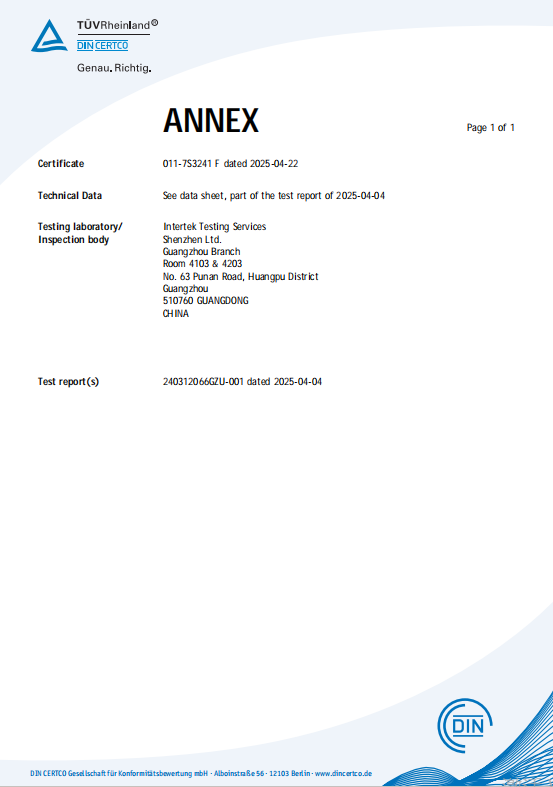
For EU-bound hotel projects, both elements carry third-party certification: Solar Keymark 011-7S3241 F covers the FPC2.0 and FPC2.5 flat plate collectors under DIN EN 12975:2022-06 and DIN EN ISO 9806:2018-04 (valid to 2030-04-30), while Solar Keymark 011-7S3343 A covers the CPS/F150 to CPS/F300 indirect systems under DIN EN 12976-1:2022-03 and DIN EN 12976-2:2019-11 (valid to 2031-06-30).
Route B — Vacuum tube heat pipe collectors with pressurized storage
Where the site demands higher-temperature collection or the climate is more demanding, vacuum tube collectors are the alternative. Kesun's HSC series solar collector uses 10 to 30 tubes of the 58-1800 vacuum tube type with heat pipe and an aluminium alloy frame, and is specified for villas, hotels, house heating, spa centres and schools. The matching storage products are the CPS series high-pressure solar geysers with 100 L to 300 L capacity, a maximum operating pressure of 6 bar, a test pressure of 9 bar, 58-1800 vacuum tube with heat pipe absorbers, 50 mm PU foam insulation, a 25° to 45° mounting angle, and tank materials in SS304, SS316, Duplex 2205 or Duplex 32001. The HSC series holds Solar Keymark 011-7S3325 R under the KESUN brand (valid to 2030-11-30), and the ENSUN-CPS100 to ENSUN-CPS300 thermal solar systems hold Solar Keymark 011-7S3077 A (valid to 2029-06-30).
Route C — PV solar water heaters (PV Series)
A PV solar water heater replaces the thermal collector with PV modules and an electric heating element. Kesun's PV Series PV solar water heater covers 100 L to 500 L capacity, with a power input from the solar panel of 600 W per panel and a heating power output of 800 W to 3500 W. The controller includes an MPPT function and a DC/AC automatic switch, and the tank uses Duplex 2205 or Inox 316L. The documented application range is villas, houses, apartments and camps — typically installations where a PV array and a simple electrical architecture already exist.
Route D — PVT hybrid collectors for sites that want both outputs
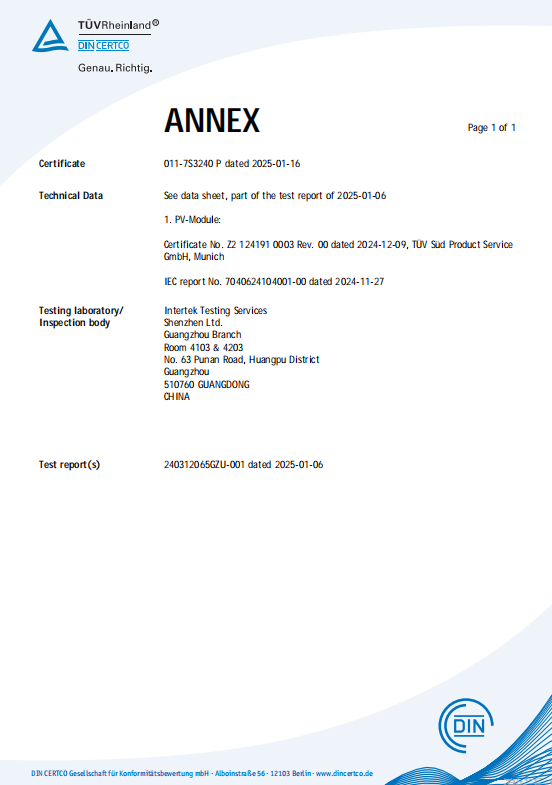
Kesun also produces PVT hybrid solar panels, and the PVT430, PVT450, PVT550, PVT580, PVT600 and PVT670 models hold Solar Keymark 011-7S3240 P under DIN EN 12975:2022-06 and DIN EN ISO 9806:2018-04 (valid to 2030-01-30). PVT collectors produce electricity and heat from the same roof area, which makes them relevant when a hotel wants PV electricity and hot water but cannot allocate separate collector and module fields.
Why the storage route matters for all-day supply. In a thermal system, solar energy is collected and stored directly as hot water in the tank, so the tank — not the collector — is what serves the 6 a.m. and evening peaks. In a PV water heater, energy passes through two conversion steps, from light to electricity and then to heat, which generally means a larger module area is needed to deliver the same daily heat output. The trade-off is architectural rather than absolute: thermal storage favours high daily DHW volume, while PV-based heating favours simple electrical integration.
Storage and auxiliary heating: the components that decide availability
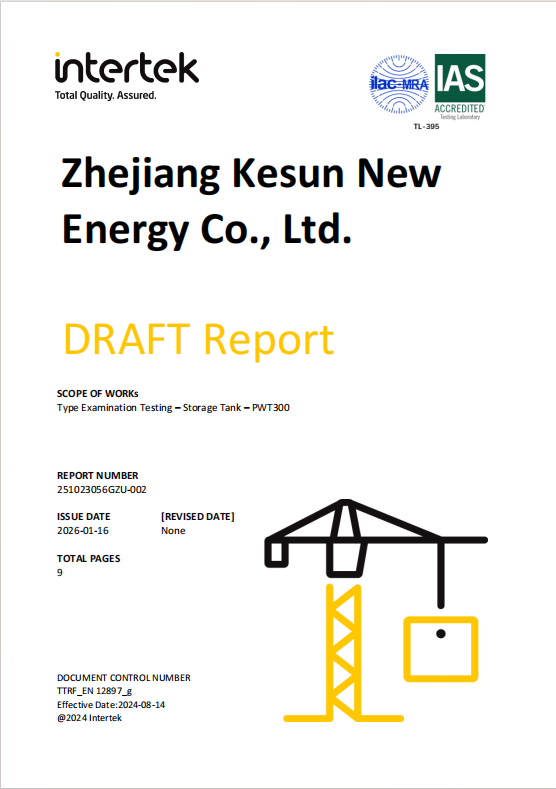
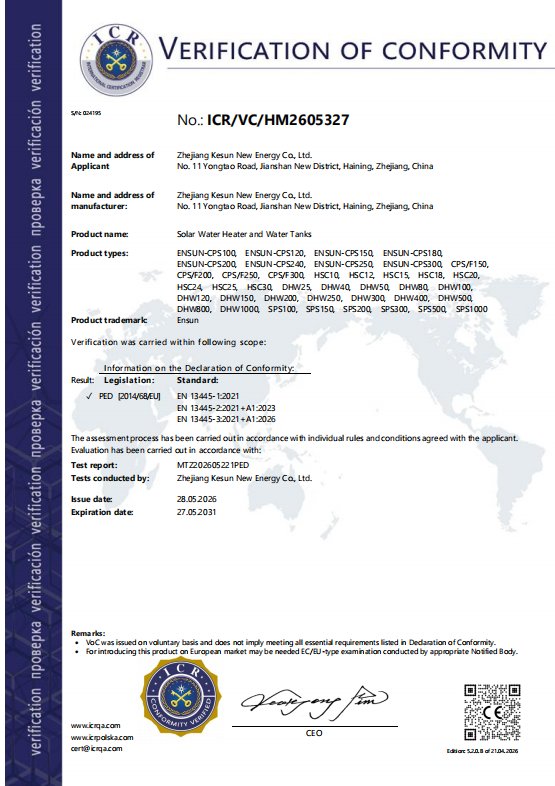
Storage behaviour is largely a tank question. Kesun's range includes buffer tanks, domestic hot water tanks and heat pump tanks, and the company's tank programme is supported by Intertek type examination test reports for storage tanks PWT200 (report 251023056GZU-001, issued 18 January 2026) and PWT300 (report 251023056GZU-002, issued 16 January 2026), both assessed against EN 12897:2016+A1:2020. A separate Intertek performance test report, 251230069GZU-001 issued 7 January 2026, covers the stainless steel inner tank. At the vessel level, PED verification of conformity ICR/VC/HM2605327 covers solar water heaters and water tanks under PED (2014/68/EU) with EN 13445-1:2021, EN 13445-2:2021+A1:2023 and EN 13445-3:2021+A1:2026, valid to 27 May 2031; the LVD and EMC verification ICR/VC/HM2605326, valid to the same date, covers the solar water heater and water tank range under LVD 2014/35/EU and EMC 2014/30/EU, and the PV Series PV solar water heater is listed among the products associated with that verification.
Auxiliary heating follows the same logic on both routes: the solar side provides heat generation and storage, while electric heaters or heat pumps provide backup and compensation. Circulation pumps, controllers, valves, mounting frames and piping accessories complete the matched equipment set, and systems can be configured for direct or indirect circulation, passive thermosiphon or pump-driven forced circulation, depending on the project design.
Step-by-Step Breakdown: Eight Decisions for a Hotel Project
The comparison only becomes useful when it is applied to a specific building. The sequence below reflects how a DHW system is actually specified for a hotel.
- Quantify the daily DHW load and the peak hour. Count guest rooms, public bathing areas and any regional heating demand. The documented Kesun reference project serves 80 guest rooms plus public bathing areas, which makes it a practical benchmark for small and medium hotel sizing.
- Decide whether you want to store heat or electricity. If hot water must be available across 24 hours with minimal electrical dependency, thermal storage with flat plate or vacuum tube collectors is the direct route; if the site's priority is PV electrical integration or a simple panel-in-tank configuration, the PV Series is the appropriate starting point.
- Size the collector field. Flat plate: FPC2.0 modules in 1 m², 1.5 m², 2 m² or 2.5 m², 80 mm thick. Vacuum tube: HSC series with 10 to 30 tubes per collector. The field size then determines the achievable daily heat input.
- Size the storage tank. Thermal options include the CPS-FJ indirect series at 150 L, 200 L, 250 L and 300 L, and the CPS pressurized geyser series at 100 L to 300 L. The PV Series spans 100 L to 500 L. Buffer tanks and heat pump tanks can be added where the load profile requires decoupling.
- Specify tank material and pressure class. CPS series tanks are available in SS304, SS316, Duplex 2205 or Duplex 32001 with a 6 bar maximum operating pressure and 9 bar test pressure; CPS-FJ uses SPCC with enamel coating; the PV Series uses Duplex 2205 or Inox 316L. Insulation is 50 mm PU foam on the CPS series.
- Plan auxiliary heating and controls. Define the backup capacity of electric heaters or heat pumps, and confirm the controller, pump, valve and mounting frame set. Mounting angle for CPS series collectors is specified between 25° and 45°.
- Match climate and site conditions. Corrosion-resistant materials, water quality treatment, freeze protection for winter and roof load-bearing capacity are the common project concerns, and each should be defined against the actual project location and design. In hot, rainy Southeast Asian conditions, the reference project relied on corrosion and weather-resistant vacuum heat collection modules.
- Verify compliance documents and commercial terms before quoting. Collect Solar Keymark, PED and CE (LVD + EMC) documentation plus tank test reports, confirm the HS code used for customs, then lock MOQ, lead time, payment terms and inspection method.
Use Cases: Where Each Configuration Fits
- 80-room hotel with all-day DHW and public bathing areas (thermal, vacuum tube). HSC series collectors paired with CPS-FJ or CPS series pressurized solar water heaters are the documented recommendation for stable, large-volume domestic hot water in hotels and commercial buildings. The reference Southeast Asian project achieved more than 40% lower electricity and gas costs, constant-temperature hot water with minimal failures, a service life of over 15 years and reduced carbon emissions for green-hotel compliance.
- Small hotel, guesthouse or school with limited plant space (thermal, flat plate). The CPS-FJ indirect solar water heater is documented for villas, houses, hotels and schools in 150 L to 300 L capacities with flat type collectors.
- Property with a pool or housing heating load (flat plate). The FPC2.0 flat plate collector is documented for swimming pools, housing heating and solar water heaters, so a single collector type can serve both the DHW and the pool or space-heating circuit.
- Villa, apartment block or camp with a PV-oriented energy design (PV). The PV Series PV solar water heater covers 100 L to 500 L with an MPPT controller and DC/AC automatic switch, suited to sites where PV modules are already part of the electrical plan.
- Spa centre, resort or school with higher temperature demand (thermal, vacuum tube). HSC series collectors are documented for spa centres, hotels and schools, and can be combined with pressurized storage.
The 40% energy cost reduction is one documented project outcome, not a universal figure; actual results depend on the load profile, local electricity and gas tariffs and solar resource at the site.
Comparison Table: Flat Plate Thermal vs. PV Solar Water Heating for Hotels
The table below compares the two routes using documented product data only. Blank or qualitative cells indicate that no figure is documented for that dimension.
| Decision criterion | Flat plate / thermal route | PV solar water heater route |
|---|---|---|
| How heat is produced | Solar radiation is absorbed and transferred to a fluid, then stored as hot water in the tank | PV modules generate electricity; an MPPT controller and heating element convert it into heat in the tank |
| Documented product reference | FPC2.0 flat plate collector; CPS-FJ indirect solar water heater; HSC series vacuum tube collector; CPS series pressurized geyser | PV Series PV solar water heater |
| Collector sizing data | FPC2.0: 1 m², 1.5 m², 2 m², 2.5 m², 80 mm thickness, copper and aluminium alloy; HSC series: 10 to 30 tubes, 58-1800 vacuum tube with heat pipe | Power input from solar panel: 600 W per panel; heating power output: 800 W to 3500 W |
| Storage capacity | CPS-FJ: 150 L, 200 L, 250 L, 300 L; CPS series: 100 L to 300 L | 100 L to 500 L |
| Tank material and pressure | SS304, SS316, Duplex 2205, Duplex 32001; 6 bar maximum operating pressure, 9 bar test pressure; 50 mm PU foam insulation; 25° to 45° mounting angle (CPS series). CPS-FJ: SPCC with enamel coating | Duplex 2205 / Inox 316L; controller with MPPT function and DC/AC automatic switch |
| Third-party certification evidence | Solar Keymark 011-7S3241 F (FPC2.0, FPC2.5); 011-7S3343 A (CPS/F150–CPS/F300); 011-7S3325 R (HSC10–HSC30, KESUN brand); 011-7S3077 A (ENSUN-CPS100–CPS300); 011-7S3239 A (CNP100–CNP300, valid to 2030-03-31) | CE verification of conformity ICR/VC/HM2605326 (LVD 2014/35/EU and EMC 2014/30/EU), valid to 27 May 2031 |
| Storage tank documentation | Intertek type examination reports for PWT200 and PWT300 to EN 12897:2016+A1:2020; Intertek performance test report 251230069GZU-001 for the stainless steel inner tank | Same tank programme: PED verification of conformity ICR/VC/HM2605327 under PED (2014/68/EU) with EN 13445-1, EN 13445-2 and EN 13445-3 |
| Auxiliary heating | Electric heaters or heat pumps provide backup and compensation; supported by buffer tanks and heat pump tanks | Backup and compensation also required; control handled through the MPPT controller and DC/AC automatic switch |
| Documented applications | FPC2.0: swimming pool, housing heating, solar water heater. CPS-FJ: villa, house, hotel, school. CPS series: house, villa, garden, gas station, car wash centre, small hotel, school. HSC series: villa, hotel, house heating, spa centre, school | Villa, house, apartment, camp |
| Documented outcome in hotel service | More than 40% reduction in electricity and gas costs; service life over 15 years; constant-temperature hot water with minimal failures (Southeast Asian hotel, 80 guest rooms) | No equivalent hotel outcome is documented in the available product and case data |
| Best-fit decision rule | Choose when the hotel's daily DHW volume is high, hot water must be available before sunrise and after sunset, and thermal storage can be accommodated | Choose when the site prioritises PV electrical integration, simple installation, or has an existing PV architecture and modest DHW volume |
FAQ: Compliance, Capability, Budget, Validation and Lead Time
Do flat plate and PV solar water heaters for hotels meet EU compliance requirements?
For an EU-bound hotel project, thermal collectors and tanks can be documented through Solar Keymark, PED and CE evidence. Kesun holds Solar Keymark 011-7S3241 F for the FPC2.0 and FPC2.5 flat plate collectors under DIN EN 12975:2022-06 and DIN EN ISO 9806:2018-04, and 011-7S3343 A for the CPS/F150 to CPS/F300 indirect solar water heaters under DIN EN 12976-1:2022-03 and DIN EN 12976-2:2019-11. The tank programme is covered by Intertek type examination test reports for PWT200 and PWT300 to EN 12897:2016+A1:2020 and by the stainless steel inner tank performance test report 251230069GZU-001. At system level, PED verification of conformity ICR/VC/HM2605327 applies under PED (2014/68/EU), and the LVD plus EMC verification ICR/VC/HM2605326 applies under LVD 2014/35/EU and EMC 2014/30/EU, both valid to 27 May 2031. For customs, note that solar water heaters have been classified separately under HS code 841912 since 2023 rather than under the generic 841919 code.
Can a supplier customise a solar hot water system for a hotel's capacity and roof layout?
Kesun provides OEM and ODM services with full customisation options, and customisation covers tank capacity, collector type and complete system configuration for both residential and commercial applications. Production capacity is 25,000 units per month. R&D is handled by 15 engineers, and the product lines available for hotel projects include the FPC2.0 flat plate collector, the HSC series vacuum tube collector, the CPS series pressurized solar geyser, the CPS-FJ indirect solar water heater, the PV Series PV solar water heater and PVT hybrid collectors. For hotel and commercial hot water projects, HSC series solar collectors are matched with CPS-FJ or CPS series pressurized solar water heaters to deliver stable, large-volume domestic hot water.
Will a solar hot water system actually reduce a hotel's operating costs?
The documented Kesun hotel case reports more than 40% lower electricity and gas costs after a complete solar hot water system replaced traditional electric and gas heating equipment, while delivering all-day domestic hot water for 80 guest rooms and public bathing areas, with a stable service life of more than 15 years, constant-temperature hot water, minimal failures and reduced carbon emissions for green-hotel compliance. Cost stability is structural as well as financial: solar equipment supplies heat generation and storage, while electric heaters or heat pumps handle backup and compensation, so the system continues to operate when solar input is insufficient. Actual savings depend on the site's load profile, local tariffs and solar resource.
How can a hotel buyer validate system quality before shipment, and what is the minimum order?
Quality is validated through documentation and inspection rather than through field trials. Production is 100% tested, the in-house laboratory performs reliability tests such as salt spray testing and pulse testing on site, and acceptance is based on pre-shipment inspection before loading. Third-party evidence includes Solar Keymark certificates issued by DIN CERTCO and Intertek test reports for tanks and inner tanks. The minimum order quantity is one 40-foot container, so buyers typically validate a configuration through its certification and test documentation first, then proceed to a container-level order.
What lead time, payment and shipping terms apply to a hotel solar water heater order?
Typical lead time is 20 to 35 days. Minimum order quantity is one 40-foot container, delivery is arranged on FOB or CIF terms, payment is by TT in advance, and after-sales service is provided through remote support. Buyers planning a hotel project can review the full product and certification range in the 2025 Kesun Solar catalogue (PDF) and contact the export team directly at alan@ensunchina.com, by phone on +86 135-8643-2400, or through WhatsApp to confirm a configuration for the property's room count and roof layout.
Conclusion: Match the System to the Load and the Site
Flat plate thermal systems and PV solar water heaters solve the same problem from opposite directions. Thermal collection stores energy as hot water, which suits hotels with high daily domestic hot water volume and a need for availability before sunrise and after sunset; PV water heating stores energy as electricity and heat delivered by a controller, which suits properties with an existing PV architecture, simpler installation priorities or smaller DHW loads. The deciding evidence is rarely the panel itself — it is the storage tank, the auxiliary heating arrangement and the documented compliance file behind them.
A practical rule for hotel projects: start from the daily DHW load and peak-hour demand, size the storage tank first, then choose the collector field, then confirm pressure class, tank material and certification. In the documented Southeast Asian hotel project, following that order produced more than 40% lower electricity and gas costs with a service life beyond 15 years — a result that came from system design, not from a single component.
Next step: request a hotel system configuration
Kesun Solar supplies flat plate collectors (FPC2.0), vacuum tube collectors (HSC series), pressurized solar geysers (CPS series), indirect systems (CPS-FJ), PV solar water heaters (PV Series), PVT hybrid collectors, plus buffer tanks, domestic hot water tanks and heat pump tanks, with OEM and ODM customisation, 25,000 units monthly capacity and 20 to 35 day lead times.
Download the catalogue: ENSUN 2025 product catalogue (PDF)
Email: alan@ensunchina.com | Tel / WhatsApp: +86 135-8643-2400
Website: www.kesunsolar.com