
Sizing and Selecting Solar Collectors for an 80-Room Hotel Hot Water System
An 80-room hotel hot water system is sized by three engineering decisions, not by a catalogue page: how much collector area the roof can carry, how much storage volume the property can justify, and which collector technology will still be serviceable after a decade of daily draw. Hotel demand is continuous, the morning and evening peaks are sharp, and the backup heat source has to cover the gap without taking over the whole building.
For installations at this scale, Kesun Solar — the brand of Zhejiang Kesun New Energy Co., Ltd., a solar water heater and solar collector manufacturer established in 2009 in Haining, Zhejiang, China — pairs HSC series heat-pipe vacuum tube collectors with CPS-F-J or CPS series pressurized solar water heaters. That combination is the configuration the company recommends for hotels and commercial buildings that need stable, large-volume domestic hot water. The same platform has been documented in a system designed for an 80-guest-room hotel in Southeast Asia, and both tank capacity and collector combinations are customized per project rather than fixed at catalogue values.
This guide sets out what a hotel owner, procurement manager or MEP consultant has to confirm before the tender closes: collector type, storage sizing logic, configuration flexibility, commercial terms, and the production capacity and lead time that decide whether the system actually arrives on site.
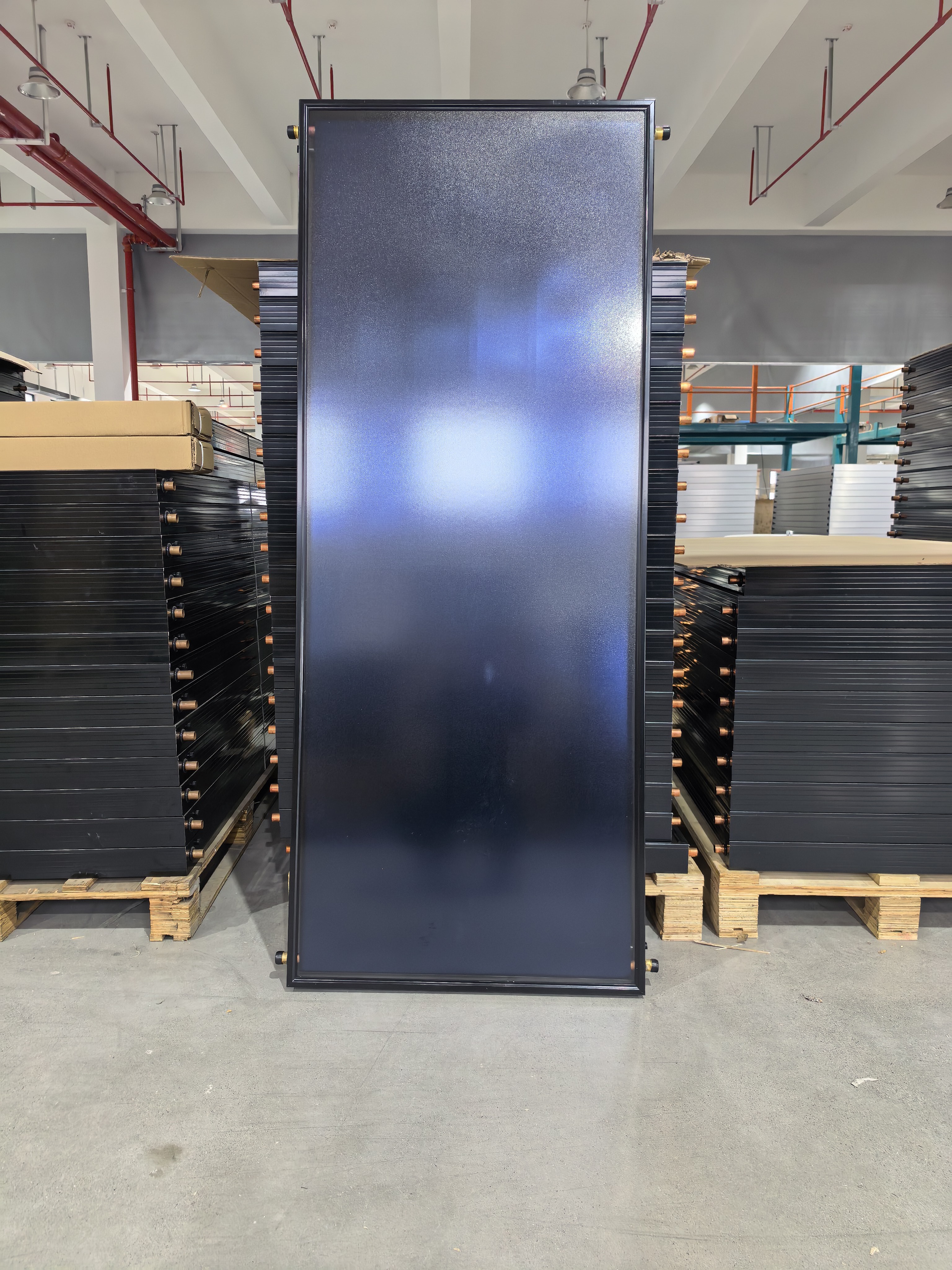
Flat plate collectors are one of three collector families used in hotel hot water systems. Selection depends on climate, water quality and available roof area.
Problem Definition: Why Hotel Solar Systems Fail on Paper Before They Fail on the Roof
Most 80-room solar hot water problems are specification problems. The equipment performs as designed; the design simply did not describe the hotel’s actual load. Solar fraction, storage volume and backup capacity are interdependent — change one and the other two move.
Six failure patterns account for most of the rework on commercial solar thermal projects:
- Collector field sized on a sunny-day assumption. A field calculated from clear-sky irradiation underperforms in monsoon, winter or harmattan months when the hotel is still selling rooms.
- Storage chosen by catalogue convenience. Picking a fixed tank size instead of deriving volume from the peak-hour draw forces the electric element or heat pump to run during exactly the hours guests notice.
- Direct and indirect circuits not separated. Where water is hard or aggressive, an indirect system that keeps the collector fluid separate from the domestic water is a specification decision, not an accessory.
- Mounting angle and roof load left unverified. Roof load-bearing requirements, water quality treatment and freeze protection for winter are common project concerns that should be defined per project location and design.
- Backup integration deferred to the installer. Building solar systems are normally paired with electric heaters or heat pumps for backup and compensation; leaving that decision to the mechanical contractor produces inconsistent performance.
- Supplier capability never verified. A technically correct specification from a supplier that cannot produce or ship on schedule delays the entire project.
Each of these is resolved by the same discipline: derive the numbers from the load first, then match components to those numbers.
Industry Background: What the Solar Thermal Market Looks Like Now
Solar thermal is not a pilot technology in the hotel segment. The global solar water heater market was valued at USD 4.2 billion in 2025, according to Fortune Business Insights. By the end of 2023, cumulative global solar heat capacity had reached 560 GWth, covering 800 million m² of collector area, based on the IEA Solar Heating & Cooling Programme’s Solar Heat Worldwide 2024 report.
Collector technology mix matters for hotel projects specifically. Evacuated tube collector technology led the market with a 44.2% revenue share in 2023, according to Grand View Research — and hotels, schools and clinics are the segments where evacuated tube collectors are typically chosen for their ability to hold temperature under high draw.
Two regulatory and trade signals deserve attention from importers:
- Tariff classification. HS Code 841912 was introduced to differentiate solar water heaters from the generic 841919 code, as reported by Solar Heat Europe. Importers specifying solar thermal equipment should confirm the correct code on commercial documents.
- Efficiency regulation. New U.S. Federal energy conservation standards for consumer water heaters took effect on July 5, 2024, with compliance required by 2029, per the Federal Register / U.S. Department of Energy. Efficiency requirements are tightening, which raises the value of a properly sized solar fraction.
Where a solar thermal system replaces gas or electric heating, the documented operating benefit is substantial: Kesun’s comparison data records a 50–65% solar fraction for its evacuated-tube systems, reducing operational energy consumption by 40–70% versus gas and electric water heaters.
Detailed Solution: Building the Correct Configuration for 80 Rooms
Sizing follows the components, not the other way round. Collector type determines what the roof can deliver; tank type determines how much of that delivery can be stored; configuration determines how the two connect to the hotel’s existing plant.
Step 1 — Select the collector family
Three collector families cover the commercial hotel range:
- HSC series heat-pipe evacuated tube solar collector. 10 to 30 tubes per unit, using a 58-1800 vacuum tube with heat pipe, an aluminium alloy frame, and aluminium alloy, copper and glass construction. Listed applications include villa, hotel, house heating, spa centre and school.
- FPC2.0 flat plate solar collector. Available in 1 m², 1.5 m², 2 m² and 2.5 m² sizes with 80 mm thickness, built from copper and aluminium alloy. Listed applications are swimming pool, housing heating and solar water heater systems.
- PV Series PV solar water heater. 100 to 500 L capacity, 600 W per panel power input, 800 W to 3,500 W heating output, MPPT controller and DC/AC automatic switch, with Duplex 2205 / Inox 316L wetted parts. The PVT / hybrid route is suited to projects that need both power generation and hot water.
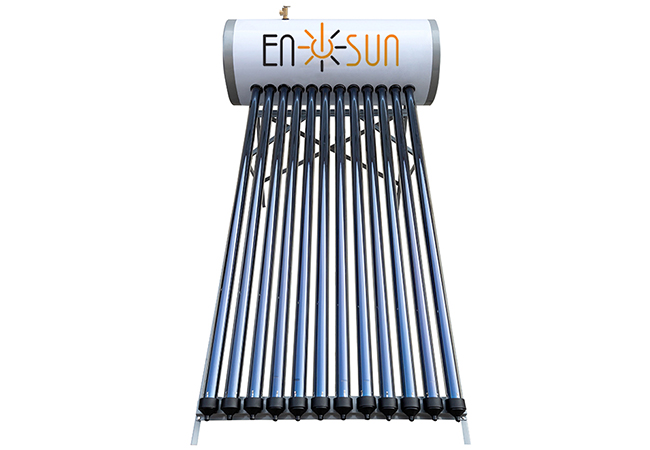
Pressurized solar water heaters keep the storage tank under mains pressure, which is what allows a hotel system to deliver balanced hot water at every fixture.
Step 2 — Match the storage and system type
Once the collector family is fixed, the system type determines pressure behaviour and water quality tolerance:
- CPS series high-pressure solar geyser: 100 L to 300 L, maximum operating pressure 6 bar, test pressure 9 bar, 58-1800 vacuum tube with heat pipe absorber, 50 mm PU foam insulation, mounting angle 25 to 45 degrees, available in SS304, SS316, Duplex 2205 and Duplex 32001.
- CPS-FJ series indirect solar water heater: 150 L, 200 L, 250 L and 300 L capacities with a flat plate collector and an SPCC tank with enamel coating. Listed for villa, house, hotel and school use.
- CNP series non-pressure solar water heater: 60 L to 500 L, 58-1800 vacuum tube absorber, 50 mm PU foam insulation, 25 to 45 degree angle, SS304 or SS316 tank.
For hotel hot water projects, the recommended pairing is HSC series solar collectors with CPS-F-J or CPS series pressurized solar water heaters. Because the CPS and CPS-FJ ranges top out at 300 L per unit, an 80-room property is built from multiple units configured as a bank rather than a single vessel — which is exactly where configuration flexibility becomes a commercial issue.
Step 3 — Confirm the customization envelope
Tank capacity and collector combination are the two variables most often fixed too early. Across the Kesun ranges, tank capacity can be specified from 60 L to 500 L depending on system type:
- 60–500 L — CNP series non-pressure
- 100–300 L — CPS series high-pressure geyser
- 150–300 L — CPS-FJ series indirect
- 100–500 L — PV series
Collector combinations scale in parallel. HSC series collectors run from 10 to 30 tubes per unit, and FPC2.0 flat plate collectors are available in four sizes from 1 m² to 2.5 m². Tank materials can be specified in SS304, SS316, Duplex 2205 or Duplex 32001, which lets the specification respond to local water chemistry instead of assuming it.
Step 4 — Decide direct, indirect or hybrid
The choice is driven by water quality and by whether the site needs electricity as well as heat. An indirect system keeps the collector circuit separate from the domestic water, which is the usual answer where water quality treatment is a project concern. A PVT / hybrid system is the right route where a project needs both power generation and hot water. In both cases the solar loop is normally paired with electric heaters or heat pumps for backup and compensation, with the control strategy defined per model and per project design.
Step 5 — Address the project-level risks explicitly
Corrosion-resistant materials, water quality treatment, freeze protection for winter and roof load-bearing requirements are common concerns on commercial solar projects. They should be defined per project location and design rather than handled by default selections.
Step-by-Step Breakdown: The Sizing Workflow for an 80-Room Property
The workflow below is the sequence applied when configuring a commercial hotel system. It is deliberately ordered so that no component is selected before the load is known.
- Establish daily hot water demand. Base it on room count, expected occupancy, in-room fixtures, laundry and food-and-beverage operations — using metered data from a comparable property or the local design code rather than a rule of thumb.
- Establish the load profile, not just the total. Identify peak draw windows. A tank that covers daily volume but not peak-hour delivery will still trigger the backup heater.
- Assess the solar resource and the roof. Irradiation, shading, orientation, mounting angle, freeze exposure and roof load-bearing. Kesun collectors are specified with mounting angles between 25 and 45 degrees, so roof pitch and frame design have to be settled early.
- Convert demand into collector area, then into collector count. Daily energy demand divided by the daily yield per collector gives the field size; yield depends on local irradiation and the required temperature rise, so the calculation is location-specific.
- Convert peak-hour demand into storage volume, then select the tank model. This is where the 60–500 L capacity range, and the choice between 100–300 L pressurized and 150–300 L indirect units, is resolved.
- Fix the configuration. Direct or indirect circuit, number of tank units banked together, and circulation mode — passive thermosiphon or forced circulation with pumps.
- Specify backup and controls. Electric backup or heat pump linkage, plus the circulation pumps, controllers, valves, mounting frames and piping accessories that tie the solar loop into the existing plant.
- Verify supplier capacity and delivery before the tender closes. Kesun manufactures at a rate of 25,000 units per month, with standard lead times of 20–35 days for commercial orders. Commercial terms for hotel-scale orders are an MOQ of one 40 ft container, FOB or CIF delivery, pre-shipment inspection before loading as the acceptance criterion, and TT payment in advance.

Production for commercial orders runs from the 42,000 m² facility in Haining, Zhejiang, at 25,000 units per month with 20–35 day lead times.
Use Cases: Where This Configuration Fits
80-room hotel, Southeast Asia. A documented system configuration designed for an 80-guest-room property in Southeast Asia uses the HSC collector and pressurized storage combination described above. The project’s relevance is structural rather than climatic: high occupancy, year-round demand, and a roof that competes with other building services.
Spa centres and resorts. HSC series collectors list spa centre among their applications, where continuous draw and higher water temperatures put pressure on collector performance.
Schools and smaller hotels. Both the CPS pressurized and CNP non-pressure ranges list school and small hotel applications, and the more economical non-pressure configuration remains viable where mains pressure is not a constraint.
Swimming pools and housing heating. FPC2.0 flat plate collectors list swimming pool and housing heating applications, where large volumes at moderate temperatures are the requirement.
Off-grid and camp installations. The PV series operates with a DC/AC automatic switch and an MPPT controller, which suits apartment, villa and camp sites where grid supply is intermittent.
Agricultural and process hot water. Solar thermal systems in this class also serve agricultural and livestock hot water systems and industrial process hot water applications, where the load is predictable and the payback calculation is straightforward.
Comparison Table: Collector and System Options Side by Side
The tables below compare only documented product data, so that a specification can be checked line by line.
| Collector family | Kesun model | Documented specification | Listed applications |
|---|---|---|---|
| Heat-pipe evacuated tube | HSC series | 10–30 tubes; 58-1800 vacuum tube with heat pipe; aluminium alloy frame; aluminium alloy, copper, glass | Villa, hotel, house heating, spa centre, school |
| Flat plate | FPC2.0 | 1 m², 1.5 m², 2 m², 2.5 m²; 80 mm thickness; copper and aluminium alloy | Swimming pool, housing heating, solar water heater |
| PV / hybrid | PV Series | 100–500 L; 600 W per panel input; 800–3,500 W heating output; MPPT controller; DC/AC automatic switch; Duplex 2205 / Inox 316L | Villa, house, apartment, camp |
| System type | Model | Capacity | Pressure & build | Materials |
|---|---|---|---|---|
| High-pressure solar geyser | CPS series | 100–300 L | Max 6 bar operating, 9 bar test; 58-1800 heat pipe tube; 50 mm PU foam; 25–45° | SS304 / SS316 / Duplex 2205 / Duplex 32001 |
| Indirect solar water heater | CPS-FJ series | 150 / 200 / 250 / 300 L | Flat plate collector; indirect circuit | SPCC with enamel coating |
| Non-pressure solar water heater | CNP series | 60–500 L | 58-1800 vacuum tube; 50 mm PU foam; 25–45° | SS304 / SS316 |
| Heating technology | Documented efficiency | Cost and lifecycle note |
|---|---|---|
| Evacuated-tube solar (Kesun) | 50–65% thermal conversion efficiency; 50–65% solar fraction | Higher initial investment than gas or electric; 4–7 year payback; 40–70% lower operational energy versus gas-electric heaters |
| Gas water heater | 50–70% heat utilisation rate | Used as the operational-energy comparison baseline |
| Electric water heater | 90–95% conversion efficiency | Relies on grid power, which is the high-cost input |
| Heat pump | COP 2–4 | Performance depends on ambient air temperature; solar shows lower full-lifecycle cost under stable solar-radiation conditions |
Long-Term Supply: What Continuity Looks Like Over a Service Life
For a hotel, the collector field is a twenty-year asset and the supplier relationship usually outlives the installer. Zhejiang Kesun New Energy Co., Ltd. was established in 2009 and has more than 15 years of experience in the solar energy industry. The company was formed by merging Haining Ensun Solar Technology Co., Ltd., which focused on non-pressure solar water heaters, with Zhejiang Yile New Energy Co., Ltd., which specialized in pressurized solar water heaters — a consolidation that retained both product lines and added PVT systems, 2205 duplex stainless steel tanks and heat pipe solar collectors.
Reliability verification is handled in-house. The production facility in Haining, Zhejiang covers 42,000 m² and includes an in-house laboratory for salt spray testing, pulse testing and other reliability tests, alongside high-pressure automatic foaming machines, robotic packaging, and TIG, high-frequency, laser and butt welding processes.
For buyers assessing a long-term partner rather than a one-off order, the relevant indicators are scale and repeatability: 130 employees, a 15-engineer R&D team, 300,000 sets of annual output, 60% export ratio with main markets in Mexico, the EU and Africa, and component supply to Fortune 500 companies in China and abroad. Third-party profile data records annual export revenue of approximately USD 19.6 million (Alibaba Verified Profile).
Frequently Asked Questions
Which solar collector and water heater combination is suitable for a hotel hot water project?
HSC series solar collectors are matched with CPS-F-J and CPS series pressurized solar water heaters. This combined system is intended for hotels and commercial buildings that require stable, large-volume domestic hot water. The CPS pressurized range holds the tank under mains pressure, with a maximum operating pressure of 6 bar and a test pressure of 9 bar, while the CPS-FJ indirect range separates the collector circuit from the domestic water using a flat plate collector and an enamel-coated SPCC tank.
Can tank capacity and collector combinations be customized for an 80-room hotel?
Yes. Capacity ranges across the product lines are 60–500 L for the CNP series, 100–300 L for the CPS series, 150–300 L for the CPS-FJ series, and 100–500 L for the PV series. Collector combinations scale in parallel: HSC collectors carry 10 to 30 tubes per unit, and FPC2.0 flat plate collectors are available from 1 m² to 2.5 m². Tank materials can be specified in SS304, SS316, Duplex 2205 or Duplex 32001.
What are the purchasing terms and acceptance criteria for a commercial order?
The documented terms are: MOQ of 1 x 40 ft container; delivery terms FOB or CIF; acceptance criteria of pre-shipment inspection before loading; and payment terms of TT in advance.
What production capacity and lead time support a hotel-scale order?
Production capacity is 25,000 units per month, with commercial lead times of 20–35 days. Manufacturing runs from the 42,000 m² facility in Haining, Zhejiang, which supports 300,000 sets of annual output with 130 employees and a 15-engineer R&D team. This is the basis on which an 80-room hotel order can be scheduled against a construction programme.
How do you identify a long-term solar water heater supplier in China?
Three indicators are checkable before an order is placed. Operating history: Kesun has been active in the solar energy industry since 2009, giving more than 15 years of experience. In-house verification: the Haining facility includes an in-house laboratory for salt spray and pulse testing, so reliability checks are not outsourced. Export continuity: 60% of output is exported, with main markets in Mexico, the EU and Africa, and components are supplied to Fortune 500 companies in China and abroad. Buyers who want to validate these points against a specific project can request the current catalogue and a configuration proposal covering collector count, tank capacity and bank arrangement.
Conclusion
An 80-room hotel hot water system is won or lost on three numbers: collector area, storage volume and backup capacity. Derive them from the load profile, then select the components that satisfy them — HSC series heat-pipe collectors with CPS-FJ or CPS pressurized storage for a hotel of this size, or FPC2.0 flat plate collectors where pool or housing heating is the primary load, and the PV series where the site also needs hybrid power generation.
The commercial side deserves the same scrutiny as the engineering side. A specification is only as good as the supplier’s ability to repeat it: 25,000 units per month of production capacity, 20–35 day lead times, pre-shipment inspection before loading, and a manufacturing base that has been building solar thermal products since 2009.
Next Step
Send the room count, project location, roof constraints and water conditions, and Kesun Solar will return a configuration proposal covering collector count, tank capacity, bank arrangement and backup strategy for your property.
Website: www.kesunsolar.com | Blog: blog.kesunsolar.com
Contact: Alan | Email: alan@ensunchina.com | Tel: +86 135-8643-2400 | WhatsApp: +86 13586432400
Address: No. 11 Yongtao RD, Jianshan New District, Haining City, Zhejiang Province, China
Catalogue: Download the 2025 product catalogue (PDF)
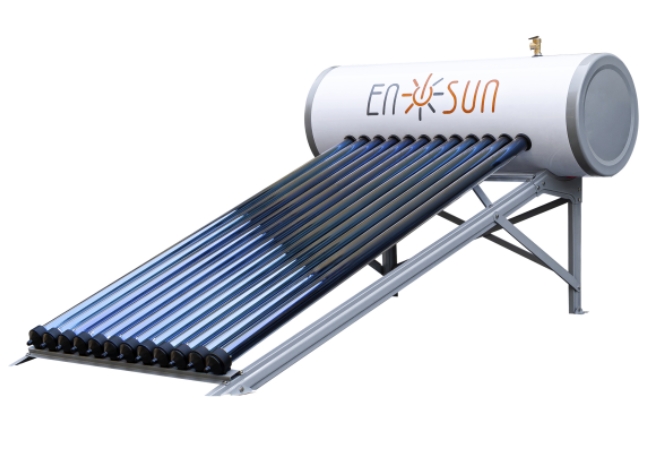
Pressurized solar water heater units can be banked and configured against a specific hotel load profile before order confirmation.