
Solar Hot Water Solutions for Southeast Asian Hotels: A Deployment Guide
Deploying a solar water heater system in a Southeast Asian hotel is a constraint-matching exercise, not a catalogue purchase. The workable configuration pairs a heat-pipe vacuum tube or flat plate collector field with pressurized storage and a defined auxiliary heat source, then commissions the whole assembly against constant-temperature demand from guest rooms and public bathing areas. In the documented hotel case referenced throughout this guide, a complete solar hot water system serving 80 guest rooms replaced electric and gas heating, reduced electricity and gas costs by more than 40%, and is rated for a stable service life of more than 15 years.
Problem Definition: Hotel Hot Water Is a Constraints Problem
A hotel does not buy hot water in a steady stream. Demand concentrates in early-morning and evening windows, is amplified by public bathing areas, and is judged by guests on one variable only: whether the water arrives at a constant temperature. That load profile collides with three operational realities common to properties across Southeast Asia.
- High energy costs and unstable supply. Domestic hot water is one of the few hotel loads that runs every day of the year regardless of occupancy forecasts. When electricity or gas prices move, or when grid supply is interrupted, the DHW plant becomes the most exposed line in the operating budget.
- A hot-rainy climate that attacks materials. Heat collection modules must resist corrosion and weather exposure in humid, high-rainfall conditions. A collector field specified for a dry temperate market is the wrong starting point.
- Site constraints that are decided before equipment is chosen. Roof load-bearing capacity, available plant room area, pipe routes, water quality and the position of existing electric or gas heating equipment all constrain what can be installed. Water quality treatment and corrosion-resistant materials are standard project concerns, and they must be defined per site rather than assumed.
The failure mode is therefore predictable. A hotel buys collectors and tanks as separate items, installs them without a defined hydraulic concept, and discovers during the first peak season that storage, backup heating and control logic do not cover the load. The deployment guide below exists to prevent that sequence.
Industry Background: A Mature Technology Moving Into Deployment Discipline
Solar thermal is no longer an emerging category, which changes what a hotel project actually needs from a supplier. According to Fortune Business Insights, the global solar water heater market was valued at USD 4.2 billion in 2025. The IEA Solar Heating & Cooling Programme reports that cumulative global solar heat capacity reached 560 GWth by the end of 2023, covering 800 million m² of collector area. Grand View Research recorded that evacuated tube collector technology led the market with a 44.2% revenue share in 2023.
Trade documentation has matured alongside the hardware. Solar Heat Europe notes that HS code 841912 was introduced specifically to differentiate solar water heaters from the generic 841919 code. For an importer or project buyer in Southeast Asia, that distinction is practical: it determines how the shipment is classified, and therefore how the equipment is described in the purchase and customs file.
The consequence for hotels is a shift in the buying question. The question is no longer whether solar thermal works; it is whether a given supplier can deliver a configured system with traceable certification, a defined auxiliary heat strategy and a commissioning sequence that a hotel engineering team can operate. Zhejiang Kesun New Energy Co., Ltd. — the manufacturer behind the Kesun Solar brand, based in Haining City, Zhejiang Province, China — builds its hotel offer around that deployment logic, combining vacuum tube collectors, flat plate collectors, pressurized and indirect storage, and PV-assisted water heating from a 42,000 m² manufacturing facility.
Detailed Solution: What a Complete Hotel System Contains
Layer 1 — The Collector Field
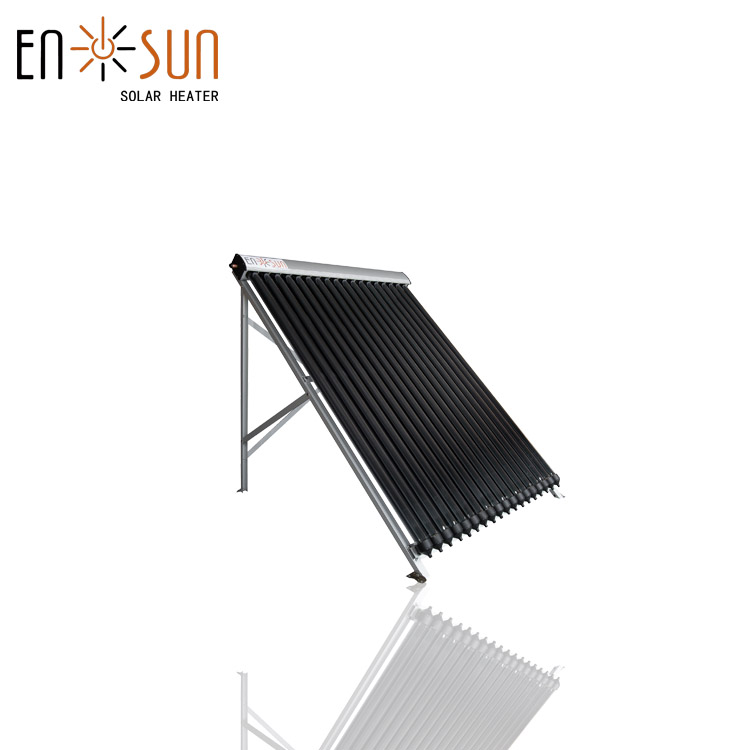
The HSC series solar collector is the vacuum tube option used for hotel and commercial hot water. It is supplied with 10 to 30 tubes per unit, uses a 58-1800 vacuum tube with heat pipe, and is framed in aluminum alloy. It is certified to Solar Keymark by DIN CERTCO under certificate number 011-7S3325 R for models HSC10, HSC12, HSC15, HSC16, HSC18, HSC20, HSC24, HSC25 and HSC30, and it is covered by the PED verification of conformity ICR/VC/HM2605327.
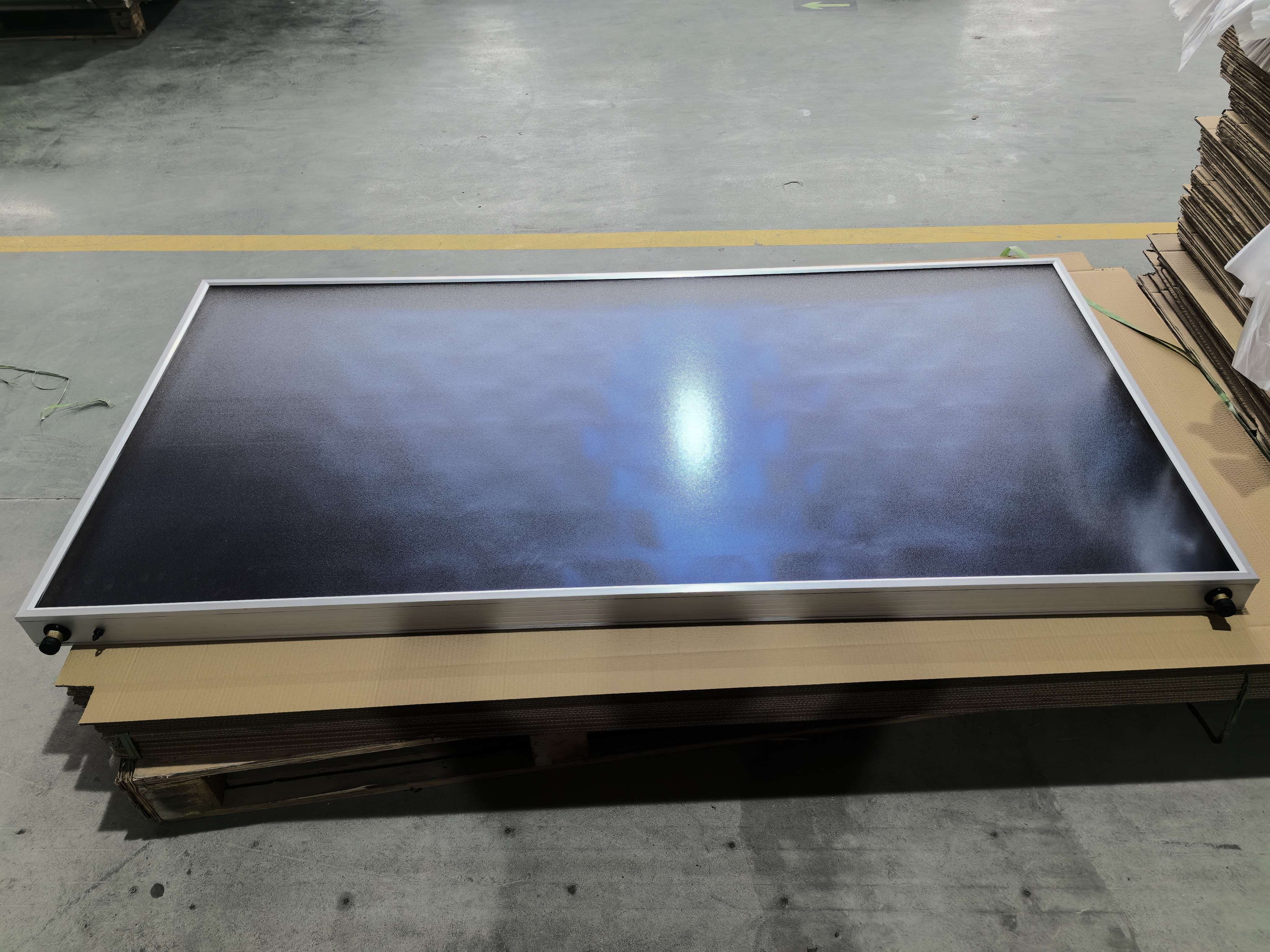
Where a flat plate array is preferred for architectural or roof-layout reasons, the FPC2.0 flat plate solar collector is available in 1 m², 1.5 m², 2 m² and 2.5 m² sizes at 80 mm thickness, built from copper and aluminum alloy, with Solar Keymark certification 011-7S3241 F issued by DIN CERTCO and validity to 2030-04-30. Kesun Solar's own product guidance pairs the HSC series collectors with CPS-FJ and CPS series pressurized solar water heaters for hotel and commercial buildings requiring stable, large-volume domestic hot water.
Layer 2 — Pressurized Storage
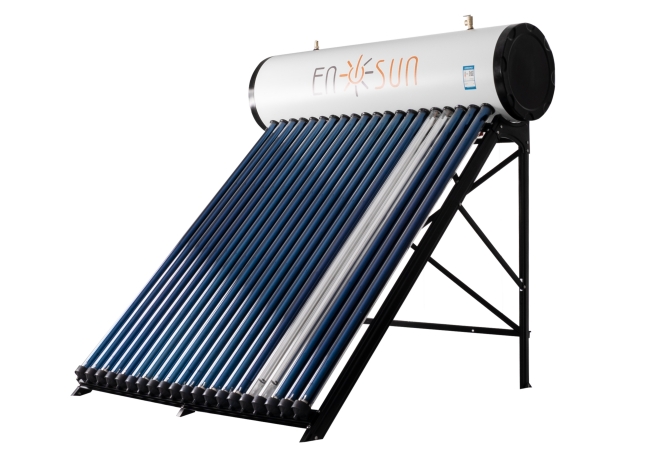
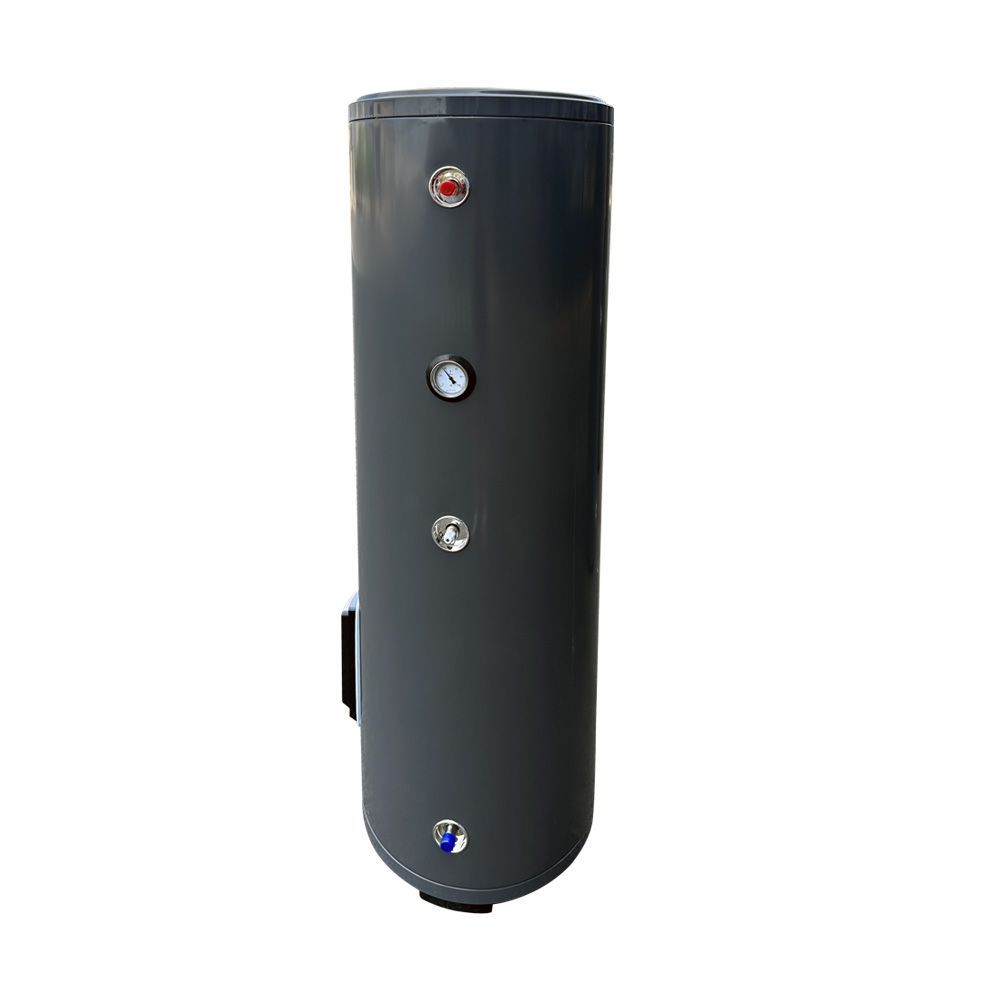
Storage determines whether the collector field's output survives until the evening peak. The CPS series solar water heater is available in 100 L, 150 L, 200 L and 300 L capacities, operates at a maximum pressure of 6 bar with a 9 bar test pressure, uses a 58-1800 vacuum tube with heat pipe as absorber, carries 50 mm PU foam insulation and is mounted at an angle of 25 to 45 degrees. The inner tank is food-grade stainless steel, selectable in SS304, SS316, Duplex 2205 or Duplex 32001, with a galvanized steel outer tank. The series is Solar Keymark certified under 011-7S3077 A (DIN CERTCO, valid to 2029-06-30), holds the LVD+EMC verification of conformity ICR/VC/HM2605326, and is covered by Intertek type examination test reports to EN 12897:2016+A1:2020 for the PWT200 (251023056GZU-001) and PWT300 (251023056GZU-002) storage tanks.
Two practical properties matter at deployment. The CPS series has no moving parts, which is the basis of its low-maintenance claim. And the stainless steel construction provides corrosion resistance — the variable that decides service life in a humid coastal or monsoon-exposed plant room.
Layer 3 — Indirect Storage Where Water Chemistry Demands It
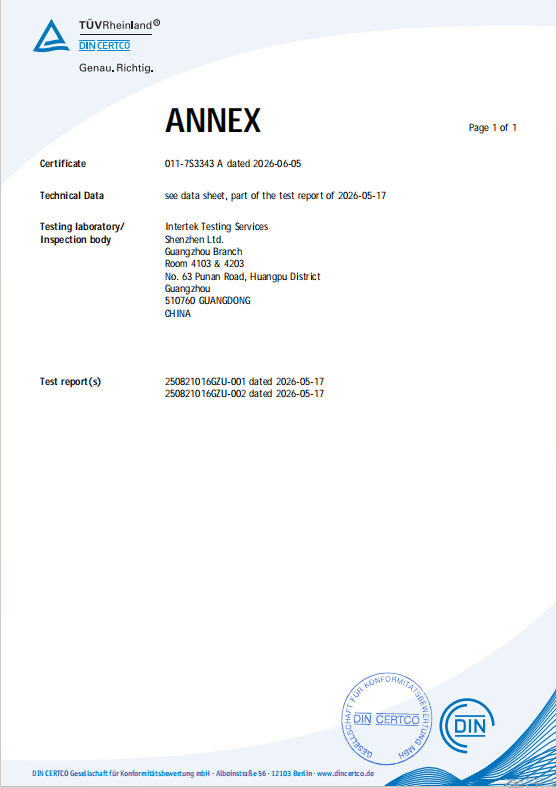
The CPS-FJ series solar water heater uses a flat type solar collector with a 150 L, 200 L, 250 L or 300 L tank made of SPCC with enamel coating. It can be fixed with anti-freezing heat transfer media, which is the correct specification when the primary loop must be sealed and separated from the potable circuit. It is Solar Keymark certified under 011-7S3343 A, and OEM is available.
Layer 4 — Auxiliary Heat and Control
Solar covers the base load; the auxiliary source covers consecutive cloudy days and peak draw. Kesun Solar's documented hotel configuration supports auxiliary regional heating alongside all-day domestic hot water supply, and the underlying application design pairs solar heat generation and storage with electric heaters or heat pumps for backup and compensation. Control strategy depends on model and project design — a point that must be resolved on the drawing, not on the datasheet.
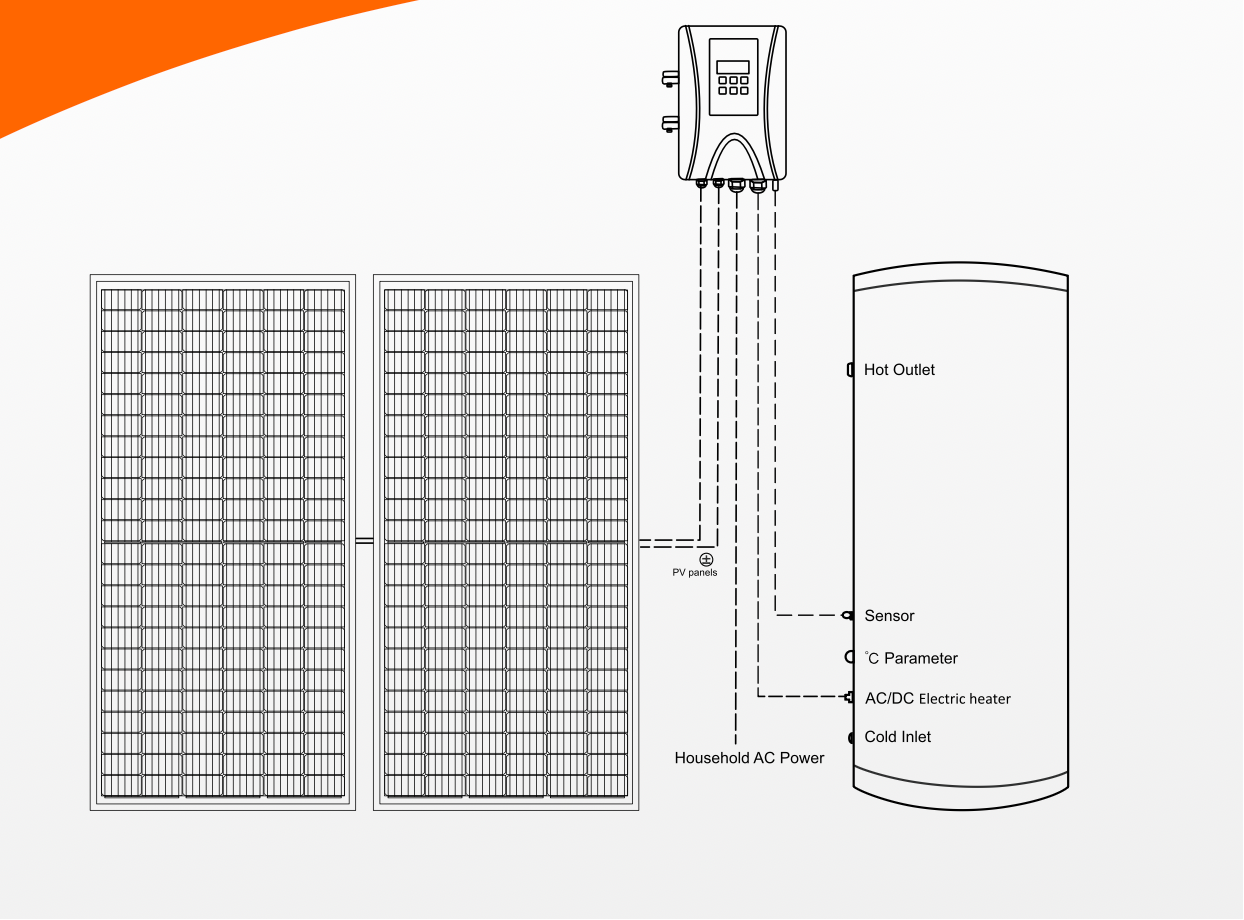
A PV-assisted path is available where the site wants solar electricity to contribute directly to heating. The PV Series solar water heater covers 100 to 500 L, takes 600 W per solar panel as power input, delivers 800 W to 3500 W of heating output, uses a controller with Maximum Power Point Tracking and supports automatic switching between DC and AC power. It is CE certified and built in Duplex 2205 or Inox 316L.
Step-by-Step Breakdown: Deploying the System in an Operating Hotel
The sequence below is the deployment order that keeps a hotel project from stalling between equipment delivery and commissioning. Each step produces a document the next step depends on.
- Survey the load and the constraints together. Record guest room count, public bathing area demand, peak draw windows, the existing electric or gas heating equipment, available roof area, structural load-bearing capacity, plant room space, pipe routes and water quality. Roof load-bearing and water quality treatment are project-level determinations and should be written into the survey, not deferred to the installer.
- Fix the hydraulic concept. Decide between direct and indirect circulation, and between passive thermosiphon and forced circulation with pumps. This single decision determines whether the project uses CPS series pressurized cylinders, CPS-FJ indirect cylinders with anti-freezing heat transfer media, or a combination.
- Select the collector family against the roof, not the brochure. Heat pipe vacuum tube HSC collectors and flat plate FPC2.0 collectors have different mounting profiles, weights and area footprints. Match the family to the roof geometry and to the maintenance access the hotel can actually provide.
- Size storage to the peak, not to the average. CPS series storage is available from 100 L to 300 L per unit; the number of units, not the unit size, is the deployment variable for an 80-room property. Confirm the pressure class — 6 bar working, 9 bar test — against the building's actual supply pressure.
- Define the auxiliary heat logic before ordering. Specify the backup source, the set-point at which it engages, and the sensor positions. Electric backup and heat pump linkage are both supported; the choice belongs to the project design.
- Specify the corrosion package against site conditions. Select SS304, SS316, Duplex 2205 or Duplex 32001 for the inner tank according to water chemistry, and confirm the aluminum alloy collector frame and galvanized outer tank against the coastal or high-rainfall exposure of the property.
- Plan mounting, piping and insulation as one scope. Circulation pumps, controllers, valves, mounting frames and piping accessories form the balance of system and must be defined per project. The integrated design of Kesun Solar's hotel system is intended for straightforward installation and low-cost maintenance, but the pipe route still has to be surveyed on site.
- Commission against measured outlet temperature. Verify constant-temperature delivery at the furthest guest room outlet and at the public bathing area, confirm auxiliary switchover, and record the results. Smart temperature adjustment is part of the documented hotel system behaviour and should be demonstrated to the engineering team at handover.
- Hand over the documentation pack and the operating routine. The pack includes the Solar Keymark certificates, the LVD+EMC and PED verifications of conformity, and the Intertek EN 12897 test reports. Because the CPS series has no moving parts, the routine is inspection-based rather than repair-based, supported by remote after-sales support.
Deployment Constraint Checklist
- Roof load-bearing capacity and mounting frame layout confirmed in writing.
- Water quality tested; inner tank material selected from SS304, SS316, Duplex 2205 or Duplex 32001.
- Working pressure class verified against building supply (CPS series: 6 bar working, 9 bar test).
- Hydraulic concept fixed: direct or indirect, thermosiphon or forced circulation with pumps.
- Auxiliary heat source, set-points and sensor positions specified.
- Collector tilt set within the 25 to 45 degree range supported by the CPS series.
- Certification pack complete for the customs and project file.
Use Cases: Four Deployment Patterns
Pattern 1 — The 80-Room City Hotel Replacing Electric and Gas
This is the documented reference case. A complete solar hot water system supplies all-day domestic hot water to 80 guest rooms and the public bathing areas, supports auxiliary regional heating, and replaces traditional electric and gas heating equipment. After implementation the hotel cut electricity and gas costs by more than 40%. The system delivers constant-temperature hot water with minimal failures, which the case links to guest satisfaction, and it lowers carbon emissions for green-hotel compliance. Its stable service life is stated as more than 15 years — the figure that converts the capital decision into an operating-cost argument.
Pattern 2 — The Resort With Unstable Grid Supply
Where supply interruptions are a recurring risk, the deployment priority shifts from fuel substitution to continuity. A solar thermal field with pressurized storage and a defined auxiliary heat source keeps the DHW plant running through interruptions, with the auxiliary source absorbing consecutive low-irradiance days. The PV Series, with its automatic DC/AC switching and MPPT controller, is relevant where the property wants daytime solar energy to contribute directly to heating.
Pattern 3 — The Coastal Property With Aggressive Water
Corrosion and weather resistance are the deciding criteria on coastal sites. Specify the Duplex 2205 or Duplex 32001 inner tank option, confirm the aluminum alloy collector frame, and consider the CPS-FJ indirect cylinder with a sealed primary loop and anti-freezing heat transfer media to separate the solar circuit from the potable water. The documented hotel system's vacuum heat collection modules were selected for corrosion and weather resistance in Southeast Asia's hot-rainy climate.
Pattern 4 — The Retrofit That Keeps the Existing Boiler
Existing gas or electric heating equipment does not have to be removed on day one. Because solar systems are designed to be paired with electric heaters or heat pumps for backup and compensation, the legacy unit can serve as the auxiliary source while solar carries the base load. This pattern reduces installation downtime and lets the hotel measure savings before committing to further plant changes.
Comparison Table: Matching the Configuration to the Property
| Configuration | Collector / absorber | Storage and pressure | Certification evidence | Best fit | Watch-outs |
|---|---|---|---|---|---|
| HSC series collector + CPS series pressurized solar water heater | 58-1800 vacuum tube with heat pipe; 10 to 30 tubes per collector; aluminum alloy frame | 100 L, 150 L, 200 L, 300 L; 6 bar working, 9 bar test; 50 mm PU foam | Solar Keymark 011-7S3325 R (HSC) and 011-7S3077 A (CPS); LVD+EMC ICR/VC/HM2605326; PED ICR/VC/HM2605327; EN 12897 test reports PWT200 and PWT300 | Hotel and commercial projects requiring stable large-volume domestic hot water | Tube count and number of cylinders must be set per project; no universal sizing figure applies |
| CPS-FJ series indirect solar water heater | Flat type solar collector; SPCC tank with enamel coating | 150 L, 200 L, 250 L, 300 L; sealed primary loop possible with anti-freezing heat transfer media | Solar Keymark 011-7S3343 A; LVD+EMC verification of conformity applies; EN 12897 test reports PWT200 and PWT300 | Sites needing separation between the solar circuit and the potable water circuit | Indirect configuration adds a heat transfer step; design must confirm the loop volume |
| CNP series non-pressure solar water heater | 58-1800 vacuum tube; SS304 or SS316 | 60 L to 500 L; non-pressure (thermosiphon) design | Solar Keymark 011-7S3239 A; LVD+EMC verification of conformity applies | Small hotels, schools, villas and low-pressure applications | Not a substitute for pressurized storage where mains-pressure delivery is required |
| PV Series PV solar water heater | PV panel input at 600 W per panel; heating output 800 W to 3500 W | 100 L to 500 L; Duplex 2205 or Inox 316L | CE certified; controller with Maximum Power Point Tracking; automatic DC/AC switching | Properties wanting daytime solar electricity to contribute to heating | Adds an electrical design scope alongside the thermal scope |
| FPC2.0 flat plate collector field | Copper and aluminum alloy; 1 m², 1.5 m², 2 m², 2.5 m²; 80 mm thickness | Matched to selected storage; collector-level product | Solar Keymark 011-7S3241 F, valid to 2030-04-30; LVD+EMC verification of conformity applies | Roof layouts that favour a flat plate profile | Collector is one layer; storage and controls must still be specified |
Frequently Asked Questions
What certification evidence should a hotel solar hot water project hold?
A hotel project should be able to produce product-level certificates, not just a compliance statement. For the CPS series solar water heater, the evidence set includes Solar Keymark certification 011-7S3077 A issued by DIN CERTCO under standards DIN EN 12976-1:2017-04 and DIN EN 12976-2:2019-11, valid to 2029-06-30; the LVD+EMC verification of conformity ICR/VC/HM2605326 issued by ICR; the PED verification of conformity ICR/VC/HM2605327, valid to 2031-05-27; and Intertek type examination test reports to EN 12897:2016+A1:2020 for the PWT200 (251023056GZU-001) and PWT300 (251023056GZU-002) storage tanks. The HSC series collector holds Solar Keymark 011-7S3325 R, and the stainless steel inner tank is covered by Intertek performance test report 251230069GZU-001.
Which configuration suits an 80-room hotel with public bathing areas?
For hotel and commercial hot water projects requiring stable, large-volume output, the recommended combination is HSC series solar collectors paired with CPS-FJ and CPS series pressurized solar water heaters. The CPS series provides 100 L to 300 L cylinders with a 6 bar working pressure and 9 bar test pressure, and the CPS-FJ series provides 150 L to 300 L indirect storage where a sealed primary loop is needed. The number of collectors and cylinders is a project-level calculation based on room count, bathing area demand, peak draw windows and site conditions; auxiliary heating is then sized to cover the residual load.
What drives the cost of a hotel solar hot water deployment?
Cost is set by five variables: the collector field, the storage volume and pressure class, the auxiliary heat source (electric backup or heat pump linkage), the control and monitoring scope, and site works such as mounting frames, piping and insulation. These are configured per project, so a deployment budget is built from the survey rather than from a catalogue price list. The return side is documented: in the 80-room hotel case, replacing electric and gas heating with a complete solar hot water system cut electricity and gas costs by more than 40%, against a stable service life of more than 15 years.
How can a hotel validate the system before committing to a full rollout?
Validation happens on three levels. First, a configuration review against the survey, so collector family, storage volume, hydraulic concept and auxiliary heat logic are fixed in writing. Second, documentation review — Solar Keymark, LVD+EMC, PED and Intertek test reports — before any equipment is shipped. Third, factory quality evidence: Kesun Solar applies 100% testing in production, and the CPS series has no moving parts, so the maintenance model can be assessed from the design rather than from promises. Order quantities start at 1 x 40ft container, which allows a first property to be equipped as a reference installation.
What lead time and supply capacity apply to a hotel project?
Kesun Solar quotes a lead time of 20 to 35 days, with a monthly capacity of 25,000 units from a 42,000 m² facility in Haining City, Zhejiang Province, China, and a minimum order quantity of 1 x 40ft container. Production supports OEM, ODM and customization by capacity, type and system configuration, with remote after-sales support. Hotel projects can request a configuration review, certificate copies and product information from the Kesun Solar team — contact Alan at alan@ensunchina.com or +86 135-8643-2400 — and the full product range is documented in the ENSUN 2025 brochure.
Conclusion: Deploy in the Right Order
The difference between a solar hot water system that performs for 15 years and one that disappoints is rarely the collector. It is the order of decisions. Survey the load and the physical constraints first. Fix the hydraulic concept — direct or indirect, thermosiphon or forced circulation — before selecting hardware. Match the collector family to the roof, size storage to the peak rather than the average, and write the auxiliary heat logic into the design instead of discovering it in the first rainy week. Then commission against measured outlet temperature and hand over a complete documentation pack.
For Southeast Asian hotels, the case for this discipline is already on record: an 80-room property replaced electric and gas heating with a complete solar hot water system, cut electricity and gas costs by more than 40%, and gained constant-temperature hot water with minimal failures and a stable service life of more than 15 years. The deployment guide above is the route to repeating that result on the next property.
Plan Your Hotel Deployment With Kesun Solar
Zhejiang Kesun New Energy Co., Ltd. manufactures solar water heaters, buffer tanks, domestic hot water tanks and hybrid solar panels in Haining City, Zhejiang Province, China, and exports to markets including Mexico, the EU and Africa. Share your room count, bathing area demand and site constraints to receive a configuration review for your property.
Email: alan@ensunchina.com | Tel: +86 135-8643-2400 | WhatsApp: +86 13586432400
Address: No. 11 Yongtao RD, Jianshan New District, Haining City, Zhejiang Province, China | Website: www.kesunsolar.com
Download the ENSUN 2025 product brochure (PDF).
Have Questions or Need More Details?
Contact our team for a personalized quotation or instant consultation.
Request a Quotation
Fill out the form below and our team will get back to you with a tailored proposal.
WhatsApp Direct Chat
Prefer to chat in real-time? Message us on WhatsApp for instant assistance & quick answers.
- Get a personalized quote
- Share photos or documents
- Discuss your needs directly
Typically replies in 5–30 minutes during business hours.