Solar Water Heater Types and Selection Guide for Homes and Businesses
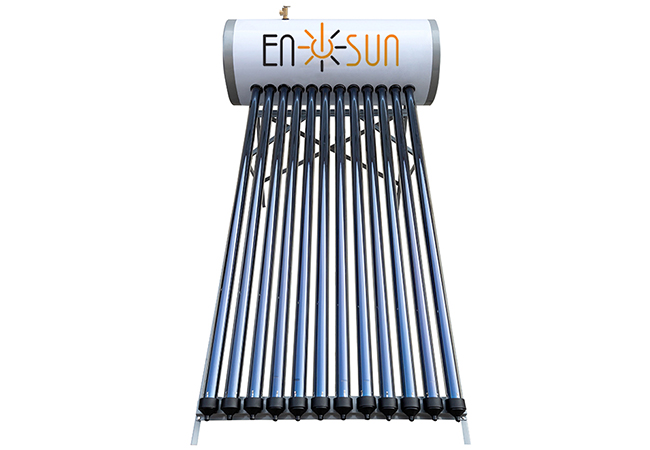
Solar water heaters — also called solar geysers, solar thermal systems, or solar hot water heaters — capture sunlight with a solar collector and transfer the heat to water stored in a tank. They can be paired with an electric heater, DHW boiler, heat pump tank, or other backup source when sunlight is insufficient. For a homeowner, importer, engineer, or commercial specifier, the most important task is not simply finding a product called a solar water heater; it is finding the right combination of collector, tank, pressure rating, and control logic for the building and the climate.
This article focuses on the main solar water heater product families, what they do, where they are best used, and the practical selection criteria that should be part of any buying decision. The examples are drawn from the product range of Zhejiang Kesun New Energy Co., Ltd., a China-based manufacturer of solar water heaters, buffer tanks, domestic hot water tanks, and hybrid solar panels.
Why Choosing a Solar Water Heater Is Not Always Simple
The term solar water heater covers several different configurations. Some units are compact and operate without mains pressure. Others are pressurized solar geysers connected directly to the incoming water supply. Some systems use a separate solar collector mounted on the roof and a storage tank installed indoors or on the roof. Others use photovoltaic modules to power an electric heating element inside a tank.
This is why a buyer who searches for a solar water heater should define the actual site conditions before looking at capacity:
- Water pressure: A house with a gravity water tank may use a non-pressure solar water heater, while a building with mains-pressure plumbing normally needs a pressurized vessel.
- Water quality: Salty or hard water can affect tank corrosion resistance and service life. Some indirect tanks use enamel-coated steel specifically for challenging water.
- Climate and freeze risk: Winter regions generally need a safe freeze-protection strategy, such as an indirect circuit with anti-freezing heat transfer media.
- Roof structure: Roof orientation, available space, and load-bearing capacity affect collector area, mounting frame, and tank placement.
- Backup and integration: The solar heater may need to work with an existing combi boiler, heat pump buffer tank, or electric backup element.
Selecting the right solar heating system therefore involves not one specification but a set of decisions about collector type, tank material, pressure, and system architecture.
Solar Water Heating Market and Industry Background
Solar thermal is a mature renewable heat technology with substantial global deployment. According to the IEA Solar Heating & Cooling Programme report Solar Heat Worldwide 2024, cumulative global solar heat capacity reached 560 GWth by the end of 2023, corresponding to about 800 million square meters of installed collector area. Market research from Grand View Research further shows that evacuated tube collector technology led the global solar water heater market with a 44.2% revenue share in 2023. Fortune Business Insights estimated the global solar water heater market at USD 4.2 billion in 2025.
This background matters for procurement because it explains why buyers encounter many different system designs. Evacuated tube systems are widely used because they perform well in many climates, while flat plate collectors are popular for pool heating and building-integrated solar water heaters. Hybrid approaches that combine solar heat with heat pumps or photovoltaic power are also becoming more common in product planning.
Detailed Guide to Solar Water Heater Product Types
The following product families demonstrate how a manufacturer structures its solar water heater portfolio around real project needs.
CNP Series: Non-Pressure Solar Water Heater
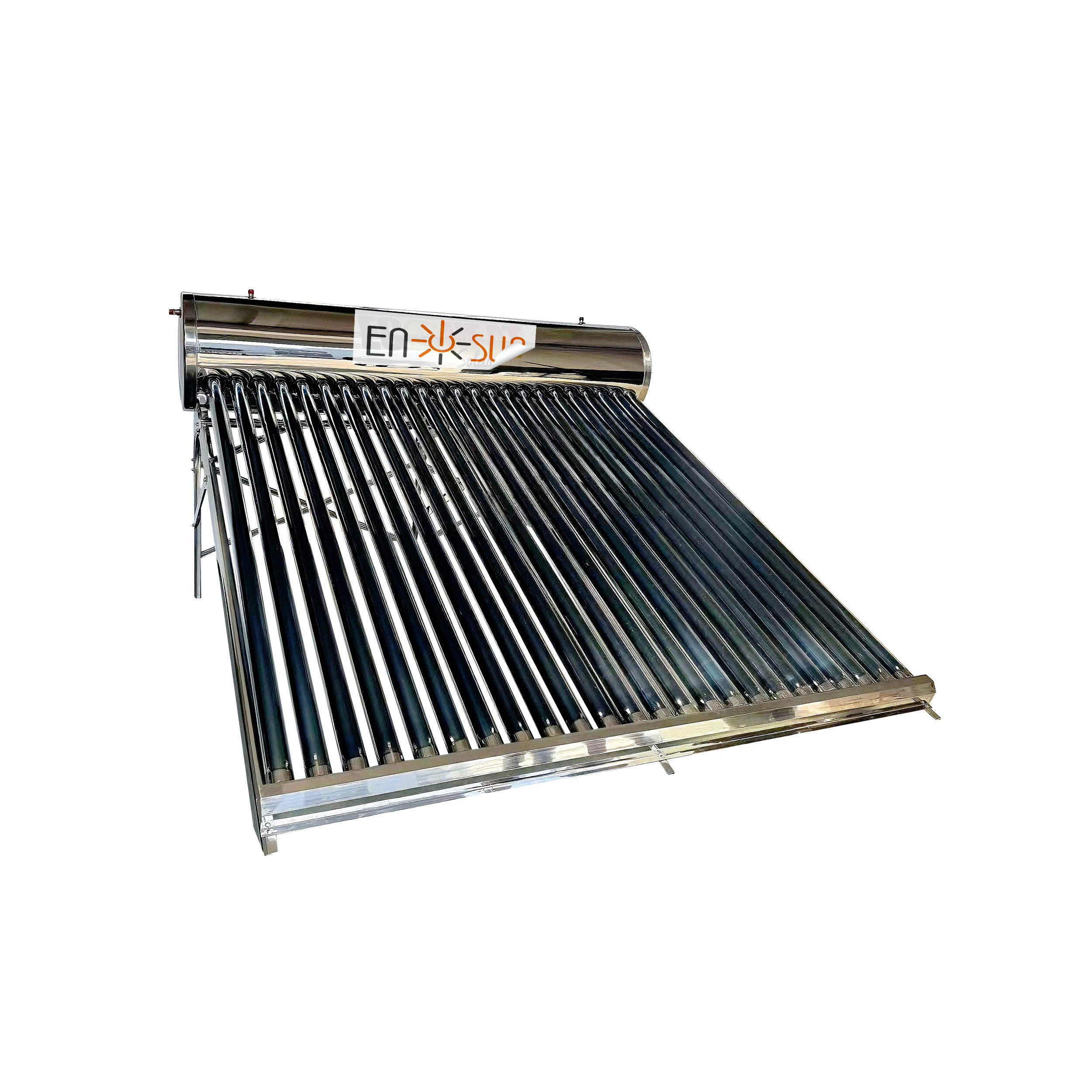
The CNP series is a non-pressure solar water heater, a configuration often used where the tank feeds outlets through gravity rather than high mains pressure. Kesun offers the CNP series in capacities from 60 L to 500 L. It uses a 58-1800 vacuum tube absorber, 50 mm PU foam insulation, and is designed for installation angles between 25 and 45 degrees. The tank material options include stainless steel grades such as SS304 and SS316 depending on the specification.
According to the product literature, the CNP series is intended for houses, villas, gardens, gas stations, car wash centers, small hotels, and schools. It can be customized in material and design, which makes it a practical option for OEM buyers looking for a simple, low-maintenance solar geyser.
CPS Series: High-Pressure Solar Geysers
The CPS series is a high-pressure solar geyser designed for housing and commercial sectors, including houses, villas, small hotels, and schools. It is available in capacities from 100 L to 300 L, with a maximum operating pressure of 6 bars and a test pressure of 9 bars. The absorber is a 58-1800 vacuum tube with heat pipe, and the tank insulation is 50 mm PU foam.
One of the most useful practical features of the CPS series is that the system has no moving parts, which results in low maintenance requirements. The tank can be manufactured in stainless steel grades depending on the project, and the product platform supports customization according to buyer needs. For a homeowner or hotel operator with reliable mains pressure, a high-pressure solar geyser is often more convenient than a non-pressure tank because it can serve normal pressurized taps and showers.
CPS-FJ Series: Indirect Solar Water Heater with Flat Collector
The CPS-FJ series is an indirect solar water heater that works with a flat type solar collector. The tank is made of SPCC steel with enamel coating, and the range is available in 150 L, 200 L, 250 L, and 300 L capacities. Enamel-coated tanks are often specified for salty water or water with corrosive chemistry because the coated inner surface protects the steel.
The CPS-FJ series is intended for villa, house, hotel, and school applications. Because it is designed as an indirect system, it can be filled with anti-freezing heat transfer media. This makes the CPS-FJ configuration relevant for projects in colder regions where a direct water-to-tank arrangement would create freeze risk.
HSC Series: Heat Pipe Solar Collector
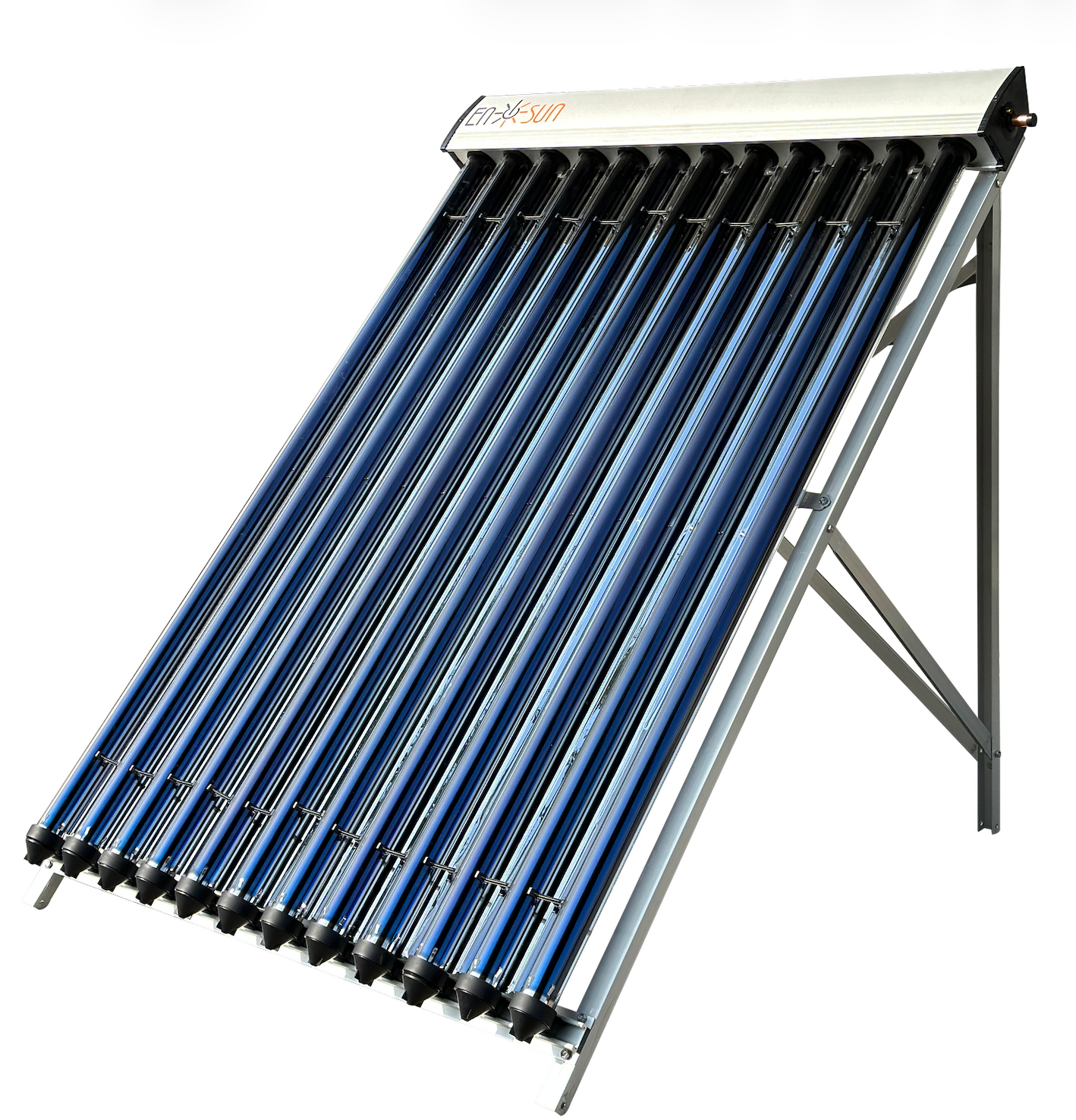
The HSC series is a solar collector classified as a heat pipe solar collector. It is manufactured from aluminum alloy, copper, and glass, with an aluminum alloy manifold and frame. The product is available in 10, 12, 15, 18, 20, 24, or 30 tubes, using 58-1800 vacuum tubes with heat pipes.
The HSC series has Solar Keymark certification and is intended for villa, hotel, house heating, spa center, and school applications. Heat pipe collectors are commonly selected for split solar systems where the collector is installed on the roof and connected to a pressurized storage tank indoors or at ground level.
FPC2.0: Flat Plate Solar Collector
The FPC2.0 is a flat plate solar collector made of copper and aluminum alloy. Buyers can choose collector areas of 1 m2, 1.5 m2, 2 m2, or 2.5 m2, with a thickness of 80 mm. The FPC2.0 is Solar Keymark certified and is intended for swimming pool heating, housing heating, and solar water heaters.
Flat plate collectors are widely used when a collector needs to blend into a roof, when the application is pool heating, or when a building requires a large, robust collector area for hydronic heating or DHW preheating.
PV Series: PV Solar Water Heater
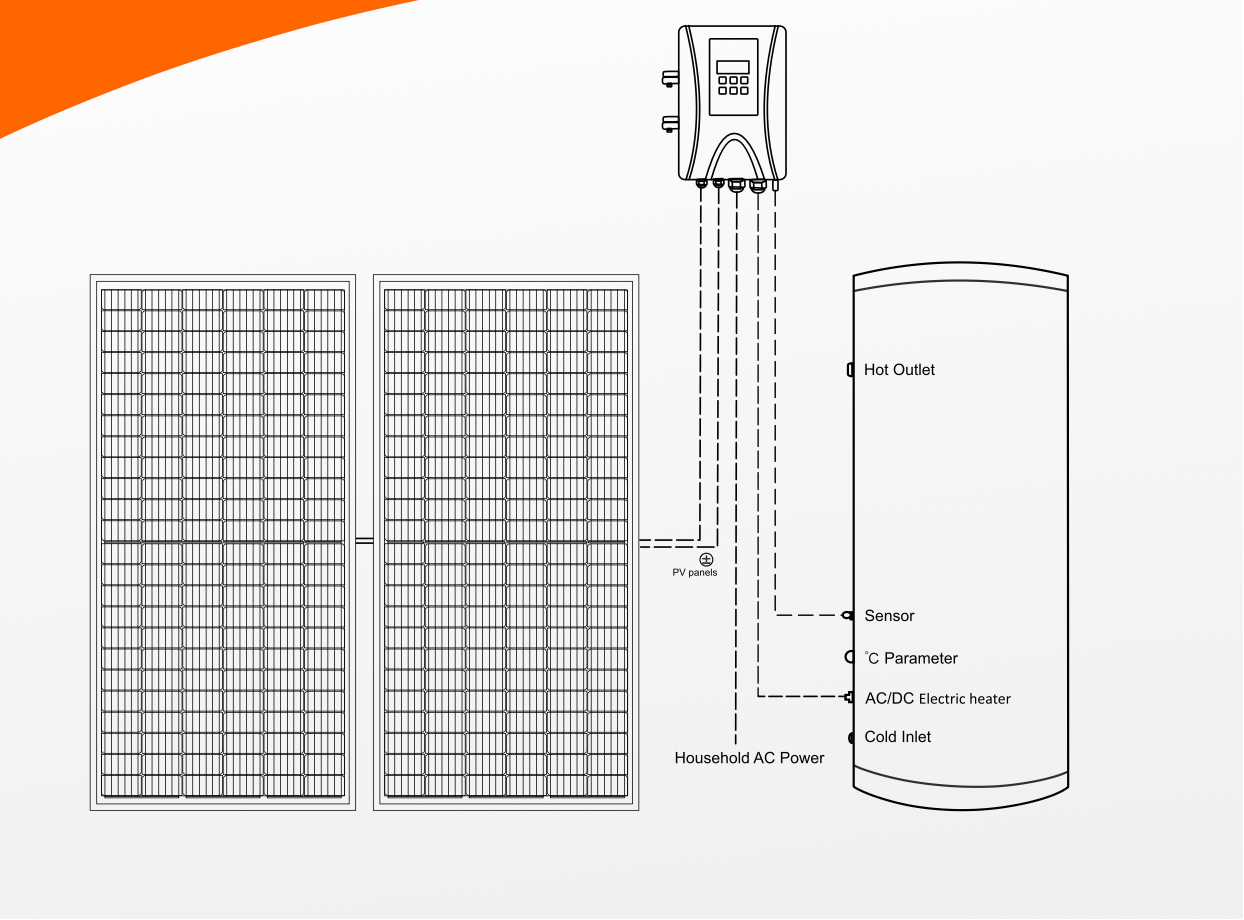
The PV Series is a PV solar water heater designed to use power input from solar panels to heat water in a storage tank. Kesun specifies the electrical power input from solar panels as 600 watts per panel. The power output for heating ranges from 800 W to 3500 W depending on the controller setting. Tank capacity is available from 100 L to 500 L, and the tank can be produced in Duplex 2205 or Inox 316L material.
The PV Series is equipped with a controller with MPPT function and a DC/AC automatic switch. It is CE certified and is designed for easy, low-cost installation. Typical applications include villas, houses, apartments, and camps. For buyers interested in the keyword solar panel water heater, this product family represents a simplified photovoltaic-thermal approach: solar panels drive electric heating inside an insulated hot water tank instead of circulating water through rooftop thermal collectors.
How to Choose a Solar Water Heater: Step-by-Step Selection
The following steps are useful for a first-stage procurement review. A qualified engineer should always validate the final design before installation.
- Confirm the required pressure range. If the building has mains-pressure plumbing, a high-pressure solar geyser such as the CPS series is appropriate. If the site is designed for gravity-fed outlets, a non-pressure unit such as the CNP series may be sufficient.
- Assess water chemistry and corrosion risk. For salty water, consider an indirect water heater with an enamel-coated tank, such as the CPS-FJ series. For projects with high corrosion resistance requirements, confirm the tank material and coating specification with the manufacturer.
- Calculate daily hot water demand and peak load. The number of occupants, showers, hotel rooms, or process outlets determines the required tank volume and collector area. This calculation should be done per project; no meaningful area can be chosen from a general rule alone.
- Select the collector type. Heat pipe evacuated tube collectors are flexible for DHW and commercial projects; flat plate collectors are often used for pool heating and roof-integrated systems. The HSC and FPC2.0 series cover these two collector families in the Kesun range.
- Plan for winter and freeze protection. Where freezing occurs, choose an indirect configuration with anti-freezing heat transfer media or verify that the full system design includes proper freeze protection.
- Define backup and integration. Solar water heaters are often combined with electric elements, heat pumps, combi boilers, buffer tanks, or DHW tanks. If the project already has a heat pump buffer tank, check how the solar loop with its own storage tank will be integrated hydraulically.
- Check certifications and manufacturing support. For many export markets, certificates such as Solar Keymark or CE are important. Buyers who plan to brand the product should also verify whether the factory supports OEM, customization, testing, and samples.
Solar Water Heater Use Cases
Solar thermal systems are used in residential, commercial building, hotel, agricultural, pool, and industrial process hot water applications. The basic role of the system is to generate and store heat for facility hot water demand, with backup from an electric heater or heat pump where needed.
- Villa or house hot water: A high-pressure solar geyser such as the CPS series is convenient for pressurized residential systems. A non-pressure CNP unit is an alternative for low-pressure or gravity-fed sites.
- Hotel and commercial hot water projects: Kesun recommends combining HSC series heat pipe solar collectors with CPS-FJ or CPS series pressurized solar water heaters. This combination is designed to provide stable large-volume domestic hot water supply for hotels and commercial buildings.
- Swimming pool heating: Flat plate solar collectors in the FPC2.0 range are suitable for pool heating projects.
- Spa centers and schools: The HSC series can be used where houses, hotels, spa centers, or schools need a heat pipe collector connected to a compatible storage tank or system.
- Apartments and camps: The PV Series is positioned for easy and low-cost installation in villas, houses, apartments, and camps, especially where solar panels are more convenient than roof-mounted water collectors.
- Gas stations, car wash centers, schools, and small hotels: The CNP non-pressure and CPS pressurized product lines are both listed for these building types, depending on the water pressure and hot water demand.
Solar Water Heater Model Comparison Table
| Product line | System type | Key standard specification | Target applications | Reference certification |
|---|---|---|---|---|
| CNP | Non-pressure solar water heater / solar geyser | 60–500 L; 58-1800 vacuum tube; 50 mm PU foam; 25–45° angle; stainless steel tank options | Houses, villas, gardens, gas stations, car wash centers, small hotels, schools | Solar Keymark certified (standard product) |
| CPS | High-pressure solar geyser | 100–300 L; max operating pressure 6 bar; test pressure 9 bar; 58-1800 heat pipe vacuum tube; no moving parts | Houses, villas, gardens, small hotels, schools, commercial buildings | Solar Keymark certified (standard product) |
| CPS-FJ | Indirect solar water heater | 150, 200, 250, 300 L; SPCC enamel-coated tank; flat type solar collector; can use anti-freezing media | Villas, houses, hotels, schools | Solar Keymark certified (standard product) |
| HSC | Heat pipe solar collector | 10, 12, 15, 18, 20, 24, or 30 tubes; 58-1800 vacuum tube with heat pipe; aluminum alloy frame and manifold | Villas, hotels, house heating, spa centers, schools | Solar Keymark certified |
| FPC2.0 | Flat plate solar collector | 1, 1.5, 2, 2.5 m2; 80 mm thickness; copper and aluminum alloy absorber | Swimming pool heating, housing heating, solar water heaters | Solar Keymark certified |
| PV Series | PV solar water heater | 100–500 L tank; 600 W solar panel input per panel; 800–3500 W heating output; MPPT; DC/AC automatic switch; Duplex 2205 / Inox 316L tank | Villas, houses, apartments, camps | CE certified |
Specifications in this table are based on standard Kesun product information. System-level design must still be confirmed for each project location and installation.
Why Kesun Is Relevant for Solar Thermal Procurement

Zhejiang Kesun New Energy Co., Ltd., commonly known as Kesun, was established in 2009. The company specializes in the design and manufacture of solar water heaters, buffer tanks, domestic hot water tanks, and hybrid solar panels. Its range includes both non-pressure and pressurized solar water heaters, and it produces a mix of thermal and photovoltaic-assisted products.
Kesun operates a standardized manufacturing facility of 42,000 square meters. The annual production capacity is 300,000 sets, with approximately 130 employees and an R&D team of 15 engineers. The factory uses production capabilities such as high-pressure automatic foaming machines and robotic packaging. Kesun exports to markets including Mexico, the EU, and Africa, and export business accounts for 60% of total sales.
For wholesalers, importers, and brand owners, this company background matters because the factory can support not just product selection but also OEM discussions, capacity planning, and larger-volume orders.
Frequently Asked Questions about Solar Water Heaters
Are Kesun solar water heaters and collectors certified for regulated markets?
Several Kesun product lines carry Solar Keymark certification, including the HSC heat pipe collector, the FPC2.0 flat plate collector, and the CNP, CPS, and CPS-FJ solar water heater lines. The PV Series is CE certified. Certification status should be confirmed with the factory for the specific model and destination before ordering.
Which solar water heater and collector is suitable for hotel and commercial hot-water projects?
Kesun recommends HSC series heat pipe solar collectors combined with CPS-FJ or CPS series pressurized solar water heaters for hotel and commercial projects. This configuration is intended to provide stable large-volume domestic hot water supply for buildings with higher hot water demand.
What is the difference between a non-pressure solar water heater and a high-pressure solar geyser?
The CNP series is a non-pressure solar water heater available in capacities from 60 L to 500 L and is generally suited to low-pressure or gravity-fed water systems. The CPS series is a high-pressure solar geyser available in capacities from 100 L to 300 L, with maximum operating pressure of 6 bar and test pressure of 9 bar. A high-pressure unit can be used where the water supply has higher pressure.
Can a solar water heater work in cold winter regions?
Yes, if the system uses the correct indirect configuration. For example, the CPS-FJ series is an indirect solar water heater with an enamel-coated tank and can be filled with anti-freezing heat transfer media. Project-specific freeze protection and winter operation should always be checked by a qualified engineer.
Does Kesun support OEM, customization, and sample requests for importers?
Kesun states that several product families are available with OEM or customization options. The CNP series can be customized in material and design, and collector products such as the HSC and FPC2.0 are listed with customization or OEM availability. With annual production capacity of 300,000 sets and a 15-engineer R&D team, Kesun can discuss project-specific requirements with importers. To request a quote or sample, contact Alan by email at alan@ensunchina.com or via WhatsApp at +86 13586432400.
Conclusion and Next Steps
Solar water heaters are not a one-size-fits-all product. The right system depends on water pressure, water quality, climate, backup integration, certification expectations, and the amount of hot water the building needs. Understanding the difference between non-pressure solar geysers, high-pressure geysers, indirect systems, heat pipe and flat plate collectors, and PV-powered water heaters will make supplier conversations more productive.

If you are planning a solar water heater project and need help shortlisting products, request our product brochure or speak directly with the Kesun team.
Download the 2025 Kesun / Ensun product brochure
Email: alan@ensunchina.com
Tel / WhatsApp: +86 13586432400
Website: www.kesunsolar.com
Tell the sales team your project location, required tank capacity or collector area, target pressure, water quality conditions, and any OEM or certification requirements. With that information, Kesun can recommend the most suitable solar water heater configuration for your project.