
 50,000
 500

Compliance Overview for Home Storage: Understanding PP Plastic Material Standards and Certifications
Compliance for home storage products is decided by three things: what each component is made of, how the finished product is intended to be used, and which market it is sold into. A multi-material cart or cabinet is never covered by a single certificate. The PP body panels, the metal pull rod, the rubber wheels and the transparent front panels each carry their own documentation, and the claim that counts is the one that matches the intended use in the destination market.
This overview is written for importers, distributors and private-label programme owners who are comparing suppliers of home organization products and need to read a material statement the way a compliance officer reads it. It uses published specifications for named models, including the PP, metal and rubber build of the YN8821 portable folding trolley, to show where a material claim becomes a compliance document, and where the gaps normally appear.
xinhaibox (Taizhou Xinhai Cross-border E-commerce Service Co., Ltd.) is a China-based supplier of plastic household storage and daily-use products, described on its company profile as the export arm of Zhejiang Jinmao Plastic Group. The company reports a 50,000 m² factory, around 500 employees, an annual output of approximately 1,000,000 units, a 30-person engineering and design team, and a 70% export share with North America, the EU, Southeast Asia and Latin America as its main markets. Its catalogue covers folding carts, pet trolleys, storage cabinets, storage boxes and toy storage bins — a range in which nearly every SKU combines at least two materials.

Why Material Compliance Is Harder for Multi-Material Home Storage
The most common compliance failure in this category is not a bad product. It is a claim that travelled further than the evidence behind it. Three patterns account for most of the problems buyers meet during supplier evaluation.
1. Claim transfer between components
A supplier statement that the body is made of BPA-free PP is a statement about the body. It is not a statement about the lid, the handles, the metal rod or the rubber tyres. On a product such as the YN8821 portable folding trolley, which is specified as PP plastic, metal and rubber, three materials sit in one box, and a finished-product declaration has to cover all three rather than the largest one.
2. Scope inflation around food contact
Food-contact rules are written for articles intended to contact food. A drawer unit used for sweaters and a stackable bin used for dry pantry goods do not sit in the same regulatory scope, even when both are moulded from the same polymer. Applying a food-contact statement to a general storage product creates a claim the buyer cannot defend; ignoring it on a pantry product creates a real risk.
3. Specification language without a data trail
Phrases such as High-Strength PP, eco-friendly PP plastic and BPA-free safe storage are useful for a listing page and useless for a customs or retail compliance review unless they resolve to something checkable: a polymer grade, a wall thickness, a load test, a declaration of compliance or a laboratory report. The foldable storage drawer YN484536, for example, is described as high-strength PP plastic with capacities from 49 L to 86 L — the phrase is the marketing layer, the capacity range and the wall structure are the engineering layer, and the missing middle is the document that connects them.
What Is Changing in the Home Storage Category
Demand is rising in exactly the segment where mixed-material design is most common. Third-party research cited in this review projects the global home organization products market to reach USD 21.65 billion by 2035, and identifies stackable storage as the fastest-growing sub-segment of the kitchen organization market with a reported CAGR of 6.25%. Both figures are source-reported projections from commercial research, not customs data, but they point in one direction: more SKUs, more configurations, more materials per carton.
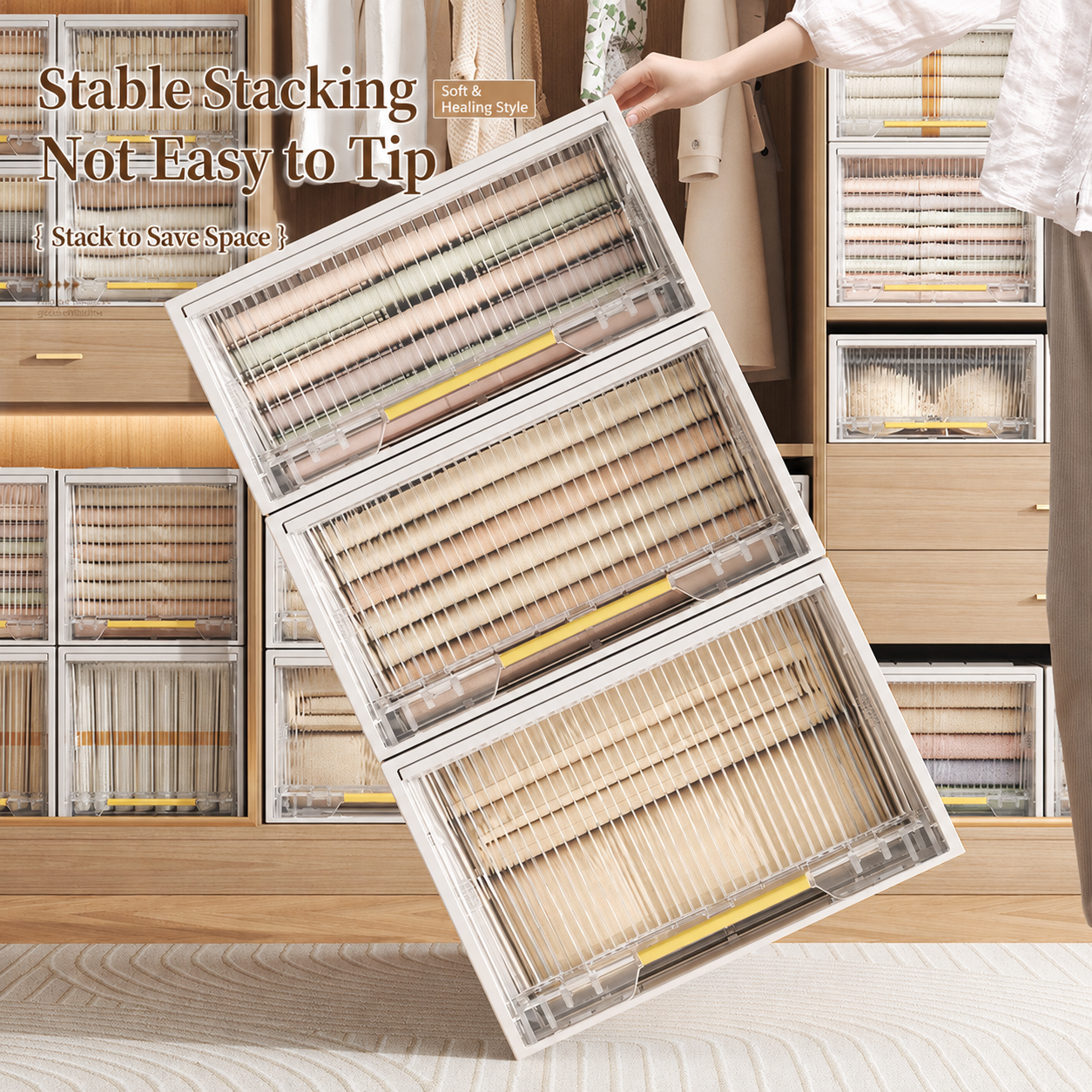
Product design is following the same path. In the current xinhaibox range alone, the YN8887 collapsible cabinet combines PP plastic with a transparent PET panel, the YN-WWT001 doll storage bucket uses a PET transparent body with a PP lid, the YN8980 car storage box is offered with a wooden-look or plastic lid, the YN8821 cart mixes PP with metal and rubber, and the YOR6020 home trash bin is moulded in ABS, PET and PP. Each additional material adds a line to the compliance file that a single-polymer product never needs.
At the same time, supplier statements are becoming more detailed but not necessarily more verifiable. A catalogue that names the polymer is a better starting point than one that says only plastic; it is still a starting point. The buyer's job is to convert the statement into a document set that survives retail onboarding, customs review and, where relevant, a food-contact challenge.
How PP Plastic Fits Into the Compliance Picture
The #5 recycling code is a starting point, not a certificate
Published compliance guidance notes that polypropylene marked with recycling code #5 is generally BPA-free and accepted for food contact under US FDA rules, with 21 CFR cited as the governing reference (Compliance Gate, Plastic Product Regulations and Safety Standards in the United States). Two qualifications matter to a buyer. First, the statement describes the polymer, not the finished article: colorants, additives, fillers and any recycled content sit outside a generic polymer description. Second, it describes a food-contact scope. A PP storage box used for blankets does not become a food-contact article because the resin would allow it.
The EU framework adds a second layer
Where a product is marketed or represented for food contact in the European Union, three instruments are relevant. Regulation (EC) No 1935/2004 sets the general framework for food-contact materials. Commission Regulation (EU) No 10/2011 is the specific measure for plastic materials and articles. Commission Regulation (EU) 2024/3190 prohibits the use of BPA and its salts in specified food-contact materials and articles placed on the EU market, subject to stated derogations. That last point is frequently misread in supplier marketing: the restriction is scoped to covered food-contact articles, and generalising it to every plastic household organizer overstates both the rule and the product's exposure.
What High-Strength PP should mean in a supplier document
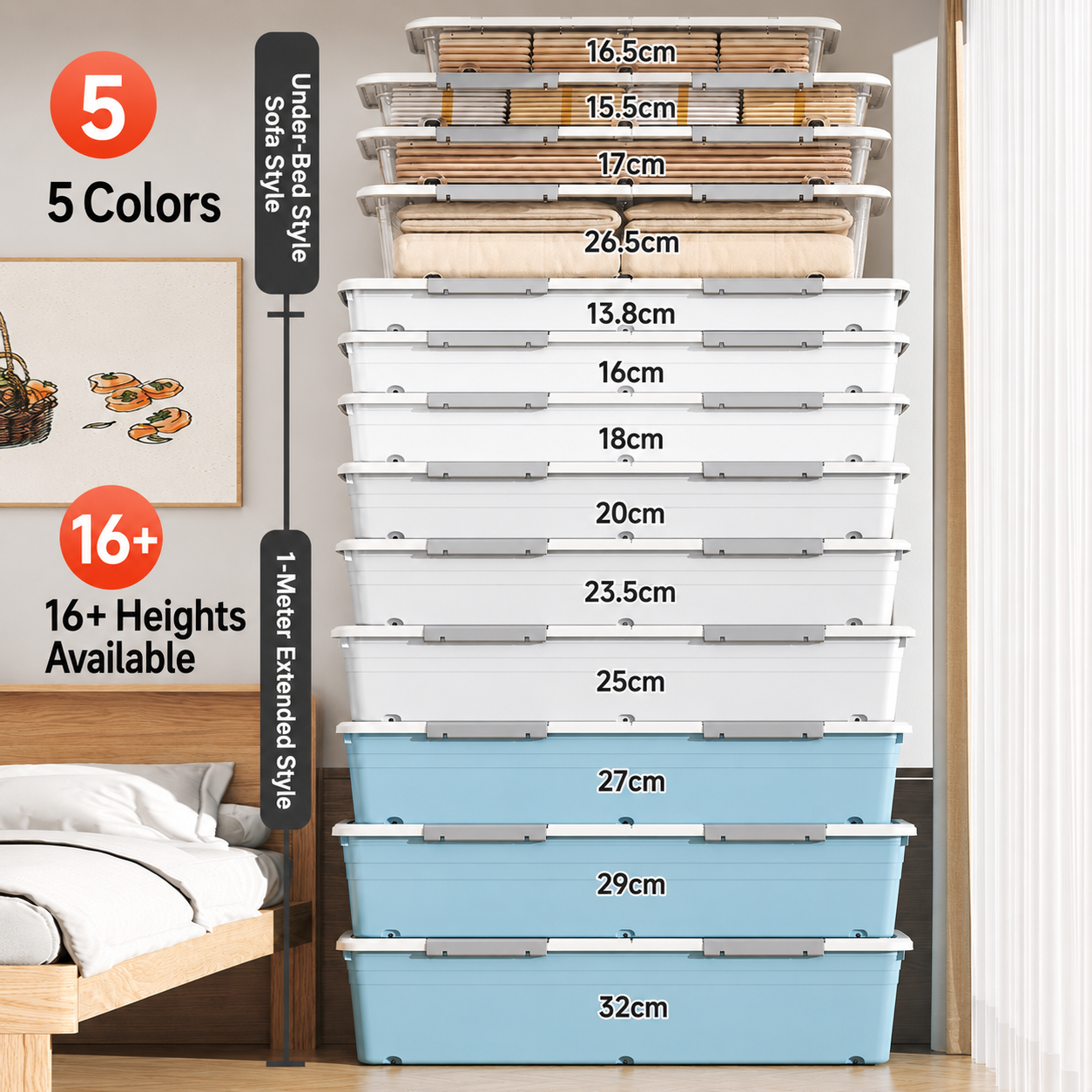
When a specification sheet says high-strength PP, a buyer should be able to ask three follow-up questions and get answers: which grade and wall thickness, what load the structure was designed for, and what test method sits behind the statement. Real answers exist in the product data itself. The HT8861 under-bed storage box is specified as high-quality PP with a flat bottom, 20 cm extended sealing latches, a capacity 30% larger than the regular version, and a structure that supports one adult stably. The load claim and the latch dimension are the parts a compliance file can verify; the adjective is not.
The other materials in the same product
A material review that stops at PP is incomplete. The YN8821 cart's metal pull rod is adjustable in two levels from 79.5 cm to 89.5 cm, its wheels are 360° silent swivel wheels with brake, and its stated load capacity is 100 kg. Those components bring their own questions — coating and plating for the rod, formulation and ageing for the wheels — that a polymer declaration does not answer. The same applies to transparent panels: the YN8887 cabinet combines PP with a transparent PET panel, and the 360° rotating cosmetic organizer BF260401 is described by the company as using BPA-free PET material, a claim that should be supported by a resin-level statement for the specific part.
Where formaldehyde and odour claims fit
Formaldehyde-free and odourless claims are common in this category and are usually stated as a quality-inspection outcome. The foldable shoe cabinet 7008 is described as passing quality inspection with zero formaldehyde and no odour, and the YN8871 storage cabinet is described as PP with zero formaldehyde. These are supplier statements about a tested property; a buyer's file should record who tested it, on which part, and against which method, because the claim will be repeated on retail packaging in a market where it is legally meaningful.
A Six-Step Compliance Check Before You Place an Order
The sequence below converts a catalogue into a decision file. It is written for a first or second order, where the cost of a documentation gap is highest.
- Fix the intended use in writing. Record whether the product will contact food directly, contact packaged food, or hold non-food items. A stackable pantry bin and a wardrobe drawer can share a polymer and still sit in different scopes. Put the intended use in the enquiry so the supplier answers the right question.
- Build a component-level bill of materials. List every material by part. For the YN8821 cart that means PP body, metal rod, rubber wheels. For the YN8887 cabinet it means PP panels plus transparent PET doors. For the YN8980 car storage box it means the PP body plus the lid option chosen.
- Map each material to the destination market. Use the reference map below as a working checklist, then confirm scope with your compliance adviser for the specific SKU.
- Request documents per SKU, not per catalogue. Ask for the material datasheet, the declaration of compliance where food contact is claimed, any BPA statement, and the test report reference. A document issued for one model does not transfer to another model with a different mould.
- Reconcile the documents with the sample and the artwork. Compare the polymer named in the file with the finish and markings on the physical sample, and check that the retail packaging repeats only wording that the file supports.
- Freeze the approved wording and keep the file. Repeat orders, new colourways and new lid options all create an opportunity for the claim and the evidence to drift apart. A locked wording list prevents that.
Regulatory reference map for buyers
| Market and scope | Instrument referred to | What the buyer should request |
|---|---|---|
| United States, plastic articles generally | FDA rules referenced as 21 CFR; PP with recycling code #5 is generally described as BPA-free and accepted for food contact in compliance guidance | Resin-level statement naming the polymer and grade; confirmation of whether the part is in food-contact scope |
| European Union, food-contact materials (general) | Regulation (EC) No 1935/2004 | Declaration of compliance covering the finished article and its intended use |
| European Union, plastic food-contact materials | Commission Regulation (EU) No 10/2011 | Material declaration plus migration test evidence where applicable |
| European Union, BPA restriction | Commission Regulation (EU) 2024/3190 — BPA and its salts prohibited in specified food-contact materials and articles, subject to stated derogations | Written confirmation that the specific part is outside the restricted scope, or evidence of compliance within it |
| General storage, non-food use | No food-contact framework applies; general product safety and contractual specification govern | Material datasheet, load and durability specification, and consistent retail wording |

Where Compliance Scrutiny Changes by Use Case
Kitchen and pantry sorting
This is the highest-scrutiny scenario because food proximity is normal and buyers often want a food-safe claim on the packaging. Stackable bins, drawers and foldable cabinets used for dry goods, snacks and packaged food should be specified with a clear statement of whether direct food contact is intended. If it is, the EU and US frameworks above apply; if it is not, the packaging should avoid implying it.
Kids room and toy storage
Children's storage attracts additional consumer-safety attention in several markets, and the material file should be reviewed with that in mind rather than assumed. The relevant products here are often multi-material by design: the YN-WWT001 doll storage bucket uses a PET transparent body with a PP lid and a removable top lid, and the YN6358 version uses a PET bucket body with a PP lid in Cream Pink, Cream White and Cream Green. Odour and finish matter as much as the polymer name on a product that sits in a bedroom.
Laundry room and bathroom utility
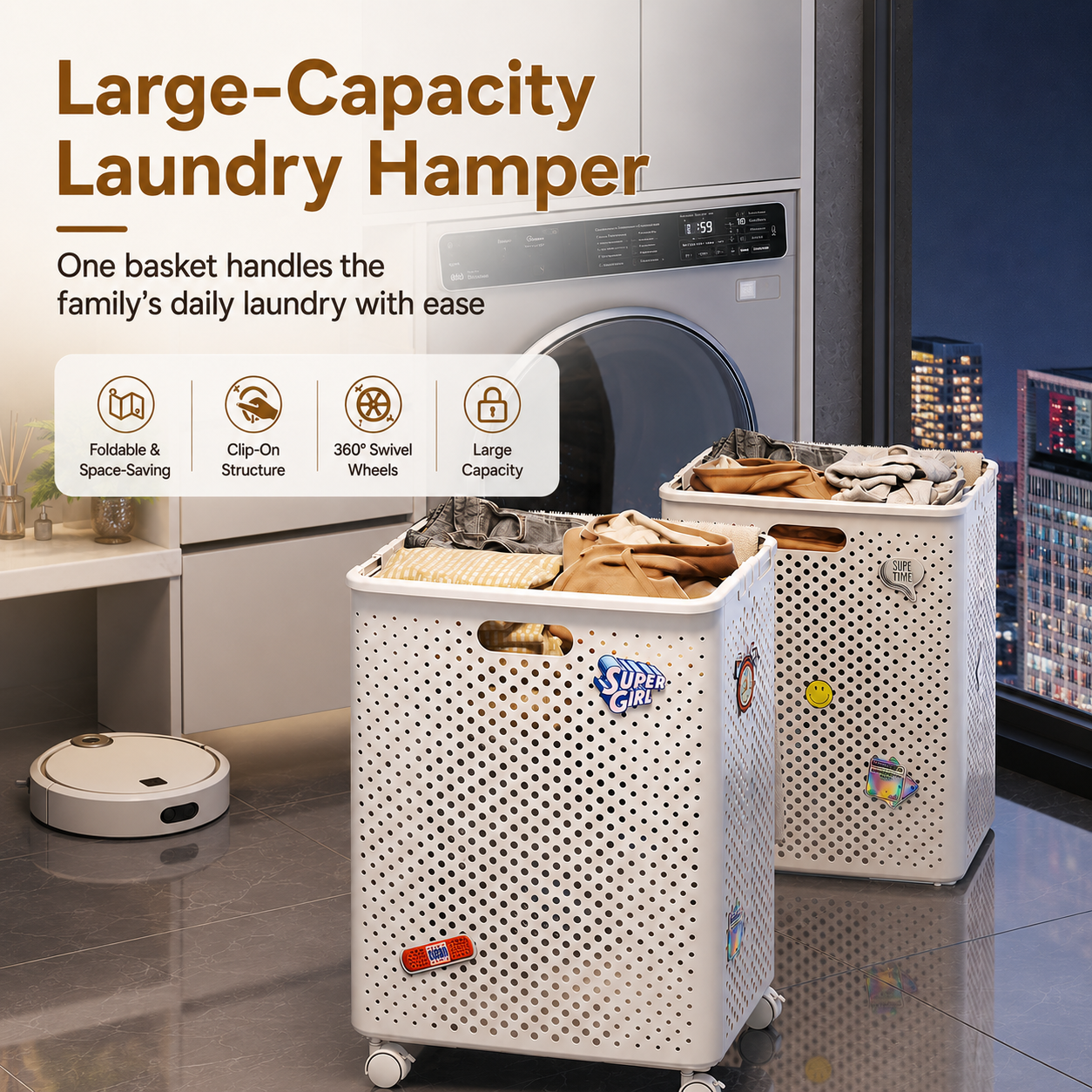
Humidity changes the question from food safety to durability and hygiene. The JH2018 laundry hamper is specified as PP plastic with all-round ventilated holes, rounded smooth edges, 360° swivel wheels, and a capacity of approximately 30 adult garments, at 37.7 × 30 × 50 cm with wheels. Ventilation and cleanability should be specified in the same document as the material, because a moisture claim without a structural detail is not verifiable.
Car trunk, camping and outdoor use
Load, temperature and handling dominate here. The YN8980 foldable car storage box is PP, offered in a 57 L medium size at 43.5 × 30 × 24 cm, folds to 7 cm, and can be supplied with a lockable lid in wooden-look or plastic. The YN8821 cart carries a stated 100 kg load with 360° silent swivel wheels and brake. Every one of those numbers is a specification the buyer can hold a supplier to; none of them substitutes for a material declaration.
Vanity and desktop storage
Small-format organizers are usually judged on transparency and finish. The BF260401 rotating cosmetic organizer is PP with a 360° rotating base and a jewellery hanging tree at 25 × 15 × 25.5 cm, and the company describes its cosmetic storage line as using BPA-free PET material with high transparency and rounded safety edges — a claim worth matching against a resin statement for the transparent parts specifically.
Material Composition by Model: A Reference Table
The table below lists stated material composition for selected models in the current range. It is a documentation map, not a ranking, and it does not by itself establish compliance for any market.
| Model | Product | Stated material composition | Compliance-relevant detail |
|---|---|---|---|
| YN8821 | Portable folding trolley | PP plastic, metal, rubber | 5-second fold to 10.9 cm; 2-level rod 79.5–89.5 cm; 360° silent swivel wheels with brake; 100 kg load |
| YN484536 | Foldable storage drawer | High-strength PP plastic | Transparent front panel; tool-free assembly; 49 L to 86 L capacity options |
| HT8861 | Under-bed storage box | High-quality PP plastic | 20 cm extended sealing latches; capacity 30% larger than regular version; supports one adult stably |
| YN8887 | Collapsible home storage cabinet | PP plastic + transparent PET panel | 5-door lockable access; 26.5 gallons per unit; 3-layer and 4-layer stacking |
| YN8980 | Foldable car storage box | PP with wooden-look or plastic lid option | 57 L medium size; folds to 7 cm; lockable lid |
| JH2018 | Laundry hamper | PP plastic | Approximately 30 adult garments; all-round ventilated holes; 360° swivel wheels |
| YN-WWT001 | Doll storage bucket | PET transparent body + PP lid | Removable top lid; zipper opening; 30 cm width, 112/142/172 cm heights |
| YOR6020 | Home trash bin | ABS + PET + PP | 60 cm height, 30 cm diameter; four colour options |
| 7008 | Foldable shoe cabinet | PP | Company states zero formaldehyde and odourless, and passing quality inspection |

FAQ: PP Material Standards and Certification Questions Buyers Ask
Is PP plastic food-safe for home storage products?
Polypropylene marked with recycling code #5 is generally regarded as BPA-free and is accepted for food contact under US FDA rules, with 21 CFR cited in published compliance guidance (Compliance Gate). That statement covers the polymer and the food-contact scope; it does not automatically cover a finished organizer with a PET lid, a coated metal rod or rubber wheels. Where a product is marketed for food contact in the EU, the framework is Regulation (EC) No 1935/2004 for food-contact materials and Commission Regulation (EU) No 10/2011 for plastics, and Commission Regulation (EU) 2024/3190 prohibits BPA and its salts in specified food-contact materials and articles placed on the EU market, subject to stated derogations. Confirm intended use first, then request documentation for each part that touches food.
Can a supplier document every material in a multi-material product such as the YN8821 cart?
It requires three separate material statements plus a finished-product declaration. The YN8821 is specified as PP plastic, metal and rubber, with a 5-second fold to 10.9 cm, a 2-level pull rod adjustable from 79.5 cm to 89.5 cm, 360° silent swivel wheels with brake, and a stated 100 kg load capacity. A supplier with in-house engineering is better positioned to answer: xinhaibox states a 30-person engineering and design team and supports customisation of colours, logos, stickers, packaging and product details. Buyers should still ask for the datasheet and declaration per component rather than accepting a single catalogue sentence.
Do compliance documents change MOQ and order economics?
They usually change the schedule before they change the price. xinhaibox publishes an MOQ of 500 units for OEM orders with logo or colour customisation and a 15–45 day lead time, while ODM projects require 5,000 units. Testing, artwork approval and material declarations sit inside that window, so a document request raised late tends to appear as a delay rather than a cost line. Agree the document list before the MOQ is fixed.
Can buyers verify material and finish on a sample before committing?
A sample is where a material statement becomes checkable: resin finish, the wall thickness behind a high-strength PP claim, the fit of a lockable lid, and the wording that will be printed on retail packaging. xinhaibox maintains a sample room and supports custom colours, logos, stickers and packaging, so the approved sample can carry the exact claims and artwork used in production. Request the sample and the material datasheet together so both are reviewed as one file.
What lead time applies to OEM and ODM home storage orders?
For OEM orders with logo or colour customisation, xinhaibox states an MOQ of 500 units and a lead time of 15–45 days; ODM orders require 5,000 units. Buyers planning a seasonal launch should add document review and sample approval ahead of that window, because those steps are normally completed before production is scheduled. To start, send your product list and destination market to zora.zhu@xinhaibox.com, or download the Xinhai Box Storage Products brochure for the full model range.
Conclusion: Compliance Is a Document Trail, Not a Label
For home storage products, the reliable path is short and unglamorous. Name every material in the bill of materials, state the intended use in writing, map that combination to the destination market, and collect a document for each part before the purchase order is signed. PP is a good starting point because recycling code #5 is widely understood and generally described as BPA-free in US food-contact guidance, but the polymer is only the first line of the file. The metal rod, the rubber wheels, the transparent PET panel and the wooden-look lid each add a line, and the finished-product declaration is what a retailer or customs reviewer will actually read.
Buyers evaluating suppliers should treat material disclosure as a capability test. A supplier that can name the polymer for each model, keep the specification consistent between catalogue and production, and support custom colours, logos, stickers and packaging is easier to qualify than one that answers with adjectives. That is the practical reason to review a supplier's material statements at the research stage, before samples are ordered and long before packaging artwork is approved.
Next Step: Check the Material File Before the Price File
If you are building a home organization range for North America, the EU, Southeast Asia or Latin America, start with the material and documentation review, then move to samples and pricing. The xinhaibox catalogue covers folding carts, storage cabinets, storage boxes, laundry hampers, toy storage bins and sorting bins, with OEM MOQ from 500 units and a 15–45 day lead time.
- Download the full model range: Xinhai Box Storage Products Brochure (PDF)
- Send your SKU list and destination market: zora.zhu@xinhaibox.com
- WhatsApp or phone: +852 4743 6360
- Company website: www.xinhaibox.com
- Address: Building D, Xinhai Digital Trade Hub, 89 Yintai Road, Jiaojiang District, Taizhou, Zhejiang, China
Have Questions or Need More Details?
Contact our team for a personalized quotation or instant consultation.
Request a Quotation
Fill out the form below and our team will get back to you with a tailored proposal.
WhatsApp Direct Chat
Prefer to chat in real-time? Message us on WhatsApp for instant assistance & quick answers.
- Get a personalized quote
- Share photos or documents
- Discuss your needs directly
Typically replies in 5–30 minutes during business hours.