
 50,000
 500
500

Supplier Evaluation for Home Organization: Capability Checks and Delivery Assurance
Supplier Evaluation for Home Organization: Capability Checks and Delivery Assurance
Short answer: a home organization supplier should be evaluated in five verifiable areas — documented product specifications, plastic material handling and compliance, folding-mechanism and tooling capability, structural load and stacking performance, and delivery controls such as production capacity, export experience and packaging management. Buyers who check these five areas before issuing a purchase order compare suppliers on evidence instead of catalog photos and unit prices.
This guide is written for importers, distributors, private-label brand owners and e-commerce sellers sourcing plastic storage products: pantry cabinets, wardrobe drawers, toy bins, laundry hampers, collapsible carts, car trunk organizers and camping boxes. The purpose is a repeatable evaluation process that gives the same answer whether you are shortlisting suppliers for the first time or reviewing one you already buy from.
Taizhou Xinhai Cross-border E-commerce Service Co., Ltd., which trades as xinhaibox, is a B2B supplier of plastic household storage and daily-use products. The company was established in 2025 and is supported by more than 20 years of manufacturing experience from Zhejiang Jinmao Plastic Group. Every product specification cited below comes from Xinhai's published product data and is used as a working example of the level of detail a buyer should demand from any home organization supplier.

Problem Definition: Why Home Organization Suppliers Are Hard to Compare
The category looks low-risk. A pantry cabinet, a stackable drawer box or a collapsible cart is mostly plastic, the retail price is moderate, and product photos look similar across supplier catalogs. The risk sits inside the product: door hinges that lose alignment, drawer runners that jam after loading, folding joints that loosen with use, stackable bodies that deform, wheel brakes that stop holding, and sealing latches that no longer close. None of these failure modes appear in a catalog photo, and most of them surface only after the goods have reached the destination market.
The second problem is specification asymmetry. Many suppliers quote a single SKU in a single size, while retail and e-commerce channels need a size ladder that fits shelf planograms, narrow gaps, bedside placement and closet depth. Without a documented size and capacity matrix, a buyer cannot plan an assortment, and cannot compare two suppliers on the same basis.
The third problem is delivery language. Quotations routinely state a delivery date without stating the capacity behind it. A buyer receiving a date has no way to see whether that date assumes available tooling, available packaging materials, available labor and a stable component supply — or whether it is simply an optimistic estimate.
The practical conclusion is that supplier evaluation in this category reduces to two questions. First, can the supplier build the product to a documented specification repeatedly? Second, can the supplier demonstrate the capacity and process controls needed to deliver that specification on schedule? The sections below answer both with checkable evidence rather than claims.
Industry Background: Growing Plastic Storage Demand Meets Tighter Regulation
Demand for home organization products continues to expand. Market Research Future estimates the global home organization products market at USD 14.06 billion in 2024, projected to reach USD 21.65 billion by 2035. Within that market, plastic remains the dominant material choice: Grand View Research reported that plastic-made products accounted for approximately 36% of the kitchen storage and pantry organization market in 2023, while jars and containers held a 27% share.
The stackable segment specifically is expanding for structural reasons rather than fashion. Strategic Market Research projected the stackable container market at USD 7.8 billion in 2024, growing at a CAGR of 6.4%, driven by e-commerce and urbanization — two forces that both push buyers toward products that ship flat, stack high and store in small apartments. Supply capacity behind these products remains concentrated: China's furniture industry exports, which include home organization items, recorded USD 67.81 billion in 2025 according to China Customs data cited by Soonfor. A deep supply base is convenient for buyers, but it also means that basic production capability is no longer a differentiator. Capability that can be documented and verified is.
Regulation is tightening at the same time. The European Commission adopted a ban on Bisphenol A (BPA) in food contact materials under Regulation (EU) 2024/3190, with an 18-month phase-out period beginning in late 2024. For pantry, kitchen and food-adjacent storage, this turns material documentation into a purchase requirement rather than a courtesy. On the recyclability side, polypropylene (PP) storage containers can achieve GreenCircle Recyclable Material certification, verifying their role in circular economy systems and recyclability in #5 plastic facilities.
The competitive landscape is also useful context for evaluation. Key global players in home organization include IKEA (Sweden), Rubbermaid (USA), Sterilite (USA) and The Container Store (USA), according to Market Research Future. A wholesale buyer comparing these brands against a manufacturing supply base should apply the same criteria list to both: documented specifications, material safety, mechanism durability, customization scope and delivery control — not brand recognition alone.
Xinhai's own operating profile illustrates the type of first-party data a buyer can request and verify. The company runs a 50,000 square meter factory with around 500 employees and an annual output of approximately 1,000,000 units. Export business accounts for 70% of sales, with major markets in North America, the EU, Southeast Asia and Latin America. Its product development team includes 30 engineers and designers, and the company supports customization of colors, logos, stickers, packaging and product details.
Detailed Solution: The Five Capability Checks That Matter
1. Specification Control: Is There a Real Size and Capacity Ladder?
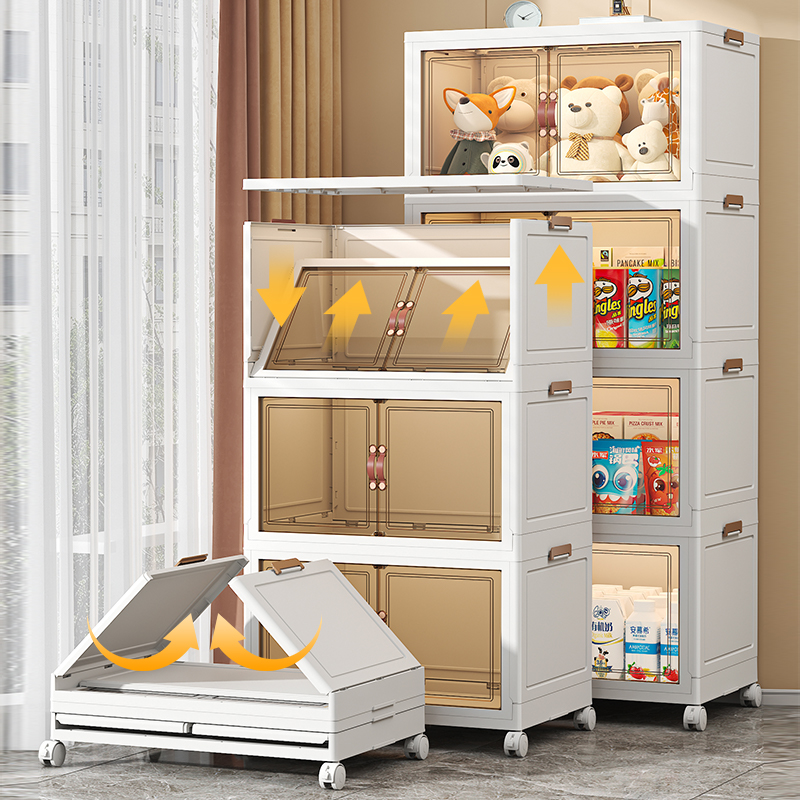
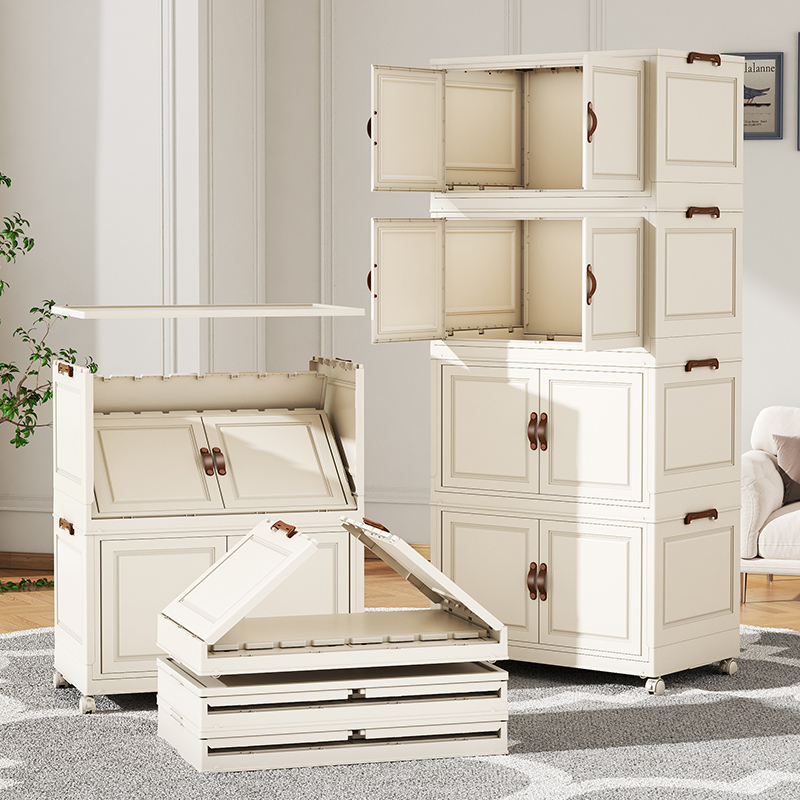
Specification control means the supplier can publish a size and capacity matrix rather than a single hero SKU. Model YN8871, the Foldable Storage Cabinet, is documented in three sizes: small (51.5 × 36 × 95 cm), medium (60 × 42 × 105.5 cm) and large (67 × 47 × 116 cm). The cabinet uses a foldable design with double doors that open and close magnetically, vintage-style textured surfaces, rounded handles, a usable top storage surface and a stackable structure — designed for bedroom storage, bedside cabinet use, clothing storage and general sundry organization.
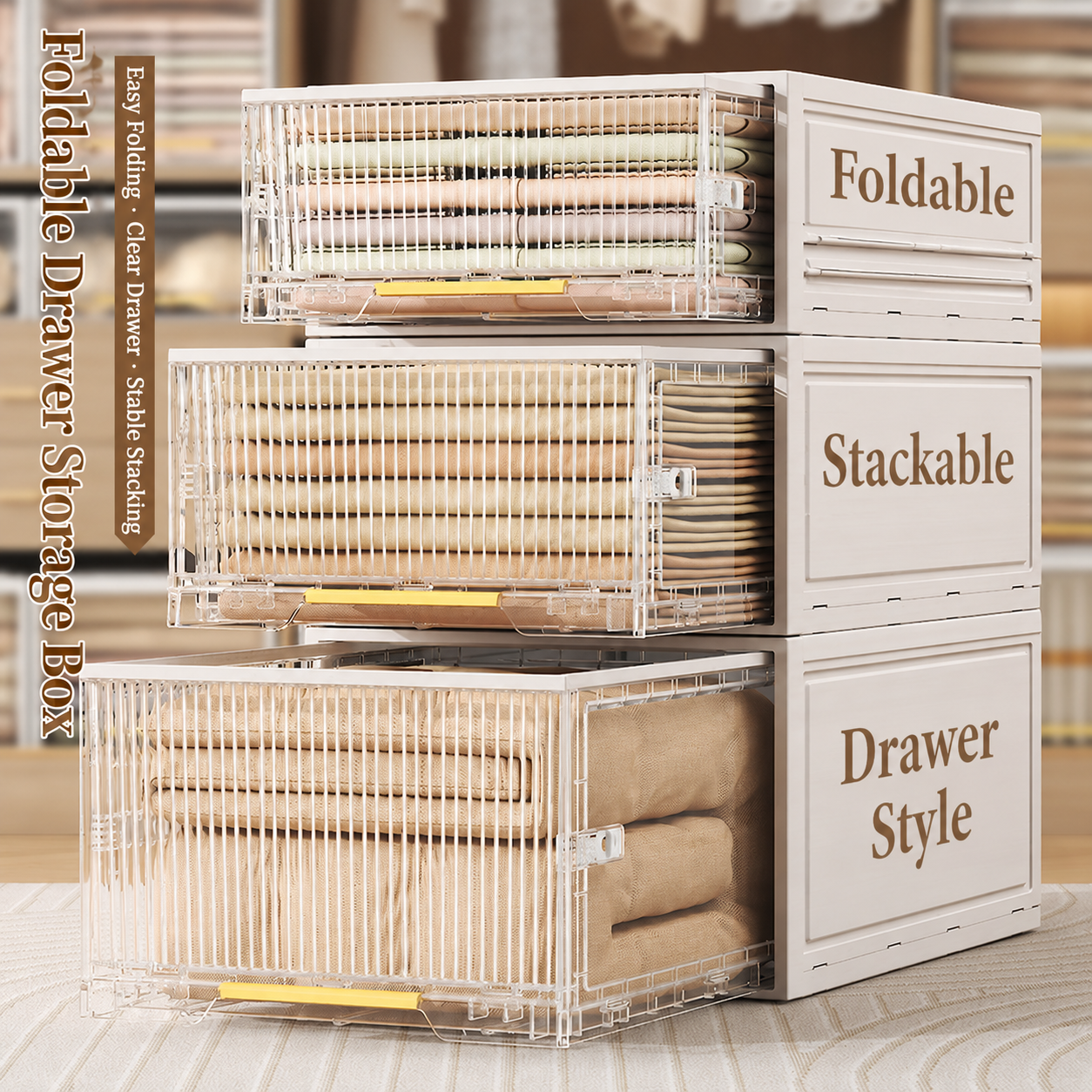
The same discipline shows on the drawer side. Model YN484536, the Foldable Storage Drawer, is offered in nine dimension variants with capacities from 49 L to 86 L, a transparent front panel for visibility and tool-free assembly. Those two examples answer a simple evaluation question: can the supplier list several coordinated sizes, or only one? A size ladder implies tooling and assembly steps that were planned together.
2. Material Handling: PP, PET and BPA Compliance
Home organization products are not made of one plastic. Xinhai's published data separates materials by component, which is exactly the granularity a buyer should request. The YN8821 portable folding trolley combines PP plastic, metal and rubber, because the pull rod and wheels carry loads that PP alone cannot handle. The doll storage bucket YN-WWT001 pairs a transparent PET body with a PP lid. The collapsible home storage cabinet YN8887 combines PP plastic with a transparent PET panel. The foldable shoe cabinet model 7008 is documented as zero formaldehyde and odorless, and passes authoritative quality inspection according to Xinhai's product data.
Material choice has compliance consequences. If the item sits near food — pantry drawers, snack cabinets, kitchen organizers — a BPA statement should be provided, because Regulation (EU) 2024/3190 restricts BPA in food contact materials across the EU market. If the retail channel markets sustainability, ask whether the PP components can be cycled through #5 plastic recycling facilities; PP containers can achieve GreenCircle Recyclable Material certification. A supplier that cannot separate its material list by part typically cannot produce a usable declaration either.
3. Mechanism and Tooling Capability: The Folding Claim Test
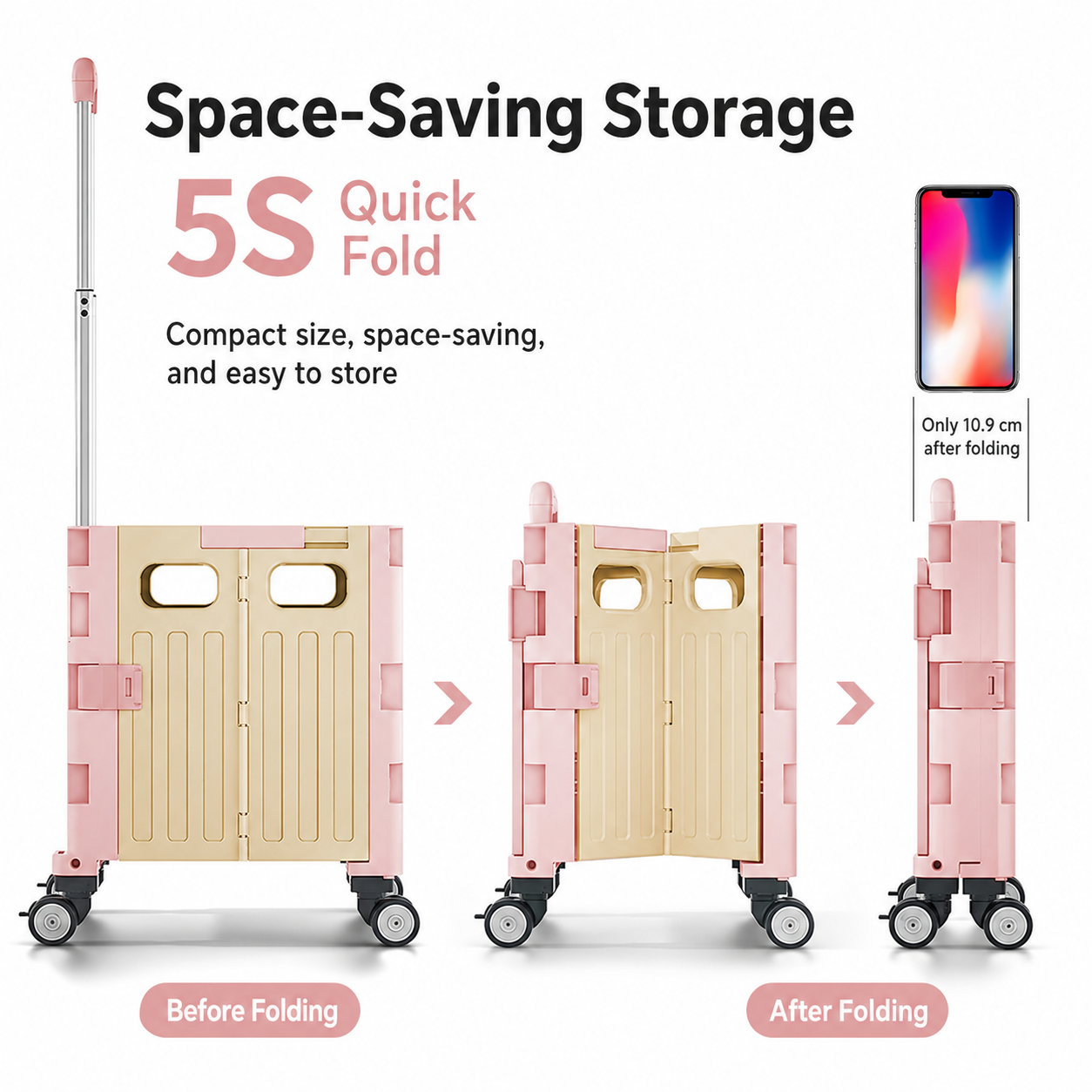
Folding mechanisms are where the least visible engineering sits, so they deserve the most specific numbers. Model YN8821 is documented with a 5-second quick folding mechanism, a folded thickness of 10.9 cm, a two-level adjustable pull rod ranging from 79.5 cm to 89.5 cm, 360° silent swivel wheels with brake, and a 100 kg load capacity. Those figures are not marketing flourishes; a supplier that can state folded thickness and rated load is demonstrating that the folding geometry is tool-controlled rather than assembled by feel.
The drawer equivalent is model YN484536, which combines tool-free assembly, a smooth pull-out drawer that does not jam, and a stable stacking structure. In the published size range, the 48 cm width is common across the nine variants — an indicator of shared tooling and defined quality-control points rather than one-off fabrication. Buyers should ask directly which parts are shared across a size range, because shared tooling is usually the difference between consistent and inconsistent repeat orders.
4. Structural Load and Stacking Performance
Stackable plastic bins sell on one promise: that a loaded stack stays stable. This claim should be documented, not assumed. Xinhai's YN8887 collapsible storage cabinet uses an enhanced rhombic and wave-wall structure for load-bearing and supports 3-layer and 4-layer stacking configurations, with 26.5 gallons of capacity per unit and pre-installed wheels. The under-bed storage box HT8861 goes further with a stated load capability of supporting one adult stably, a capacity 30% larger than the regular version and 20 cm extended sealing latches.
During a sample round, load claims are testable: stack fully loaded units, leave them standing through a normal transit and storage cycle, and check for panel deformation, latch gap and drawer alignment afterward. A supplier that provides a load statement and a stacking configuration is giving the buyer something to test; a supplier that does not provide either is giving the buyer nothing.
5. Delivery Assurance: Capacity, Export Experience and Packaging Control
Delivery assurance is not a promise date; it is evidence that the date is achievable. Three evidence types matter. The first is capacity: factory area, workforce size and annual output — for Xinhai, 50,000 square meters, around 500 employees and approximately 1,000,000 units per year. The second is export routine: an export share of 70% across North America, the EU, Southeast Asia and Latin America means container planning, carton marking and export documentation are normal operations rather than occasional projects. The third is packaging control, because custom colors, logos, stickers and retail packaging are the most schedule-sensitive parts of an order and the most common source of delay when they are not confirmed before production.
Evaluation rule: if a supplier can document specifications, materials, mechanisms and capacity in the same conversation, the delivery date is likely built on those facts. If the specifications are vague but the delivery date is firm, the date is a guess.
Step-by-Step Breakdown: An Eight-Step Supplier Evaluation Process
- Define the scenario and channel before contacting suppliers. A pantry program, a closet drawer program and a collapsible cart program need different mechanisms, sizes and packaging. Scenario definition prevents suppliers from quoting a generic item that fits nothing on your planogram. The scenario list used by Xinhai's product data — kitchen and pantry, wardrobe and closet, kids room, laundry area, car trunk and outdoor camping — is a workable starting taxonomy.
- Request a written specification matrix, not a single SKU. Ask for every size, capacity, material and component in one table. YN8871 across three sizes and YN484536 across 49 L to 86 L are examples of the format to expect.
- Cross-check mechanism claims against the product family. Folding thickness, load capacity, drawer travel and wheel type should be stated per model. YN8821's 10.9 cm folded thickness and 100 kg capacity are the level of specificity that allows verification.
- Verify material and compliance documentation. Request part-by-part material lists, BPA statements for food-adjacent items, and recyclability information where the channel requires it.
- Order samples and run repeat-mechanism tests. Fold and unfold the cart repeatedly, pull the drawer under load, stack loaded boxes, check the magnetic door closure on the cabinet, and confirm the wheel brake holds.
- Confirm customization scope and its schedule impact. Colors, logos, stickers, packaging and product detail changes should be written down before the schedule is agreed, since they are the most schedule-sensitive part of an order.
- Review packing and container-planning data. Ask how the folded geometry affects carton size and how many units fit per container. Products that fold flat, such as the YN8980 car storage box that reduces to 7 cm thickness or the YN8821 cart at 10.9 cm, are designed around this question.
- Agree on delivery checkpoints and one named contact. Fix the sample approval date as the starting point of the schedule, then set checkpoints at material release, production and packing. A named contact — the same person across quotation, sampling and production — removes the most common cause of missed handoffs.

Use Cases: Matching Verifiable Specs to Real Storage Problems
Kitchen Pantry Sorting
Pantry storage needs visible contents, stackable volume and food-adjacent material safety. The YN8871 Foldable Storage Cabinet provides double doors with magnetic opening and closing plus a top storage surface for snacks and drinks, while the YN8887 collapsible home storage cabinet adds a five-door lockable multi-access structure with 26.5 gallons per unit and a transparent PET panel that keeps contents visible. For European retail, this is the scenario where Regulation (EU) 2024/3190 BPA documentation should be requested before ordering.
Closet Clothes Storage
The YN484536 Foldable Storage Drawer is specified for T-shirts, sweaters, sweatshirts, lightweight down jackets, thin blankets, summer quilts and thick quilts, with capacities from 49 L to 86 L and a transparent front panel that removes the need to open every drawer. For seasonal bedding, the HT8861 under-bed storage box offers lengths of 96.5 cm or 100 cm, widths of 46.5 cm or 51 cm, more than 16 height options between 13.8 cm and 32 cm, a tri-fold lid with dual-way opening, and 20 cm extended sealing latches for dust protection.
Kids Toy Organization
Toy storage has to survive daily handling by children. The HYN8021 toy storage basket is a PP wall-mounted and wheeled foldable bin available in four sizes from 37.5 × 20 × 22.5 cm to 37.5 × 24.5 × 49.5 cm, with 360° swivel wheels, ergonomic handles, rounded safety edges, a hollow breathable panel and a wall-mounting option using traceless adhesive hooks. For plush toys, the doll storage bucket YN-WWT001 uses a PET transparent body with a PP lid, 30 cm width and heights of 112 cm, 142 cm or 172 cm, while model YN6358 offers a 28 cm width in heights of 65 cm, 97 cm, 130 cm or 162 cm in cream pink, cream white and cream green.
Laundry Room Utility
Laundry storage fails when it is hard to move or traps moisture. The JH2018 laundry hamper is a foldable wheeled basket in PP with dimensions of 37.7 × 30 × 50 cm with wheels (37.7 × 30 × 46 cm without), a capacity of approximately 30 adult garments, all-round ventilated holes, skin-friendly handles, rounded smooth edges and 360° swivel wheels. It folds quickly for storage between uses.
Car Trunk Organization and Outdoor Camping Gear
Vehicle and outdoor storage reward flat-folding geometry. The YN8980 Foldable Car Storage Box reduces to 7 cm thickness when folded, with a medium size of 43.5 × 30 × 24 cm at 57 L and a large size of 54 × 36 × 29 cm, plus side handles, a carry handle, a lockable lid and wooden-look or plastic lid options. The YN8880 foldable camping storage box comes in three sizes (39.6 × 26.3 × 21 cm, 42.5 × 30 × 24 cm and 54 × 36 × 29 cm, 0.009 to 0.015 m³), with a wooden top that can serve as a small table, side-opening access and a stackable design.
Comparison Table: Three Product Families Checked Side by Side
The three models below come from different product families, which makes them a useful cross-section of supplier capability: door hardware, drawer tolerance and folding geometry are three separate engineering problems.
| Model | Product family | Material | Verifiable published specification | What to test in a sample round | Capability it demonstrates |
|---|---|---|---|---|---|
| YN8871 | Foldable Storage Cabinet | PP | Three sizes: small 51.5 × 36 × 95 cm, medium 60 × 42 × 105.5 cm, large 67 × 47 × 116 cm; double doors with magnetic opening and closing; stackable structure; top storage surface | Door alignment after repeated open and close cycles; stacked stability with loaded cabinets | Size-ladder discipline and door/hinge tooling control |
| YN484536 | Foldable Storage Drawer | High-strength PP | Nine dimension variants; capacity 49 L to 86 L; tool-free assembly; transparent front panel; stable stacking; smooth pull-out drawer that does not jam | Repeated drawer pulls under load; stacking loaded boxes; folding and unfolding the panels | Shared tooling across a capacity ladder plus drawer tolerance control |
| YN8821 | Portable folding trolley (collapsible utility cart) | PP plastic + metal + rubber | 5-second quick fold; folded thickness 10.9 cm; two-level pull rod 79.5–89.5 cm; 360° silent swivel wheels with brake; 100 kg load capacity | Fold and unfold cycles; brake holding on a slope; loaded pull over uneven ground | Folding-geometry control and hardware integration (rod, wheels, brake) |
The same evidence can be organised as a checklist. The right column shows what a documented answer looks like using Xinhai's published data as the reference format.
| Evaluation area | What to request from the supplier | Example of verifiable evidence |
|---|---|---|
| Specification control | Full size and capacity matrix, not one SKU | YN8871 in three sizes; YN484536 from 49 L to 86 L |
| Material handling | Part-by-part material list (which parts are PP, PET, metal or rubber) | YN-WWT001 uses a PET body with a PP lid; YN8821 uses PP, metal and rubber |
| Compliance | BPA statement for food-adjacent items; recyclability information | Regulation (EU) 2024/3190 BPA restriction; PP recyclable in #5 facilities (GreenCircle Recyclable Material certification) |
| Mechanism | Folded thickness, load capacity, cycle claim | YN8821: 10.9 cm folded, 100 kg capacity, 5-second fold |
| Structural load | Stacking configuration and load statement | YN8887 supports 3-layer and 4-layer stacking; HT8861 supports one adult stably |
| Customization | Confirmed scope for color, logo, sticker, packaging, product details | Xinhai supports customization of colors, logos, stickers, packaging and product details |
| Capacity and delivery | Factory area, workforce, annual output, export share and markets | 50,000 m² factory, around 500 employees, approximately 1,000,000 units per year, 70% export share across North America, EU, Southeast Asia and Latin America |
FAQ: Supplier Evaluation for Home Organization
What compliance and material documents should I request when evaluating a home organization supplier?
Request a part-by-part material list, a BPA statement for anything used near food such as pantry cabinets and drawer boxes, and recyclability information if your retail channel promotes it. The EU bans Bisphenol A in food contact materials under Regulation (EU) 2024/3190, adopted in 2024 with an 18-month phase-out period, so suppliers selling into Europe should be able to show how food-adjacent items comply. PP containers can also achieve GreenCircle Recyclable Material certification for #5 plastic facilities. The level of detail to expect is the separation Xinhai publishes: model YN8871 is PP, model YN-WWT001 uses a PET body with a PP lid, and model 7008 is documented as zero formaldehyde and odorless.
How can I verify folding-mechanism and tooling capability instead of trusting a catalog photo?
Ask for mechanism-level numbers and a shared-part map. Model YN8821 is documented with a 5-second quick folding mechanism, a folded thickness of 10.9 cm, a two-level pull rod adjustable from 79.5 cm to 89.5 cm, 360° silent swivel wheels with brake, and a 100 kg load capacity — specifications that only hold consistently if the folding geometry is tool-controlled. On the drawer side, model YN484536 combines tool-free assembly, a smooth pull-out drawer that does not jam and a stable stacking structure, all of which should be re-tested by folding, pulling and stacking the sample repeatedly. It also helps to ask which dimensions repeat across a size range: in the YN484536 range the 48 cm width is common to nine variants, which points to shared tooling and defined quality-control points rather than one-off fabrication.
What actually drives the unit cost of home organization products?
Four drivers dominate. Material and part count come first: the YN8821 cart uses PP plastic plus metal and rubber, while a plain storage box uses PP alone, so hardware integration raises both cost and durability. Tooling amortisation across a size ladder is second, because a nine-variant drawer range spreads mold cost differently than a single SKU. Customization scope is third — custom colors, logos, stickers and packaging add process steps. Packing efficiency is fourth, since folded geometry determines how many units fit in a container. Material is also the largest market-level swing factor: plastic-made products accounted for approximately 36% of the kitchen storage and pantry organization market in 2023, according to Grand View Research, so resin prices move the whole category. The practical rule is to compare suppliers on the total cost of the full size ladder you intend to stock, not on the headline price of one SKU.
Can I validate a supplier through samples before placing a bulk order?
Yes, and a sample round is the cheapest place to catch mechanism and material problems. Ask for samples produced with the same tooling and materials as mass production, then test them the way end users will: repeat the fold cycle on a cart such as YN8821, pull a loaded YN484536 drawer to check for jamming, stack loaded boxes to check deformation, verify the magnetic door closure on a cabinet such as YN8871, and confirm the wheel brake holds. Xinhai maintains an in-house sample room and supports customization of colors, logos, stickers, packaging and product details, with a product development team of 30 engineers and designers. If a supplier cannot provide production-representative samples, treat the sample result as unverified.
How do I get delivery assurance rather than a delivery promise?
Ask for capacity evidence and packing data rather than a date. Xinhai operates a 50,000 square meter factory with around 500 employees and an annual output of approximately 1,000,000 units; 70% of its sales are export orders to North America, the EU, Southeast Asia and Latin America, which means container planning and export documentation are routine operations. Then fix four checkpoints in writing: a capacity statement sized to your order quantity, the tooling-dependent steps in the process, the sample approval date as the start of the schedule, and the availability of custom packaging materials, which are the most schedule-sensitive items in a customized order. If you want to test this framework on a live project, you can request a sample or quotation by emailing zora.zhu@xinhaibox.com or messaging WhatsApp +852 4743 6360.
Conclusion: Turn the Checks into a Purchase Decision
Supplier evaluation in home organization is not a matter of opinion once the criteria are fixed. A capable supplier can publish a size and capacity ladder, separate materials part by part, state folding thickness and load capacity per model, document stacking configuration, and show the factory capacity and export experience behind a delivery date. A supplier that cannot do these things is not necessarily incapable, but the buyer has no way to tell the difference before the goods ship — and that uncertainty becomes visible in returns, complaints and reorders.
The three models used throughout this guide show how the framework works in practice: YN8871 tests size-ladder and door-hardware control across three published sizes, YN484536 tests drawer tolerance and tooling sharing across a 49 L to 86 L range, and YN8821 tests folding geometry with a 10.9 cm folded thickness and a 100 kg load rating. Applied to any supplier's catalog, the same five checks — specification, material, mechanism, load, delivery — produce a shortlist that can be defended with documents rather than impressions.
Next Step: Validate the Supplier with a Sample
The fastest way to apply the five checks above is a sample round run against a written specification matrix. Xinhai (Taizhou Xinhai Cross-border E-commerce Service Co., Ltd.) supports custom colors, logos, stickers, packaging and product detail changes, and ships samples from its in-house sample room.
Email zora.zhu@xinhaibox.com or WhatsApp +852 4743 6360 to request a quotation or sample. The full product range is listed in the Xinhai storage products brochure (PDF), and company information is published at www.xinhaibox.com. Address: Building D, Xinhai Digital Trade Hub, 89 Yintai Road, Jiaojiang District, Taizhou, Zhejiang, China.