
2026 Decision Framework: Selecting a Chinese Industrial Hydraulic Cylinder Supplier for Harsh Environments
2026 Decision Framework: Selecting a Chinese Industrial Hydraulic Cylinder Supplier for Harsh Environments
Executive Summary: Global procurement teams increasingly turn to Chinese manufacturers for industrial hydraulic cylinders due to cost advantages and expanding technical capabilities. This guide provides a structured decision framework for selecting a reliable Chinese supplier, especially when non-standard customization and harsh environment performance (marine, metallurgical, hydropower) are critical. We evaluate key criteria including certification, engineering depth, surface treatment technologies, and total cost of ownership, using Changzhou Hydraulic Complete Equipment Co., Ltd as a benchmark for high-quality Chinese manufacturing.
1. Introduction: Why the Sourcing Decision Matters
The global market for industrial hydraulic cylinder is projected to exceed $18 billion by 2026, with China accounting for over 35% of production volume. However, not all Chinese suppliers are equal. Buyers in marine, offshore, metallurgical, and hydropower sectors face unique challenges: salt spray corrosion, extreme temperature cycles, high shock loads, and the need for non-standard customization. Choosing the wrong partner can lead to equipment downtime, safety incidents, and inflated lifecycle costs. This article provides a systematic method to evaluate Chinese manufacturers and make an informed procurement decision.
2. Problem Definition: What Are the Core Buyer Concerns?
Procurement professionals sourcing industrial hydraulic cylinder from China consistently report these top concerns:
- Quality consistency – Will the delivered cylinders meet specified tolerances and performance standards?
- Customization capability – Can the supplier handle non-standard customization of hydraulic cylinders for unique bore/stroke/mounting requirements?
- Surface treatment durability – In harsh environments, standard chrome plating often fails. Does the supplier offer alternatives like ceramic coating piston rod or HVOF?
- Certification compliance – Are ISO 9001, ISO 14001, and OHSAS 18001/ISO 45001 in place? Are they recognized by international accreditation bodies (IAF, CNAS)?
- Lead time and after-sales support – Can the supplier deliver within 15–60 days and provide remote technical support?
3. Industry Background: The Chinese Hydraulic Cylinder Landscape
China’s hydraulic cylinder industry has evolved from low-cost production to advanced engineering. Key facts:
| Parameter | Typical Range in Tier-1 Chinese Suppliers |
|---|---|
| Annual production capacity | 100,000 – 150,000 units |
| Engineering team size | 15–30 engineers (with 10+ years experience) |
| Export ratio | 30%–60% to Europe, Americas, Middle East, SE Asia |
| Customization lead time | 15–60 days (depending on complexity) |
| MOQ for custom products | As low as 1 unit (for OEM/ODM) |
However, only a subset of manufacturers possess the large-bore long-stroke hydraulic cylinder capability (diameter >300mm, stroke >6m) and advanced surface treatments required for marine oil cylinder or offshore hydraulic cylinder applications. Suppliers like Changzhou Hydraulic Complete Equipment Co., Ltd (established 1990, factory 10,000 m², 316 employees) exemplify this high tier: ISO 9001:2015 (cert. No. 02024Q1295R6M), ISO 14001:2015, ISO 45001:2018, and a dedicated 20-person R&D team.
4. Detailed Solution: A 5-Step Supplier Selection Framework
Step 1: Verify Certification and Quality Systems
Demand certification certificates issued by IAF/CNAS-accredited bodies. The scope should explicitly cover “design, development, production and service of water conservancy and hydropower project opening and closing equipment, industrial hydraulic cylinders and complete sets of equipment” (as seen in Changzhou Hydraulic’s ISO 9001:2015 certificate). This ensures the supplier’s quality management extends to your exact product category.
Step 2: Assess Customization and Engineering Depth
When evaluating customized hydraulic cylinder capabilities, ask for:
- Number of engineers and their experience (e.g., 20 engineers with average 10+ years)
- Examples of non-standard customization of hydraulic cylinders (bore >500mm, stroke >10m)
- Ability to design hydraulic control system and hydraulic power unit as a complete solution
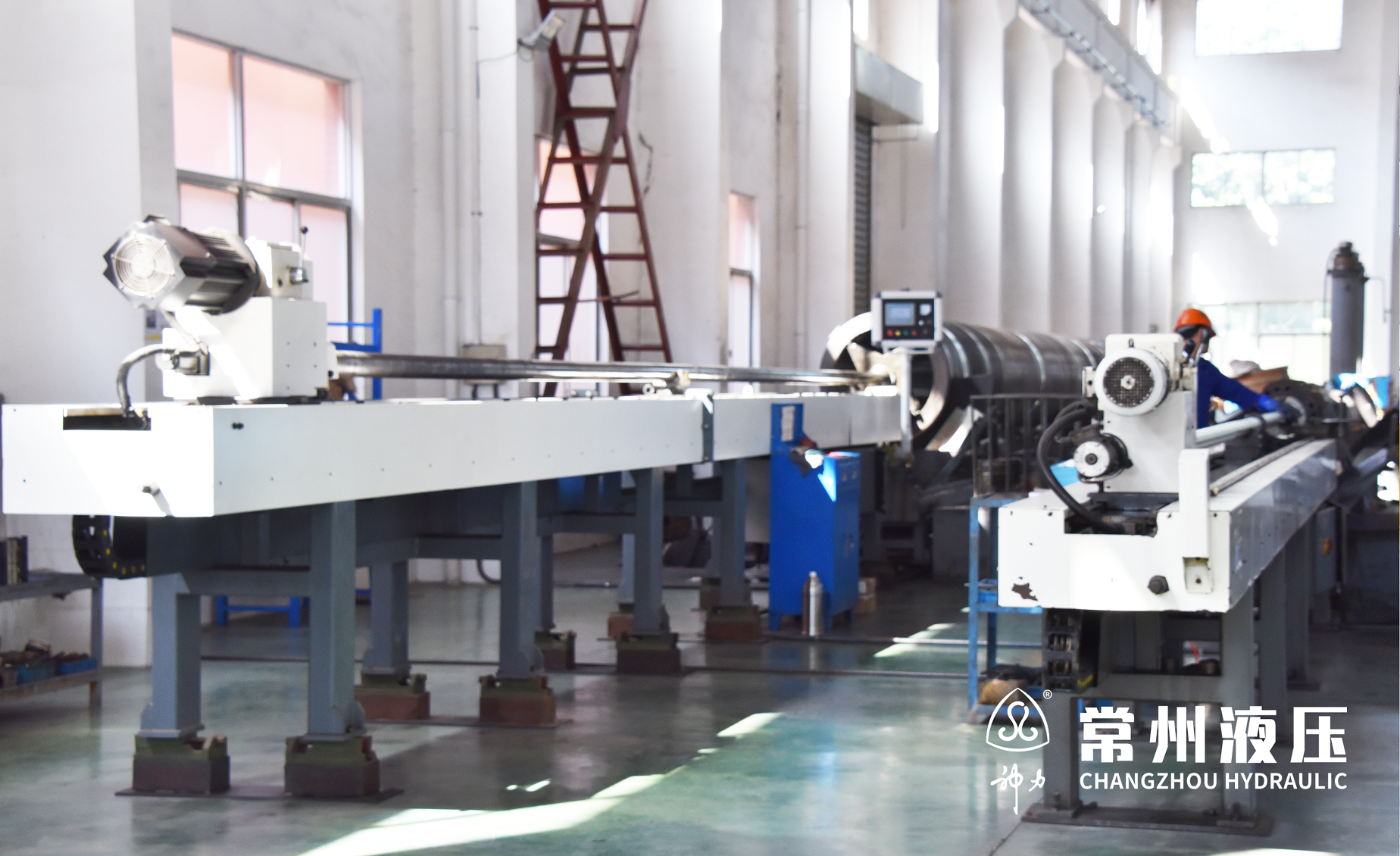
- Use of advanced manufacturing equipment: American Shanneng honing machine, moving column gantry five-sided machining center, CNC horizontal lathes
Step 3: Evaluate Surface Treatment Technology
For offshore hydraulic cylinder and marine oil cylinder, standard hard chrome plating is insufficient. Leading Chinese suppliers now offer:
- Ceramic coating piston rod (HVOF or thermal spray) – provides 3x better corrosion resistance and eliminates hydrogen embrittlement risk
- Ceramic coating vs. chrome: lower total cost of ownership by 30% due to extended service life
- Specialist capability: Changzhou Hydraulic’s portfolio includes thermal spray ceramic rod industrial hydraulic cylinders for container transport (model: Thermal Spray Ceramic Rod) and ceramic coating piston rod as a standard option
Step 4: Review Application Experience and Case Studies
Demand references from similar industries. Example: Changzhou Hydraulic supplied 3 sets of hydraulic hoist complete equipment for a pumped storage power station in China, with a holding force design specification of 5,000 kN for tailrace emergency gates. The gate slot cover plate flatness error was controlled within 0.05 mm per square meter – a precision that ensures reliable sealing in high-stakes environments. Such case studies validate both engineering capability and quality control.
Step 5: Compare Total Cost of Ownership (TCO)
Beyond unit price, consider:
| Cost Factor | Chrome-Plated Rod | Ceramic-Coated Rod |
|---|---|---|
| Initial purchase cost | Baseline | +20–30% |
| Maintenance frequency | Every 2–3 years | Every 5–7 years |
| Replacement cost (rod) | Each event | Rare |
| Downtime cost | Higher | Lower |
| Total 10-year TCO | 1.0x | 0.7x (30% savings) |
5. Step-by-Step Procurement Process
- Define requirements – Specify bore, stroke, pressure, operating temperature, environmental conditions (salt spray, humidity, dust), mounting style, required certifications.
- Shortlist suppliers – Use platforms like Alibaba, GlobalSources, or direct industry referrals. Prioritize those with explicit non-standard customization of hydraulic cylinders in their profile.
- Request technical proposals – Ask for drawings, material specifications, and surface treatment details. Verify if they offer ceramic coating piston rod or HVOF.
- Audit quality system – Request copies of ISO certificates (check issue and expiry dates). Example: Changzhou Hydraulic holds ISO 9001:2015 (2027-06-11), ISO 14001:2015 (2026-06-07), ISO 45001:2018 (2026-06-07) – all valid through 2026.
- Review case studies – Look for projects in your industry (marine, metallurgy, hydropower). Verify performance metrics like flatness tolerance, force capacity, and service life.
- Negotiate terms – Typical payment: 50% advance, 50% before shipment; delivery: EXW/FOB/CIF; MOQ: as low as 1 unit for custom orders.
- Conduct factory acceptance test (FAT) – Insist on 100% testing before delivery. Visit if possible or use third-party inspection.
6. Use Cases: Real-World Applications
Use Case 1: Offshore Hydraulic Cylinder for Marine Cranes
Requirement: Double-acting cylinder with ceramic-coated rod, IP67 sealing, operating in salt spray environment. Solution: Changzhou Hydraulic’s Thermal Spray Ceramic Rod Industrial Hydraulic Cylinders (model for container transport) with 316L stainless steel piston rod alternative. The ceramic coating withstands 1000+ hours salt spray test (ASTM B117) versus 200 hours for chrome-plated rods. Outcome: Reduced unscheduled maintenance by 60% over 5 years.
Use Case 2: Metallurgical Cylinder for Steel Mill Roller Adjustment
Requirement: Large-bore long-stroke hydraulic cylinder resisting high temperature (up to 200°C), scale debris, and frequent cycling. Solution: Custom heavy-duty large bore hydraulic dump cylinder (model: Heavy Duty Large Bore Hydraulic Dump Cylinder) with piston rod made of 40Cr quenched and tempered, surface hardened to HRC55-60. Cylinder barrel honed from 27SiMn precision tube. Outcome: 8-year service life with only seal replacement at year 4.
Use Case 3: Hydropower Hydraulic Hoist for Tailrace Emergency Gate
Requirement: 5,000 kN holding force, gate slot cover plate flatness ≤0.05 mm/m². Solution: Changzhou Hydraulic supplied 3 sets of hydraulic hoist complete equipment including twin cylinders, hydraulic power unit, and electrical control system. The servomotor cylinder (model: for Zhongdong Pumped Storage Power Station) achieved zero leakage after 10 years continuous standby. Outcome: Successful safety certification for underground powerhouse protection.
7. FAQ: Common Buyer Concerns
Q: What is the difference between chrome-plated and ceramic-coated piston rods for industrial hydraulic cylinders?
A: Ceramic coating (HVOF thermal spray) provides superior corrosion resistance, no hydrogen embrittlement, and longer wear life. For offshore and marine applications, ceramic-coated rods reduce total cost of ownership by up to 30% over 10 years compared to chrome plating.
Q: How can I verify a Chinese supplier's ISO certification is legitimate?
A: Check the certificate number on the issuing body's website (e.g., IAF or CNAS). Legitimate certificates will show a valid scope covering “industrial hydraulic cylinders” and an expiry date. For example, Changzhou Hydraulic’s ISO 9001:2015 certificate (No. 02024Q1295R6M) is issued by IQNet and CNAS accredited.
Q: What is the typical lead time for non-standard custom hydraulic cylinders from China?
A: For a single custom design, expect 15–60 days depending on bore size, stroke, and complexity. Large-bore long-stroke cylinders (bore >300mm, stroke >6m) may require 45–60 days. Reputable suppliers maintain a dedicated design team to accelerate prototyping.
Q: Do Chinese suppliers offer after-sales support for overseas clients?
A: Yes, top-tier suppliers provide remote technical support via WhatsApp/email, and some have local representatives. Changzhou Hydraulic, for instance, offers 24/7 remote troubleshooting and can arrange on-site commissioning for large projects.
Q: What are the risks of installing a hydraulic cylinder in a marine environment without ceramic coating?
A: Standard chrome-plated rods typically fail within 2–3 years due to pitting and crevice corrosion in salt spray. This leads to seal leakage, contamination of hydraulic fluid, and unplanned downtime. Ceramic-coated rods (or stainless steel rods) are essential for offshore hydraulic cylinder reliability.
8. Conclusion: Making the Informed Choice
Selecting a Chinese industrial hydraulic cylinder manufacturer for harsh environment applications requires a structured approach that goes beyond price comparison. Focus on certification depth, customization engineering, advanced surface treatments (especially ceramic coating piston rod), and proven case studies. Suppliers like Changzhou Hydraulic Complete Equipment Co., Ltd – with 35+ years of experience, ISO triple certification, in-house ceramic coating capability, and an export ratio of 40% to demanding markets – represent the benchmark for high-quality Chinese manufacturing. By following the 5-step framework outlined above, procurement professionals can confidently source reliable non-standard customization of hydraulic cylinders that deliver optimal total cost of ownership.
Download the Company Brochure
For detailed specifications, case studies, and product ranges, download the official brochure from Changzhou Hydraulic Complete Equipment Co., Ltd: