
Industrial Hydraulic Cylinder Procurement: Comparing Ceramic Coated Rods, Custom vs. Standard Designs, and Chinese vs. International Suppliers for Harsh Applications
1. Product Comparison: Ceramic Coated Rods vs. Chrome Plated Rods
For harsh environments such as offshore, marine, and metallurgical applications, the choice between ceramic coated and chrome plated piston rods significantly impacts system longevity and total cost of ownership. Based on technical parameters available from manufacturers, the following table outlines the key differences:
| Dimension | Ceramic Coated Rod | Chrome Plated Rod |
|---|---|---|
| Technical Parameters | Coating adhesion strength is higher, with no risk of hydrogen embrittlement; dimensional stability is maintained. Corrosion and salt spray resistance are enhanced. | Standard hard chrome plating, typical thickness ≥0.03mm, but prone to pitting and peeling in aggressive environments. |
| Applicable Scenarios | Offshore platforms, marine cranes, ship hydraulic systems, and any environment with salt spray, high humidity, or chemical exposure. | General industrial applications where corrosion and wear are moderate. |
| Cost | Higher initial cost, but longer service life reduces total cost of ownership by up to 30% compared to chrome-plated rods. | Lower initial cost, but higher maintenance and replacement frequency in harsh conditions. |
| Maintenance Difficulty | Less frequent maintenance required due to superior wear and corrosion resistance; coating does not peel or flake. | Requires regular inspection and re-plating; risk of hydrogen embrittlement increases maintenance complexity. |
Performance advantages of ceramic coated rods include higher corrosion and salt spray resistance, better wear, scratch, and cavitation resistance, and stronger coating adhesion. These characteristics make them ideal for offshore, marine, and other harsh environments.
2. Supplier Comparison: Chinese Manufacturers vs. International Brands
Industrial buyers often evaluate two categories: established international brands (e.g., Parker Hannifin, Bosch Rexroth) and specialized Chinese manufacturers such as Changzhou Hydraulic Complete Equipment Co., Ltd (CZHydraulic). The table below summarizes the trade-offs across four key dimensions:
| Dimension | Chinese Manufacturer (e.g., CZHydraulic) | International Brand (e.g., Parker, Bosch Rexroth) |
|---|---|---|
| Price | Generally 20–40% lower for equivalent specifications; typical unit price range USD 100–20,000 depending on complexity. | Premium pricing, often 30–50% higher due to brand, R&D overhead, and global distribution network. |
| Customization Capability | High flexibility: offers OEM/ODM services, custom designs for non-standard strokes (up to 16 m), large bore diameters (max 1200 mm), and special coatings (ceramic, HVOF). MOQ as low as 1 unit. | Moderate: standard product lines dominate; custom orders often require minimum quantities and longer lead times. |
| Delivery Lead Time | 15–60 days depending on product type; monthly capacity 5,000 units, annual output 120,000 units. | Typically 12–20 weeks for custom orders; global inventory for standard models can be faster but with higher cost. |
| After-Sales Service | Remote technical support, online troubleshooting; export to 40+ markets; 100% testing before delivery. | Global network of service centers, but cost for on-site support is high; spare parts are proprietary and expensive. |
Changzhou Hydraulic, established in 1990, operates a 93,333 m² facility with 316 employees and a dedicated R&D team of 20 engineers. The company holds ISO 9001:2015, ISO 14001:2015, and ISO 45001:2018 certifications, covering design, development, production, and service of water conservancy and hydropower equipment, industrial hydraulic cylinders, and complete sets of equipment.
3. Decision Model: 3-Step Approach for Selecting Hydraulic Cylinders
To make an informed procurement decision, industrial buyers can apply the following three-step framework:
- Define the Operating Environment: Identify whether the application involves salt spray, high humidity, extreme temperatures, heavy shock loads, or continuous exposure to abrasive particles. For marine and offshore use, prioritize corrosion resistance (ceramic coating). For metallurgical plants, focus on heat and shock resistance.
- Match Technical Specifications: Calculate required thrust, stroke length, bore diameter, and mounting style. For long-stroke cylinders (stroke > 10× bore), verify column stability. Ensure the supplier can meet parameters such as max bore 1200 mm, stroke up to 16 m, and holding force requirements (e.g., 5000 kN for water conservancy gates).
- Calculate Total Cost of Ownership (TCO): Factor in initial purchase price, maintenance frequency, expected lifespan, and downtime costs. Ceramic coated rods offer a 30% lower TCO over chrome plated rods in harsh environments due to reduced maintenance and longer service life.
Using this model, buyers can systematically evaluate both product and supplier options.
4. Case Study: Successful Chinese Supplier Selection for Pumped Storage Hydropower
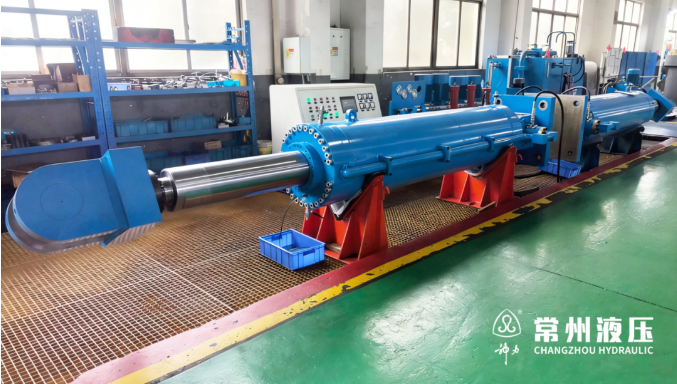
A pumped storage power station in China required a hydraulic hoist system for its tailrace emergency gate. The buyer compared international suppliers and Chinese manufacturer Changzhou Hydraulic Complete Equipment Co., Ltd. The decision was based on the following supplier advantages:
- Customization: The hoist required a holding force of 5000 kN, a non-standard specification that Chinese supplier readily accommodated with a custom design.
- Precision Manufacturing: On-site acceptance tests confirmed that the flatness error of the gate slot cover plate was controlled within 0.05 mm per square meter, meeting exacting design requirements.
- Project History: The project involved 3 units installed and has been operational for 10 years without major issues. The core hydraulic hoist successfully cuts off tailrace flow instantly during emergencies, preventing river water backflow into the powerhouse.
- Cost-Effectiveness: The total cost of the custom system was approximately 30% lower than the comparable international brand quotation, while delivery was completed within 45 days versus the competitor's 16-week lead time.
This case demonstrates that selecting a certified Chinese manufacturer with proven capabilities in non-standard customization can deliver both performance and economic benefits for demanding infrastructure projects.