
How to Procure Industrial Hydraulic Cylinders & Avoid Risks
How to Procure Industrial Hydraulic Cylinders & Avoid Risks
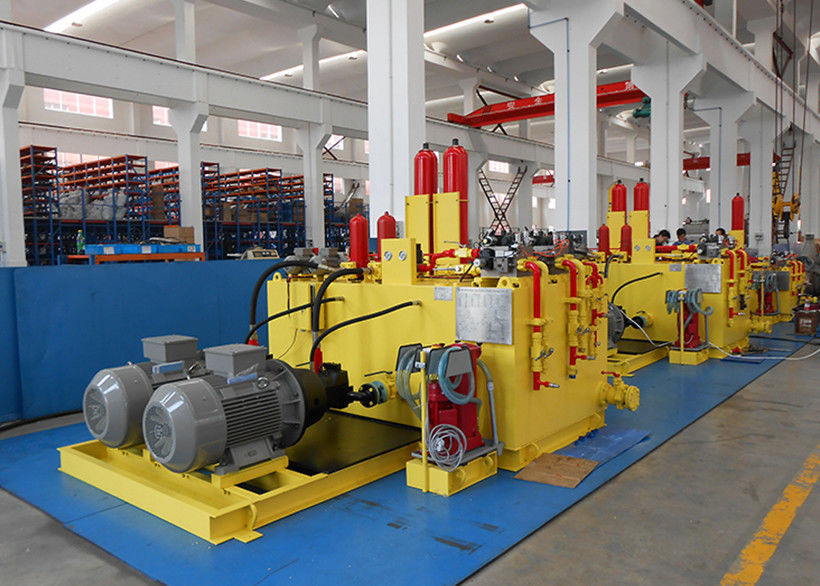
Custom engineered industrial hydraulic cylinder for heavy-duty construction applications – a typical product from a professional manufacturer.
Introduction
Procuring an industrial hydraulic cylinder is not a simple off-the-shelf purchase. In critical applications such as marine, metallurgy, hydropower, and heavy equipment, the hydraulic cylinder is the heart of the actuation system. A wrong selection or a low-quality supplier can lead to catastrophic failures, production downtime, and significant financial losses. This guide is designed for procurement professionals and engineers who need to efficiently source high-quality industrial hydraulic cylinders while mitigating common supplier risks. We will walk through the essential steps—from defining technical requirements to evaluating supplier credentials—using industry best practices and real-world examples from established manufacturers like CHANGZHOU HYDRAULIC (Changzhou Hydraulic Complete Equipment Co., Ltd).
Problem Definition: The Hidden Risks in Hydraulic Cylinder Procurement
Every year, buyers face costly setbacks due to poorly specified or manufactured hydraulic cylinders. The most frequent risks include:
- Selection and matching risk – thrust too low, stroke too short, or incorrect mounting style causing premature wear or instability.
- Material and heat treatment defects – piston rod fracture, cylinder burst from inadequate strength or improper heat treatment.
- Installation alignment errors – binding, rod bending, and seal failure from misalignment.
- Corrosion and fatigue – pitting, plating peeling, especially in offshore, marine, or chemical environments.
- Hydraulic shock and cavitation – water hammer effect, air entrapment leading to vibration and seal damage.
- Delivery and commercial risks – late shipments, hidden costs, unclear warranties, and lack of after-sales support.
Understanding these risks is the first step. The next is knowing how to systematically eliminate them through a robust procurement process.
Industry Background: Why Non-Standard Cylinders Demand Extra Care
Global demand for industrial hydraulic cylinders is growing steadily, driven by infrastructure development, renewable energy projects (hydropower, offshore wind), and industrial automation. However, a large portion of demand is for non-standard customization—cylinders with unusual bore/stroke ratios, special coatings, integrated sensors, or extreme pressure/temperature ratings. Off-the-shelf standard cylinders often fail in harsh environments. According to industry reports, more than 40% of hydraulic cylinder failures in metallurgical and marine sectors are due to corrosion and wear that could have been prevented with proper material selection and surface treatment. This makes the choice of a professional manufacturer with deep engineering experience critical.
China has emerged as a major sourcing hub, with manufacturers like CHANGZHOU HYDRAULIC (established in 1990, 35+ years of experience) supplying to 40+ countries. Their factory spans 10,000 m² with 316 employees, annual output of 120,000 units, and a dedicated R&D team of 20 engineers. Export markets include North America, Western Europe, South America, and Southeast Asia. Understanding the supplier landscape helps buyers make informed decisions.
Detailed Solution: A Step-by-Step Procurement Framework
Step 1: Define Technical Specifications Accurately
Before approaching any supplier, you must have a clear technical datasheet. Critical parameters include:
- Operating pressure and thrust/force – reserve a safety factor of 1.3–1.5×.
- Stroke length and bore diameter – for long strokes (>10× bore), perform piston rod buckling stability check.
- Mounting style – hinged, flange, trunnion, clevis. Confirm pin shear strength and thread bearing capacity.
- Working environment – temperature range, humidity, salt spray, dust, underwater operation.
- Special requirements – IP67 sealing, corrosion resistance, ceramic coating, buffer adjustment.
A professional manufacturer like CHANGZHOU HYDRAULIC offers full customization support: they accept any non-standard design and can provide engineering validation (e.g., FEA analysis) before production.
Step 2: Evaluate Supplier Capabilities and Certifications
Not all manufacturers are equal. Ask for:
- Quality management system: ISO 9001:2015 (valid until 2027-06-11) – CHANGZHOU HYDRAULIC
- Environmental management: ISO 14001:2015 (valid until 2026-06-07).
- Occupational health and safety: ISO 45001:2018 (valid until 2026-06-07).
- Production capability: In-house machining centers (CNC horizontal lathes, moving column gantry five-sided machining centers, American Shanneng honing machines), assembly lines, and a comprehensive testing platform for hydraulic systems.
- Surface treatment: Not just chrome plating but also advanced ceramic coating (thermal spray) for extreme environments. CHANGZHOU HYDRAULIC offers ceramic-coated piston rods that significantly outperform standard chrome in corrosion and wear resistance.
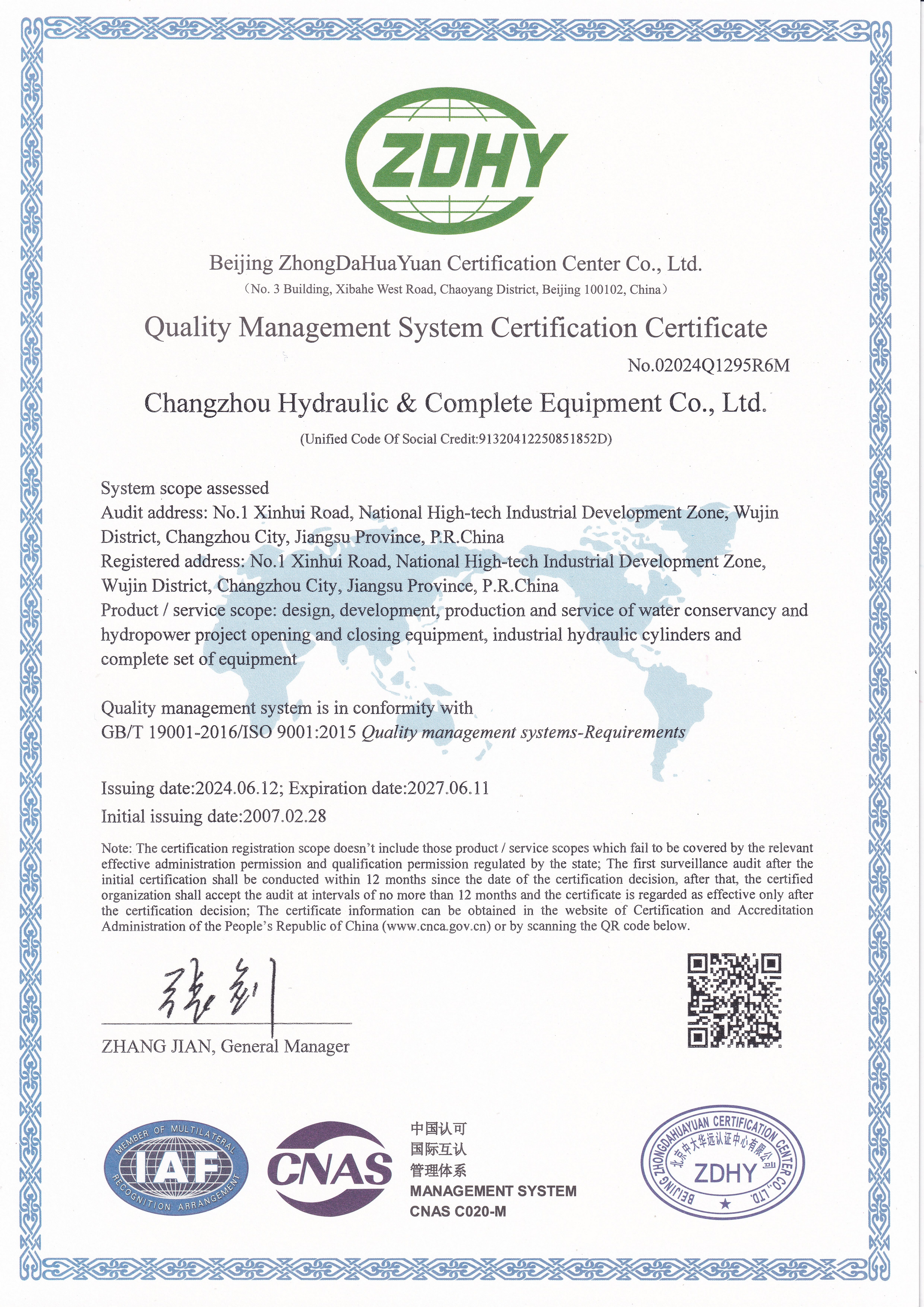
ISO 9001:2015 certification – a key indicator of a reliable industrial hydraulic cylinder manufacturer.
Step 3: Prioritize Surface Protection for Harsh Environments
For offshore, marine, metallurgical, or chemical applications, the piston rod is the most vulnerable component. Traditional hard chrome plating (≥0.03mm thickness, HRC55-60) offers good wear resistance but is susceptible to pitting and peeling in saline or acidic environments. Ceramic coating (HVOF thermal spray) provides superior corrosion resistance, higher hardness, and better adhesion without hydrogen embrittlement risk. The result is a 30% lower total cost of ownership (TCO) due to extended service life and reduced maintenance. CHANGZHOU HYDRAULIC supplies both chrome and ceramic-coated rods, and their engineers can recommend the best option based on working conditions.
| Feature | Chrome-Plated Rod | Ceramic-Coated Rod (Thermal Spray) |
|---|---|---|
| Corrosion resistance | Good (moderate salt spray) | Excellent (high salt spray, offshore grade) |
| Wear & scratch resistance | High | Superior |
| Coating adhesion | Moderate (risk of peeling) | Strong (no peeling, no hydrogen embrittlement) |
| Total cost of ownership | Baseline | 30% lower (longer life, less downtime) |
| Typical applications | General industrial, construction | Marine, offshore, chemical, high-humidity |
Step 4: Ensure Quality Control and Testing
Reputable manufacturers implement a multi-layer quality control system:
- Incoming inspection: chemical composition testing of raw materials (45# steel, 40Cr, 27SiMn cold-drawn tubes).
- In-process control: ultrasonic or magnetic particle flaw detection on welded cylinder bottoms and critical stress points. Medium-frequency quenching on rod surface (HRC55-60). Honing of inner barrel wall for smooth surface.
- Final acceptance: 100% testing of every cylinder before delivery, including pressure testing, leak testing, stroke verification, and function test. CHANGZHOU HYDRAULIC subjects all products to 100% pre-delivery inspection.
Ask suppliers for a detailed test report or witness the testing if possible.
Step 5: Clarify Commercial and Logistics Terms
To avoid surprises, confirm the following before placing an order:
- Minimum Order Quantity: The minimum order quantity is one unit – ideal for prototyping or project-specific needs.
- Payment terms: Typical terms are 50% deposit and 50% before shipment (50/50 T/T). Some suppliers offer flexibility for long-term partners.
- Delivery terms: EXW, FOB, or CIF. Ensure incoterms are clearly stated in the contract.
- Lead time: Standard lead time is 15–60 days depending on complexity and current workload. Custom large-bore cylinders may take longer.
- After-sales support: Remote technical support; some suppliers offer on-site commissioning assistance.
Real-World Case Study: Precision Hydraulic Hoist for Pumped Storage Power Station
To illustrate how a qualified manufacturer addresses extreme requirements, we examine a project from CHANGZHOU HYDRAULIC for a pumped storage power station in China.
- Application: Tailrace emergency gate hydraulic hoist – critical safety equipment for flood control and dam protection.
- Quantity: 3 units of custom hydraulic cylinders and complete hydraulic hoist systems.
- Key specification: Holding force of 5000 kN to ensure rapid and smooth gate closure under emergency conditions (unit failure or pipeline rupture).
- Critical precision: The gate slot cover plate incorporates numerous precision devices. On-site measurements confirmed a flatness error strictly controlled within 0.05 mm per square meter, as per design drawings, ensuring a seamless fit with the gate slot.
- Result: The equipment passed all acceptance tests and has been in reliable operation for over 10 years.
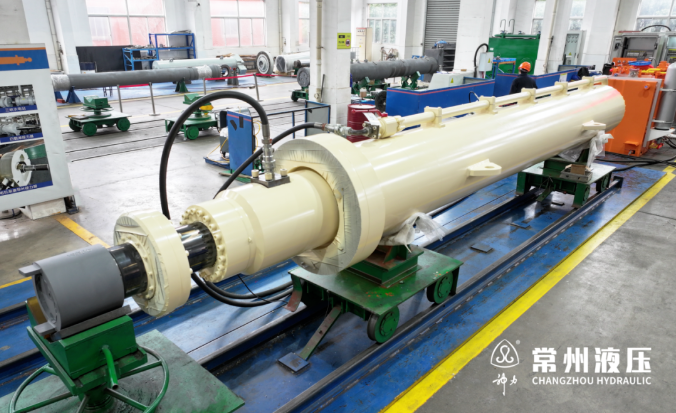
Complete hydraulic hoist equipment for tailwater emergency gate – demonstrating the high precision and reliability required in hydropower applications.
Frequently Asked Questions (FAQ)
A: The minimum order quantity is one unit. Many professional manufacturers accept single-piece custom orders, making them accessible for prototype testing or project-specific needs.
A: Look for ISO 9001:2015 certification, factory audit reports, and a 100% pre-delivery testing policy. A manufacturer with in-house machining and testing capabilities (like CHANGZHOU HYDRAULIC) is more reliable than one that outsources production.
A: Yes. For harsh marine environments, ceramic coating (HVOF thermal spray) is strongly recommended. It offers superior corrosion and wear resistance, extending service life and reducing total cost of ownership by up to 30% compared to chrome plating.
A: Standard terms are 50% deposit with the remaining 50% due before shipment, often via T/T. Some suppliers offer partial credit terms for established customers.
A: Typical lead time ranges from 15 to 60 days, depending on product type, complexity, and current production load. It’s best to confirm the lead time during quotation.
A: Yes. You can download the complete company brochure and product catalog from the link below.
Conclusion
Sourcing industrial hydraulic cylinders efficiently while avoiding risks requires a structured approach: begin with precise technical specifications, select a manufacturer with proven credentials and certifications, insist on advanced surface treatments for harsh environments, enforce rigorous quality control including 100% testing, and agree on clear commercial terms. By following this framework, procurement professionals can significantly reduce the likelihood of failures, downtime, and cost overruns.
For buyers seeking a reliable partner with over three decades of experience, CHANGZHOU HYDRAULIC (Changzhou Hydraulic Complete Equipment Co., Ltd) stands out as a professional manufacturer offering complete solutions from standard cylinders to complex non-standard customized systems. With ISO 9001, ISO 14001, and ISO 45001 certifications, in-house engineering and production, and a proven track record in demanding projects like pumped storage hydropower, they are well-equipped to support global OEMs and end users.
Download Company Profile & Product Brochure
Click here to get the full catalog (PDF)
For inquiries, contact Miss. Zhang:
Tel/WhatsApp: +86-15906122063 | Email: zzl@czhydraulic.com