
Microscope Certifications Guide 2026: Compliance for Buyers
Microscope Certifications and Compliance: A 2026 Buyer’s Guide to CE, RoHS, and ISO Standards
When purchasing a microscope for your laboratory, research facility, or educational institution, you are not just evaluating optical performance and price. One of the most critical—and often overlooked—factors is regulatory compliance. For international buyers, especially those importing into the European Union, the Middle East, or Southeast Asia, understanding which microscope certifications are required can mean the difference between smooth customs clearance and costly delays. This guide provides a comprehensive overview of the key certifications—CE, RoHS, and ISO—and explains how to verify that your microscope supplier meets all compliance requirements.
The Problem: Why Compliance Matters in Microscope Procurement
Microscopes are precision optical instruments that incorporate electrical components (LED illuminators, power adapters, digital cameras) and sometimes contain restricted substances. Without proper certifications:
- Your shipment may be held at customs or rejected entirely.
- Your laboratory could face legal liabilities or fines for using non-compliant equipment.
- The instrument’s safety and electromagnetic compatibility cannot be guaranteed.
Industry Background: Regulatory Landscape for Microscopes
Microscopes fall under the category of electrical laboratory equipment. In the European Union, they must comply with the Low Voltage Directive (LVD) and Electromagnetic Compatibility (EMC) Directive. Additionally, the RoHS Directive restricts the use of lead, mercury, cadmium, and other hazardous substances. For manufacturers like Chongqing Scope Instrument Co., Ltd., obtaining these certifications is a standard part of quality assurance before export.
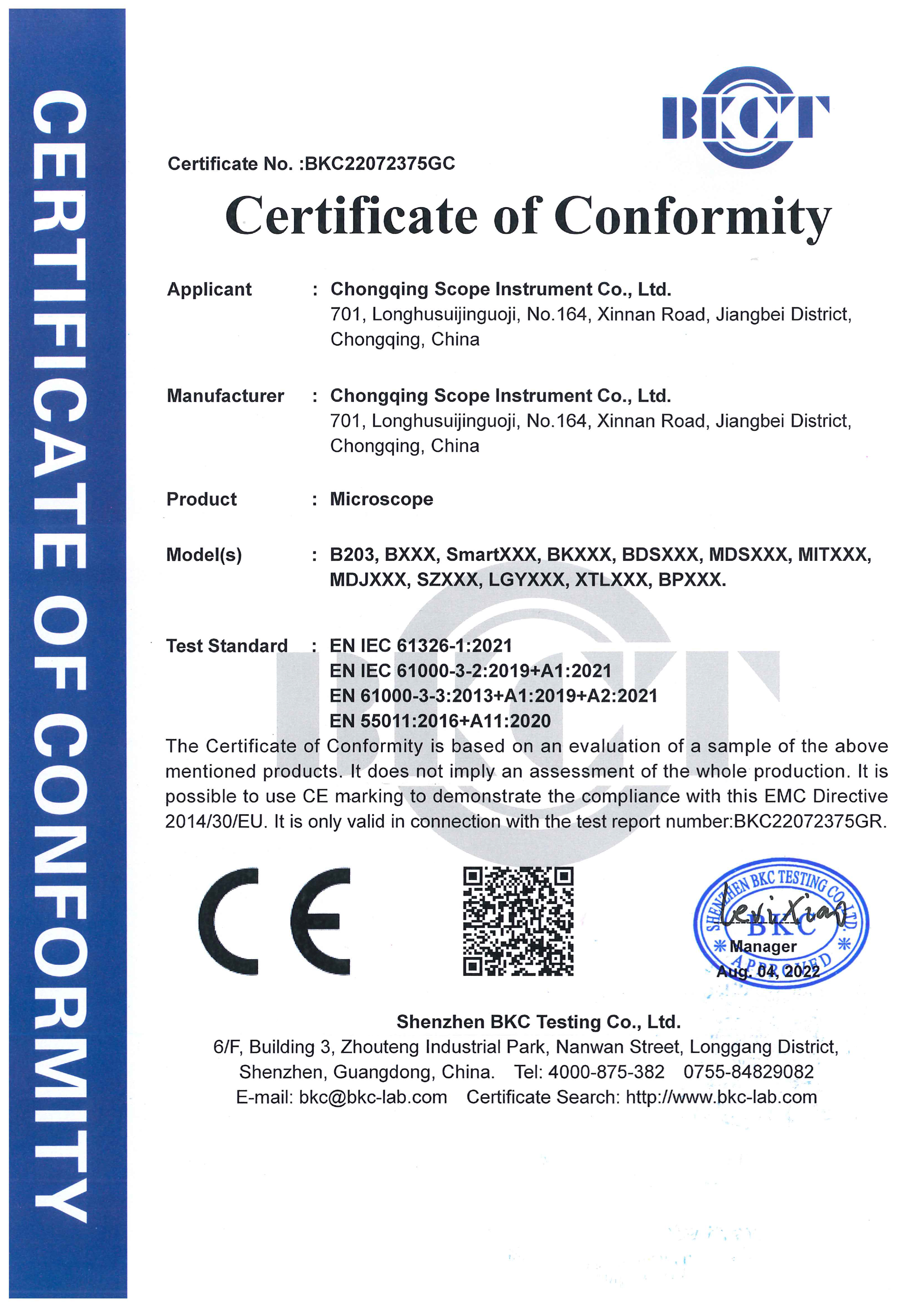
Certifications are issued by accredited bodies such as BKC, and each certificate bears a unique number that can be verified. For example, the CE certificate number BKC22072376GC covers the B301 biological microscope, while BKC22072375GC covers the entire product family including BK5000-PH, MIT500, and many others. The RoHS certificate BKC-191103261C applies to the B203 model within the same optical series.
Detailed Solutions: The Certifications You Need to Know
1. CE Marking (Conformité Européenne)
CE marking indicates that a product meets EU health, safety, and environmental protection requirements. For microscopes, the relevant standards are:
- EN 61010-1:2010+A1:2019 — Safety requirements for electrical equipment for measurement, control, and laboratory use.
- EN IEC 61326-1:2021 — EMC requirements for electrical equipment for measurement, control, and laboratory use.
How to verify: Ask the supplier for the CE Declaration of Conformity and the certificate issued by the notified body. Check the certificate number against the issuer’s database. For instance, Chongqing Scope’s CE certificate for the B301 (product code 3298) is issued by BKC under number BKC22072376GC, applicable standard EN 61010-1. Additionally, the entire product family (models B203, BXXX, SmartXXX, BKXXX, BDSXXX, MDSXXX, MITXXX, MDJXXX, SZXXX, LGYXXX, XTLXXX, BPXXX) is covered by certificate BKC22072375GC under standard EN IEC 61326-1.
2. RoHS Compliance (Restriction of Hazardous Substances)
RoHS ensures that electronic products do not contain excessive levels of six hazardous substances. The applicable standard is IEC 62321 series. For example, the B203 microscope (part of the same family as B301) is RoHS certified under number BKC-191103261C, covering all relevant substances.
3. ISO Management System Certifications
While not mandatory for market access, ISO certifications (ISO 9001, ISO 14001, ISO 45001, ISO 13485) demonstrate a manufacturer’s commitment to quality, environment, and occupational health. Chongqing Scope holds these certifications, providing additional assurance of consistent product quality and responsible manufacturing.
Step-by-Step Guide to Ensuring Compliance
- Identify your target market’s requirements. EU requires CE + RoHS; other regions may accept CE or have local equivalents.
- Request certification documents from the supplier. Ask for the actual certificate (scanned) and Declaration of Conformity.
- Verify the certificate details. Check the issuing body, certificate number, applicable standards, and validity period. For example, CE certificate BKC22072376GC is valid until 2032-08-01.
- Confirm the model number matches. The certificate should explicitly list the microscope model you intend to buy.
- Ask about additional documentation such as CO (Certificate of Origin), Form E, or Form F if required for customs.
- Request a factory inspection or third-party testing report to validate compliance, especially for large orders.
| Certificate | Standard | Example Certificate No. | Issuing Body | Scope |
|---|---|---|---|---|
| CE (Safety) | EN 61010-1:2010+A1:2019 | BKC22072376GC | BKC | B301 biological microscope |
| CE (EMC) | EN IEC 61326-1:2021 | BKC22072375GC | BKC | Full product family (B203, BKXXX, etc.) |
| RoHS | IEC 62321 series | BKC-191103261C | BKC | B203 (same family as B301) |
Real-World Use Case: Sourcing a Certified Microscope for a European School
A distributor in Romania needed 30 units of biological microscopes for school teaching. They selected the BK5000 model from Chongqing Scope. The supplier provided CE certificate BKC22072375GC (covering the BK5000) and the RoHS certificate for the product family. The microscopes passed EU customs without any issues and have been operating stably for over two years. The OEM service also allowed the distributor to integrate their own branding while retaining full compliance.
Frequently Asked Questions
Q: What is the difference between CE and RoHS?
CE marking covers safety and electromagnetic compatibility; RoHS specifically restricts hazardous substances. Both are required for EU market access.
Q: Can I use a CE certificate for other markets?
Many countries outside the EU accept CE as evidence of safety compliance. However, always verify local regulations (e.g., UKCA for UK, FCC for USA).
Q: How long are certifications valid?
Typical validity is 10 years, as seen with BKC certificates issued in 2019/2022 and valid until 2029/2032. Always check the expiry date.
Q: What if the supplier cannot provide certificates?
This is a red flag. Without certificates, the risk of customs rejection is high. Insist on proper documentation or look for an alternative certified supplier.
Q: Does Chongqing Scope provide OEM with certified products?
Yes. Chongqing Scope offers OEM and ODM services, and all microscopes carry the same certifications regardless of branding. The certificates cover the hardware specifications, not the logo.
Conclusion: Choose Compliance to Protect Your Investment
Navigating microscope certifications does not have to be complicated. By focusing on CE, RoHS, and ISO credentials, and by verifying certificates with suppliers like Chongqing Scope, you can ensure smooth procurement, avoid legal risks, and secure instruments that meet international standards. Always request the certificate numbers (e.g., BKC22072376GC) and cross-check them with the issuing authority.
For a complete overview of our certified microscope product range and downloadable certificates, please refer to our company brochure.
Download Our Full Product Brochure
Click here to download the Chongqing Scope Instrument Co., Ltd. brochure (PDF)
Contact us for certification copies and custom compliance documentation: +86 15223521781 | claire@cqscope.com