
Efficient Tempered Glass Sourcing: A Risk-Avoidance Framework for Industrial Buyers
Efficient Tempered Glass Sourcing: A Risk-Avoidance Framework for Industrial Buyers

Procuring tempered glass for large-scale construction projects is a high-stakes process. Between managing technical specifications, navigating international suppliers, and ensuring compliance with safety standards, industrial buyers face significant operational and financial risks. This article presents a structured, risk-avoidance framework that helps procurement professionals source tempered glass efficiently — from defining product requirements to final delivery acceptance. Whether you need door tempered glass, window tempered glass, or specialized types like low iron tempered glass or insulated tempered glass, the principles outlined here will reduce uncertainty and protect your investment.
Problem Definition: Common Risks in Tempered Glass Procurement
Industrial buyers often encounter the following issues when sourcing tempered glass:
- Quality Variability: Inconsistent surface stress, edge defects, and optical distortions can compromise safety and aesthetics.
- Spontaneous Breakage: Nickel sulfide inclusions in the glass can cause sudden breakage months after installation.
- Non-Compliant Certifications: Suppliers may claim compliance with standards like EN 12150 tempered glass or AS/NZS 2208 without proper documentation.
- Delivery Delays: Misaligned lead times and logistics miscommunications can stall project timelines.
- Hidden Costs: Unclear payment terms and hidden fees for custom processing (e.g., custom cut tempered glass, beveled tempered glass) erode budget.
Addressing these issues requires a systematic procurement framework that integrates technical knowledge with commercial discipline.
Industry Background: The Growing Demand for High-Performance Tempered Glass
The global tempered glass market, valued at over $60 billion in 2025, is driven by rapid urbanization, green building mandates, and safety regulations. Architectural applications — including curtain walls, skylights, partitions, and doors — demand glass that meets specific performance criteria: mechanical strength, thermal stability, and safety upon breakage. For example, heat resistant tempered glass and insulated tempered glass are critical for energy-efficient building envelopes. Meanwhile, aesthetic variants like frosted tempered glass and tinted tempered glass are increasingly specified for commercial interiors. Buyers must navigate a fragmented supplier landscape, where capabilities vary widely. A risk-avoidance framework becomes essential.
Detailed Solution: A 5-Step Risk-Avoidance Procurement Framework
Step 1: Define Technical Specifications with Precision
Every procurement must begin with a clear technical brief. Key parameters for tempered glass include:
| Parameter | Typical Range / Value | Criticality |
|---|---|---|
| Thickness | 4mm, 5mm, 6mm, 8mm, 10mm, 12mm, 15mm, 19mm, 22mm, 25mm | Defines load-bearing capacity and insulation |
| Surface Stress | ≥95 MPa | Ensures safety fragmentation |
| Thermostability | 250–320°C | Critical for thermal shock resistance |
| Edge Processing | Bright polished (Ra 0.1–0.3 μm) | Reduces edge chipping and improves strength by 30%+ |
| Flatness | ≤0.3mm/m curvature | Avoids distortion in laminated assemblies |
For applications requiring high safety and energy performance, consider combining tempered glass with laminated or insulated configurations — e.g., 6mm+12A+6mm double glazed tempered glass, or 10mm+1.52mm SGP laminated tempered glass for anti-typhoon curtain walls.
Step 2: Evaluate Supplier Capabilities and Certifications
Supplier credibility is the cornerstone of risk mitigation. Look for manufacturers that hold internationally recognized certifications:
- SGCC (Safety Glazing Certification Council) — required for US projects (ANSI Z97.1, CPSC 16 CFR 1201).
- CE/EN 12150 — European standard for thermally toughened soda lime silicate glass.
- AS/NZS 2208 — Australian and New Zealand standard for safety glazing.
- SGS Test Reports — independent validation of product performance (e.g., impact resistance per BS 6206).
- Calibration of Heat Soak Process Oven — ensures the HST process meets BS EN 14179-1:2016.
Dongguan Kunxing Glass Co., Ltd (KXGLASS) exemplifies a supplier with robust certification coverage: it holds SGCC certification (cert. #5566/5568), SGS test reports for 6mm, 10mm, and 15mm heat-soaked toughened glass, and a calibration report for its HST oven. These documents provide verifiable proof of quality control.
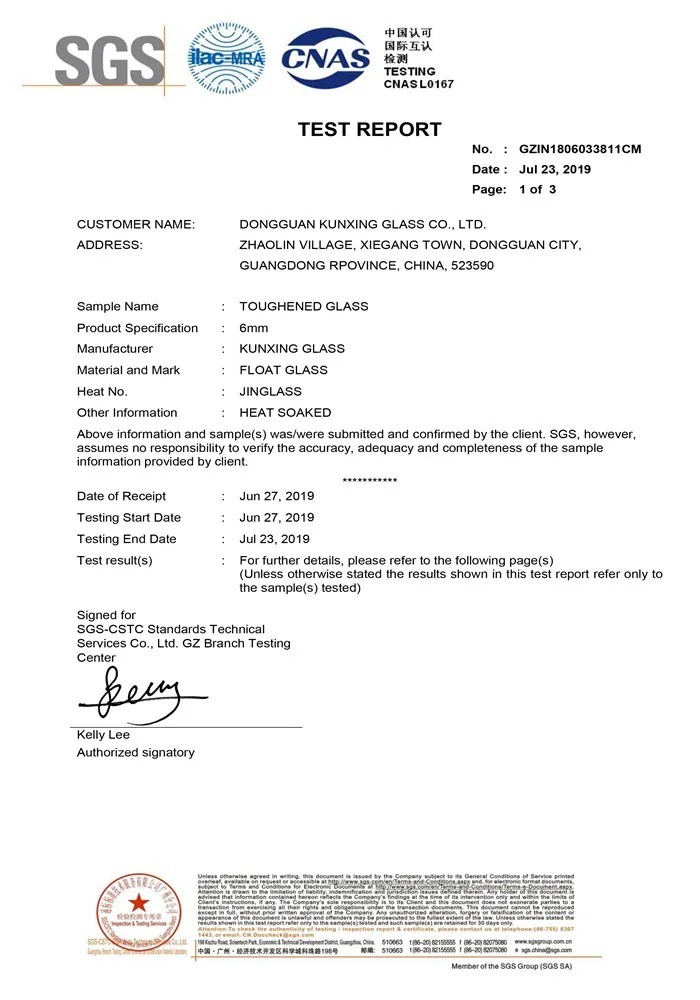
SGS test report for 6mm heat soaked toughened glass — independent verification of safety glazing performance.
Step 3: Implement Risk Mitigation Measures
Heat Soak Test (HST) is non-negotiable for tempered glass used in overhead or high-risk applications. The process heats glass to 290°C to trigger early breakage of nickel sulfide‑containing units, eliminating most spontaneous breakage risks. KXGLASS operates a calibrated HST oven (model CS-HST-1808) and complies with BS EN 14179-1:2016. Buyers should request the HST calibration report and discuss the percentage of glass tested.
Edge processing matters. Standard milled edges can harbor micro-cracks that reduce edge strength by over 30%. Bright polished edges (Ra 0.1–0.3 μm) eliminate these defects, especially important for door tempered glass and bent tempered glass where handling stresses are high.
Quality control at source. A 100% pre‑shipment test ensures that each piece meets dimensional and visual standards. KXGLASS performs 100% inspection before delivery, reducing on‑site rejection rates.
Step 4: Agree on Commercial Terms That Protect Both Parties
Clear payment and delivery terms prevent costly misunderstandings. The standard framework accepted by many industrial buyers includes:
| Commercial Element | Standard Practice (per KXGLASS) |
|---|---|
| Minimum Order Quantity (MOQ) | 100 square meters |
| Payment Terms | 30% T/T in advance, 70% balance T/T before shipment |
| Delivery Incoterms | EXW, FOB, or CIF |
| Lead Time | 15–20 days (depending on complexity) |
| Acceptance | Pre‑shipment test (100% quality check) |
| After‑Sales Support | 5 years return and replacement |
These terms reduce the buyer’s upfront risk and provide recourse if issues arise after delivery. For large projects, buyers may negotiate partial shipments to align with construction phases.
Step 5: Verify Through Third‑Party Audits and Reference Projects
Independent verification eliminates reliance on supplier claims. Request test reports from accredited labs like SGS (e.g., report #GZIN1806033816CM for 10mm glass). Review case studies that demonstrate the supplier’s experience in similar applications. For example:
- Vietnam Airport Project: KXGLASS supplied silkscreen printing glass and tempered glass for curtain walls, achieving color stability ≥85% and safety factor 5×. The project required high weather resistance and aesthetic consistency — a risk reduced by rigorous pre‑production color matching and HST.
- Australia Mall Build‑to‑Rent: Over 500 units of insulated tempered glass and laminated glass were delivered for facade and curtain wall applications. The result: stable structural performance and 65% energy savings, validated by on‑site testing.
- Dubai Safari Mall: KXGLASS provided 100–200 units of tempered and laminated glass for skylights and curtain walls. The glass withstood loads >3500 Pa and maintained color stability for over 2 years in extreme heat.
These real‑world cases demonstrate the supplier’s ability to manage complex specifications and deliver consistent quality.
Step‑by‑Step Breakdown: Your Procurement Checklist
- Define glass type and dimensions — e.g., custom cut tempered glass 1200×2000mm, 10mm thick, bright polished edges.
- Request certifications — ask for SGCC, CE/EN 12150, and SGS test reports specific to your glass thickness.
- Confirm HST capability — ask for oven calibration report and HST protocol.
- Agree on commercial terms — MOQ 100m², 30/70 payment, FOB/CIF as needed.
- Schedule factory inspection or request video inspection — witness the 100% pre‑shipment test.
- Arrange logistics with clear Incoterms — ensure insurance covers the full FOB/CIF value.
- Document everything — keep copies of test reports, certificates, inspection records, and correspondence.
Use Cases: How the Framework Prevents Real‑World Risks
Use Case 1: Spontaneous Breakage Mitigation
A European façade contractor specified 15mm tempered glass for a hotel skylight. By requiring HST per BS EN 14179‑1:2016, they eliminated nickel‑sulfide‑induced failures. The supplier, KXGLASS, provided its HST calibration report (cert. #J18‑117‑R01‑180903) and tested 100% of the glass. Result: zero breakage after two years of installation.
Use Case 2: Edge Quality for Door Applications
An Australian glass processor needed bright‑polished edges for 12mm door tempered glass to avoid sharp edges in public buildings. KXGLASS used advanced edge processing to achieve Ra 0.1–0.3 μm, increasing edge strength by 30%+ and eliminating chipping during transport. The processor reported 50% fewer on‑site rejects compared to previous suppliers.
Use Case 3: Certification Compliance for US Market
A US‑based importer required SGCC‑certified tempered glass for a curtain wall project. KXGLASS provided its SGCC acknowledgement (cert. #5566/5568) and SGS reports. The importer passed customs review without delays, and the project met all local building codes.
Frequently Asked Questions (FAQ)
What is the Heat Soak Test (HST) and why is it important?
HST heats tempered glass to approximately 290°C to identify and break glass pieces containing nickel‑sulfide inclusions. It dramatically reduces the risk of spontaneous breakage after installation. Always request HST for overhead or safety‑critical applications.
What certifications should a qualified tempered glass supplier have?
For global projects, look for SGCC (US), CE/EN 12150 (EU), AS/NZS 2208 (Australia), and SGS test reports. Additional certifications like ISO 9001 indicate strong quality management.
What is the typical MOQ for custom tempered glass?
Most reputable manufacturers require a minimum of 100 square meters per order. KXGLASS follows this standard MOQ.
How can I ensure my glass arrives without defects?
Choose a supplier that performs 100% pre‑shipment inspection. Request images or video of the inspection process, and consider a third‑party inspection if the order value is high.
What are the advantages of bright‑polished edges over standard milled edges?
Bright‑polished edges have a roughness of Ra 0.1–0.3 μm, which eliminates micro‑cracks and increases edge strength by 30%+. They also provide a smoother, more aesthetic finish suitable for visible installations like glass doors and partitions.
Which payment terms are commonly used in tempered glass trade?
Standard terms are 30% T/T in advance and 70% balance T/T before shipment. This balances the buyer’s risk with the supplier’s need for working capital.
Conclusion
Efficient tempered glass sourcing is not just about finding the lowest price — it’s about systematically eliminating risks that can derail projects and inflate costs. By following the five‑step framework outlined above — defining specifications, evaluating certifications, implementing mitigation measures, agreeing on protective commercial terms, and verifying through third‑party evidence — industrial buyers can confidently procure high‑quality glass, whether it’s 10mm tempered glass for curtain walls, 19mm tempered glass for heavy‑duty doors, or insulated tempered glass for energy‑efficient envelopes.
Dongguan Kunxing Glass Co., Ltd (KXGLASS), with its 30,000 m² facility, 150 employees, annual output of over 1.8 million m² of tempered glass, and a portfolio of international certifications (SGCC, CE, SGS, AS/NZS 2208), exemplifies the type of supplier that meets the highest risk‑avoidance standards. For a detailed overview of their capabilities, download the company brochure below.
All product specifications and certification details are sourced from verifiable documents provided by KXGLASS. For further inquiries, contact Kevin at kevin@kxglass.com or WhatsApp +86 1353500092849.